Category: Computers

  • Walmart Shopper Gets 7TB SSDs Worth $1,266 for Only $210

    Walmart Shopper Gets 7TB SSDs Worth $1,266 for Only $210

    Key Takeaways

    1. A gamer scored a GeForce RTX 5080 GPU for $562 during a Walmart clearance sale, originally priced at $1,000.
    2. @xxemox discovered significant SSD deals at Walmart, spending only $210 on items worth $1,266.
    3. The 1 TB PNY Upgrade Kit was purchased for $35, down from about $218.88.
    4. Two 2 TB WD Black SN750 M.2 drives were bought for $65 each, typically priced at $399 each.
    5. A 2 TB Samsung T5 external SSD was acquired for $45, instead of nearly $250, showcasing the potential for big savings in tech purchases.


    A few days ago, we shared a story about a gamer who got a GeForce RTX 5080 gaming GPU priced at $1,000 for only $562, thanks to a clearance sale at Walmart. Just a short while later, another savvy shopper seems to have found a treasure in yet another Walmart clearance.

    SSD Deals Galore!

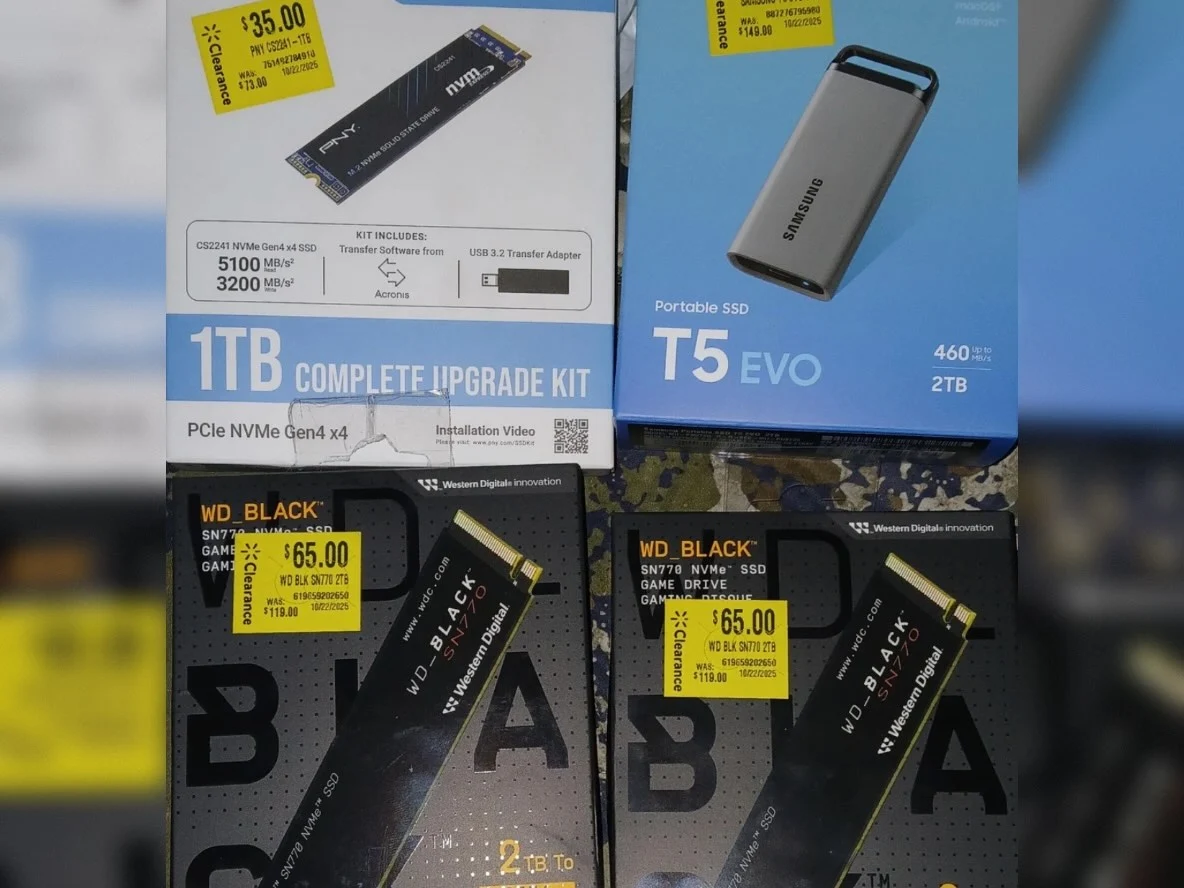
    Specifically, @xxemox stumbled upon some amazing SSD offers at their local Walmart and acted fast. They purchased a total of four items amounting to about $1,266. The first item is a 1 TB PNY Upgrade Kit that includes a CS2241 NVMe Gen 4 x4 drive and an adapter with a USB 3.2 connector. This kit is priced around $218.88 on Walmart’s website, but @xxemox managed to snag it for only $35.

    More Bargains on M.2 Drives

    Moving on, @xxemox also picked up two M.2 drives, both of which are PCIe Gen 4 versions of the 2 TB WD Black SN750. These drives usually sell for about $399 each, yet @xxemox got them for just $65 each. Lastly, they found a 2 TB Samsung T5 external SSD that generally goes for just under $250. While it may not be as advanced as the latest T9 SSD (currently priced at $290 on Amazon), @xxemox scored a significant deal, purchasing it for only $45.

    Total Savings

    In total, @xxemox’s SSD finds cost him roughly $210, a staggering savings compared to the $1,266 they would have spent at regular store prices. Having saved over $1,000, it’s evident that even though storage prices have risen sharply, clever bargain hunters can still find incredible deals with a little effort and a dash of luck.

    Source:
    Link


  • Intel Cancels Core Ultra 9 290K Plus Arrow Lake Refresh CPU Launch

    Intel Cancels Core Ultra 9 290K Plus Arrow Lake Refresh CPU Launch

    Key Takeaways

    1. Intel’s Core Ultra 9 290K Plus CPU may not be released, despite previous leaks and benchmarks.
    2. This isn’t a cancellation, as the product was never officially announced, but Intel has decided to pull back on its launch plans.
    3. Product placement issues with the upcoming Core Ultra 200K Plus series led to the decision, due to overlapping features.
    4. The Core Ultra 9 290K Plus was expected to offer a 10% performance increase with a thermal velocity boost, appealing to high-end CPU enthusiasts.
    5. Gamers can look forward to the upcoming Nova Lake gaming CPUs, set to launch later this year.


    According to a new report from VideoCardz, Intel’s highly anticipated Core Ultra 200S Plus flagship CPU, the Core Ultra 9 290K Plus, might not be released after all. This is surprising because there have been many leaks and benchmarks leading up to this point.

    Not Quite a Cancellation

    It’s important to note that this isn’t really a cancellation, as the product was never officially announced. Intel had genuinely thought about launching it, shown by the fact that they had sent units to partners. However, they have now decided to pull back on that plan.

    Reasons Behind the Decision

    VideoCardz suggests that there are product placement issues with the upcoming Core Ultra 200K Plus series. The Core Ultra 7 270K Plus is expected to feature a 24-core configuration, similar to the existing 285K and the speculated 290K Plus. Because of this, Intel concluded there was too much overlap among their products.

    While it’s true that the Core Ultra 9 290K Plus was said to have a thermal velocity boost of 100 MHz higher, which could provide a 10% performance increase as seen in leaked benchmark tests, many enthusiasts would appreciate a high-end CPU. A 10% performance gain is significant.

    Looking Ahead for Gamers

    Still, with the Nova Lake gaming CPUs reportedly set to launch later this year, fans of Intel still have plenty of exciting products to anticipate.

    Source:
    Link


  • Affordable Raspberry Pi Alternative with Multiple USB-C Ports

    Affordable Raspberry Pi Alternative with Multiple USB-C Ports

    Key Takeaways

    1. The Radxa Cubie A7S is a new single-board computer priced around $44 on AliExpress and $25 from Araca Tech, offering 4 GB of RAM with options for 8 or 16 GB.
    2. It features an Allwinner A733 processor with two Cortex-A76 cores and six Cortex-A55 cores, supporting NPU performance of 3 TOPS.
    3. Video output is via USB-C, supporting DisplayPort and 4K resolution at 60 frames per second, along with MIPI CSI for video input.
    4. Connectivity options include Gigabit Ethernet, WiFi 6, and Bluetooth 5.4 for easy device pairing.
    5. The board has 45 GPIO headers, measures 51 x 51 mm, and supports NVMe SSD connection through an FPC connector with a PCIe 3.0 interface.


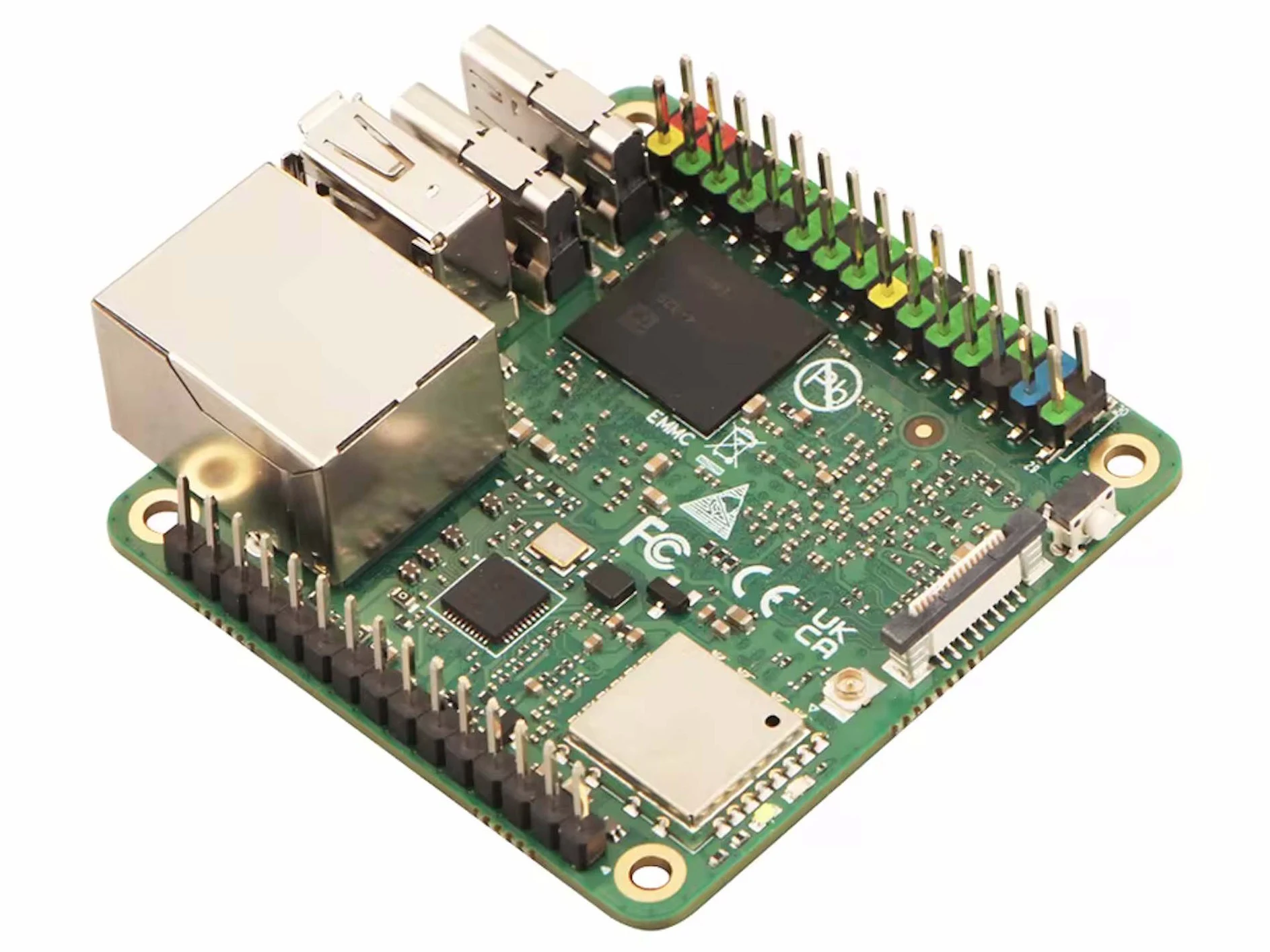
    A new, smaller substitute for the Raspberry Pi has hit the market. The Radxa Cubie A7S can be found on AliExpress for about $44, not including shipping costs, while Araca Tech offers it for approximately $25. At that lower price, buyers get a single-board computer equipped with just 4 GB of RAM; however, the model can also be found with options of 8 or 16 GB of LPDDR5 RAM. Additionally, there is an option for 256 GB of eMMC storage. Like most single-board computers, it comes with a microSD card slot to make installing the operating system simple.

    Performance and Connectivity

    The processor is an Allwinner A733, which features two Cortex-A76 cores and six Cortex-A55 cores. The NPU performance is rated at 3 TOPS. For video output, the setup is simple, but instead of HDMI, it uses USB-C, which can support DisplayPort and 4K resolution at 60 frames per second. The Cubie A7S can also accept video input through MIPI CSI, mainly from specific cameras, making it useful for automated image processing tasks. For networking, it includes Gigabit Ethernet and WiFi 6 support. There’s also Bluetooth 5.4, which allows for easy pairing with devices such as keyboards and mice.

    Power and Expansion Options

    Power is delivered through USB-C, with support also for USB 2.0 and USB OPT. Additionally, there are 45 GPIO headers, and the board measures 51 x 51 mm, featuring an FPC connector with a PCIe 3.0 interface (one lane). This setup permits the connection of NVMe SSDs, expanding the storage capabilities even further.

    Source:
    Link


  • MIT Engineers Convert Waste Heat to Computing Power with Silicon

    MIT Engineers Convert Waste Heat to Computing Power with Silicon

    Key Takeaways

    1. MIT engineers have developed tiny silicon structures that use waste heat for computing tasks instead of relying on electricity.
    2. The researchers utilized inverse design techniques to create intricate silicon shapes capable of performing mathematical calculations with over 99% accuracy.
    3. The project demonstrates that heat can be harnessed as a form of information, challenging the conventional view of heat as a waste product in electronics.
    4. The team divided matrices into positive and negative parts to manage heat flow effectively and modified silicon thickness for better heat conduction.
    5. While the technology shows promise in heat management, it faces challenges in bandwidth and scaling, with future efforts focused on creating programmable structures for more complex operations.


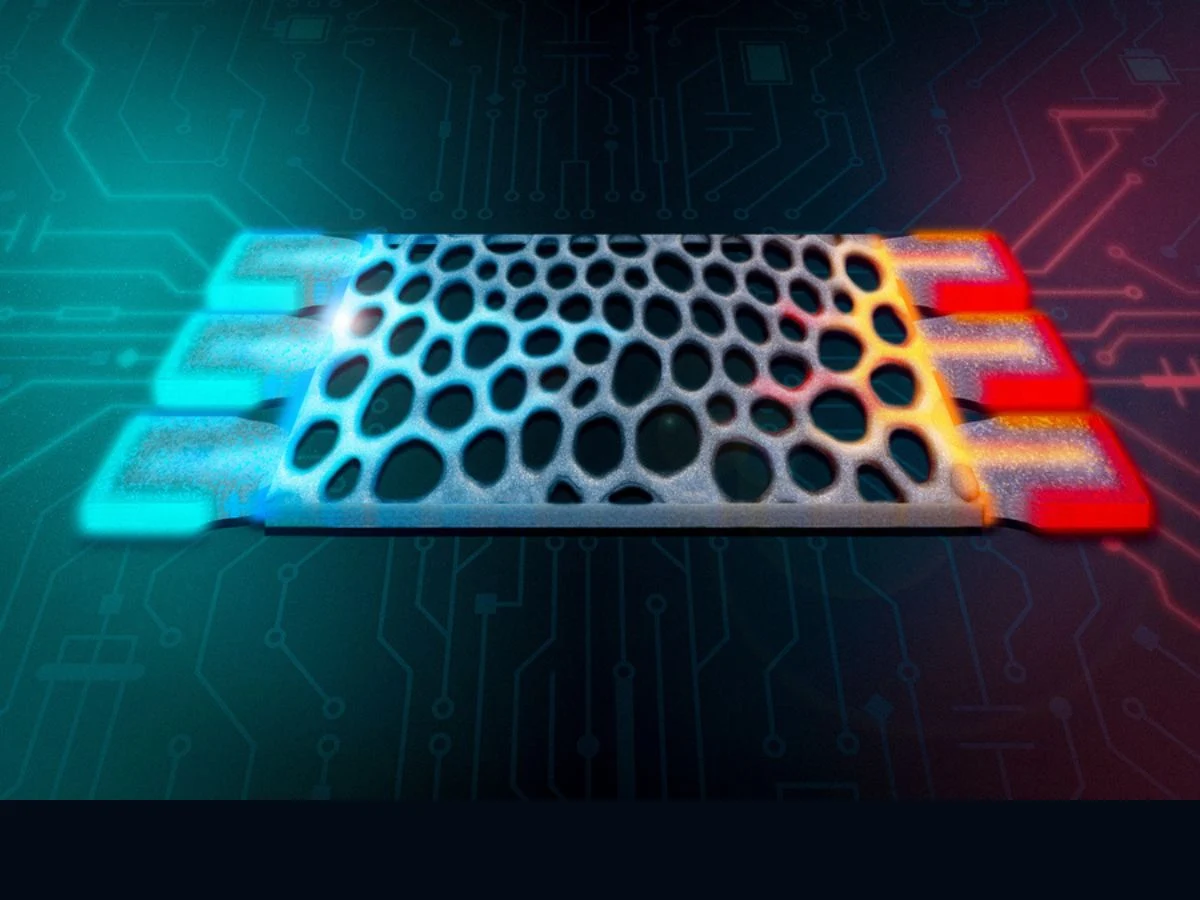
    MIT engineers have managed to turn a usual electronic problem — waste heat — into something useful for computing. In a recent article in the journal Physical Review Applied, the research team presented tiny silicon structures that can carry out mathematical tasks using heat rather than electricity.

    Innovative Design Techniques

    The group of researchers, which includes undergraduate Caio Silva and research scientist Giuseppe Romano, employed a method known as inverse design to create these structures. By inputting the desired functions into a software tool, algorithms were able to produce intricate silicon shapes, about the size of a speck of dust, filled with pores. These silicon structures control heat flow to perform matrix vector multiplication — a basic calculation underpinning machine-learning models like Large Language Models (LLMs) — achieving more than 99% accuracy in simulations.

    Turning Heat Into Computation

    Normally, when doing calculations on electronic devices, the heat generated is seen as a byproduct. People usually aim to eliminate as much heat as possible. However, in this case, we took a different route by utilizing heat as a form of information, demonstrating that it is indeed possible to compute with heat. — Caio Silva, the main author of the paper.

    To tackle the challenge that heat naturally flows from hotter areas to cooler ones, the team divided target matrices into positive and negative parts, processing them through distinct structures. They also modified the thickness of the silicon to more accurately control heat conduction.

    Future Potential and Challenges

    Although the technology still faces challenges regarding bandwidth and scaling for more complex deep-learning applications, it offers immediate benefits in managing heat. The silicon structures could automatically identify overheating or temperature differences in electronic devices without needing external power or digital sensors. The research team is now focused on creating programmable structures that can handle sequential operations.

    APS Journals via MIT News

    Source:
    Link


  • Minix Unveils Compact AMD Mini PC with 8TB Storage Support

    Minix Unveils Compact AMD Mini PC with 8TB Storage Support

    Key Takeaways

    1. The new Minix NR660 LP mini PC features soldered 16GB LPDDR5 RAM, making it non-upgradable.
    2. Users can upgrade storage up to 8TB via two M.2 slots, but it comes with a 512GB PCIe 3.0 SSD.
    3. The NR660 LP lacks a USB4 port, which reduces high-speed connectivity options compared to the non-LP version.
    4. It is powered by the AMD Ryzen 5 6600H CPU and Radeon 660M integrated GPU, suitable for most tasks and light gaming.
    5. The mini PC supports WiFi 6E, Bluetooth 5.0, and triple display outputs, with a price of $515 currently listed.


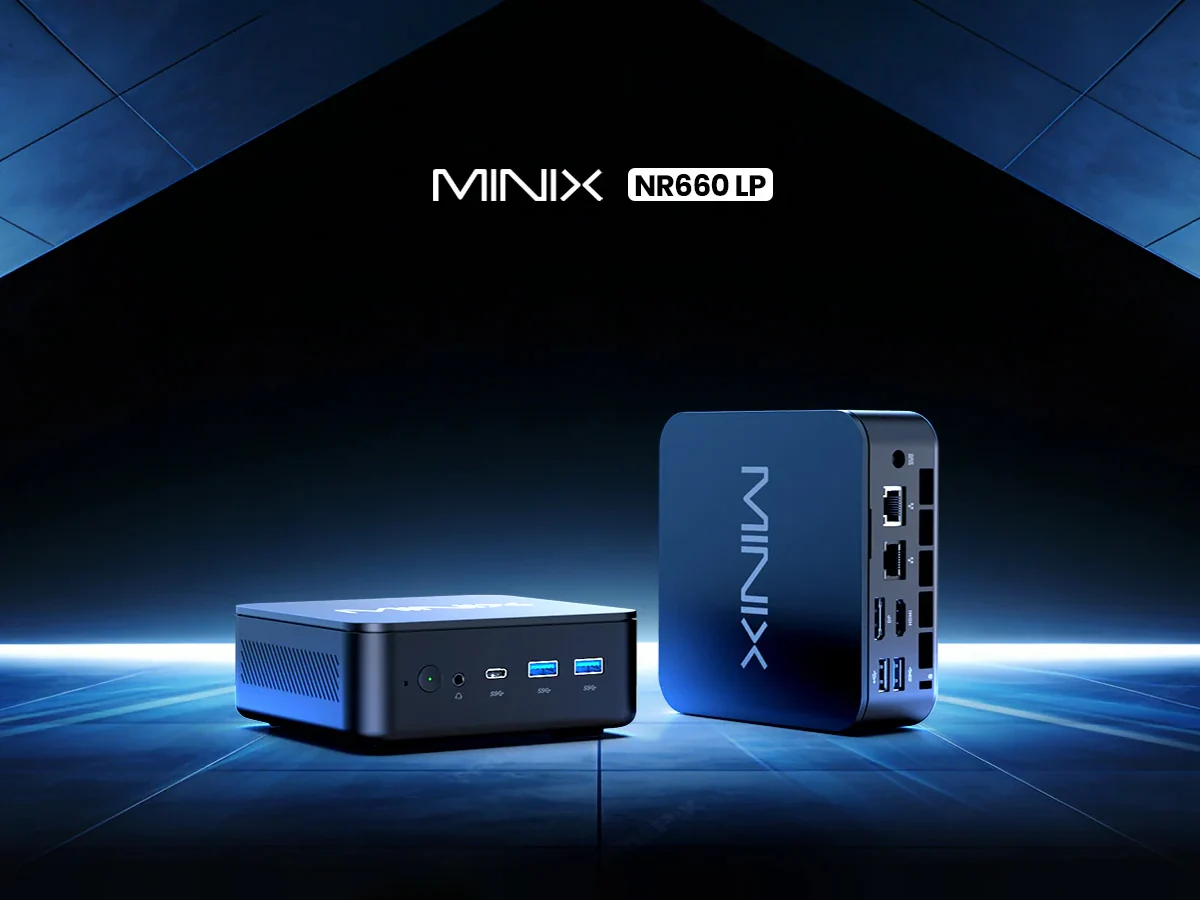
    Minix has launched a new version of the NR660 mini PC, now featuring an LP suffix in its model name. Unlike the regular NR660, this LP version comes with soldered RAM. While this could be seen as a smart move given the current memory scarcity, it also means users cannot upgrade the RAM later.

    Specifications and Storage

    The mini PC comes equipped with 16GB of LPDDR5 RAM, which should suffice for most everyday activities. When it comes to storage, Minix provides an option to upgrade to a maximum of 8TB using two M.2 slots for PCIe 4.0 storage, but the system itself is shipped with a 512GB PCIe 3.0 SSD. As a reference, a 1TB TeamGroup MP44L SSD is currently priced at $166.99 on Amazon.

    Port Selection

    A significant change in the NR660 LP is its port selection. It lacks a USB4 port, which is a step back from the non-LP version that allows for high-speed connections to devices like eGPUs. Still, the port setup remains satisfactory for users who may not need USB4 functionality. The available ports include:

    Performance and Features

    Inside, the NR660 LP is driven by the same AMD processor found in the non-LP variant. Specifically, it houses the Ryzen 5 6600H, a Zen 3+ CPU paired with the Radeon 660M integrated GPU. Although the CPU is somewhat dated, it can handle most tasks efficiently, and the integrated GPU is decent for light gaming.

    The Minix NR660 LP also boasts a compact design, supports WiFi 6E, Bluetooth 5.0, and offers triple display output capabilities. While the mini PC is listed on the official website, it is currently not available for purchase. The price shown is $515, which might just be a placeholder. For comparison, the non-LP version with 16GB of DDR5 RAM and a 512GB SSD is priced at $499 in the official store.

    Source:
    Link


  • Beelink Launches Global SER10 Max Mini-PC: Specs and Features

    Beelink Launches Global SER10 Max Mini-PC: Specs and Features

    Key Takeaways

    1. Beelink launched the SER10 Max mini-PC, a successor to the SER9 Pro and SER9 Max models.
    2. The SER10 Max features the AMD Ryzen AI 9 HX 470 processor, offering improvements over the previous model.
    3. The design includes an aluminum casing and multiple connectivity options, including USB Type-C and USB 3.2 ports.
    4. Pricing for the SER10 Max starts at CNY 4,499 (approximately $721) and can go up to CNY 10,999 (about $1,585) for higher configurations.
    5. Pre-orders for the SER10 Max will be available soon, with global pricing yet to be announced.


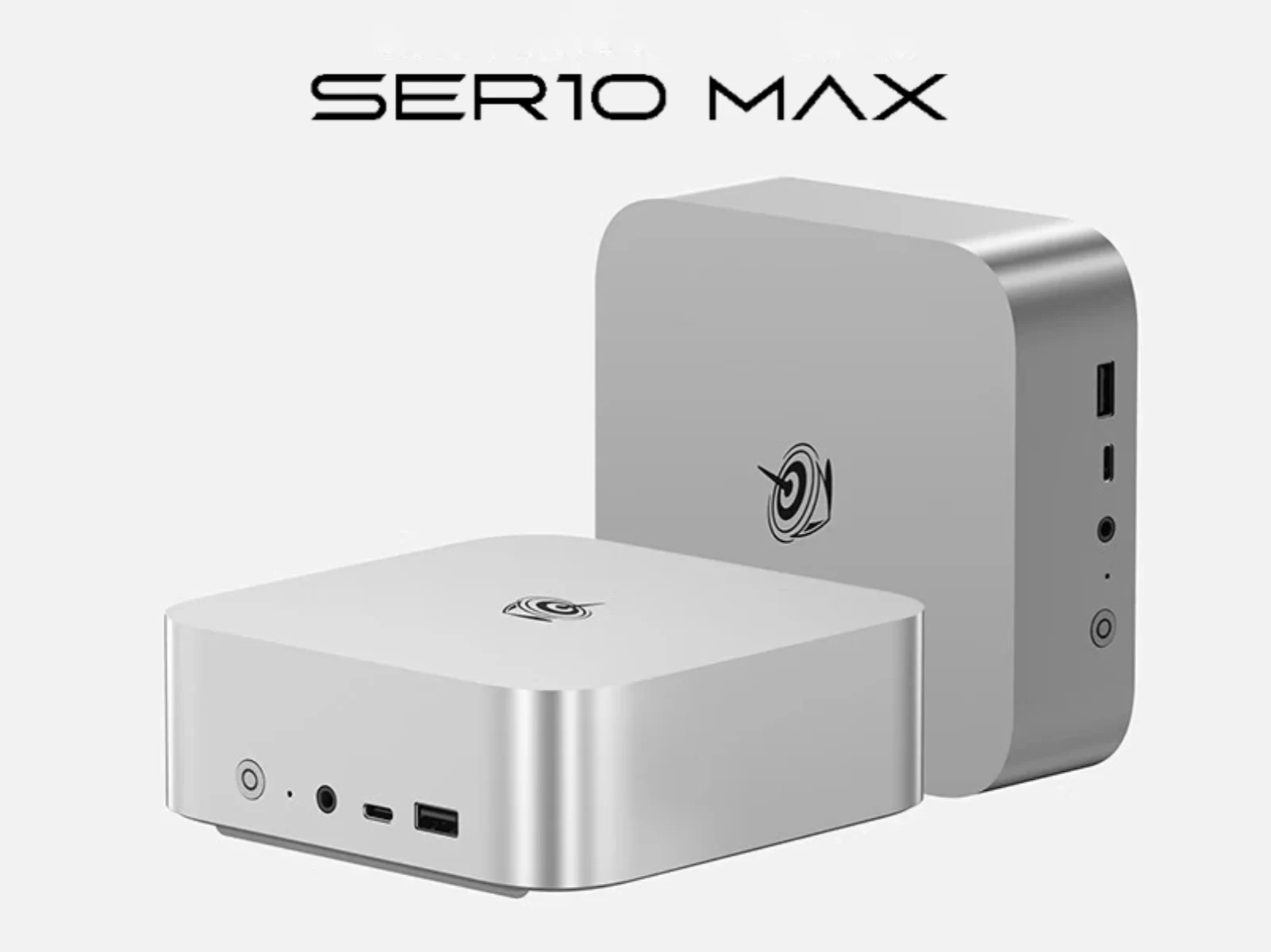
    Beelink has just launched the SER10 Max mini-PC, following its introduction last month alongside the SER10 Pro. These new models are the successors to the SER9 Pro and SER9 Max (currently priced at $729 on Amazon). Both the SER10 Pro and SER10 Max are built on the AMD Gorgon Point platform. In particular, Beelink has chosen the Ryzen AI 9 HX 470, which offers slight improvements over the previous Ryzen AI 9 HX 370.

    Design and Features

    The SER10 Max closely resembles its predecessor, featuring an aluminum casing measuring 135 x 135 x 44.7 mm. It also includes a Clear CMOS button, a 3.5 mm audio jack, USB Type-C (10 Gbps), and USB 3.2 Type-A (10 Gbps) ports located on the front panel. The cooling system boasts large fins that take up a majority of the back side of the SER10 Max, along with additional I/O options.

    Specifications and Pricing

    Moreover, Beelink has incorporated dual M.2 2280 and SODIMM slots for PCIe 4.0 x4 storage and DDR5-5600 RAM, respectively. The base price for the Beelink SER10 Max starts at CNY 4,499 (approximately $721), and can go up to CNY 8,188 (around $1,180) for a pre-configured version. For customers needing more than 32 GB of RAM and 1 TB of storage, Beelink offers a model with 64 GB of RAM and a 2 TB SSD, but the price increases by 34% to CNY 10,999 (about $1,585). While Beelink has yet to announce global pricing, it has revealed that pre-orders for the SER10 Max will be available soon.

    Conclusion

    JD.com through ITHome reported these details, leaving many eager for further announcements regarding global availability.

    Source:
    Link


  • ASRock Responds to AMD Ryzen 9000 CPU Damage Concerns

    ASRock Responds to AMD Ryzen 9000 CPU Damage Concerns

    Key Takeaways

    1. ASRock has acknowledged ongoing issues with Ryzen 9000 CPUs, which can heat up excessively and cause visible damage.
    2. Despite BIOS updates, the heating problems persist, and ASRock is investigating the situation without providing detailed technical explanations.
    3. User feedback is crucial for ASRock, and the company encourages customers to report technical issues to their support team.
    4. There have been over 260 reports of Ryzen 9000 chips failing on ASRock motherboards, indicating a significant concern for users.
    5. ASRock is collaborating with AMD to improve system performance and stability while reviewing the situation closely.


    It’s rare for big tech firms to really take note of what users are saying, unless the complaints become super loud. After two weeks of not saying much since Asus talked about AM5 CPU problems, ASRock has finally shared its thoughts on the situation as well. To put it in perspective, the company had earlier blamed the issues on wrong settings and had rolled out BIOS updates.

    Known Issue with Ryzen 9000 CPUs

    This problem is well-known and has been mentioned many times on various forums. Basically, it seems that some Ryzen 9000 CPUs heat up so much that they leave visible heat damage on both the socket and the delicate side of the CPU. However, this doesn’t mean that the Ryzen 9000 chips are bad in any way — Puget Systems’ yearly report praised the Ryzen 9000 series for having one of the lowest failure rates in the market.

    Ongoing Concerns Despite BIOS Updates

    Even after the BIOS updates were released, the issue still pops up from time to time. Like Asus, ASRock didn’t give any detailed technical reasons for the problems and only mentioned that they’re looking into it and checking different options. They also encouraged users who are affected to get in touch with their support team. The company’s official statement is shown below:

    ASRock is keeping a close watch on the latest talks about the performance and behavior of AMD Ryzen™ 9000 series processors on ASRock AMD platforms. In response to these claims, we have started extensive internal reviews and strict verification processes. We are continuously collaborating with AMD to validate system performance across a wide range of hardware setups, while also optimizing BIOS and boosting overall system stability.

    User Feedback is Important to ASRock

    ASRock really values what users say as a key part of our ongoing improvements. Customers facing technical issues or looking for more help are encouraged to reach out to the ASRock Technical Support Department. We are dedicated to providing high-performance products that uphold the highest quality and performance standards.

    As noted by VideoCardz, there have been over 260 reports of expensive Ryzen 9000 chips — including X3D models — failing in ASRock motherboards. While it might seem like a small percentage of the total number of these systems out there, the number is still significant enough to be seen as a serious problem affecting the platform.

    Source:
    Link


  • Ugreen Launches 25,000mAh Power Bank with Dual Cables & Display

    Ugreen Launches 25,000mAh Power Bank with Dual Cables & Display

    Key Takeaways

    1. The Ugreen Nexode Pro 25,000mAh power bank competes with the Anker model, featuring a similar price but faster charging speeds and support for Xiaomi’s 90W protocol.

    2. It includes a 2.2-foot retractable cable, a 1.2-foot lanyard cable, and can charge up to four devices simultaneously, with a capacity to recharge a 13-inch MacBook Air about 1.3 times.

    3. The Nexode Pro delivers up to 200W output, allowing a 16-inch MacBook Pro to charge 43% in just 30 minutes, even while charging multiple devices.

    4. It features an integrated TFT smart display that shows battery level, output, and battery health, with dimensions of 158 x 54 x 50 mm and a weight of 631 g.

    5. The Ugreen Nexode Pro is priced at £89.99 in the UK and €99.99 in Germany, making it competitive with the Anker Laptop Power Bank.


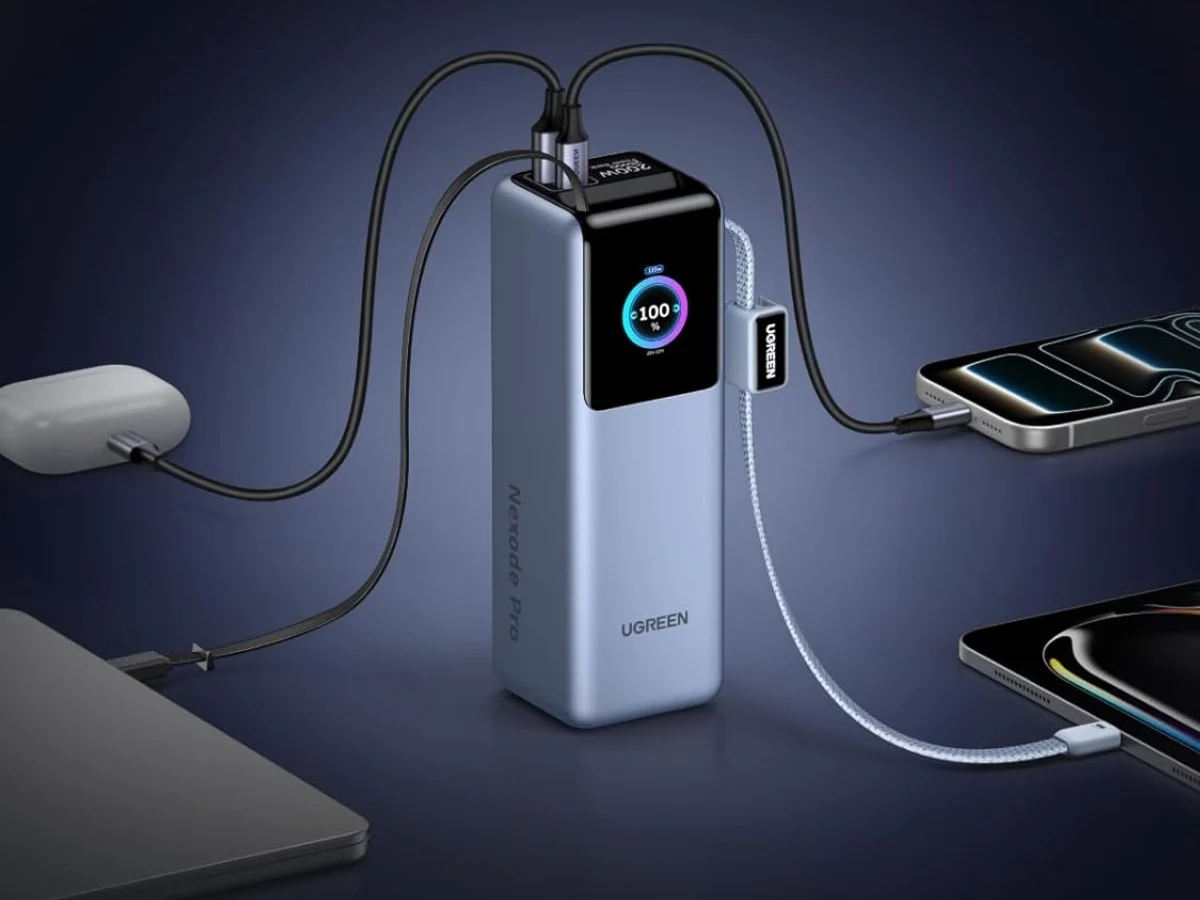
    The Ugreen Nexode Pro 25,000mAh power bank for laptops is a fresh contender that goes head-to-head with the Anker Laptop Power Bank (25K, 165W, with built-in and retractable cables) which was launched last year. It is now up for grabs in the UK and Germany, boasting similarities with the Anker model, including its price point, yet it provides somewhat quicker charging speeds and supports Xiaomi’s 90W charging protocol.

    Design and Functionality

    Much like its Anker counterpart, the Nexode Pro comes equipped with a 2.2-foot retractable cable along with a shorter 1.2-foot cable that can also act as a lanyard. Additionally, users can connect up to four devices simultaneously using the extra USB-C and USB-A ports. With a massive 25,000 mAh capacity, this power bank can keep several devices charged or run a laptop for extended periods. Ugreen claims that it can recharge a 13-inch MacBook Air roughly 1.3 times or fully power an iPhone 17 Pro nearly five times.

    Charging Power

    On another note, both the built-in USB-C cables and the USB-C port can each provide up to 100W when charging a single device, enabling a 16-inch MacBook Pro to reach 43% charge in just half an hour. Unlike the Anker model, which has a maximum output of 165W, the Nexode Pro elevates that number to 200W. Even when you’re charging four devices at the same time, one USB-C cable can still supply a full 100W, while the other 100W is divided among the other ports. This allows you to keep a laptop charging efficiently while also powering other gadgets.

    Display and Dimensions

    Another standout feature is the integrated TFT smart display that offers a quick glance at the remaining battery level, output, health of the battery, and additional details. Measuring in at 158 x 54 x 50 mm, it’s nearly the same size as the Anker model but is slightly heavier at 631 g compared to 585 g.

    The Ugreen Nexode Pro 25,000mAh laptop power bank is presently priced at £89.99 in the UK and €99.99 in Germany, positioning it on par with the Anker Laptop Power Bank prior to any discounts.

    Source:
    Link


  • Asus Fanless Rugged Mini PC with 12-Core CPUs and 4 LAN Ports

    Asus Fanless Rugged Mini PC with 12-Core CPUs and 4 LAN Ports

    Key Takeaways

    1. Asus has launched the PE1000U fanless mini PC designed for industrial edge computing, featuring a durable design and MIL-STD810H certification.
    2. Buyers can choose between Intel Core Ultra 7 265U and Core Ultra 5 235U processors, with the 265U offering 12% better performance in multi-core tests.
    3. The mini PC operates without a fan, using passive cooling for its 15W processors, making it suitable for light to moderate tasks.
    4. It includes various connectivity options, expansion capabilities, and supports up to 64 GB of DDR5 memory, all within a compact size of 63 x 110 x 160 mm.
    5. Pricing and availability are unclear, and potential buyers for industrial use will likely need to contact Asus directly for quotes.


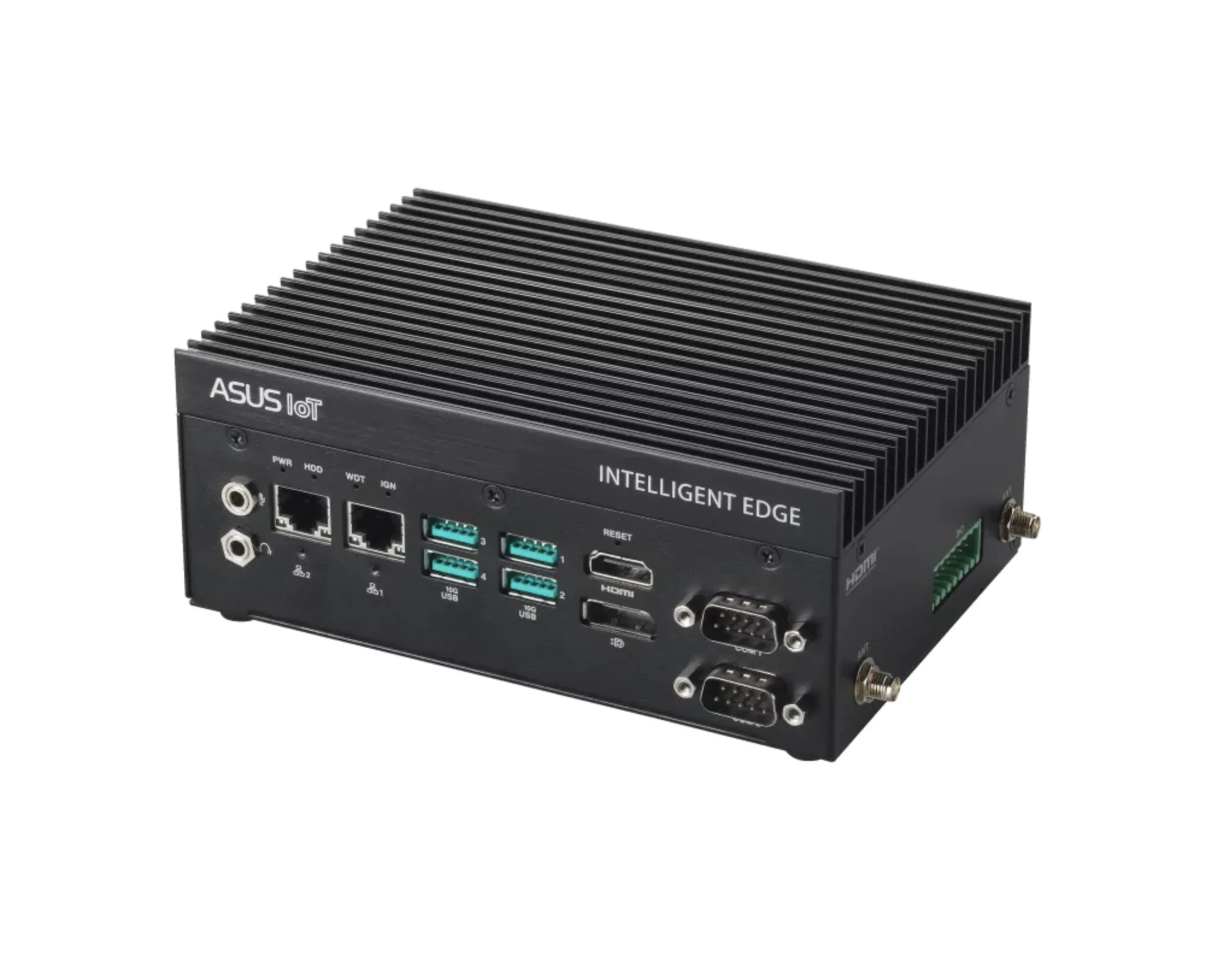
    Asus has launched a new fanless mini PC featuring a sturdy design. Targeted mainly at the industrial edge computing market, the PE1000U mini PC runs on impressive Intel Core Ultra Series 2 processors and comes with MIL-STD810H certification, meaning it can endure significant wear and tear.

    CPU Choices

    In terms of processor options, buyers can select between the Core Ultra 7 265U and the Core Ultra 5 235U models. Even though both are labeled with the 200 series, the more powerful 12-core Core Ultra 7 265U is part of the Arrow Lake-U generation, while the more affordable 12-core Core Ultra 5 235U belongs to the Meteor Lake-U series.

    Performance Insights

    When it comes to performance, the 265U has a decent, although not overwhelming, 12% advantage over the 235U in multi-core synthetic tests, and it is approximately as effective as the Apple M2 SoC. For light to moderate tasks, either chip should perform adequately. As previously stated, the mini PC operates entirely without a fan and relies on passive cooling to maintain the 15W processors.

    Connectivity Features

    Input/output options are essential for any industrial-focused system, and the Asus PE1000U mini PC comes equipped with several ports:

    Additionally, it offers expansion possibilities like M.2 E and B-keys for WiFi and cellular, an M.2 2280 M-key for PCIe Gen 4 solid-state drives, a 2.5-inch drive bay, and integrated dual CAN bus. Memory can be upgraded with dual SODIMMs, allowing for up to 64 GB of DDR5-6400. Compact in size at 63 x 110 x 160 mm, the PE1000U mini PC weighs around 1 kg or 2.2 lbs.

    Pricing and Availability

    Details regarding pricing and availability remain uncertain at this moment. Typically, for industrial mini PCs, potential customers will likely need to reach out to Asus sales directly to obtain a quote, which may vary based on the quantity ordered. For everyday users, the significantly more robust Apple Mac mini (currently priced at $549 on Amazon) presents an excellent alternative.

    Source:
    Link


  • Lenovo Launches ThinkBook 14+ and 16+ with AMD Gorgon APU

    Lenovo Launches ThinkBook 14+ and 16+ with AMD Gorgon APU

    Key Takeaways

    1. Lenovo has updated its ThinkBook 14+ and 16+ laptops in China with an advanced AMD Ryzen AI 7 H 450 APU, featuring 8 cores and 16 threads.
    2. The new APU offers a 100 MHz speed boost over the previous model and can handle faster memory, outperforming the Apple M4 SoC in leaked benchmarks.
    3. The laptops lack an integrated GPU, relying on the Radeon 860M iGPU, but support ultra-fast external graphics via a TGX slot.
    4. The 14.5-inch model features a 3072 x 1920 resolution display at 120 Hz, while the larger model has a 3200 x 2000 display at 165 Hz, covering 100% of the DCI-P3 color space.
    5. Available in China for 6,999 Yuan (about $1,008), the laptops include 32 GB of memory, 512 GB of storage, and various advanced features, but there are no plans for a global release.


    Lenovo is rolling out a fresh version of its ThinkBook 14+ and 16+ laptops in China, now featuring an advanced AMD Gorgon Point APU. The overall design and features of the laptops appear to be the same, maintaining their premium specs and high-speed eGPU compatibility.

    New APU Details

    The latest addition to the lineup includes the AMD Ryzen AI 7 H 450 chip, which consists of 4 Zen 5 and 4 Zen 5c cores, totaling 8 cores and 16 threads. This chip is basically a reworked version of the previous Ryzen AI 7 350, boasting a 100 MHz speed boost and the ability to handle faster memory. According to leaked Geekbench 6 results, this APU seems to slightly surpass the Apple M4 SoC in performance.

    Graphics Performance

    There is no integrated GPU, which means the Radeon 860M iGPU is responsible for graphics tasks. When faced with demanding workloads that the older iGPU can’t handle, the ThinkBook 14+/16+ has a TGX slot for ultra-fast eGPU setups, comparable to OCuLink in performance with about 64 Gbps throughput.

    Display and Features

    Lenovo’s new 14.5-inch ThinkBook will showcase a stunning 3072 x 1920 resolution display with a 120 Hz refresh rate and claims to cover 100% of the DCI-P3 color space. The larger model will feature a 3200 x 2000 display with an even quicker refresh rate of 165 Hz. The I/O options are quite robust, including a variety of useful ports:

    Memory and storage capabilities are managed by dual-channel LPDDR5X-8533 and two M.2 2280 slots. Additional highlights include an IR camera supporting Windows Hello, a physical camera shutter, a four-speaker audio system, a 99.9 Wh battery, WiFi 7, and compatibility with MagicBay accessories.

    These Lenovo ThinkBook 14+ and 16+ laptops, equipped with 32 GB of memory and 512 GB of storage, are currently available in China at a price of 6,999 Yuan on JD.com, which is about $1,008. Unfortunately, there’s no sign of a global release anytime soon, and it seems pretty unlikely.

    Source:
    Link