
Key Takeaways
1. MIT engineers have developed tiny silicon structures that use waste heat for computing tasks instead of relying on electricity.
2. The researchers utilized inverse design techniques to create intricate silicon shapes capable of performing mathematical calculations with over 99% accuracy.
3. The project demonstrates that heat can be harnessed as a form of information, challenging the conventional view of heat as a waste product in electronics.
4. The team divided matrices into positive and negative parts to manage heat flow effectively and modified silicon thickness for better heat conduction.
5. While the technology shows promise in heat management, it faces challenges in bandwidth and scaling, with future efforts focused on creating programmable structures for more complex operations.
MIT engineers have managed to turn a usual electronic problem — waste heat — into something useful for computing. In a recent article in the journal Physical Review Applied, the research team presented tiny silicon structures that can carry out mathematical tasks using heat rather than electricity.
Innovative Design Techniques
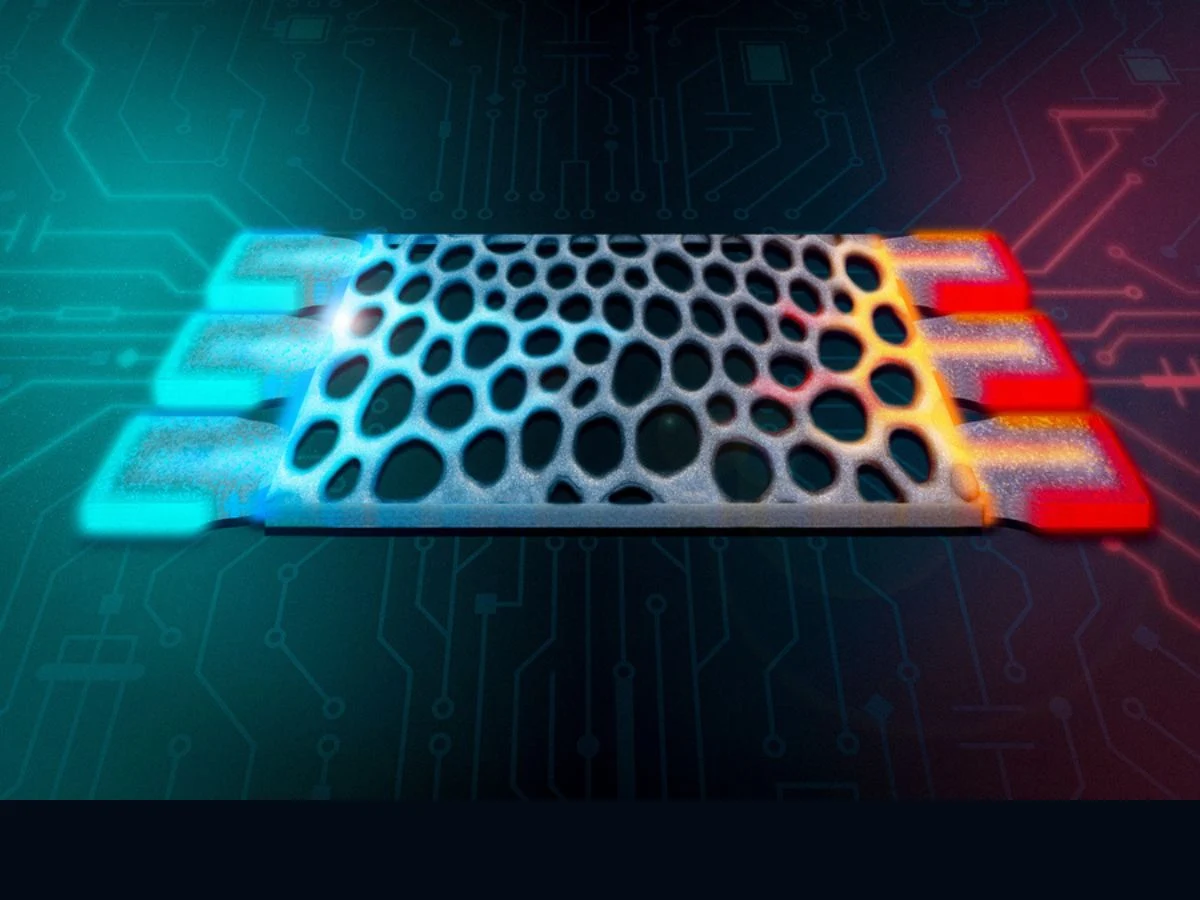
The group of researchers, which includes undergraduate Caio Silva and research scientist Giuseppe Romano, employed a method known as inverse design to create these structures. By inputting the desired functions into a software tool, algorithms were able to produce intricate silicon shapes, about the size of a speck of dust, filled with pores. These silicon structures control heat flow to perform matrix vector multiplication — a basic calculation underpinning machine-learning models like Large Language Models (LLMs) — achieving more than 99% accuracy in simulations.
Turning Heat Into Computation
Normally, when doing calculations on electronic devices, the heat generated is seen as a byproduct. People usually aim to eliminate as much heat as possible. However, in this case, we took a different route by utilizing heat as a form of information, demonstrating that it is indeed possible to compute with heat. — Caio Silva, the main author of the paper.
To tackle the challenge that heat naturally flows from hotter areas to cooler ones, the team divided target matrices into positive and negative parts, processing them through distinct structures. They also modified the thickness of the silicon to more accurately control heat conduction.
Future Potential and Challenges
Although the technology still faces challenges regarding bandwidth and scaling for more complex deep-learning applications, it offers immediate benefits in managing heat. The silicon structures could automatically identify overheating or temperature differences in electronic devices without needing external power or digital sensors. The research team is now focused on creating programmable structures that can handle sequential operations.
APS Journals via MIT News
Source:
Link