Category: Computers

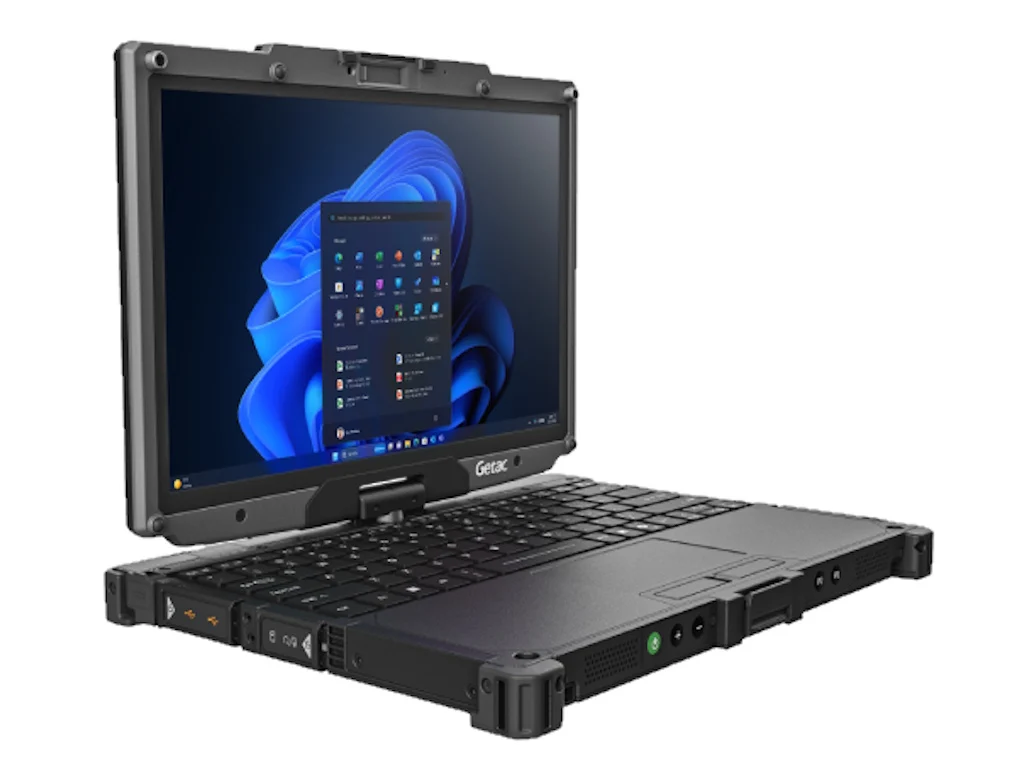
  • Getac Launches Rugged 12.2-Inch V120 2-in-1 Laptop with Ultra CPUs

    Getac Launches Rugged 12.2-Inch V120 2-in-1 Laptop with Ultra CPUs

    Key Takeaways

    1. Rugged Design: The Getac V120 is certified IP66, MIL-STD-810H, and MIL-STD-461G, ensuring durability against drops, water, dust, and extreme temperatures.

    2. Powerful Performance: It features Intel Core Ultra 5 or 7 processors, up to 64 GB of DDR5 RAM, and 2 TB of NVMe storage, with a bright 1,000 nits touchscreen display.

    3. Connectivity Options: The laptop includes multiple ports (USB, Thunderbolt, HDMI) and supports Ethernet, Wi-Fi 7, Bluetooth 5.4, and optional 4G/5G connectivity.

    4. Hot-Swappable Batteries: It has two lithium batteries available in standard and large capacity, allowing for continuous use without downtime.

    5. Launch Date: The Getac V120 2-in-1 laptop is expected to be available in October 2025.


    Getac has introduced their tough 12.2-inch V120 2-in-1 laptop, made for use in harsh conditions.

    Rugged Design and Certifications

    The Getac V120 holds IP66, MIL-STD-810H, and MIL-STD-461G certifications, proving it can withstand drops from 4 ft. (1.2 m), water jets, dust, and shocks. It can function in extreme temperatures, from -29° C to 63° C (-20° F to 145° F).

    Powerful Performance

    This device is powered by Intel Core Ultra 5 or 7 processors, allowing for up to 64 GB of DDR5 RAM and as much as 2 TB of NVMe storage. The touchscreen display is exceptionally bright, boasting 1,000 nits with a resolution of 1,920 x 1,200 pixels, making it easy to read in daylight conditions.

    Connectivity and Power Options

    Equipped with a 5 MP camera, stereo speakers, and dual microphones, the laptop also features two USB 3.2 Gen 2 Type-A ports, two Thunderbolt 4 Type-C ports, and an HDMI 2.0 port for connectivity. It supports connections via 10/100/1000 base-T Ethernet, Wi-Fi 7, Bluetooth 5.4, and can even connect to optional 4G/5G cellular networks.

    The laptop’s power comes from two hot-swappable lithium batteries available in standard (7.74 V, 4,070 mAh) or large capacity (11.61 V, 4,070 mAh) configurations, allowing for seamless, ongoing use. It weighs in at 2.1 kg (4.63 lbs.) and its dimensions are 313 x 238 x 35.7 mm (11.89 x 8.82 x 1.41 in.).

    Source:
    Link


  • Acer Chromebox CX16: New Mini PC with Intel Core i7 Processor

    Acer Chromebox CX16: New Mini PC with Intel Core i7 Processor

    Key Takeaways

    1. The Acer Chromebox CX16 is a compact mini PC designed for efficient connectivity and performance.
    2. It offers multiple processor options, including Intel Core 7, Core 5, Core 3, and Core i3, with support for up to 16 GB of DDR4 RAM.
    3. The device features WiFi 6E, Bluetooth 5.2, and VESA mounting support for versatile connectivity and space-saving.
    4. The Enterprise model includes enhanced security and management features.
    5. Pricing starts at €299 (approximately $348) for the standard version and €399 (about $464) for the Enterprise version, with availability in September 2025.


    In IFA 2025, Acer has launched several new ChromeOS devices, including the Chromebox CX16, a mini PC designed for efficient connectivity in a small form factor. This product is aimed at users who need a compact solution without sacrificing performance.

    Processor Options

    The Chromebox CX16 can be equipped with an Intel Core 7 150U, but buyers also have the choice to opt for an Intel Core 5 120U, Core 3 100U, or Core i3 1305U. It can support up to 16 GB of DDR4 RAM, and features an M.2 slot for SSD installation. However, Acer did not disclose the maximum storage capacity, although a 1 TB Samsung 990 EVO Plus is currently priced at $64.99 on Amazon.

    Connectivity Features

    In terms of ports, the Chromebox CX16 is designed with a variety of connectivity options. It supports WiFi 6E and Bluetooth 5.2 for wireless connections. Additionally, the unit comes with VESA mounting support, making it suitable for limited desk spaces. The Enterprise model includes enhanced features for better security, easier management, and greater access flexibility.

    Pricing and Availability

    The Chromebox CX16 is expected to hit the market in September 2025, with a starting price of €299 in Europe, roughly translating to $348. The Enterprise version begins at €399, which is about $464. For further details, refer to the specifications sheet attached below regarding this latest ChromeOS mini PC.


  • Acer Predator Helio 18P AI with ECC RAM and Arrow Lake vPro CPU

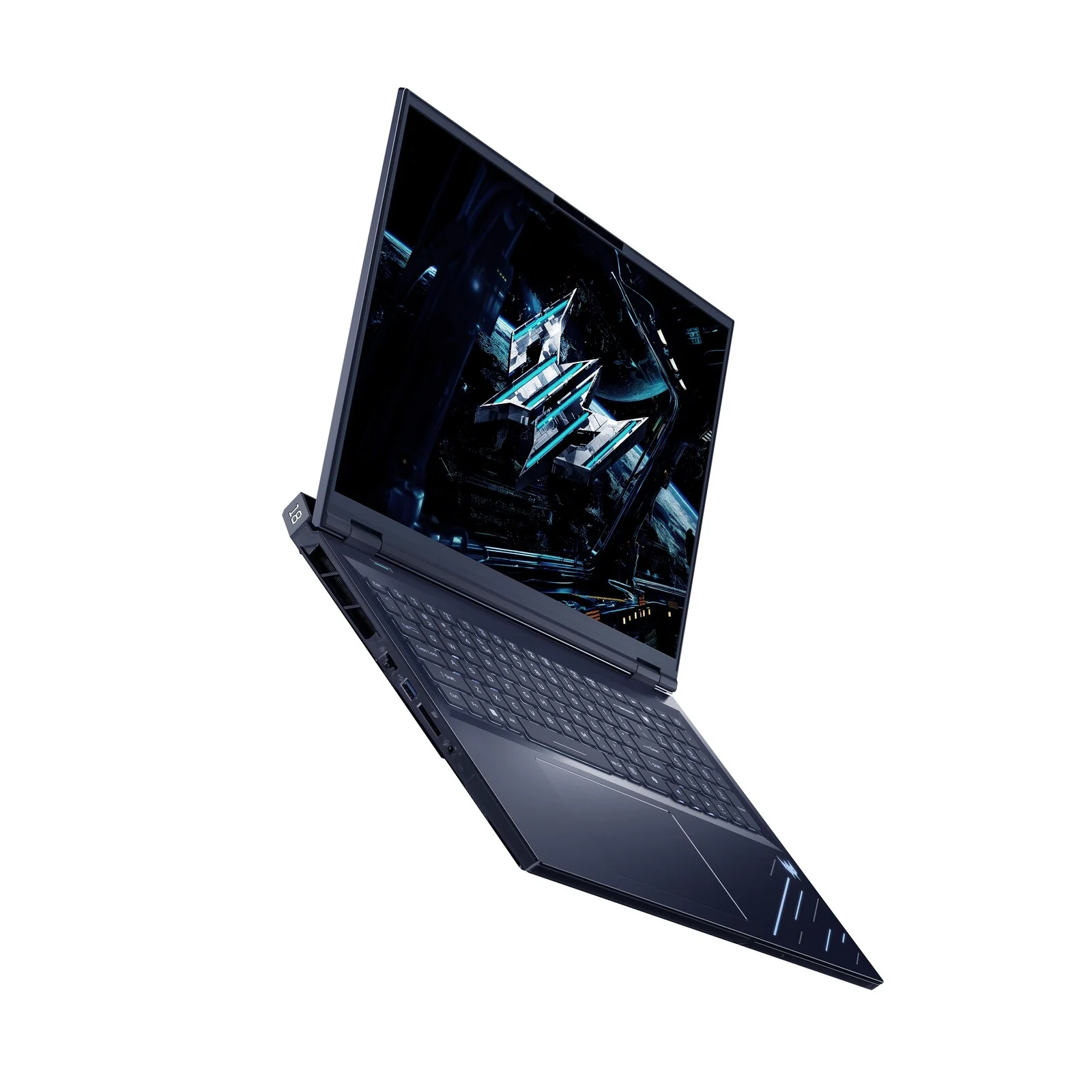
    Acer Predator Helio 18P AI with ECC RAM and Arrow Lake vPro CPU

    Key Takeaways

    1. Powerful Hardware: The Acer Predator Helios 18P AI features Intel’s Core Ultra 9 285HX vPro and GeForce RTX 5090 GPU, with up to 192 GB of ECC DDR5 RAM and 6 TB of storage.

    2. Advanced Cooling System: The laptop uses two sixth-gen AeroBlade fans, liquid metal thermal paste, and heat pipes for effective cooling of high-performance components.

    3. High-Quality Display: It has a 4K mini-LED display with 1,000 nits brightness, 120 Hz refresh rate, and 100% DCI-P3 color gamut coverage.

    4. Robust Connectivity: The device includes Wi-Fi 7, Bluetooth 5.4, Thunderbolt 5, HDMI 2.1, and an SD card reader.

    5. Premium Price: The Acer Predator Helios 18P AI is priced at EUR 4,999, indicating it is a high-end investment.


    Acer recently showcased its top-tier Predator Helios 18 AI at CES 2025, featuring cutting-edge hardware from Intel and Nvidia. Now, this laptop has undergone a mid-cycle update, resulting in the Acer Predator Helios 18P AI. While maintaining its gaming look, this device can also function as a portable workstation capable of handling intensive tasks.

    Powerful Upgrades

    To kick things off, the laptop is now equipped with Intel’s premium Core Ultra 9 285HX vPro, an upgrade from the Core Ultra 9 275HX found in the previous model. Users can pair this with a GeForce RTX 5090 laptop GPU, a staggering 192 GB of ECC DDR5 RAM, and a whopping 6 TB of storage, achieved through a combination of PCIe Gen5 and Gen4 drives. Acer has designed the system to keep its power-hungry components cool using two sixth-gen AeroBlade fans, liquid metal thermal paste, and an intricate network of heat pipes.

    Stunning Display and Features

    Other notable features of the Acer Predator Helios 18P AI include a stunning 4K (3,840 x 2,400) mini-LED display, boasting a peak brightness of 1,000 nits, a refresh rate of 120 Hz, and a quick grey-to-grey response time of just 3 ms, along with 100% coverage of the DCI-P3 color gamut. The notebook is powered by a robust 99.9 Wh battery. In terms of connectivity, it offers Wi-Fi 7, Bluetooth 5.4, Thunderbolt 5, an HDMI 2.1 port, and an SD card reader.

    Pricey Investment

    As anticipated, the Acer Predator Helios 18P AI is not going to be budget-friendly. While the exact release date remains unclear, the laptop comes with a staggering price of EUR 4,999, likely for the base model configuration.

  • Acer Swift Air 16 Launches with AMD Ryzen AI 7 and 2.8K OLED Display

    Acer Swift Air 16 Launches with AMD Ryzen AI 7 and 2.8K OLED Display

    Key Takeaways

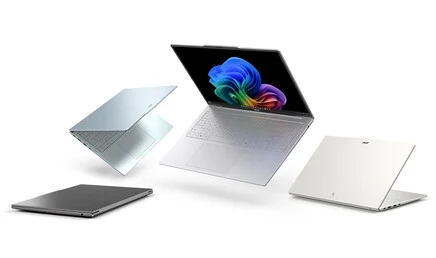
    1. The Acer Swift Air 16 is a lightweight laptop made from a magnesium-aluminum alloy, weighing under 1 kg and available in multiple colors.
    2. It features two display options: a 16:10 1,920×1,200 60 Hz IPS screen and a 2,880×1,800 120 Hz AMOLED display with full DCI-P3 color coverage.
    3. The laptop is powered by AMD Ryzen AI processors, including the Ryzen AI 5 330, 340, and 7 350, with integrated Radeon graphics.
    4. It includes a 2 MP FHD IR webcam with a privacy shutter, various ports (USB-C, USB-A, HDMI), and supports Wi-Fi 6E and Bluetooth 5.4.
    5. The device has a 50 Whr battery offering up to 13 hours of video playback and will be available in the EMEA region starting November, with prices from €999.


    We just took a look at the Acer Swift 16 AI, which is powered by the Intel Lunar Lake Core Ultra 9 288V processor. At the IFA 2025 event, Acer is launching a new version called the Swift Air 16 that features Ryzen AI. According to Acer, the Swift Air 16 is designed for those who travel often and need a lightweight laptop.

    Design and Display

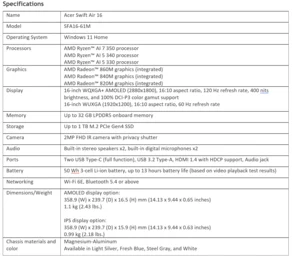
    The Swift Air 16 is made from a magnesium-aluminum alloy, making it super light at under 1 kg. You can choose from several colors: Light Silver, Fresh Blue, Steel Gray, and White. It offers two display options: a 16:10 1,920×1,200 60 Hz IPS screen or a 2,880×1,800 400 nits 120 Hz AMOLED display, which covers the full DCI-P3 color gamut.

    Performance

    This laptop is powered by AMD Ryzen Krackan Point APU options, which include the Ryzen AI 5 330, Ryzen AI 5 340, and Ryzen AI 7 350. Each of these processors comes with integrated Radeon graphics: the 820M, 840M, and 860M, respectively.

    Features and Battery Life

    The Swift Air 16 is equipped with a 2 MP FHD IR webcam featuring a privacy shutter, allowing for Windows Hello biometric logins. It also includes two full-function USB Type-C ports, a USB 3.2 Type-A port, and an HDMI 1.4 port with HDCP support. For connectivity, you’ll find Wi-Fi 6E and Bluetooth 5.4.

    According to Acer, the device boasts a 3-cell 50 Whr Li-ion battery that provides 13 hours of video playback.

    The Acer Swift Air 16 SFA16-61M will be available in the EMEA region starting in November, with prices beginning at €999.


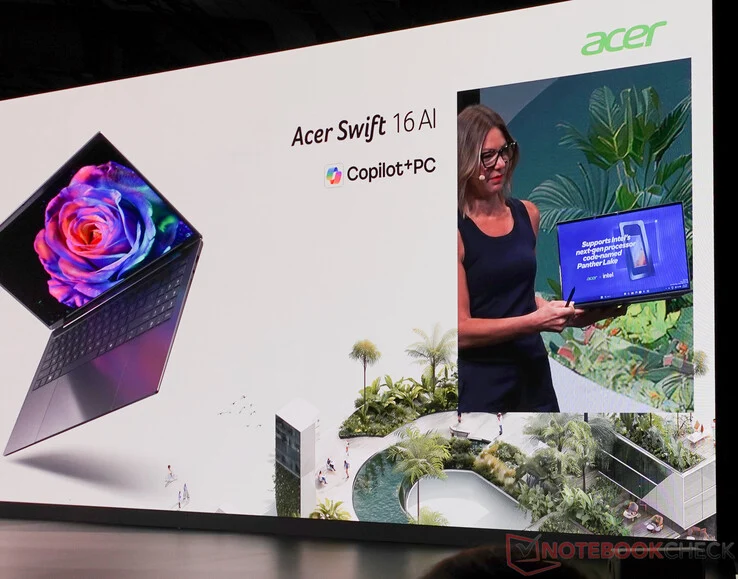
  • Acer Swift 16 AI Launches: First Intel Panther Lake Laptop with Haptic Touchpad

    Acer Swift 16 AI Launches: First Intel Panther Lake Laptop with Haptic Touchpad

    Key Takeaways

    1. The Acer Swift 16 AI features Intel’s upcoming Panther Lake CPUs, designed for thin and light laptops, showcasing at IFA 2025.
    2. Panther Lake processors utilize the Intel 18A process, introducing stronger Xe3 iGPU, enhanced NPU for faster AI tasks, and new P/E-cores.
    3. Rumored specs include up to 16 cores, 12 Xe3 iGPU cores, and AI performance reaching 180 TOPs for tasks like local Generative AI agent creation.
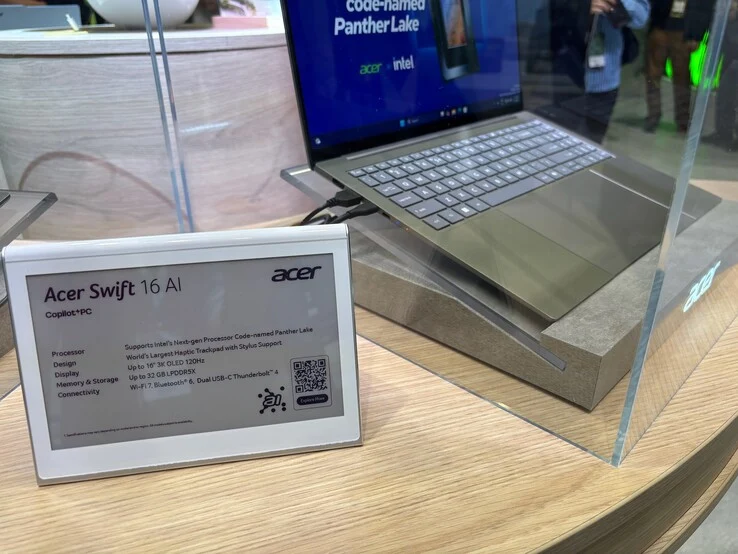
    4. The laptop presents a sleek design with a 3K OLED display at 120 Hz, up to 32 GB LPDDR5X memory, and a 1080p webcam with a privacy slider.
    5. The Acer Swift 16 AI will launch in early 2026, featuring a large haptic touchpad and a full-size keyboard, but will only have Thunderbolt 4 ports.


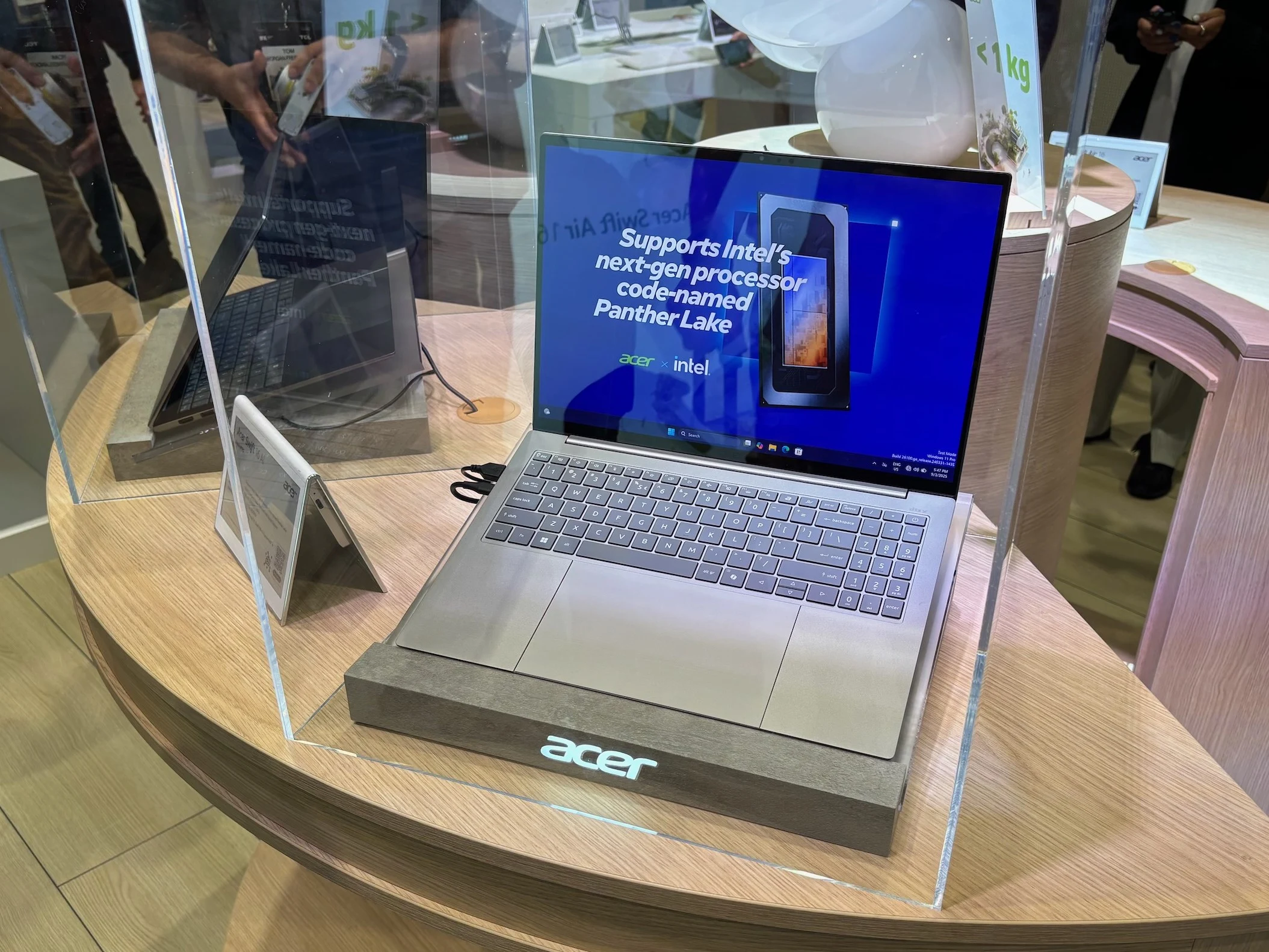
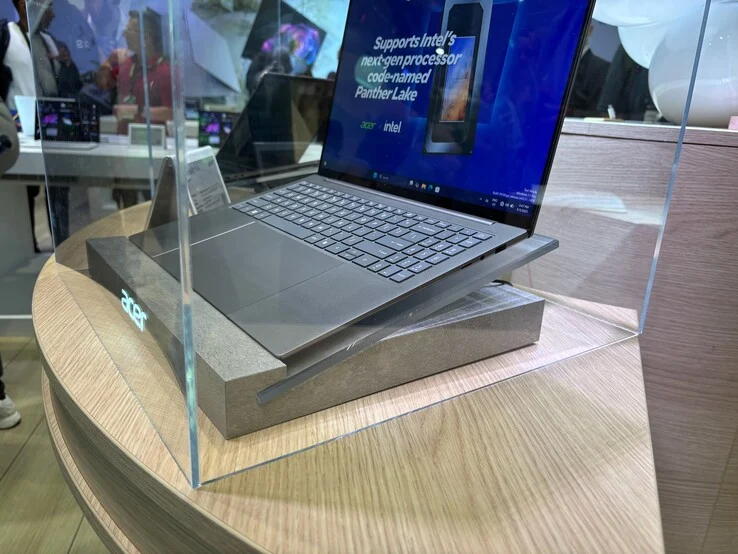
    After a long wait filled with leaks and speculations, we now get our first glimpse of a real notebook featuring Intel’s upcoming “Panther Lake” CPUs designed for thin and light laptops. The device in question is the Acer Swift 16 AI, which Acer recently showcased at IFA 2025. Interestingly, this seems to be the same model that was presented earlier at Computex 2025.

    Exciting Details Emerge

    Although Acer hasn’t disclosed a lot of information about the Intel Panther Lake-powered Swift 16 AI, what has been shared is pretty thrilling.

    To begin with, the most significant point is that the Acer Swift 16 AI is driven by the forthcoming Intel Panther Lake laptop APUs. Built on the innovative Intel 18A process node, the Panther Lake chips are set to succeed the Lunar Lake Core Ultra 200V notebook processors. The new PTL processors, which are expected to be included in devices in 2026, introduce a much stronger Xe3 iGPU, an enhanced NPU for quicker AI tasks, and new P/E-cores.

    Specifications and Performance

    Regarding unofficial specifications, the Intel Core Ultra 300 Panther Lake APUs are rumored to feature up to 16 cores in total, utilizing Cougar Cove P-cores and Skymont E-cores. The updated iGPU is believed to have as many as 12 Xe3 cores. The combined performance of the NPU and iGPU is said to reach an impressive 180 TOPs for AI tasks. Intel plans to leverage the enhanced AI capabilities of the Panther Lake processors for functions like the Intel AI Assistant Builder, which purportedly enables users to create local Generative AI agents.

    On to the laptop itself, the Acer Swift 16 AI showcases a redesigned chassis that is sleeker than the current Lunar Lake Swift 16 AI. It offers an OLED panel with a resolution up to 3K and a refresh rate of 120 Hz, along with a maximum of 32 GB of LPDDR5X memory, and a new 1080p webcam equipped with a privacy slider. Unfortunately, the Acer Swift 16 AI does not include Thunderbolt 5 and will instead offer two Thunderbolt 4 ports, consistent with the Lunar Lake-based Swift 16 AI.

    Input Features and Launch Timeline

    For user inputs, the Acer Swift 16 AI features a full-size keyboard with larger keys, a numpad, and a single-color backlight. It also boasts a large trackpad, which Acer claims is the largest haptic touchpad in the world. This touchpad operates entirely on vibrations for feedback, has no moving parts, and supports stylus input.

    While Acer hasn’t provided any pricing details, the company mentioned that the Acer Swift 16 AI with Core Ultra 300 Panther Lake chips is set to be available in early 2026.

    Source:
    Link


  • Beelink Launches 80 Gbps Mini PC Dock with M.2 Slots for Mac Mini

    Beelink Launches 80 Gbps Mini PC Dock with M.2 Slots for Mac Mini

    Key Takeaways

    1. Beelink launched the Mate SE mini PC dock in China with a new port configuration, including an 80 Gbps USB-C port.
    2. The dock features a Thunderbolt 5 port, making it compatible with Apple Mac mini, alongside support for USB4 and Thunderbolt 3 or 4.
    3. The Mate SE offers expandability with two M.2 2280 PCIe 4.0×2 SSD slots, supporting up to 16 TB of storage, but requires external power for devices needing over 15 W.
    4. It includes an additional SD card reader compared to its predecessor, but does not have a 3.5 mm audio port; only one version of the Mate SE is available.
    5. The launch price in China is CNY 985 (about $138), matching the previous model’s launch price, with global pricing and availability details to be announced soon.


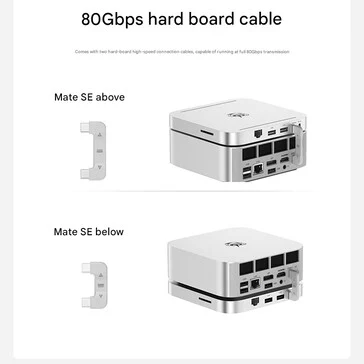
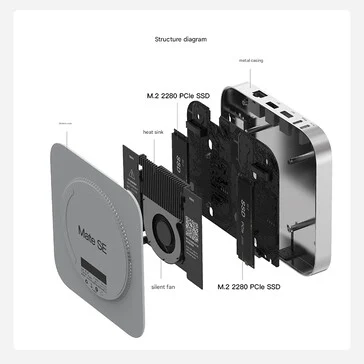
    Beelink has launched a new mini PC dock in China called the Mate SE. This new dock features a slightly altered port configuration compared to its predecessor, but it still includes the 80 Gbps USB-C port. Notably, this isn’t the USB4 2.0 port that USB-IF described in late 2024.

    Thunderbolt Compatibility

    According to the Chinese product listing, the dock is equipped with a Thunderbolt 5 port, which means it can work with the Apple Mac mini. It also supports USB4 and Thunderbolt 3 or 4 ports that are common on many mini PCs.

    Expandability Features

    The Beelink Mate SE offers a variety of ports for expandability. It’s important to note that this mini PC dock can function without needing external power. However, if the devices connected to it require more than 15 W, you will need to plug in a power adapter to the PD In port (45 W Anker Nano priced at $19.99 on Amazon).

    The Mate SE is capable of accommodating two M.2 2280 PCIe 4.0×2 SSDs. Beelink emphasizes that each slot can support an 8 TB SSD, allowing for a maximum expanded storage capacity of up to 16 TB.

    Additional Features and Pricing

    When compared to the Mate mini, the new Beelink dock includes an additional SD card reader, although it lacks a 3.5 mm audio port. Furthermore, it appears that there is only a single version of the Mate SE available, unlike its predecessor. In terms of pricing, the launch price in China is CNY 985, which is about $138, matching the launch price of the non-SE model in China. Details regarding global pricing and availability are still pending but are anticipated to be announced soon.

    Source:
    Link


  • Anker Ultra-Compact Desktop Charger Launches in the US

    Anker Ultra-Compact Desktop Charger Launches in the US

    Key Takeaways

    1. Anker has launched the Nano Charger (130W, 6 Ports) in the US, following its release in China and Europe.
    2. The charger is priced at $59.99 and is available in black and white on Amazon, but not on Anker’s website.
    3. It features four USB-C ports (up to 100W) and two USB-A ports (12W each), allowing for fast charging of devices like laptops.
    4. The Nano Charger includes safety features like ActiveShield 2.0 to monitor temperature and prevent overvoltage.
    5. Its compact design measures 3.7 x 3.9 x 0.75 inches and weighs 11.3 oz, making it ideal for saving desk space.


    Anker has introduced the Nano Charger (130W, 6 Ports) in the US. This product first came out in China in May and made its way to Europe in June 2025. The company describes this charger as a “high-power charging solution” designed to help users make the most of their desk space.

    Pricing and Availability

    You can now get the Anker Nano Charger (130W, 6 Ports) in both black and white colors on Amazon in the US for a price of $59.99. It’s not clear why the product isn’t available for direct purchase from Anker’s own website at this time.

    Charging Capabilities

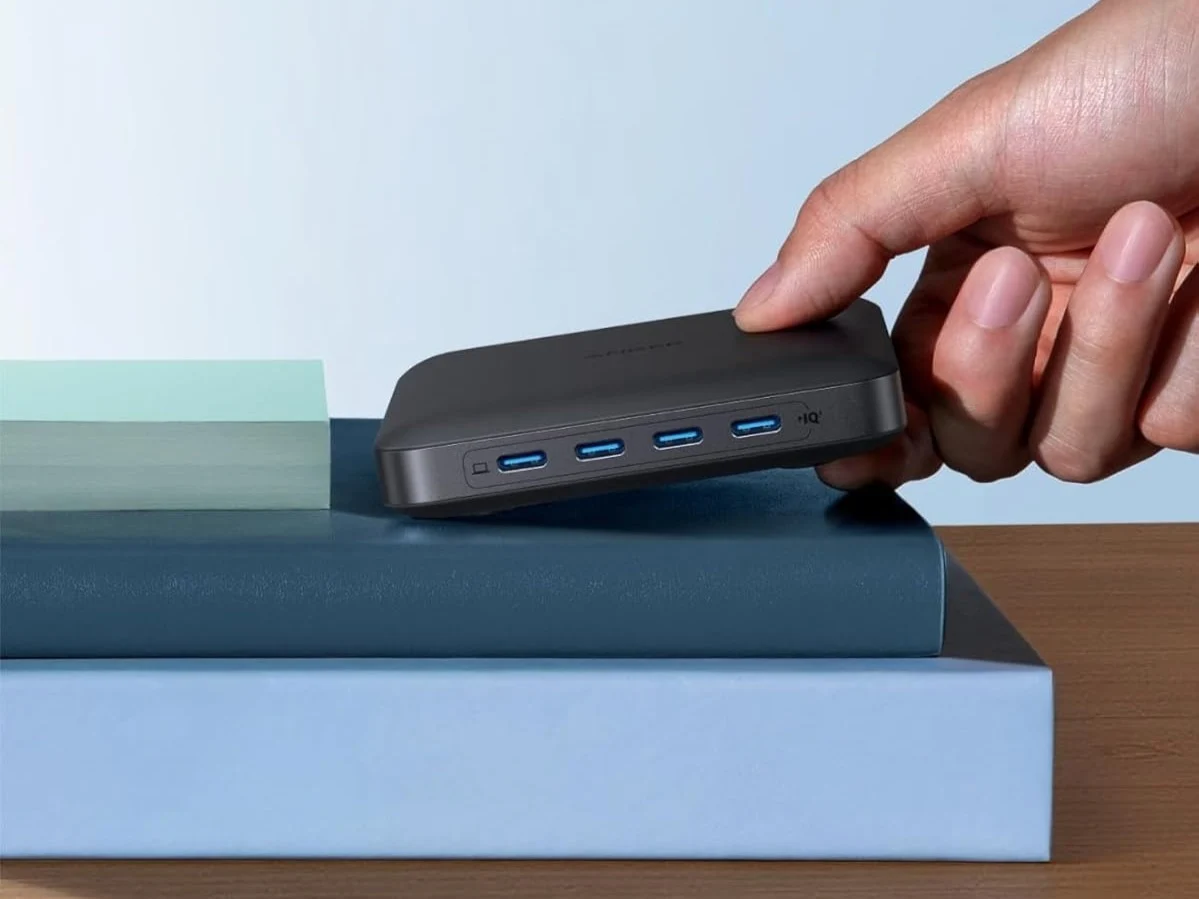
    The Nano Charger (130W, 6 Ports) has outputs on two different sides. On the front, there are four USB-C ports, which can provide up to 100W power when used by itself. If two USB-C ports are utilized at the same time, they can deliver up to 65W each. Anker claims that this will let you recharge two 15-inch MacBook Air M4 laptops in just thirty minutes. On one side, there are also two USB-A ports that provide 12W each. When using all six outputs simultaneously, the maximum output of 130W is reached by one USB-C port giving 45W, while the other three USB-C ports supply 20W each, and the USB-A ports offer 12W each.

    Safety Features and Design

    The Nano Charger (130W, 6 Ports) from Anker includes ActiveShield 2.0 technology, which is claimed to monitor temperature and prevent overvoltage. Additionally, it features a soft AC cord measuring 5 ft (~1.5 m) at the back, along with a charging indicator light located on the top of the device. Anker promotes the Nano Charger as an ultra-compact gadget, with dimensions of 3.7 x 3.9 x 0.75 inches (~93 x 98 x 19 mm) and a weight of 11.3 oz (~320 g).

    Source:
    Link


  • Chilkey ND104 Wireless Mechanical Keyboard: Full-Size with Num Pad

    Chilkey ND104 Wireless Mechanical Keyboard: Full-Size with Num Pad

    Key Takeaways

    1. Chilkey is set to launch the ND104, a full-size version of the popular ND75 wireless mechanical keyboard, aimed at budget-conscious users.
    2. Key features of the ND104 will include a built-in calculator display above the num pad, ambient lighting, and specially designed office switches for a smooth typing experience.
    3. The ND75 has established itself as a reliable and affordable wireless mechanical keyboard, suggesting that the ND104 will incorporate many of its high-end features.
    4. The ND104 is expected to feature a quick-disassembly design for easy modifications and will offer multiple color choices based on fan feedback.
    5. Pricing for the ND104 is anticipated to be affordable, likely similar to the $111.99 Epomaker Galaxy100 rather than more expensive models like the $240 Keychron Q13 Max.


    Chilkey has made it clear that it will be launching a full-size version of its popular budget-friendly wireless mechanical keyboard, the ND75 (current price: $139.99 on Amazon). While there isn’t a lot of information available yet, Chilkey has hinted at some features that could make the ND104 a great choice for those in need of a full-size keyboard for work and productivity tasks.

    Exciting Features Ahead

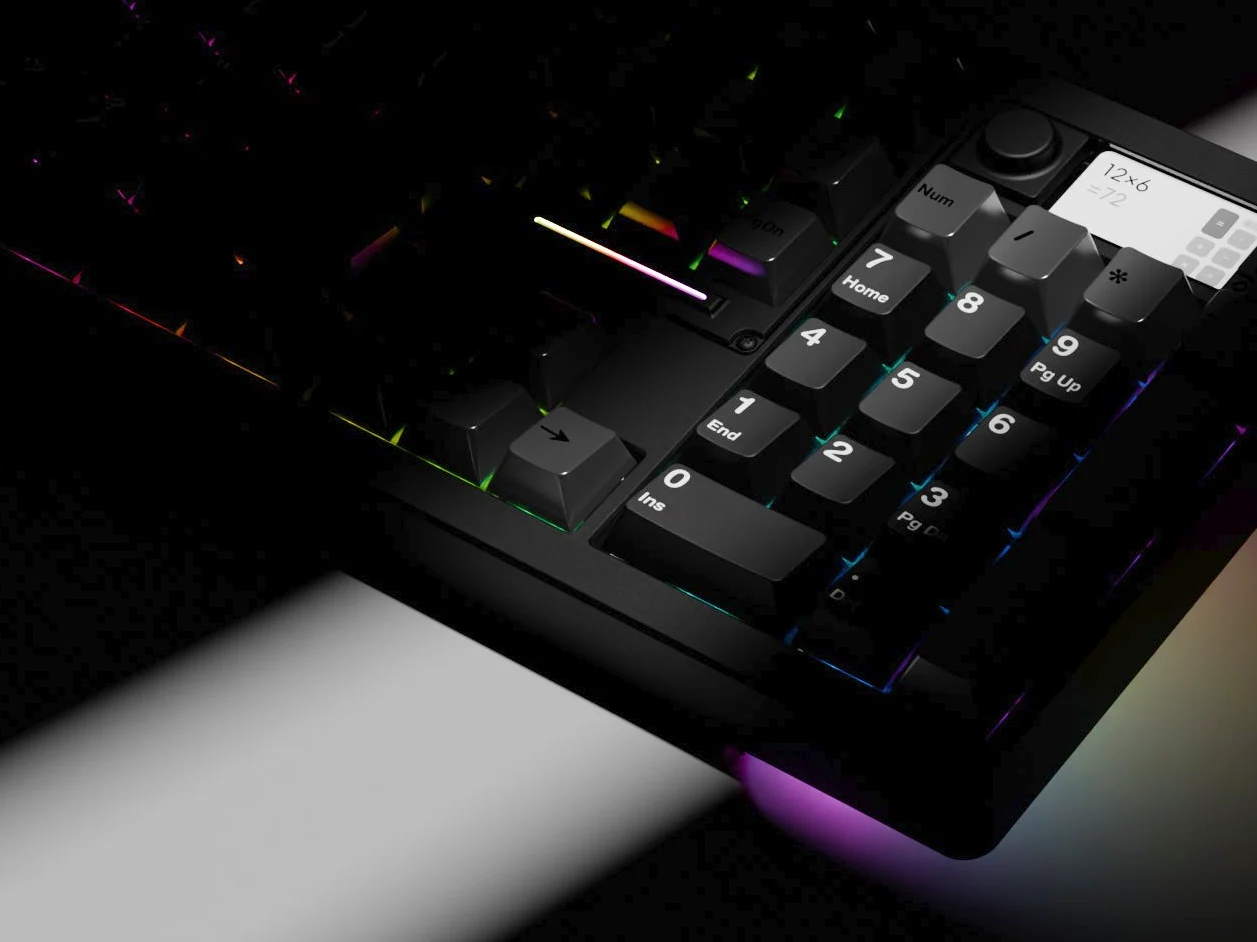
    So far, Chilkey has announced that the ND104 will be released soon, and it will come equipped with a built-in calculator display located just above the num pad. Additionally, it will feature ambient lighting and “specially designed office switches” that promise to offer a “smooth, quiet, and crisp typing experience.” This hints at the possibility of using something similar to the Wuque Studios Blue Dopamine linear switches found in the ND75, or maybe a silent linear alternative like the Wuque Studios WS Light Tactile switches, as many typists often prefer tactile switches.

    Popularity of the ND75

    The Chilkey ND75 has gained a reputation as a reliable and budget-friendly wireless mechanical keyboard, providing high-end features such as various mounting styles and color options, a quick-disassembly case design, and dependable wireless connectivity. It’s reasonable to expect that many of these features will also be incorporated into the ND104.

    Modding and Color Choices

    Most likely, Chilkey will keep the same quick-disassembly feature, which allows for easy modifications and different mounting styles. The ND75 includes a split o-ring gasket mount, a soft silica gel “particle mount,” and a classic top mount. Chilkey has also conducted a survey to gather feedback from fans on five potential color choices: Shadow Black, Lumen Yellow, Sky Blue, Lunar White, and Soft Pink, along with options for aluminum, FR4, or PC plates.

    While the exact pricing hasn’t been confirmed yet, the ND series typically aims for affordability. We can expect the ND104 to be priced more like the $111.99 Epomaker Galaxy100 we reviewed earlier, rather than the $240 Keychron Q13 Max. The ND104 will likely use standard double-shot PBT keycaps in the Cherry profile, which should make it familiar for most mechanical keyboard fans, although it may lack some visual excitement.

    Source:
    Link


  • Global Foundry Revenue Hits $41.7B in Q2 2025, TSMC at 70% Share

    Global Foundry Revenue Hits $41.7B in Q2 2025, TSMC at 70% Share

    Key Takeaways

    1. Global foundry earnings reached a record $41.7 billion in Q2 2025, a 14.6% increase quarter-on-quarter.
    2. TSMC led the market with $30.24 billion in revenue, capturing a 70.2% market share, the highest ever for the company.
    3. Demand growth was driven by China’s consumer subsidies and upcoming product launches in smartphones, PCs, and servers.
    4. Tier-2 foundries also grew, with HuaHong Group earning $1.06 billion and other smaller foundries seeing significant increases.
    5. Challenges remain for advanced node production, particularly for SMIC, which faced a 1.7% revenue decline due to shipment delays.


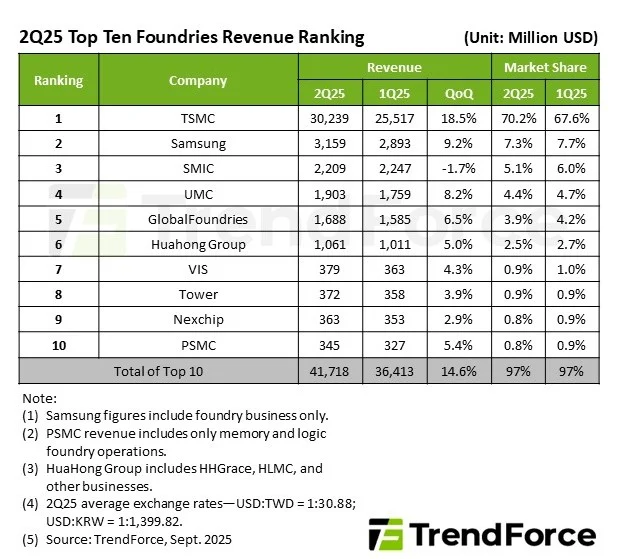
    Global foundry earnings reached an all-time high of $41.7 billion in the second quarter of 2025, marking an increase of 14.6 percent quarter-on-quarter, as reported by TrendForce. TSMC topped the list with an impressive revenue of $30.24 billion, capturing a 70.2 percent share, which is the highest it has ever achieved. Samsung claimed the second spot with $3.16 billion and a 7.3 percent market share, while China’s SMIC secured third place, earning $2.21 billion and holding a market share of 5.1 percent.

    Demand Surge

    The rise in demand was fueled by China’s consumer subsidy initiative and the anticipation of product launches in the latter half of the year for smartphones, notebooks/PCs, and servers. TrendForce predicts that seasonal product trends will continue to drive orders in Q3: advanced nodes are set to gain from flagship chip sales, while mature nodes will benefit from demand for peripheral ICs, with growth expected to slow down from the rapid increase seen in Q2.

    TSMC’s Dominance

    TSMC’s strong position is attributed to its advanced nodes and the scale of its packaging capabilities. Currently, around three-quarters of its revenue is generated from 7nm technology and smaller nodes, with about a quarter coming from 3nm, which is largely driven by Nvidia’s Blackwell GPUs, AMD’s Zen 5 CPUs, and Apple’s M-series Macs. The ramp-up in high-performance chip production and mobile device manufacturing, along with the capacity for advanced packaging, has kept both shipments and average selling prices on the rise.

    Samsung’s foundry revenue increased by 9.2 percent quarter-on-quarter to $3.16 billion, still placing it far behind TSMC. In contrast, SMIC experienced a decline of 1.7 percent due to challenges in advanced node production, as shipment delays affected average selling prices. UMC’s revenue grew by 8.2 percent to $1.9 billion, capturing a 4.4 percent share, while GlobalFoundries saw a 6.5 percent increase to $1.69 billion, holding a 3.9 percent share. Despite substantial investments, Intel Foundry’s revenue continues to be significantly lower.

    Growth Among Tier-2 Foundries

    Tier-2 foundries also saw growth thanks to orders for peripheral ICs: HuaHong Group reached approximately $1.06 billion, accounting for 2.5 percent of the market, Vanguard earned $379 million, Tower made $372 million, Nexchip reached $363 million, and PSMC garnered $345 million. While supply is anticipated to improve this year, costs are expected to stay high. The TSMC 2nm node is likely to come with a higher price tag, as GPU manufacturers are already raising prices to counterbalance wafer costs.

    Source:
    Link


  • China Launches World’s First 6G Chip with 100 Gbps Speeds

    China Launches World’s First 6G Chip with 100 Gbps Speeds

    Key Takeaways

    1. Chinese scientists developed a new wireless networking chip that can reach speeds of up to 100 Gbps, currently a working prototype.
    2. The chip measures 11mm by 1.7mm and operates over a wide frequency range from 0.5 GHz to 115 GHz, integrating nine systems into one device.
    3. It uses a novel technique for signal generation and transmission, incorporating a broadband electro-optic modulator to convert wireless signals to optical signals.
    4. The chip features optoelectronic oscillators that produce stable signals with a frequency tuning value as low as 180 microseconds and bandwidth exceeding 100 GHz.
    5. Commercial applications of this technology are not expected until at least 2030 due to the need for specific infrastructure and compatible devices for 6G networks.


    Chinese scientists have made an exciting new advancement in the wireless networking sector. A chip created by a collaboration of experts from Peking University and the City University of Hong Kong has been revealed, boasting the ability to reach speeds of up to 100 Gbps, though it is still merely a working prototype.

    Chip Specifications

    This innovative chip has dimensions of 11 millimeters by 1.7 millimeters and operates over a wide frequency range from 0.5 GHz to 115 GHz. Existing commercial hardware typically necessitates nine separate systems to cover this frequency range, but the new design consolidates all essential components into a single thin-film lithium niobate (TFLN) device.

    Technology Behind the Breakthrough

    The research team describes that their system utilizes a novel technique for generating and transmitting signals. The hardware incorporates a broadband electro-optic modulator that converts wireless signals into optical signals. These transformed signals are then handled by optoelectronic oscillators, which produce stable signals across the frequency spectrum. Tests conducted thus far have shown remarkable outcomes, including a frequency tuning value as low as 180 microseconds and a bandwidth that surpasses 100 GHz.

    Unfortunately, the deployment of 6G networks requires specific infrastructure and compatible devices for end users. Due to these needs, most analysts in the industry predict that we won’t see any commercial applications until at least 2030.

    Source:
    Link