Tag: Nvidia Blackwell

  • Nvidia RTX 5090 Works on macOS with Tiny Corp’s Custom Driver

    Nvidia RTX 5090 Works on macOS with Tiny Corp’s Custom Driver

    Key Takeaway

    1. A new open-source driver from Tiny Corp enables Nvidia Blackwell GPUs to connect with macOS Macs via Thunderbolt 5 or USB4, reintroducing Nvidia hardware into the Mac ecosystem.
    2. The setup currently uses a custom kernel extension and Tiny Grad compiler, resulting in lower performance compared to native Metal or CUDA solutions.
    3. While performance is modest now, the project holds significant potential for future optimization, especially in improving kernel efficiency for heavy compute tasks.

    Apple and Nvidia had a fallout many years ago, which left Mac users without official GPU support. This break up killed CUDA support on macOS, making developers and researchers turn to Apple’s Metal framework. But now, a new open-source driver from Tiny Corp has changed the game, reintroducing Nvidia Blackwell hardware to the Mac environment.

    Introduction to the Tiny GPU Project

    The project utilizes a special kernel extension called Tiny GPU. It permits external GPUs such as the RTX 5090, with its 32 GB VRAM, to connect directly with Apple Silicon Macs over Thunderbolt 5 or USB4. This significant tech advancement bypasses the need for virtual machines, streamlining the connection process. In a demo shown by Alex Ziskind, the RTX 5090 successfully paired with a Mac Mini M4 Pro, which retails at approximately $1399 on Amazon, featuring 24 GB RAM and 512 GB storage (note: price may vary).

    Performance and Current Limitations

    Though the connection is stable, the current software is still in early phases. The driver is dependent on the Tiny Grad compiler rather than native Metal or CUDA, leading to noticeable performance limitations during heavy calculation tasks. When testing with the Llama 3.1 8B model, the setup managed about 7.48 tokens each second. While offering compatibility benefits, it’s considerably slower than the native Metal-based Llama CPP, which is nearly ten times faster on similar hardware, Alex explains.

    Future Potential and Usage

    Nonetheless, the major value of this project lies in its future prospects for optimization. The main bottleneck now isn’t the Thunderbolt 5 cable—which transfers model weights efficiently—but the efficiency of automatically generated kernels. For simple chat functions, the Blackwell setup performs quite well, providing time-to-first-token speeds that are three to four times quicker than native Metal solutions.

    Installation and Practical Use

    The setup involves approving a system extension and running a Docker-based compiler pipeline. Although this isn’t yet a replacement for streamlined Metal workflows, it marks the first operational solution in years. It offers a promising glimpse into future possibilities for Nvidia GPU support on macOS.

    Alex Ziskind discusses this project extensively on his YouTube channel, demonstrating its potential and progress.


    Sources

  • Dell Pro Max 18 Plus: Powerful Performance with High Temperatures

    Dell Pro Max 18 Plus: Powerful Performance with High Temperatures

    Key Takeaways

    1. The Dell Pro Max 18 Plus features Intel Arrow Lake-HX processors and Nvidia Blackwell graphics for impressive performance.
    2. It has a unique 18-inch display and uses CAMM2 RAM, providing benefits over standard SODIMM.
    3. The CPU temperature can exceed 100°C during stress testing, affecting performance stability.
    4. The CPU clock rate starts at 4 GHz but drops to 3.3 GHz under stress due to high temperatures.
    5. It includes modular USB-C ports and supports USB-C charging up to 300 W, removing the need for traditional AC adapters.


    The Dell Pro Max 18 Plus is a standout in Dell’s lineup of mobile workstations, known for its impressive performance. It features some of the latest processors from the Intel Arrow Lake-HX series and the Nvidia Blackwell series. Additionally, this workstation boasts one of the few 18-inch displays currently available and incorporates CAMM2 RAM, offering advantages over the standard SODIMM. However, the CPU’s performance could have been even better if it didn’t run so hot.

    Temp Problems

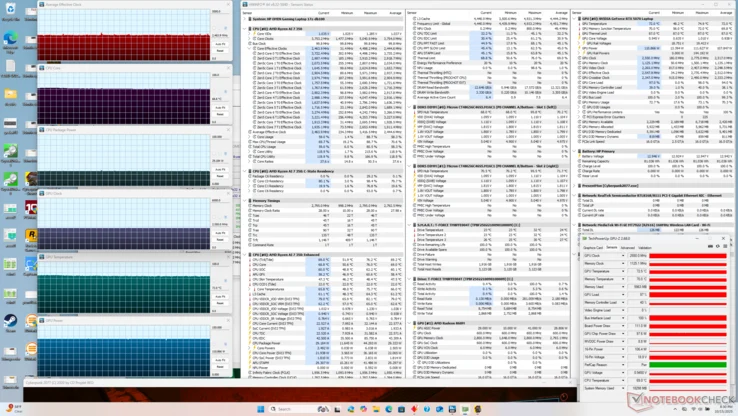
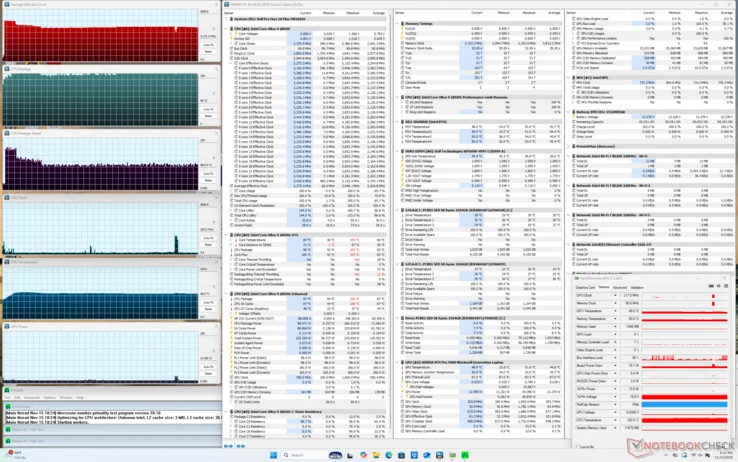
    Our tests revealed that the CPU temperature can rise above 100°C while using Prime95 stress testing. While this is technically safe, it is still very close to the limits for operational temperatures. The impact on performance is noticeable; the CPU clock rate peaks at 4 GHz at the beginning of the stress test, but then drops to 3.3 GHz after a brief time. If the CPU could maintain cooler temperatures, it might sustain higher clock speeds for longer durations.

    Unique Features

    Among its other interesting features are modular USB-C ports designed for easier repairs, along with support for USB-C charging up to 300 W. This eliminates the need for traditional barrel AC adapters.


  • 2025 HP Omen 17: Cooler & Quieter AMD Zen 5 Gaming Laptop

    2025 HP Omen 17: Cooler & Quieter AMD Zen 5 Gaming Laptop

    Key Takeaways

    1. The 2025 HP Omen 17 features upgraded AMD CPU from Zen 4 to Zen 5 and Nvidia GPU from Ada Lovelace to Blackwell.
    2. The laptop maintains a stable temperature of around 70 C while gaming, which is cooler than many competitors.
    3. Fan noise during gaming peaks at approximately 50 dB(A), making it quieter than similar models.
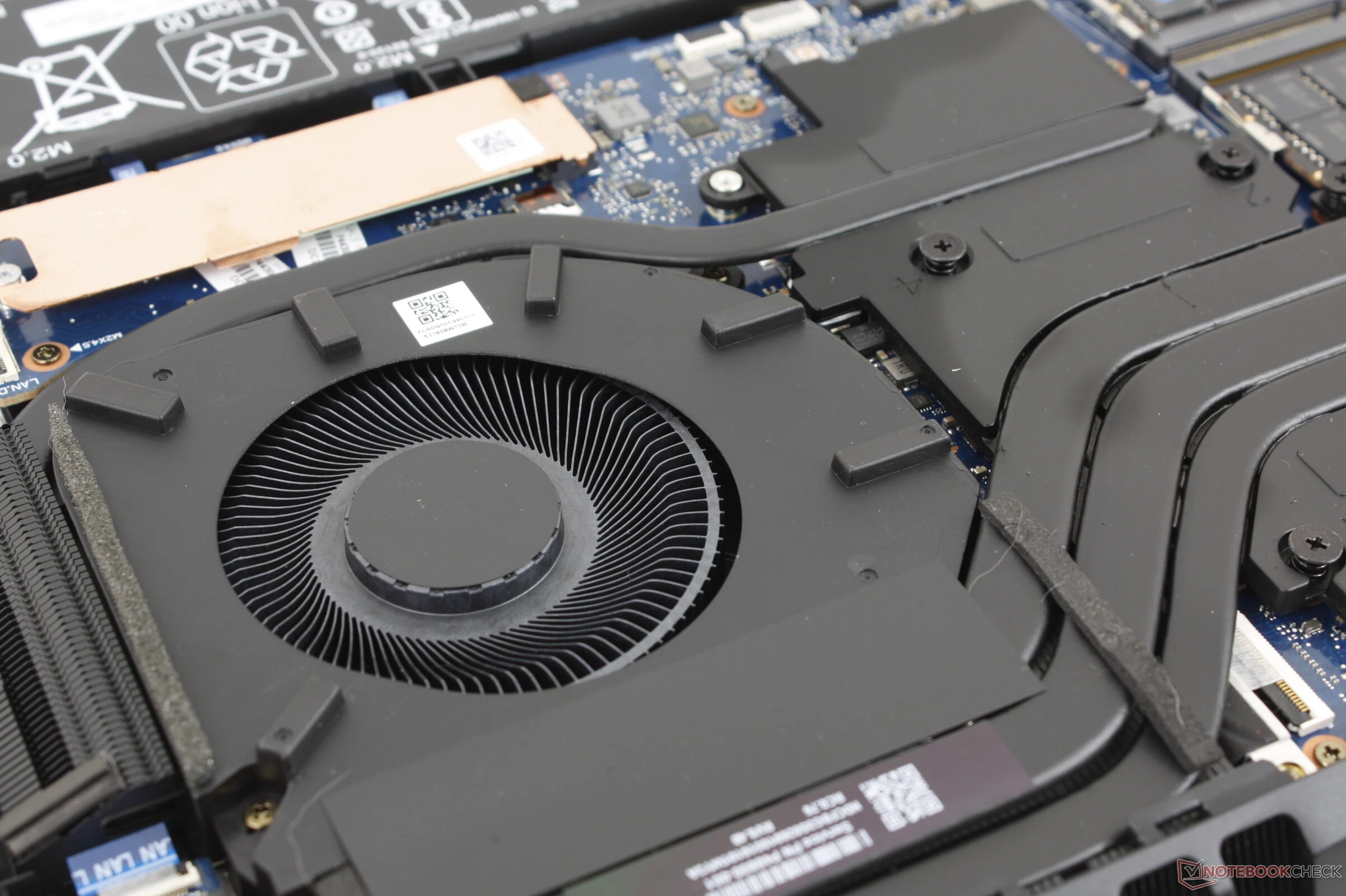
    4. The HP Omen 17 has larger fans and more heat pipes, contributing to better overall cooling performance.
    5. The chassis design remains unchanged for a second year, focusing on performance enhancements rather than aesthetics.


    Although the 2025 HP Omen 17 has been out for a while, we just recently got the opportunity to examine it and see how it stacks up against the 2024 model. This new version keeps the same chassis design for a second consecutive year, focusing mainly on enhancements like the improved AMD CPU (upgrading from Zen 4 to Zen 5) and the Nvidia GPU (switching from Ada Lovelace to Blackwell).

    Performance and Temperature

    In our assessment of the HP system, we noted that both the CPU and GPU maintained a stable temperature of about ~70 C while playing Cyberpunk 2077, which is cooler than what is typically seen in gaming laptops. For example, other 17.3-inch laptops, such as the Asus TUF Gaming A17, can heat up to 85 C. It’s also common for sleeker and lighter models to hit similar temperature levels.

    Fan Noise and Cooling

    One might think that to make up for the lower core temperatures, the fan noise would be higher than normal, but that’s not the case. The fans max out at approximately 50 dB(A) during gaming, which is significantly quieter than both the Lenovo LOQ 17 and the MSI Crosshair A17, each equipped with the same RTX 5070 GPU. The HP Omen 17 features larger fans compared to the MSI and has more heat pipes than the Lenovo, resulting in a better cooling system overall. While it is still a noisy machine, it falls on the quieter side when compared to others.


  • American-Made Nvidia AI Chips Taped Out by TSMC in US Onshoring

    American-Made Nvidia AI Chips Taped Out by TSMC in US Onshoring

    Key Takeaways

    1. Nvidia is producing advanced AI chips using its new Blackwell architecture at TSMC’s facility in Arizona.
    2. TSMC has invested $165 billion in its Arizona chip factory, contributing to the US’s domestic chip supply chain.
    3. This marks the first time crucial chips are produced domestically by TSMC in the US, supporting reindustrialization efforts.
    4. The Arizona foundry’s rapid development showcases TSMC’s commitment to onshoring advanced technology production.
    5. Other semiconductor companies, like Tesla and Samsung, are also collaborating to manufacture AI chips in the US, enhancing local tech capabilities.


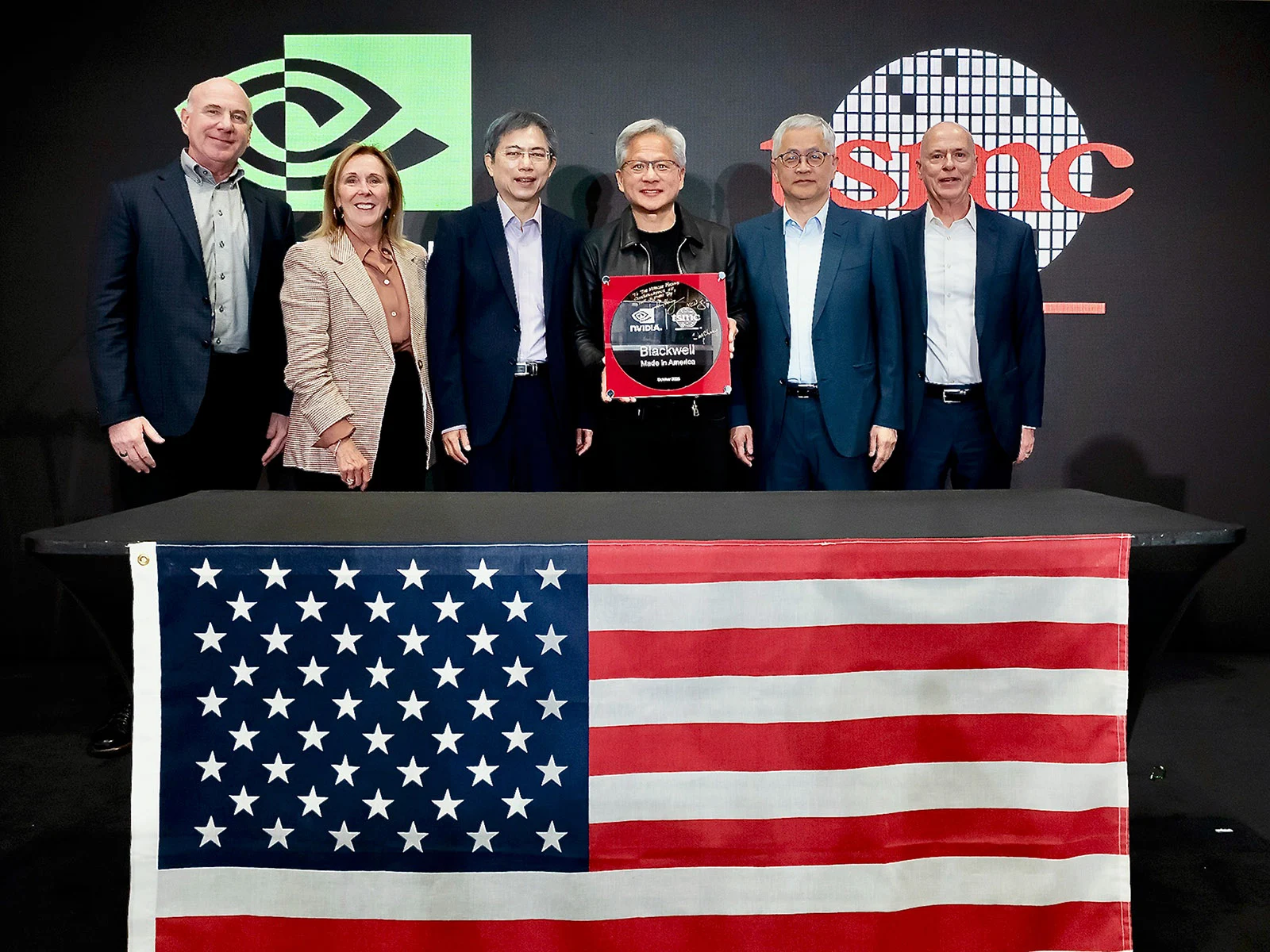
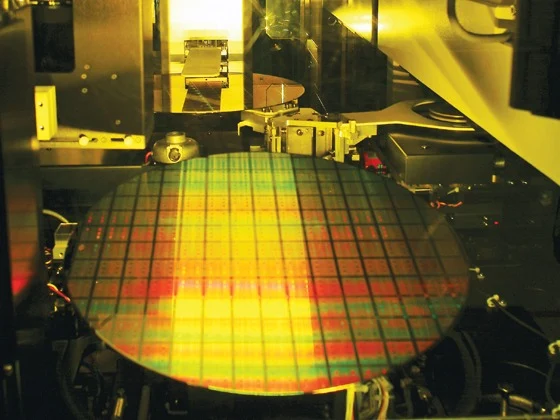
    Nvidia is now making state-of-the-art AI chips using its new Blackwell architecture in the US. The first wafers made in America meant for Blackwell tapeouts have been produced at TSMC’s facility in Arizona.

    Keynote Ceremony

    Jensen Huang, Nvidia’s CEO, celebrated this achievement with a keynote speech in front of TSMC employees at the American foundry. He also signed a Blackwell wafer alongside Wang, TSMC’s VP of operations.

    Major Investment

    TSMC has made a significant investment in its initial chip factory located in the US, committing $165 billion so far, with more funds to come. Although the Arizona plant will only fulfill a small part of the processor requirements for US companies, the ability to create the most advanced AI chips highlights its strategic role.

    The US is working to create a domestic chip supply chain to gain more independence in AI data processing, and the first Blackwell wafers made in Arizona showcase that its new onshoring strategy is yielding results. Huang stated, “this is a historic moment for several reasons.”

    Historic Moment

    This marks the first time in recent US history that the most crucial chip is being produced domestically by the top-notch fab, TSMC, in America. This aligns with President Trump’s vision for reindustrialization—bringing manufacturing back to the US, generating jobs, and emphasizing that this sector is the most critical manufacturing industry and technology sector worldwide.

    TSMC is clearly proud of its achievements as well. It took just a few years from beginning work on the Arizona foundry to producing cutting-edge AI chips there, utilizing the architecture that drives popular gaming cards like the Asus RTX 5070 Ti, which is currently on sale for 15% off on Amazon. The US encouraged TSMC to invest in Intel, but ultimately, it opted to have TSMC nearly double its chip production investment in the US to avoid import tariffs.

    Collaborations in AI Chip Production

    In addition to TSMC, several other leading semiconductor companies have struck deals with American firms to manufacture AI chips within the US. Tesla recently joined forces with Samsung to create the upcoming AI6 chips for autonomous driving and Optimus robots at its Texas factory. Unlike TSMC’s Nvidia Blackwell production, which is being taped out in Arizona on a 4nm node, Samsung’s AI chips for Tesla will be manufactured in Texas using a next-gen 2nm process.

    Source:
    Link


  • Global Foundry Revenue Hits $41.7B in Q2 2025, TSMC at 70% Share

    Global Foundry Revenue Hits $41.7B in Q2 2025, TSMC at 70% Share

    Key Takeaways

    1. Global foundry earnings reached a record $41.7 billion in Q2 2025, a 14.6% increase quarter-on-quarter.
    2. TSMC led the market with $30.24 billion in revenue, capturing a 70.2% market share, the highest ever for the company.
    3. Demand growth was driven by China’s consumer subsidies and upcoming product launches in smartphones, PCs, and servers.
    4. Tier-2 foundries also grew, with HuaHong Group earning $1.06 billion and other smaller foundries seeing significant increases.
    5. Challenges remain for advanced node production, particularly for SMIC, which faced a 1.7% revenue decline due to shipment delays.


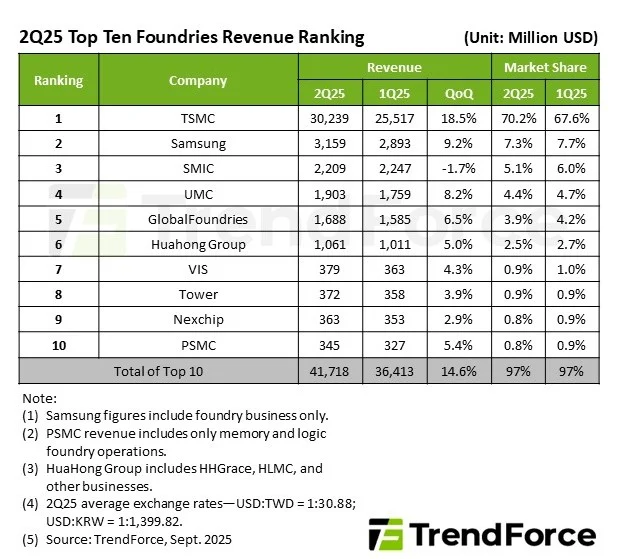
    Global foundry earnings reached an all-time high of $41.7 billion in the second quarter of 2025, marking an increase of 14.6 percent quarter-on-quarter, as reported by TrendForce. TSMC topped the list with an impressive revenue of $30.24 billion, capturing a 70.2 percent share, which is the highest it has ever achieved. Samsung claimed the second spot with $3.16 billion and a 7.3 percent market share, while China’s SMIC secured third place, earning $2.21 billion and holding a market share of 5.1 percent.

    Demand Surge

    The rise in demand was fueled by China’s consumer subsidy initiative and the anticipation of product launches in the latter half of the year for smartphones, notebooks/PCs, and servers. TrendForce predicts that seasonal product trends will continue to drive orders in Q3: advanced nodes are set to gain from flagship chip sales, while mature nodes will benefit from demand for peripheral ICs, with growth expected to slow down from the rapid increase seen in Q2.

    TSMC’s Dominance

    TSMC’s strong position is attributed to its advanced nodes and the scale of its packaging capabilities. Currently, around three-quarters of its revenue is generated from 7nm technology and smaller nodes, with about a quarter coming from 3nm, which is largely driven by Nvidia’s Blackwell GPUs, AMD’s Zen 5 CPUs, and Apple’s M-series Macs. The ramp-up in high-performance chip production and mobile device manufacturing, along with the capacity for advanced packaging, has kept both shipments and average selling prices on the rise.

    Samsung’s foundry revenue increased by 9.2 percent quarter-on-quarter to $3.16 billion, still placing it far behind TSMC. In contrast, SMIC experienced a decline of 1.7 percent due to challenges in advanced node production, as shipment delays affected average selling prices. UMC’s revenue grew by 8.2 percent to $1.9 billion, capturing a 4.4 percent share, while GlobalFoundries saw a 6.5 percent increase to $1.69 billion, holding a 3.9 percent share. Despite substantial investments, Intel Foundry’s revenue continues to be significantly lower.

    Growth Among Tier-2 Foundries

    Tier-2 foundries also saw growth thanks to orders for peripheral ICs: HuaHong Group reached approximately $1.06 billion, accounting for 2.5 percent of the market, Vanguard earned $379 million, Tower made $372 million, Nexchip reached $363 million, and PSMC garnered $345 million. While supply is anticipated to improve this year, costs are expected to stay high. The TSMC 2nm node is likely to come with a higher price tag, as GPU manufacturers are already raising prices to counterbalance wafer costs.

    Source:
    Link


  • Nvidia GeForce RTX 5070 Ti and RTX 5070 Specs Unveiled

    Nvidia GeForce RTX 5070 Ti and RTX 5070 Specs Unveiled

    Prolific leaker Kopite7kimi has consistently provided accurate information about Nvidia products. Recently, a leak has revealed details about Nvidia’s mid-range Blackwell graphics cards, specifically the GeForce RTX 5070 Ti and GeForce RTX 5070. This time, Nvidia’s product segmentation is confusing, particularly for laptops, as there are several SKUs that offer the same amount of VRAM.

    GeForce RTX 5070 Ti Specs

    Let’s start with the GeForce RTX 5070 Ti (PG147-SKU60), which boasts 16 GB of GDDR7 VRAM and operates on a 256-bit bus. It features a GB203-300-A1 GPU that includes 8,960 CUDA cores and has a total graphics power (TGP) of 300 Watts. This card should at least match the performance of the previous generation GeForce RTX 4080, especially since it shares the same VRAM capacity. Depending on the tasks it’s handling, the performance could range between that of the RTX 4080 and the high-end GeForce RTX 4090. Then, there’s its non-TI counterpart,

    GeForce RTX 5070 Features

    the GeForce RTX 5070 (PG146/147-SKU70). This model comes equipped with 12 GB of GDDR7 VRAM on a 192-bit bus, featuring a GB205-300-A1 GPU with 6,144 CUDA cores and a TGP of 250 watts. Judging by these specifications, this card is more suited for 1080p gaming rather than 1440p, especially due to the increasing VRAM requirements of modern games. While it will outperform other 12 GB options such as the Intel Arc B580 and AMD Radeon RX 9060 in terms of raw power, its pricing might be on the higher side.

    Consider Future VRAM Needs

    For those in need of more VRAM, the GeForce RTX 5060 Ti may be a smart choice, as it’s said to have 16 GB of GDDR7 VRAM. It might come with fewer CUDA cores and a lower TGP, but the added VRAM can help ensure it remains relevant for future games, similar to how the GeForce RTX 3060 12 GB has surprised many with its performance in certain titles. Alternatively, if your budget allows, you might want to look into the GeForce RTX 5080, which, for some unknown reason, will also be launched with 16 GB of video memory.

  • Nvidia GeForce RTX 5080 Leak: January 2025 Launch & RTX 5090 Soon

    Nvidia GeForce RTX 5080 Leak: January 2025 Launch & RTX 5090 Soon

    We’ve been aware for a bit that Nvidia is gearing up to present its GeForce RTX 5000 series “Blackwell” GPUs at CES 2025, with the RTX 5090, 5080, and 5070 models leading the charge. Yet, it seems like Nvidia might be changing its typical launch approach, especially regarding when the products will be available in stores.

    New Launch Strategy

    Recent leaks from Wccftech concerning the Nvidia Blackwell series have shown that the top-end RTX 5090 32 GB won’t be the first card to hit the retail market after the CES 2025 reveal. Instead, the RTX 5080 16 GB is set to debut first, around mid-January. This suggests that the card will be available right after or soon after the CES announcement, with the RTX 5090 32 GB coming out shortly thereafter.

    Uncertain Release Timing

    As for the RTX 5070, it remains unclear where it fits into this launch plan. It could be released either after the 5090 or simultaneously with it, positioning it alongside the RTX 5080. Additionally, gamers who prefer mobile setups will likely get some GPU updates at the same time as Nvidia’s desktop reveal. However, the leaks do not provide clear confirmations about the recent Asus laptop Blackwell specs we discussed earlier this week.

    Caution About Leaks

    It’s important to keep in mind that these leaks may not be entirely reliable, as Wccftech hasn’t offered any firm proof to back up its assertions, merely indicating that they have “received some information” regarding the retail launches.

    Source: Link

  • Nvidia Blackwell AI Chips Overheat in Server Racks Issues

    Nvidia Blackwell AI Chips Overheat in Server Racks Issues

    Nvidia’s Blackwell AI chips might be delayed again due to overheating issues in server racks that can hold up to 72 GPUs. According to The Information (via Reuters), Nvidia has asked its suppliers to modify the design of these high-capacity racks and is collaborating with them to enhance thermal efficiency.

    Collaboration with Partners

    A spokesperson from Nvidia stated to Reuters, "Nvidia is working with leading cloud service providers as an integral part of our engineering team and process. The engineering iterations are normal and expected." This highlights the company’s ongoing commitment to address the challenges faced during development.

    Previous Delays

    This isn’t the first instance of delays related to Blackwell. Back in August, Bloomberg shared that Nvidia had to adjust the chip design to ensure it would be more compatible with the Hopper H100 data centers. This history of modifications raises questions about the stability of the release timeline.

    Concerns from Major Companies

    In March, Nvidia had assured that the new chips would be on the market by the second quarter of the year, but those plans changed due to the recent setbacks. The Information reports that companies like Microsoft, Google, and Meta are now anxious about how these delays could impact their schedules for deploying the new chips in their data centers, which may also slow down the release of next versions of their AI-based products.

    As reported by Reuters and Bloomberg, the situation remains critical for Nvidia and its partners.

    Source: Link,Link