
Key Takeaways
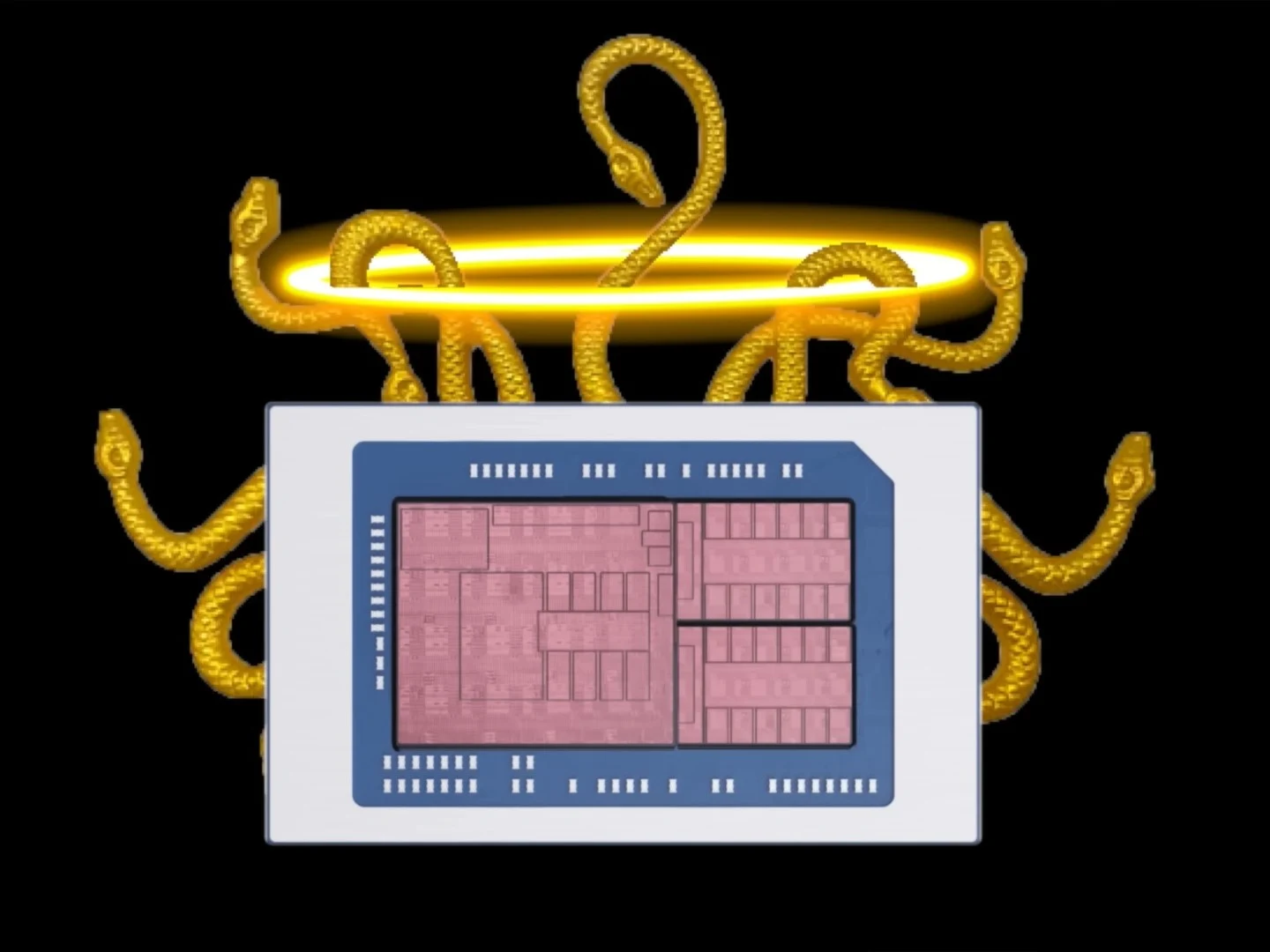
1. AMD is set to release the Medusa Halo laptop APU in late 2027, featuring a powerful Zen 6 CPU and RDNA 5 iGPU.
2. The Medusa Halo APU may include up to 24 high-performance cores and 2 low-energy cores, built on advanced 2nm and 3nm processes.
3. Memory options might consist of either a 384-bit LPDDR6 or a 256-bit LPDDR5X memory controller.
4. The iGPU is expected to have 48 Compute Units and could be based on the same chip used in AMD’s discrete RDNA 5 desktop GPUs.
5. A smaller variant, the Medusa Halo Mini, will have a 14-core CPU and a 128-bit LPDDR5X memory controller, with a possible 192-bit LPDDR6 option.
After the release of the next-gen Zen 6 CPUs and RDNA 5 GPUs in late 2026, AMD is anticipated to unveil the Medusa Halo laptop APU in the second half of 2027. Similar to the Strix Halo design, the Medusa Halo APU is said to feature a robust Zen 6 CPU and a strong RDNA iGPU. According to Moore’s Law Is Dead, the iGPU in the Medusa Halo might utilize the upcoming RDNA 5/UDNA graphics framework, boasting up to 48 Compute Units and a 384-bit bus.
New Specifications Unveiled
The leaker has now shared further specifications about the Medusa Halo. In addition, the leaker has confirmed the existence of the Medusa Halo Mini, a smaller variant of the Halo model with fewer cores for CPU and GPU.
Focusing on the more potent Medusa Halo APU, MLID has stated that the APU consists of 12 Zen 6 cores and 2 low-power Zen 6 cores. There is a chance that it could also include an extra 12-core Zen 6 CCD, bringing the total to 24 high-performance cores and 2 low-energy cores. It is expected that the 12-core CCD(s) will be built on TSMC’s state-of-the-art 2nm N2P process, while the IOD housing the low-power cores is reported to use the 3 nm N3P technology.
Memory Features
For the memory subsystem, MLID claims it might come equipped with either a 384-bit LPDDR6 or a 256-bit LPDDR5X memory controller. This aligns with the previous insights shared by the leaker.
The Medusa Halo’s iGPU is arguably the most captivating aspect of the entire setup. This iGPU is suggested to be based on the RDNA 5 architecture with 48 Compute Units and possibly around 20 MB of L2 cache. However, it is possible that this 48-CU iGPU is actually the same one AMD intends to implement in the discrete RDNA5 “AT3” desktop GPU.
Desktop GPU Integration
AMD appears to be planning to utilize the same GPU chiplet die from a discrete RDNA 5 card, likely the 1060XT. While details about the discrete RDNA 5 board remain unknown, MLID has shared a wealth of information about the GPU, which we have detailed in another article.
Additionally, AMD is thought to adopt a similar tactic of integrating a desktop GPU die within a mobile APU for the Xbox Magnus APU.
For the Medusa Halo Mini APU, AMD is reportedly designing a 14-core CPU that comprises 4 Zen 6 cores, 8 Zen 6c cores, and 2 low-power Zen 6 cores. This CPU is matched with a 128-bit LPDDR5X memory controller. The leaker suggests there’s a possibility that a broader 192-bit LPDDR6 might also be included.
Performance Expectations
In conclusion, the Medusa Halo Mini, much like its larger counterpart, is said to feature the “AT4” RDNA 5 desktop GPU chiplet as its iGPU. This iGPU is claimed to have 28 CUs and 10 MB of L2 cache.
Unfortunately, MLID has not provided any performance metrics for the Medusa Halo and the Medusa Halo Mini APUs yet. However, the leaker has given some performance forecasts for the discrete AT3 and AT4 RDNA 5 GPUs, which could hint at the graphics prowess of these Zen 6 APUs.
The Medusa Halo and Medusa Halo Mini are speculated to be launched in 2027 at the earliest. Therefore, it’s important to approach these leaked specifications with a healthy amount of caution.
Source:
Link

Leave a Reply