Tag: Medusa Halo

  • AMD Ryzen AI Max 400 Series Official: Up to 192 GB RAM

    AMD Ryzen AI Max 400 Series Official: Up to 192 GB RAM

    Key Takeaway

    – AMD’s new Gorgon Halo Pro lineup includes three Ryzen AI Pro APUs with 16/12/8 Zen 5 cores, 5.2/5.0 GHz boosts, and 40–80 MB cache, each paired with a Radeon iGPU (8050S/8065S) and a 50–80 TOPS NPU.
    – Memory capacity is expanded up to 192 GB RAM, with up to 160 GB allocated to the iGPU, signaling a focus on memory-intensive AI workloads.
    – The top model, Ryzen AI Max+ 495 Pro, features 16 Zen 5 cores, 80 MB cache, Radeon 8065S iGPU (40 CUs), and a 55 TOPS NPU; other models are 490 Pro (12C/24T) and 485 (8C/16T).


    AMD introduces Gorgon Halo chips with Pro SKUs

    A previous leak showed one of AMD’s new Medusa Halo chips. The Ryzen AI Max+ 495 Pro showed up on PassMark with the same fundamental specs as its Strix Halo counterpart, with the only notable difference being a new GPU. It has now been officially shown off alongside two other chips. Unlike Strix Halo, which debuted with consumer-grade (read: non-Pro) SKUs, AMD has decided to push out the Ryzen AI Pro models this time, with no indication of non-Pro variants coming anytime soon.

    Top tier Ryzen AI Max+ 495 Pro details

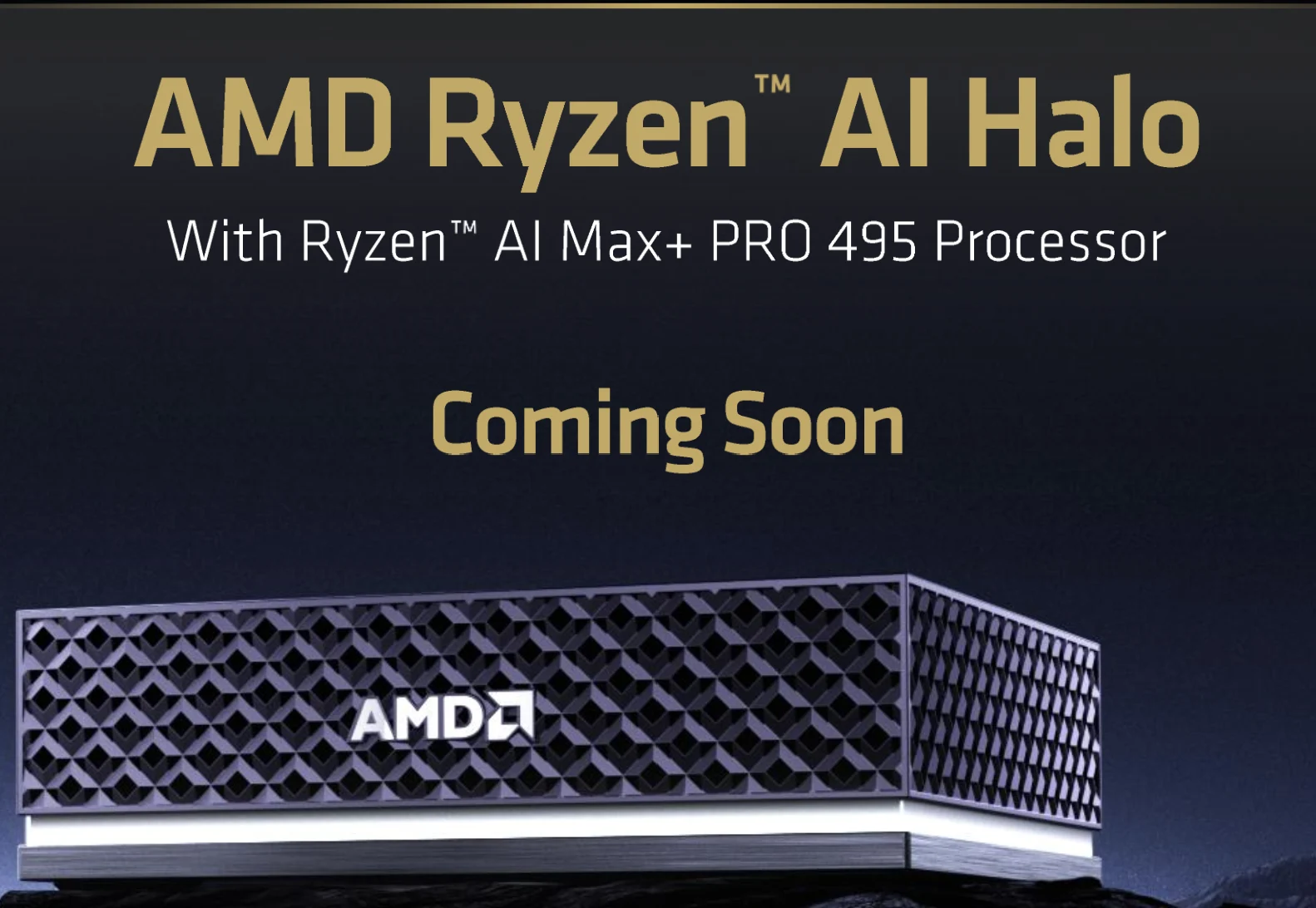
    At the top of the stack lies the Ryzen AI Max+ 495 Pro (yeah, it’s a mouthful) with 16 Zen 5 cores, 32 threads, a boost clock of 5.2 GHz and 80 MB of total cache. It is accompanied by a Radeon 8065S iGPU with 40 CUs. Exactly how it differs from the Radeon 8060S remains unknown. Furthermore, it is the only Gorgon Halo APU that has a 55 TOPS NPU.

    Next up, the Ryzen AI Max 490 Pro is a 12-core/24-thread model with a 5 GHz boost clock and 76 MB total cache. Lastly, the Ryzen AI Max 485 comes with 8 cores, 16 threads, 5 GHz boost and just 40 MB of cache. Both APUs employ a Radeon 8050S iGPU with 32 CUs and a 50 TOPS NPU. AMD hasn’t specified a launch date for either model, simply stating they’ll be coming soon.

    RAM capacity and future prospects

    However, the largest upgrade offered by Gorgon Halo is support for up to 192 GB of RAM, of which 160 GB can be allocated to the iGPU. Interesting choice to make in the middle of a memory crisis, but developers will undoubtedly welcome the extra resource with open arms.

    Unfortunately, that’s all we know about Gogon Halo for now. A Ryzen AI Halo variant with the chips is slated to debut soon, as well. AMD is presumably tight-lipped about Gorgon Halo performance because it is nothing to write home about, as evidenced by the jump between Gorgon Point and Strix Point. Then again, Gorgon Halo is likely a stop-gap solution for memory-hungry workloads, with the real performance boost coming via the next-gen Medusa Halo lineup.



    Sources

    • AMD RDNA 5 Desktop GPU Leak: Mid-Range AT3 with 48 CUs

      AMD RDNA 5 Desktop GPU Leak: Mid-Range AT3 with 48 CUs

      Key Takeaways

      1. AMD’s upcoming high-end mobile APUs, the Zen 6 Medusa Halo and Medusa Halo Mini, will use new iGPU dies, AT3 and AT4, which are also part of the RDNA 5 desktop graphics cards.

      2. The AT4 RDNA 5 GPU will feature 24 Compute Units, a potential 10 MB L2 cache, and a 128-bit LPDDR5X memory controller, with expected VRAM between 12-24 GB.

      3. Performance of the AT4 GPU is anticipated to be between the RTX 3060 and RTX 4060, making it a budget-friendly option by 2027.

      4. The AT3 RDNA 5 GPU will have 48 Compute Units and increased memory bandwidth, with potential VRAM support up to 512 GB, but realistically expected between 16-32 GB.

      5. The AT3’s performance is predicted to be comparable to the RTX 4070 and RX 9070, with significantly improved ray tracing capabilities, making it a strong contender in the market.


      According to the well-known leaker Moore’s Law Is Dead, AMD is set to alter its design approach for the integrated graphics (iGPU) in its upcoming high-end mobile APUs, the Zen 6 Medusa Halo and Medusa Halo Mini. Unlike the existing Strix Halo APUs, the new Medusa models are expected to incorporate the “AT3” and “AT4” iGPU dies, which will also be featured in AMD’s upcoming discrete RDNA 5 desktop graphics cards.

      Specifications of the New GPUs

      The AT4 RDNA 5 GPU is said to include 24 Compute Units, along with a potential 10 MB L2 cache and 8x PCIe Gen 5 lanes. This is particularly interesting for the more affordable card that will utilize this GPU, as the leaker mentions a 128-bit LPDDR5X memory controller instead of the standard GDDR memory commonly found in desktop configurations.

      MLID suggests that the RDNA 5 card equipped with AT4 might use laptop memory and could theoretically support up to 128 GB of VRAM. However, the leaker realistically estimates the VRAM to be between 12-24 GB.

      Performance Expectations

      In terms of performance, MLID believes that the RDNA 5 desktop card with the AT4 will likely perform “roughly” between the RTX 3060 and the RTX 4060. This suggests that by 2027, this desktop board could be very budget-friendly, similar to the current RX 6500 XT.

      On the other hand, the AT3 RDNA 5 GPU is reportedly much stronger than AT4, featuring double the Compute Units and increased memory bandwidth. It is said to come with 48 CUs and a memory controller that could be either 384-bit LPDDR6 or 256-bit LPDDR5X. Like AT4, the AT3-based RDNA 5 desktop card is also expected to leverage laptop LPDDR memory in place of GDDR.

      Future of RDNA 5 GPUs

      Theoretically, the AT3 RDNA 5 board could support up to 512 GB of VRAM, while MLID predicts the actual range for a desktop gaming card will be around 16-32 GB. For performance, MLID anticipates that the AT3 GPU will offer rasterization performance between the RTX 4070 and the RX 9070, along with significantly improved ray tracing capabilities. This range is quite broad, as the RX 9070 is approximately 37% faster than the RTX 4070 based on testing.

      In summary, MLID’s leaked information regarding the cost-effective RDNA 5 GPUs is quite intriguing and ambitious, especially the use of laptop memory over GDDR and the sharing of GPU chiplets with the Medusa Halo APUs. Until further reports validate these claims, it’s wise to approach them with a healthy degree of skepticism.

      Source:
      Link


    • AMD Medusa Halo APUs Leak: 26x Zen 6 Cores & RDNA 5 iGPUs

      AMD Medusa Halo APUs Leak: 26x Zen 6 Cores & RDNA 5 iGPUs

      Key Takeaways

      1. AMD is set to release the Medusa Halo laptop APU in late 2027, featuring a powerful Zen 6 CPU and RDNA 5 iGPU.
      2. The Medusa Halo APU may include up to 24 high-performance cores and 2 low-energy cores, built on advanced 2nm and 3nm processes.
      3. Memory options might consist of either a 384-bit LPDDR6 or a 256-bit LPDDR5X memory controller.
      4. The iGPU is expected to have 48 Compute Units and could be based on the same chip used in AMD’s discrete RDNA 5 desktop GPUs.
      5. A smaller variant, the Medusa Halo Mini, will have a 14-core CPU and a 128-bit LPDDR5X memory controller, with a possible 192-bit LPDDR6 option.


      After the release of the next-gen Zen 6 CPUs and RDNA 5 GPUs in late 2026, AMD is anticipated to unveil the Medusa Halo laptop APU in the second half of 2027. Similar to the Strix Halo design, the Medusa Halo APU is said to feature a robust Zen 6 CPU and a strong RDNA iGPU. According to Moore’s Law Is Dead, the iGPU in the Medusa Halo might utilize the upcoming RDNA 5/UDNA graphics framework, boasting up to 48 Compute Units and a 384-bit bus.

      New Specifications Unveiled

      The leaker has now shared further specifications about the Medusa Halo. In addition, the leaker has confirmed the existence of the Medusa Halo Mini, a smaller variant of the Halo model with fewer cores for CPU and GPU.

      Focusing on the more potent Medusa Halo APU, MLID has stated that the APU consists of 12 Zen 6 cores and 2 low-power Zen 6 cores. There is a chance that it could also include an extra 12-core Zen 6 CCD, bringing the total to 24 high-performance cores and 2 low-energy cores. It is expected that the 12-core CCD(s) will be built on TSMC’s state-of-the-art 2nm N2P process, while the IOD housing the low-power cores is reported to use the 3 nm N3P technology.

      Memory Features

      For the memory subsystem, MLID claims it might come equipped with either a 384-bit LPDDR6 or a 256-bit LPDDR5X memory controller. This aligns with the previous insights shared by the leaker.

      The Medusa Halo’s iGPU is arguably the most captivating aspect of the entire setup. This iGPU is suggested to be based on the RDNA 5 architecture with 48 Compute Units and possibly around 20 MB of L2 cache. However, it is possible that this 48-CU iGPU is actually the same one AMD intends to implement in the discrete RDNA5 “AT3” desktop GPU.

      Desktop GPU Integration

      AMD appears to be planning to utilize the same GPU chiplet die from a discrete RDNA 5 card, likely the 1060XT. While details about the discrete RDNA 5 board remain unknown, MLID has shared a wealth of information about the GPU, which we have detailed in another article.

      Additionally, AMD is thought to adopt a similar tactic of integrating a desktop GPU die within a mobile APU for the Xbox Magnus APU.

      For the Medusa Halo Mini APU, AMD is reportedly designing a 14-core CPU that comprises 4 Zen 6 cores, 8 Zen 6c cores, and 2 low-power Zen 6 cores. This CPU is matched with a 128-bit LPDDR5X memory controller. The leaker suggests there’s a possibility that a broader 192-bit LPDDR6 might also be included.

      Performance Expectations

      In conclusion, the Medusa Halo Mini, much like its larger counterpart, is said to feature the “AT4” RDNA 5 desktop GPU chiplet as its iGPU. This iGPU is claimed to have 28 CUs and 10 MB of L2 cache.

      Unfortunately, MLID has not provided any performance metrics for the Medusa Halo and the Medusa Halo Mini APUs yet. However, the leaker has given some performance forecasts for the discrete AT3 and AT4 RDNA 5 GPUs, which could hint at the graphics prowess of these Zen 6 APUs.

      The Medusa Halo and Medusa Halo Mini are speculated to be launched in 2027 at the earliest. Therefore, it’s important to approach these leaked specifications with a healthy amount of caution.

      Source:
      Link


    • Zen 6 Medusa Halo iGPU: 20% More CUs, 50% Wider Bus

      Zen 6 Medusa Halo iGPU: 20% More CUs, 50% Wider Bus

      Key Takeaways

      1. The Ryzen AI Max+ 395 in the Strix Halo APU features 16 Zen 5 cores and the powerful Radeon 8060S iGPU, making it the fastest x86 iGPU available today.
      2. AMD plans to release the Zen 6-based Medusa Halo APU next year, which is expected to offer significant CPU and GPU performance improvements.
      3. Medusa Halo may include up to 24 Zen 6 cores and a 50% increase in CPU performance compared to Strix Halo.
      4. The iGPU in Medusa Halo is expected to have 48 Compute Units (CUs) and a 384-bit wide bus, potentially improving performance by 30% to 50%.
      5. While exciting, the information about Zen 6 products is still speculative and should be treated with caution until more details are confirmed.


      After a lot of waiting, the first reviews of AMD’s Strix Halo came out last month. The Ryzen AI Max+ 395, which is the quickest Strix Halo APU, really impressed us with its excellent CPU abilities, featuring 16 Zen 5 cores, and the super-fast iGPU performance powered by a 40 CU Radeon 8060S. In fact, the Radeon 8060S is the fastest x86 iGPU available today and can compete with an RTX 4070 laptop GPU that has a TDP of 65-75 W.

      Performance Highlights

      So, Strix Halo is a clear victory when it comes to pure performance. Nonetheless, AMD looks to be preparing to surpass Strix Halo next year with their Zen 6-based Medusa Halo, an APU that promises to deliver extraordinary boosts in both CPU and GPU performance.

      According to Moore’s Law Is Dead, AMD is set to release the Medusa Halo APU next year featuring up to 24 Zen 6 cores thanks to two 12-core CCDs. We previously mentioned that AMD plans to use this 12-core CCD in both desktop and mobile processors. This means that the desktop Zen 6 Medusa Ridge, mobile Medusa Point, and workstation Medusa Halo will utilize either a single or multiple 12-core CCDs.

      Upcoming Enhancements

      With a 24-core Zen 6 CPU, MLID anticipates that Medusa Halo will achieve up to 50% better CPU performance compared to Strix Halo.

      What’s even more exciting is the news about Medusa Halo’s UDNA iGPU. MLID has reported that AMD will be increasing the Compute Units (CUs) from 40 to 48, which is a 20% increase. Some Medusa Halo SKUs might also feature a 384-bit wide bus, making it 50% wider than the 256-bit bus on Strix Halo. This increase in CU count and additional bandwidth should lead to a significant improvement in iGPU performance; MLID predicts the uplift could be between 30% to 50%.

      Performance Comparisons

      To give some context to this iGPU performance, a 30% increase on top of the Radeon 8060S would mean the Medusa Halo’s iGPU could match the desktop RTX 4060 Ti. If it reaches a 50% increase, Medusa Halo would easily surpass the desktop RTX 3070 Ti, based on our 3DMark Time Spy Graphics results.

      That being said, it’s still too early to make any definite claims about the specs and performance of the Zen 6 products. So, while the information from MLID is thrilling, it’s wise to take this leak with a grain of salt.

      Source:
      Link