

Key Takeaways
1. AMD’s upcoming high-end mobile APUs, the Zen 6 Medusa Halo and Medusa Halo Mini, will use new iGPU dies, AT3 and AT4, which are also part of the RDNA 5 desktop graphics cards.
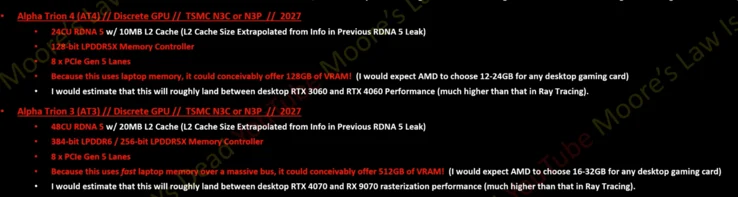
2. The AT4 RDNA 5 GPU will feature 24 Compute Units, a potential 10 MB L2 cache, and a 128-bit LPDDR5X memory controller, with expected VRAM between 12-24 GB.
3. Performance of the AT4 GPU is anticipated to be between the RTX 3060 and RTX 4060, making it a budget-friendly option by 2027.
4. The AT3 RDNA 5 GPU will have 48 Compute Units and increased memory bandwidth, with potential VRAM support up to 512 GB, but realistically expected between 16-32 GB.
5. The AT3’s performance is predicted to be comparable to the RTX 4070 and RX 9070, with significantly improved ray tracing capabilities, making it a strong contender in the market.
According to the well-known leaker Moore’s Law Is Dead, AMD is set to alter its design approach for the integrated graphics (iGPU) in its upcoming high-end mobile APUs, the Zen 6 Medusa Halo and Medusa Halo Mini. Unlike the existing Strix Halo APUs, the new Medusa models are expected to incorporate the “AT3” and “AT4” iGPU dies, which will also be featured in AMD’s upcoming discrete RDNA 5 desktop graphics cards.
Specifications of the New GPUs
The AT4 RDNA 5 GPU is said to include 24 Compute Units, along with a potential 10 MB L2 cache and 8x PCIe Gen 5 lanes. This is particularly interesting for the more affordable card that will utilize this GPU, as the leaker mentions a 128-bit LPDDR5X memory controller instead of the standard GDDR memory commonly found in desktop configurations.
MLID suggests that the RDNA 5 card equipped with AT4 might use laptop memory and could theoretically support up to 128 GB of VRAM. However, the leaker realistically estimates the VRAM to be between 12-24 GB.
Performance Expectations
In terms of performance, MLID believes that the RDNA 5 desktop card with the AT4 will likely perform “roughly” between the RTX 3060 and the RTX 4060. This suggests that by 2027, this desktop board could be very budget-friendly, similar to the current RX 6500 XT.
On the other hand, the AT3 RDNA 5 GPU is reportedly much stronger than AT4, featuring double the Compute Units and increased memory bandwidth. It is said to come with 48 CUs and a memory controller that could be either 384-bit LPDDR6 or 256-bit LPDDR5X. Like AT4, the AT3-based RDNA 5 desktop card is also expected to leverage laptop LPDDR memory in place of GDDR.
Future of RDNA 5 GPUs
Theoretically, the AT3 RDNA 5 board could support up to 512 GB of VRAM, while MLID predicts the actual range for a desktop gaming card will be around 16-32 GB. For performance, MLID anticipates that the AT3 GPU will offer rasterization performance between the RTX 4070 and the RX 9070, along with significantly improved ray tracing capabilities. This range is quite broad, as the RX 9070 is approximately 37% faster than the RTX 4070 based on testing.
In summary, MLID’s leaked information regarding the cost-effective RDNA 5 GPUs is quite intriguing and ambitious, especially the use of laptop memory over GDDR and the sharing of GPU chiplets with the Medusa Halo APUs. Until further reports validate these claims, it’s wise to approach them with a healthy degree of skepticism.
Source:
Link
Leave a Reply