Tag: Samsung Foundry

  • Snapdragon 8 Elite Gen 5: Qualcomm’s 2nm Upgrade & Foldable Rumors

    Snapdragon 8 Elite Gen 5: Qualcomm’s 2nm Upgrade & Foldable Rumors

    Key Takeaways

    1. Qualcomm’s Snapdragon 8 Elite Gen 5 is currently made using TSMC’s N3P manufacturing process, found in flagship devices like the OnePlus 15.
    2. The N3P process offers improved transistor density, performance, and reduced power usage compared to the older N3E.
    3. Qualcomm’s CEO, Cristiano Amon, confirmed that the Snapdragon 8 Elite Gen 5 will be produced by Samsung Foundry using a new 2-nanometer process.
    4. The collaboration with Samsung aims to enhance performance and efficiency for the Snapdragon 8 Elite Gen 5.
    5. The shift to Samsung’s technology could impact the smartphone market and competition with other chip manufacturers.


    Rumors about Samsung Foundry testing a new version of the Snapdragon 8 Elite Gen 5 have been circulating for quite some time. At present, Qualcomm relies on TSMC’s N3P manufacturing technique for the Snapdragon 8 Elite Gen 5, which is featured in recent flagship devices such as the OnePlus 15 (currently priced at $899.99 on Amazon). The N3P process, a 3 nm-class node, delivers slight improvements in transistor density and performance compared to TSMC’s older N3E, along with a reduction in power usage.

    Confirmation from Qualcomm’s CEO

    Recently, Qualcomm’s CEO, Cristiano Amon, confirmed during CES 2026 that the speculation surrounding the Snapdragon 8 Elite Gen 5 being produced by Samsung Foundry is indeed true. He stated, “Among several chip design companies, we began discussions with Samsung Electronics first regarding foundry production utilising the latest 2-nanometer process…We have also completed the design work, aiming for commercialisation soon.”

    Future Prospects

    This shift to Samsung’s 2-nanometer technology may lead to notable advancements in performance and efficiency for the upcoming Snapdragon 8 Elite Gen 5. As Qualcomm pushes forward with this new collaboration, it will be interesting to see how these developments impact the smartphone market and whether it can compete effectively against other leading chip manufacturers.

    Source:
    Link



  • Hyundai to Develop In-House Chips for Its Cars Like Apple

    Hyundai to Develop In-House Chips for Its Cars Like Apple

    Key Takeaways

    1. Hyundai Mobis aims for at least 10% of its semiconductor chips to be made internally by 2030 to reduce reliance on external suppliers.
    2. The company already has experience, having developed 16 system semiconductors and producing around 20 million units annually.
    3. Hyundai Mobis is taking a hybrid approach, combining in-house design with collaborations with major South Korean semiconductor companies.
    4. Upcoming projects include a multi-functional body-control chip by 2026 and a smart LED solution developed with various partners.
    5. Future plans include manufacturing power management ICs and launching silicon IGBT by 2026, enhancing supply chain resilience and supporting South Korea’s semiconductor industry.


    Hyundai Mobis, which is the auto parts branch of Hyundai Motor Group focused on connected vehicles, self-driving tech, and electric systems, is increasing its focus on semiconductor design to enhance its independence. A source close to the situation revealed that the firm aims for a minimum of 10% of the chips used within Hyundai Motor Group to be made internally by the year 2030. This goal comes in light of the global automotive semiconductor shortage that occurred between 2021 and 2023.

    Building on Existing Foundations

    Hyundai Mobis isn’t beginning from ground zero. The company has already collaborated on the development of 16 system semiconductors with various partners and produces around 20 million units each year. Additionally, it runs six production lines that manufacture seven different power module models. In the upcoming two to three years, Hyundai Mobis intends to launch ten new chips. CEO Lee Gyu-suk emphasized the importance of having a long-term plan to lessen reliance on outside suppliers.

    Collaborative Innovation

    Hyundai Mobis is adopting a hybrid approach that mixes in-house design with collaboration throughout South Korea’s semiconductor industry. The firm has announced partnerships with Samsung Foundry, LX Semicon, Cadence, Synopsys, and ADT to work on a network SoC that it has designed and will validate itself. Upcoming projects include a body-control chip, which will incorporate five functions and is expected to be ready by 2026, developed alongside Dongwoon Anatech, DB Hitek, and ASE Korea, plus a smart LED solution co-created with Global Technology, SK Key Foundry, and Dongbu LED.

    Future Prospects

    Looking forward, Hyundai Mobis plans to start manufacturing power management ICs together with its partners and is aiming for a silicon IGBT (Si-IGBT) launch in 2026. The company asserts that this strategy will not only enhance the resilience of Hyundai Motor Group’s supply chain but also contribute to the growth of South Korea’s automotive and semiconductor sectors.

    Source:
    Link


  • Samsung Foundry Secures $16.5B Deal with Tesla for Auto Chips

    Samsung Foundry Secures $16.5B Deal with Tesla for Auto Chips

    Key Takeaways

    1. Samsung Foundry is experiencing challenges with its advanced SF2 node but has seen increased demand for earlier processes, especially from Nintendo for the Switch 2.
    2. Samsung Electronics secured a significant $16.5 billion deal to produce Tesla’s next-gen AI6 chip at its new Texas fab.
    3. Tesla is likely to use one of Samsung’s older nodes (5 nm or 4 nm) for the A16 chip, rather than cutting-edge technology.
    4. The possibility exists that the node for Tesla’s chips could be SF2A, Samsung’s 2nm node meant for automotive components, with work not starting until late 2033.
    5. Elon Musk will personally oversee efforts to expedite the production process for Tesla’s A16 chip, which may have a larger die size than the Exynos 2600.


    While Samsung Foundry has been facing difficulties with its advanced SF2 node recently, there has been an uptick in demand for some of its earlier processes, especially from companies like Nintendo. The gaming giant has utilized Samsung’s 8N node for the Tegra T239 SoC in the upcoming Nintendo Switch 2. Recently, Samsung Foundry has landed what might be its biggest order yet.

    Major Deal Unlocked

    According to Reuters, Samsung Electronics, which owns Samsung Foundry, has secured a deal worth $16.5 billion with a “global firm.” This mystery was unveiled by Elon Musk, the founder of Tesla, who shared on X that, “Samsung’s massive new Texas fab will be focused on producing Tesla’s next-gen AI6 chip.”

    Speculations on Technology

    However, it’s probable that Tesla is opting for one of Samsung’s older nodes for the A16 chip. Reuters mentions that “the order is unlikely to involve the cutting-edge tech.” While the specific node has not been disclosed, it is likely to be either 5 nm or 4 nm. A report from 2023 suggested that the yields for these nodes were around 75%, making them suitable for large-scale production.

    What’s Next for SF2A?

    In contrast, X analyst Jukanlosreve and the South Korean news source Chosun have pointed out that the node in question may be SF2A, which is Samsung’s 2nm node designed for automotive components. This possibility isn’t far-fetched since the Reuters article indicates that “until the contract is completed at the end of 2033,” Samsung may not begin working on the chips for Tesla right away.

    At present, there is no public information about the yield rates for Samsung’s SF2A node. However, its non-A variant, SF2, is believed to be yielding around 40%, likely intended for the Exynos 2600, which could have a die size of approximately 150 mm². While Tesla’s A16 chip is expected to be bigger, Samsung should have ample time to refine its processes. Elon Musk has stated that he will “personally oversee efforts to speed up progress.”

    Source:
    Link

  • Snapdragon 8 Elite 2 on Samsung’s 2nm Node: OEM Adoption Ahead

    Snapdragon 8 Elite 2 on Samsung’s 2nm Node: OEM Adoption Ahead

    Key Takeaways

    1. Samsung Foundry’s Snapdragon 8 Elite 2 (SM8850s) is still in development despite earlier rumors of being scrapped.
    2. The Samsung version of the Snapdragon 8 Elite 2 will not launch simultaneously with the TSMC version due to ongoing yield stabilization efforts.
    3. Two versions of the Snapdragon 8 Elite 2 will exist: one made by Samsung for its devices and another by TSMC for broader use.
    4. There may be performance discrepancies between the Samsung and TSMC versions, as Samsung’s chips historically underperform compared to TSMC’s.
    5. The Samsung version could allow for more budget-friendly flagship devices, benefiting consumers with lower prices.


    Murmurs about a Samsung Foundry-made Snapdragon 8 Elite 2 had been going around the online space. Then soon after, another rumor claimed that it was completely scrapped. Now, leaker Digital Chat Station from Weibo has mentioned that the SM8850s (likely a codename for the aforementioned chip) is still in the game.

    Speculations About Launch Dates

    According to DCS, some OEMs might choose to avoid the very costly TSMC N3P-made Snapdragon 8 Elite 2 and instead go for the Samsung version. However, it seems it won’t be released at the same time as its TSMC N3P counterpart toward the end of September since Samsung is still working diligently to stabilize yields for its 2 nm SF2 node, which is the foundation for the SM8850s.

    New Developments in the Snapdragon Lineup

    This is an interesting turn of events, as the Snapdragon 8 Elite 2 was mostly thought to be the ‘For Galaxy’ edition aimed at Samsung’s foldable devices like the Galaxy Z Fold 8 and Galaxy Z Flip 8. This will result in two classification of Snapdragon 8 Elite 2 devices: one utilizing Samsung chips and another using TSMC.

    Sadly, users won’t have any easy way to differentiate them without conducting benchmarks. On paper, the performance should be the same, but historically, Samsung Foundry’s chips have underperformed compared to TSMC’s, and there’s no compelling reason to think this trend will change shortly.

    Broader Device Compatibility

    On the bright side, this news isn’t all bad because it opens the door for the Snapdragon 8 Elite 2 to be included in a wider array of devices. OEMs wanting to introduce budget-friendly flagship phones can rely on the less expensive version and pass the cost savings down to the consumers.

    Digital Chat Station on Weibo

    Source:
    Link


  • Samsung Rejected Nvidia CEO Jensen Huang’s HBM Proposal in 2018

    Samsung Rejected Nvidia CEO Jensen Huang’s HBM Proposal in 2018

    Key Takeaways

    1. Samsung Foundry is struggling with low production yields and complications in HBM production, impacting its advanced process nodes.
    2. Samsung received approval to supply Nvidia with HBM3E memory for AI chips, but it still trails behind SK Hynix, the main supplier for Nvidia.
    3. Samsung missed an opportunity to collaborate with Nvidia in 2018, which could have positioned them as a key partner in HBM production and AI chip development.
    4. Nvidia’s reliance on SK Hynix for HBM has contributed to a significant increase in SK Hynix’s stock price, while Samsung has lost out on AI chip manufacturing opportunities.
    5. Samsung is now working to secure HBM business from Nvidia and AMD, aiming to provide HBM4 by early 2026.


    It’s no secret that Samsung Foundry is having a tough time. The company is said to be facing challenges with low production yields in its advanced process nodes, which has also affected the manufacturing of its upcoming 1.4 nm node. Additionally, there are complications surrounding High-Bandwidth Memory (HBM) production.

    Partnership Dynamics

    Recently, Samsung has received approval to provide Nvidia with HBM3E memory for AI chips after missing out on the approval last year. Despite this, the company still lags behind SK Hynix, which is the primary supplier of HBM for Nvidia. The situation could have been quite different if Samsung had not turned down Nvidia’s offers back in 2018.

    A new report reveals that Nvidia’s CEO, Jensen Huang, sought to expand the HBM partnership with Samsung in 2018. Huang reportedly visited Samsung to discuss collaboration in three main areas: HBM production, the development of new process nodes, and cooperation on CUDA. Such a partnership could have positioned Samsung as a pivotal ally for Nvidia.

    Missed Opportunities

    However, Samsung declined Nvidia’s proposals. Huang expressed his frustration, saying, “there was no one at Samsung to discuss long-term strategy with me.” This inability to engage in strategic discussions may have been linked to an ongoing criminal investigation involving Samsung Electronics Chairman Lee Jae-Yong at that time.

    Nvidia has significantly benefitted from the AI boom due to its AI chips, which have seen remarkable demand. HBM is critical for these AI superchips, as components like the H200 require substantial high-throughput memory for AI inference tasks.

    Market Impact

    A large portion of Nvidia’s HBM chips comes from SK Hynix, which has greatly benefitted from this arrangement. At the present moment, SK Hynix’s stock price has surged more than 220% over the past five years.

    Samsung’s choice to not collaborate with Nvidia may have repercussions for Samsung Foundry as well. Currently, TSMC manufactures all of Nvidia’s AI chips, including the latest B200 GPU. There have been speculations that Nvidia could engage Samsung to fabricate its upcoming gaming chips using the 2 nm process, but there is no concrete news about Samsung making Nvidia’s AI accelerators.

    With Intel facing its own troubles and Samsung struggling to keep pace with TSMC, TSMC has gained a monopoly on Nvidia’s AI GPUs.

    Future Prospects

    While it may be too late for Samsung to fully counteract the consequences of its past decisions, the company is now working to secure some HBM business from Nvidia and AMD. Reports suggest that Samsung is aiming to provide HBM4 to both companies in early 2026.

    Source:
    Link

  • Nintendo Switch 2 Achieves Record-Breaking Sales Figures

    Nintendo Switch 2 Achieves Record-Breaking Sales Figures

    Key Takeaways

    1. The Nintendo Switch 2 sold over 3.5 million units within four days of its release.
    2. Sales for the Switch 2 are expected to grow as it becomes available in more regions.
    3. The Switch 2 aims to surpass recent handheld consoles, which collectively sold around 6 million units since 2022.
    4. The predecessor of the Switch 2 sold around 150 million units, nearing the PlayStation 2’s record of 160 million.
    5. Samsung Foundry is benefiting from the Switch 2’s success, projecting $1.2 billion in earnings from the Tegra T239 SoC.


    Nintendo has shared impressive news about the Switch 2’s sales performance. In just four days after its release, the console has already sold over 3.5 million units. This isn’t too shocking, considering it was a highly anticipated upgrade to an already beloved gaming system. It’s likely that these numbers will continue to grow in the next few months as the console becomes available in more regions.

    Switch 2’s Sales Projections

    The Nintendo Switch 2 is set to become a top seller among handheld consoles from the last three years. According to IDC (via The Verge), the combined sales of the ROG Ally, Steam Deck, Lenovo Legion Go, and MSI Claw have reached around 6 million units since 2022. While achieving 4.5 million sales in such a short time is notable, the Switch 2 still has a long journey ahead. Its predecessor managed to sell around 150 million units overall, which is just a bit shy of the 160 million record held by the PlayStation 2.

    Impact on Partners

    The remarkable success of the Nintendo Switch 2 has also positively influenced an unexpected ally: Samsung Foundry. The chip manufacturing sector of Samsung had been facing difficulties due to low demand and subpar production yields. The Tegra T239 SoC, which powers the console and is produced on Samsung’s 8 nm node, is projected to bring in $1.2 billion in earnings. Furthermore, Nintendo may utilize its 5 nm technology for a future ‘performance enhanced’ model of the Switch 2.

    Source:
    Link

  • Nvidia to Use Samsung’s 2nm Node for New GPU Production

    Nvidia to Use Samsung’s 2nm Node for New GPU Production

    Key Takeaways

    1. Samsung Foundry’s 2 nm production yields have improved to 40-50%, despite reduced performance.
    2. Qualcomm is considering restarting collaboration with Samsung for the Snapdragon 8 Elite 2, and Nvidia may produce a new GPU using Samsung’s 2 nm technology.
    3. Nvidia is unlikely to use Samsung for its AI and data center chips due to strong ties with TSMC.
    4. Future Nvidia RTX 60 series gaming GPUs may benefit from Samsung’s GAA FET-based SF2 technology, but performance gains might be limited.
    5. Upcoming months are crucial for Samsung’s Foundry business, as Nvidia and Qualcomm’s decisions could lead to more contracts and opportunities.


    Samsung Foundry’s troubles may finally be coming to a close in the near future. An earlier article mentioned that their 2 nm production yields have improved to between 40-50%, but this has come with a reduction in performance. Even so, this hasn’t stopped major companies from considering the chipmaker. Qualcomm might restart its collaboration with Samsung Foundry for the Snapdragon 8 Elite 2 for Galaxy, and according to a recent report from Chosun, Nvidia could also follow suit.

    Nvidia’s Next Move

    The report suggests that a new Nvidia GPU could be produced using Samsung Foundry’s 2 nm technology. However, it doesn’t specify which variant (SF2/SF2P) is in question, and it’s too early to make any predictions. Nvidia’s highly profitable AI and data center chips are unlikely to be chosen due to the company’s strong ties with TSMC. Moreover, an alleged roadmap from TSMC earlier indicated some of its 2 nm clients, which included Nvidia.

    Future Gaming GPUs

    This leads us to the next generation of RTX 60 series gaming GPUs, which will utilize the Rubin architecture. Nvidia has previously collaborated with Samsung Foundry’s 8N technology for the Ampere (RTX 30 series) chips. Transitioning from TSMC’s Fin FET-based 4NP to Samsung’s GAA FET-based SF2 may bring some performance gains, but they probably won’t be as significant as the leap from Ampere to Ada Lovelace.

    Opportunities Ahead

    That being said, there’s a good possibility that Nvidia may choose Samsung’s nodes for its upcoming laptop GPUs or Windows-on-Arm products. Laptop processors are generally much smaller and simpler to produce. For instance, the Snapdragon X Elite has a die area of around 170 mm², while Nvidia’s flagship GB202 GPU is a massive 750 mm². Large chips like this are usually manufactured on established nodes, and SF2/SF2P has not been around long enough to be considered mature.

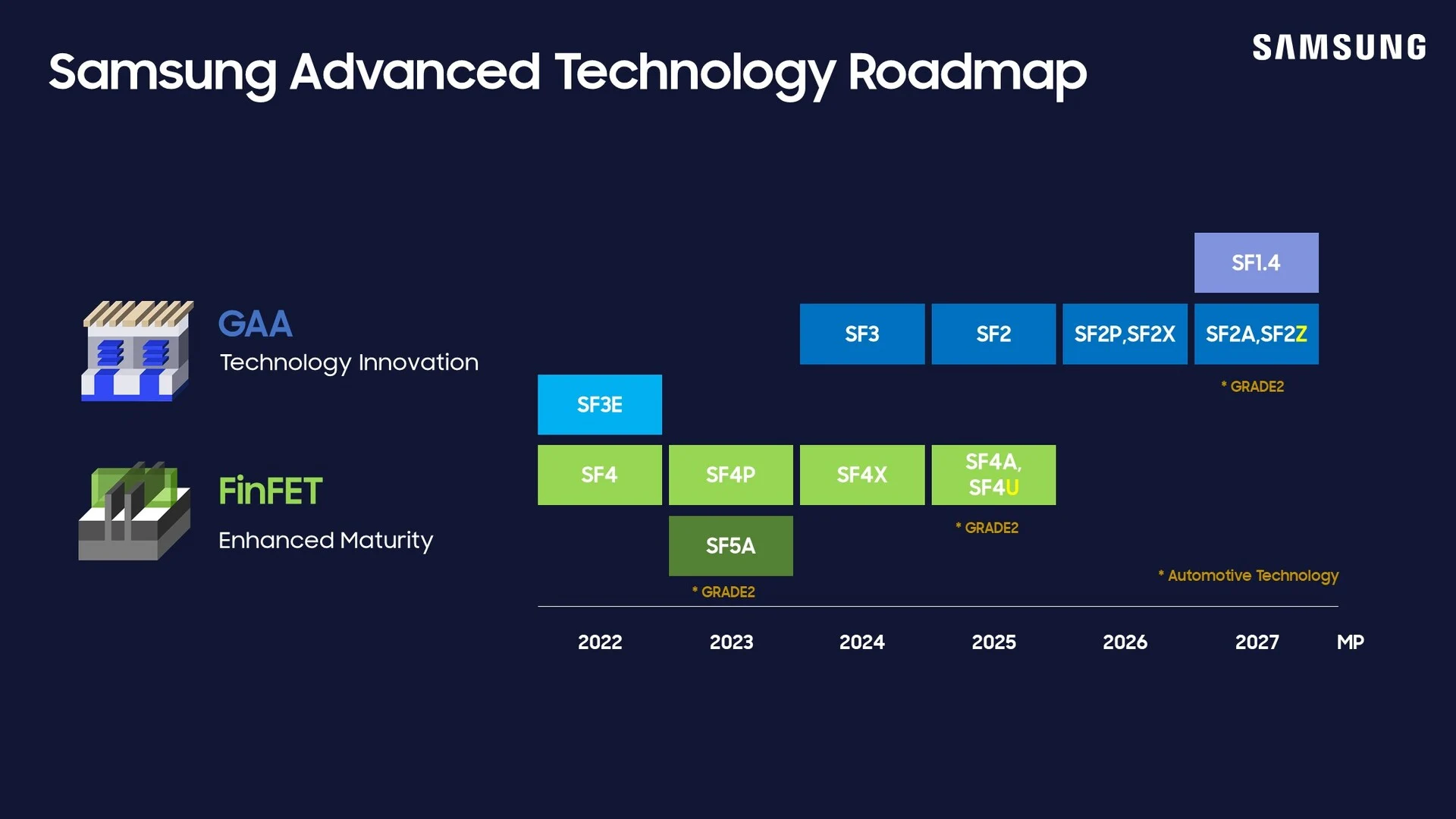
    In the upcoming months, Nvidia and Qualcomm will play a key role in determining the future of Samsung’s Foundry business. At the moment, Samsung doesn’t even need to surpass TSMC; matching their performance would be enough. If things turn out positively, more contracts could be on the horizon because Samsung, despite its challenges, has a strategy that keeps pace with its rivals. Its SF2Z node set for 2027 has backside power delivery, and its 1.4 nm SF1.4 is timed close to TSMC’s planned release of its A14 node.

    Source:
    Link

  • Snapdragon 8 Elite 2 for Galaxy to Be Made on Samsung’s 2nm Node

    Snapdragon 8 Elite 2 for Galaxy to Be Made on Samsung’s 2nm Node

    Key Takeaways

    1. Samsung Foundry is expected to regain Qualcomm as a client, particularly for the Snapdragon 8 Elite 2 production.
    2. The Snapdragon 8 Elite 2 will utilize Samsung’s SF2 technology and is likely intended for devices launching in late 2026, such as the Galaxy Z Fold 8 and Galaxy Z Flip 8.
    3. The Galaxy S26 Ultra faces uncertainty as it may not have a Snapdragon chip ready in time, complicating its production options.
    4. Qualcomm risks facing another Chipgate scandal, as Samsung Foundry’s SF2 technology has advantages but lags behind TSMC in power efficiency and performance.
    5. Designing the same chip for different manufacturing nodes presents significant challenges for Qualcomm and Samsung.


    An earlier report from media outlets in South Korea suggests that Samsung Foundry is on the verge of winning Qualcomm back as a client. Although the two companies have traditionally collaborated on mid-range chips, Qualcomm’s top-tier products have been produced by TSMC since the Snapdragon 888 and Snapdragon 8 Gen 1 did not meet expectations. However, SEDaily indicates that this situation could change in the coming year.

    Snapdragon 8 Elite 2 Production

    Rumor has it that Samsung Foundry will produce the Snapdragon 8 Elite 2 for Galaxy using its SF2 technology. This would align it with the Exynos 2600, which is also expected to launch in 2026. However, this chip won’t be used in the Galaxy S26 lineup but will be designated for other devices expected to debut in the latter half of 2026. This likely points to the Galaxy Z Fold 8 and Galaxy Z Flip 8. If this turns out to be true, Samsung’s 2026 product range might look like this:

    Uncertainties Around Galaxy S26 Ultra

    The Galaxy S26 Ultra is currently in a state of uncertainty because, based on the Galaxy S24 lineup, the Ultra version used Qualcomm while the other models utilized Exynos. This time, it won’t be as simple since the Snapdragon chip won’t be ready in time. Another option could be for Samsung to implement a TSMC N3P-based Snapdragon 8 Elite 2 for the Galaxy S26 Ultra, which would unnecessarily complicate the situation.

    The Chipgate Risk

    Moreover, Qualcomm may face the possibility of experiencing the Chipgate scandal again. On paper, SF2 has a slight advantage over TSMC N3P thanks to its GAAFET architecture compared to FinFET. Nevertheless, Samsung Foundry has lagged behind TSMC in terms of power efficiency and overall performance in recent generations. Furthermore, designing essentially the same chip for two completely different nodes is an enormous challenge by itself.

    Source:
    Link

  • Samsung Foundry Nears Deal to Acquire Qualcomm as Customer

    Samsung Foundry Nears Deal to Acquire Qualcomm as Customer

    Key Takeaways

    1. Qualcomm and Samsung Foundry’s partnership has faced challenges since the Snapdragon 888 and Snapdragon 8 Gen 1, with Samsung focusing on entry-level and mid-range chips.

    2. A deal between Qualcomm and Samsung Foundry is expected soon, with chip samples recently delivered; production will likely use advanced 3 nm class nodes.

    3. The Snapdragon 8 Elite 2 for Galaxy is rumored to be produced on Samsung’s 2 nm node, while the standard version will use TSMC’s N3P node.

    4. The Snapdragon 8 Elite 2 is anticipated to power upcoming Galaxy S26 and Galaxy Z Fold 8 devices, with improved yield rates at Samsung Foundry potentially facilitating production.

    5. Sourcing chips from both TSMC and Samsung may lead to compatibility issues, and while Samsung’s technology has advantages, it may still struggle to compete with TSMC.


    Qualcomm and Samsung Foundry have had a rocky partnership since the Snapdragon 888 and Snapdragon 8 Gen 1. Following those events, Samsung Foundry has mostly focused on producing entry-level and mid-range chips. However, a recent report from the South Korean news site FNNews indicates that this situation might change shortly.

    New Developments on the Horizon

    The report mentions that a deal with Qualcomm is “imminent,” as Samsung Foundry has recently delivered samples to the U.S. chip manufacturer. Although the specifics are not clearly stated, it is expected that the chips will be produced using one of Samsung’s 3 nm class nodes, probably SF3P or SF2. Since this is an advanced technology node, it’s improbable that it would be utilized for mid-range products.

    Rumors About Snapdragon 8 Elite 2

    This aligns with previous rumors suggesting that the Snapdragon 8 Elite 2 for Galaxy (previously referred to as the Snapdragon 8 Gen 5 for Galaxy) will be produced on Samsung’s 2 nm node. Meanwhile, the standard version of the Snapdragon 8 Elite 2 is anticipated to utilize TSMC’s N3P node.

    If everything goes as planned, the Snapdragon 8 Elite 2 for Galaxy is expected to power the Galaxy S26 and Galaxy Z Fold 8 series in the upcoming year. This time around, the chip may actually be ready before the devices are available for purchase, as another report claims Samsung Foundry’s 2 nm yield has improved to approximately 40% (up from 20%). While this yield isn’t sufficient for mass production, it provides Samsung ample opportunity to surpass the 60% threshold needed for production.

    Potential Issues Ahead

    That being said, sourcing chips from both TSMC and Samsung Foundry could create some issues for end users and might lead to a situation similar to Chipgate. On paper, Samsung’s node holds an advantage over TSMC’s N3P due to its GAA (gate all around) design, unlike TSMC’s FinFET. However, this advantage alone may not be enough to surpass TSMC’s capabilities.

    FNNews’s report highlights these developments, providing insight into the ongoing dynamics between Qualcomm and Samsung Foundry.

    Source:
    Link

  • Samsung Foundry May Scrap 1.4 nm Node Plans

    Samsung Foundry May Scrap 1.4 nm Node Plans

    Key Takeaways

    1. Samsung Foundry is facing issues with low yields from its SF3 node, delaying the launch of the Exynos 2500.
    2. The upcoming 1.4 nm node (SF1.4) may be abandoned, with potential delays instead of a complete scrapping.
    3. Samsung is currently focused on the Exynos 2600 and AI chips while receiving new orders for its 4 nm nodes.
    4. Samsung Foundry’s market share is only 8.2%, significantly lower than TSMC’s 67.1%, raising concerns about its future.
    5. Possible restructuring within Samsung Foundry may include integrating the Exynos division into Samsung MX for better oversight.


    Samsung Foundry’s troubles could be getting even worse. After disappointing yields from its SF3 node, which caused the Exynos 2500 launch to be delayed, the company had to scale back some of its older 5 nm and 7 nm processes due to low interest. Now, reliable insider @Jukanlosreve has suggested that Samsung’s upcoming 1.4 nm node (SF1.4) might be completely abandoned.

    Potential Changes to SF1.4

    A prior roadmap from Samsung Foundry indicated that SF1.4 was set to begin high volume manufacturing (HVM) by 2027. This node was supposed to run alongside SF2A, which is geared toward automotive applications, and SF2Z, marking the first node featuring a Backside Power Delivery Network (BSPDN). However, there is a chance that SF1.4 could be delayed further instead of being entirely scrapped.

    Current Developments

    For the moment, Samsung Foundry is still working on the Exynos 2600 utilizing SF2, along with some artificial intelligence chips for PFN. Additionally, some of its 4 nm nodes have received new orders from a few Chinese fabless companies affected by trade restrictions. However, key players continue to turn away from Samsung, opting for TSMC or even Intel instead.

    Market Share Concerns

    According to the Korea Economic Daily, Samsung Foundry might undergo significant changes due to its low market share of just 8.2%, which pales in comparison to TSMC’s dominating 67.1%. This could lead to substantial restructuring within the organization. Business Post reports that the Exynos division may be integrated into Samsung MX, which would provide greater oversight over upcoming smartphone SoC designs.

    Source:
    Link