Tag: PlayStation 6

  • PS6 Leaks Reveal Cross-Gen PS5 Support, Faster Cloud Gaming & Storage

    PS6 Leaks Reveal Cross-Gen PS5 Support, Faster Cloud Gaming & Storage

    Key Takeaway

    1. The PS6 is expected to feature upgraded PCIe Gen5 NVMe SSDs, offering significantly faster storage and load times compared to the PS5’s PCIe Gen4 SSD.
    2. Sony has been investing in new server technology to enhance cloud gaming, with the PS6 supporting faster streaming and remote play options, including the PlayStation Portal.
    3. The console is rumored to have a 1TB storage capacity, with efforts underway to reduce game installation sizes through techniques like neural texture compression and AI-based file downsizing.
    4. Cross-generation compatibility is planned, allowing PS5 and PS6 games to be played on both consoles, likely resulting in an extended PS5 lifecycle.

    Upcoming PlayStation 6 May Focus on Cloud Gaming

    Many of the rumours circulating around PS6 lately have been quite centered on the console’s hardware specs. But, there’s been talks suggesting that Sony is actually giving a good amount of attention to cloud gaming capacity as well. An article from MP1st explains how Sony bruger to have upgraded their infrastructure for better streaming speeds. For local gameplay, the system is said to include a significantly improved SSD. More evidence hinting that the hardware will support PS5 titles was also found.

    Improvements in Server and Storage Technologies

    James Lara report that Sony has been investing heavily into new server technology for over 3 years now. (That’s quite a long time!) One major update involves storage: the new PCIe Gen5 NVMe SSDs will dramatically increase data transfer speeds. Aligning with other rumors circulating the net, MP1st also believes that the PS6 will come pre-installed with the same type of drive. The current PS5 uses a PCIe Gen4 SSD, which greatly improves download speeds and load times. The new console’s specs might double these performance feats, but this might lead to price hikes for consumers. The shortages in storage and memory could push the final price higher, making cloud gaming even more attractive to many gamers.

    Expanding Cloud Gaming and Hardware Support

    Already, Sony has beefed up its streaming options through PS Plus Premium, and the PlayStation Portal has become a really popular mobile extension for game streaming. In future, the alleged PS6 handheld might be able to play PS5 games directly on the device. It might also support cloud gaming and remote play, allowing users to stream games from home consoles to other devices easily.

    Storage & Cross-Generation Compatibility

    The upcoming PlayStation is expected to feature faster storage solutions, but probably with similar capacities to keep prices stable. According to Kepler_L2, who has been leaking PS6 info, the console could have 1TB of storage, which is pretty standard. Sony is testing methods to make game installations smaller—like neural texture compression—where an AI GPU could compress files on the fly and then reconstruct them in-game.

    Extended Lifecycle and Future Titles

    If the new console costs a lot, Sony might extend the current PS5 lifecycle. MP1st learned that Sony is working on creating assets for both PS5 and PS6, including 2D and 3D elements. This supports previous leaks about the consoles being compatible with each other, meaning players won’t need to buy all new games immediately after upgrading. As for launch titles, reports hint at an “immersive third-person horror shooter” still in the creative process.
    Sources
  • Sony PS6 Portable Leak Reveals Key Handheld Console Features

    Sony PS6 Portable Leak Reveals Key Handheld Console Features

    Key Takeaway

    1. Sony is developing both a PlayStation 6 home console and a portable PlayStation 6 Portable, marking their return to standalone portable gaming since the PS Vita.
    2. The PS6 Portable is expected to be more powerful than the Xbox Series S and will support native gameplay for PS6, PS5, and PS4 titles.
    3. The console will likely only support digital games, with potential plans to enable physical game owners to access digital versions.
    4. Release is anticipated around Fall 2027, with a projected lower price point, offering an affordable next-gen gaming experience.

    Next-generation PlayStation Devices Incoming

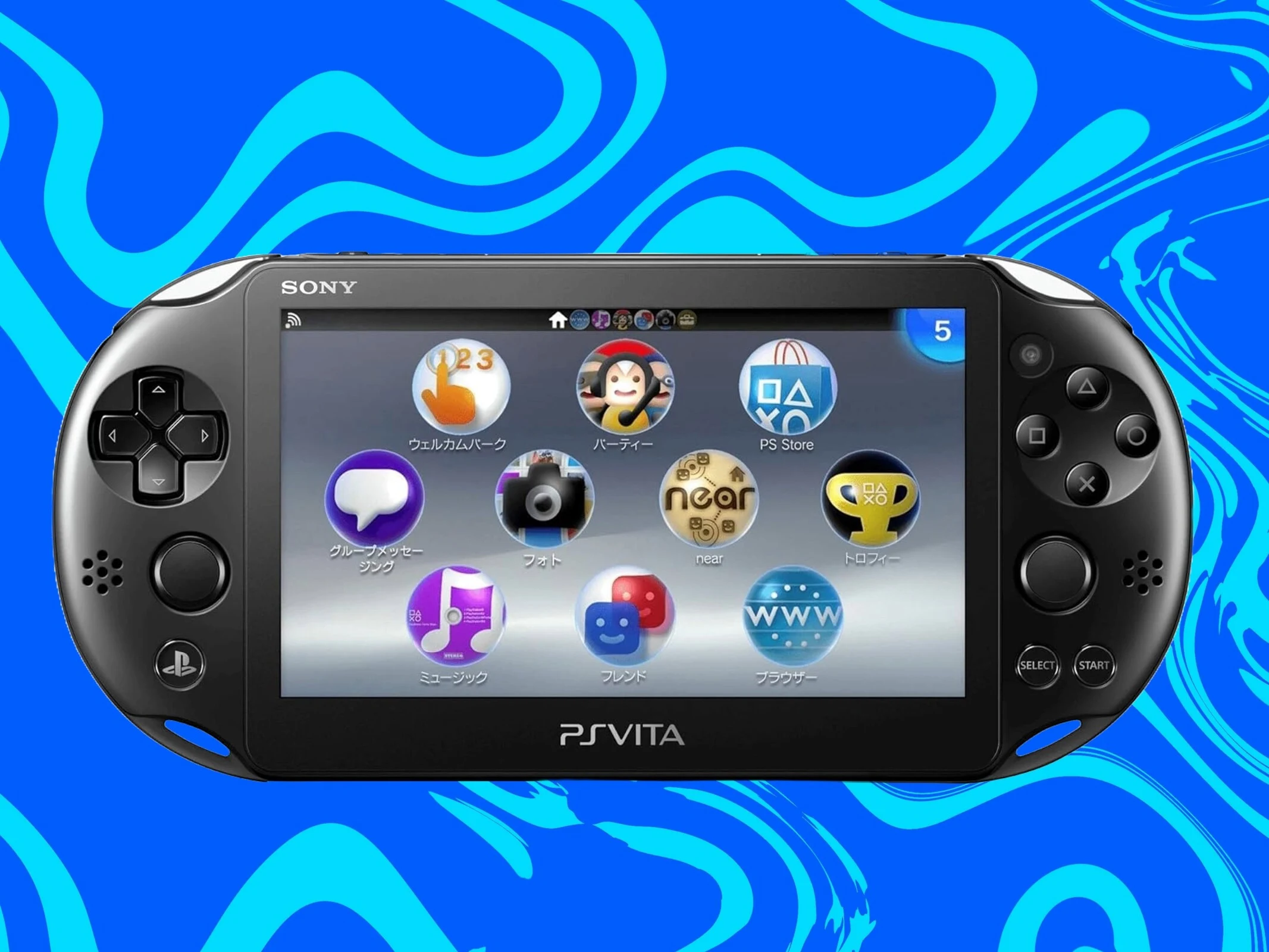
    According to recent leaks, Sony is working on not only a new home console, the PlayStation 6, but also a new handheld device called the PlayStation 6 Portable. This marks the first attempt by Sony since the PS Vita back in 2011 to launch a standalone portable gaming device. Rumors suggest that the PS6 Portable will be more powerful than the Xbox Series S and capable of playing games from the PS6 itself, which is quite exciting for fans who love portable gaming.

    Backward Compatibility Clarified

    One of the biggest questions around the upcoming systems has been whether they will support backward compatibility. While many expect that PS6 and its portable counterpart will support PS5 games, there has been some uncertainty about older titles. Recently, Moore’s Law Is Dead revealed that the PS6 Portable will handle PS4 and PS5 titles natively. This suggests that players will be able to enjoy a broad range of their existing game library on the new portable device, making it a very attractive option for gamers who want to keep playing their favorites without issues.

    Technical Details and Digital-Only Play

    The information came from an internal Sony document that states the Canis APU in the PS6 Portable will be capable of running games from PS4, PS5, and PS6. However, since the handheld is unlikely to play physical discs, owners will need digital versions of their games. If you already own physical copies, you will probably need to re-purchase them digitally to play on the device, which can be a bit inconvenient but is common for most digital-only consoles. Sony may find a way to let owners of physical discs access digital versions, which would be a fantastic feature for gamers.

    Expected Release and Current Alternatives

    The latest rumors indicate that both the PS6 and the PS6 Portable could launch sometime in Fall 2027. However, the pricing might be more affordable than many people are anticipating, making it a tempting option once available. In the meantime, those eager to play Sony games on the go can opt for the PlayStation Portal, which lets you stream your PS5 library remotely from your console, offering a decent interim solution for portable gaming.

    Sources
  • PS6 Price Might Approach PS5 Levels Despite Memory Shortage

    PS6 Price Might Approach PS5 Levels Despite Memory Shortage

    Key Takeaway

    1. The estimated manufacturing cost for the PS6 could be around $743, with a realistic release price of $749, despite economic challenges and component costs.
    2. High tariffs and component shortages, particularly for RAM and SSDs, significantly influence the final retail price, potentially inflating it to $949 or more.
    3. Sony is expected to adopt a cautious approach, delaying detailed announcements about PS6 amidst market uncertainty and cost fluctuations.
    4. Compared to previous generations, the PS6 is anticipated to launch at a higher price point, potentially reflecting ongoing economic and manufacturing pressures.

    Expected Cost and Rumors of the PS6

    After the recent price hike of the PS5, many gamers are worried that the next gen console may come with a sky-high retail price. Yet, a popular YouTuber, known for discussing leaked details, suggests those worries are probably exaggerated. He recently analyzed the possible costs involved in building the PS6, focusing on components likely to be used in the upcoming console.

    Component Prices and Manufacturing Cost Breakdown

    The insider estimates that the more powerful PS6, which will use the Orion APU, could have a manufacturing cost around $743. The costs for key components such as memory are significant due to shortages. For instance, 30GB of RAM might cost about $300, while a 1TB SSD would be roughly $142.50, both working under current limited supply conditions.

    Pricing Expectations and Economic Influences

    In spite of these high costs, the YouTuber believes a retail price close to $749 could still be feasible. However, tariffs pose a big challenge; they could add up to 30%, pushing the final price to about $949. The increase is mainly because taxes inflate component costs, which in turn makes the final console price more expensive. Predictions suggest that tariffs might be reduced by the time the PS6 is released, potentially easing costs on the final product.

    Market Dynamics and Industry Movements

    Meanwhile, Microsoft has already started talking about its next console, the Project Helix. Recognizing that fans are eager for updates, they aim to reassure their audience. Sony, on the other hand, seems to be staying silent for now, possibly to wait until economic and supply chain issues, like the memory shortage and tariffs, become clearer. This suggests they might adopt a cautious strategy before revealing their next big leap.

    Future Outlook and Possible Retail Price

    There is speculation that Sony isn’t overly concerned about a very high PS6 price tag. When analyzing the potential building costs, the company might find ways to stay under expectations. If the economic situation improves, prices could fall, delighting consumers. Still, a retail price of around $749 would be significantly more than the previous generation started at, indicating a potential shift in market expectations and manufacturing costs.

    Sources
  • Sony PlayStation 6 May Achieve 4K 120 FPS with Ray Tracing

    Sony PlayStation 6 May Achieve 4K 120 FPS with Ray Tracing

    Key Takeaways

    1. The PlayStation 6 may target 4K output at 120 FPS with ray tracing enabled, but true native performance is unlikely.
    2. Expected performance boosts include 2.5 to 3 times greater rasterization than the PS5, and 6 to 12 times better ray tracing.
    3. The console is rumored to use a next-gen GPU based on RDNA 5 and a Zen 6 CPU for these enhancements.
    4. Sony’s AI upscaling technology, PSSR, will likely play a key role in achieving high resolutions.
    5. The PS6 is projected to launch in late 2027 or early 2028, with no expected delays according to recent insights.


    Rumors are swirling again about Sony’s upcoming home console, the PlayStation 6. The latest insights come from the well-known leaker Moore’s Law Is Dead. During a recent livestream, the insider revealed that Sony might be aiming for 4K output at 120 FPS while having ray tracing activated.

    Expected Performance Boosts

    Previously, the leaker disclosed the complete specifications for the PS6, indicating that the console could achieve rasterization performance that is approximately 2.5 to 3 times greater than that of the PlayStation 5. Regarding ray tracing, earlier leaks hinted at an enhancement ranging from 6 to 12 times compared to the PS5.

    When comparing with the PS5 Pro, rumors suggest that the rasterization improvement would be around 2 times, with ray tracing performance advancing by 3 to 6 times. These potential advancements are attributed to Sony’s utilization of a next-gen GPU based on RDNA 5, which will work alongside a Zen 6 CPU.

    Cautious Optimism

    However, like any hardware rumors, these performance expectations should be approached cautiously. It’s important to note that the PS6 is unlikely to achieve true native 4K 120 FPS with ray tracing enabled. Instead, the console is expected to significantly depend on Sony’s AI upscaling technology, PSSR, to deliver output at such high resolutions.

    Launch Timeline Speculations

    The conversation also touched on recent rumors suggesting that the PlayStation 6 might face delays. As previously discussed, YouTuber Moore’s Law Is Dead maintains that the launch schedule is not likely to shift. In other words, Sony might still be aiming for a release in late 2027 or early 2028 for the PS6. For those curious, the insider delves deeper into the console and the rumored PlayStation 6 handheld at the 29:30 and 43:00 marks in the video linked below.

    Source:
    Link


  • Nintendo Considers Switch 2 Price Hike Amid Memory Issues, PS6 Delayed to 2028

    Nintendo Considers Switch 2 Price Hike Amid Memory Issues, PS6 Delayed to 2028

    Key Takeaways

    1. Nintendo is not willing to sell the Switch 2 at a loss and may consider raising its price above $500 due to memory market challenges.
    2. The current price of the Switch 2 is $449, but to avoid losses, Nintendo must increase the price, putting it in competition with the PlayStation 5 Disk Edition priced at $539.
    3. Sony is likely to delay the PlayStation 6 release, potentially moving it from 2027 to 2028 or 2029, in response to rising memory prices.
    4. The memory chip shortage is affecting multiple industries, leading to panic buying in the automotive sector and changes in smartphone manufacturing strategies.
    5. Memory producers like Samsung are shifting to more profitable AI chips, leaving consumer electronics manufacturers struggling with rising memory costs.


    Nintendo is not interested in selling its new Switch 2 gaming console at a loss, especially given the supply-driven memory market, and may actually increase the price of the Switch 2 instead.

    Changes in Pricing Strategy

    As reported by sources from Bloomberg, the $650 billion investment that major Silicon Valley companies like Amazon and Google are making to expand their AI data centers is forcing both Sony and Nintendo to rethink their sales approaches. While Sony plans to delay the PlayStation 6 release to ride out the memory price surge, Nintendo cannot handle a $50 loss on every Switch 2 sold if it keeps the price unchanged.

    Current Pricing of the Switch 2

    Right now, the Switch 2 sells for $449 on Amazon, and if Nintendo aims to avoid losses with each sale in 2026, it will need to set the console’s price above $500. This would put it in closer competition with the PlayStation 5 Disk Edition, priced at $539, for example.

    Industry Insights on PlayStation 6

    This isn’t the first time industry insiders have mentioned that Sony might delay the PlayStation 6 release and possibly downgrade its specs to keep the launch price manageable, indicating there could be some truth to the rumors. The expected release year for the PlayStation 6 was 2027, but the ongoing memory crisis could push it back to 2028 or even 2029, according to sources familiar with the situation. The shortage of “commercial” DRAM and storage memory chips used in devices like phones, laptops, and consoles is likely to persist throughout the decade, with the most challenging times ahead in the next year or so, as per Counterpoint analysts.

    Impact on the Industry

    “We are already noticing signs of panic buying in the automotive sector, and smartphone manufacturers are turning to cheaper chip options to lessen the impact,” they comment. Both the Switch 2 and PlayStation 5 are performing well in sales, and both companies are simply trying to navigate the unprecedented cycle of memory chip production as effectively as possible.

    Memory Chip Market Dynamics

    Samsung and other memory producers are reallocating their manufacturing to focus on the much more lucrative HBM AI chips for companies like Nvidia, selling at prices double what they used to be. This leaves consumer electronics manufacturers in a tough position as memory chips quickly become the most expensive component in their products.

    Source:
    Link


  • Sony May Delay PS6 Launch to 2029 Over Memory Shortages

    Sony May Delay PS6 Launch to 2029 Over Memory Shortages

    Key Takeaways

    1. The tech sector is facing significant shortages and rising prices for memory, particularly RAM.
    2. Sony is considering delaying the release of its next-generation PlayStation console to 2028 or 2029.
    3. This delay marks a shift from previous expectations of a late 2027 launch.
    4. A postponed release could disrupt Sony’s strategy to maintain user engagement across console generations.
    5. The anticipated PS6 may require 30GB of GDDR7 RAM, which could lead to higher prices if released during a memory shortage.


    The tech sector is currently facing significant shortages and increasing prices for memory. RAM costs have surged rapidly, impacting GPUs, SSDs, and various other hardware. Now, due to this ongoing memory crisis, it appears that Sony might have to postpone the release of its next-generation console.

    Possible Delay for PlayStation

    A recent report from Bloomberg reveals that Sony Group Corp is thinking about delaying the launch of its upcoming PlayStation console until 2028 or even 2029. This marks a notable shift from prior expectations, which suggested a launch in late 2027.

    “According to sources close to the company, Sony Group Corp. is now contemplating a delay in the introduction of its next PlayStation console to 2028 or 2029. This would disrupt a carefully planned strategy aimed at maintaining user engagement across different hardware generations,” Bloomberg stated.

    Impact on Sony’s Strategy

    Bloomberg mentions that such a delay would interfere with Sony’s typical console launch strategy. The company usually organizes its hardware releases meticulously to keep players interested between console generations. Pushing back the PS6 by one or two years would represent a considerable change, but releasing it during a memory shortage could lead to a price tag that’s much higher than Sony desires. Previous leaks suggested that the PS6 is anticipated to come with 30GB of GDDR7 RAM, which is 14GB more than what the current PS5 offers.

    Bloomberg’s report reveals the potential challenges ahead for Sony in an increasingly competitive gaming landscape.

    Source:
    Link


  • PS6 Handheld CPU May Feature 4 Cores for 8-Thread Gaming

    PS6 Handheld CPU May Feature 4 Cores for 8-Thread Gaming

    Key Takeaways

    1. Sony is reportedly developing two versions of the next-gen PlayStation 6: a standard home console and a handheld device, each with different performance specs.
    2. The introduction of Low Power and Power Saver modes for PS5 games aims to ensure compatibility on the less powerful PS6 handheld.
    3. Sony is prioritizing Power Saver Mode support for developers over updates for the PS5 Pro, encouraging optimized game performance on limited CPU threads.
    4. Future games may need to operate on varying CPU configurations, reflecting the different designs of the PS6 home console and handheld.
    5. The release of the PS6 consoles is still a long way off, and Sony is unlikely to confirm the existence of the handheld version soon.


    For a while now, there has been chatter about Sony working on several next-gen PlayStation 6 consoles. Reports indicate that we could see a standard PS6 home console alongside a PS6 handheld. Naturally, these two gaming systems will differ significantly in performance due to their varying CPU, GPU, and memory setups. If there truly are two PS6 consoles with distinct specifications, Sony will need to make sure that game developers consider these differences.

    Power Modes and Compatibility

    Some analysts, such as Moore’s Law Is Dead, believe that Sony is introducing Low Power and Power Saver modes for PS5 games. This move seems to be a strategy to ensure that PS5 games run smoothly on the less powerful PS6 handheld when it is released. Recently, Moore’s Law Is Dead reported that Sony has updated all PS5 Software Development Kits (SDKs) to version 1.0 to include support for Power Saver Mode. This means that the latest SDK now has Power Saver Mode enabled by default.

    Developer Guidance

    According to the source behind this leak, Sony is prioritizing Power Saver Mode support over game updates for the PS5 Pro (which can be found on amazon.com). The source also mentioned that there are “new Low Power modes coming soon” and that Sony is encouraging developers to make sure their games can function on just eight CPU threads. The PS6 handheld console is said to have 4x Zen 6c cores alongside 2x Low Power (LP) cores. The four Zen 6c cores, equipped with eight threads in total, are mainly intended for gaming purposes. Thus, Sony’s insistence on developers optimizing their games for 8x threads hints at the imminent release of the PS6 portable.

    Future CPU Configurations

    Adding more weight to the claims about the PS6 handheld, the document cited by MLID’s source reportedly states that “games may operate in settings with various CPU configurations.” This implies that Sony is indeed informing developers that their games might need to function on consoles with differing CPUs in the future, which is directly linked to the PS6 home console and the PS6 handheld having completely different CPU designs.

    In conclusion, it’s becoming more and more evident that Sony is in the process of creating multiple next-gen PS6 consoles, including a portable version. Unfortunately, the release of the PS6 consoles is still quite a ways off. Therefore, it’s improbable that Sony will acknowledge the existence of a portable gaming device in the near future.

    Source:
    Link


  • Kojima Productions’ Physint: Gritty Poster and Cast Reveal

    Kojima Productions’ Physint: Gritty Poster and Cast Reveal

    Key Takeaways

    1. Hideo Kojima announced his new PlayStation exclusive action-espionage game, Physint, during the “Beyond the Strand” livestream celebrating Kojima Productions’ tenth anniversary.

    2. Kojima revealed that Physint is still in early development, with him currently handling character design and casting while focusing on completing the Xbox horror project, OD.

    3. The first poster for Physint features a dark, gritty main character inspired by Solid Snake, with the tagline “Here Comes the Feeling,” though its meaning remains unclear.

    4. The cast includes Charlee Fraser, Don Lee, and Minami Hamabe, with their roles yet to be disclosed due to delays from the 2023 SAG-AFTRA strikes.

    5. Kojima aims for groundbreaking visual quality in Physint, claiming it will surpass the visuals of the Decima Engine used in Death Stranding 2, with a potential release date after 2030.


    On September 23, 2025, during a livestream titled “Beyond the Strand,” Hideo Kojima celebrated the tenth anniversary of Kojima Productions in Tokyo by revealing some initial insights about his next PlayStation exclusive action-espionage game called Physint.

    Exciting Updates on New Projects

    The livestream also showcased a fresh trailer for Kojima’s upcoming Xbox horror project, OD, along with news about expanding the Death Stranding universe. This expansion includes an anime series named Death Stranding Mosquito and a live-action film adaptation.

    In January 2024, during a PlayStation State of Play event, Sony’s Hermen Hulst first hinted at Physint. Kojima appeared and described the game as “a culmination” of his career and a step forward in tactical espionage gameplay.

    Kojima’s Vision for Physint

    In a candid moment with viewers, Kojima mentioned that Physint is still in its early stages of development. He is currently working alone on character design and casting while the team focuses on finishing OD. He remarked, “It’s just the start,” indicating that more is to come.

    The first poster for Physint gives a dark and gritty look at the main character. The shadowy figure, a male, is seen carrying an SMG and wearing a stylish trenchcoat, with gloomy buildings visible in the background.

    Tagline and Casting News

    The poster includes a tagline that reads, “Here Comes the Feeling,” yet Kojima hasn’t provided any details about its meaning. The casting for the lead role is still secretive, partially due to delays caused by the 2023 SAG-AFTRA strikes. However, Kojima has assured fans that an announcement will come soon, mentioning that the character design is loosely inspired by Solid Snake.

    During the reveal, Kojima also introduced the first three cast members, who sent in pre-recorded video messages during “Beyond the Strand.” The cast includes Charlee Fraser, an Australian model and actress known for her role as Mary Jabassa in George Miller’s Furiosa: A Mad Max Saga. South Korean actor Don Lee, recognized for his performance in Train to Busan and as Gilgamesh in Marvel’s Eternals, is also part of the cast. Lastly, Japanese actress Minami Hamabe, who appeared as Noriko Oishi in Godzilla Minus One, completes the trio.

    Ambitious Visual Goals

    Though the specifics of their roles are still unknown, Kojima gave audiences a peek at the game’s photorealistic ambitions by revealing a lifelike character model of Minami Hamabe. He stated that the technology used in Physint will exceed the visual quality of the Decima Engine, which powered Death Stranding 2: On the Beach.

    Kojima is currently focused on the release of OD, and there is no set date for Physint. He previously mentioned that the project might take another five to six years to complete, suggesting that the game could launch after 2030, likely for the PlayStation 6.

    Source:
    Link


  • PS6 Specs Leaked: APU Up to 8x Faster than PS5, Xbox Rivalry

    PS6 Specs Leaked: APU Up to 8x Faster than PS5, Xbox Rivalry

    Key Takeaways

    1. The PlayStation 6 will feature a powerful AMD Orion APU with Zen 6 CPU cores and an RDNA 5 GPU, expected to deliver 34 to 40 TFLOPs of GPU power.

    2. The PS6 is anticipated to be 2.5 to 3 times faster than the PS5 in basic tasks and 6 to 12 times faster in ray tracing, with an overall performance gain of 4 to 8 times due to FSR4.

    3. The upcoming Xbox Magnus is predicted to be about 25% quicker than the PS6 and will run on a tailored version of Windows with access to various digital storefronts.

    4. The PS6 will have full backwards compatibility with PS5 and PS4 games but likely won’t support PS3 titles.

    5. The PlayStation 6 is expected to be released in Fall 2027, with production starting in mid-2027.


    The Sony PlayStation 6 and the upcoming Xbox are set to lead the new era of home gaming systems. Both of these consoles are said to be equipped with powerful AMD APUs featuring Zen 6 CPU cores and RDNA 5 GPU cores. The PlayStation 6 is rumored to use the AMD Orion APU, which includes a mix of Zen 6 and Zen 6c CPU cores, along with an RDNA 5 integrated GPU.

    Inside the PlayStation 6

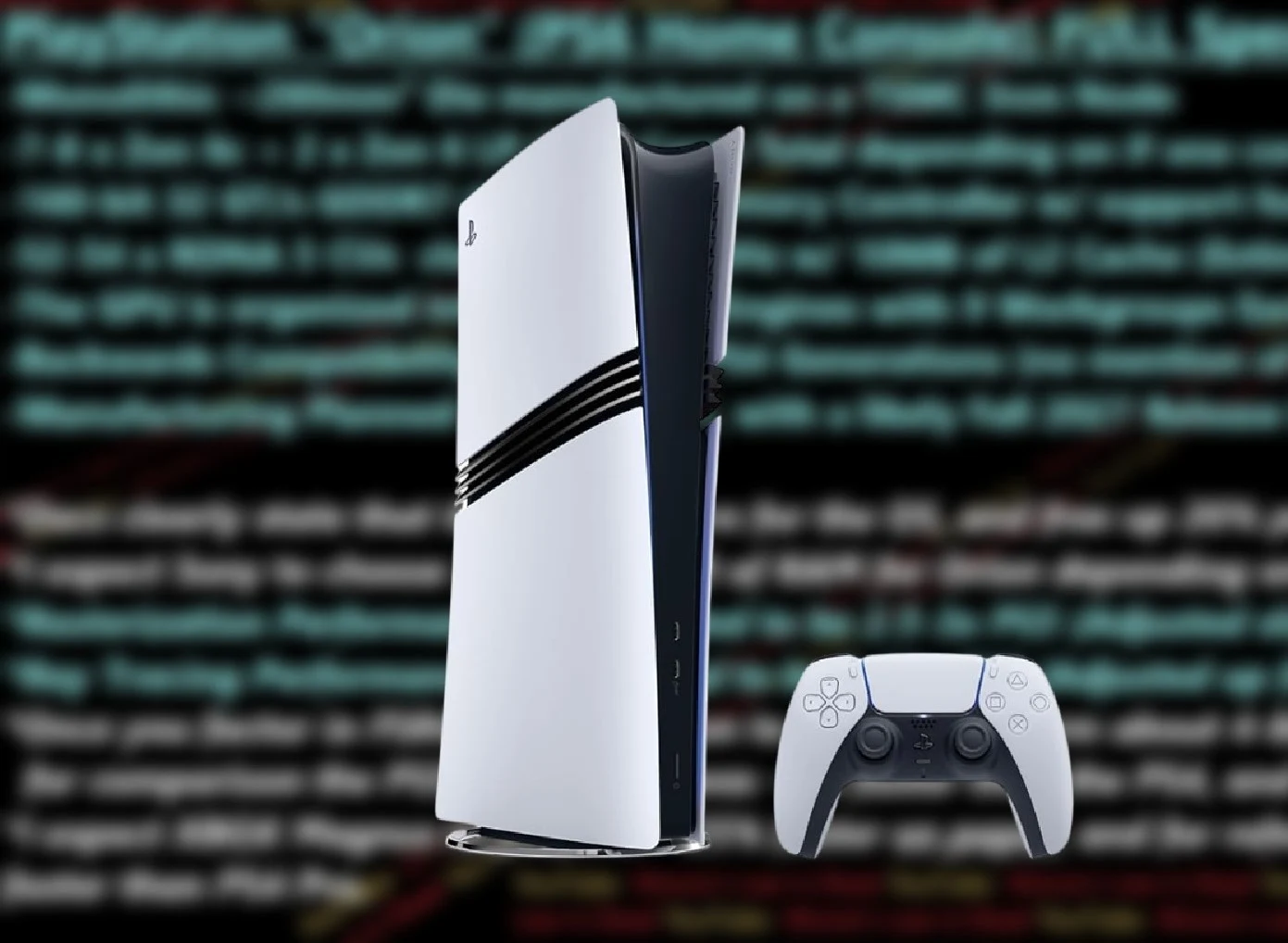
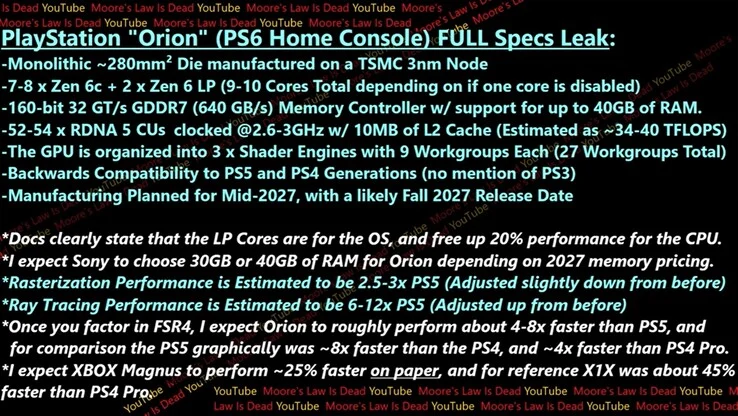
    Moore’s Law Is Dead has disclosed nearly all there is to know about the internal technology and capabilities of the PlayStation 6. The insider has also shared the anticipated launch date for the PS6. According to MLID, the console will utilize the AMD Orion APU. This APU has an approximate size of 280 mm2 and is manufactured on the TSMC 3 nm process. On the CPU front, the PS6 Orion APU is expected to have 7-8 Zen 6c cores alongside 2 Zen 6 LP cores. The latter is reportedly intended to manage background processes of the operating system, allowing for a 20% boost in CPU performance for gaming.

    GPU Performance and Comparisons

    The graphics component is likely managed by a 50-52 Compute Units RDNA 5 integrated GPU that runs at speeds of about 2.6 to 3 GHz and has 10 MB of L2 cache. This setup might provide the PS6 with between 34 to 40 TFLOPs of raw GPU power. In contrast, the PlayStation 5 delivers approximately 10.28 TFLOPs, while the Xbox Series X offers a stronger performance at 12 TFLOPs (Buy the console on Amazon).

    The details from MLID suggest that with a maximum of 40 TFLOPs, the PS6 could be around 2.5 to 3 times quicker than the PS5 in basic Rasterization tasks, and significantly faster—by 6 to 12 times—in Ray tracing scenarios. With the incorporation of FSR4, the overall performance gain for the PS6 compared to the PS5 could be between 4 to 8 times (Available on Amazon).

    Xbox Magnus vs. PS6

    However, the insider predicts that the Xbox Magnus will be about 25% quicker than the PlayStation 6. Many sources have claimed that the next Xbox will resemble a desktop PC in almost every aspect, except for its name. It’s expected to operate on a tailored version of Windows and will provide access to various digital storefronts such as Steam and Epic. Nevertheless, it may come with a significantly higher price tag than current gaming consoles. Therefore, even if the Xbox is faster, it could be more costly.

    Moreover, the PS6 is rumored to feature up to 40 GB of GDDR7 memory operating at 32 GT/s on a 160-bit bus. This would yield a memory bandwidth of around 640 GB/s. For comparison, both the PS5 and Xbox Series X have 16 GB of GDDR6 SDRAM.

    Backwards Compatibility and Release Timeline

    Finally, MLID asserts that the PS6 will support full backwards compatibility with both PS5 and PS4 games. Similar statements have been made about a potential PS6 handheld as well. However, fans hoping for compatibility with PS3 games may be let down, as Sony seemingly has no plans for that feature.

    Prior leaks have pointed to late 2027 as a likely release timeframe for the PlayStation 6. While MLID does not provide a specific launch date, the leaker suggests that Sony aims to start production in mid-2027, with an official release slated for sometime in Fall 2027.

    Source:
    Link


  • PlayStation 6: 10x PS5 Performance and Enhanced Ray Tracing

    PlayStation 6: 10x PS5 Performance and Enhanced Ray Tracing

    Key Takeaways

    1. The PlayStation 6 may significantly improve ray tracing performance, offering 5 to 10 times more capability than the PS5.
    2. Rasterization improvements for the PlayStation 6 are expected to be minimal, not exceeding double the performance of the PS5 Pro.
    3. Sony is shifting focus towards achieving a stable 4K120 experience rather than further enhancing rasterization.
    4. A second, lower-priced model of the PlayStation 6 may be introduced, targeting 1080p resolution at around $299.
    5. The primary PlayStation 6 model is anticipated to cost between $500 and $900, competing with the rumored Xbox “Magnus.”


    A recent leak from Moore’s Law Is Dead suggests that Sony’s forthcoming PlayStation 6 could offer a significant boost in ray tracing performance, boasting capabilities that are 5 to 10 times greater than the original PlayStation 5. Conversely, improvements in rasterization are anticipated to be rather limited, reportedly not even reaching double the performance of the PlayStation 5 Pro. This indicates a notable change in Sony’s focus regarding performance.

    Sony’s Strategic Shift

    As stated by Moore’s Law Is Dead, this change stems from Sony’s internal evaluations, which reveal that most PlayStation 5 games already deliver a stable 4K60 or 4K80 experience, while user uptake of 120Hz remains relatively low. Instead of enhancing rasterization further, Sony seems to be concentrating on achieving a consistent 4K120 experience, along with significantly enhanced ray tracing capabilities. The PlayStation 6 is said to include custom silicon developed alongside AMD, designed to optimize the hardware’s performance on specific tasks like ray tracing and AI upscaling, akin to technologies like DLSS or FSR.

    Potential Variants and Pricing

    Moore’s Law Is Dead also hints at the introduction of a second PlayStation 6 model, potentially priced around 299 dollars. This version would share the same architecture but would be tailored for 1080p resolution. This strategy would resemble the dual-SKU approach seen with the PlayStation 5 and its Digital Edition, but with more pronounced hardware differences. The primary model is anticipated to retail between 500 and 900 dollars, positioning it as a strong competitor against the rumored Xbox “Magnus,” which could be approximately 30% faster yet also pricier.

    In conclusion, Moore’s Law Is Dead hints that this is merely “the tip of the iceberg,” stating, “I honestly know a lot more but I can’t say anything yet” — so let’s keep an eye on further developments.