Tag: Xbox Magnus

  • New Xbox Magnus: Full Specs and Impressive RAM Revealed

    New Xbox Magnus: Full Specs and Impressive RAM Revealed

    Key Takeaways

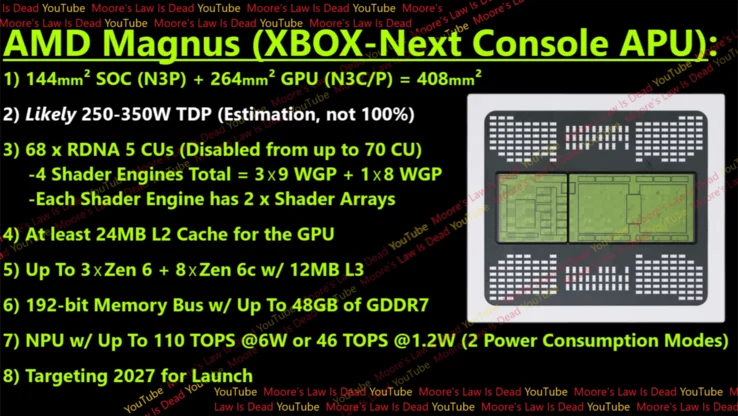
    1. The Xbox Magnus SoC will feature 68 Compute Units (CUs) and a 192-bit memory bus, potentially supporting up to 48 GB of GDDR7 VRAM.
    2. It will be manufactured using TSMC’s N3P or N3C node and will have an 11-core CPU setup, including three Zen 6 cores and eight Zen 6c cores, with some cores potentially disabled.
    3. The die size of the Xbox Magnus is rumored to be 408 mm², making it one of the largest chips in mainstream consoles, but smaller than Nvidia’s top-tier products.
    4. The SoC may consume up to 350 Watts of power, significantly higher than the Xbox Series X’s 200 Watts.
    5. The inclusion of a neural processing unit (NPU) indicates a focus on artificial intelligence tasks, suggesting the Xbox Magnus will operate like a high-performance gaming PC.


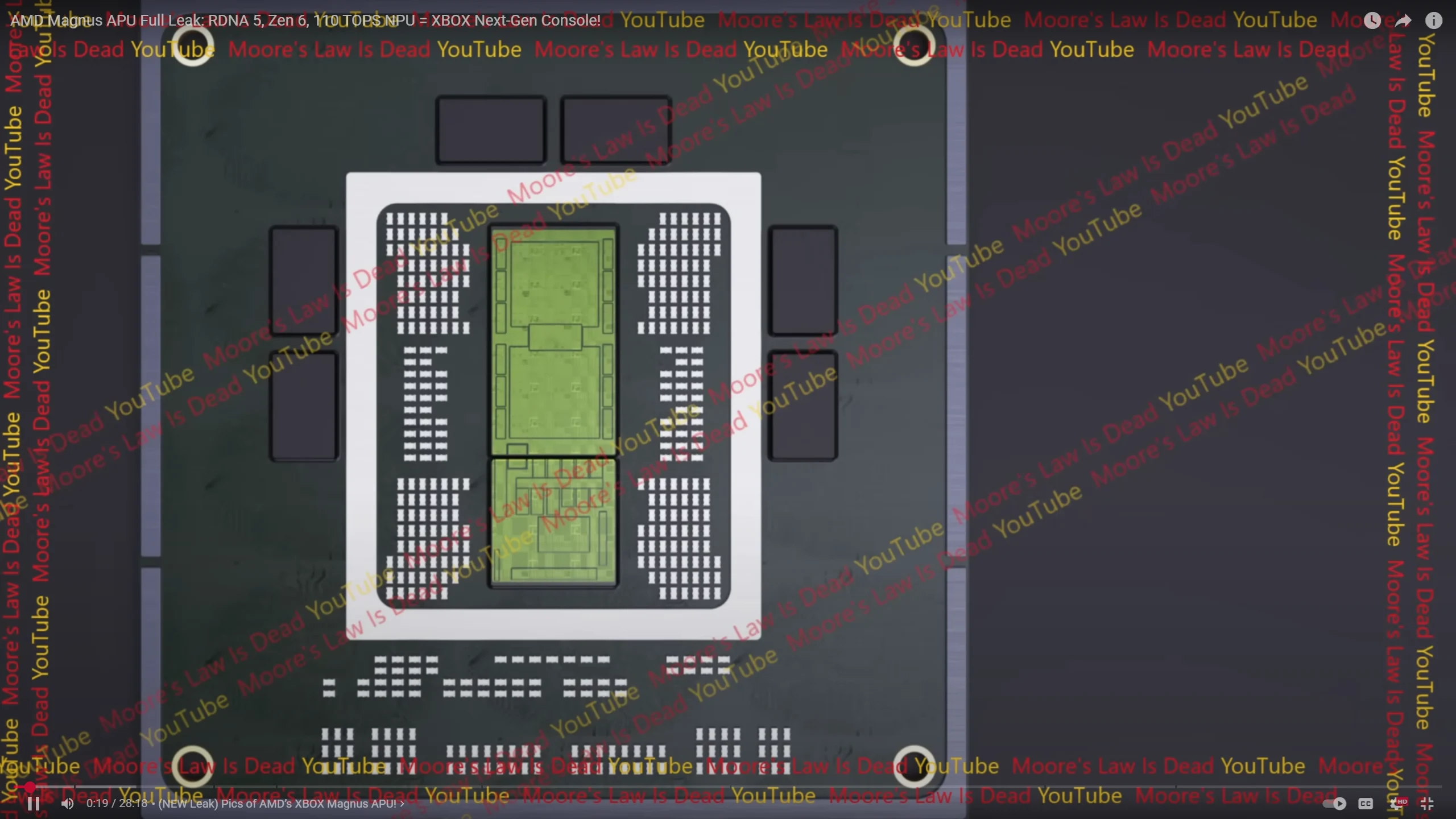
    An earlier leak from YouTuber Moore’s Law is Dead gave some insights into the Magnus SoC that is expected to power the upcoming Xbox. It highlighted some impressive specifications, including 68 Compute Units (CUs) and an unknown amount of memory that operates on a 192-bit bus. Tom’s latest video now reveals more about what Xbox Magnus has in store.

    Manufacturing Details

    The GPU will be produced using TSMC’s N3P or N3C node, while the SoC will also be built on TSMC N3P. On the CPU side, it will feature an 11-core setup, which includes three Zen 6 cores and eight Zen 6c cores. Tom mentions that this number is not final, and some cores might be disabled. Additionally, Xbox Magnus will have an NPU to handle artificial intelligence tasks right on the device.

    Memory Specifications

    Now, let’s talk about the most interesting part. The previously mentioned 192-bit bus could support up to 48 GB of GDDR7 VRAM. This amount is almost excessive for a gaming console, but considering that the next Xbox with Magnus is expected to launch in 2027, this may be essential for staying competitive during an eight-year release cycle. Still, a more reasonable figure, like 24 GB, seems likely.

    All this processing capability will need quite a bit of silicon space. With a rumored die size of 408 mm², the Xbox Magnus might turn out to be one of the largest chips found in mainstream consoles. However, this is still significantly smaller compared to Nvidia’s top-tier products, such as the RTX 5090’s GB202 die, which measures 761 mm². Lastly, the Magnus could consume as much as 350 Watts of power under maximum load, which is considerably higher than the Xbox Series X’s 200 Watts.

    Power Requirements

    If earlier speculation about the Xbox acting like a high-performance gaming PC holds true, Microsoft will require all the power it can muster to operate a full Windows operating system. The addition of third-party launchers like Steam and Battle.net will further increase the demand for additional computational resources.

    Moore’s Law is Dead on YouTube.

    Source:
    N/A)


  • PS6 Specs Leaked: APU Up to 8x Faster than PS5, Xbox Rivalry

    PS6 Specs Leaked: APU Up to 8x Faster than PS5, Xbox Rivalry

    Key Takeaways

    1. The PlayStation 6 will feature a powerful AMD Orion APU with Zen 6 CPU cores and an RDNA 5 GPU, expected to deliver 34 to 40 TFLOPs of GPU power.

    2. The PS6 is anticipated to be 2.5 to 3 times faster than the PS5 in basic tasks and 6 to 12 times faster in ray tracing, with an overall performance gain of 4 to 8 times due to FSR4.

    3. The upcoming Xbox Magnus is predicted to be about 25% quicker than the PS6 and will run on a tailored version of Windows with access to various digital storefronts.

    4. The PS6 will have full backwards compatibility with PS5 and PS4 games but likely won’t support PS3 titles.

    5. The PlayStation 6 is expected to be released in Fall 2027, with production starting in mid-2027.


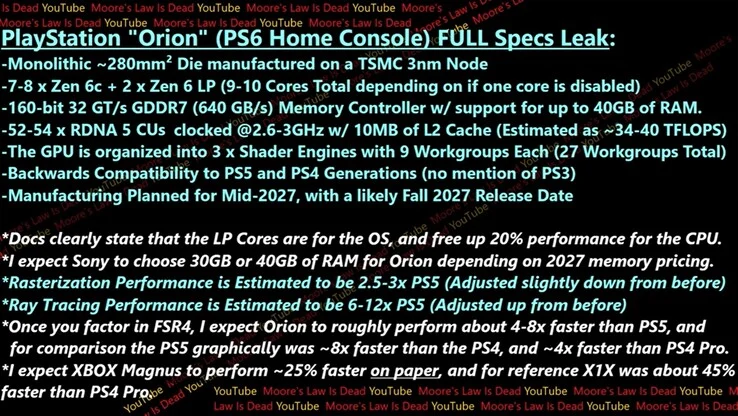
    The Sony PlayStation 6 and the upcoming Xbox are set to lead the new era of home gaming systems. Both of these consoles are said to be equipped with powerful AMD APUs featuring Zen 6 CPU cores and RDNA 5 GPU cores. The PlayStation 6 is rumored to use the AMD Orion APU, which includes a mix of Zen 6 and Zen 6c CPU cores, along with an RDNA 5 integrated GPU.

    Inside the PlayStation 6

    Moore’s Law Is Dead has disclosed nearly all there is to know about the internal technology and capabilities of the PlayStation 6. The insider has also shared the anticipated launch date for the PS6. According to MLID, the console will utilize the AMD Orion APU. This APU has an approximate size of 280 mm2 and is manufactured on the TSMC 3 nm process. On the CPU front, the PS6 Orion APU is expected to have 7-8 Zen 6c cores alongside 2 Zen 6 LP cores. The latter is reportedly intended to manage background processes of the operating system, allowing for a 20% boost in CPU performance for gaming.

    GPU Performance and Comparisons

    The graphics component is likely managed by a 50-52 Compute Units RDNA 5 integrated GPU that runs at speeds of about 2.6 to 3 GHz and has 10 MB of L2 cache. This setup might provide the PS6 with between 34 to 40 TFLOPs of raw GPU power. In contrast, the PlayStation 5 delivers approximately 10.28 TFLOPs, while the Xbox Series X offers a stronger performance at 12 TFLOPs (Buy the console on Amazon).

    The details from MLID suggest that with a maximum of 40 TFLOPs, the PS6 could be around 2.5 to 3 times quicker than the PS5 in basic Rasterization tasks, and significantly faster—by 6 to 12 times—in Ray tracing scenarios. With the incorporation of FSR4, the overall performance gain for the PS6 compared to the PS5 could be between 4 to 8 times (Available on Amazon).

    Xbox Magnus vs. PS6

    However, the insider predicts that the Xbox Magnus will be about 25% quicker than the PlayStation 6. Many sources have claimed that the next Xbox will resemble a desktop PC in almost every aspect, except for its name. It’s expected to operate on a tailored version of Windows and will provide access to various digital storefronts such as Steam and Epic. Nevertheless, it may come with a significantly higher price tag than current gaming consoles. Therefore, even if the Xbox is faster, it could be more costly.

    Moreover, the PS6 is rumored to feature up to 40 GB of GDDR7 memory operating at 32 GT/s on a 160-bit bus. This would yield a memory bandwidth of around 640 GB/s. For comparison, both the PS5 and Xbox Series X have 16 GB of GDDR6 SDRAM.

    Backwards Compatibility and Release Timeline

    Finally, MLID asserts that the PS6 will support full backwards compatibility with both PS5 and PS4 games. Similar statements have been made about a potential PS6 handheld as well. However, fans hoping for compatibility with PS3 games may be let down, as Sony seemingly has no plans for that feature.

    Prior leaks have pointed to late 2027 as a likely release timeframe for the PlayStation 6. While MLID does not provide a specific launch date, the leaker suggests that Sony aims to start production in mid-2027, with an official release slated for sometime in Fall 2027.

    Source:
    Link


  • Xbox Magnus Leak: Next-Gen 4K120 Gaming with AMD Zen 6

    Xbox Magnus Leak: Next-Gen 4K120 Gaming with AMD Zen 6

    Key Takeaways

    1. Microsoft’s upcoming Xbox, codenamed Magnus, will feature AMD’s Zen 6 CPU cores and RDNA 5 graphics technology, promising performance up to twice that of the PlayStation 5 Pro.
    2. The Magnus APU will use a two-chiplet architecture with an AT2 GPU die, including 68 active compute units and a 192-bit GDDR7 memory interface.
    3. Expected performance is comparable to a Radeon-class GPU similar to an RTX 5080, with 50 to 100 percent higher performance than the PS5 Pro for various tasks.
    4. The console is anticipated to support features like FSR upscaling, ray tracing, and backwards compatibility with older Xbox games, with a potential launch price between $500 and $600.
    5. The Magnus design could significantly impact the mid-range PC market by using the same technology found in desktop GPUs, with more details on pricing and release dates expected soon.


    A recent leak from Moore’s Law is Dead indicates that Microsoft’s upcoming Xbox, known internally as Magnus, is set to incorporate AMD’s Zen 6 CPU cores alongside RDNA 5 graphics technology. This combination is projected to provide performance that could be up to twice as powerful as the PlayStation 5 Pro. The release of this system could happen as soon as late 2026 or in 2027.

    Technical Details

    The leaked information points out that the Magnus APU will feature a two-chiplet architecture that revolves around the AT2 GPU die, which will also be utilized in AMD’s mid-tier desktop graphics cards. This graphics unit is believed to include 68 active compute units and will have a 192-bit GDDR7 memory interface. Meanwhile, the CPU will be based on a cutting-edge 3nm Zen 6 design. Moore’s Law is Dead estimates that the performance will be comparable to a Radeon-class GPU akin to an RTX 5080, potentially offering between 50 to 100 percent higher performance than the PS5 Pro, depending on the specific tasks.

    Cost and Features

    Utilizing the AT2 die for both the console and desktop graphics could help Microsoft reduce manufacturing costs over time, as well as enhance driver support. The Magnus is also anticipated to include features like FSR upscaling, ray tracing capabilities, and backwards compatibility with older Xbox games. While the exact pricing remains unclear, there is speculation suggesting a launch price might fall within the $500 to $600 range, with a minimum of 32GB RAM to facilitate high-resolution gaming at 120Hz.

    Future Outlook

    If these leaks are accurate, the Magnus design could mark a major advancement for Xbox, utilizing AMD’s next-gen technologies to focus on high-refresh 4K gaming. This could also shake up the mid-range PC market by using the same silicon found in desktop GPUs. More detailed information, such as pricing and release dates, is likely to surface in the upcoming months as development progresses.

    Source:
    Link