Tag: NVIDIA

  • Intel Unveils New FPS Boosting Tech for GPU Users

    Intel Unveils New FPS Boosting Tech for GPU Users

    Key Takeaways

    1. Intel and Nvidia are collaborating to enhance AI infrastructure and personal computing solutions, signaling a shift in the tech sector.
    2. A Reddit user discovered code in Intel’s Arc driver files indicating upcoming multi-frame generation capabilities for Arc GPUs.
    3. Intel’s frame generation technology (XeSS FG) competes with AMD’s Fluid Motion Frames and Nvidia’s exclusive multi-frame generation for RTX 50 series GPUs.
    4. Intel is actively hiring for a role focused on optimizing gaming performance for discrete graphics, indicating continued investment in GPU development.
    5. The timeline for Intel’s next Arc Battlemage GPU release remains unclear, but the company plans to stick to its product roadmap.


    Last week, Intel and Nvidia revealed a collaboration aimed at creating AI infrastructure and personal computing solutions. This news marked a significant shift in the tech sector, although it raised questions regarding Intel’s current products, especially in the GPU area, which has not received much attention lately. Recently, there have been rumors about new dedicated gaming GPUs, and now a leak suggests potential tech upgrades for Intel’s Arc graphics cards.

    Exciting Discoveries from Reddit

    A Reddit user named Organic-Bird-587 shared findings on the IntelArc subreddit regarding multi-frame generation capabilities coming to Arc GPUs. The user examined the Arc driver files and discovered lines of code referencing “Multi-Frame Generation (XeSS)” along with an icon related to frame generation. Although Intel has yet to officially comment on this technology’s arrival for its GPUs, the presence of this code indicates that developments might be underway.

    Competition in Frame Generation Technology

    Intel currently offers frame generation (XeSS FG), similar to AMD’s Fluid Motion Frames (AFMF), and both technologies function on competitive graphics cards. Meanwhile, Nvidia has the exclusive multi-frame generation feature, which is only available for its RTX 50 series GPUs. This implies that Intel’s multi-frame generation could potentially extend to GPUs that aren’t part of Intel’s lineup. However, it is worth mentioning that Lossless Scaling, a third-party solution, can already provide up to 20x frame generation across GPUs from all three manufacturers.

    Intel’s Future in Graphics

    This leak aligns with the recent discovery of a job posting by Intel for an SoC Performance Engineer. This role focuses on validating and optimizing gaming performance for high-end desktop SoCs, particularly emphasizing discrete graphics (dGFX) gaming performance. This suggests that Intel is still engaged in the development of discrete graphics solutions, but the timeline for the next Arc Battlemage GPU remains uncertain. The company has assured that it will adhere to its roadmap and continue to introduce new GPU products.

    Source:
    Link


  • Nvidia GeForce RTX 6090: Rubin CPX GPU Unlikely for Launch

    Nvidia GeForce RTX 6090: Rubin CPX GPU Unlikely for Launch

    Key Takeaways

    1. Nvidia’s Rubin CPX AI GPU features a monolithic die with 128 GB of GDDR7 memory, designed for high performance in AI tasks.
    2. Speculations suggest that the Rubin CPX could be the basis for the upcoming GeForce RTX 6090, but its specialized design raises doubts about compatibility.
    3. The RTX 50 Super series is expected to debut at CES 2026, leading to the belief that the RTX 60 series will not be revealed until late 2026.
    4. Technical insights indicate that the Rubin CPX may not be suitable for the RTX 6090 due to its lack of video output and focus on AI inference.
    5. Current GPU prices have stabilized, making it a good time to buy, with popular models like the RX 9070 XT and RTX 5080 available at reasonable prices.


    As 2026 approaches, chatter about the upcoming desktop gaming GPUs is intensifying. We’ve gathered plenty of information regarding AMD’s forthcoming RDNA 5 series along with the AT4, AT3, AT2, and AT0 GPUs. However, Nvidia’s intentions for the GeForce RTX 60 series remain somewhat of a mystery. This changed for some when Nvidia presented the Rubin CPX AI GPU earlier in September.

    Rubin CPX Specifications

    The Rubin CPX boasts a monolithic die equipped with 128 GB of GDDR7 memory. Nvidia claims that this GPU is designed to offer “extremely high performance and energy efficiency for AI inference tasks”. More specifically, it’s crafted for “handle million-token coding and generative video applications”.

    Speculations on RTX 6090

    Interestingly, there have been numerous online speculations suggesting that the Rubin CPX die could potentially serve as the foundation for the GeForce RTX 6090. This theory is partially supported by the timing of the Rubin CPX’s launch, scheduled for late 2026. Rumors indicate that Nvidia will introduce the RTX 50 Super series GPU at CES 2026, implying that the next-gen RTX 60 series will probably not be revealed until the end of 2026.

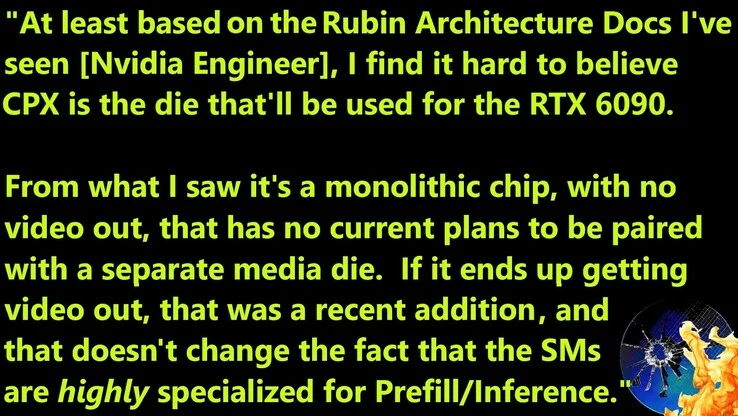
    Moore’s Law Is Dead has attempted to clarify the speculation about the Rubin CPX being the core of the RTX 6090. Referencing a source within Nvidia, the leaker asserts that the Rubin CPX is “highly specialized for Prefill/Inference”. Allegedly, this monolithic die does not even feature a video output, and according to MLID’s source, Nvidia has no intention of integrating this GPU with a separate media die.

    Timing for Upgrading GPUs

    While it’s conceivable that Nvidia might adjust the Rubin CPX for the RTX 6090, the technical information shared by MLID in their video regarding why the Rubin CPX isn’t likely suitable for the RTX 6090 seems to be quite persuasive.

    Regardless of the outcome, if you’re in need of a graphics card, it’s wise not to wait for the next-gen GPUs. Right now is an excellent time to purchase a new graphics card, as GPU prices have settled significantly and are no longer as outrageous as they were in early 2025. Popular GPUs like the RX 9070 XT and the RTX 5080 are available without excessive surcharges. Even models like the RTX 5060 Ti 16 GB can be found at attractive discounts.

    Source:
    Link


  • Nvidia Invests in Robotaxi AI Firm Outperforming Tesla FSD

    Nvidia Invests in Robotaxi AI Firm Outperforming Tesla FSD

    Key Takeaways

    1. Nvidia has invested $500 million in Wayve to enhance its presence in the robotaxi market, viewing it as a potential “next trillion-dollar company.”

    2. Wayve’s autonomous driving solution uses an AI-driven system that learns from camera data, similar to Tesla’s Full Self-Driving (FSD) technology.

    3. Wayve has secured a major partnership with Nissan, launching the ProPilot robotaxi system powered by Wayve’s AI Driver software in Tokyo.

    4. Wayve’s AI technology allows for Level 4 autonomous driving, enabling the vehicle to understand its environment and predict future events for safe navigation.

    5. Nissan aims to equip vehicles with Wayve’s AI Driver and Nvidia’s Drive Thor hardware by 2027, claiming it may be “smarter than Tesla’s FSD.”


    After investing a staggering $100 billion in OpenAI to compete with Google’s Gemini and Elon Musk’s Grok, Nvidia is also setting its sights on the emerging robotaxi market.

    With a fresh investment of $500 million, Nvidia’s Jensen Huang refers to this venture as “the next trillion-dollar company.” This investment comes as he experienced a ride in an autonomous vehicle powered by Nvidia’s software, aiming to challenge Tesla’s Robotaxi service. The UK-based company Wayve had previously secured a robust $1 billion investment from Nvidia, Uber, and SoftBank, and now, Huang wants to increase his stake by another half a billion.

    Wayve’s Autonomous Solution

    Wayve offers a complete autonomous driving solution compatible with any vehicle. Their AI-driven system closely resembles Tesla’s FSD, functioning as an end-to-end neural network that learns from vast amounts of camera data rather than depending on strict algorithms and HD maps.

    Huang expressed great admiration for Wayve’s achievements with Nvidia’s customized self-driving AI hardware, even praising the team during a ride in downtown London, calling them “the next trillion-dollar company, you guys.”

    Partnerships and Developments

    The autonomous driving startup has already made significant strides, securing a major client in Nissan. Nissan has revealed the launch of its ProPilot robotaxi system powered by Wayve’s AI Driver software. This driver-assist technology has been integrated into several Ariya electric SUVs, showcasing Level 4 autonomous driving on the bustling streets of Tokyo.

    Wayve’s advanced AI can comprehend its environment and predict future events, allowing it to maneuver safely, much like a skilled human driver would. Its rapid processing capabilities enable quick responses to sudden changes, ensuring safe actions in real-time. Moreover, Wayve’s AI takes inspiration from human cognitive and behavioral processes, understanding the evolution of driving scenes instead of merely reacting to individual objects. By grasping the dynamics of its environment, it can adapt to numerous real-world situations and make sound decisions, even in complicated scenarios.

    Future Plans and Competition

    Nissan plans to equip select local vehicles with Wayve’s AI Driver using dedicated Nvidia Drive Thor hardware, starting in 2027. The Japanese automaker believes that its new self-driving system is currently “smarter than Tesla’s FSD,” although it will require some marketing and regulatory refinement by that time.

    Source:
    Link


  • Intel Nvidia Hammer Lake Leaks Large iGPU as Titan Lake Goes Mobile

    Intel Nvidia Hammer Lake Leaks Large iGPU as Titan Lake Goes Mobile

    Key Takeaways

    1. Intel and Nvidia are collaborating to integrate Nvidia’s RTX iGPUs into Intel’s x86 products, impacting both datacenter and consumer segments.
    2. The integration aims to enhance Intel’s existing Arc Graphics series rather than replace it.
    3. Intel’s roadmap has changed, focusing on Titan Lake mobile APUs with upgraded iGPUs and scrapping plans for Titan Lake desktop CPUs.
    4. The transition to Nvidia graphics in Intel’s products is expected to happen gradually, with a full shift potentially not occurring until 2029.
    5. The future of Intel’s Arc desktop GPUs remains uncertain as the company prepares for this transition.


    Intel’s collaboration with Nvidia to develop graphics solutions for x86 products is likely the most significant PC news of 2025. This partnership impacts not only Intel’s datacenter solutions but also its consumer segment, which includes laptop APUs and discrete desktop GPUs. Intel has stated that the integration of Nvidia’s RTX iGPUs in x86 Intel APUs is intended to enhance, rather than replace, Team Blue’s existing Arc Graphics series.

    Marketing or Reality?

    Nonetheless, Moore’s Law Is Dead suggests that this might be just a marketing strategy, as Intel is expected to fully transition to Nvidia GeForce RTX iGPUs with the introduction of Intel Hammer Lake. According to previous leaks from MLID, Intel plans to follow the Panther Lake mobile architecture with Nova Lake, Razer Lake, Titan Lake, and Hammer Lake. Initially, it was believed that all four architectures would use the LGA 1954 socket, which Intel is rumored to unveil with Nova Lake-S desktop CPUs in late 2026.

    Changes in Strategy

    Intel appears to have slightly altered its roadmap. MLID indicates that Team Blue has scrapped plans for Titan Lake desktop CPUs and is now solely focusing on Titan Lake mobile APUs that will feature “upgraded iGPUs.” These new iGPUs could potentially be Nvidia RTX variants, unlike those in Hammer Lake.

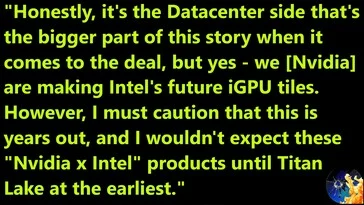
    MLID has also reported that Intel Hammer Lake products are now being “redefined” to feature a “new large and powerful iGPU” by 2029. This powerful iGPU is likely to be an Nvidia GeForce RTX iGPU, as an Nvidia insider informed MLID that Intel x Nvidia products will debut with Titan Lake at the earliest, and not before.

    Future Implications

    In simpler terms, we might witness Intel’s mobile and desktop APUs continue to utilize Arc iGPUs for several more years before transitioning to Nvidia graphics in 2029. The impact of this shift on Intel Arc desktop GPUs remains uncertain. MLID has provided an updated specification for the upcoming Arc B770, which we have discussed in a separate article.

    Source:
    Link


  • Nvidia and Intel Team Up for AI and Consumer Chip Development

    Nvidia and Intel Team Up for AI and Consumer Chip Development

    Key Takeaways

    1. Intel and Nvidia have formed a long-term partnership focusing on both data centers and consumer goods, with Intel CPUs working alongside Nvidia’s AI accelerators.
    2. Upcoming Intel processors will include integrated Nvidia GPUs, raising questions about the future of Nvidia’s Arc graphics line.
    3. The partnership may affect Nvidia’s plans for the Windows-on-Arm market, delaying the launch of the Nvidia N1X to 2026 or potentially canceling it.
    4. The collaboration gives Intel a competitive edge in handheld devices, leveraging Nvidia’s intellectual property.
    5. Low-power options like Lunar Lake and Panther Lake paired with Nvidia components could enhance portable gaming performance.


    Intel and Nvidia have formed a long-term partnership that covers both data center and consumer goods. The data center aspect will see Intel CPUs collaborating with Nvidia’s AI accelerators. This move will enable Nvidia to provide X86-based solutions alongside its current Arm-based products. This news follows Nvidia’s interest in Intel’s 14A node for some of its upcoming products.

    Future of Intel and Nvidia

    On the consumer front, upcoming Intel processors will come with integrated Nvidia GPUs. This development leads to uncertainties surrounding the future of Arc graphics. While standalone graphics solutions might still be available, it’s likely that Arc-branded integrated GPUs will be phased out. However, they may linger for a generation or two due to the anticipated arrival of Panther Lake and Nova Lake, which are expected to feature Celestial and Druid-based graphics technologies.

    Implications for Windows-on-Arm

    The new partnership between Intel and Nvidia also brings up questions regarding Nvidia’s plans for the Windows-on-Arm market. The Nvidia N1X was originally set to launch this year, but its release has been delayed to 2026. There’s a possibility it may not come out at all, as Nvidia has chosen Intel x86 chips as the foundation for its laptop offerings, thus removing the need to create an Arm chip from the ground up.

    Competitive Edge in Handhelds

    Even though the potential discontinuation of Arc Mobile is unfortunate, Nvidia’s existing intellectual property will give Intel a crucial advantage against AMD in the handheld market. Low-power options like Lunar Lake and Panther Lake, when paired with a similarly equipped Nvidia component, can lead to outstanding chips for portable gaming devices.

    Source:
    Link


  • China Launches Anti-Monopoly Probe Against Nvidia Amid Trade Talks

    China Launches Anti-Monopoly Probe Against Nvidia Amid Trade Talks

    Key Takeaways

    1. China has accused Nvidia of breaching anti-monopoly laws amid ongoing US-China trade discussions, particularly concerning semiconductor chips.
    2. The investigation into Nvidia began in December 2024, focusing on commitments related to the 2020 acquisition of Mellanox, which had conditions tied to GPU supply to China.
    3. China accounts for 13% of Nvidia’s sales, increasing uncertainty for the company as it faces pressure from the Chinese government to promote local alternatives over Nvidia products.
    4. The situation reflects escalating trade tensions, with China launching an anti-dumping investigation into US semiconductor chips as part of ongoing countermeasures against US tariffs.
    5. Despite a temporary drop in Nvidia’s stock, analysts believe the investigation will not drive Nvidia out of the Chinese market but signals China’s negotiation tactics and strategy.


    China’s market regulator has accused Nvidia of breaching anti-monopoly laws following initial investigations. This announcement comes at a time when US-China trade discussions are taking place in Madrid, where chips are a significant topic. US Treasury Secretary Scott Bessent has described the timing as “poor timing,” while some analysts interpret it as a tactic for leverage. Since Trump’s first term, both countries have been embroiled in rising trade tensions, recently imposing high tariffs before easing off.

    Investigation Details

    The inquiry into Nvidia began in December 2024, focusing on the company’s commitments regarding the 2020 acquisition of Mellanox. China had approved the Mellanox deal on the condition that Nvidia would guarantee GPU supplies to the Chinese market. However, US export restrictions later forced Nvidia to halt sales of its most advanced chips to China. Under Chinese anti-monopoly legislation, potential fines for Nvidia may range from 1 to 10 percent of its annual sales.

    Impact on Nvidia

    China accounts for 13 percent of Nvidia’s overall sales, which creates notable uncertainty for the firm. Even with CEO Jensen Huang’s three trips to China this year, the efforts to charm the market seem to have not worked. The Chinese government is discouraging local tech companies, such as Tencent and Bytedance, from buying Nvidia chips, instead advocating for domestic alternatives. The H20 chips, specifically made for the Chinese market, remain unsold due to unresolved US payment regulations.

    Trade War Escalation

    This development follows China’s recent announcement of an anti-dumping investigation into US analog semiconductor chips. It is also part of a back-and-forth escalation in the ongoing trade war, which features US tariffs and Chinese countermeasures. Analysts view this as a warning regarding the implications of ongoing US export control policies. The timing hints at a relationship with the trade negotiations in Madrid and a potential agreement about TikTok’s ownership.

    On Monday, Nvidia’s stock dropped by two percent before bouncing back, with the company ensuring continued cooperation. Industry analysts have pointed out the risk posed to billions in networking equipment sales via Mellanox. Recently, Chinese semiconductor officials have called for an indefinite cessation of Nvidia GPU use, with authorities strongly advocating for local alternatives. Although experts believe this investigation is unlikely to drive Nvidia out of the Chinese market, it does indicate China’s strategy in negotiations.

    Source:
    Link


  • Nvidia Fixes Optimus Performance Issues in Gaming Laptops

    Nvidia Fixes Optimus Performance Issues in Gaming Laptops

    Key Takeaways

    1. Nvidia released Game Ready Driver 581.29, replacing the previous version 581.15.
    2. The update optimizes GPUs for upcoming games Dying Light: The Beast and Borderlands 4, featuring DLSS 4, Multi Frame Generation, and Ray Tracing support.
    3. Dying Light: The Beast will be available on September 19, while Borderlands 4 releases tomorrow.
    4. The driver includes bug fixes, particularly for performance issues in Marvel Rivals and ‘performance degradation over time’ on laptops using Optimus mode.
    5. Nvidia representatives confirmed that the performance issue fix was initially planned for the previous driver but was included in 581.29.


    Yesterday, Nvidia unveiled its newest Game Ready Driver, which is labeled as 581.29. This version replaces the previous 581.15 that came out at the end of August. At first glance, 581.29 showcases a few key highlights.

    Game Optimization

    Nvidia points out that this update fine-tunes the currently supported GPUs for Dying Light: The Beast and Borderlands 4 (currently priced at $69 on Amazon) just in time for their release later this month. To support these games, Nvidia will implement DLSS 4, Multi Frame Generation, and Ray Tracing from the very first day they are launched. For context, while 2K and Telltale Games are set to release Borderlands 4 tomorrow, Dying Light: The Beast won’t be available until September 19.

    Bug Fixes Included

    As usual, Nvidia’s latest driver update comes with several bug fixes, including one addressing issues with Marvel Rivals, where certain 581.xx drivers may have led to performance problems. Interestingly, Nvidia chose not to elaborate on what might be the most significant improvement brought by 581.29.

    In follow-up posts on Discord and Reddit, representatives from Nvidia confirmed that 581.29 resolves a problem that caused ‘performance degradation over time’ on laptops using Optimus mode. It seems that Nvidia originally planned to include this fix in the 581.15 release but ended up leaving it out. Upon initial review, it appears that 581.29 fully addresses this bug. To download the latest driver package, please visit Nvidia’s website directly.

    Source:
    Link


  • Linux Mint 22.2 Released with Some Old Bugs Still Present

    Linux Mint 22.2 Released with Some Old Bugs Still Present

    Key Takeaways

    1. Linux Mint 22.2 “Zara” has several bugs despite being labeled as stable, affecting all main versions of the distribution.
    2. Nvidia users with older GPUs face crashes when using the 470 driver, and the HWE kernel 6.14 has issues with VirtualBox.
    3. ZFS support has been removed from the installer due to low user demand, and graphics card issues may cause system freezes during boot.
    4. The incorporation of Pipewire as the new sound server may lead to sound stuttering over HDMI on certain hardware setups.
    5. Sticky Notes for MATE is reported to be non-functional, and users experience problems with deleting icons related to file actions.


    While the recent update was intended to be the stable release of Linux Mint 22.2 “Zara,” it appears to have several bugs hidden within. Beyond user feedback, the official release notes also mention some issues that should not exist in software labeled as “stable.” All three main versions of this distribution seem to be encountering similar challenges.

    Nvidia Users Struggle

    One of the most frustrating issues, particularly for Nvidia users with older GPUs using the 470 driver, involves crashes. Additionally, the HWE kernel 6.14, included with all three Linux Mint versions, presents problems with VirtualBox. For the time being, the best option is to continue using Mint 22.1, as it comes with the more reliable 6.8 LTS kernel.

    ZFS Support Removed

    The installer has removed ZFS support due to its low usage among users. During the boot process, certain graphics cards may cause the system to freeze, and users can resolve this by selecting the “Compatibility Mode” boot option.

    Pipewire Sound Issues

    Given that Linux Mint 22.2 incorporates Pipewire, this new sound server could lead to problems on specific hardware setups. One notable issue is the sound stuttering over HDMI, which is currently on the list for fixes.

    In the Linux Mint forum, one user mentioned that Sticky Notes for MATE is “in a non-working state” and also pointed out that any actions related to files result in an inability to delete the icons created by those actions.

    If you use Linux Mint and are experiencing other issues or can confirm any of the ones mentioned above, please let us know in the comments below.

  • Nvidia H100 H200 GPU Supply Strong Despite Shortage Claims

    Nvidia H100 H200 GPU Supply Strong Despite Shortage Claims

    Key Takeaways

    1. Nvidia denies rumors of shortages for H100 and H200 GPUs, stating that they can fulfill new orders without delays.
    2. Confusion arose from Nvidia’s earnings call, leading some to believe the H100 and H200 GPUs were sold out, which Nvidia refutes.
    3. The rise in demand for the H20 GPU does not impact the production of H100 or H200 units, according to Nvidia.
    4. Nvidia has achieved record revenue of $41.096 billion in its AI sector and assures customers they can meet demand.
    5. Future high-end AI GPUs are planned for annual updates, with new models expected in 2026, 2027, and 2028, and potential manufacturing in Taiwan.


    Nvidia has recently rejected claims about shortages of H100 and H200 GPUs, which were said to prioritize H20 GPU orders, calling them “incorrect rumors.” The company asserts that cloud partners can operate all H100 and H200 units online, and they can still process new orders without any delays. This statement comes as a response to ongoing market speculation regarding a limited supply.

    Earnings Call Confusion

    Previously, comments made during Nvidia’s latest earnings call led to beliefs that the H100 and H200 GPUs were “sold out.” Some interpreted this as a sign of scarcity, but this view contradicts Nvidia’s recent assurance of ample supply, likely due to a lack of context in the earlier communications.

    H20 Demand and Production

    The H20 GPU, designed with U.S. export regulations in mind, experienced a surge in demand after Washington allowed Nvidia to resume selling it. Nonetheless, the company insists that the rise in H20 demand does not affect the production of H100 or H200 units.

    Claims about backdoors and a “kill switch” from Beijing have been denied by Nvidia and remain unsubstantiated. There are whispers of a new GPU specifically for China, codenamed B30A, but no specific information is available at this time.

    Strong Revenue and Future Plans

    Nvidia’s AI sector has achieved a record revenue of $41.096 billion, indicating strong demand. Despite this, the company maintains that it can satisfy buyer needs and encourages customers to reach out directly. Plans are in place for annual updates on upcoming high-end AI GPUs, with Rubin expected in 2026, Rubin Ultra in 2027, and Feynman in 2028. There are intentions to manufacture the new Rubin chips in Taiwan, although these details have yet to be confirmed.

    Source:
    Link


  • China Boosts Homegrown AI Chip Production Amid U.S. Pressure

    China Boosts Homegrown AI Chip Production Amid U.S. Pressure

    Key Takeaways

    1. Shift to Inference Tasks: Chinese tech companies are focusing on running AI applications rather than training them due to U.S. restrictions on advanced Nvidia components.

    2. Alibaba’s In-House Chip Development: Alibaba is creating a versatile in-house chip for inference tasks, compatible with Nvidia’s software, to reduce dependency on U.S. technology.

    3. Diverse Strategies Among Competitors: Companies like MetaX and Cambricon are exploring different strategies, such as developing higher memory GPUs and achieving significant earnings through localized chip production.

    4. Government Support and Investment: The Chinese government is investing $8.4 billion to reduce reliance on foreign tech, while companies like Huawei are developing competitive systems despite challenges in market acceptance.

    5. Technical and Supply Chain Challenges: Ongoing issues with tooling, supply chains, and integration difficulties hinder progress, emphasizing the gap between inference capabilities and the need for advanced training infrastructure.


    China’s largest technology companies are hustling to fill the gap left by U.S. silicon, but the immediate advantages lie in running AI applications rather than training them. Restrictions on advanced Nvidia components have pushed local chip designers to create “good-enough” alternatives that maintain service continuity while longer-term investments in manufacturing develop.

    Alibaba’s Innovations

    Alibaba stands out as a key player in this shift. Once a major buyer of Nvidia products, it is now experimenting with a new in-house chip designed for a wide array of inference tasks, rather than just specific, limited applications. This chip is produced in a Chinese foundry instead of TSMC, a change brought on by U.S. regulations. To facilitate its use, Alibaba has ensured that it remains compatible with Nvidia’s software ecosystem, allowing teams to utilize their existing codebases.

    Competitive Landscape

    Other companies are taking varied approaches. For instance, the Shanghai startup MetaX has introduced a GPU featuring more memory than Nvidia’s H20, which is the most sophisticated model that Washington briefly allowed back into China before Beijing advised buyers to hold off on purchases. MetaX is looking to expand by utilizing older manufacturing processes and a multi-die strategy to overcome capacity restrictions at local fabs. Meanwhile, Cambricon has reported approximately $247 million in quarterly earnings due to robust demand for its Siyuan 590 chip and has cautioned investors following a rapid increase in share prices; its market capitalization remains significantly higher than before.

    Challenges Ahead

    State backing is extending the timeline for advancements. The Chinese government has initiated an $8.4 billion fund aimed at reducing reliance on foreign technology, while Huawei has unveiled a system that combines 384 Ascend chips. Some assessments suggest that this system could outperform leading U.S. hardware on certain metrics, although the energy costs are substantial. Nonetheless, major public cloud providers remain hesitant to make large-scale purchases of Ascend chips, partly because they view Huawei as a rival in the cloud space.

    Bottlenecks in Progress

    Obstacles in tooling and supply chains persist. Many engineers still favor Nvidia’s established software suite; integrating domestic chips can be more challenging, and there are ongoing reports of overheating and system malfunctions during prolonged training sessions. Chinese fabrication facilities, limited by restricted access to the latest technology, struggle to increase the capacity that designers need, prompting some vendors to merge smaller dies or rely on older process nodes. Although Alibaba’s latest chip aids in compatibility, it does not resolve the training challenges.

    The current divide between efficient inference and complex training underscores the existing gap. U.S. restrictions prevent the most advanced training processors from entering the market, and Alibaba’s new chip is focused on executing pre-trained models rather than developing them. Until local hardware can consistently support extensive, intensive training cycles, China’s significant advancements will lean towards maintaining responsive AI services instead of constructing larger foundational models.

    Ongoing Developments

    Despite these challenges, progress is being made. DeepSeek has suggested that software solutions, along with enhancements in domestic silicon, could advance training capabilities. Some investors believe that a fully “made-in-China” AI framework could achieve scale faster than anticipated, putting pressure on Nvidia both at home and internationally.

    Source:
    Link