Tag: NVIDIA

  • Nvidia Boosts RTX 50 Supply: Great News for Gamers

    Nvidia Boosts RTX 50 Supply: Great News for Gamers

    Key Takeaways

    1. Current challenges for PC gamers include tariffs, overheating power cables, and stock shortages.
    2. Nvidia is facing criticism for promoting the 8 GB VRAM RTX 5060 Ti, which has not been well received.
    3. Nvidia has reportedly increased the supply of RTX 50 GPUs significantly, with retailers receiving much larger shipments.
    4. The RTX 5060 Ti 8 GB model was not included in the latest supply, possibly due to its poor reception.
    5. There is hope for improved availability and potentially lower prices of GPUs if the restocks continue in the future.


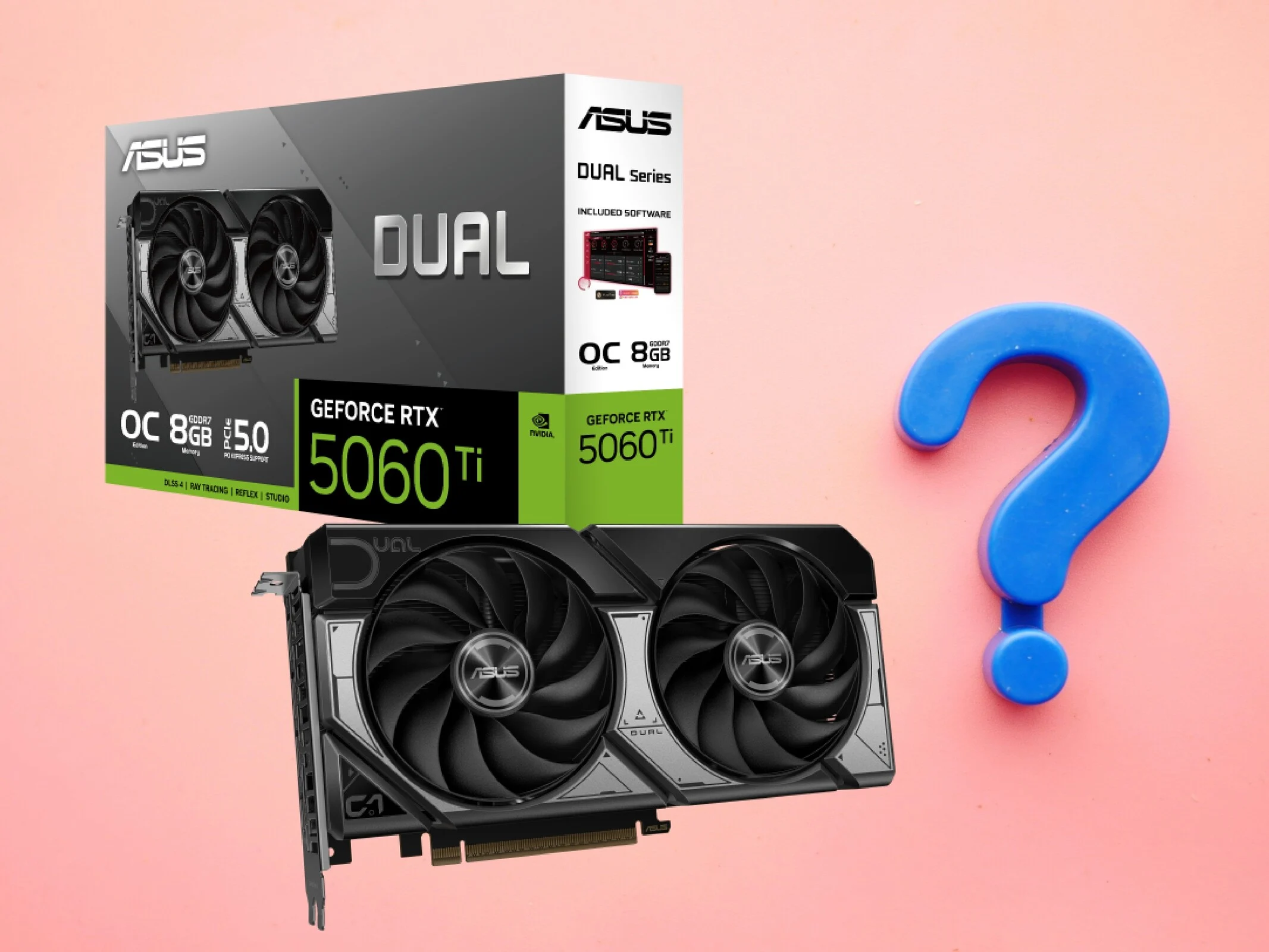
    It’s not an ideal moment to be a PC gaming enthusiast. With tariffs, overheating power cables, and serious stock shortages, fans have been struggling to stay optimistic this year. To make matters worse, Nvidia is trying to push an 8 GB VRAM RTX 5060 Ti 2025 on gamers, adding to the frustration.

    Is There Hope for PC Gaming?

    So, could PC gaming regain its former excitement like it had before 2020? While we can’t definitively answer that, we do have some news that might provide a glimmer of hope for gamers feeling down.

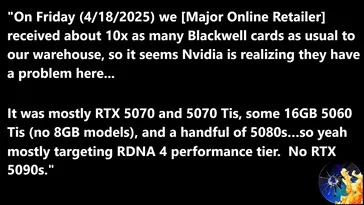
    The news comes from a source known as Moore’s Law Is Dead. According to this leaker, who claims to have information from “Major Online Retailer” sources, Nvidia has dramatically upped the supply of RTX 50 GPUs. Allegedly, on April 18, 2025, the retailer received “about 10x as many Blackwell cards as usual.” The restocked GPUs included the RTX 5070, RTX 5070 Ti, RTX 5060 Ti 16 GB, and some RTX 5080 models. However, no RTX 5090s were delivered, leaving those GPUs still quite rare.

    Nvidia’s Supply Strategy

    Curiously, it seems that Nvidia didn’t send any RTX 5060 Ti 8 GB GPUs to this retailer. Given the poor reception of this particular GPU, it makes sense for Nvidia to hold back on its supply. It’s possible that they might have redirected the RTX 5060 Ti 8 GB stock to system integrators who can sell it more easily as part of pre-built systems, although that’s just a guess.

    Moving along, MLID indicates that this RTX 50 restock isn’t just a one-off for a single retailer. Another source from a different retailer mentioned receiving a “couple hundred” RTX 50 GPUs, while they typically only get around 10-30 at a time. Furthermore, a separate branch of the retailer is said to have received over a hundred cards.

    Future Prospects for Gamers

    In simpler terms, Nvidia appears to have significantly boosted the supply of the RTX 50 Blackwell cards to various retailers. It’s uncertain whether this is a one-time event or if retailers will keep getting substantial restocks in the future. We’re hopeful for the latter, as it could help meet demand and potentially reduce the overall prices of current-generation GPUs.

    Source:
    Link


  • RTX 50 Series GPUs: Benchmark Boost but Gaming Performance Drops

    RTX 50 Series GPUs: Benchmark Boost but Gaming Performance Drops

    Key Takeaways

    1. Nvidia’s 576.02 driver update improves performance for RTX 50 series GPUs, with gains of 3% to 8% reported in synthetic benchmarks.
    2. The update addresses various gaming and bug issues, including black screen problems for some RTX 50 series users.
    3. Users have observed a reduction in power consumption by up to 7W while idle.
    4. Some gamers report instability with the new drivers, including frame rate fluctuations and thermal sensor issues.
    5. Users experiencing black screen issues should consider updating, while others may want to avoid the new drivers due to performance concerns.


    Nvidia has rolled out the 576.02 driver update together with the RTX 5060 Ti GPUs on April 16. This update is accessible for all RTX GPUs, but it appears to give a performance increase especially to the 50 series cards, at least according to synthetic benchmarks. Many users have noted that their GPUs are performing significantly better, with increases ranging from 3% to 8%. Conversely, some individuals are reporting problems in games, pointing to issues with thermal sensors that have arisen due to the latest drivers.

    Performance Improvements and Fixes

    The recent Nvidia driver update comes with a specific PDF containing the release notes, which outline various fixes related to gaming and general bugs, including the black screen problems encountered by some RTX 50 series users. Notably, certain users have observed enhanced performance in synthetic benchmarks, with some gains reported to be as high as 6%.

    German digital outlet Computer Base conducted a 3D Mark test on all RTX 50 series GPUs, including the RTX 5060 Ti. They discovered that the RTX 5070 and higher models exhibited performance improvements between 6% and 8% with the new drivers when compared to the original launch drivers.

    Power Consumption Observations

    Additionally, some users have reported a reduction in power consumption of up to 7W, as the clock speed dropped to just 22 MHz while the card was idle. Videocardz tested an RTX 4090 in 3D Mark Steel Nomad but only saw a mere 1 FPS gain, indicating that the boost in synthetic benchmark performance is mainly impacting the RTX 50 series cards.

    Gaming Performance Concerns

    However, when it comes to gaming performance, the situation is quite different. Numerous Reddit users have noted performance instability with the updated drivers. One user mentioned that their GPU displayed “odd clock behavior” with frame rate fluctuations causing stutters, while others reported higher clock speeds accompanied by increased temperatures. It seems there is a glitch with the thermal sensors due to the new drivers, which is causing clocks to exceed normal levels and hindering thermal monitoring software from providing accurate readings.

    Given these reported instability concerns, it may be wise to refrain from updating to the latest drivers, particularly for RTX 50 series users. Nevertheless, those facing black screen issues should either update to the new drivers or revert to a previously stable version.

  • RTX 5060 Ti 8GB vs 16GB: 30% Lower 1% Lows & 18% Slower Frames

    RTX 5060 Ti 8GB vs 16GB: 30% Lower 1% Lows & 18% Slower Frames

    Key Takeaways

    1. Insufficient VRAM: The RTX 5060 Ti 8 GB is criticized for having only 8 GB of VRAM, making it difficult to justify its price over $300 in 2025.

    2. Lack of Reviews: There are few reviews available for the RTX 5060 Ti 8 GB, with major tech reviewers also not covering it extensively.

    3. Performance Discrepancies: Tests show that the RTX 5060 Ti 8 GB performs significantly worse than its 16 GB counterpart, especially in demanding games and scenarios.

    4. Frame Generation Limitations: The RTX 5060 Ti 8 GB struggles with 4x Frame Generation, leading to lower performance compared to the 16 GB version, particularly in VRAM-intensive scenarios.

    5. Suitable for Less Demanding Games: While it may perform adequately in less demanding games, the RTX 5060 Ti 8 GB falls short in newer titles that require more VRAM, mirroring trends from previous generations.


    The RTX 5060 Ti 8 GB is found lacking in various ways. It’s hard to justify a GPU priced over $300 with only 8 GB of VRAM in 2025. Additionally, there’s a lack of reviews for the RTX 5060 Ti 8 GB, not just from us but also from well-known tech reviewers like Linus Tech Tips and Hardware Unboxed.

    Lack of Coverage

    It appears that Nvidia might not want the media to talk about the RTX 5060 Ti 8 GB. What could be the reason behind this? Perhaps it’s related to how the RTX 5060 Ti 8 GB performs compared to its 16 GB counterpart.

    According to some tests shared by a Chinese reviewer on bilibili, the RTX 5060 Ti 8 GB doesn’t only have half the VRAM of the RTX 5060 Ti 16 GB; it’s also shown to be slower in key situations.

    Performance Comparisons

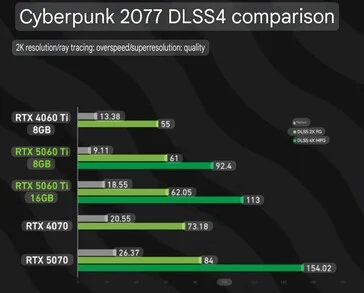
    In a DLSS 4 performance test in Cyberpunk 2077, the RTX 5060 Ti 16 GB and the RTX 5060 Ti 8 GB recorded around 18.5 and 9.1 FPS, respectively, at 2K resolution with ray tracing and other settings maxed out. The DLSS was set to “Quality” with no Frame Generation applied.

    When 2x Frame Generation is used, it supposedly removes this huge 200% performance gap, with the RTX 5060 Ti 8 GB and RTX 5060 Ti 16 GB hitting 61 and 62 FPS, respectively. However, the situation shifts significantly when 4x Frame Generation is introduced.

    With 4x Frame Generation, the RTX 5060 Ti 16 GB outperforms the RTX 5060 Ti 8 GB by 22%, achieving frame rates of 113 compared to 92.4. This makes sense since generating three more frames for each “real” frame demands that the GPU processes more data in its VRAM.

    VRAM Limitations

    This means that the 4X Frame Generation, which Nvidia has been promoting heavily, seems to underperform when the VRAM is restricted to 8 GB. This raises further questions about the necessity of the RTX 5060 Ti 8 GB.

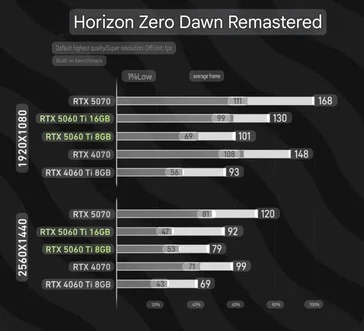
    Moreover, the RTX 5060 Ti 8 GB struggles in games that require more VRAM. For instance, Horizon Zero Dawn Remastered (HZD Remastered) has official system requirements suggesting it ideally needs 16 GB of VRAM.

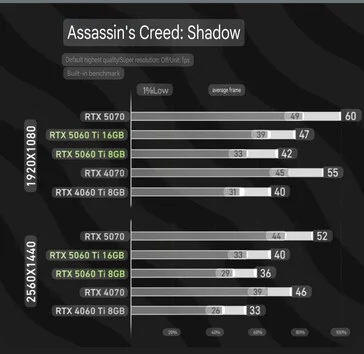
    Given this, it’s not surprising that the RTX 5060 Ti 16 GB is about 29% faster in average FPS at 1080p and 16% faster at 1440p. What’s notable is that the 1% lows at 1080p for the RTX 5060 Ti 8 GB are 30% lower. Thus, HZD Remastered should run more smoothly on the RTX 5060 Ti 16 GB.

    Suitable for Less Demanding Games

    On the bright side, the RTX 5060 Ti 8 GB is likely fine for games that don’t need more than 8 GB of VRAM. For example, in Assassin’s Creed: Shadows, it performs nearly the same as the RTX 5060 Ti 16 GB. For 1080p/60 FPS, Ubisoft recommends the RTX 3060 Ti 8 GB in the official system requirements, so it’s no surprise that the game runs just as well on both the 8 GB and 16 GB versions of the RTX 5060 Ti.

    In summary, the situation mirrors last generation’s trends: Games that require more VRAM will perform significantly worse on the RTX 5060 Ti 8 GB compared to the RTX 5060 Ti 16 GB. The performance gap is also present with 4x Frame Generation. It’s puzzling that mid-range cards with only 8 GB of VRAM still exist in 2025, especially since the newest AAA titles are very demanding and upcoming games are expected to follow suit.

    Source:
    Link


  • Nvidia Fixes Game Crashing Issue with 576.02 GPU Drivers

    Nvidia Fixes Game Crashing Issue with 576.02 GPU Drivers

    Key Takeaways

    1. Nvidia released new 576.02 GPU drivers to fix game crashing issues experienced by GeForce graphics card users.
    2. The update specifically addresses stability problems for Windows 11 version 24H2, including BSOD during gameplay.
    3. RTX 50 series GPUs faced crashes and black screen issues, which the new drivers aim to resolve.
    4. The update fixes crashes in popular games like Fortnite, Star Wars Outlaws, and Overwatch 2, among others.
    5. Users can download the 576.02 GPU driver update through the Nvidia app to resolve their issues.


    Nvidia has just put out new drivers for its GeForce graphics cards to solve the frustrating game crashing problem. The latest 576.02 GPU drivers finally bring a solution to the various trouble gamers have been experiencing globally. Here are all the specifics.

    What Nvidia’s New Drivers Offer

    In recent days, Nvidia got a lot of feedback from users of GeForce GPUs regarding game crashes, problems with stability, and issues with black screens. The new 576.02 GPU drivers have been unveiled to resolve the numerous concerns that were caused by the prior 572.83 drivers which came out back in March 2025.

    Stability Fixes for Windows 11

    According to the release notes for the Nvidia 576.02 drivers, the stability problems have been addressed for systems using Windows 11 version 24H2, which were experiencing BSOD (Blue screen of death) while playing certain titles, especially DLSS 4 games with Multi Frame Generation enabled.

    RTX 50 Series Crashing Problems

    Playing under these settings on RTX 50 series GPUs led to stability issues along with unexpected black screen troubles. The new drivers work to fix crashes in various games like Fortnite, while also dealing with the hanging problem in Star Wars Outlaws when the game is not active. Even Overwatch 2 had a stuttering problem when V-Sync was turned on.

    The update also includes fixes for Control, The Last of Us Part 1, Uncharted Legacy of Thieves Collection, and Hellblade 2. The 576.02 GPU driver update is now available and can be accessed via the Nvidia app. So, if you’ve been experiencing any of these listed issues, ensure your GPU drivers are current.

  • Nvidia Stops AIBs from Sending RTX 5060 Ti 8GB to Reviewers

    Nvidia Stops AIBs from Sending RTX 5060 Ti 8GB to Reviewers

    Key Takeaways

    1. The RTX 5060 Ti series has faced delays, limited stock, and high prices, causing significant debate among consumers.
    2. Only the RTX 5060 Ti 16GB version is being sent to reviewers, while the 8GB version is reportedly withheld by Nvidia.
    3. The RTX 5060 Ti 8GB model is expected to be released later, despite sharing the same advertised launch date as the 16GB version.
    4. Confusion exists around the review process, with some AIB partners claiming the 8GB variant isn’t ready for review due to Nvidia’s restrictions.
    5. Major tech channels like Hardware Unboxed and Linus Tech Tips have expressed frustration with Nvidia’s marketing and launch tactics.


    The launch of the RTX 50 series has stirred up a lot of debate, mainly due to delays, missing ROPs, limited stock, and high prices. This ongoing saga continues with the newest RTX 5060 Ti cards. Nvidia made a formal announcement about the RTX 5060 Ti 16GB, RTX 5060 Ti 8GB, and the RTX 5060 on April 15, with the RTX 5060 Ti models set to release on April 16. However, it seems that only the RTX 5060 Ti 16GB is being sent to reviewers, while AIBs have reportedly been instructed not to provide the 8GB version.

    Confusion Surrounding Reviews

    A popular tech review channel on YouTube, Hardware Unboxed, recently released a video asserting that AIBs or board partners will not be supplying the 8GB variant of the RTX 5060 Ti for review purposes. Some partners claimed that the cards weren’t ready yet, while others stated that Nvidia has specifically stopped them from sending the 8GB card to reviewers. Interestingly, Nvidia had granted permission to reviewers to obtain the RTX 5060 Ti 8GB for initial reviews. This implies that even though both variants are launching simultaneously, only the 16GB version is making its way to reviewers.

    Delayed Release for 8GB Model

    Moreover, Hardware Unboxed mentioned that Nvidia informed them that the 8GB model will be arriving somewhat later, potentially a week after the 16GB version, notwithstanding the same advertised launch date.

    It remains uncertain why Nvidia appears to be keeping the RTX 5060 Ti 8GB’s performance under wraps. Both versions have appeared on retailer websites but, as expected, are already sold out. Additionally, it’s not just Hardware Unboxed that has faced issues; another major tech review channel, Linus Tech Tips, also had a frustrating experience with Nvidia’s marketing, launch tactics, and review restrictions.

    Source:
    Link

  • GeForce RTX 5060 Laptop GPU: 8GB GDDR7, 100W Power Revealed

    GeForce RTX 5060 Laptop GPU: 8GB GDDR7, 100W Power Revealed

    Key Takeaways

    1. Nvidia has introduced the GeForce RTX 5060 for laptops, along with the RTX 5060 Ti and desktop versions.
    2. The RTX 5060 features 8 GB of GDDR7 VRAM and 3,228 CUDA cores, offering a slight improvement over the RTX 4060.
    3. The laptop’s TGP range is between 45 and 100 Watts, compared to the RTX 4060’s 35-115 W.
    4. Performance is expected to improve by 10-15% over the previous generation, with a boost speed of up to 2,497 MHz.
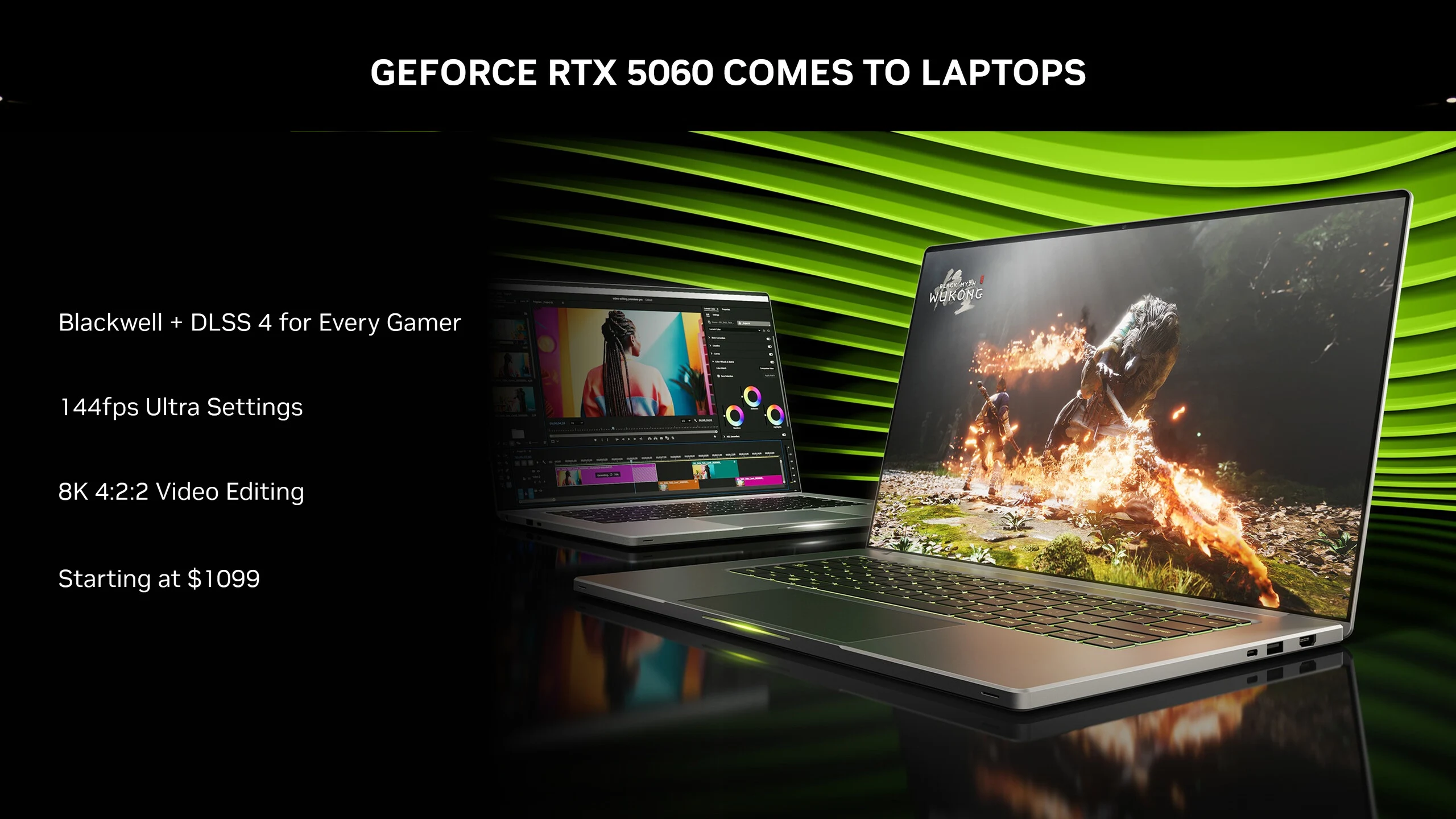
    5. Laptops with the RTX 5060 will start at $1,099 and will be available from major manufacturers in May.


    Nvidia has quietly introduced the GeForce RTX 5060 for laptops, along with the RTX 5060 Ti and the RTX 5060 desktop versions. As hinted by a previous leak, this new GPU will feature 8 GB of GDDR7 VRAM on a 128-bit bus. While the Blackwell laptop series does not offer a Ti version, telling the difference between an RTX 5060 laptop and an RTX 5070 laptop can be quite difficult.

    Specifications Overview

    The new GPU boasts 3,228 CUDA cores, which is slightly more than the 3,072 found in the RTX 4060. However, this increase in CUDA cores comes with a trade-off in terms of TGP range. The RTX 5060 laptop can be set up to consume between 45 and 100 Watts, compared to the RTX 4060’s range of 35-115 W. It can achieve boost speeds up to 2,497 MHz, which again, is a little bit higher than the RTX 4060 laptop.

    Release and Performance

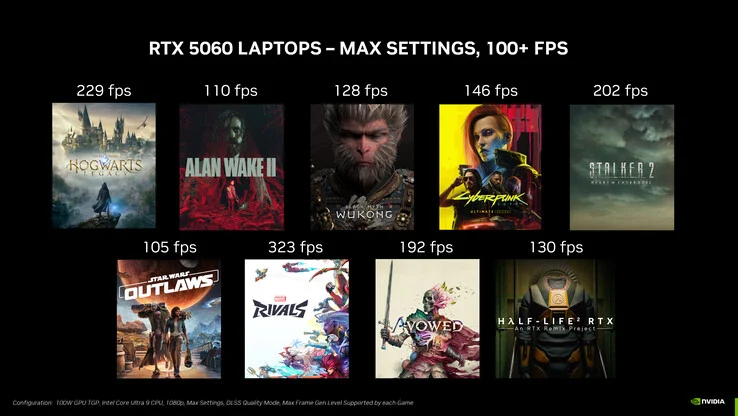
    Nvidia has announced that laptops featuring the GeForce RTX 5060 are expected to be available in May. The company has not shared much information regarding performance improvements, only demonstrating that it can reach over 100 FPS in several games when DLSS and multi-frame generation are activated. Due to its additional CUDA cores and upgraded architecture, it should deliver a performance boost of around 10-15% compared to the previous generation, but the somewhat lower TGP could hinder its performance slightly, especially with just 8 GB of VRAM.

    Laptops equipped with the RTX 5060 will start at a price of $1,099 and will be available from well-known manufacturers like Acer, Asus, Alienware, Gigabyte, HP, Lenovo, and Razer.

    Source:
    Link


  • Nvidia Projects $5.5 Billion Loss from US Chip Export Restrictions

    Nvidia Projects $5.5 Billion Loss from US Chip Export Restrictions

    Key Takeaways

    1. Nvidia warns that new Trump administration measures could reduce its revenue by $5.5 billion due to H20 chip export restrictions to China.
    2. The company’s first quarter earnings may include $5.5 billion in charges linked to H20 products, affecting inventory and purchase agreements.
    3. Nvidia needs a license to sell the H20 chip to China for the indefinite future, as it was previously designed for export.
    4. Concerns arise over the potential use of the H20 chip in Chinese AI technologies, particularly with the introduction of the DeepSeek language model.
    5. The Trump administration is investigating trade policies, including tariffs on semiconductor imports, following existing restrictions on chip exports to China since October 2022.


    In a recent regulatory announcement made on Tuesday, Nvidia has cautioned that new measures from the Trump administration, which may restrict exports of the H20 chip to China, could potentially reduce the company’s revenue by as much as $5.5 billion.

    Financial Impacts of H20 Chip

    Nvidia stated that its first quarter earnings might reflect up to about $5.5 billion in charges related to H20 products, which include costs linked to inventory, purchase agreements, and associated reserves.

    The filing noted that the Government has informed Nvidia it will need a license to sell this chip “for the indefinite future.” This chip was the most powerful one Nvidia had available for China and was already undergoing scrutiny by the White House, which was likely to ban its exports. The company had specifically designed and produced this chip with the intention of exporting it to China, as it adhered to current regulations.

    Concerns Over Chinese AI Development

    These new restrictions follow the introduction of the Chinese language model, DeepSeek, which posed a challenge to American models and raised alarms within the Government regarding the chip’s potential use in fueling such technologies.

    The report mentioned that the Government believes “the covered products may be used in, or diverted to, a supercomputer in China.” This action could significantly affect Nvidia’s financial performance, estimating a $5.5 billion impact for the quarter ending on April 27th.

    Ongoing Investigations into Trade Policies

    In recent days, the Trump administration has also initiated investigations into the pharmaceutical and semiconductor sectors to assess whether additional tariffs on imports are necessary. Since October 2022, the United States has enacted restrictions on chip exports to China, which have intensified in recent days under the Trump administration.

    Source:
    Link

  • RTX 5060 Ti Launch Stock Low, Prices Higher for Gamers

    RTX 5060 Ti Launch Stock Low, Prices Higher for Gamers

    Key Takeaways

    1. The RTX 5060 Ti is expected to be more affordable than previous models, with unknown pricing for 8 GB and 16 GB versions.
    2. The GPU is rumored to have a significant performance boost compared to the RTX 4060 Ti, making it a potential upgrade.
    3. Initial supply of the RTX 5060 Ti may be limited, possibly even less than the RTX 5070 at launch.
    4. Due to restricted supply, street prices could rise, potentially adding around $100 to the expected MSRP.
    5. The RTX 5060 Ti may become a more appealing choice for consumers, especially in light of difficulties finding the Radeon RX 9070 at fair prices.


    The RTX 5060 Ti is set to be officially unveiled today. At this moment, the exact prices for the RTX 5060 Ti 8 GB and 16 GB versions are still unknown, but it’s very likely that they will be more affordable than the previous models. With a rumored performance boost in double digits compared to the RTX 4060 Ti, the RTX 5060 Ti could serve as a worthy upgrade.

    Supply Issues Ahead

    On the flip side, Nvidia’s earlier RTX 50 launches haven’t really built much trust regarding the availability of this GPU. Unfortunately, as per Moore’s Law Is Dead, it seems this situation will be no different, as the RTX 5060 Ti might be facing the same stock limitations as the RTX 5070.

    Tight Launch Supply

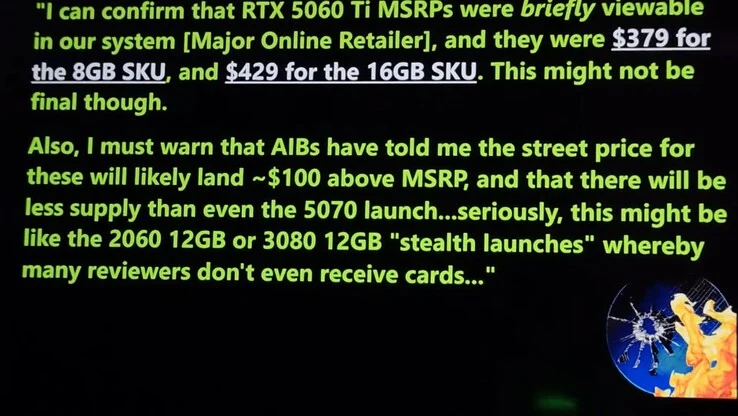
    Moore’s Law Is Dead has also shared that the initial supply of the RTX 5060 Ti will be quite constrained. The insider suggests that the RTX 5060 Ti could have “even less supply than the RTX 5070 at launch.” This situation has been likened to the “stealth launches” seen with the RTX 2060 12 GB and RTX 3080 12 GB, which could lead to reviewers struggling to obtain samples.

    Pricing Concerns

    Naturally, a restricted launch supply means prices on the street could rise. According to one source affiliated with MLID, the pricing for the $379 RTX 5060 Ti 8 GB and the $429 RTX 5060 Ti 16 GB models might see an increase of around $100. This suggests that gamers could be looking at a price of $479 for the RTX 5060 Ti 8 GB and a hefty $529 for the RTX 5060 Ti 16 GB.

    If everything were operating smoothly and the Radeon RX 9070 was available at its official $549 MSRP, the RTX 5060 Ti 16 GB, which is presumed to be weaker than the RX 9070, would have had a tough time competing. However, in the current climate, where many consumers struggle to find the RX 9070/XT at fair prices, the RTX 5060 Ti could be a more appealing option for several users.

    Source:
    Link


  • Nvidia GeForce RTX 5060 Ti Announced at $379, RTX 5060 in May

    Nvidia GeForce RTX 5060 Ti Announced at $379, RTX 5060 in May

    Key Takeaways

    1. Nvidia has officially launched the RTX 5060 Ti and RTX 5060, expanding its lineup of Blackwell GPUs aimed at 1440p gaming.
    2. The RTX 5060 Ti features 4608 CUDA cores, a boost clock speed of 2.57 GHz, and offers 8GB or 16GB GDDR7 VRAM options.
    3. Both the RTX 5060 Ti and RTX 5060 will support advanced technologies like DLSS 4 Multi Frame Generation and Neural Rendering for improved gaming performance.
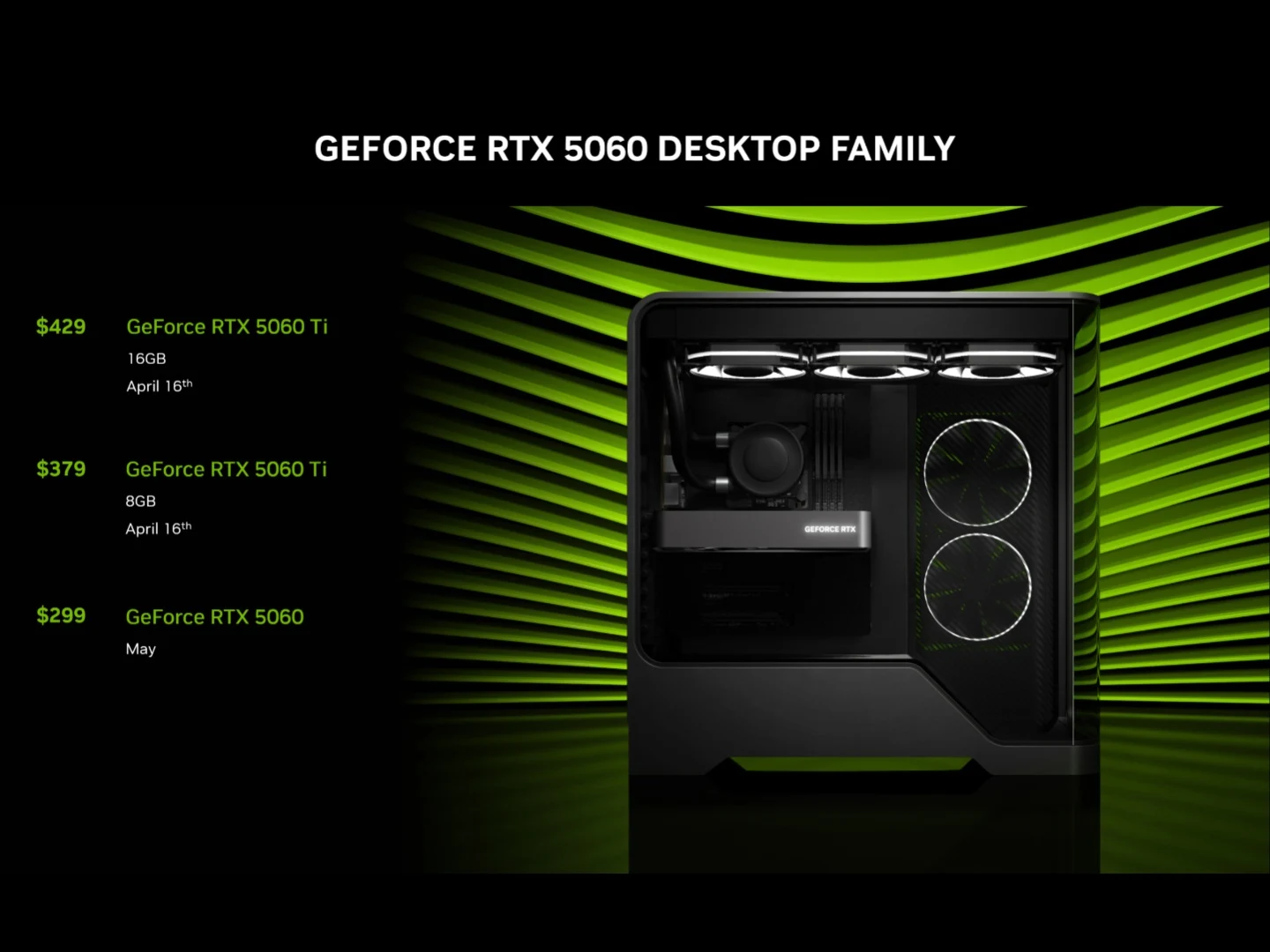
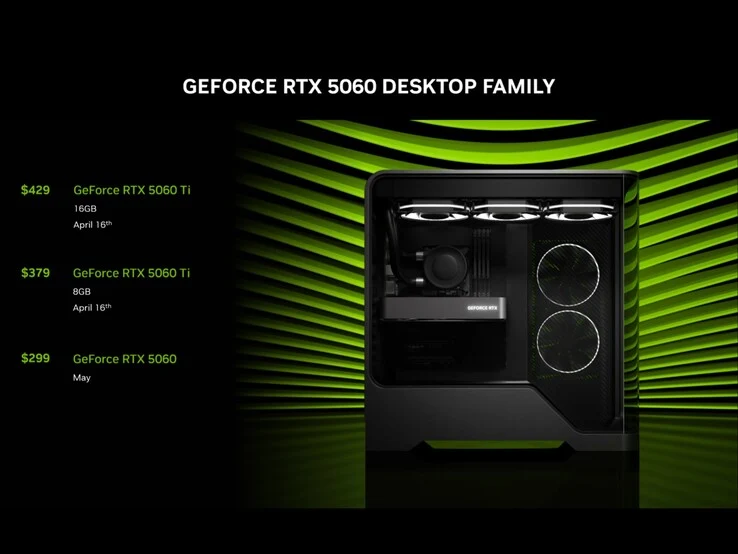
    4. The pricing for the RTX 5060 Ti starts at $379 for the 8GB version and $429 for the 16GB version, while the RTX 5060 is priced at $299.
    5. The RTX 5060 Ti and RTX 5060 will be available starting April 16, with laptops featuring the RTX 5060 expected in May.


    Nvidia has made it official with the introduction of the RTX 5060 Ti and RTX 5060, which now join their previously launched Blackwell GPUs: the RTX 5090, RTX 5080, RTX 5070 Ti, and RTX 5070. These new entry-level cards come with two VRAM options, either 8GB or 16GB, and Nvidia aims to cater to 1440p gaming enthusiasts with these models. Much of the card’s specs were known ahead of the announcement due to multiple leaks and rumors, but now it’s confirmed with a launch date set for April 16.

    Specifications and Performance

    The RTX 5060 Ti boasts 4608 CUDA cores, 72 TFLOPS of Ray tracing cores, a boost clock speed of 2.57 GHz, and a base clock of 2.41 GHz. It’s interesting to note that it has higher clock speeds compared to the RTX 5070, RTX 5070 Ti, and even the RTX 5090. However, it operates on a slower 128-bit memory interface, but other than that, it shows improvements over the previous generation RTX 4060 Ti in all key areas.

    VRAM Versions and Technologies

    Available in both 8GB and 16GB GDDR7 VRAM versions, the performance gap between these two variants should be clearer once reviews are published later today, April 15. Naturally, it will support Nvidia’s latest technologies like DLSS 4 Multi Frame Generation, Neural Rendering, and other Blackwell features that are claimed to provide a smooth, low-latency gaming experience at 1440p.

    Pricing and Availability

    In addition to the RTX 5060 Ti, Nvidia also unveiled the RTX 5060 and RTX 5060 laptops, although exact release dates for these have not been confirmed yet. The RTX 5060 also comes with 8GB GDDR7 VRAM and is said to deliver double the performance of the RTX 4060, aided by DLSS4 Multi Frame Generation.

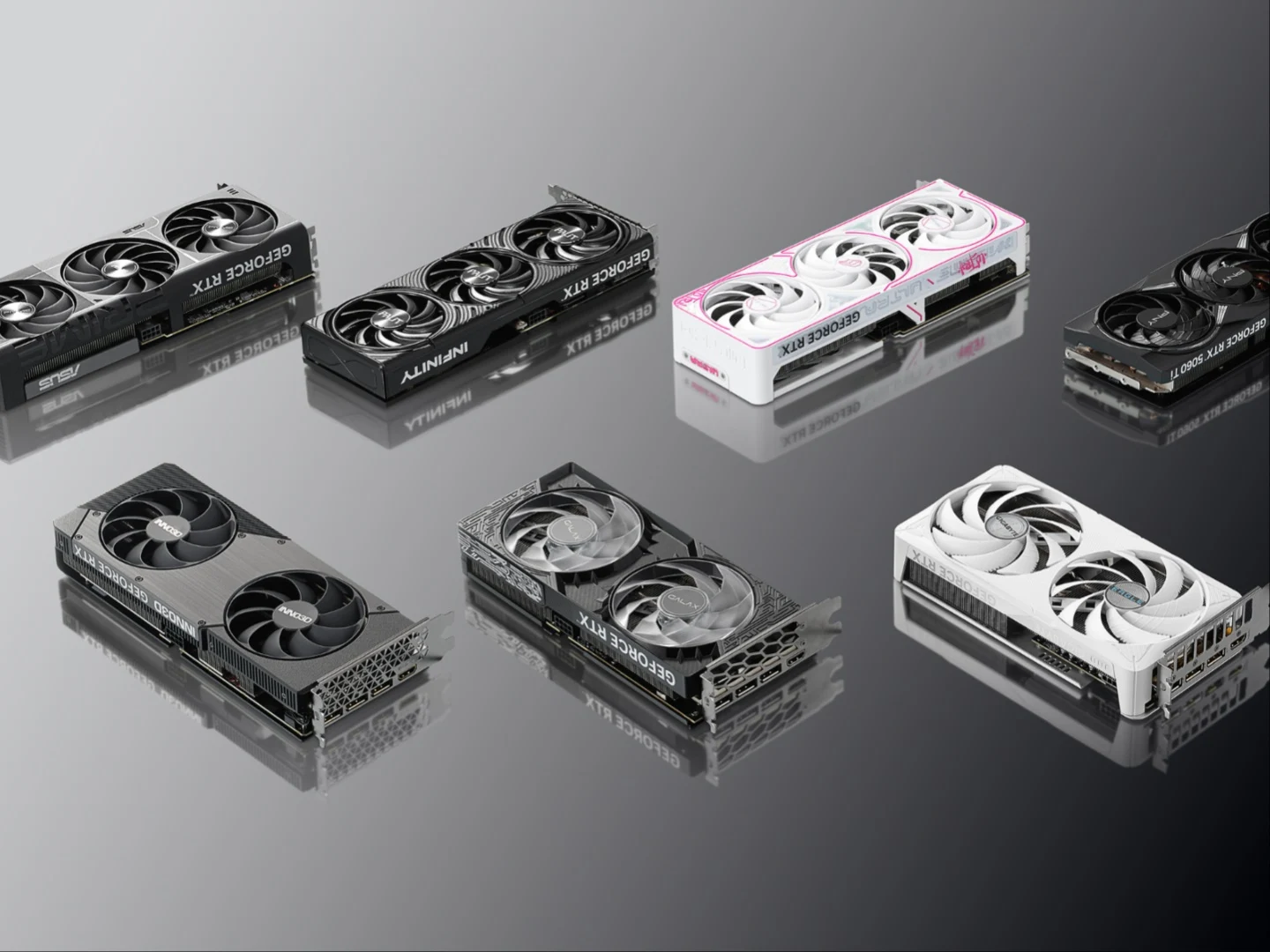
    The pricing for the 8GB version of the RTX 5060 Ti is set at $379, while the 16GB version is going for $429. Both variants will be available starting tomorrow, April 16, from a variety of board partners including ASUS, GALAX, GIGABYTE, INNO3D, Colorful, Gainward, MSI, Palit, KFA2, PNY, and ZOTAC. They are priced $20 less for the 8GB model and $70 less for the 16GB model compared to the RTX 4060 Ti.

    The RTX 5060 starts at a price of $299, making it the only GPU that maintains the same cost as its predecessor. The laptops featuring the RTX 5060 are expected to start at $1,099. Both the desktop GPU and the laptops powered by this GPU are anticipated to be available sometime in May.

    Source:
    Link


  • RTX 5070 Power Cable Issues: Following RTX 5090 Problems

    RTX 5070 Power Cable Issues: Following RTX 5090 Problems

    Key Takeaways

    1. A user reported a melting power cable issue with the Zotac RTX 5070, raising concerns about potential design flaws in Nvidia’s Blackwell GPU series.
    2. The incident may be linked to a damaged pin and inadequate load balancing, similar to previous issues noted in the RTX 4090 series.
    3. Thermal imaging by overclocker Der8auer revealed uneven current distribution in the RTX 5090, suggesting broader implications for the RTX 50 lineup.
    4. Nvidia has not communicated effectively about these issues, leaving users anxious due to the high cost of the GPUs.
    5. Concerns about reliability and potential warranty voiding may diminish interest in the RTX 50 series, which starts at over $500.


    Nvidia’s Blackwell GPU series is under fresh criticism after an RTX 5070 user reported a power cable that melted. Although such incidents are uncommon, they point to possible design flaws that could affect the entire RTX 50 lineup, even the less power-hungry models.

    Incident Overview

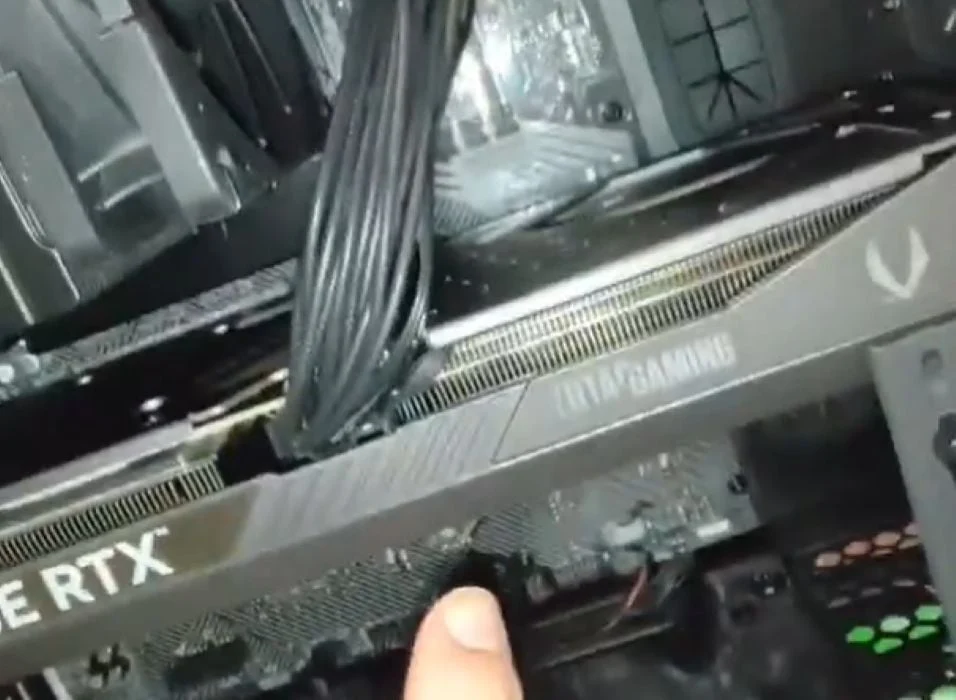
    The recent case was shared by X user ere9w, who experienced the issue with a Zotac RTX 5070 connected to a 750-watt Seasonic PSU in a brand new gaming setup. Just after turning on the system, smoke was seen rising, indicating that it was the cable that melted, not the GPU’s 12V-2×6 connector.

    Possible Causes

    A damaged pin and inadequate load balancing might have contributed to this problem. In earlier reports concerning the RTX 4090 series, Nvidia initially attributed similar issues to improper connection but later supported a modified 12V-2×6 design. During the inspection of the GPU, Ere9w found a damaged pin on the power connector. Given how difficult it is to misalign the components, many users believed it to be a manufacturing flaw. The user also emphasized the importance of correct installation.

    Broader Implications

    This situation mirrors the findings of overclocker Der8auer, who examined an RTX 5090 with a melted connector and cable. By using thermal imaging, he discovered that the current was not distributed evenly, with certain wires handling too much load. The 12V-2×6 design does not have a system to track power draw per pin, which leads to poor load distribution and overheating. This issue now seems to extend beyond the power-thirsty 5090, potentially affecting the RTX 5070 and 5080 as well. This raises significant concerns about the reliability of the entire series.

    Nvidia’s lack of communication (at the time of this writing) leaves gamers feeling uneasy, especially given the steep price of these GPUs. While the RTX 40 series led to a fix for the connector issues, the problems with the RTX 50 series suggest that difficulties in Blackwell’s architecture remain unresolved. Users who purchase these cards, which start at over $500, risk damage that could void warranties if classified as user error. Until Nvidia addresses these concerns, reports of melted cables may diminish excitement for the otherwise promising RTX 50 series.

    Source:
    Link