Tag: GPU Pricing

  • Framework criticizes OpenAI over high RTX 5070 12GB graphics card price

    Framework criticizes OpenAI over high RTX 5070 12GB graphics card price

    Key Takeaway

    1. The RTX 5070 mobile GPU now offers 12 GB of VRAM, up from 8 GB, but at a significantly higher price.
    2. The $1,199 price for Framework’s RTX 5070 12 GB module is largely attributed to inflated memory costs, linked to a perceived global memory shortage.
    3. OpenAI’s alleged role in causing the memory shortage has contributed to persistent graphics card component price inflation.
    4. Future gaming laptops with the RTX 5070 12 GB are expected to be costly, potentially approaching the prices of RTX 5070 Ti systems.
    5. Consumers might find it more practical to opt for a gaming laptop with an RTX 5070 Ti, which offers similar VRAM but better performance at a comparable price.

    The Price and Availability of the RTX 5070 12 GB Laptop GPU

    The launch of the RTX 5070 laptop GPU raised some eyebrows mainly because of its VRAM. The initial version featured only 8 GB of VRAM which left many users disappointed. Finally, Nvidia decided to fix that issue by offering the mobile RTX 5070 with a substantial upgrade to 12 GB of VRAM. But, this upgrade has brought a new challenge: higher prices. Due to ongoing shortages, memory like GDDR7 has become expensive, and that expense is passed on to consumers. The additional 4 GB of VRAM in the RTX 5070 12 GB model comes with a significant cost increase, meaning more money for the same performance level.

    The Price Disparity

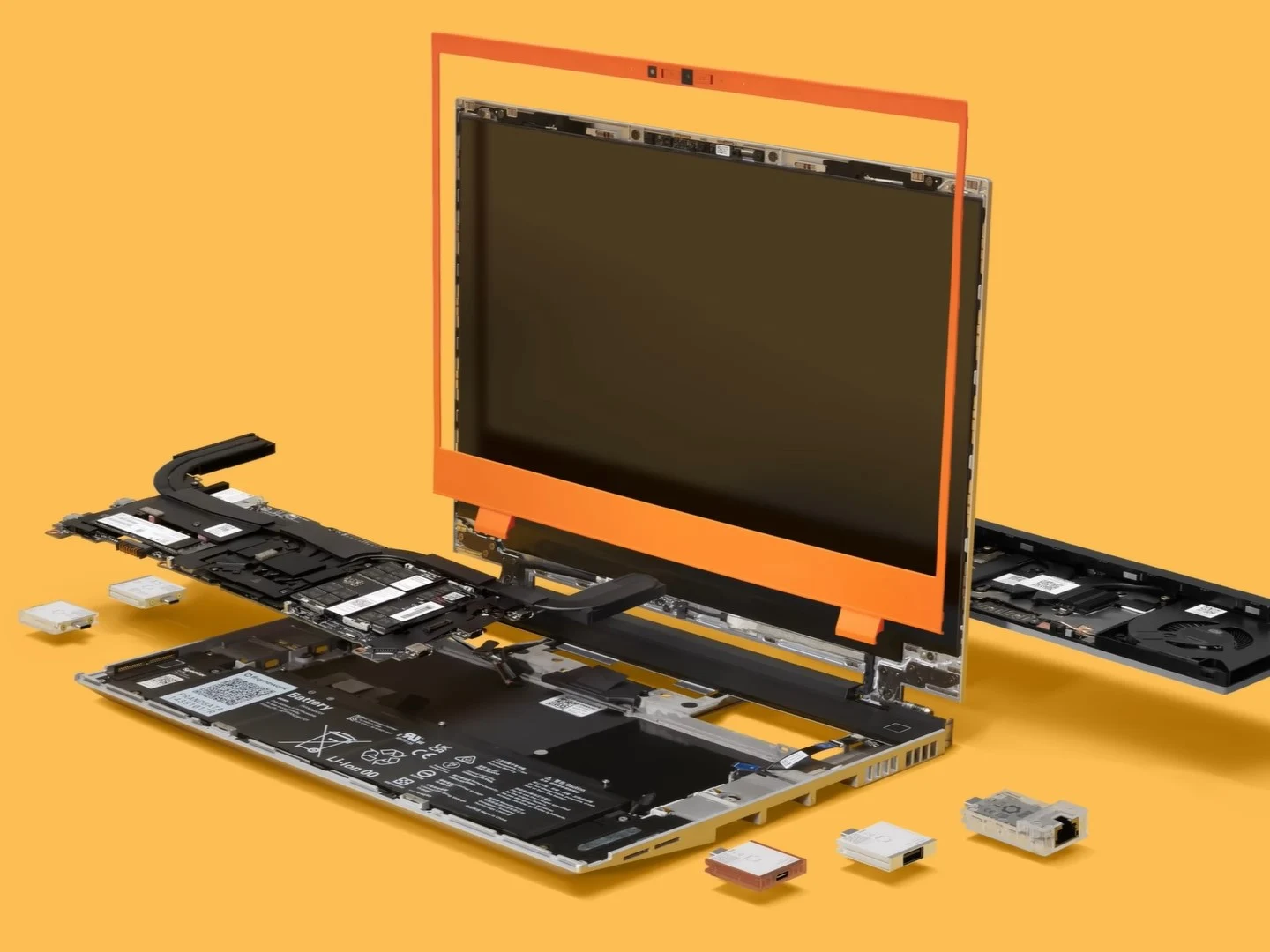
    Framework’s version of the RTX 5070 12 GB module is priced at $1,199, which is a hefty $500 more than its 8 GB counterpart. This sharp increase for just 4GB of VRAM seems unreasonable, yet the company explained that their hands are tied financially. The markup is primarily driven by the rising costs of GDDR7 memory, which is currently in high demand and short supply across the market. This makes the newer 12 GB modules more costly to produce, and in turn, more expensive for consumers. The price gap, which is about 70%, appears quite steep for a relatively small upgrade in VRAM.

    Speculations Behind the Price Spike

    In a unique twist, Framework hinted that OpenAI might be a contributor to the skyrocketing prices. Though the statement might be playful or sarcastic, it’s not entirely without controversy. Many experts believe OpenAI’s aggressive push to control a large chunk—about 40%—of the available global memory supply has played a role in constricting availability. This situation has contributed heavily to the overall memory shortage that affects industries from gaming to AI research. Interestingly, OpenAI has recently stepped away from some of these memory procurement plans, but the market conditions haven’t improved and prices remain high. The result is a tough environment for hardware makers and consumers alike.

    The Future of Gaming Laptops with RTX 5070

    For those waiting on gaming laptops equipped with the RTX 5070 12 GB GPU, good news is on the horizon. These laptops are expected to be available within the next few months. Once they arrive, it will be easier to see if the price premium that Framework is asking is typical or if other OEMs like Dell or Lenovo will price their models more competitively. However, early indications suggest that these laptops might be priced similar to those with the RTX 5070 Ti, which boasts comparable VRAM but offers over 20% better performance. So, if you have been planning to buy a new gaming laptop with this GPU, it might be more practical to consider a slightly more expensive but significantly faster RTX 5070 Ti model instead.

    Sources
  • Nvidia MSRP Myth: GPU Prices and the RAM Crisis Explained

    Nvidia MSRP Myth: GPU Prices and the RAM Crisis Explained

    Key Takeaways

    1. Rising system memory prices are affecting not just memory modules but also graphics cards (GPUs) due to their dependence on VRAM.
    2. Nvidia’s suggested retail prices (MSRP) are unreliable, as actual sales prices often do not reflect these recommendations.
    3. Nvidia’s pricing strategy with board partners allows them to transfer increased costs from rising RAM prices to consumers without changing the MSRP.
    4. The end of Nvidia’s Observed Pricing Program (OPP) has made it harder for manufacturers to sell GPUs at MSRP, impacting profitability.
    5. The shift in focus towards high-end models may lead to reduced availability and increased prices for budget graphics cards.


    System memory prices have been rising, which isn’t shocking anymore. However, the so-called RAR crisis is affecting more than just memory modules; it also impacts other parts like graphics cards. This seems reasonable since GPUs depend on RAM, or more specifically, VRAM. In a recent video, German hardware YouTuber der8auer reveals that the recent spike in GPU prices is more complicated than it seems. Titled “Die Nvidia UVP-Lüge” (“The Nvidia MSRP Lie”), he claims that Nvidia’s suggested retail prices are no longer a good guide. Although they promote their entry-level prices, these are seldom seen in actual sales.

    Internal Pricing Issues

    Der8auer, who is known for his hardware reviews and overclocking content, has over half a million subscribers on YouTube. He points out a significant problem with Nvidia’s MSRP, which lies in its pricing strategy with board partners. Typically, GPUs and VRAM are sold together, so when RAM prices rise, it directly affects what the manufacturers have to pay. This setup helps Nvidia keep its profit margins intact while transferring cost increases to the downstream without officially changing the MSRP. Consequently, board partners take on these extra costs and often pass them along to consumers when they sell the products.

    The End of the OPP Program

    For a long time, Nvidia’s OPP (Observed Pricing Program) was crucial in keeping graphics card pricing close to the suggested MSRP. Under this program, manufacturers received financial incentives when they sold cards at the recommended price. Der8auer explains that many models would not be profitable without this support. However, now that the program is gone, achieving the MSRP has become even more difficult. While the suggested price still exists in theory, selling at that price is rarely beneficial for retailers. Because of this, der8auer warns that manufacturers might increasingly concentrate on high-end models since lower-tier cards are no longer profitable without subsidies. This change could lead to reduced availability in the budget category and drive prices even higher.

    der8auer via YouTube

    Source:
    Link


  • AMD Collaborates with Partners to Avoid GPU Price Increases

    AMD Collaborates with Partners to Avoid GPU Price Increases

    Key Takeaways

    1. The tech industry is experiencing a memory crisis, impacting DDR5 RAM, SSDs, GPUs, and potentially power supplies and CPU coolers.
    2. AMD is focused on maintaining GPU prices close to the manufacturer’s suggested retail price (MSRP) despite rising costs.
    3. AMD has built long-term relationships with DRAM suppliers to secure stable pricing and supply for memory components.
    4. Collaborations with add-in card partners aim to align market prices with AMD’s recommended MSRPs, but predicting market conditions remains difficult.
    5. Price hikes are anticipated in the future, leading to advice for consumers to purchase GPUs before the end of 2025.


    The tech industry is currently facing a significant memory crisis. It began with a dramatic rise in DDR5 RAM prices, but the repercussions have extended beyond that. SSDs and GPUs are also feeling the squeeze, and there are indications that power supplies and CPU coolers may be the next to see price hikes. With a multitude of essential PC parts experiencing simultaneous cost increases, the future appears challenging for those building PCs. In the midst of this turmoil, AMD seems to be striving to maintain its graphics card prices as close to the manufacturer’s suggested retail price (MSRP) as possible.

    AMD’s Strategy

    In a conversation with Gizmodo, David McAfee, who leads AMD’s Ryzen division, shared that managing GPU pricing effectively in 2026 is a crucial objective for the company. He mentioned that AMD has established long-term relationships with key DRAM suppliers, which aids in securing adequate supply and more stable pricing for memory components. This is vital since memory costs significantly impact the final price of a graphics card.

    “We’ve built very strategic partnerships over many years with all the DRAM manufacturers to ensure that both the quantity of supply required and the cost structure we can get from them align with what we support in our graphics business,” he said.

    Challenges Ahead

    McAfee also pointed out that AMD is collaborating closely with its add-in card (AIC) partners to keep actual market prices in line with AMD’s recommended MSRPs. However, he acknowledged that predicting the market situation is difficult. Should memory prices continue to climb, it will become increasingly challenging for board partners to manufacture GPUs that meet the desired performance and price equilibrium. Essentially, without reasonably priced memory, even the best-laid plans for GPU pricing can quickly unravel.

    Nonetheless, it’s crucial to remember that a few months back, a spokesperson from PowerColor, one of AMD’s main board partners, advised users on Reddit to purchase GPUs before the end of 2025, hinting that price hikes are anticipated. Currently, AMD claims it is doing all it can to keep GPU prices within a reasonable range. Whether these efforts will suffice while memory and component prices keep rising remains to be seen.

    Gizmodo

    Source:
    Link


  • AMD RDNA 4 GPU Prices Surge Again Due to Memory Supply Issues

    AMD RDNA 4 GPU Prices Surge Again Due to Memory Supply Issues

    Key Takeaways

    1. AMD and Nvidia may stop producing lower-end and mid-range graphics cards due to rising memory prices.
    2. AMD plans to increase prices by $10 for every 8 GB of GDDR VRAM in the RDNA 4 series.
    3. Retailers have adjusted prices to reflect a return to higher pricing seen during past stock shortages.
    4. Current MSRPs for RDNA 4 GPUs are lower, making it a good time to consider purchasing an AMD Radeon card.
    5. No specific price hikes for Nvidia GeForce RTX 50 GPUs have been mentioned, but increased costs for GDDR memory are expected to affect pricing.


    Ever since the prices of memory shot up dramatically, it was anticipated that desktop gaming GPUs would experience significant impacts. There have been claims that AMD and Nvidia might stop producing their lower-end and mid-range desktop graphics cards due to the financial constraints in this sector. Recently, rumors have spread that AMD plans to raise prices by $10 for every 8 GB of GDDR VRAM.

    Revised Pricing for RDNA 4

    This supposed price hike for the RDNA 4 series will change the Manufacturer’s Suggested Retail Prices (MSRPs) for the existing RDNA 4 models. When comparing these prices to current DDR5 kit prices, the increase seems relatively modest and should not greatly affect consumers. However, according to Moore’s Law Is Dead, the actual price rise for RDNA 4 RX 9000 GPUs, such as the RX 9070 XT, might be considerably higher.

    Retailer Adjustments

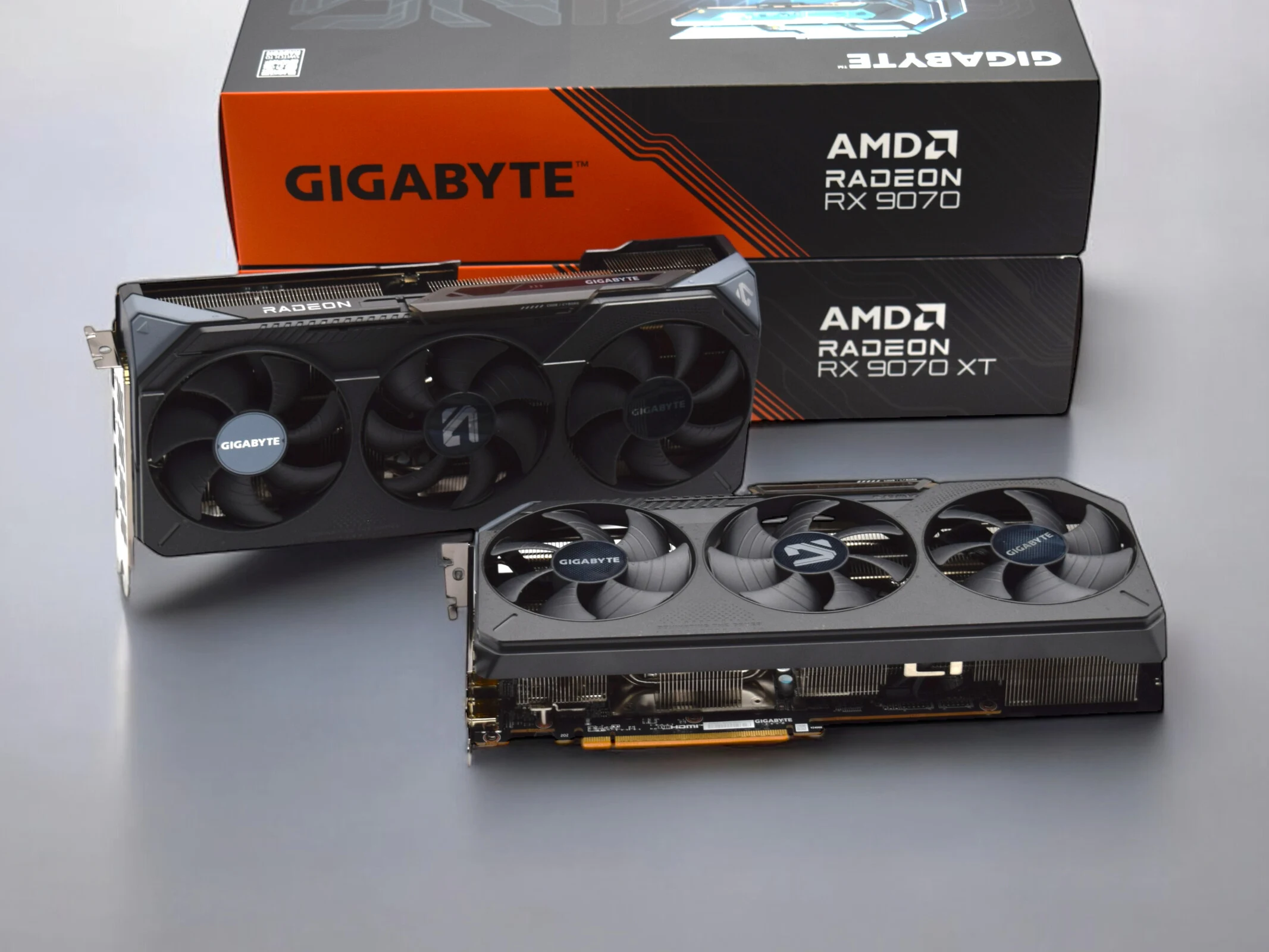
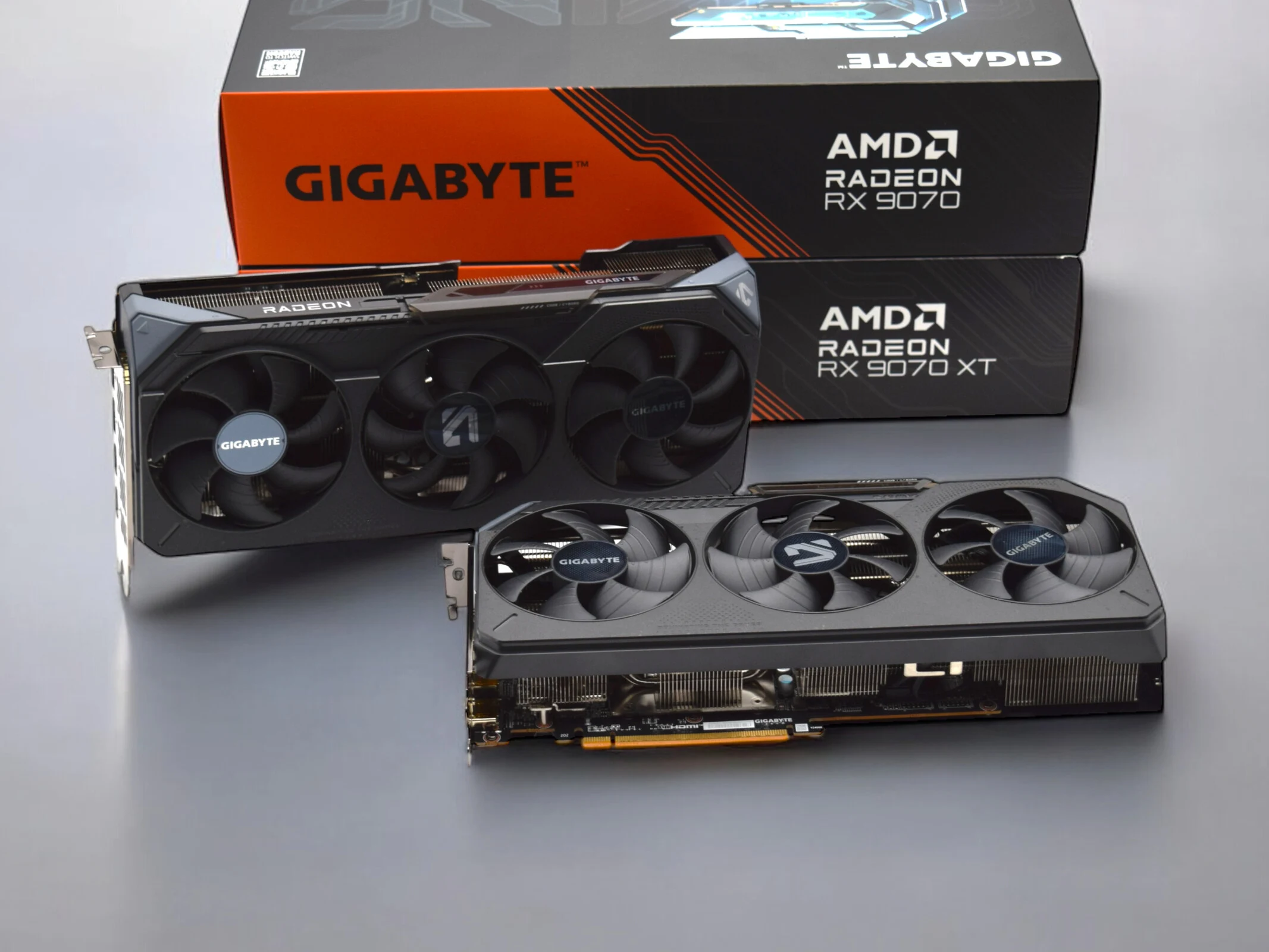
    Sources indicate that retailers have already adjusted their internal prices, and the outlook appears grim. Essentially, it seems the RDNA 4 graphics cards will revert to the pricing seen back in 2025 when stock shortages were prevalent, where the RX 9070 and RX 9070 XT were sold for significantly higher than their original MSRPs.

    Expected Retail Prices

    Following the price increase due to memory inflation, MLID anticipates that RDNA 4 graphics cards will be sold at:

    When you look at these figures, the current MSRPs for the RDNA 4 GPUs mentioned above are much lower. Thus, if you’ve been deliberating on purchasing an AMD Radeon card, now might be an excellent opportunity to do so.

    MLID doesn’t mention any price hikes for Nvidia GeForce RTX 50 GPUs. Although Nvidia will likely pass the increased costs of GDDR memory onto customers, it remains unclear how much more Team Green will require for GPUs like the RTX 5070.

    Source:
    Link


  • RX 9070 XT Prices Drop as Demand Decreases for Patient Gamers

    RX 9070 XT Prices Drop as Demand Decreases for Patient Gamers

    Key Takeaways

    1. The AMD Radeon RX 9070 XT is nearing its suggested retail price of $599 after a five-month period.
    2. Initial market prices for the RX 9070 XT exceeded expectations due to high demand and limited MSRP cards.
    3. Demand for the RX 9070 XT has decreased, leading to prices approaching $600 for some AIB cards.
    4. Retail prices for the RX 9070 XT vary widely, with some listings still above $700.
    5. Future price drops are likely as demand fades and new GPU models from Nvidia and AMD are expected soon.


    While it took about 5 months, the AMD Radeon RX 9070 XT is finally nearing its suggested retail price of $599. When AMD launched this card in March, the RX 9070 XT was expected to be the best graphics card deal on the market, especially since its competitor, the RTX 5070 Ti, was priced much higher at $749.

    Pricing Issues

    Unfortunately, the RX 9070 XT didn’t achieve the success AMD hoped for, as the actual market price was far from the $599 figure they announced. This wasn’t because of any shortage on AMD’s side; reports suggested they had plenty of RX 9070 XT cards ready. The ongoing rise in the RX 9070 XT’s price might’ve been due to demand significantly surpassing supply, along with a smaller number of MSRP RX 9070 XT compared to non-MSRP AIB cards.

    Demand Decrease

    It appears that the demand for the RX 9070 XT has dropped enough that AIB cards are finally approaching the $600 mark. Data shared by TechEpiphany on X reveals a decline in price for the ASRock Radeon RX 9070 XT Steel Legend. The card is now priced near $600.

    This trend aligns with current GPU prices at retailers like Best Buy, where the RX 9070 XT has been available for significantly under $700. Nevertheless, there are still many RX 9070 XT cards that are excessively priced. For example, the lowest priced RX 9070 XT on Newegg is around $699.99, whereas Amazon lists it for about $719.99.

    Future Price Predictions

    According to TechEpiphany, this drop in RX 9070 XT street prices is attributed to a “fade” in demand. If this is accurate, prices might continue to decrease, especially since Nvidia and AMD are expected to roll out additional GPU models by the end of this year.

    Source:
    Link


  • RTX 5060 Ti Price Leak: Good News or Trouble from US Tariffs?

    RTX 5060 Ti Price Leak: Good News or Trouble from US Tariffs?

    Key Takeaways

    1. The RTX 5060 Ti is expected to be announced on April 15, with reviews and sales starting on April 16; the RTX 5060 may launch in May.
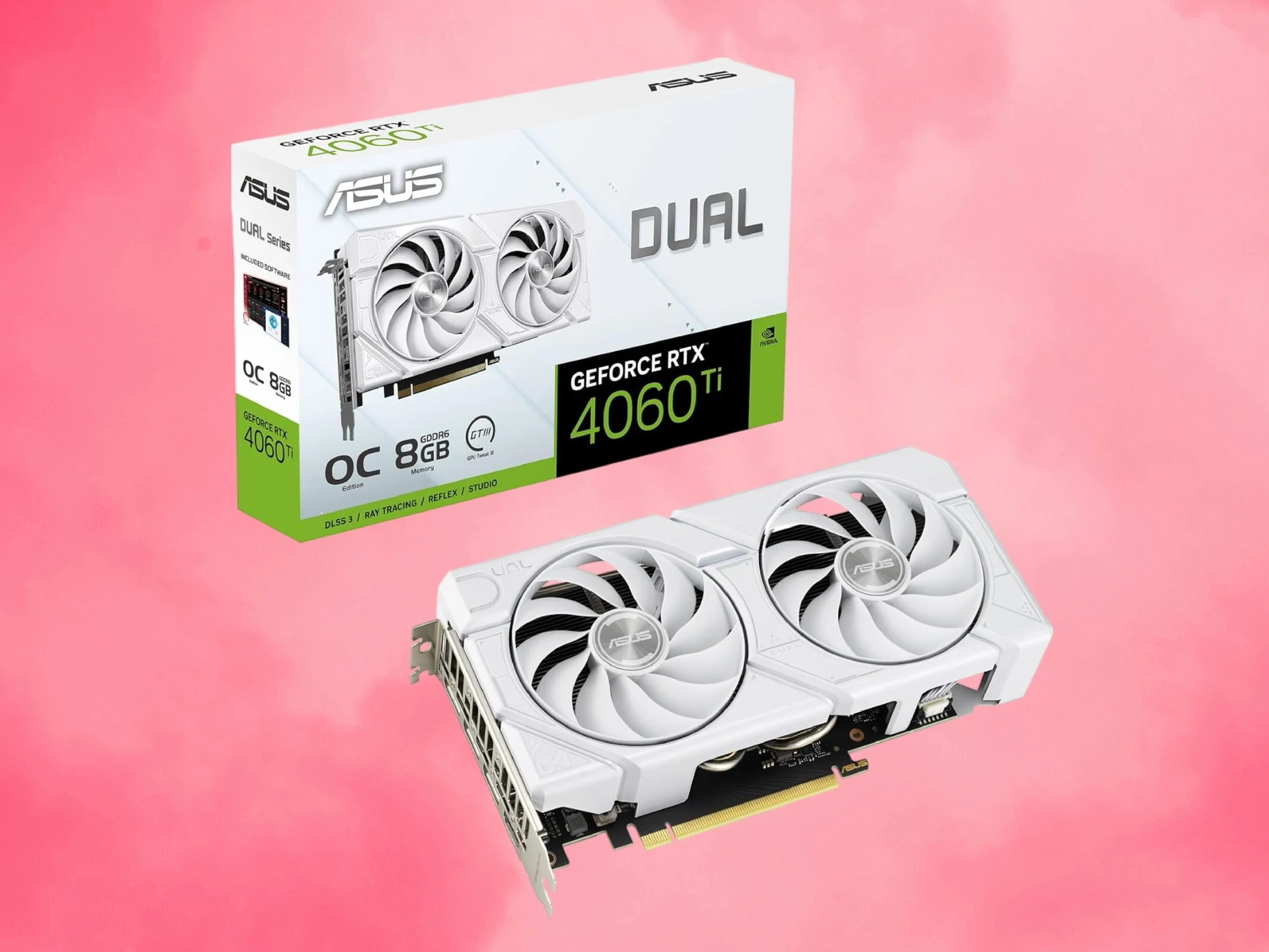
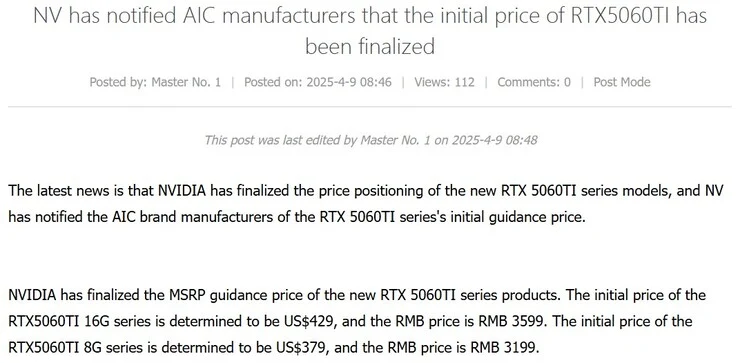
    2. Initial pricing for the RTX 5060 Ti could be $429 for the 16 GB model and $379 for the 8 GB variant, making them competitive against previous models.
    3. The RTX 4060 Ti faced criticism for its pricing, as the performance increase over the RTX 3060 Ti was minimal, highlighting pricing concerns in the market.
    4. The final retail price of the RTX 5060 Ti is still uncertain and may be influenced by high demand and fluctuating market conditions.
    5. Recent US tariffs on imports from Taiwan and China could lead to higher consumer prices for the RTX 5060 Ti if they remain in place.


    The RTX 5060 Ti is expected to release soon, as rumors suggest that the announcement could happen on April 15. Last month, we shared that Nvidia might reveal both the RTX 5060 and RTX 5060 Ti on this date. Reviews and the official sales for the RTX 5060 Ti are anticipated to be available the following day, April 16. The RTX 5060, however, is rumored to hit the market in May.

    Specifications and Pricing Uncertainty

    We have some insights into the specifications for both the RTX 5060 and the RTX 5060 Ti, but the final pricing for these GPUs remains a mystery. It’s common for GPU prices to fluctuate until officially announced. However, Nvidia appears to have communicated the final price of the RTX 5060 Ti to its AIB partners about a week before the launch.

    As per details shared on Board Channels (through VideoCardz), Nvidia is expected to set the initial price for the RTX 5060 Ti at $429 (RMB 3,599) for the 16 GB model. Meanwhile, the 8 GB variant of the RTX 5060 Ti is said to be priced at $379 (RMB 3,199), which is $50 less. If these figures are correct, they seem quite competitive, especially when compared to the launch prices of the RTX 4060 Ti models.

    Comparison to Previous Models

    The RTX 4060 Ti 8 GB debuted at $399, whereas the 16 GB version was priced at $499. This $100 price gap drew a lot of negative feedback, as the RTX 4060 Ti didn’t offer a significant performance boost compared to the RTX 3060 Ti. Consequently, Nvidia faced criticism for imposing an extra $100 charge for an additional 8 GB of VRAM.

    Despite this, we still don’t know what the actual retail price of the RTX 5060 Ti will be. The high demand, which has caused prices for mid-range GPUs like the RX 9070 to soar, could impact the final consumer pricing for the RTX 5060 Ti.

    Market Challenges Ahead

    Additionally, the recent tariffs imposed by the current US government on countries like Taiwan and China may worsen the already struggling GPU market. The US has enacted a 32% tariff on goods from Taiwan and an astonishing 104% on imports from China, following the latest increases. Both nations play a crucial role in Nvidia’s supply chain. If these tariffs remain in place, US consumers might find themselves facing much higher prices than the leaked MSRPs for the RTX 5060 Ti.


  • RTX 5060 Ti 16GB Price Leak: $499 Expected Release Cost

    RTX 5060 Ti 16GB Price Leak: $499 Expected Release Cost

    Key Takeaways

    1. Nvidia is expected to unveil the RTX 5060 Ti around mid-April, but details on the launch schedule are unclear.
    2. The RTX 5060 Ti will have two versions: 8 GB priced at $399 and 16 GB priced at $499, with custom models potentially costing more.
    3. The 16 GB version may outperform the RTX 5070 in VRAM-heavy games, similar to the RTX 3060 12 GB’s performance.
    4. The standard RTX 5060 is anticipated to launch in May at a price of $299, while the RTX 5050 is expected to return at $199.
    5. Pricing rumors are subject to change due to market instability and external factors like tariffs.


    Nvidia is expected to unveil the RTX 5060 Ti around mid-April. However, we won’t have a definitive answer until the actual day since Nvidia has not been very open about its launch schedules lately. Regardless, a recent leak has provided insights into the potential pricing of this mid-range desktop graphics card.

    Pricing Details

    The GeForce RTX 5060 Ti is anticipated to be released in two different versions: 8 GB and 16 GB. The price for the 8 GB model is expected to be $399, while the 16 GB version may go for $499. It’s important to note that these prices are just the suggested retail price, and custom versions could be priced higher, sometimes even exceeding the cost of an RTX 5070.

    Performance Expectations

    This might not be a negative aspect, as the RTX 5060 Ti 16 GB could actually surpass the performance of the RTX 5070 in games that rely heavily on VRAM, such as Indiana Jones and the Great Circle. A similar situation occurred in the past with the RTX 3060 12 GB, so it is likely that the RTX 5060 Ti 16 GB will also demonstrate its capabilities beyond what one might expect.

    Other Models

    We also have the standard RTX 5060 to consider. If the aforementioned prices hold true, a price of $299 seems reasonable for this model. However, its release is not scheduled until May. Lastly, the RTX 5050 is expected to return this generation, and a price of $199 would be perfect to help Nvidia regain its position in the entry-level GPU market.

    As always, rumors about pricing can be unreliable and are subject to last-minute changes. This is particularly relevant right now due to the market’s instability related to tariffs and other issues.

    Source:
    Link

  • Trump Tariffs Could Cause RTX 5080 Price to Soar, AIB Warns

    Trump Tariffs Could Cause RTX 5080 Price to Soar, AIB Warns

    Key Takeaways

    1. The initial stock for the RTX 50 series was very poor, with misleading MSRPs for the RTX 5090 and RTX 5080.
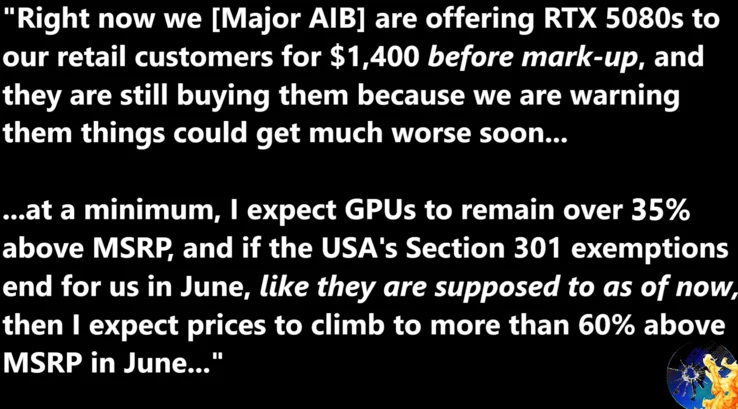
    2. Recent leaks suggest the price of the RTX 5080 could increase by 60% over its MSRP, with retail prices exceeding $1,400.
    3. Anticipated US tariffs could further raise the price of the RTX 5080 by at least 35% if exemptions expire in June.
    4. Gamers face a difficult situation with limited options, either waiting or paying significantly more for GPUs.
    5. Nvidia and AMD are set to release more affordable GPU alternatives, the RTX 5060 and RX 9060, which may provide better options for gamers.


    We have been discussing the terrible situation regarding the RTX 50 stock and pricing since the RTX 5090 and RTX 5080 were introduced on January 30, 2025. It’s well-known that the initial stock for the RTX 50 launch was extremely poor, and the so-called “official” MSRPs for the RTX 5090/5080, along with the later RTX 5070/5070 Ti, were basically misleading.

    Price Increases Ahead

    As if the situation couldn’t get any worse, a recent leak from Moore’s Law Is Dead suggests that the price of the RTX 5080 might soar to as much as 60% over its MSRP. A “Major” AIB source disclosed to MLID that they are selling “5080s to our retail partners for more than $1,400 before any additional mark-up.” Despite this inflated cost, retailers are still purchasing the RTX 5080 at such high prices because the AIB has cautioned them that “things could get even worse soon.”

    Potential for More Problems

    Just how much worse could it get? The AIB source indicated that they anticipate the RTX 5080 to “stay over 35% above MSRP.” However, this number could potentially rise to 60% if the US Section 301 tariffs implemented by former President Donald Trump in 2017 come back into play. The AIB noted that the exemptions for these tariffs are set to expire in June “as they are supposed to at this moment.” Thus, if these exemptions do indeed end and the tariffs are reinstated, the RTX 5080 produced by this “Major” AIB will become significantly pricier.

    Uncertain Future for Gamers

    Considering MLID’s recent findings and the fact that even system integrators are struggling to obtain the RTX 5090 at a fair price, it seems very unlikely that the situation will get any better anytime soon. Unfortunately for gamers, the only options available are to either wait and hope or spend a lot more money.

    On a positive note, both Nvidia and AMD are preparing to introduce their more affordable GPU alternatives in the RTX 5060 and RX 9060, respectively. If these new GPUs avoid the same troubles as their larger counterparts, gamers might finally have some next-gen choices to explore.

    Source:
    Link


  • RX 9070 XT Offers 19% Better Value Over RTX 5070 Ti

    RX 9070 XT Offers 19% Better Value Over RTX 5070 Ti

    Key Takeaways

    1. The RX 9070 and RX 9070 XT were expected to improve GPU prices and supply, but initial stock is very limited due to high demand.
    2. Official prices for the RX 9070 ($549) and RX 9070 XT ($599) offer the best value, but real-world prices are significantly higher, making older models more appealing.
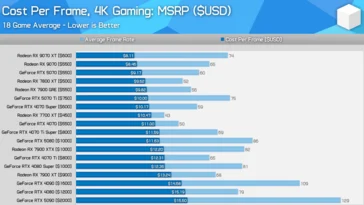
    3. The RX 9070 and RX 9070 XT have a competitive cost-per-frame of around $8.46 and $8.11 at 4K, outperforming Nvidia’s RTX 5070 and RTX 5070 Ti.
    4. With inflated street prices, the RX 9070 XT and RX 9070 are no longer the top value options, now compared to the RX 7700 XT and RX 7800 XT.
    5. High-end GPUs like the RTX 5090 have poor value, with a cost-per-frame of $20.93, indicating a challenging market for gamers looking to upgrade.


    Hopes were really high that the release of the RX 9070 and RX 9070 XT would help reduce the price issues and supply problems that have been troubling the GPU market. While the RX 9070 GPUs definitely added some competition for Nvidia, the massive demand from gamers who have been left waiting made the initial stock of these cards seem very small.

    Lack of Availability

    Currently, it’s nearly impossible to find any RX 9070 cards at their official prices. Data from Hardware Unboxed (HU) shows that the RX 9070 and RX 9070 XT are considered the best value GPUs available, providing the lowest cost-per-frame across 18 games tested. However, this only holds true if we consider their official prices of $549 for the RX 9070 and $599 for the RX 9070 XT.

    Real-World Pricing

    When we take a look at the actual street prices for the RX 9070 and RX 9070 XT, the value starts to fade and older RX 7000 cards begin to look more appealing. HU indicates that if we use the MSRP of $549 and $599 for the RX 9070 and RX 9070 XT, respectively, they rank as the best value in the market, followed closely by the RTX 5070 and RX 7800 XT. The cost-per-frame for the RX 9070 and RX 9070 XT is around $8.46 and $8.11 at 4K. In contrast, Nvidia’s competitors, the RTX 5070 and RTX 5070 Ti, have cost-per-frame ratings of $9.17 and $10, making it clear why AMD has been selling a lot of GPUs and increasing its market presence.

    Bottom Performers

    Not surprisingly, the RTX 5090, which has a cost-per-frame of $15.50, the RTX 4080 at $15.19, and the RTX 4090 at $14.68, rank as the least favorable options in this analysis.

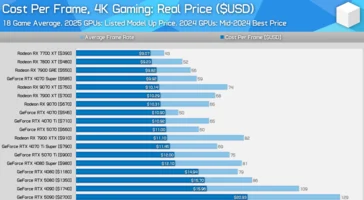
    However, as we all know, it’s very hard to find any next-gen GPUs at their listed prices. Therefore, any value comparison needs to consider street prices. Hardware Unboxed has also gathered data based on actual Newegg pricing for these cards.

    Changing Value Proposition

    Given the inflated prices of $750 for the RX 9070 XT and $670 for the RX 9070, RDNA 4 boards are no longer the top value cards, as they have been surpassed by the RX 7700 XT and the RX 7800 XT. In this situation, the RX 9070 XT costs $10.14 per frame and the RX 9070 costs $10.31 per frame. The RX 9070 XT gives a 15% better value compared to the RTX 5070 Ti, while the RX 9070 shows a modest 6% advantage over the RTX 5070.

    The Worst Offenders

    Looking at the least valuable GPUs, the RTX 5090 priced at $2,700 delivers a staggering cost of $20.93 per frame. Although the RTX 5080 offers better value at $15.70, it’s still not a great choice overall, especially since it loses to the RTX 4080 Super, which the RTX 5080 is supposed to replace.

    In addition to analyzing cost-per-frame at 4K in the US, Hardware Unboxed also reviews data for 1440p, premium AIB options, and markets outside of the US like the EU and Australia. Therefore, the entire video linked below is definitely worth watching if you are in the market for a new graphics card.

    Conclusion

    Ultimately, it’s pretty disheartening to see the current state of PC gaming. With so many exciting games like Doom: The Dark Ages on the horizon, gamers looking to upgrade have no choice but to be patient. We really don’t know how much longer it will take for prices and supply to return to normal.

    Source:
    Link


  • AMD Responds to RX 9070 Series MSRP Issues Amid Retail Stock Drop

    AMD Responds to RX 9070 Series MSRP Issues Amid Retail Stock Drop

    Key Takeaways

    1. AMD is working with partners to maintain MSRP prices for the RX 9070 series GPUs, despite rumors of potential price increases after initial stock sells out.

    2. The price of AMD Radeon RX 9070 and 9070 XT will be influenced by supply and demand, with AMD needing to ensure adequate stock to keep prices stable.

    3. AMD’s stock availability appears to be better than Nvidia’s during the RTX 5000 series launch, with more RX 9070 models available at retailers.

    4. A comparison showed that while AMD’s RX 9070 GPUs are in stock at Micro Center, Nvidia’s RTX 5070 Ti and 5080 models are sold out.

    5. Online demand for AMD cards remains high, with reports of order cancellations due to stock shortages, making platforms like Amazon a good option for mid-range gamers.


    Yesterday, after the introduction of the AMD Radeon RX 9070 and 9070 XT GPUs, which we have reviewed, rumors and leaks surfaced suggesting that AMD might raise the MSRP of the RDNA 4 GPUs once the initial retail stock was sold out. However, new details indicate this might not be true—though it doesn’t mean that prices won’t rise in the future.

    Stock Replenishment Efforts

    Frank Azor from AMD has stated that the company is collaborating with its add-in-board partners to restock retailers. Despite the high demand, he noted that “MSRP pricing (not including region specific tariffs and/or taxes) will continue to be encouraged,” even after the launch. This implies that the suggested prices for AMD’s RX 9070 series are likely to remain stable, yet there is still room for potential price hikes from retailers and AIBs.

    Supply and Demand Dynamics

    Currently, it appears that the price of the AMD Radeon RX 9070 and 9070 XT will be dictated by supply and demand. This suggests that the only way AMD can guarantee MSRP—or something close to it—is by ensuring there is a sufficient supply. In this aspect, AMD seems to be performing a bit better in keeping stores stocked compared to Nvidia during the launch of the RTX 5000 series.

    Stock Comparisons

    An amusing Reddit post highlighted that the Micro Center in Illinois had 170 RX 9070 GPUs and 440 RX 9070 XT units available, whereas Nvidia’s RTX 5070 Ti and 5080 were completely sold out, with only seven RTX 5090s and 10 RTX 5070s on the shelves. Conversely, online retailers have witnessed much greater demand, as many users in the r/PCMasterrace subreddit and on X have reported order cancellations due to a shortage of stock and increasing demand.

    Source:
    Link