Tag: RX 9070 XT

  • AMD’s Frank Azor denies FSR 4.1 cancellation rumor for RDNA 3.5 APUs

    AMD’s Frank Azor denies FSR 4.1 cancellation rumor for RDNA 3.5 APUs

    Key Takeaway

    – FSR 4.1 support for RDNA 3.5 APUs (e.g., Ryzen Z2 Extreme, AI 300/400) is not decided, with AMD VP David McAfee stating it is “not currently planned” and internal discussions “leaning toward no.”
    – AMD’s Frank Azor firmly denied any final decision has been made, emphasizing that the company continues to listen to customer feedback.
    – No technical reason prevents FSR 4.1 from working on RDNA 3.5, as users have successfully tested it via third-party injection tools like OptiScaler.
    – Rapid backlash and response from AMD suggest customer feedback may still influence a reversal of the decision.
    – RDNA 4 GPUs (e.g., RX 9070 XT) remain the guaranteed path for FSR 4.1 and long-term software support.


    AMD has officially announced a staggered FSR 4.1 release schedule for RDNA 3 and 2 GPUs, but rumors have been circulating that Team Red has decided to skip its mobile RDNA 3.5 APUs, such as the Ryzen Z2 Extreme, AI 300, AI 400, and Radeon RX 8000 Mobile series. According to reports, AMD was considering dropping support for RDNA 3.5 in favor of older discrete desktop RDNA 3 and RDNA 2 GPUs.

    Interview Reveals Uncertainty

    The confusion spread when German news outlet HardwareLuxx interviewed David McAfee at Computex 2026. AMD Vice President David McAfee stated that the company doesn’t have any concrete plans to bring FSR 4.1 to RDNA 3.5 APUs, but the decision hasn’t been finalized yet. As a result, FSR 4.1 support for RDNA 3.5 APUs is currently up in the air. In his own words, “FSR 4.1 is not currently planned for RDNA 3.5.” He mentioned that AMD needs to weigh the pros and cons of introducing the technology to iGPUs, and that the internal discussion seemed to be “leaning toward ‘no.’”

    Frank Azor Clarifies

    However, more recently, AMD’s Frank Azor, Corporate Vice President of Client and Graphics Marketing, stepped into the discussion to state firmly that no such decision has been made regarding the implementation of FSR 4.1 for RDNA 3.5 handhelds and mini-PCs. Frank Azor responded directly to numerous posts from various outlets, such as Digital Foundry and Pirat_Nation, in a statement on X, saying: “I wasn’t there to hear the exact words said. However, I will share that no such decision as being reported or implied here has been made. We are not ready to speak to any other potential future product plans at this time. We continue to listen to our customers, and we hear you.”

    Technical Feasibility

    Still, there’s no definitive reason why FSR 4.1 or FSR 4 INT8 wouldn’t work on RDNA 3.5 GPUs, as many gamers have already tested the technology on Strix Halo APUs using third-party injection tools like OptiScaler. Given the speed at which Frank Azor responded to online reports, which is contrary to AMD’s usual style, it’s possible that customer feedback (and backlash) continues to shape AMD’s decision to implement FSR 4.1 support for RDNA 3.5 GPUs in the future.

    Future Outlook

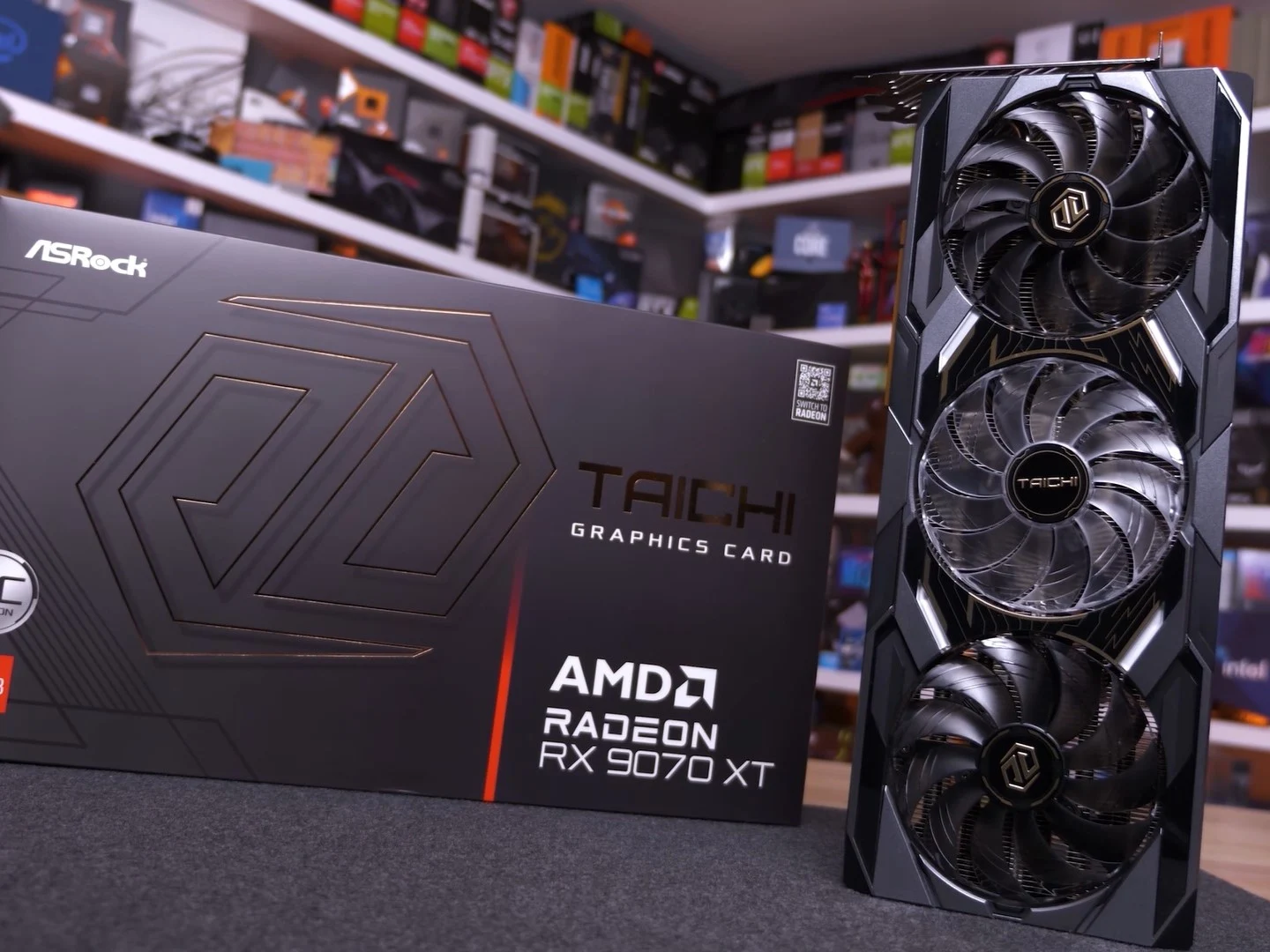
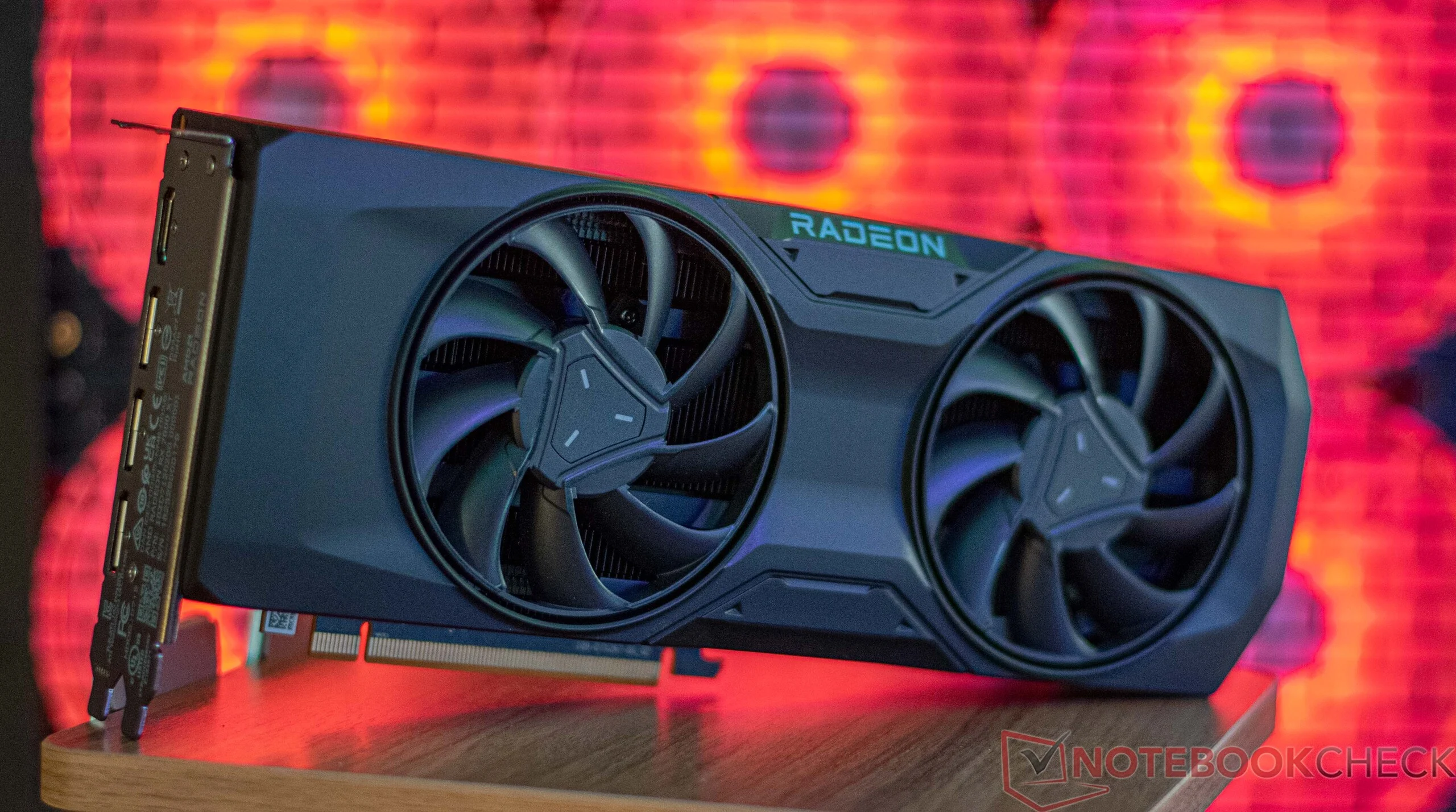
    RDNA 4-based GPUs like the currently on sale RX 9070 XT are expected to be gamers’ best bet when it comes to long-term software support and a guaranteed path to FSR 4.1, even as many decry what they feel is AMD pulling back from its older “fine wine” narrative to offering sustained value across the board to consumers, often years after release. The RX 9070 XT features 64 compute units, 16GB GDDR6 memory, and a boost clock of 2.8 GHz, with a TDP of 304W, priced at approximately $599.

    Sources
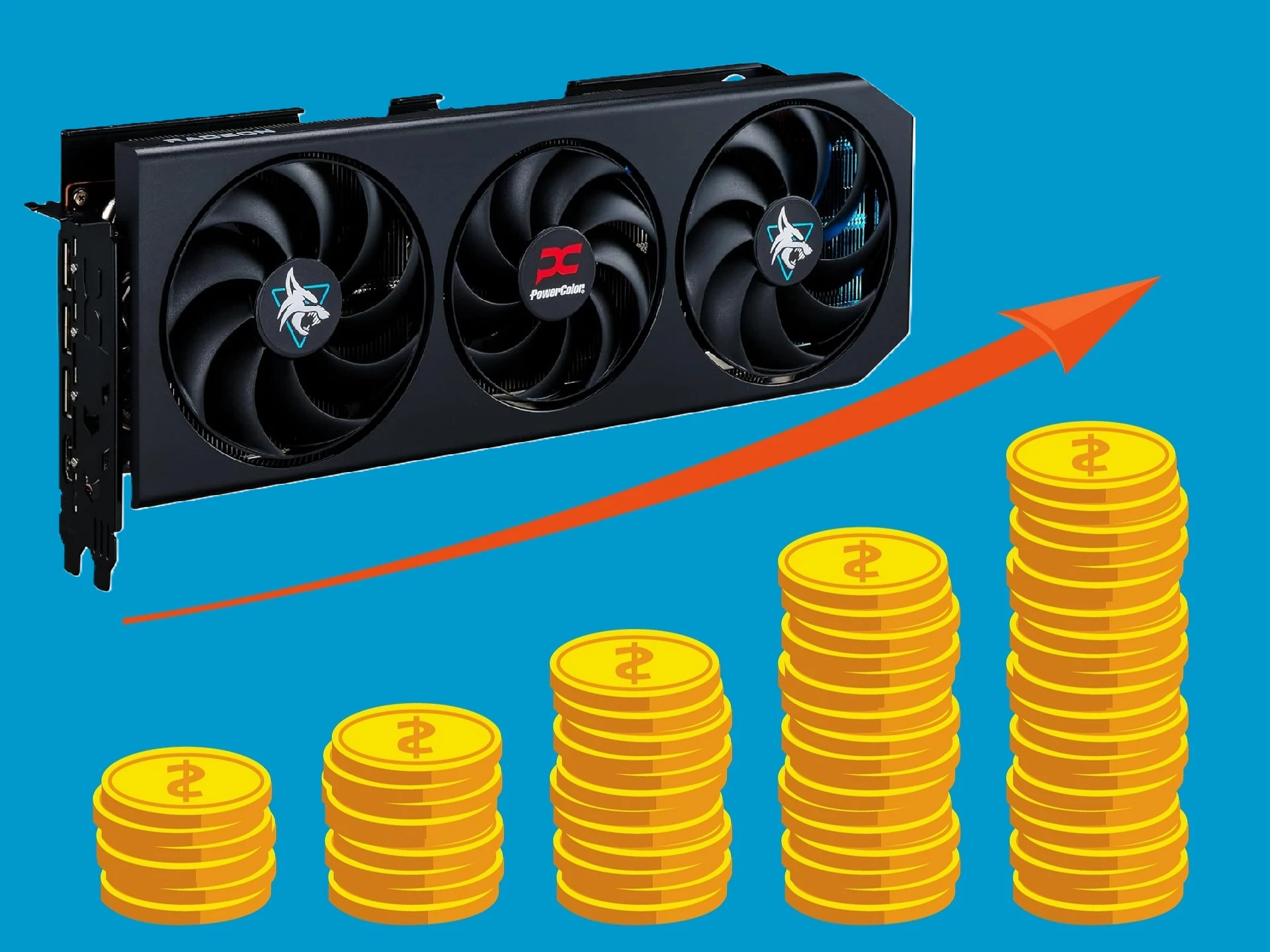
  • RTX 5070 Ti Hits $1,000; AMD RX 9070 XT Price Surges 21%

    RTX 5070 Ti Hits $1,000; AMD RX 9070 XT Price Surges 21%

    Key Takeaways

    1. Rising GPU Prices: The prices of popular GPUs like the RTX 5070 Ti, RTX 5080, and RTX 5090 have significantly increased, making them unaffordable for many gamers, with the RTX 5070 Ti priced around $1,000.

    2. Supply Issues: The RTX 5070 Ti has limited supply, causing its price to rise by 25% since November 2025, with similar increases for the RTX 5080 and RTX 5090.

    3. Competitive Pricing of AMD: The RX 9070 XT has only seen a 7% price increase globally, making it a more affordable alternative to Nvidia’s offerings, priced around $700.

    4. Opportunity for AMD: The rising prices and supply issues of Nvidia GPUs present a chance for AMD to gain market share, particularly with the competitively priced RX 9070 and RX 9070 XT.

    5. Market Positioning: The RX 9070 XT offers better performance than the RTX 5070 Ti at a lower price, making it an attractive choice for gamers seeking mid-range GPUs with good value.


    The time when gamers could easily find affordable desktop gaming PCs appears to be over, due to increasing prices of memory, storage, CPUs, and GPUs. A recent investigation by Hardware Unboxed into the prices of AMD and Nvidia GPUs shows that the RTX 5070 Ti, RTX 5080, and RTX 5090 are now largely inaccessible for many gamers. Currently, the RTX 5070 Ti is priced at about $1,000, while the RTX 5080 and RTX 5090 are around $1,400 and $3,500 in the US, respectively.

    Price Increases for GPUs

    The RTX 5070 Ti, which seems to have been significantly limited in supply, has an average price that is 25% higher in February 2026 compared to November 2025 across the 10 regions analyzed by Hardware Unboxed. The price increases for the RTX 5080 and RTX 5090 are 25% and 32%, respectively. Interestingly, the RX 9070 XT, which is a direct competitor to the RTX 5070 Ti, has only seen an average price rise of 7% globally since November 2025.

    In the US, however, the RX 9070 XT has experienced a more significant price increase of 21% since November 2025. Even so, the RX 9070 XT is considerably more affordable than the RTX 5070 Ti, priced at around $700.

    RX 9070 Price Stability

    Similarly, the RX 9070 has only increased in price by about 7% worldwide and 6% in the US, making it just $20 above its official MSRP. On Nvidia’s end, the RTX 5070 has seen a 15% price increase in the US since November 2025. However, since the RTX 5070 was already below its $550 MSRP back then, it can still be purchased for $550 today.

    Unfortunately, Nvidia seems to have significantly restricted the supply of the RTX 5070 Ti. This implies that once the existing stock is gone, any new restocks of the RTX 5070 Ti will likely lead to even higher prices. While this is disappointing for gamers, it gives AMD a golden chance to capture some much-needed market share.

    AMD’s Opportunity

    Aside from the RTX 5090, which has always been hard for gamers to acquire, the price increases of the RTX 5070 Ti and RTX 5080 create an excellent opening for AMD to take some market share from Nvidia. Hardware Unboxed notes that the rate at which the prices of the RTX 5070 Ti and RTX 5080 have gone up suggests that price gouging may be at play.

    By either supplying more units or lowering its own profit margins, AMD seems to have managed to keep the prices of the Radeon RX 9070 and RX 9070 XT relatively stable. Although these GPUs are now pricier than they were a few months ago, they are still much more reasonably priced compared to the RTX 5070 Ti and RTX 5080.

    Thus, if AMD can make the RX 9070 and RX 9070 XT more accessible, gamers in search of a mid-range GPU with 16 GB of VRAM at a fair price will likely be drawn to the RX 9070 or the RX 9070 XT. This will certainly position the RX 9070 XT as the top mid-range choice, especially since it not only surpasses the RTX 5070 Ti in performance but also comes at a much lower price.

    Source:
    Link


  • AMD and Nvidia to Increase GPU Prices by 15% Soon

    AMD and Nvidia to Increase GPU Prices by 15% Soon

    Key Takeaways

    1. Standalone GPUs, especially those with 16 GB or more VRAM, are expected to face significant price increases due to the ongoing DRAM crisis.
    2. Asus and Gigabyte plan to raise prices for their AMD Radeon RX 9000 series and Nvidia GeForce RTX 50 graphics cards by 10% to 15% by January 2026.
    3. MSI has already adjusted their pricing, influencing other manufacturers like Asus and Gigabyte to follow suit.
    4. AMD and Nvidia have not officially announced price hikes, allowing retailers to manage customer backlash while distancing themselves from negative feedback.
    5. Current pricing trends show that many GPUs are already selling above their suggested retail prices, indicating that prices may continue to rise, making it advisable for consumers to buy sooner rather than later.


    Since the beginning of the ongoing DRAM crisis, it was anticipated that standalone GPUs would be among the most severely affected areas in consumer technology. The forthcoming increase in prices was thought to be quite severe, particularly for graphics cards equipped with 16 GB or more of VRAM. A report from Taiwan indicates that Asus and Gigabyte plan to elevate the prices of their AMD Radeon RX 9000 series and Nvidia GeForce RTX 50 graphics cards by the close of January 2026.

    Price Increases Ahead

    This proposed increase in prices seems to be influenced by MSI, who has reportedly already adjusted their pricing for their boards. The price hikes by Asus and Gigabyte are expected to fall between 10% to 15%, based on the amount of VRAM. For example, GPUs such as the RTX 5080 and the RX 9070/XT, which contain 16 GB of VRAM, may see a price rise of 15%, while cards with 8 GB VRAM, like the RTX 5060/Ti and RX 9060 XT, could witness a 10% increase.

    AMD and Nvidia’s Strategy

    Interestingly, since AMD and Nvidia haven’t officially announced any price increases for the RDNA 4 and RTX 50 GPUs, it appears that Team Red and Team Green are allowing MSI, Asus, and Gigabyte to handle these price hikes, thus taking on the customer backlash. This could be a rather poor decision, if the reports are accurate, because AMD and Nvidia can then distance themselves from any negative feedback by hiding behind inflated MSRPs.

    Recently, Nvidia’s approach to deny any price increases or discontinuations for their GPUs was highlighted when Hardware Unboxed mentioned that the RTX 5070 Ti and RTX 5060 Ti 16 GB might be discontinued. Nvidia and Asus subsequently denied these claims, asserting that neither GPU has been phased out. However, examining the current pricing trends for the RTX 5070 Ti and the RTX 5060 Ti 16 GB on Newegg reveals a clear picture of the situation.

    Current Pricing Trends

    For instance, the vast majority of RTX 5070 Ti AIB variants listed on Newegg are presently priced significantly higher than the $749 MSRP. The same observation holds true for the RTX 5060 Ti 16 GB. On a positive note, the RX 9070 and RX 9070 XT are still being sold at reasonable prices.

    In simple terms, the era of GPUs being sold at or near their suggested retail prices seems to be coming to an end. The situation is likely to deteriorate in the near future. Therefore, if you’re in the market for a GPU, it might be wise to start your search now before AIBs hike their prices and supply shortages make matters even worse.

    Source:
    Link


  • AMD RDNA 4 GPU Prices Surge Again Due to Memory Supply Issues

    AMD RDNA 4 GPU Prices Surge Again Due to Memory Supply Issues

    Key Takeaways

    1. AMD and Nvidia may stop producing lower-end and mid-range graphics cards due to rising memory prices.
    2. AMD plans to increase prices by $10 for every 8 GB of GDDR VRAM in the RDNA 4 series.
    3. Retailers have adjusted prices to reflect a return to higher pricing seen during past stock shortages.
    4. Current MSRPs for RDNA 4 GPUs are lower, making it a good time to consider purchasing an AMD Radeon card.
    5. No specific price hikes for Nvidia GeForce RTX 50 GPUs have been mentioned, but increased costs for GDDR memory are expected to affect pricing.


    Ever since the prices of memory shot up dramatically, it was anticipated that desktop gaming GPUs would experience significant impacts. There have been claims that AMD and Nvidia might stop producing their lower-end and mid-range desktop graphics cards due to the financial constraints in this sector. Recently, rumors have spread that AMD plans to raise prices by $10 for every 8 GB of GDDR VRAM.

    Revised Pricing for RDNA 4

    This supposed price hike for the RDNA 4 series will change the Manufacturer’s Suggested Retail Prices (MSRPs) for the existing RDNA 4 models. When comparing these prices to current DDR5 kit prices, the increase seems relatively modest and should not greatly affect consumers. However, according to Moore’s Law Is Dead, the actual price rise for RDNA 4 RX 9000 GPUs, such as the RX 9070 XT, might be considerably higher.

    Retailer Adjustments

    Sources indicate that retailers have already adjusted their internal prices, and the outlook appears grim. Essentially, it seems the RDNA 4 graphics cards will revert to the pricing seen back in 2025 when stock shortages were prevalent, where the RX 9070 and RX 9070 XT were sold for significantly higher than their original MSRPs.

    Expected Retail Prices

    Following the price increase due to memory inflation, MLID anticipates that RDNA 4 graphics cards will be sold at:

    When you look at these figures, the current MSRPs for the RDNA 4 GPUs mentioned above are much lower. Thus, if you’ve been deliberating on purchasing an AMD Radeon card, now might be an excellent opportunity to do so.

    MLID doesn’t mention any price hikes for Nvidia GeForce RTX 50 GPUs. Although Nvidia will likely pass the increased costs of GDDR memory onto customers, it remains unclear how much more Team Green will require for GPUs like the RTX 5070.

    Source:
    Link


  • RX 9070 XT vs RTX 5070: Speed and Value of RDNA 4 GPU

    RX 9070 XT vs RTX 5070: Speed and Value of RDNA 4 GPU

    Key Takeaways

    1. The RX 9070 XT is 24% faster than the RTX 5070 at 1440p, making it a strong option for gamers.
    2. AMD’s drivers have improved performance for the RX 9070 XT since its launch, enhancing its value.
    3. The RX 9070 is priced around $549, making it a better budget option compared to the RX 9070 XT.
    4. The RX 9070 XT is currently priced at $650, which is above its MSRP and less appealing due to limited performance gain over the RX 9070.
    5. The RX 9070 offers better value for those looking to spend the least, while the RX 9070 XT needs to drop in price to compete effectively.


    Last week, Hardware Unboxed (HU) shared a comparison of gaming performance between the Radeon RX 9070 and the GeForce RTX 5070, utilizing the newest drivers and FSR 4/DLSS 4. This comparison revealed that thanks to updates in drivers and games, the RX 9070 has become even more powerful since its launch, making it tough to justify the investment in the RTX 5070.

    New Addition to the Test

    Now, HU has incorporated the RX 9070 XT into the evaluation to check the current performance and value provided by the top RDNA 4 GPU. This addition is logical as the RX 9070 XT, priced at $599, is designed to be about $50 pricier than both the RX 9070 and the RTX 5070.

    As a quick reminder, the RX 9070 XT was shown to be 12% faster than the RX 9070 in games during our original review. The performance gap compared to the RTX 5070 is roughly 19%.

    Performance Insights

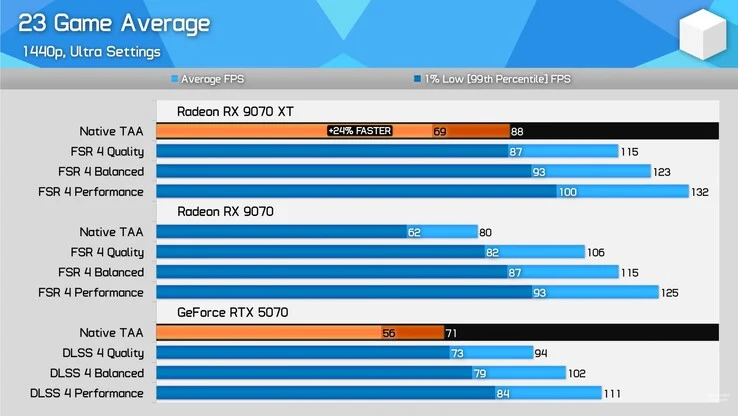
    According to HU’s average performance across 23 games at 1440p, the RX 9070 XT is now approximately 24% faster than the RTX 5070 and 10% faster than the RX 9070. Although the performance difference between the RX 9070 XT and RX 9070 remains the same as at launch, the RTX 5070 has lagged even further behind. This trend holds true even when the RTX 5070 uses DLSS 4.

    While using FSR 4 in Quality, Balanced, and Performance modes, the RX 9070 XT appears to be 22%, 21%, and 19% faster than the RTX 5070, respectively, with the matching DLSS 4 profiles. The performance gap between the RX 9070 XT and RX 9070 with FSR 4 active is 8% (Quality), 7% (Balanced), and 6% (Performance).

    AMD’s Driver Reputation

    It seems that AMD drivers are indeed living up to their image of improving over time, as the RX 9070 XT now shows clear performance upgrades since its initial launch. Nevertheless, the GPU is still not available at its official price of $599.

    In the United States, the availability of RDNA 4 cards has significantly improved in recent months. Prices for the RX 9070 and RX 9070 XT have also decreased. For example, you can find the RX 9070 for around $549 or close to its MSRP. However, the RX 9070 XT is still selling above its $599 MSRP, which makes the card less attractive.

    Pricing Comparison

    HU mentions that the RX 9070 XT, which is currently priced at $650 on Newegg, provides 24% better performance than the RTX 5070 for just 18% more cost. With an additional 4 GB of VRAM, the 18% price increase might be justified for some gamers. However, the value of the $650 RX 9070 XT doesn’t measure up well against the RX 9070, as the former only delivers a 10% performance increase for 18% more money. Both GPUs have the same 16 GB VRAM capacity.

    In simpler terms, if you want to spend the least amount possible, the RX 9070 is definitely the superior option right now. We hope the RX 9070 XT drops to its official MSRP, making it a much better choice compared to the RX 9070 and the RTX 5070 (which can be found on Amazon).

    Source:
    Link


  • Doom Dark Ages Benchmark: RX 9700 XT vs RTX 5080 Performance

    Doom Dark Ages Benchmark: RX 9700 XT vs RTX 5080 Performance

    Key Takeaways

    1. Release Date: Doom: The Dark Ages is set to launch on May 15th, requiring hardware that supports ray tracing for optimal gameplay.

    2. Performance Comparison: Early assessments show varying performance on different gaming laptops, with the RX 9070 XT performing comparably to the RTX 5080 at 1080p.

    3. AMD vs. Nvidia: AMD’s RX 9070 and RX 9070 XT outperform similar Nvidia GPUs at 1080p, with the RX 9070 XT matching the RTX 5080 and the RX 9070 competing with the RTX 5070 Ti.

    4. Resolution Challenges: At 1440p, performance gaps remain, with the RX 9070 achieving 81.1 FPS compared to the RTX 5070’s 68.3 FPS, while the RTX 5060 Ti struggles to reach 60 FPS.

    5. 4K Performance: Doom: The Dark Ages is demanding at 4K, with even high-end GPUs like the RTX 4090 barely surpassing 60 FPS, emphasizing the need for mid-range or high-end hardware for smoother gameplay at lower resolutions.


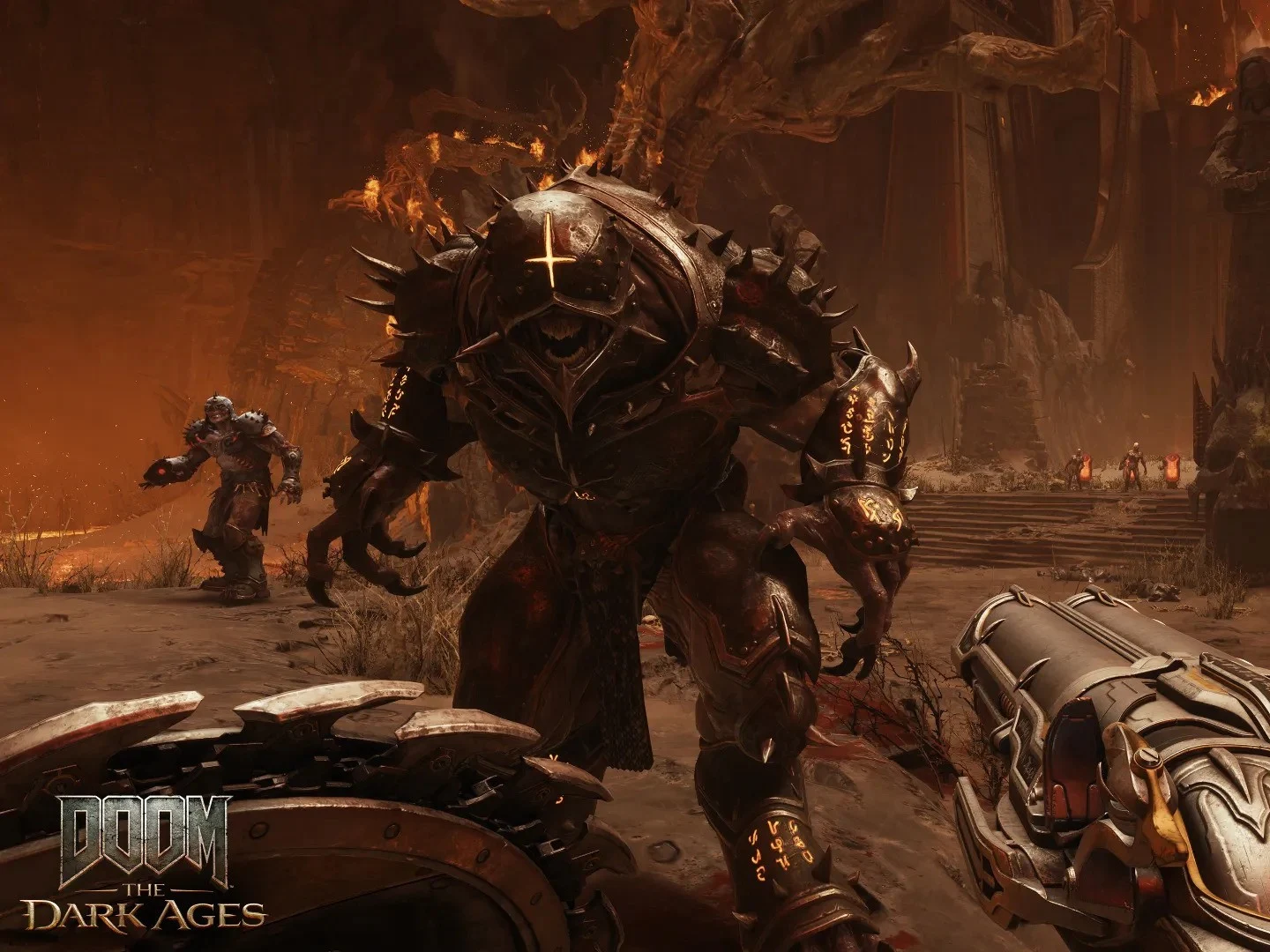
    The newest addition to the iconic Doom FPS franchise, Doom: The Dark Ages, is scheduled for release on May 15th. Our review is already live, and overall, Doom: The Dark Ages meets expectations. This time, however, ID Software requires hardware that supports ray tracing for optimal gameplay, raising questions about how well the game will perform.

    Performance on Various Laptops

    In our assessment, we examined the game’s performance on various gaming laptops, such as the Asus ROG Strix G16 equipped with the RTX 5080 laptop GPU. We’re still finalizing our comparison with desktop GPUs. Meanwhile, TechPowerUp has been testing Doom: The Dark Ages across a range of GPUs, both newer and older.

    AMD vs. Nvidia Performance

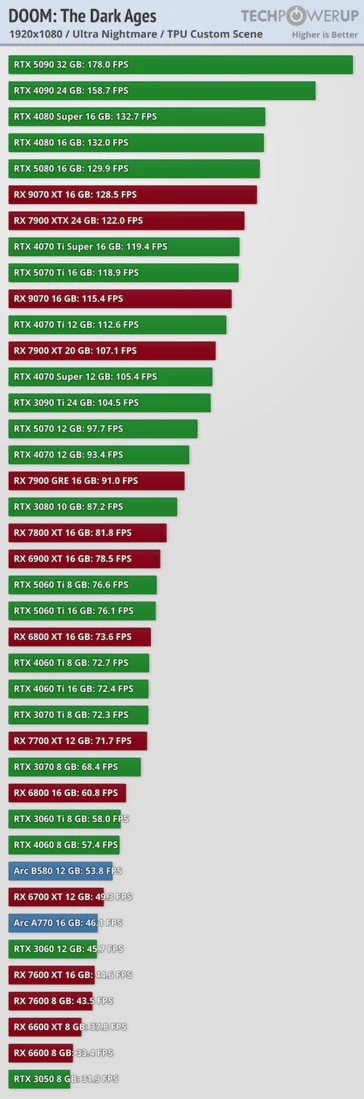
    Interestingly, findings from TechPowerUp indicate that the AMD Radeon RX 9070 and RX 9070 XT have a distinct advantage over their Nvidia equivalents. At 1080p with the “Ultra Nightmare” graphics settings, the performance is as follows:

    The RX 9070 XT performs on par with the RTX 5080, while the RX 9070 matches the RTX 5070 Ti, marking a significant success for Team Red, as these Radeon GPUs are priced lower. In contrast, Nvidia’s new RTX 5060 Ti 16 and 8 GB versions only achieve 76 FPS.

    Increased Resolution Challenges

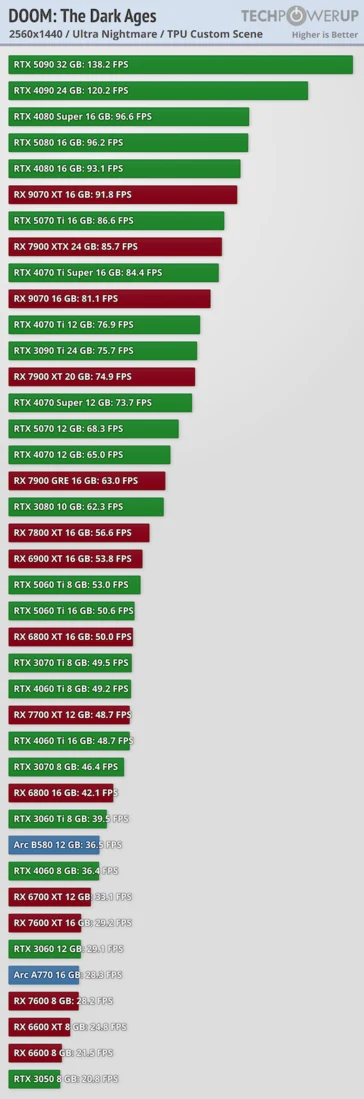
    When increasing the resolution to 1440p, it’s expected that the game becomes more challenging to run. Here, the RX 9070 XT and the RTX 5080 again compare closely, with frame rates of 91.8 and 96.2 FPS, respectively. The RTX 5070 Ti is now more competitive with the RX 9070 XT, registering 86.7 FPS.

    Despite this, a significant performance gap remains—about 19%—between the RX 9070, which achieves 81.1 FPS, and the RTX 5070 at 68.3 FPS. This means the RX 9070 is closer in performance to the RTX 5070 Ti than to its intended competitor, the RTX 5070. Sadly, the RTX 5060 Ti models struggle to reach 60 FPS at 1440p on max settings, which is disappointing for GPUs in the $400+ range.

    4K Performance Insights

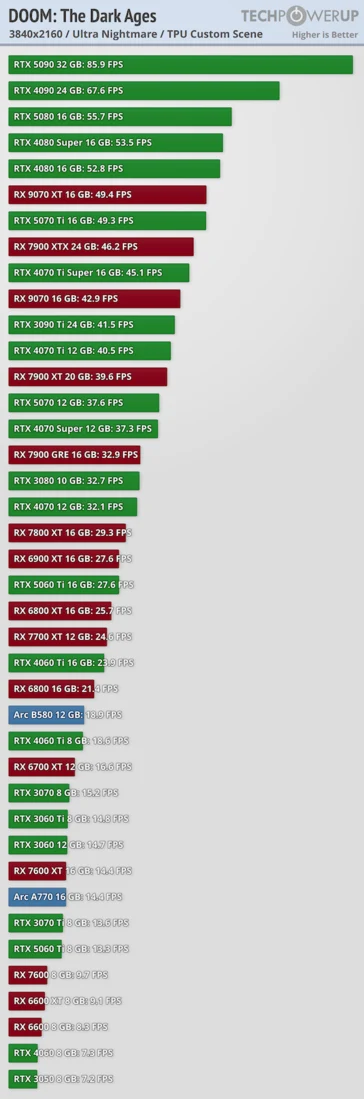
    Doom: The Dark Ages proves to be quite demanding at 4K resolution, as even the RTX 4090 barely surpasses 60 FPS. Therefore, it’s not surprising that the RTX 5080, RTX 5070 Ti, and RX 9070 XT all fall below 60 FPS while playing.

    The RX 9070 XT now matches the RTX 5070 Ti with a frame rate of 49 FPS, but the RX 9070 and RTX 5070 still show a clear performance difference. The RX 9070 reaches 42.9 FPS, while the RTX 5070 lags behind at 37.6 FPS.

    In conclusion, Doom: The Dark Ages presents a significant challenge at 4K. However, if you possess modern mid-range or high-end hardware, you should enjoy smooth gameplay at 1440p and excellent performance at 1080p.

    Source:
    Link


  • Best Buy Offers RX 9070 XT GPUs at High Prices Above MSRP

    Best Buy Offers RX 9070 XT GPUs at High Prices Above MSRP

    Key Takeaways

    1. Best Buy has limited stock of RX 5070 and RX 5070 XT GPUs, priced at $549.99 and $599.99, with potential price increases after initial stock runs out.
    2. Many customers are considering the RX 9070 XT due to its performance comparable to the Nvidia RTX 5070 Ti, which is priced higher at $750 or more.
    3. The RX 9070 XT has varying prices among manufacturers, with some custom models exceeding $849.99.
    4. Newegg and Micro Center offer more affordable options for RX 9070 and RX 9070 XT GPUs, but availability and prices can fluctuate.
    5. Retailers in the EU are also facing challenges with pricing, suggesting North American buyers may soon encounter similar price increases for RX 9070 XT models.


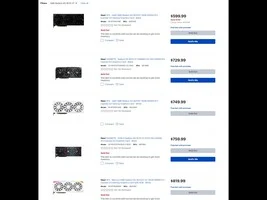
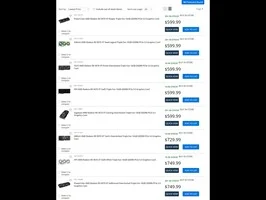
    Best Buy customers looking to grab an RX 5070 or RX 5070 XT at the official price are experiencing a tough launch day. The retailer in the U.S. has only a few AMD GPUs available, priced at $549.99 or $599.99. To make matters worse, there’s a chance that prices could rise even more once the initial stock is depleted.

    Focus on RX 9070 XT

    Many shoppers are shifting their attention to the RX 9070 XT due to its performance being comparable to the Nvidia RTX 5070 Ti, which costs $750 or more. AMD stated that the RDNA 4 GPU would start at around $599. Yet, since there are no reference cards to guide the market, manufacturers have the freedom to set their own prices for the custom RX 9070 XT models. Indeed, some overclocked versions with eye-catching RGB lighting are being sold for as much as $849.99.

    Best Buy’s Current Inventory

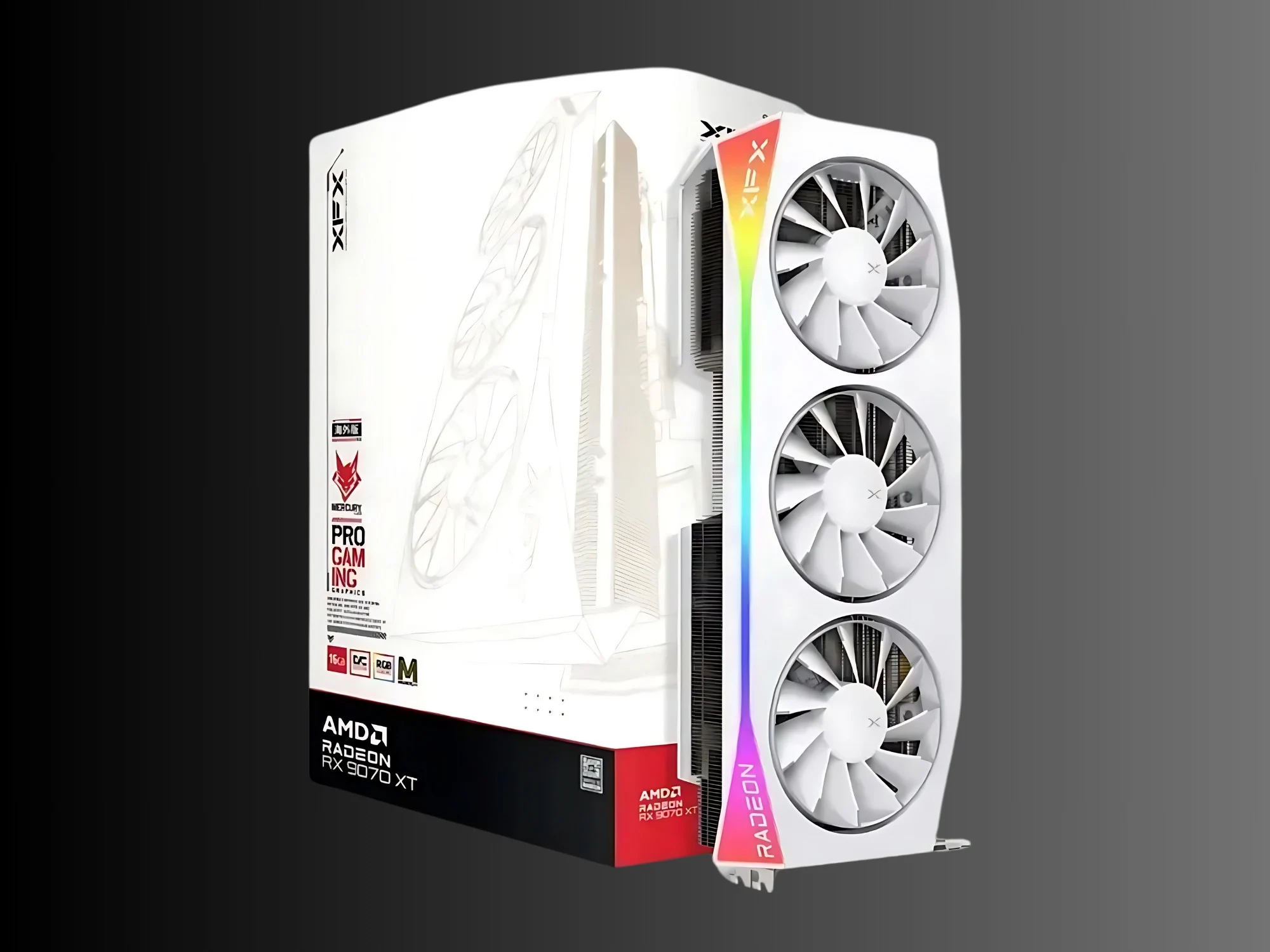
    At Best Buy, XFX models are leading the charge in RDNA 4 offerings. The most affordable RX 9070 XT is the XFX Swift, which features standard clock settings. However, there’s a significant price leap to the next model, which is also an XFX card but in white, retailing at $749.99. The overclocked Mercury versions, which consume more power, are even pricier.

    Alternatives at Newegg and Micro Center

    For those searching for RX 9070 and RX 9070 XT GPUs at official prices, Newegg and Micro Center provide more choices. Shoppers can find cards from Gigabyte, Asus, and ASRock priced at $549 or $599. However, availability varies across retailers, leading to fluctuating prices. It’s not surprising that the higher-priced RDNA 4 GPUs have been more accessible thus far.

    Retailers in the EU have indicated that chances to buy at MSRP will be limited. The Swedish retailer Inet.se mentioned that to stay profitable, they can only offer a few cards at the original price before increasing it. North American buyers might soon face similar challenging pricing situations. This could push many RX 9070 XT models well over the under $700 range AMD mentioned during their product launch. The silver lining is that RDNA 4 stock levels seem to be relatively stable compared to the Nvidia Blackwell launch.

    Source:
    Link


  • RX 9070 XT Set to Outshine RTX 5070 with 10x Launch Supply

    RX 9070 XT Set to Outshine RTX 5070 with 10x Launch Supply

    Key Takeaways

    1. The RTX 5070 has received negative reviews, with critics accusing Nvidia of overhyping the card.
    2. AMD’s RX 9070 and RX 9070 XT are launching soon, with promising availability and competitive pricing starting at $549 and $599, respectively.
    3. The RX 9070 XT is expected to have significantly better stock availability compared to the RTX 50 series, which struggled at launch.
    4. Reports suggest that the RX 9070 XT’s pricing is more genuine than Nvidia’s RTX 50 series pricing, making it more appealing to consumers.
    5. AMD is likely to capture market share due to the RX 9070 and RX 9070 XT’s favorable supply and pricing compared to the RTX 5070.


    Reviews for the RTX 5070 have been released, and the card does not live up to Nvidia’s hype from its CES 2025 reveal. The response has been quite negative; Gamers Nexus has accused Nvidia of “selling lies,” while Hardware Unboxed has labeled this GPU as “the worst 70 series ever.”

    A Challenging Launch

    Overall, the RTX 5070 is being viewed unfavorably, creating an excellent opportunity for AMD’s RX 9070 and RX 9070 XT. These new RDNA 4 graphics cards are set to launch tomorrow, March 6th, with pricing starting at $549 for the RX 9070 and $599 for the RX 9070 XT. AMD appears to have a significant amount of stock ready for launch, which is a promising sign for buyers.

    Better Availability Expected

    Several reports are now indicating that it will be much easier for consumers to purchase the RX 9070 and RX 9070 XT compared to the RTX 50 series. Moore’s Law Is Dead has also provided some exciting details that should leave gamers feeling optimistic.

    It’s well-known that the availability of the RTX 5090 and RTX 5080 during their launch was quite poor. Even now, over a month post-release, finding these cards at their official MSRPs is nearly impossible. The same goes for the RTX 5070 Ti, which also struggled at launch.

    Supply Insights

    Luckily, Moore’s Law Is Dead reports that the launch supply for the RX 9070 XT is looking much better, expected to be 3 to 10 times more plentiful than the RTX 5080. However, they do mention that a “decent amount of supply is above MSRP.” Still, the $599 MSRP for the RX 9070 XT is said to be more genuine compared to Nvidia’s pricing for their RTX 50 cards.

    While some RX 9070 XTs may be priced higher than $599, if Moore’s Law Is Dead’s information holds true, it should be possible to purchase one at the official starting price.

    More Stock for the XT

    The leaker has also indicated that there will be a considerably larger supply of the RX 9070 XT compared to the RX 9070. They compare the RX 9070’s supply to that of the RX 6800, which is a less powerful version of the RX 6800 XT. This makes sense, as AMD’s pricing of the RX 9070 just $50 less than the XT suggests they are encouraging gamers to opt for the XT version.

    Furthermore, MLID has shared insights about the launch stock for the RTX 5070, which is expected to have similarly poor availability as other RTX 50 models. Reports suggest that AIB pricing for this GPU will be quite unfavorable as well, and unfortunately, the supply situation is not likely to improve in the near future.

    In summary, it looks like the RX 9070 and RX 9070 XT are in a prime position to capture some much-needed market share. Let’s see if these cards can fulfill AMD’s expectations.

    Buy the Gigabyte Radeon RX 7800 XT OC on Amazon

    Moore’s Law Is Dead on YouTube, Teaser image: Gigabyte, Boliviainteligente on Unsplash, edited.

    Source:
    Link

  • AMD Mocks 32 GB RX 9070 XTX Report with Cheeky Satire

    AMD Mocks 32 GB RX 9070 XTX Report with Cheeky Satire

    Key Takeaways

    1. The 32 GB RX 9070 XT has been a popular topic, despite AMD’s Frank Azor denying its existence.
    2. A leaker suggested the GPU might be named “RX 9070 XTX,” sparking further speculation.
    3. Frank Azor used sarcasm on social media to mock the rumors, suggesting an exaggerated model name and specs.
    4. Azor humorously claimed the card would require absurd power demands, highlighting the ridiculousness of the rumors.
    5. AMD has officially denied the existence of the 32 GB RX 9070 XT or XTX multiple times, casting doubt on the leak.


    The 32 GB version of the RX 9070 XT has been the talk of the town recently. Even though AMD’s Frank Azor has rejected the idea of this card, a leaker who first mentioned the 32 GB RX 9070 XT has come back, suggesting that the GPU might actually be called the “RX 9070 XTX”.

    Sarcastic Rebuttal

    To highlight how ridiculous these rumors are, Frank Azor took to social media to mock them with some heavy sarcasm. In response to a post by Videocardz about the RX 9070 XTX with 32 GB VRAM, Azor jokingly corrected the claim, stating that the GPU is actually “a 320 GB card we are calling the 90700.05XTXT Max”. Yes, you heard right, a “90700.05XTXT Max”.

    Further Ridicule

    But Azor didn’t stop there; he continued to poke fun at the claims by saying the card comes with “new 96 pin power connectors” and needs a “1.21 gigawatts PSU”. When someone asked if this power-demanding beast could “beat the RTX 5090” at 600 W, Mr. Azor suggested it would only win “in raster”.

    Conclusion on the Rumors

    On a more serious note, if anyone still had doubts about the 32 GB RX 9070 XT or XTX RDNA 4 GPU, those should be put to rest now. AMD has firmly denied the existence of such a card not just once, but twice. It remains unclear if Zhangzhonghao, the source of the initial leak, will back down or continue to defend their claim.

    Source:
    Link

  • Frank Azor Denies 32GB Radeon RX 9070 Rumors, Hints at RX 9080 9090

    Frank Azor Denies 32GB Radeon RX 9070 Rumors, Hints at RX 9080 9090

    Key Takeaways

    1. AMD officially announced the RX 9070 and 9070 XT graphics cards will launch in late February.
    2. The RX 9070 XT will not be available in a 32 GB RAM version, as confirmed by AMD’s Frank Azor.
    3. Azor’s statement applies only to the RX 9070 XT, leaving open the possibility of a future 32 GB variant in the RX 9000 line.
    4. Current RX models like the 7900 XT, 7900 XTX, and 7900 GRE offer more VRAM than the upcoming RX 9070 XT.
    5. AMD may reveal more graphics cards in the future, potentially including a 32 GB card aimed at machine learning and non-gaming uses.


    Ever since AMD announced its RDNA 4 design along with the upcoming RX 9070 and 9070 XT graphics cards, the internet has been filled with lots of talk, leaks, and speculation regarding their specifications and performance. A recent piece of gossip suggested that the AMD RX 9070 XT would be available in a 32 GB RAM version.

    AMD’s Official Announcement

    Today, AMD made an official announcement about the launch date, set for late February, through a post on X. In a follow-up post, AMD’s Frank Azor addressed the rumor about the 32 GB RX 9070 XT, stating clearly, “No, the 9070 XT card is not coming in 32 GB.”

    Future Possibilities

    It’s important to note that Azor’s statement only concerns the RX 9070 XT specifically, not the RDNA 4 architecture or the RX 9000 line as a whole. This has led to speculation that there could possibly be another variant with 32 GB released in the future. This new card might aim to replace models like the RX 7900 XT (currently priced at $749.99 on Amazon), 7900 XTX, or 7900 GRE, all of which offer more VRAM than the forthcoming RX 9070 XT’s 16 GB.

    What to Expect Next

    So far, AMD has disclosed only two graphics cards based on the RDNA architecture, and it’s likely that the company has more to announce later on. Furthermore, there is a good chance that a 32 GB graphics card focused on machine learning and other non-gaming applications is in development.

    Source:
    Link