Tag: RDNA 3.5

  • AMD’s Frank Azor denies FSR 4.1 cancellation rumor for RDNA 3.5 APUs

    AMD’s Frank Azor denies FSR 4.1 cancellation rumor for RDNA 3.5 APUs

    Key Takeaway

    – FSR 4.1 support for RDNA 3.5 APUs (e.g., Ryzen Z2 Extreme, AI 300/400) is not decided, with AMD VP David McAfee stating it is “not currently planned” and internal discussions “leaning toward no.”
    – AMD’s Frank Azor firmly denied any final decision has been made, emphasizing that the company continues to listen to customer feedback.
    – No technical reason prevents FSR 4.1 from working on RDNA 3.5, as users have successfully tested it via third-party injection tools like OptiScaler.
    – Rapid backlash and response from AMD suggest customer feedback may still influence a reversal of the decision.
    – RDNA 4 GPUs (e.g., RX 9070 XT) remain the guaranteed path for FSR 4.1 and long-term software support.


    AMD has officially announced a staggered FSR 4.1 release schedule for RDNA 3 and 2 GPUs, but rumors have been circulating that Team Red has decided to skip its mobile RDNA 3.5 APUs, such as the Ryzen Z2 Extreme, AI 300, AI 400, and Radeon RX 8000 Mobile series. According to reports, AMD was considering dropping support for RDNA 3.5 in favor of older discrete desktop RDNA 3 and RDNA 2 GPUs.

    Interview Reveals Uncertainty

    The confusion spread when German news outlet HardwareLuxx interviewed David McAfee at Computex 2026. AMD Vice President David McAfee stated that the company doesn’t have any concrete plans to bring FSR 4.1 to RDNA 3.5 APUs, but the decision hasn’t been finalized yet. As a result, FSR 4.1 support for RDNA 3.5 APUs is currently up in the air. In his own words, “FSR 4.1 is not currently planned for RDNA 3.5.” He mentioned that AMD needs to weigh the pros and cons of introducing the technology to iGPUs, and that the internal discussion seemed to be “leaning toward ‘no.’”

    Frank Azor Clarifies

    However, more recently, AMD’s Frank Azor, Corporate Vice President of Client and Graphics Marketing, stepped into the discussion to state firmly that no such decision has been made regarding the implementation of FSR 4.1 for RDNA 3.5 handhelds and mini-PCs. Frank Azor responded directly to numerous posts from various outlets, such as Digital Foundry and Pirat_Nation, in a statement on X, saying: “I wasn’t there to hear the exact words said. However, I will share that no such decision as being reported or implied here has been made. We are not ready to speak to any other potential future product plans at this time. We continue to listen to our customers, and we hear you.”

    Technical Feasibility

    Still, there’s no definitive reason why FSR 4.1 or FSR 4 INT8 wouldn’t work on RDNA 3.5 GPUs, as many gamers have already tested the technology on Strix Halo APUs using third-party injection tools like OptiScaler. Given the speed at which Frank Azor responded to online reports, which is contrary to AMD’s usual style, it’s possible that customer feedback (and backlash) continues to shape AMD’s decision to implement FSR 4.1 support for RDNA 3.5 GPUs in the future.

    Future Outlook

    RDNA 4-based GPUs like the currently on sale RX 9070 XT are expected to be gamers’ best bet when it comes to long-term software support and a guaranteed path to FSR 4.1, even as many decry what they feel is AMD pulling back from its older “fine wine” narrative to offering sustained value across the board to consumers, often years after release. The RX 9070 XT features 64 compute units, 16GB GDDR6 memory, and a boost clock of 2.8 GHz, with a TDP of 304W, priced at approximately $599.

    Sources
  • AMD to Focus on RDNA 3.5 Even After RDNA 5 iGPUs Launch

    AMD to Focus on RDNA 3.5 Even After RDNA 5 iGPUs Launch

    Key Takeaways

    1. AMD has launched RDNA 3.5 iGPUs with the Strix Point and Strix Halo models for systems without discrete GPUs, including gaming handhelds.
    2. The RDNA 3.5 architecture will be used for lower performance integrated GPU products, like office laptops and systems with high-end discrete GPUs.
    3. AMD is developing iGPUs along two paths: the RDNA 3.5 iGPU and “premium” RDNA 5 iGPU devices.
    4. The premium RDNA 5 iGPU products, potentially part of the Medusa line, are not expected to launch until 2027.
    5. AMD plans to stick with the RDNA 3.5 design until at least 2029, with no significant updates anticipated until the RDNA 5 launch.


    AMD’s RDNA 3.5 iGPUs have been launched with the Strix Point and Strix Halo models, powering several systems without discrete GPUs. This includes gaming handhelds such as the Asus ROG Ally X and GPD Win 5. The new Gorgon Point also utilizes the same iGPU setup, and it appears that AMD plans to stick with this design until 2029.

    AMD’s Future Plans

    According to a report from @Kepler_L2 on X, a well-known source for tips, AMD intends to keep the RDNA 3.5 iGPU architecture for products that do not necessitate high performance from integrated GPUs. This category includes office laptops as well as systems featuring high-end discrete GPUs, like the RTX 5070 Ti-equipped Legion 7 Pro, which currently sells for $1,649 on Lenovo.

    Roadmap Insights

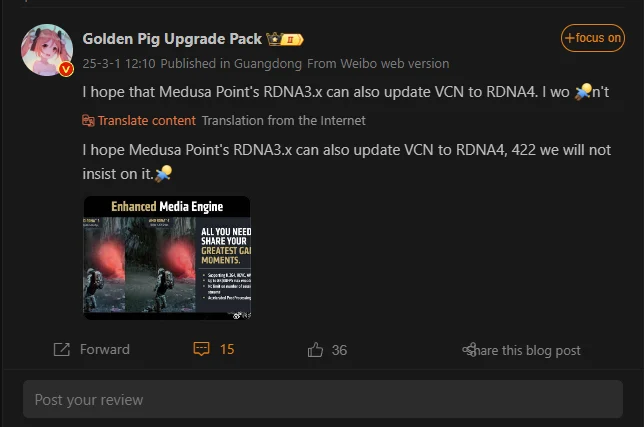
    The report indicates that AMD has split its iGPU development into two paths, with @Kepler_L2 mentioning that the RDNA 3.5 iGPU will coexist with the “premium” iGPU devices featuring RDNA 5 architecture. It is important to mention that this discussion originated from a post made by a popular Weibo leaker named Golden Pig Upgrade.

    A Weibo leaker casually shared an AI-generated roadmap, prompting some well-known insiders, including HXL, to provide additional context. However, Kepler_L2 has a reputation for offering relatively accurate AMD leaks, and the detailed information from this tipster implies that the roadmap wasn’t entirely random.

    Premium Devices on the Horizon

    Kepler_L2 didn’t specify much about the “premium” RDNA 5 iGPU products mentioned, but these are probably the anticipated Medusa “Halo/Premium” systems. For context, the Medusa line is not expected to launch until 2027, which means that AMD likely won’t be making significant updates to the RDNA 3.5 iGPUs until then.

    Source:
    Link


  • AMD Ryzen AI 9 465 and AI 7 450 CPUs Found in CrossMark Database

    AMD Ryzen AI 9 465 and AI 7 450 CPUs Found in CrossMark Database

    Key Takeaways

    1. Two new AMD Ryzen AI laptop models, the Ryzen AI 9 465 and Ryzen AI 7 450, have surfaced online.
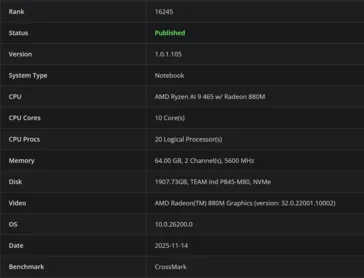
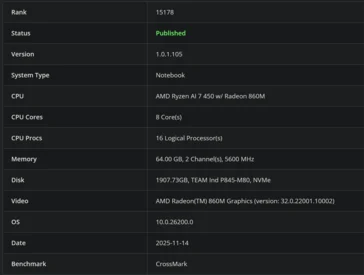
    2. The Ryzen AI 9 465 features a Radeon 880M iGPU, while the Ryzen AI 7 450 includes a Radeon 860M, indicating the continuation of RDNA 3.5 architecture.
    3. The Ryzen AI 9 465 has 10 cores and 20 threads, while the Ryzen AI 7 450 has 8 cores.
    4. Both processors are expected to utilize Zen 5 and Zen 5c cores, similar to their Strix Point counterparts.
    5. Benchmark scores show the Ryzen AI 9 465 at 1,897 points and the Ryzen AI 7 450 at 1,944 points, although these are likely pre-production results.


    Just a day after the AMD Ryzen AI 9 HX 470 was seen online, two more Gorgon Point laptop models have appeared. Now, we have our first look at the Ryzen AI 9 465 and Ryzen AI 7 450. The Ryzen AI 9 465 is equipped with a Radeon 880M iGPU, while the Ryzen AI 7 450 is paired with a Radeon 860M, showing that RDNA 3.5 will be around for at least one more generation.

    Processor Details

    The CrossMark listings show that the Ryzen AI 9 465 has 10 cores and 20 threads. In a similar way, the Ryzen AI 7 450 includes eight cores. Both processors are expected to use a combination of Zen 5 and Zen 5c cores, like their Strix Point siblings. Sadly, the listings do not provide important specifications such as boost clocks and TDP, but both were tested with 64 GB of RAM.

    Benchmark Results

    In the benchmark tests, the Ryzen AI 9 465 achieved a score of 1,897 points overall, while the Ryzen AI 7 450 reached 1,944 points. These results don’t carry much weight since both chips are likely still pre-production versions. However, they indicate that AMD is finalizing Krackan Point before its anticipated reveal at CES 2026 alongside Intel’s Panther Lake.


    Source:
    Link


  • AMD Ryzen AI 400 Medusa Point Laptop Chips to Feature RDNA 3 GPU

    AMD Ryzen AI 400 Medusa Point Laptop Chips to Feature RDNA 3 GPU

    Key Takeaways

    1. AMD’s Zen 6 series will be branded as Medusa, with Medusa Ridge for desktops and Medusa Point/Halo for portable devices.
    2. Medusa Point laptops will feature an unknown version of RDNA 3 iGPUs, likely RDNA 3.5, but will not upgrade to RDNA 4.
    3. The Video Core Next (VCN) for Medusa Point may also be limited, affecting performance compared to Nvidia and Intel GPUs.
    4. AMD has confirmed that RDNA 4 will be exclusive to desktop discrete GPUs, explaining the choice of RDNA 3.5 for Medusa Point.
    5. Medusa Halo might benefit from newer GPU technology, but there are concerns about reusing the RDNA 3.5 GPU from the previous Strix Halo generation.


    A recent leak suggests that AMD’s Zen 6 series will operate under the Medusa name, featuring Medusa Ridge for desktop processors and Medusa Point/Medusa Halo for portable devices. It would be logical to think that the new Zen 6 CPU cores would come with an updated RDNA integrated GPU (iGPU). However, according to a new leak from Weibo, this may not be true for laptops.

    Medusa Point’s iGPU Limitations

    Laptops under the Medusa Point label will apparently be using an unknown version of the RDNA 3 iGPUs, likely falling into the RDNA 3.5 category. Unfortunately, these devices won’t receive the highly sought-after RDNA 4 upgrade, which introduces hardware-based FSR 4.0 and other features that come with the new architecture. As a result, the Video Core Next (VCN) may also be limited to the older version, which could create issues as it lacks many of the advanced capabilities of its Nvidia and Intel counterparts.

    AMD’s Confirmation on RDNA Exclusivity

    In a prior statement, AMD made it clear that RDNA 4 would be reserved only for desktop discrete GPUs, so the choice to utilize RDNA 3.5 for Medusa Point isn’t particularly shocking. Meanwhile, RDNA 5 (or UDNA, depending on who you ask) is still planned for the desktop Ryzen 11,000 series components. This brings us to the eagerly anticipated Strix Halo successor—Medusa Halo. A newer generation GPU could significantly benefit from its additional memory bandwidth and the rumored 3D V-cache. It would be quite disappointing if AMD decides to reuse the Strix Halo’s RDNA 3.5 GPU for yet another generation.

    Source:
    Link


  • AMD Radeon RX 8800 XT Reference Design Leaked in Ad

    AMD Radeon RX 8800 XT Reference Design Leaked in Ad

    AMD has announced plans to unveil its RDNA 3.5 and RDNA 4 Radeon RX 8000 and 9000 GPU series in early 2025, coinciding with CES. This event will also see the launch of Nvidia’s GeForce RTX 5000 series, which we recently discussed. Although some details about AMD’s upcoming GPUs have been leaked, it seems that they have been hiding in plain sight for a while.

    New Graphics Card Discovery

    A sharp-eyed redditor on the r/AMD subreddit noticed that AMD has featured a never-before-seen graphics card in an official advertisement on Reddit for the past couple of months. The ad showcases an AMD Ryzen 9 CPU box alongside a triple-fan AMD Radeon graphics card.

    This particular design is different and has not been seen before from AMD. It looks like a first-party design since there’s no branding from any third-party AIB makers on the shroud. All these hints imply that this could be a new RX 8000 series GPU design, although it is still uncertain which exact model it is. The tri-fan structure suggests it’s aimed at a high-end GPU, and it wouldn’t make sense for AMD to show its top-tier Ryzen 9 CPU with a lower-end GPU in the advertisement. Thus, this likely represents the reference design for the upcoming Radeon RX 8800 XT, or whatever AMD may choose to call it. However, it could also correspond to the recently leaked RDNA 4-based AMD Radeon RX 9070.

    Performance Expectations

    Currently, all signs point towards the RX 8000 series being built on AMD’s RDNA 3.5 architecture. This seems to be a slight refresh of the RDNA 3 architecture that was utilized for the RX 7000 series GPUs. While this news may not be alarming for gamers on a budget or those looking for mid-range GPU options, it implies that AMD may struggle to compete in the high-end GPU market.

    Source: Link