Tag: ARM

  • Microsoft launches 13-inch laptop with Snapdragon X2 Elite, 64GB RAM

    Microsoft launches 13-inch laptop with Snapdragon X2 Elite, 64GB RAM

    Key Takeaway

    – Surface Laptop 8 for Business returns with ARM-based Snapdragon X2 chips.
    – Display remains an unchanged 13.8-inch 120Hz IPS panel (no OLED).
    – Supports removable SSD and up to 64GB LPDDR5X RAM.
    – Battery life rated up to 20 hours.
    – Starts at $1,599; black finish exclusive for 64GB RAM configuration.


    New Surface Laptop 8 keeps same display

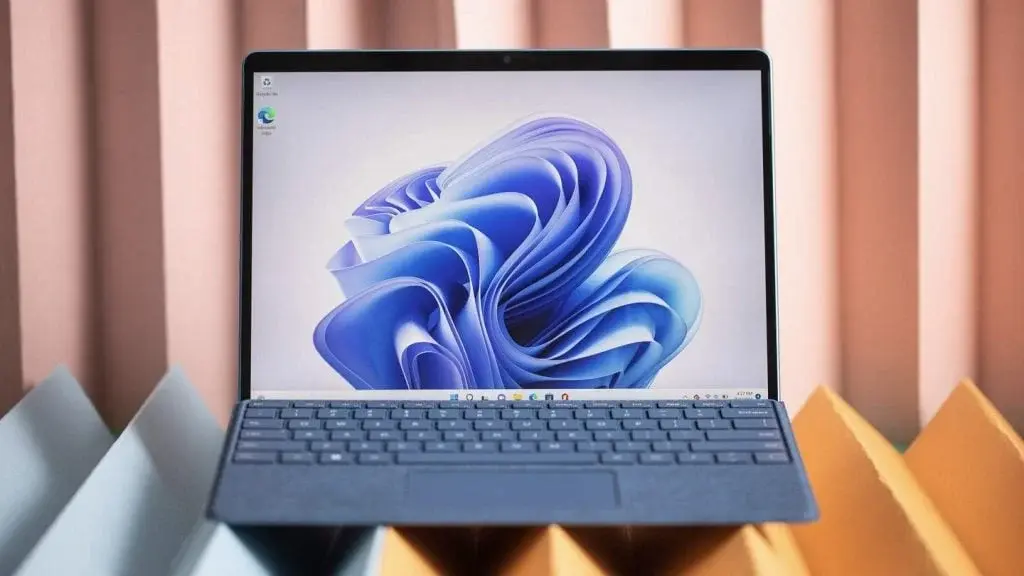
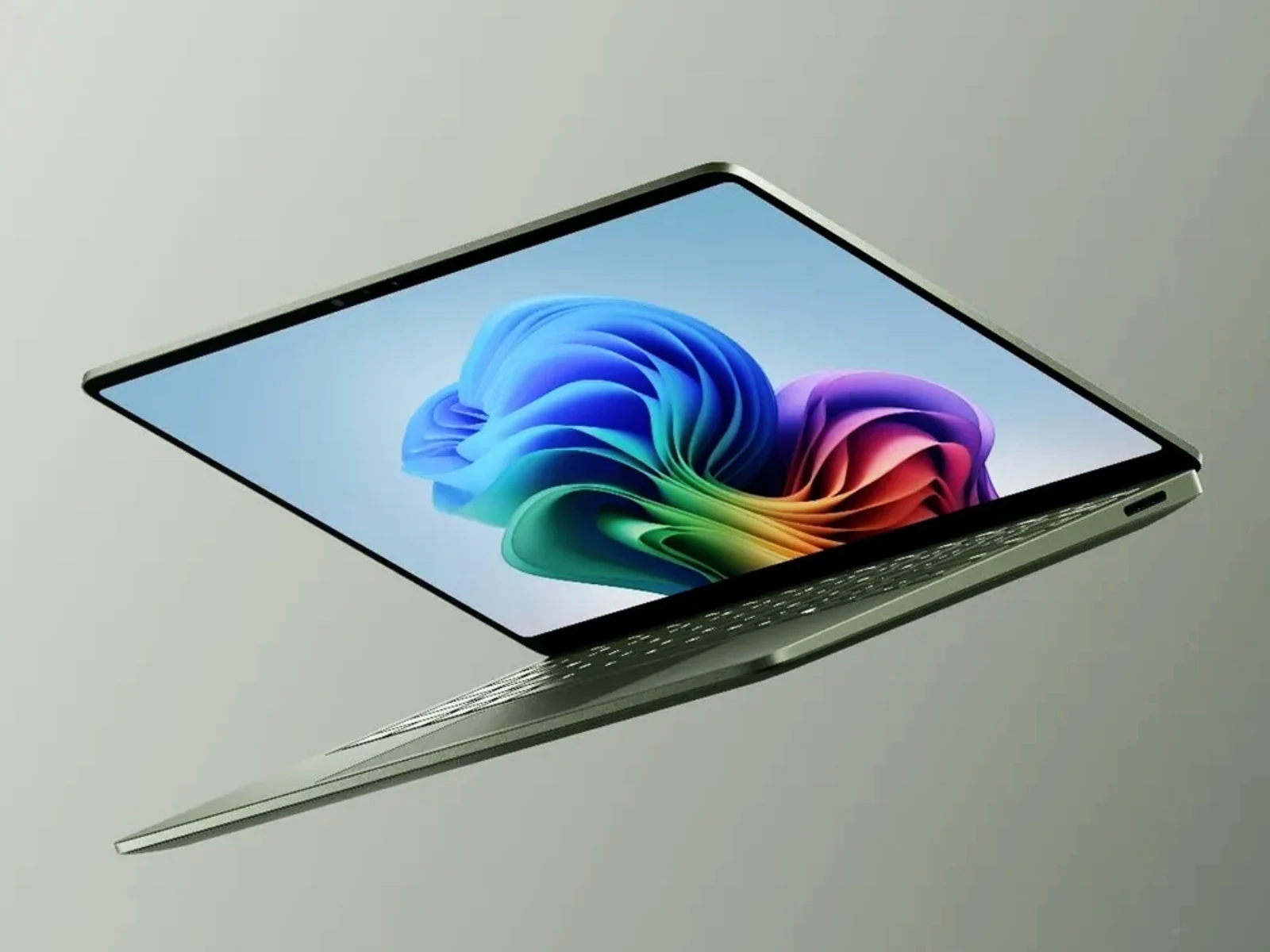
    A little more than a month after Microsoft updated its Surface Laptop lineup with the Surface Laptop 8 for Business, the company is back with a fresh model for consumers. The preivous Surface Laptop 7 for Business relied on Intel processors to keep full x86 compability, but now Microsoft has launched a sucessor to the ARM-based Surface Laptop 7 13.8 inch, which we first reviewed about two years ago on this site.

    Same screen and new chipsets

    It looks like the PixelSense Flow display is returning unchanged. This panel outputs at 2,304 by 1,536 pixels with a pixel density of 201 PPI, a fast 120 Hz refresh rate, and a peak brightness of 600 nits. This is an IPS panel, so earlier rumors about an OLED version turned out to be wrong. That aside, the 120 Hz screen now works with either a Snapdragon X2 Plus chipset, which has 10 cores, or a Snapdragon X2 Elite chipset with 12 cores. You can also configure it with 16 GB, 24 GB, 32 GB, or even 64 GB of LPDDR5X RAM.

    Design and storage details

    This 13.8-inch laptop also continues to support a removable SSD, which is a nice feature for users who want to upgrade storage later. The entire device fits inside a chassis that measures 301 by 220 by 17.5 millimeters and weighs about 1.36 kilograms. Color options include Black, Dune, Jade, and Platinum. Acording to Microsoft, this new model should last up to 20 hours on a single charge, which is a significant improvement over older versions.

    Pricing and configuration limits

    The base price for the Surface Laptop 8 13.8 starts at $1,599 for the version powered by the Snapdragon X2 Plus chipset. If you want the more powerfull Snapdragon X2 Elite chipset, the price goes up by $100. One important detail is that you can only order the laptop with 64 GB of RAM if you choose the Black finish. Microsoft also released a 15-inch version of the Surface Laptop 8 today, so you can check our launch article for more info about that larger model.

    Sources

  • ARM CEO gifts Nvidia’s Huang historic Windows-ARM device

    ARM CEO gifts Nvidia’s Huang historic Windows-ARM device

    Key Takeaway

    – ARM CEO Rene Haas gifted Nvidia CEO Jensen Huang a Surface RT, highlighting its historical significance.
    – The 2012 Surface RT featured an Nvidia Tegra 3 ARM chip, promising fanless design and 10-hour battery life.
    – Windows RT’s limited software ecosystem and poor app support made the Surface RT a commercial flop.
    – Despite failure, the Surface RT laid early groundwork for ARM’s eventual integration into Windows.
    – Nvidia’s new RTX Spark platform will continue to run on Windows, building on that foundation.


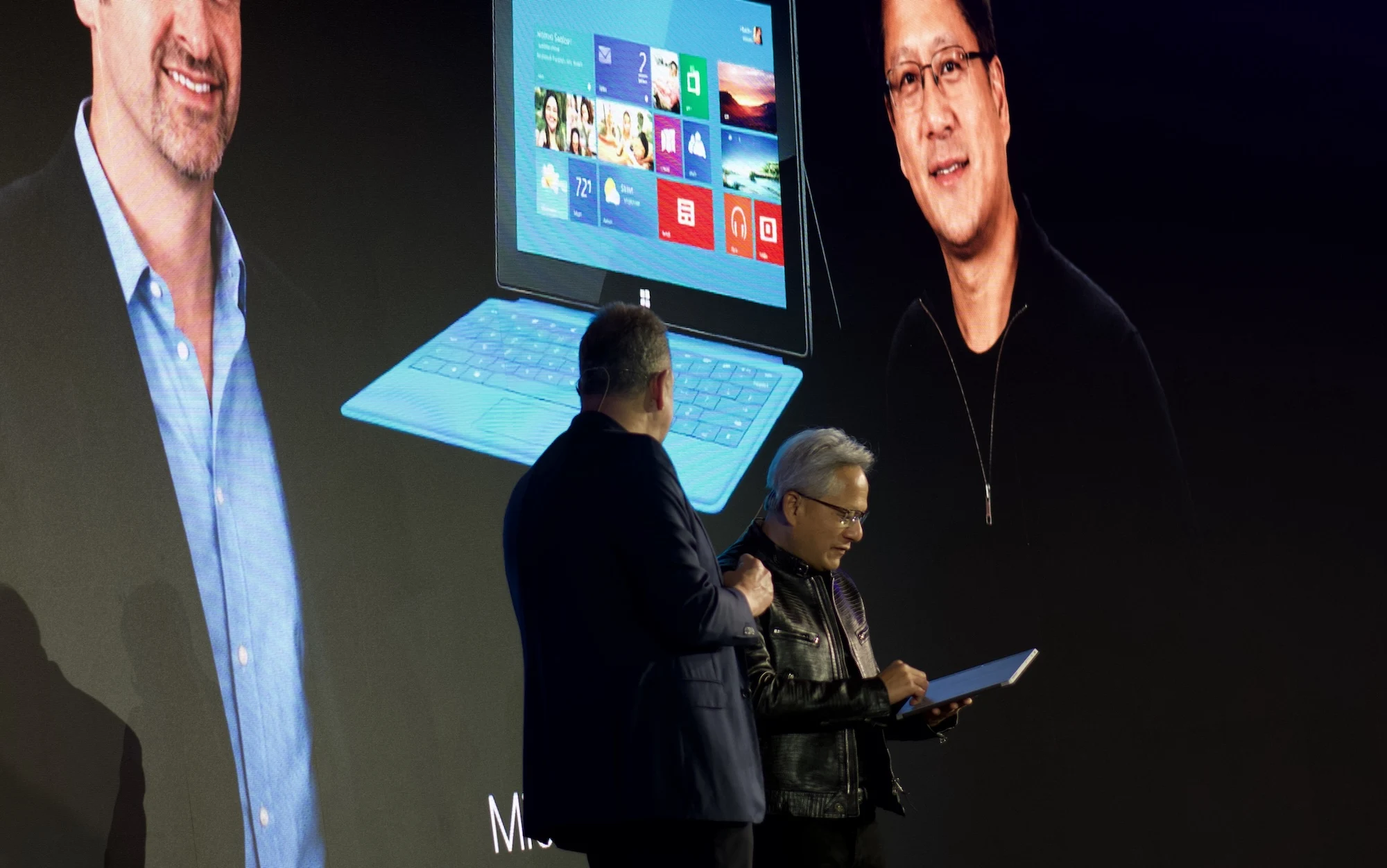
    At Arm’s Computex press conference, amidst a host of AI-related topics, the chip developer had a little surprise in store at the end. Arm CEO Rene Haas invited Nvidia CEO Jensen Huang onto the stage and presented him with a Surface RT. It was a real blast from the past, showing how far things have come.

    A gift from the past for Jensen Huang

    The Surface RT was something special at the time, as the Windows device featured an ARM chip developed by Nvidia (Tegra 3). It was unveiled by Rene Haas, who was then working for Nvidia. The promise in 2012: a fanless design and ten hours of battery life thanks to an energy-efficient platform. These were groundbreaking claims back then.

    How Microsoft redefined its Surface brand

    The Surface RT arrived at a time when Microsoft had largely abandoned the original Surface concept, a rather large table with a touchscreen and sensors for its surface. Instead, the brand name was established for tablets and notebooks. This pivot was quite drastic and changed the direction of the company.

    Back then, the device was something special. Much like the Windows Phone predecessors as MP3 players (Zune), it was extremely difficult to install apps or programs. At the time, the software infrastructure was nowhere near as advanced. In short, the Surface RT was an exciting device to give to relatives or acquaintances who weren’t very tech-savvy. After all, you couldn’t really go wrong with it, mess up the settings, or even catch malware. It was a locked down system.

    Why it was considered a commercial failure

    However, due to these limitations, the Surface RT and Windows RT were also a flop, especially since the devices weren’t particularly fast. Our review of the Surface RT from 2012 was also mixed. Microsoft’s first attempt failed, and it took several more attempts to help ARM gain some traction. After all, Windows was already working in the embedded systems sector, but that didn’t help much at the time.

    • Limited app avalibility hindered adoption.
    • Poor performance compared to Intel counterparts.
    • Confusing marketing for consumers.

    Ultimately, Microsoft, ARM and Nvidia laid the groundwork for establishing ARM in the Windows world. As Jensen Huang stated at the ARM keynote, the new RTX Spark platform will continue to run on Windows. This shows a full circle moment for the technology.

    Sources
    • Arm Unveils Lumex CPU Cores and Mali G1-Ultra GPU for Smartphones

      Arm Unveils Lumex CPU Cores and Mali G1-Ultra GPU for Smartphones

      Key Takeaways

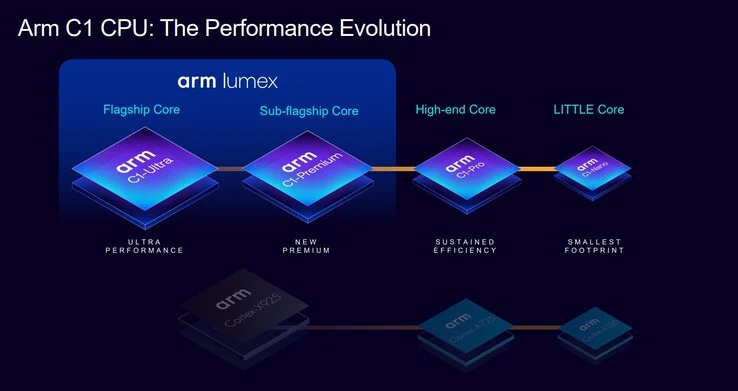
      1. Arm has introduced new CPU and GPU cores for smartphone SoCs, including the Lumex C1 Ultra, C1 Premium, C1 Pro, and C1 Nano, set to launch in 2025-26.
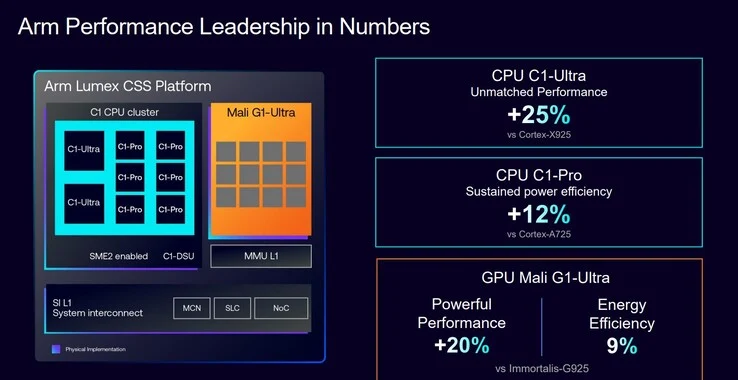
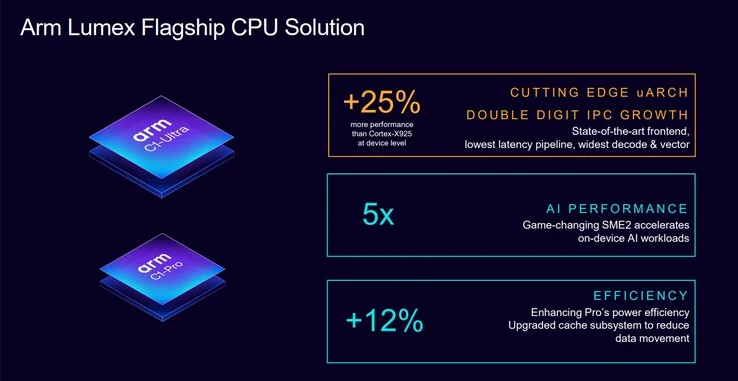
      2. The Lumex C1 Ultra offers up to a 25% performance increase over the Cortex-X925, while the C1 Pro is 12% more power efficient than the Cortex-A725.
      3. All new cores will utilize Arm’s v9.3 architecture, featuring the SME2 instruction set, which can enhance AI performance by up to 5x and improve power efficiency by 3x.
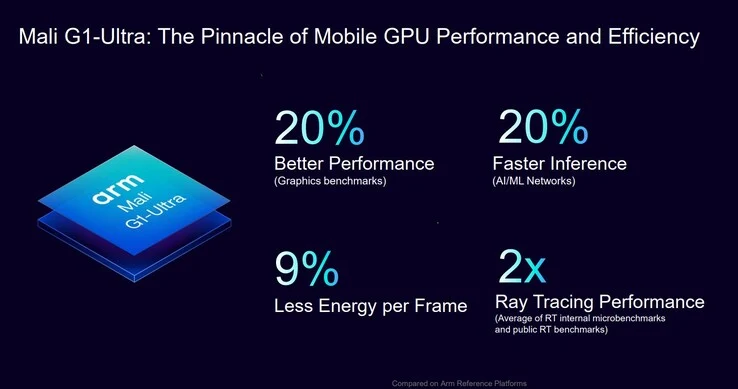
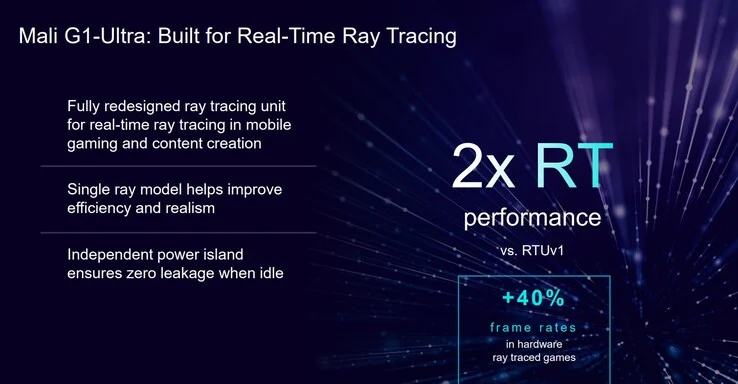
      4. The GPU branding has changed from Immortalis to Ultra, with the Mali G1-Ultra promising a 20% performance boost and a 2x improvement in ray tracing capabilities.
      5. The competitive landscape includes contenders like Apple’s GPUs, Qualcomm’s Adreno 840, and Samsung’s Xclipse 950, making the market highly competitive.


      Arm has unveiled its latest CPU and GPU cores designed for smartphone SoCs set to launch in 2025-26. The Dimensity 9500 from MediaTek is expected to be among the first to implement these new technologies, closely followed by Samsung’s Exynos 2600. In a significant shift, Arm has revamped its naming conventions for CPUs and GPUs, moving away from familiar names like Cortex and Mali to a more streamlined yet somewhat perplexing system.

      New Core Classifications

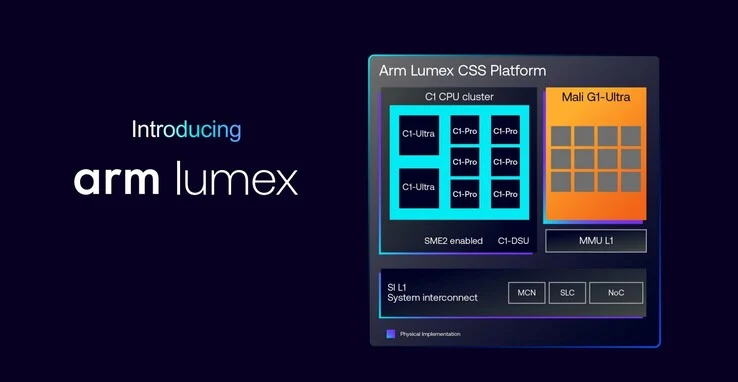
      The newly designed smartphone SoC cores will be divided into four distinct categories: Lumex C1 Ultra, Lumex C1 Premium, Lumex C1 Pro, and Lumex C1 Nano. The C1 Ultra serves as the successor to the Cortex-X925, while both the C1 Premium and C1 Pro act as ‘middle’ cores, succeeding the Cortex-A725. Meanwhile, the C1 Nano is the next iteration of the Cortex-A520. Arm showcased a reference design that includes two Lumex C1 Ultra cores along with a six-core cluster of Lumex C1 Pro, potentially giving us a first look at the Dimensity 9500.

      Performance Improvements

      In terms of performance, Arm asserts that the Lumex C1 Ultra can be as much as 25% quicker than the Cortex-X925, and the Lumex C1 Pro features 12% improved power efficiency over the Cortex-A725, thanks to notable gains in IPC. Competitors for these cores include successors to Apple’s Everest and Sawtooth cores found in the A19/A19 Pro and Qualcomm’s upcoming Nuvia cores, which are expected to launch alongside the Snapdragon 8 Elite 2/Snapdragon 8 Elite Gen 5.

      Architectural Advancements

      All four cores—the Lumex C1 Ultra, Lumex C1 Pro, Lumex C1 Premium, and Lumex C1 Nano—will be built on Arm’s latest v9.3 architecture. The most significant update is the introduction of the SME2 (Scalable Matrix Extension) instruction set. According to Arm, SME2 could provide up to a 5x performance boost in AI workloads, while also being 3x more efficient in terms of power consumption.

      Arm’s GPU branding has transitioned from Immortalis to Ultra, although it remains unclear what the names for lower-tier models will be. An earlier Geekbench listing for the Dimensity 9500 has already revealed this new branding. Arm claims that the Mali G1-Ultra can deliver a 20% enhancement in overall performance and a 2x boost in ray tracing capabilities, translating to a potential 40% increase in frames per second (FPS).

      Competitive Landscape

      Despite these impressive specifications, the competition is notably intense this time around. Alongside Apple’s GPUs, Qualcomm’s Adreno 840 and Samsung’s Xclipse 950 are also contenders, with the latter possibly being Samsung’s first set of in-house chips in recent years. While Arm has not provided a specific timeline for the release of these components, if recent leaks are to be believed, we can expect them to hit the market soon.

      Source:
      Link


    • ARM’s New Travis Core: IPC Boost and SME Support Explained

      ARM’s New Travis Core: IPC Boost and SME Support Explained

      Key Takeaways

      1. ARM is set to unveil a new high-performance CPU core named Travis in September, focusing on improving IPC (instructions per cycle).
      2. The Travis core is expected to deliver significant double-digit IPC improvements over its predecessor, emphasizing efficiency over just higher clock speeds.
      3. It will support the Scalable Matrix Extension (SME) to enhance performance for AI and machine learning tasks, aligning with ARM’s strategy for diverse workloads.
      4. MediaTek is expected to be the first to use the Travis core in its upcoming Dimensity 9500 chip, competing against Qualcomm’s Snapdragon 8 Elite 2.
      5. The new MediaTek chip is reportedly showing impressive performance, benefiting from both the CPU enhancements and a new GPU design, possibly ARM’s Mali-G1 Ultra.


      ARM’s upcoming CPU enhancement has recently become more concrete, at least according to leaks. A new report from industry insider Digital Chat Station suggests that ARM will unveil a new high-performance CPU core named Travis this coming September. The chief focus of this core is said to be its IPC, or instructions per cycle.

      Understanding IPC’s Importance

      IPC is a metric that evaluates how much processing a chip can accomplish at a specified clock speed. According to DCS, the Travis core is expected to deliver double-digit IPC improvements when compared to its predecessor. This is a significant advancement, especially as chip manufacturers are now prioritizing efficiency and intelligent workload distribution instead of merely increasing clock speeds.

      New Features of the Travis Core

      The Travis core will also feature support for the Scalable Matrix Extension (SME), which aims to enhance performance for AI and machine learning tasks. SME is a part of ARM’s larger plan to update compute architecture to handle a variety of workloads across mobile and edge devices more effectively.

      Adding credibility to the leak, DCS has released images that seem to be from an official ARM press event, which confirms these features.

      MediaTek’s Role in the Launch

      While ARM is leading the design of the core, it seems that MediaTek will be the first to utilize it in a commercial product. The Dimensity 9500 is anticipated to be MediaTek’s response to whatever Qualcomm is developing with the Snapdragon 8 Elite 2.

      DCS indicates that the new MediaTek chip is already demonstrating impressive performance, likely benefiting from not only the CPU enhancements but also a new GPU design, which is rumored to be ARM’s Mali-G1 Ultra, codenamed Drage.

      ARM has yet to make any official statements, but if these leaks are accurate, the Travis core could represent a significant change in the technology behind next-generation Android flagship devices.

      Source:
      Link


    • Arm Creates In-House Chip, Meta May Be First Customer

      Arm Creates In-House Chip, Meta May Be First Customer

      Key Takeaways

      1. Arm is reportedly developing its own customizable CPU for data centers, potentially launching it this summer.
      2. The company will collaborate with TSMC for the production of these new chips as a fabless chipmaker.
      3. Softbank, which owns Arm, recently partnered with OpenAI to create extensive AI infrastructure, with Arm as a key player.
      4. Arm’s chip designs are widely used in smartphones, mobile devices, and the latest Apple Macs, known for their power efficiency.
      5. The new processors may support AI applications, increasing Arm’s relevance in the evolving tech landscape.


      Arm could be set to reveal its own processor this year, according to new rumors. The well-known chipmaker might be developing in-house chips, potentially making Meta their first client. Here’s what we’ve learned so far.

      Arm’s New Chip Venture

      A report from The Financial Times suggests that Arm is creating a CPU aimed at data centers, which will be customizable to meet the needs of various clients. As a fabless chipmaker, Arm plans to collaborate with TSMC (Taiwan Semiconductor Manufacturing Company), the largest contract chip manufacturer globally, to produce these new chips. Industry insiders believe these in-house processors might be launched as soon as this summer.

      Partnership with OpenAI

      This development comes just a month after Softbank, which owns Arm, partnered with OpenAI to create up to $500 billion in AI infrastructure. This large-scale initiative will include Arm along with Microsoft and Nvidia as key tech partners. Arm could play a significant role in this project, possibly connecting with AI-driven personal devices being developed by John Ive (a former Apple designer) and Sam Altman from OpenAI.

      Arm’s Ubiquity in Technology

      For those who might not know, Arm’s designs power almost every smartphone available today. They’re also found in most mobile devices and even run the latest Apple Macs and Qualcomm-powered Windows PCs. CPUs that utilize the ARM architecture offer impressive power efficiency without sacrificing performance, rivaling Intel and AMD chipsets. This is a key factor in their growing popularity in data centers that support AI applications.

    • Arm Enters Chip Making with Meta as a Confirmed Customer

      Arm Enters Chip Making with Meta as a Confirmed Customer

      Key Takeaways

      1. MediaTek and Nvidia are entering the “AI PC” sector, increasing competition for Intel, AMD, and Apple.
      2. Arm is planning to launch a new chip aimed at data centers and servers, supported by the acquisition of Ampere.
      3. Arm has secured Meta as a significant client for its upcoming chip, indicating potential use in consumer devices.
      4. There could be conflicts of interest as many companies rely on Arm’s intellectual property while competing in the market.
      5. Production may involve TSMC and potentially Intel, with a likelihood of using older TSMC nodes for the initial chip version.


      With MediaTek and Nvidia set to enter the “AI PC” sector later this year, Intel, AMD, and Apple are about to face new competition. However, a fifth player is also looking to join the competition: Arm. CEO Rene Haas may reveal the new chip “as early as this summer.”

      Arm’s Ambitions

      This upcoming Arm chip is intended for use in data centers and server markets. The efforts of Arm will be supported by Ampere, a company that Softbank (Arm’s parent) is planning to acquire soon. Ampere has struggled to gain significant market share against Intel and AMD in the server sector, but things could shift once Arm steps in.

      A New Major Client

      Moreover, Arm has secured a significant client for the aforementioned chip: Meta. This chip could also be utilized in Sir Jony Ive’s secretive device. This indicates that Arm might be developing a low-power chip aimed at consumer gadgets as well. However, this scenario could lead to serious conflicts of interest, given that many companies, such as Qualcomm, Apple, and recently Intel, rely on Arm’s intellectual property.

      The report indicates that production might be outsourced to TSMC, although there’s a strong possibility that Intel will play a role as well since Arm mentioned it would utilize Intel’s 18A node for a mobile chip. If this chip actually debuts this year, it’s likely that the design has already been finalized. It’s probable that the first version will be produced on an older TSMC node like N3 or N4.

      Source:
      Link

    • Microsoft to Challenge M3 MacBooks with ARM-Based Surface Devices – Event Date Confirmed

      Microsoft to Challenge M3 MacBooks with ARM-Based Surface Devices – Event Date Confirmed

      Although Microsoft is commonly associated with its Windows operating system, the tech giant has a diverse product portfolio that extends beyond software into hardware. One notable success for Microsoft has been its Surface laptop and 2-in-1 product lines. The company is gearing up for an upcoming event where it will unveil new products and advancements, including the highly anticipated Surface Pro 10, Surface Laptop 6, updates to Windows 11 AI, and enhancements to Copilot. Here's a closer look at what to expect from Microsoft's exclusive showcase event scheduled for March 21.

      Microsoft's Showcase Event: Unveiling Surface and Windows Innovations

      Microsoft, renowned for its software prowess, has made significant strides in the hardware sector with its impressive lineup of Surface devices. The upcoming event promises to showcase the latest innovations from Microsoft, offering a glimpse into the future of computing technology.

      Exciting Product Reveals and Technological Advancements

      Attendees can look forward to the unveiling of the Surface Pro 10 and Surface Laptop 6, which are expected to set new benchmarks in performance and design. Additionally, Microsoft will introduce updates to its AI capabilities within Windows 11, enhancing user experiences and productivity. The event will also highlight advancements in Copilot technology, demonstrating Microsoft's commitment to cutting-edge solutions.

      Mark Your Calendars for March 21

      Mark your calendars for March 21 as Microsoft takes center stage to unveil a host of groundbreaking products and advancements that are set to redefine the tech landscape. Stay tuned for more details as Microsoft continues to push the boundaries of innovation and creativity.

    • Report: Xiaomi Collaborates with ARM to Develop In-House Chip

      Report: Xiaomi Collaborates with ARM to Develop In-House Chip

      A processor is the heart of any smartphone, and currently, big companies like Qualcomm and MediaTek pretty much run the show. But Xiaomi might be looking to change things up a bit. They’re apparently working with ARM to make their own processors.

      Xiaomi Collaborating with ARM for Chip Development

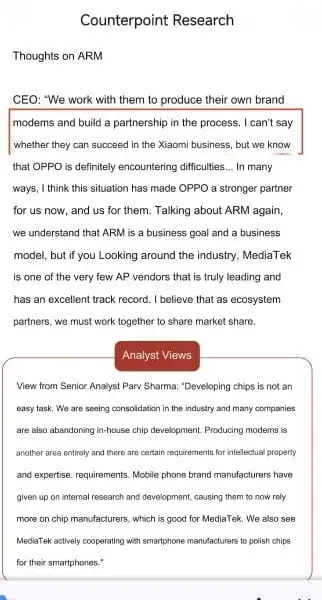
      MediaTek CEO Rick Tsai directly confirmed that ARM is collaborating with Xiaomi on chip development. While the source of this statement comes from a Counterpoint Research report, the original report has been hard to find.

      Report: Xiaomi Collaborates with ARM to Develop In-House Chip

      ARM’s Previous Collaboration with Oppo

      The news initially surfaced through popular tipster Digital Chat Station on Weibo. According to the report, ARM was previously collaborating with Oppo, but the project faced challenges and was eventually abandoned.

      To give you more background on this, there were reports in 2022 about Oppo venturing into manufacturing its own smartphone chips with ARM.

      Basically, Oppo was most likely to use ARM’s Cortex CPUs and Mali GPUs in their processors. However, Oppo ceased its chip design efforts in 2023 due to a downturn in the global smartphone market.

      ARM Finds a New Partner in Xiaomi

      Now that Oppo is out of the picture, it seems like ARM has found a new partner in Xiaomi for their own smartphone chipset.

      It’ll be interesting to see who Xiaomi picks for chip design and manufacturing. For instance, Apple relies on TSMC for manufacturing A-series Bionic chips, while Google is currently relying on Samsung for Tensor SoCs.

      So Xiaomi will also have to choose its partner for this endeavor. ARM will basically provide the base for processors, developing a chip from scratch involves a different set of challenges.

      The Complexity of Chip Development

      Parv Sharma, Senior Analyst at Counterpoint Research, also emphasized the complexity of chip development and the trend of companies outsourcing this task. MediaTek, in particular, stands to benefit from this shift as they actively collaborate with smartphone manufacturers to refine chips for their devices.

      Only time will tell if Xiaomi can successfully develop its chips from scratch.

    • Breaking Boundaries: NVIDIA and AMD Set to Unveil ARM-Based Processors for PCs

      Breaking Boundaries: NVIDIA and AMD Set to Unveil ARM-Based Processors for PCs

      In a groundbreaking move, tech giants NVIDIA and AMD are gearing up to launch ARM-based chips for PCs, marking a significant stride in the ongoing rivalry with Intel. This bold venture promises a new horizon of performance and efficiency in the computing realm.

      Embracing the ARM Architecture

      Traditionally, the PC market has been dominated by x86 architecture, primarily from Intel. However, the winds of change are blowing, as NVIDIA and AMD step into the realm of ARM-based chips. ARM’s architecture is renowned for its efficiency and low power consumption, making it a preferred choice for mobile devices. Transitioning this technology to the PC sector signifies a monumental shift, potentially offering consumers more efficient, cooler, and quieter computing solutions.

      NVIDIA’s foray into ARM-based PC chips poses a major new challenge to Intel, which has long held a stronghold on the PC market. As per a recent report from Reuters, NVIDIA’s commitment to developing ARM-based chips is now official, and the tech behemoth aims to diversify its chip offerings, reducing the reliance on the x86 architecture.

      The Competitive Landscape

      The move by NVIDIA and AMD comes at a critical juncture where the battle for market share in the chip industry is intensifying. Intel, once the unrivaled champion in the chip-making realm, now faces fierce competition. The incoming ARM-based chips from NVIDIA and AMD are rumored to hit the market by 2025, according to insights from The Verge. This timeline sets the stage for an exhilarating race in innovation and market positioning among the chip-making titans.

      Moreover, the collaborative effort between NVIDIA and AMD as reported by VideoCardz, highlights a remarkable coalition aimed at disrupting the status quo in the chip industry. The united front presents a formidable challenge to Intel and heralds a new era of processor technology, marked by enhanced efficiency and potentially lower costs for consumers.

      Future Implications

      The shift to ARM-based chips signifies more than just a technical evolution; it’s a pivotal movement in the chip industry’s landscape. The success of these ventures could potentially redraw the competitive boundaries, offering a fresh narrative in the ongoing saga of processor technology evolution.

      Intel, with its rich legacy in the chip industry, is bound to respond to this new challenge, and as such, the next couple of years will be brimming with innovation and strategic moves that could reshape the PC processor market in profound ways.

      The anticipation surrounding the ARM-based chips from NVIDIA and AMD is palpable, and the tech community is keenly watching the developments as they unfold.


      Sources: Reuters, VideoCardz, The Verge