Category: Computers

  • ECS Liva Z8 Plus: New AMD Strix Point Mini PC Launch

    ECS Liva Z8 Plus: New AMD Strix Point Mini PC Launch

    Key Takeaways

    1. The Liva Z8 Plus mini PC is powered by the Ryzen AI 9 HX 370, AMD’s top-tier Strix Point series processor.
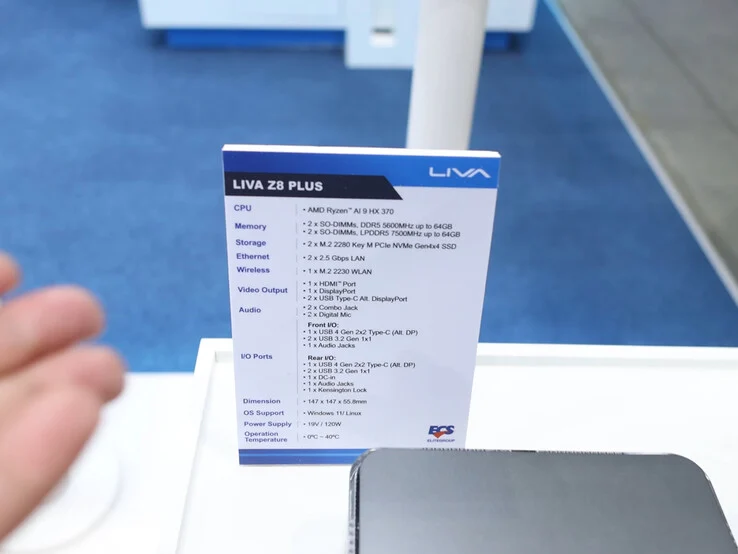
    2. It supports up to 64 GB of DDR5-5600 or LPDDR5-75000 RAM, with the possibility of two different versions available.
    3. The device includes two M.2 2280 slots for PCIe Gen 4 SSDs and a dedicated M.2 2230 slot for a wireless card.
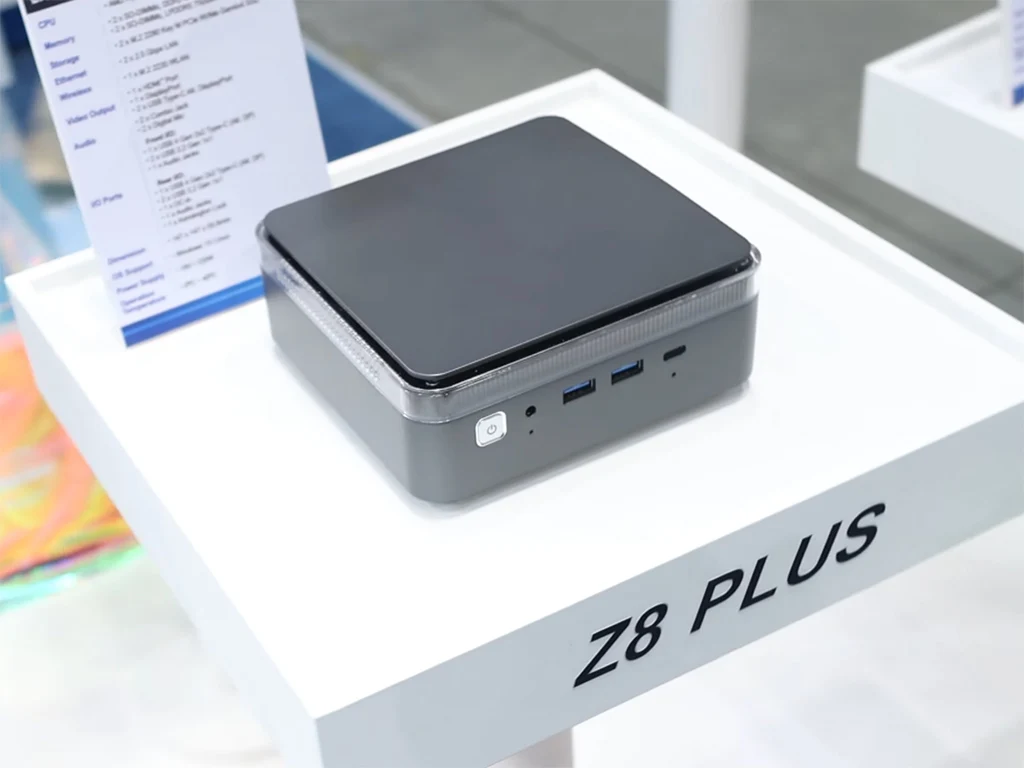
    4. Its compact dimensions are 147x147x55.8 mm, featuring RGB lighting and a stylish black exterior.
    5. ECS has not yet revealed the pricing and availability details for the Liva Z8 Plus.


    ECS recently unveiled several new mini PCs at Computex 2025, including the Liva Z8 Plus. This compact device is powered by the Ryzen AI 9 HX 370, which represents the highest tier in AMD’s Strix Point series. With the Radeon 890M integrated, this mini PC is well-equipped to handle demanding AAA games at 1080p resolution.

    Memory and Configuration Options

    The Ryzen AI 9 HX 370 in the Liva Z8 Plus can support up to 64 GB of DDR5-5600 or LPDDR5-75000 RAM. Although ECS has not provided extensive information about memory compatibility, it is likely that the LPDDR5 memory is soldered to the motherboard. This suggests that there could be two separate versions of the Liva Z8 Plus available.

    Storage and Connectivity Features

    Additionally, the Liva Z8 Plus is designed with two M.2 2280 slots for PCIe Gen 4 SSDs, and for reference, a 2 TB Samsung 990 EVO Plus is currently priced at $139.99 on Amazon. ECS has emphasized the extensive range of ports available on the Z8 Plus, which include a dedicated M.2 2230 slot for a wireless card. The dimensions of the chassis are noted to be 147x147x55.8 mm, featuring an RGB lighting array along the upper corners.

    Among other features of the Liva Z8 Plus is a 120 W power supply included in the package, a dual-microphone setup, and a stylish black exterior. ECS has yet to announce the pricing and availability for this mini PC powered by the Ryzen AI 9 HX 370.

    Source:
    Link

  • Hyte X50 Gaming Case: Sleek Design & Superior Cooling Performance

    Hyte X50 Gaming Case: Sleek Design & Superior Cooling Performance

    Key Takeaways

    1. Unique design with a smooth, rounded shape and highly perforated steel front cover for improved airflow.
    2. Supports up to ten case fans with multiple configurations for optimal cooling, including space for a 360 mm radiator.
    3. Tool-less access to side panels and front plate for easy internal component access.
    4. Available in various colors (white, black, red, pink, green, violet) with a more affordable X50 Air version featuring a second perforated side panel.
    5. Expected prices of around $150 for the X50 and $120 for the X50 Air, with no announced release date.


    The Hyte X50 impresses with its unique design. Featuring a highly perforated steel front cover and a see-through side window, the case boasts a smooth, rounded shape that sets it apart from the increasing number of angular PC cases. Hyte claims that they focused on improving airflow in the X50.

    Airflow and Fan Capacity

    To enhance airflow, the case includes a perforated side panel, front, rear, and base plate, capable of housing up to ten case fans. The bottom section can accommodate three 120 mm fans, while both the front and right panels can support three fans each or one 360 mm radiator. Additionally, there’s room for another fan on the back panel. A special compartment is designed to hide an ATX power supply and optimize cable management. Hyte also uses unique silicone cable grommets, which are further explained in the Gamers Nexus video linked below.

    Easy Access and Color Options

    Both side panels and the front plate can be removed without any tools for quick access to the internal components. The Hyte X50 will come in various colors like white, black, red, pink, green, and violet. There’s also a more affordable version called the Hyte X50 Air, which swaps the transparent window for a second perforated side panel, available only in white and black. If there are no changes, the expected prices for the X50 and X50 Air are around $150 and $120, respectively. However, the release date has not been announced yet.

    Source:
    Link
  • Samsung’s UT One OLED Panel May Reduce Power Use in Future MacBook Pro

    Samsung’s UT One OLED Panel May Reduce Power Use in Future MacBook Pro

    Key Takeaways

    1. Future MacBook Pro expected to feature an OLED screen, replacing mini-LED display.
    2. Launch of the first OLED MacBook Pro anticipated in 2026, using advanced Samsung panels.
    3. Samsung’s Gen 8.6 OLED panel is 30% slimmer and lighter, potentially reducing laptop weight by 50 grams.
    4. New panel offers a variable refresh rate down to 1 Hz, improving power efficiency.
    5. Intelligent Color Technology (ICT) enhances power efficiency and image brightness without noticeable flickering.


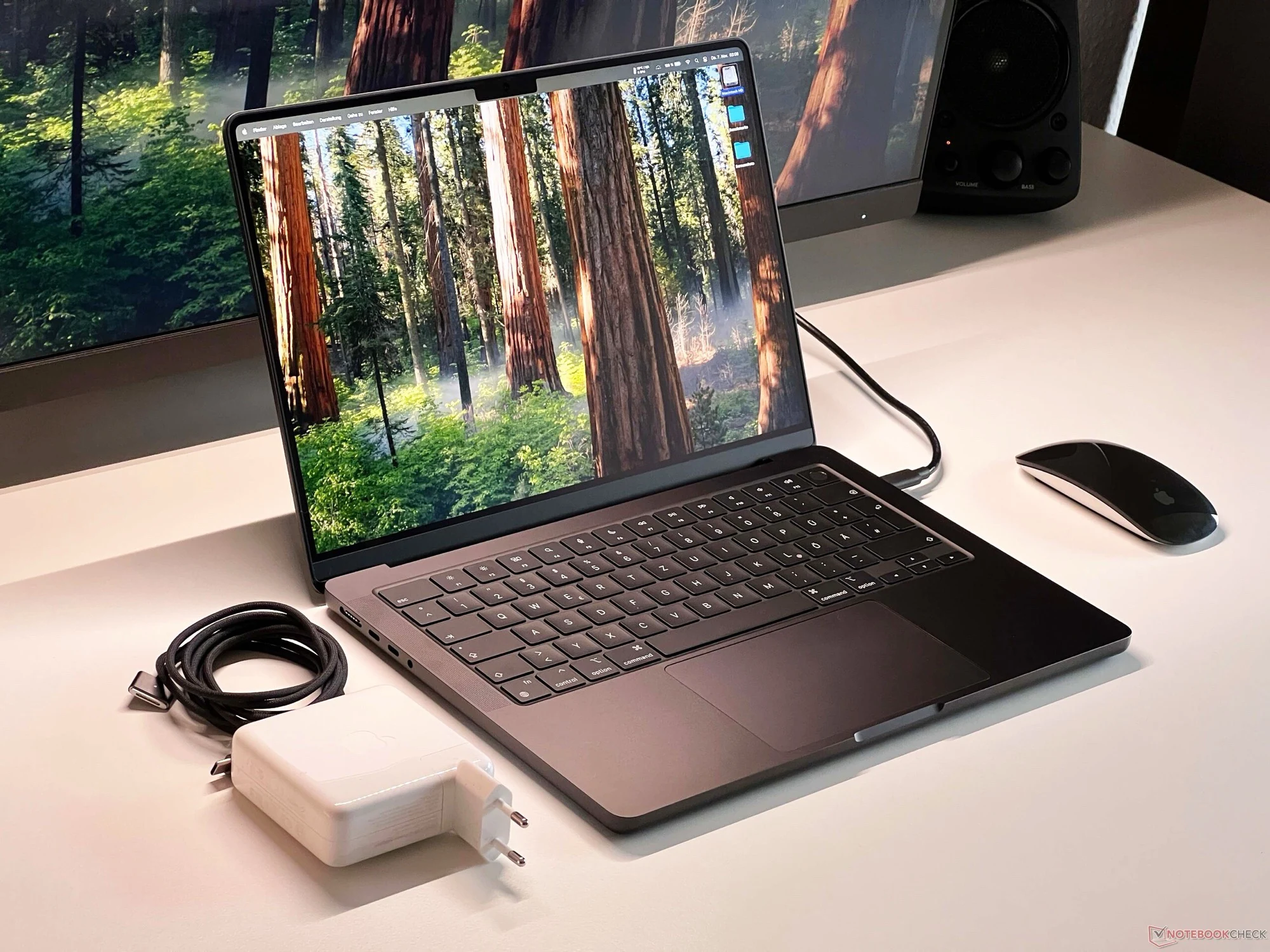
    Rumors have been going around for a long time that a future Apple MacBook Pro will come with an OLED screen, replacing the mini-LED display currently used in models priced around $1,780 on Amazon. The first MacBook Pro with an OLED display is anticipated to launch in 2026, with Apple reportedly selecting advanced eighth-generation tandem OLED panels, mainly sourced from Samsung Display.

    Cutting-Edge Technology

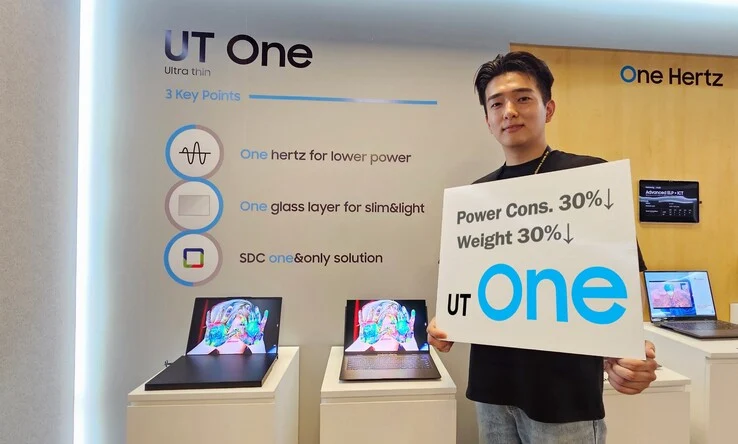
    Samsung Display has introduced its Gen 8.6 OLED panel, which is set to begin mass production next year. The timing and specifications match earlier rumors about the MacBook Pro, suggesting that this panel could have been specifically designed for Apple’s leading laptop. The Samsung “UT One” OLED panel is claimed to provide two notable advantages over existing standard OLED panels. It is 30% slimmer and lighter, which may result in a decrease in a laptop’s weight by approximately 50 grams (1.76 ounces). Additionally, it features a variable refresh rate that can decrease to as low as 1 Hz – a capability that has been common in smartphones but is a first for laptops.

    Improved Power Efficiency

    Samsung’s internal tests indicate that reducing the refresh rate to this extent can potentially reduce power consumption by 30%. The company also asserts that this UT One OLED panel will not show noticeable flickering, even at refresh rates below 10 Hz. The display can support refresh rates up to 120 Hz. Moreover, Samsung’s new Intelligent Color Technology (ICT) aims to enhance power efficiency further by dimming brightness while increasing saturation, which helps images to look brighter than they truly are.

    Source:
    Link



  • Phison Shows Apex PCIe 5.0 RAID with 140 GB/s SSD Speeds

    Phison Shows Apex PCIe 5.0 RAID with 140 GB/s SSD Speeds

    Key Takeaways

    1. PCIe 5.0 offers transfer speeds over 14 GB/s, while PCIe 6.0 and 7.0 are expected to reach 28 GB/s and 56 GB/s, respectively.
    2. A demonstration at Computex showed 32 PCIe 5.0 SSDs in RAID 0 achieving speeds comparable to PCIe 7.0 X8, with sequential speeds of 113.6 GB/s.
    3. The AMD Ryzen Threadripper Pro 7985WX system used for the demo utilized three PCIe 5.0 slots to enhance transfer speeds.
    4. Phison’s PS5028-E28 Gen5 SSDs are rated for maximum read speeds of 14.8 GB/s and write speeds of 14 GB/s, with support for 3,000K IOPS.
    5. Current Windows 11 kernel limitations may restrict speeds, suggesting potential for higher transfer rates with future software updates.


    PCIe 5.0 is currently the quickest expansion bus standard for mainstream SSDs, boasting transfer speeds that exceed 14 GB/s. Each new PCIe generation typically doubles the maximum theoretical speeds of its predecessor. Therefore, the anticipated PCIe 6.0 standard should enable transfer speeds of nearly 28 GB/s over 4 lanes, while PCIe 7.0 could potentially reach around 56 GB/s on the same 4 lanes. However, users don’t have to wait for future PCIe versions to enjoy speeds that go well beyond the theoretical limits of PCIe 5.0. At this year’s Computex event, Phison partnered with Apex Storage to showcase a solution that links up to 32 PCIe 5.0 SSDs in RAID 0, achieving speeds comparable to PCIe 7.0 X8 and even higher.

    AMD-Powered Demonstration

    For their showcase at Computex, Phison utilized an AMD-driven system featuring an AMD Ryzen Threadripper Pro 7985WX installed on an Asus Pro WS WRX90E-SAGE SE motherboard, which offers a total of 7 PCIe 5.0 slots. They only needed three of those slots to create a RAID matrix that included 32 SSDs distributed across three Apex cards.

    Although it was possible to use just two cards for a 32 SSD matrix, spreading the SSDs across three cards seems to have enhanced the transfer speeds even more. The sequential speeds hit an impressive 113.6 GB/s, while sequential write speeds were slightly lower at 104.6 GB/s according to CrystalDiskMark 8.0.6. This version of the well-known SSD benchmark also features a Mix test that combines 70% read speeds with 30% write speeds, where the Phison matrix achieved a remarkable transfer rate of 146 GB/s.

    Phison’s New SSDs

    The matrix of 32 SSDs consists of Phison’s latest PS5028-E28 Gen5 individual units. These units are manufactured on TSMC’s N6 fabrication nodes and are rated for maximum read speeds of 14.8 GB/s, while write speeds can reach up to 14 GB/s. They also support random transfers of up to 3,000K IOPS.

    Phison noted that the existing Windows 11 kernel used during the tests is restricting speeds, indicating that there is potential for even quicker transfer rates with enhancements to the operating system code. Additionally, the PM584 microchip switch with 84 lanes that powers each Apex card is currently limited to 128 TB per matrix. This means the setup could accommodate either 32 x 4 TB SSDs across two cards or 16 x 8 TB SSDs on a single card.

    Source:
    Link


  • Bosgame M5 AI Mini Desktop with AMD Ryzen AI Max+ 395 Strix Halo

    Bosgame M5 AI Mini Desktop with AMD Ryzen AI Max+ 395 Strix Halo

    Key Takeaways

    1. Several OEMs, including Zotac, Framework, Beelink, GMKTec, and Bosgame, have introduced mini-PCs with AMD’s Strix Halo chips.
    2. The Bosgame BeyondMax Series features an AMD Ryzen AI Max+ 395 Strix Halo chip with 64 GB of VRAM, showing a multicore score of 16,044, lower than the benchmark average due to potential software issues.
    3. The mini-PC will be launched as the Bosgame M5 AI Mini Desktop, equipped with a dual-fan cooling system, three heat pipes, and two PCIe Gen 4 NVMe SSD slots.
    4. Additional features include a front-facing USB 4.0 port, Wi-Fi 6E, and Bluetooth 5.4 capabilities, with support for up to 128 GB of RAM and 2 TB of storage.
    5. The Bosgame M5 AI Mini Desktop is currently available for pre-order at a price of $1,699.


    Over the last few weeks, several OEMs have introduced AMD’s Strix Halo chips in their mini-PCs, following AMD CEO Dr. Lisa Su’s commitment to expand the chip’s presence to more desktop systems. Notable brands like Zotac, Framework, Beelink, and GMKTec are included in this group. Recently, a new entry has appeared online, produced by Bosgame.

    Performance Insights

    A recent Geekbench report for the Bosgame BeyondMax Series indicates it utilizes an AMD Ryzen AI Max+ 395 Strix Halo chip with 64 GB of VRAM. Its multicore score stands at 16,044, which is significantly lower than the benchmark average of 21,269; this is likely due to software instability. Conversely, its single-core score of 2,852 fits well within an acceptable range.

    Product Details

    According to the company’s website, this mini-PC is set to be launched as the Bosgame M5 AI Mini Desktop. A promotional video on their YouTube channel highlights that it will feature a dual-fan cooling system, three heat pipes, two PCIe Gen 4 NVMe SSD slots, a front-facing USB 4.0 port, as well as Wi-Fi 6E and Bluetooth 5.4 capabilities.

    Additional Specifications

    Other specifications for the Bosgame M5 AI Mini Desktop include support for up to 128 GB of RAM and 2 TB of storage, although the previously mentioned variant only comes with 64 GB. Even though the listing for the Bosgame M5 AI Mini Desktop is mostly blank, it is available for pre-order right now for $1,699.

    Source:
    Link


  • Asus ExpertCenter P600 Launches as First Copilot+ AiO Model

    Asus ExpertCenter P600 Launches as First Copilot+ AiO Model

    Key Takeaways

    1. Asus has launched the ExpertCenter P600 series, its first Copilot+ AiO collection, featuring 27-inch and 24-inch FHD touchscreens with anti-glare coating.
    2. The 27-inch model has a 93% screen-to-body ratio, contributing to a sleek design with thin bezels, though it does not surpass the previous P400 model.
    3. The P600 AiO includes a retractable camera with a 5 MP FHD sensor, infrared capabilities, an integrated microphone array, and a proximity sensor for improved video calls and security.
    4. It can be equipped with a Ryzen AI 300 series processor, offering up to 50 TOPS of dedicated NPU, and is designed for durability suitable for business use.
    5. Pricing and availability details are not yet released, but the previous P400 AiO was expected to launch in March 2025, starting at $1099.99 for the top-tier CPU variant.


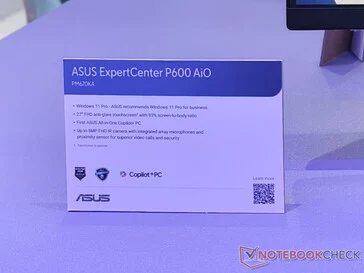
    Asus has introduced its inaugural Copilot+ AiO collection, the ExpertCenter P600 series. This series includes two versions: one with a 27-inch display and another with a 24-inch screen. Both options are equipped with FHD touchscreens and feature an anti-glare coating for a more pleasant viewing experience.

    Screen Features

    The firm asserts that the 27-inch ExpertCenter P600 AiO has a screen-to-body ratio of 93%. While this is not particularly impressive, and it doesn’t even surpass the previous P400 AiO model, it does contribute to a sleek appearance with thin bezels around the display.

    Camera and Configuration

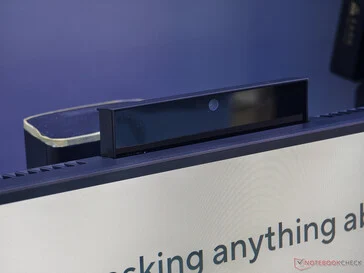
    Another impressive feature of the P600 AiO is its retractable camera, which uses a mechanism similar to that of the older P400 AiO. Asus states that these devices can be set up with a 5 MP FHD sensor that includes infrared capabilities and an integrated microphone array. Additionally, there’s a proximity sensor included, which is said to improve video calls and security measures.

    Specs and Availability

    Although Asus hasn’t provided all the specifications for the P600 AiO yet, it did mention that the models can be equipped with a Ryzen AI 300 series processor, capable of delivering up to 50 TOPS of dedicated NPU. The company also emphasizes the durability suited for business use, but has yet to release information on pricing and availability. Historically, the previous P400 AiO was available for purchase in March 2025, with the top-tier CPU variant priced at $1099.99.


  • Asus Launches ExpertCenter P700: First Copilot+ PC Desktop

    Asus Launches ExpertCenter P700: First Copilot+ PC Desktop

    Key Takeaways

    1. Asus has launched the ExpertCenter P700 series of business desktops, introducing the Copilot PC+ desktops with two models available.
    2. The ExpertCenter PM700MK mini tower can support up to Nvidia RTX 5070 graphics and Ryzen AI 300 series processors with 50 TOPS NPU capability.
    3. The ExpertCenter PM700SK is a Small Form Factor (SFF) PC that can be upgraded with Nvidia RTX A400 graphics and also supports Ryzen AI 300 series processors.
    4. Both models feature a tool-less chassis, meet MIL-STD-810H durability standards, and include Asus AI ExpertMeet for enhanced video conferencing.
    5. Pricing and availability details for the ExpertCenter P700 series have not yet been announced.


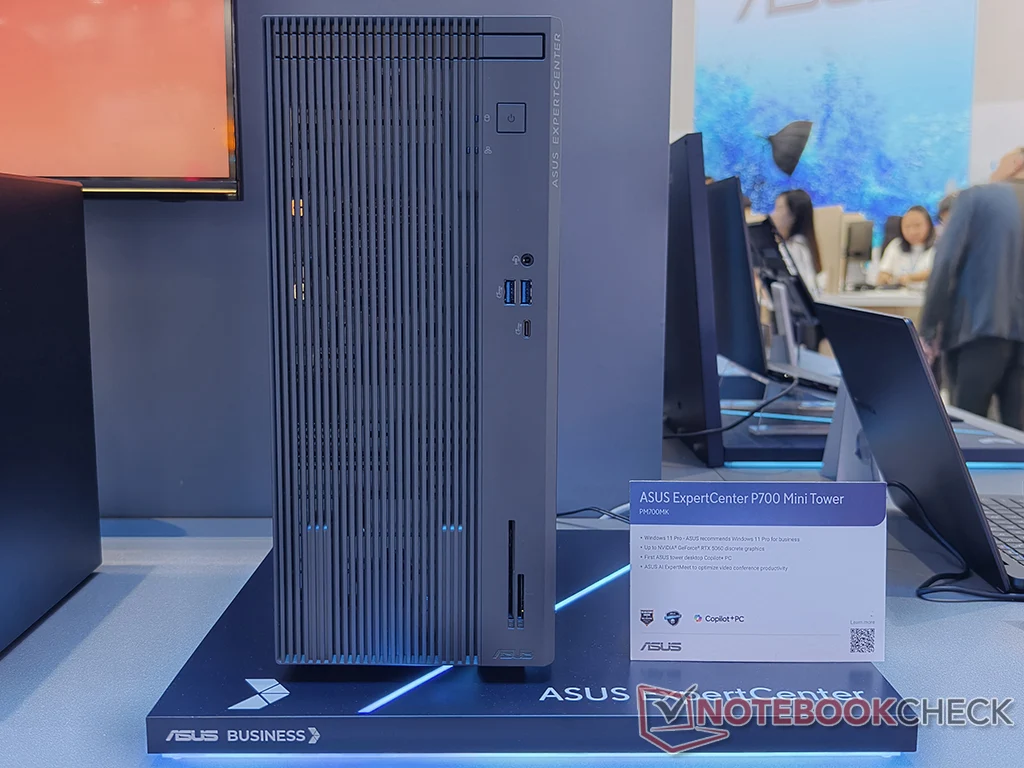
    Asus has launched a new series of business desktops called the ExpertCenter P700. This marks the debut of the company’s Copilot PC+ desktops, and there are currently two models available. One of these is a mini tower desktop with a stylish design and an ample number of ports.

    ExpertCenter PM700MK Specifications

    The mini tower model, known as the ExpertCenter PM700MK, can be fitted with up to the Nvidia RTX 5070 discrete graphics card. While Asus has not revealed the specific CPU options for this desktop, they did mention that there will be a configuration available featuring a Ryzen AI 300 series processor with an impressive capability of up to 50 TOPS NPU.

    The SFF Model

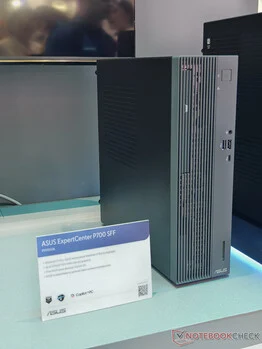
    The second variant in the P700 lineup is the ExpertCenter PM700SK, which is a Small Form Factor (SFF) PC. This model also boasts a compact design that mirrors the aesthetics of the mini tower version.

    However, in contrast to the ExpertCenter PM700MK, the PM700SK can be upgraded with up to Nvidia RTX A400 discrete graphics. Asus has not provided further specifications for this business-class model either, but it can similarly be configured with a Ryzen AI 300 series processor offering up to 50 TOPS NPU.

    Key Features and Availability

    Both desktop models feature a tool-less chassis, meet the MIL-STD-810H durability standard, and include Asus AI ExpertMeet for improved video conferencing experiences. The company has not yet disclosed any pricing or availability information for the ExpertCenter P700 series.


  • Asus ExpertCenter PN54: AMD Ryzen AI 300 Mini-PC with I/O and Windows Copilot Key

    Asus ExpertCenter PN54: AMD Ryzen AI 300 Mini-PC with I/O and Windows Copilot Key

    Key Takeaways

    1. Asus introduced the ExpertCenter PN54 mini-PC for professionals at Computex 2025, featuring a compact design.
    2. Connectivity options include Wi-Fi 7, Bluetooth 5.4, 2.5 Gbps Ethernet, and multiple 10 Gbps USB ports.
    3. The device is equipped with a fingerprint sensor for enhanced security.
    4. It offers performance with AMD Ryzen AI 7 350 or Ryzen AI 5 340 CPUs and can support up to four 4K video streams.
    5. Memory capacity can reach 64 GB DDR5, and storage options include a 2 TB PCIe Gen 4 NVMe SSD.


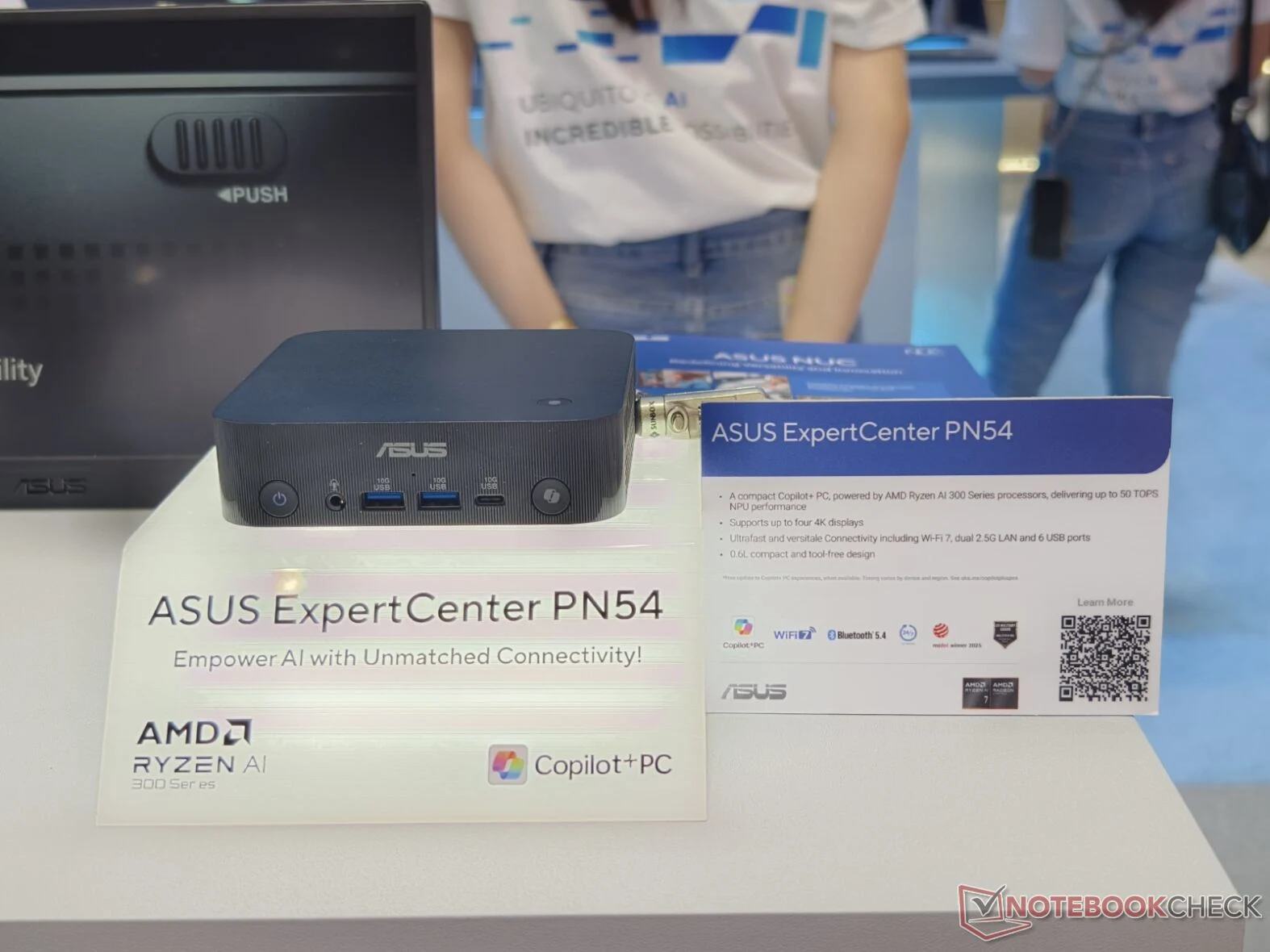
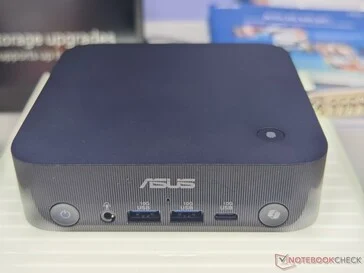
    Asus has unveiled a new mini-PC aimed at professionals during Computex 2025. The ExpertCenter PN54 stands out with its small size and a wide range of connectivity features, including Wi-Fi 7, Bluetooth 5.4, and 2.5 Gbps Ethernet. On the front panel, users will find two 10 Gbps USB Type-A ports, a 10 Gbps USB Type-C port, and a 3.5 mm audio jack, plus a button for Windows Copilot, which is a bit puzzling.

    Connectivity Options

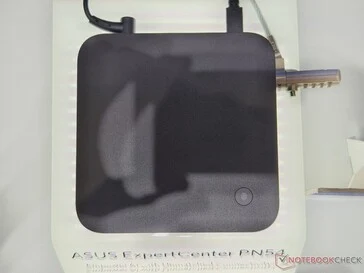
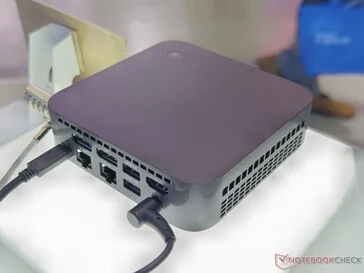
    On the back, the connectivity continues with a single 40 Gbps USB 4.0 port, two DisplayPort connectors (standard not specified), one HDMI output, two Ethernet ports, one USB 2.0 Type-A port, and another 10 Gbps USB Type-A port. Interestingly, the top of the device features what appears to be a fingerprint sensor, enhancing security through biometric authentication. The compact dimensions of this mini-PC are 130 mm x 130 mm x 34 mm, and it has a weight of 0.55 kg.

    Performance and Specifications

    The Asus ExpertCenter PN54 is available with either an AMD Ryzen AI 7 350 or the Ryzen AI 5 340 Krackan Point CPU. This model’s integrated Radeon iGPU can handle up to four 4K video streams at once. For memory and storage, it supports a maximum of 64 GB DDR5 (speed not specified) and a 2 TB PCIe Gen 4 NVMe SSD. Asus will announce the pricing and availability details in the future.


  • MSI Prestige 13 AI+ Ukiyo-e Edition: Limited 2.2-lbs Ultrabook

    MSI Prestige 13 AI+ Ukiyo-e Edition: Limited 2.2-lbs Ultrabook

    Key Takeaways

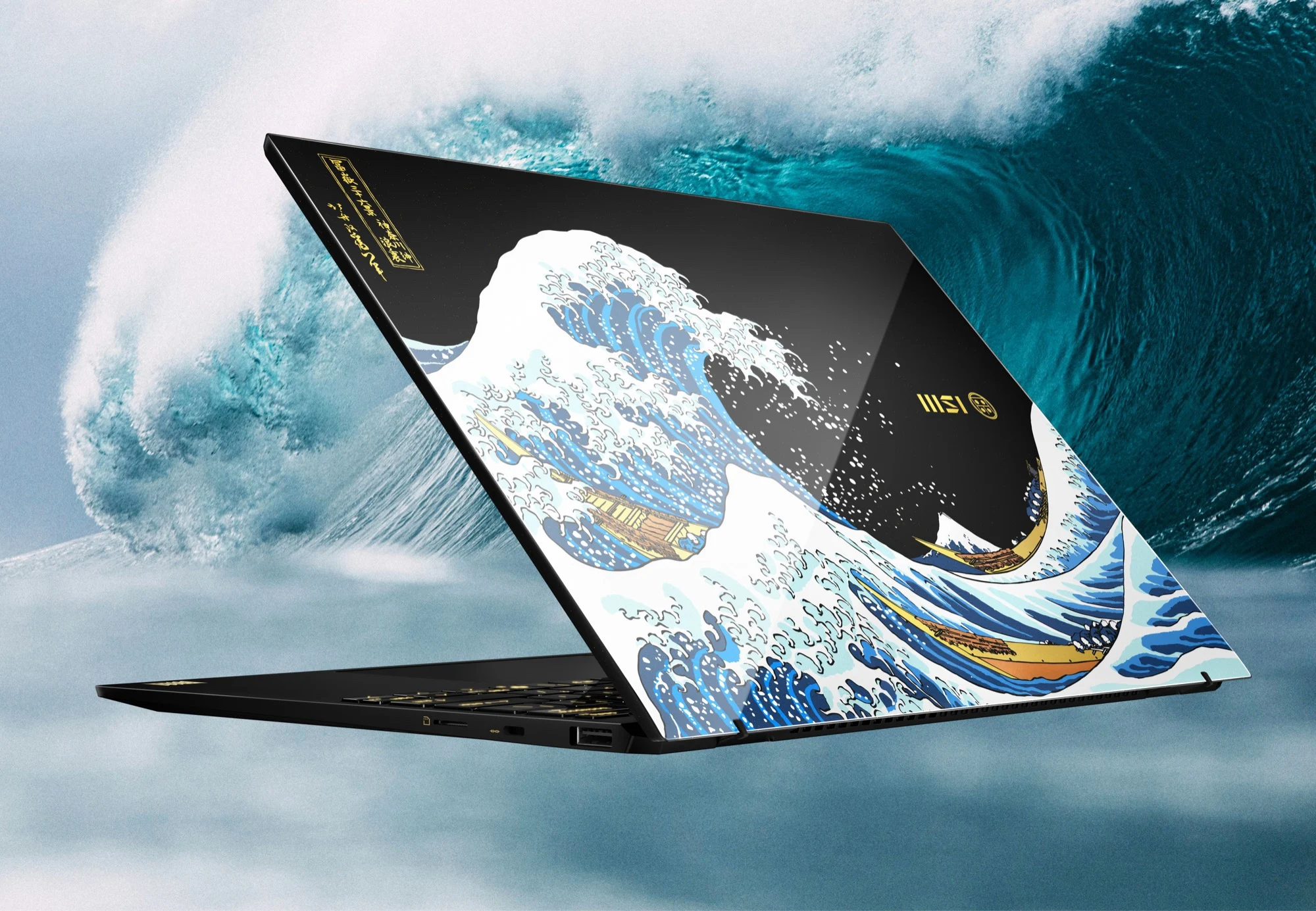
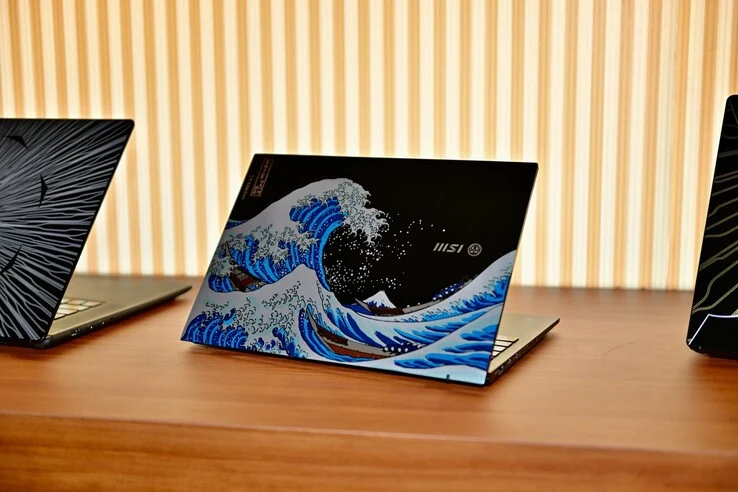
    1. MSI introduced a special edition of the Prestige 13 AI+ Evo featuring Katsushika Hokusai’s artwork “The Great Wave off Kanagawa” on the lid, created through a handcrafted process.
    2. The Ukiyo-e Edition maintains the same specifications as last year’s model, including an Intel Core Ultra 9 processor and 32GB of RAM.
    3. The ultrabook boasts impressive battery life, lasting up to 13.4 hours during web surfing, thanks to its 75Wh battery.
    4. The 13.3-inch OLED display has a resolution of 2880 x 1800 pixels but operates at 60Hz and reaches up to 400 nits of brightness.
    5. Availability and pricing for the Ukiyo-e Edition have not been announced, but it is expected to be produced in limited quantities.


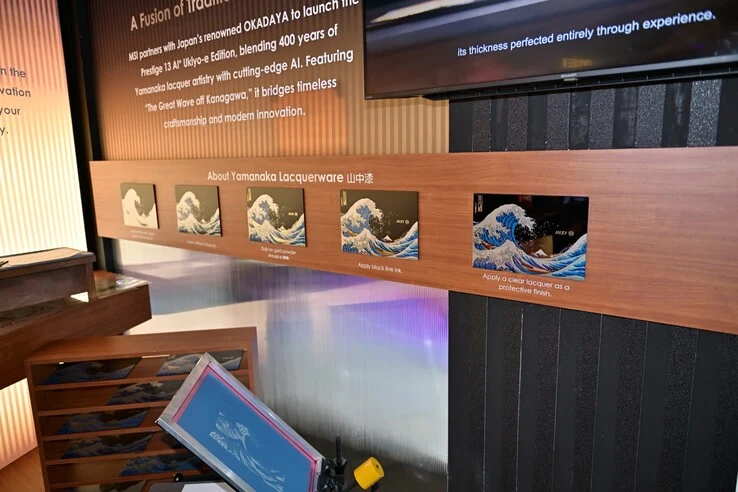
    MSI has introduced a special version of the Prestige 13 AI+ Evo at Computex. While it shares the same technical features as last year’s model, the lid now features Katsushika Hokusai’s iconic artwork “The Great Wave off Kanagawa.” This famous piece, originally a color woodcut from 1830, has been meticulously recreated on the laptop by the Japanese artisan Okadaya through a handcrafted technique.

    Unique Handcrafted Process

    The creation of this edition involves a five-step process, with some steps done by hand. This craftsmanship is why the Ukiyo-e Edition can only be made in small numbers. The specifications of the ultrabook are still the same, which isn’t a bad thing at all. The MSI Prestige 13 AI+ Evo is powered by an Intel Core Ultra 9 288V, featuring four performance cores and four efficiency cores, reaching boost clock speeds up to 5.1GHz. It also comes with the Intel Arc 140V iGPU, capable of handling less demanding gaming. Moreover, it has 32GB of LPDDR5x-8533 RAM and a PCIe 4.0 SSD.

    Impressive Battery Life

    With a modern Intel processor and a relatively large 75Wh battery, users can expect a long battery duration. In our thorough assessment, the standard model managed an impressive 13.4 hours during our web surfing test over WiFi. Additionally, the 13.3-inch OLED display offers a resolution of 2880 x 1800 pixels, but it doesn’t excel in smoothness or brightness, operating at 60Hz and reaching up to 400 nits. The MSI Prestige 13 AI+ Evo isn’t particularly slim at 0.67 inches; however, it weighs a lightweight 2.18 lbs and includes a 5MP webcam, two USB-C Thunderbolt 4 ports, one USB-A port, HDMI 2.1, and a microSD card reader.

    Availability and Pricing

    MSI has not yet announced when the Prestige 13 AI+ Ukiyo-e Edition (A2VM) will be released, nor has the pricing been disclosed. Still, this partially handcrafted laptop is anticipated to be available in very limited numbers. For comparison, the MSI Prestige 13 AI+ Evo with the Core Ultra 7 is currently listed at $1,349 on Amazon.

    Source:
    Link


  • China Launches 12 Satellites into Orbit with Long March 2D

    China Launches 12 Satellites into Orbit with Long March 2D

    Key Takeaways

    1. The Long March 2D rocket successfully launched 12 “space computing” satellites on May 14, 2025, marking the 576th mission in the Long March series.
    2. The satellites were arranged using a two-layer setup, with careful timing for their separation during launch to optimize performance.
    3. The quick turnaround from contract signing to launch took only five months, highlighting efficient collaboration among engineers and satellite teams.
    4. The satellites are part of the “Star Computing” program, designed to perform high-speed calculations and support a future network of 2,800 satellites.
    5. Equipped with advanced communication links and an X-ray detector, the satellites enable real-time data analysis and aim to reduce emissions from traditional data centers on Earth.


    The Long March 2D rocket took off from the Jiuquan Satellite Launch Center at 12:12 PM (Beijing time) on May 14, 2025. This mission successfully placed twelve “space computing” satellites into a sun-synchronous orbit, marking the 576th triumph for the Long March series.

    Launch Details

    For this mission, planners used a two-layer setup for the satellites: two main satellites were stacked vertically on the top, while ten additional ones were arranged in twin rings along the side. The payloads were released through four carefully timed separation events, and the flight path was optimized to reduce disturbances to the rocket’s upper stage.

    Rapid Turnaround

    The time from signing the contract to the actual launch was a quick five months. Engineers from the China Aerospace Science and Technology Corporation’s Eighth Academy worked closely with the satellite teams to finalize electromechanical connections and orbital details, speeding up the integration process. This showcased the liquid-propellant rocket’s capability to carry mixed payloads weighing up to 1.3 tons to a sun-synchronous orbit at 700 km.

    Future of Space Computing

    These twelve satellites are the first batch of the “Star Computing” program, also known as “Satellite Computing.” Guoxing (ADA) Space manufactured the buses, while Zhijiang Laboratory provided the main payload according to the “Three-Body Computing Constellation” specifications. Each satellite is capable of performing five peta-operations per second. The program’s managers have plans for a larger network of 2,800 satellites, which could potentially deliver around 1,000 POPS.

    In addition to their powerful processing capabilities, the satellites are equipped with 100 Gbps laser communication links between them, as well as an X-ray detector from Guangxi University. This setup allows for real-time onboard data analysis and monitoring of astrophysical events like gamma-ray bursts. Ground collaborators, including SoftStone and Kepu Cloud, are establishing data centers that will connect with the satellite network, aiming to move energy-heavy tasks off the planet and decrease emissions from earthbound data centers.

    Source:
    Link