Category: Computers

  • Intel to Introduce Higher Cache SKUs in Nova Lake Lineup

    Intel to Introduce Higher Cache SKUs in Nova Lake Lineup

    Key Takeaways

    1. Intel’s new Nova Lake Core Ultra 400 series processors will have many cores but will not support hyperthreading.
    2. At least two models in the Nova Lake series are expected to feature larger cache memory, similar to AMD’s X3D lineup.
    3. The processors may include configurations with eight P-cores and either 16 or 12 E-cores, along with four LP-E cores.
    4. Both processors are likely to have a thermal design power (TDP) of 125W, which may place them in the Core Ultra 5 range.
    5. Intel is rumored to be working on introducing 3D stacked cache technology to its mainstream consumer products, although these details remain unconfirmed.


    Intel is developing its new Nova Lake Core Ultra 400 series processors, which are anticipated to feature a high number of cores but will not include hyperthreading. Recently, Intel has been missing high cache options like AMD’s X3D lineup, but this may change soon. A recent leak suggests that at least two models in the Nova Lake series will offer larger cache memory.

    Details from the Leak

    The information was shared by Haze on X on June 16, indicating that the Nova Lake series includes two specific models equipped with bLLC, or ‘big Last Line Cache.’ This means there will be at least two types in the lineup that offer more cache memory, comparable to AMD’s X3D CPUs. One of these processors is reported to have an eight P-core and 16 E-core setup, while the other is predicted to come with an eight P-core and 12 E-core arrangement.

    Processor Specifications

    Both processors are expected to include four LP-E cores and a thermal design power (TDP) of 125W. Currently, the exact amount of bLLC or L3 cache in these CPUs remains uncertain. However, given the 125W TDP, they might belong to the Core Ultra 5 range. Recent leaks indicate that the Nova Lake series will incorporate the following models and core counts:

    AMD began shipping its X3D chips with the Ryzen 5000 series, which quickly became popular among gamers. The Ryzen 7 7800X3D established itself as one of the top gaming CPUs available. With its rumored bLLC processors, Intel appears to be working towards introducing 3D stacked cache to mainstream consumer products. Nevertheless, it’s important to highlight that these are merely rumors since Intel has not released any official announcements yet.

    Source:
    Link

  • Nvidia RTX 5090DD Launch in August 2025: China Focused Graphics Card

    Nvidia RTX 5090DD Launch in August 2025: China Focused Graphics Card

    Key Takeaways

    1. Nvidia’s RTX 5090 is the most powerful consumer GPU but is hard to find at its retail price globally.
    2. Export limitations in China have forced Nvidia to adapt its GPUs to meet local regulations, impacting its premier offerings.
    3. Nvidia is creating China-specific GPUs, like the RTX 5090D and the upcoming RTX 5090DD, to maintain market presence.
    4. The RTX 5090D and RTX 5090DD have the same core count and TDP as the RTX 5090 but differ in AI performance and memory specs.
    5. The RTX 5090DD is expected to launch around August 2025, featuring reduced memory and bandwidth compared to the flagship RTX 5090.


    Nvidia’s RTX 5090 stands out as the most potent consumer GPU the company has ever produced, yet it remains notoriously difficult to acquire at its suggested retail price in many regions around the globe when it’s even available.

    Challenges in the Chinese Market

    In China, export limitations have compelled Nvidia to modify its premier GPU offerings repeatedly over the past few years, so they meet local regulations. This adjustment is crucial due to the massive potential market in China, especially with rising worries in the United States regarding Chinese AI researchers leveraging Nvidia’s top-tier consumer GPU to gain an advantage in the quest for Artificial General Intelligence (AGI).

    Domestic Solutions

    As a result, Nvidia has been creating GPUs tailored for the Chinese market that adhere to these restrictions since the previous generation. These GPUs are designed to comply with current regulations while ensuring that Nvidia maintains a strong presence in the domestic consumer GPU market, effectively keeping Team Green at the forefront.

    Nvidia is rumored to be planning the launch of the RTX 5090DD, which would follow the RTX 5090D GPU currently available in China. This move aims to satisfy the increasing performance standards required for any GPU sold in the region.

    Recent Developments

    It’s worth mentioning that Nvidia already introduced a limited version of the previous Ada Lovelace flagship, the RTX 4090, in the form of the China-exclusive RTX 4090D. Additionally, there was an earlier variant of the current RTX 5090 known as the RTX 5090D.

    The key difference lies in the specs; while the RTX 4090D had fewer cores and a lower TDP than the RTX 4090, both the RTX 5090D and the anticipated RTX 5090DD maintain the same CUDA core count (21760) and TDP (575W) as the full RTX 5090.

    Memory and Performance Variations

    However, a significant difference exists: the RTX 5090D delivers the complete speed and memory capacity of the RTX 5090 but comes with limited AI TOPs. On the other hand, the RTX 5090DD is said to reduce memory to 24GB of GDDR7 with a narrower 384-bit bus bandwidth compared to the 512-bit configuration of Nvidia’s flagship model.

    Although Nvidia has not officially announced the RTX 5090DD, sources suggest a tentative release around August 2025, according to a Taiwanese site, Benchlife.

    Source:
    Link

  • CTL 12.2-inch Chromebook PX121E: Durable, Spill-Proof, Wi-Fi 6E

    CTL 12.2-inch Chromebook PX121E: Durable, Spill-Proof, Wi-Fi 6E

    Key Takeaways

    1. The CTL Chromebook PX121E is designed for schools, featuring a 3.6 GHz Intel N150 processor and a 12.2-inch LCD screen that opens 180 degrees.

    2. It offers 8 GB of LP-DDR5 RAM, 64 GB of eMMC storage, and various ports including two USB-C and one USB-A port, plus a microSD card slot.

    3. The laptop supports Wi-Fi 6E and Bluetooth 5.3, includes a 720p webcam with a privacy shutter, and has dual speakers for online learning.

    4. The PX121E is durable, passing MIL-STD-810H tests, has a spill-proof keyboard with replaceable keys, and weighs 2.65 lbs.

    5. CTL provides a four-year warranty with quick service, free zero-touch enrollment, and the Chromebook will receive Google ChromeOS updates until 2035.


    CTL has launched the Chromebook PX121E, designed specifically for schools. This laptop is equipped with a 3.6 GHz Intel N150 4C/4T processor, and it features a 12.2-inch LCD screen that can fully open to a 180-degree angle. It also includes various ports and will receive Google ChromeOS updates until 2035.

    Display and Specifications

    The Chromebook boasts a 16:10 aspect ratio for its LCD display, with a resolution of 1,280 x 800 pixels. The PX121E is available in one configuration, which includes 8 GB of LP-DDR5 RAM and 64 GB of eMMC storage. Connectivity is enhanced by two USB-C ports, one USB-A port, a microSD card slot, and a security lock slot.

    Connectivity and Features

    For wireless options, the device supports Wi-Fi 6E and Bluetooth 5.3, enabling connections to networks and headphones seamlessly. It comes with a 720p webcam, which has a physical shutter for privacy, along with dual 2-watt speakers, making it suitable for online learning.

    Durability and Warranty

    This laptop has passed the MIL-STD-810H durability tests, which includes withstanding drops from heights of 30 inches (75 cm). If any keys on the spill-proof keyboard get damaged, they can be replaced individually. The Chromebook PX121E has a 45-watt battery and weighs 2.65 lbs (1.2 kg).

    For educational institutions, CTL provides extensive warranty plans that cover repairs and dead batteries for up to four years. They promise a service turnaround of five days with no deductibles. Additionally, all PX121E Chromebooks come with free zero-touch enrollment (ZTE). The expected release date is in the third quarter of 2025, and schools interested can request a quote now.

    Those who seek an affordable Chromebook for home use may want to check this one on Amazon. Keep in mind that Chromebooks do not support Windows 11 or regular PC applications, unlike traditional laptops available on Amazon.

    Source:
    Link


  • Beelink SER9 Pro Mini PC Launches Affordable New Configuration

    Beelink SER9 Pro Mini PC Launches Affordable New Configuration

    Key Takeaways

    1. Beelink has launched a budget-friendly SER9 Pro mini PC variant featuring the Ryzen 7 255H processor, which has 8 Zen 4 cores and a TDP of 45 W.
    2. The latest SER9 Pro comes with RDNA 3 graphics, specifically the Radeon 780M, capable of handling AAA games at low to medium settings at 1080p resolution.
    3. The mini PC includes a USB4 port for connecting to external GPUs, WiFi 6, Bluetooth 5.2, and supports up to 8 TB of storage with two PCIe 4.0 slots.
    4. The initial price for the Ryzen 7 255H variant is CNY 3,299 (around $460), significantly lower than the previous Ryzen AI 9 variants.
    5. Availability of the new variant globally has not been announced yet, but it may launch with the Ryzen 7 250 model.


    Beelink has rolled out yet another version of its SER9 Pro mini PC. This device first hit the market with the Ryzen AI 9 HX 370, followed by an option featuring the AI 9 365. Now, a more budget-friendly variant is up for grabs, which includes the Ryzen 7 255H. This processor is a China-exclusive APU that is part of the Hawk Point series, boasting 8 Zen 4 cores and a standard TDP of 45 W.

    Graphics Capabilities

    Unlike the previous two SER9 Pro configurations that came with RDNA 3.5 integrated graphics, the latest, more economical version comes equipped with RDNA 3 graphics. Specifically, it has the Radeon 780M, a capable GPU that can handle AAA titles at low to medium settings at a resolution of 1080p.

    Connectivity and Features

    While the SER9 Pro lacks an OCuLink port, it does come with a USB4 port, allowing users to connect it to an external GPU for enhanced gaming performance (GMKtec AD-GP1 is currently priced at $469.99 on Amazon). The mini PC also supports several other ports, which include the following:

    For wireless options, the Beelink SER9 Pro is equipped with WiFi 6 and Bluetooth 5.2. Additional features of this mini PC are 32 GB of LPDDR5X RAM, two PCIe 4.0 slots that can support up to 8 TB of storage, a dual-speaker system, and a four-array microphone.

    Pricing and Availability

    The initial price for the Ryzen 7 255H variant in China is CNY 3,299, which is about $460. In comparison, the Ryzen AI 9 HX 370 variant starts at CNY 4,995, roughly $696 in China and $929 worldwide. For the Ryzen AI 9 365 model, the starting price is CNY 4,295, about $598 in China, and $829 on the international market. Beelink has not yet announced when this new variant will be available globally, but it may debut alongside the non-H Ryzen 7 250.

    Source:
    Link


  • Mac Mini Retro Docking Station: 5-Inch Screen, 8TB Storage, Ports

    Mac Mini Retro Docking Station: 5-Inch Screen, 8TB Storage, Ports

    Key Takeaways

    1. The Wokyis enclosure is designed to appeal to fans of the original Macintosh from 1984, featuring a retro look.
    2. It includes a small 5-inch screen with a resolution of 1280 x 720, capable of playing videos and displaying photos, but its functionality as a main monitor is uncertain.
    3. The enclosure supports easy integration for Mac mini users, while MacBook users will need a cable connection.
    4. It offers a variety of ports, including USB-C, HDMI, four USB-A (10 Gbps), SD, microSD, and an audio jack, plus an M.2 port for up to 8 TB SSDs.
    5. No official launch date or pricing details are available yet, but it is expected to be released in the coming months at a higher price point.


    Over the months since the redesigned Mac mini was released, there has been a surge of enclosures and docks made especially for it. For fans of classic Macs, it looks like there’s yet another choice on the market.

    Retro Appeal

    This latest enclosure is from Wokyis, and its look will surely delight those who cherish the original Macintosh from 1984. It includes a small 5-inch screen positioned precisely where the old display would have been, adding to its authentic vibe.

    Display Features

    The screen itself is quite simple, offering a resolution of 1280 x 720. It can play videos, show lyrics, and function as a photo frame, among other things. The screen connects through USB-C, but it’s not clear if it can act as the main monitor, which seems doubtful at best.

    Port Availability

    Owners of the Mac mini can easily slide their device into the Wokyis, while MacBook users will need to connect it with a cable. The enclosure is equipped with many ports, such as USB-C, HDMI, four USB-A (10 Gbps), SD (UHS-II), microSD, and an audio jack. For those looking to expand storage, there’s an M.2 port that can hold up to 8 TB SSDs (currently, the WD Black SN850X is priced at $619 on Amazon).

    As of now, there’s no launch date for this product, but it’s likely to hit the market in the next few months. Pricing details are also not available, but given its features and the specialized market, the Wokyis is expected to come with a higher price tag.

    Source:
    Link


  • EcoFlow Rapid Pro Desktop Charger vs Anker 250W Prime Charger

    EcoFlow Rapid Pro Desktop Charger vs Anker 250W Prime Charger

    Key Takeaways

    1. Power Output: The EcoFlow Rapid Pro Desktop Charger offers a total power output of 320W, capable of charging up to six devices simultaneously.

    2. Port Configuration: It features five USB ports, including four USB-C and one USB-A, along with pogo pins for additional charging options.

    3. Display Features: The charger includes a larger 3.02-inch display that shows charging information and can be customized via a companion app.

    4. Charging Capacities: The C1 and C2 ports can output up to 140W each, while the USB-A and C4 ports can deliver up to 30W, allowing for simultaneous charging of multiple laptops and devices.

    5. Pricing and Availability: The Rapid Pro Desktop Charger is priced at €159.99, with a pre-order discount of €139.99 available until July 18, and it is compared to Anker’s 250W Prime Charger, which has a similar price point.


    EcoFlow has introduced the Rapid Pro Desktop Charger, a powerful 5-port GaN charger that can charge up to six devices at the same time. With its features and design, it positions itself as a competitor to Anker’s 250W Prime Charger, leading to an interesting comparison by the end of this discussion.

    Power and Ports

    The Rapid Pro Desktop Charger offers a total power output of 320W. It comes with five USB ports, which consist of four USB-C ports and one USB-A port. As mentioned earlier, it can charge six devices at once due to the pogo pins on top, which are used for charging the Rapid Pro X Power Bank and the Rapid Pro power bank series.

    Display Features

    Similar to Anker’s 250W Prime Charger, EcoFlow’s version features a display; however, it’s larger, measuring 3.02 inches compared to Anker’s 2.26 inches. The screen provides information on charging, time, and various animations. The display can also be customized through a companion app, while a knob on the side allows users to cycle through the information and modify charging settings.

    Charging Capacities

    The C1 and C2 ports on the Rapid Pro Desktop Charger can output a maximum of 140W each, while the C2 port offers a maximum of 65W. Both the C4 port and the USB-A port can deliver up to 30W. The pogo pins, however, can provide a maximum power output of 320W. The total power output is influenced by how many devices are connected and how much power each device can draw.

    EcoFlow claims that the Rapid Pro Desktop Charger can charge multiple laptops simultaneously and is also suitable for charging smartphones, cameras, headphones, portable devices, and smartwatches. The cost of the Rapid Pro Desktop Charger is set at €159.99, but customers who pre-order between now and July 18 can get it for just €139.99. It is available for pre-order on EcoFlow’s official website and on Amazon.

    Price Comparison

    In comparison, the Anker 250W Prime Charger launches at €159.99 in Europe and $169.99 in the United States, although it is currently listed on Amazon for $119.99.

    EcoFlow’s new charger is certainly making waves in the charging market, providing users with a powerful and versatile option to meet their needs.

    Source:
    Link

  • Next-RAP8 SBC: 16GB LPDDR5X and Intel Core i7 Performance

    Next-RAP8 SBC: 16GB LPDDR5X and Intel Core i7 Performance

    Key Takeaways

    1. The Aaeon de next-RAP8 is available for preorder at a base price of $750, with delivery possibly taking up to two months.
    2. It can be configured with Intel Core i7, i5, or i3 processors, offering up to 10 cores and a maximum of 16GB LPDDR5X memory.
    3. The board supports dual monitor setups, with eDP 1.4 offering 4K resolution and HDMI 1.2a limited to 1080p at 60Hz.
    4. Users can expand storage using a SATA connection and an M.2 2280 SSD, along with access to PCIe 3.
    5. The device includes multiple connectivity options, such as two Ethernet ports (2.5Gbps and 1Gbps) and several USB ports for peripherals.


    Aaeon has introduced a new single-board computer to its lineup. The latest device, known as the de next-RAP8, is now available for preorder, with the base model priced at $750. Customers should be aware that delivery could take up to two months, so it’s important to check the shipping details before making a purchase. Notably, the price does not include a CPU cooler.

    Powerful Configurations

    The SBC can be configured with an Intel Core i7-1365UE, Intel Core i5-1335UE, or i3-1315UE, offering up to 10 cores depending on the selected option. The LPDDR5X memory is soldered onto the board and can reach a maximum capacity of 16GB. The dimensions of the Aaeon de next-RAP8 are 3.4 x 2.2 inches, and it supports dual monitor setups through eDP 1.4 and HDMI 1.2a connections. According to the manufacturer, the eDP connection supports a resolution of 3840 x 2160 pixels, while the HDMI connection is limited to 1920 x 1080 pixels at 60Hz.

    Expansion and Connectivity

    For storage expansion, there is a SATA connection available, and users can also install an M.2 2280 SSD. Like the Raspberry Pi 5, the device provides access to PCIe 3 with four lanes through a specific cable. There are additional ports, including USB and RS232/422/485 options, and two USB 3.2 Gen 2 ports for connecting peripherals or external storage. Finally, the single-board computer includes two Ethernet ports, one offering 2.5Gbps bandwidth and the other at 1Gbps.

    In conclusion, the Aaeon de next-RAP8 stands out as a versatile and powerful option for those looking to explore single-board computers.

    Source:
    Link


  • Transform Your Keyboard into a Digital Typewriter with BYOK

    Transform Your Keyboard into a Digital Typewriter with BYOK

    Key Takeaways

    1. BYOK stands for “bring your own keyboard,” allowing users to choose their preferred keyboard for a personalized writing experience.
    2. The device is compatible with most USB and Bluetooth keyboards and features an easy-to-read FSTN LCD screen with backlighting.
    3. Texts are saved on a microSD card and can be synced via Wi-Fi, with a built-in battery that lasts up to 20 hours and charges through USB-C.
    4. Limited features include a word counter, storage meter, and three font options, but it lacks spell-check and advanced formatting.
    5. The BYOK will launch at $169 during preorder, with a likely price increase to $200 afterward, excluding shipping and import costs.


    BYOK means “bring your own keyboard,” which is a perfect name for this compact device that includes everything necessary for focused writing, except for the keyboard itself. While the setup process is a bit more complicated, it allows users to choose any keyboard they like, giving them flexibility in layout, size, and switch type.

    Compatibility and Display

    This gadget works with most contemporary keyboards that connect through USB or Bluetooth. It features an FSTN LCD screen that can’t display colors but is easy to read in bright sunlight; it also has a backlight for nighttime use. The manufacturer hasn’t revealed the exact screen size, but the overall dimensions of the device are 6.46 x 3.11 x 0.59 inches, making it similar in size to an average smartphone.

    Storage and Battery Life

    Texts are saved on a microSD card and can be synced through Wi-Fi to access them on other devices. The built-in battery lasts up to 20 hours and charges using USB-C. Besides a battery level indicator, a word counter, and a storage meter, BYOK has limited features. Notably, it lacks spell-checking, and formatting options are restricted to three fonts in three sizes.

    Pricing and Availability

    The BYOK is set to launch at a price of $169 during a preorder promotion. After this period, the price is likely to increase to $200. Keep in mind that these figures do not account for shipping or import costs. The official product website allows users to sign up for email updates about this intriguing gadget.

    Source:
    Link


  • GMK NucBox G10: Affordable AMD Mini PC Launch Discounts Worldwide

    GMK NucBox G10: Affordable AMD Mini PC Launch Discounts Worldwide

    Key Takeaways

    1. GMKtec has launched the budget-friendly NucBox G10 mini PC, starting at $189.99 globally.
    2. The basic version includes 16 GB of RAM and a 512 GB SSD, with an alternative option of 1 TB storage priced at $215.99.
    3. It runs on the Ryzen 5 3500U processor with Radeon RX Vega 8 integrated GPU, suitable for less intensive graphical tasks.
    4. The mini PC has a compact design (103 x 98 x 42 mm) and offers a variety of ports, including two USB Type-C ports.
    5. It supports three-screen output, WiFi 5, Bluetooth 5.0, and can be upgraded to 64 GB of RAM and 16 TB of storage.


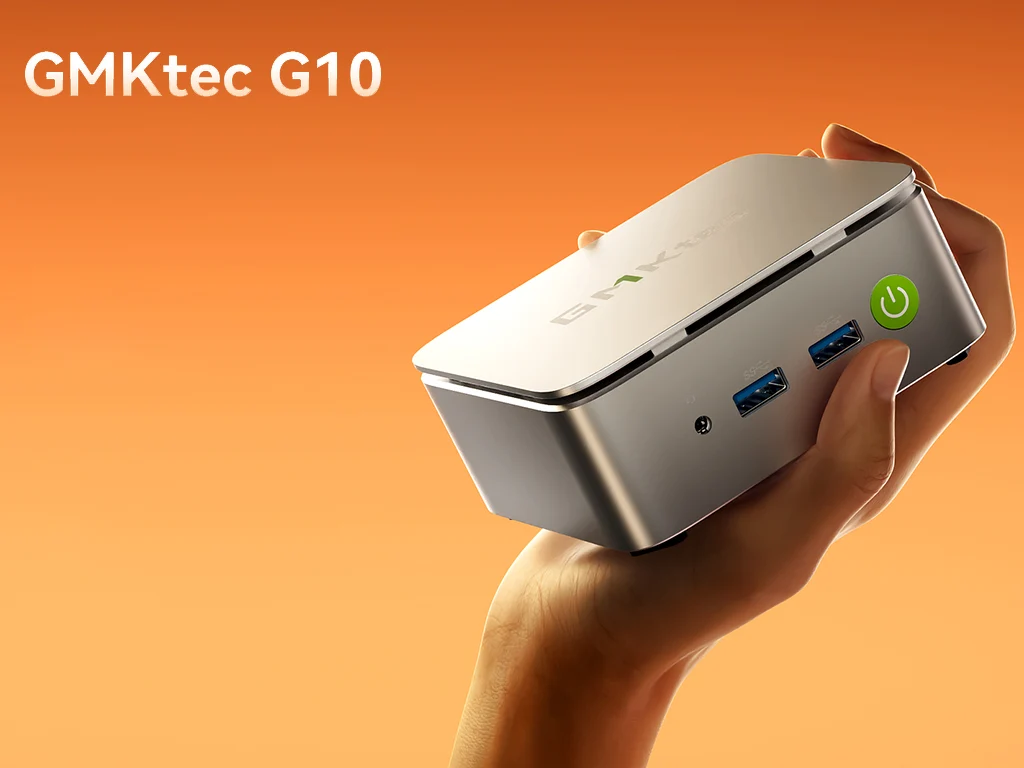
    GMKtec has launched the NucBox G10 in China earlier this month, and now it’s available worldwide. This budget-friendly mini PC is listed on the international website, starting at a price of $189.99. The basic version includes 16 GB of RAM along with a 512 GB SSD.

    Enhanced Storage Options

    There’s an alternative configuration that offers the same RAM but increases the storage capacity to 1 TB. This version of the AMD mini PC is priced at $215.99. Both configurations are currently enjoying special introductory prices, although GMKtec hasn’t mentioned when these discount offers will finish.

    Specifications and Performance

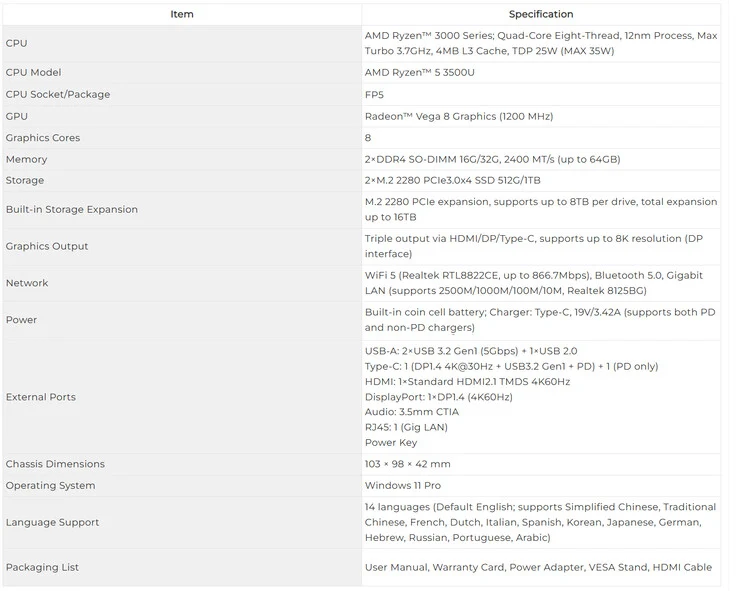
    The mini PC runs on the Ryzen 5 3500U, which is an older APU from the Picasso series. It includes the Radeon RX Vega 8 integrated GPU, which may struggle with modern games at 1080p resolution but is capable of managing less intensive graphical tasks.

    Compact Design and Connectivity

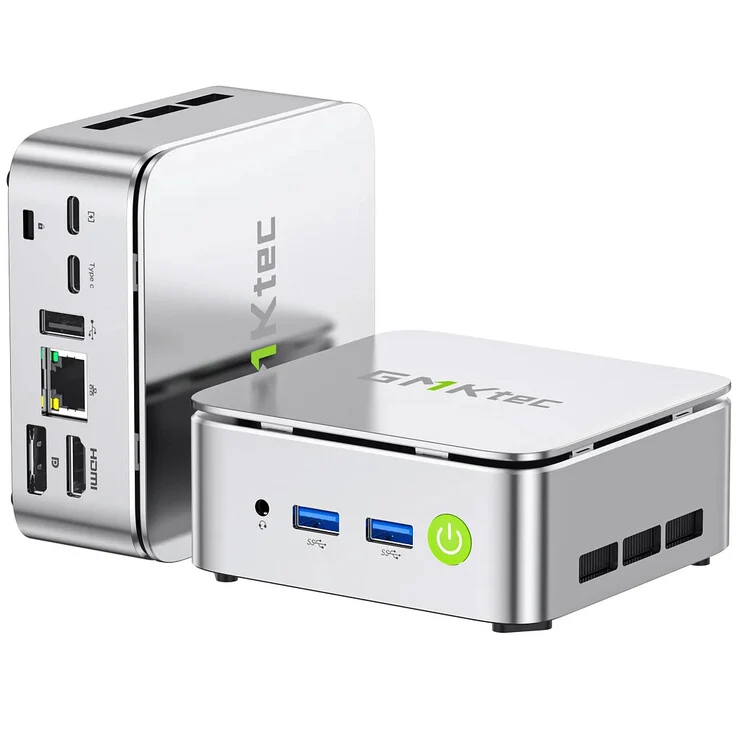
    The company emphasizes the small size of this economical mini PC, which measures 103 x 98 x 42 mm. Despite its compact dimensions, it comes with a wide array of ports. It’s important to note that one of the two USB Type-C ports is for PD only, while the other is a multifunctional port. Some other features of the GMKtec NucBox G10 include support for three-screen output, WiFi 5, Bluetooth 5.0, a quiet cooling system, and compatibility with up to 64 GB of RAM and 16 TB of storage (with a 4 TB Samsung 990 EVO Plus currently priced at $259.99 on Amazon). For more information regarding the mini PC, refer to the complete specifications sheet below.


  • Starlink Increases Congestion Fee to $750 in Select States

    Starlink Increases Congestion Fee to $750 in Select States

    Key Takeaways

    1. New demand surcharge for Starlink in the U.S. can be up to $750 based on location.
    2. The fee is implemented in regions with high dish installations to prevent slow download speeds.
    3. The surcharge has increased from $100 to $250, and now to $750 in areas like Washington and Oregon.
    4. Total cost for a Starlink Residential connection is now at its highest, reaching $1,100 ($750 surcharge + $350 dish).
    5. SpaceX plans to launch Starship 3 in 2026 to improve download speeds, while the congestion fee helps manage current demand.


    Those interested in signing up for Starlink satellite Internet in the United States should get ready to shell out up to $750 in a “demand surcharge,” which varies based on their location.

    New Congestion Fee Explained

    This fee is new and applies in specific regions where an overload of dish installations could harm download speeds for all users. The surcharge reflects the company’s effort to manage network demand effectively.

    In major cities like Seattle, Redmond, and Spokane in Washington, as well as around Portland in Oregon, new Starlink dish purchasers are facing this $750 demand surcharge for their initial connection. This is part of an effort to ensure that the service remains reliable despite high demand.

    Historical Context of the Surcharge

    Last year, Starlink rolled out this demand surcharge for areas with high traffic. Initially, the fee was just $100 for each new connection. It later increased to $250, making the standard Starlink kit more costly than the roaming version for a period before SpaceX reduced the price of the Mini dish.

    Recently, after celebrating its six millionth customer, Starlink raised the surcharge to $450 and now to an astonishing $750 in certain parts of Washington and Oregon. This move aims to alleviate the overwhelming pressure on the network in crowded locations, thus preventing the need to throttle service for all users.

    Current Pricing and Future Plans

    “Because of high demand in your area, there is an extra one-time fee to access Starlink services,” states SpaceX. With the $750 surcharge added to the $350 cost for a dish, the total price for a Starlink Residential connection is now at its all-time high in the US.

    While SpaceX is gearing up to launch the Starship 3 rocket, which will deploy the advanced Starlink V3 satellites to enhance download speeds by ten times in 2026, the congestion fee remains a practical approach to manage high demand until then.

    Source:
    Link