Category: Artificial intelligence

  • Withings Intelligence Offers Deep Health Insights for Wearables

    Withings Intelligence Offers Deep Health Insights for Wearables

    Key Takeaways

    1. Withings Intelligence is a new feature in beta testing, which may have imperfections.
    2. Access to Withings Intelligence requires a Withings+ subscription at $9.95 monthly or $99.50 annually.
    3. Users must also purchase a compatible wearable device if they do not already own one.
    4. The feature acts as a personalized AI health assistant, providing real-time insights and identifying health trends.
    5. Withings Intelligence offers advanced data analysis to uncover patterns in health metrics for better well-being suggestions.


    Withings has unveiled a brand new feature called Withings Intelligence. However, it comes with two significant drawbacks. To start, it’s still in beta testing, which means users need to be patient and shouldn’t expect everything to work perfectly yet. Additionally, Withings has made this feature accessible only to Withings+ subscribers, introducing a paywall. The subscription is priced at $9.95 each month or $99.50 annually. Plus, users will also need to consider the price of a compatible wearable if they don’t already own one. For instance, the Whoop Peak retails for $239 on Amazon.

    A Personalized Health Companion

    As per the company, Withings Intelligence is crafted to act as a personalized AI health assistant that gives real-time insights and identifies trends automatically. Essentially, it keeps track of various health metrics around the clock to spot patterns and possible health changes. In this way, the built-in digital assistant offers tailored suggestions for improving well-being and responds to inquiries in real-time.

    Advanced Data Analysis

    The system promises to shine with its thorough data analysis capabilities. Based on our experience, AI systems like this excel at uncovering relationships in vast data sets that might not be obvious at first glance. A (made-up) scenario for Withings Intelligence could be the assistant discovering that starting your workout an hour later on certain days results in less recovery the next day.

    In conclusion, Withings has introduced a promising tool, but users need to navigate the limitations tied to its current stage and subscription costs.

    Source:
    Link


  • Free Perplexity Pro for Samsung Galaxy Phone Owners

    Free Perplexity Pro for Samsung Galaxy Phone Owners

    Key Takeaways

    1. Samsung is partnering with Perplexity AI to enhance AI features in Galaxy devices.
    2. Eligible US Galaxy users can get a free one-year subscription to Perplexity Pro, worth $200.
    3. To claim the subscription, users must install the Perplexity AI app from the Galaxy Store.
    4. Existing app users may need to uninstall and reinstall the app to access the free Pro subscription.
    5. Perplexity Pro offers enhanced research capabilities, making it a valuable tool for students and professionals.


    Samsung has always been at the forefront when it comes to using artificial intelligence in their mobile devices. A lot of the AI features found in Galaxy smartphones come from Google’s innovations. But, according to recent updates, it seems Samsung is aiming to broaden its horizons by teaming up with Perplexity AI. In connection with this, Samsung is providing Perplexity Pro for free to US customers who own its tablets and phones.

    Exciting Offer for Galaxy Users

    For a limited period, Samsung is giving away a one-year subscription to Perplexity Pro free of charge for eligible Galaxy devices bought in the US. This isn’t just a minor bonus; typically, this subscription costs a hefty $200 each year. However, now you can obtain it without paying anything extra.

    How to Get Your Free Subscription

    Claiming your free year of Perplexity Pro on your Samsung Galaxy device is straightforward. If you have an eligible tablet or smartphone in the United States, just visit the Galaxy Store. First, you need to search for and install the Perplexity AI app. After it’s installed, simply launch the app and either log into your current account or set up a new one. That’s all there is to it! Many users have reported that the Pro version activates right away once downloaded from the Galaxy Store.

    Important Installation Note

    It’s important to mention that some users discovered that if the app was already on their device, they might need to uninstall it and then reinstall it through the Galaxy Store to unlock the free Pro subscription.

    For those who aren’t aware, Perplexity functions as an AI chatbot that competes with ChatGPT, Gemini, and other similar tools. It answers queries by combining information from different sources, giving you quick and referenced results, which saves you both time and energy. With the Pro version, you’ll enjoy an enhanced ability for “Deep Research,” which allows for up to 500 more detailed “automatic” inquiries each day. The Pro plan also provides access to several high-quality AI models.

    In summary, Perplexity Pro turns your Galaxy device into a powerful research assistant, making it ideal for students, professionals, or anyone who loves to explore. Getting it for a year at no cost, which saves you over $200, is an awesome benefit!

  • Euvola Launches First AI Companion Device on Kickstarter

    Euvola Launches First AI Companion Device on Kickstarter

    Key Takeaways

    1. SmartApe Tech addresses loneliness with its innovative device, the “World’s First Emotional AI Companion Device.”
    2. Users can customize their companion by choosing from pre-made characters or uploading personal photos and voice clips.
    3. The device engages users through conversation, empathy, and comfort, becoming more familiar over time.
    4. Privacy is prioritized with features like “end-to-end encryption” and limited data collection, despite potential ethical concerns.
    5. The device is available for crowdfunding on Kickstarter, with a special “Super Early Bird” price of $199.


    SmartApe Tech is a new company that says it has found a way to tackle loneliness, which it calls “the epidemic we ignore.” With more than 17,000 search results on PubMed, it’s clear that loneliness is a real issue. Now, the company claims its technology is ready for the spotlight, or at least for crowdfunding.

    An Innovative Companion

    The device, titled the “World’s First Emotional AI Companion Device,” resembles a vertical MagSafe charger, but instead of a charging pad, it features a smartphone-like screen designed to show an artificial human friend. Users can select from a wide range of pre-made characters, or they can create a unique companion by uploading a photo and voice clip of someone they hold dear, even including long-gone celebrities.

    Interacting with Your Companion

    As the user engages with the “Companion,” it can converse, empathize, or offer comfort, becoming friendlier and more familiar over time, much like existing chatbots. Euvola’s gadget also includes features similar to those found in iPhones, such as proximity sensors and emotive speakers that come with ambient LED lighting. This means the device will spring to life and be ready for conversation whenever someone approaches it.

    Privacy and Emotional Appeal

    The company promises that the Companion will last a lifetime, along with its expanding memory, although they do offer a Euvola Premium package that guarantees this memory is “permanent & unlimited,” reminiscent of a certain episode from Black Mirror. Despite the potential ethical and mental health concerns regarding the use of this “True Empathy AI,” especially considering the hints at simulated intimacy, the start-up ensures user privacy through features like “end-to-end encryption” and limited data collection.

    To tug at potential backers’ heartstrings, Euvola encourages them to get the device at its “Super Early Bird” price of $199, which is $100 less than the expected retail price, before the offer expires.

    Source:
    Link

  • Anbernic Handhelds Get AI Features for Real-Time Translation

    Anbernic Handhelds Get AI Features for Real-Time Translation

    Key Takeaways

    1. Anbernic has released an AI application specifically for its handheld gaming devices running on Android.
    2. The AI features include an AI translator that can translate on-screen text in games and emulators.
    3. A chatbot is available to help players with in-game questions and obstacles.
    4. Additional AI functions include image creation and photo editing tools, such as colourisation and manipulation.
    5. Users need to update their devices via an over-the-air package to access the new AI features.


    Anbernic has made it official with the release of their own AI application. However, it is very unlikely that it uses a self-trained AI model. This Anbernic AI is only for the company’s handheld gaming devices that run on Android, specifically the RG Cube, RG 406V, RG 406H, and RG556. To use the AI features, users will need to update their devices, which is conveniently provided as an over-the-air package.

    AI Translator Feature

    In a video from Anbernic, one notable feature shown is the AI translator, which can be activated in games or emulators to translate text that appears on the screen. This could be especially helpful in games that have never been localised, and it might even work with strange scripts that players might not be familiar with.

    Chatbot and More

    Additionally, the AI app comes with a chatbot that is meant to give useful answers to players’ questions. Gamers can access this feature during their playtime through a sidebar, which could help them find solutions to any in-game obstacles they face. Anbernic also pointed out other functions like AI image creation and photo editing tools, which include colourisation, manipulation, and stylisation. The AI assistant is also said to be capable of tackling complex issues, like solving math equations.

    Source:
    Link

  • ChatGPT’s New Feature Aims to Compete with Google

    ChatGPT’s New Feature Aims to Compete with Google

    Key Takeaways

    1. ChatGPT now integrates with Google Drive and other cloud platforms, allowing personalized and precise responses by accessing files directly.
    2. The software is compatible with SharePoint, Dropbox, Box, and OneDrive, enabling summarization and data extraction from various document types.
    3. OpenAI emphasizes security, ensuring only authorized users can access documents to maintain data protection.
    4. ChatGPT serves as a comprehensive work companion, offering features like audio transcription and tailored report generation, enhancing productivity.
    5. The user base is rapidly growing, with 3 million paying users as of October 2023, indicating strong demand for its professional tools.


    OpenAI has recently unveiled an exciting new feature that could impact its rivals significantly, announcing the integration of ChatGPT with Google Drive. This capability allows the AI to access files saved in the cloud, aiming to provide responses that are more personalized and precise.

    Compatibility with Multiple Platforms

    This software isn’t limited to Google Drive; it can also connect with SharePoint, Dropbox, Box, and OneDrive. This means you can instruct ChatGPT to summarize documents, whether they’re text or images, or pull data from an Excel spreadsheet. The AI will conduct an analysis and deliver the key information without you needing to dig through the files yourself.

    Focus on Security

    Nevertheless, OpenAI stressed a crucial aspect. Only individuals authorized by the organization can access documents, thus maintaining corporate structures and ensuring data security.

    A New Work Companion

    With this new functionality, ChatGPT could become your ultimate work companion, especially since it already has features for recording and transcribing audio discussions. This can really save you time.

    Additionally, it’s important to mention that this AI can create tailored reports based on the intended audience. These advancements position it squarely against Google Gemini and Microsoft 365, which already offer similar tools in their office suites.

    Rapid Growth in User Base

    Moreover, ChatGPT is experiencing tremendous growth among businesses, boasting 3 million paying users across its Enterprise, Team, and Education plans, a rise from 2 million in February 2025. There are also other options like ChatGPT Team, which cater to various needs and target organizations that don’t have enough users to qualify for the Enterprise plan.

    With these innovative features, OpenAI is striving to establish itself as a vital professional tool on multiple levels. Its role in this landscape is solidifying over time, and it could potentially surpass its competitors soon.

    Source:
    Link

  • Nvidia Offers $180,000 Salaries to Attract Taiwan Tech Talent

    Nvidia Offers $180,000 Salaries to Attract Taiwan Tech Talent

    Key Takeaways

    1. Nvidia is increasing hiring in Taiwan to launch a second research and development center.
    2. The company is offering high salaries, up to NT$5.5 million (around US$180,000), to attract experienced engineers.
    3. Nvidia’s recruitment strategy aims to boost R&D investments in Taiwan, known for its strong semiconductor industry.
    4. Competitive compensation packages are shifting the tech talent market in the region.
    5. The hiring efforts align with Nvidia’s long-term growth plans in AI and semiconductor industries, leveraging Taiwan’s engineering skills.


    Nvidia is stepping up its hiring in Taiwan as it gears up to launch a second research and development center in the area. Reports from local news sources indicate that the company is offering annual salaries of as much as NT$5.5 million (around US$180,000) to attract seasoned engineers, particularly those who have experience with top firms like TSMC.

    Attractive Salaries

    According to EBC News, Nvidia’s new operation is drawing in senior engineers with its high-paying salaries. This initiative is part of Nvidia’s strategy to boost its R&D investments in Taiwan, a region often called “Silicon Island” due to its significant role in the global semiconductor industry. Local media outlets describe Nvidia’s recruitment efforts as aggressive, noting that the competitive compensation packages are causing considerable shifts in the tech talent market.

    Competitive Landscape

    While the salaries being provided may seem modest when compared to those in Silicon Valley, Taiwan’s lower cost of living makes them more attractive. Additionally, there are various perks associated with tech positions available. As a result, these job openings are expected to attract a lot of interest.

    Nvidia’s ramped-up hiring efforts likely reflect its long-term plans for growth in the area, taking advantage of Taiwan’s engineering skills to enhance its position in the swiftly advancing AI and semiconductor industries.

    Source:
    Link


  • Affordable Humanoid and Desktop Robots from Hugging Face

    Affordable Humanoid and Desktop Robots from Hugging Face

    Key Takeaways

    1. Hugging Face has launched two budget-friendly humanoid robots, HopeJR and Reachy Mini, aimed at making robotics accessible to everyone.
    2. The first units are expected to ship by late 2025, following the acquisition of Pollen Robotics for expertise in design and motion control.
    3. HopeJR features 66 degrees of freedom, can walk, and interact with surroundings, priced at $3,000.
    4. Reachy Mini is a smaller robot designed for developers and educational institutions, with a price range of $250 to $300.
    5. Both robots are open source and modular, allowing users to assemble, modify, and understand their functionality, promoting transparency in software and training data.


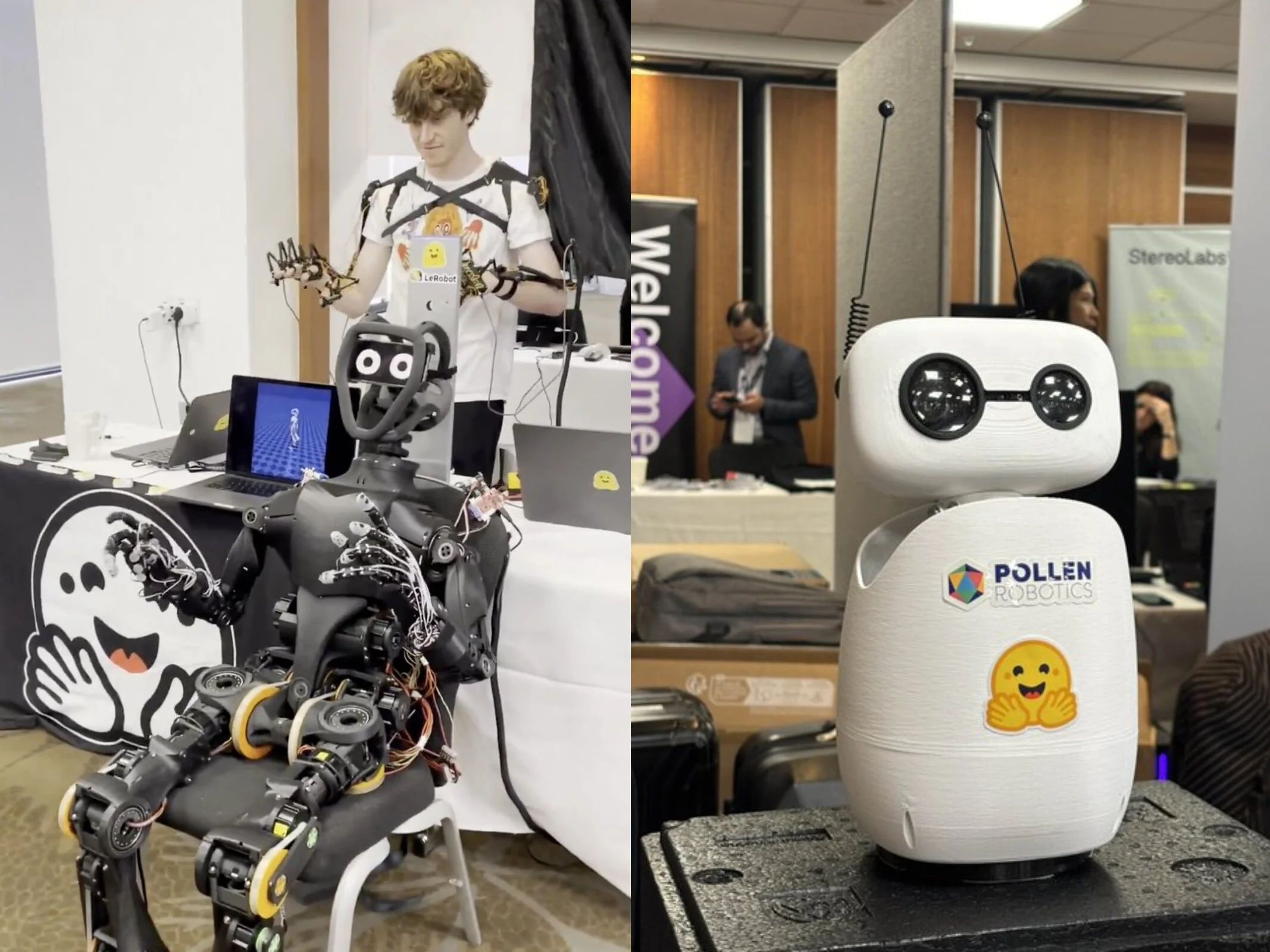
    With the introduction of HopeJR and Reachy Mini, Hugging Face, a US-based company, has launched two humanoid robots that are both budget-friendly and completely open source. Their intention is to make robotics more democratic, allowing technology that was previously confined to a few large companies to be accessible and understandable for everyone.

    Shipping Timeline

    Hugging Face aims to begin shipping the first units of both robots by late 2025. This progress follows the acquisition of the French start-up Pollen Robotics in April 2025, which brought vital knowledge in design and motion control to the table. According to Hugging Face, this team played a pivotal role in making the project a reality.

    Features of HopeJR

    HopeJR is a full-size humanoid robot that boasts 66 degrees of freedom. It has the ability to walk and interact with its surroundings, and is being designed for long-term autonomous use. A popular video on X features a Hugging Face team member demonstrating the robot shaking hands and moving via remote control – it’s not fully autonomous yet, but it’s still a remarkable demonstration. What’s even more surprising is the cost: only $3,000.

    Overview of Reachy Mini

    In addition to the larger HopeJR, Hugging Face also presented Reachy Mini, a small tabletop robot that can talk, listen, and move its head. This robot is aimed at developers and educational institutions looking to dive into AI-driven robotics. Similar to HopeJR, the focus is on making it accessible, with a price tag anticipated to be between $250 and $300.

    Both of these robots are modular and open source, allowing the community to assemble, modify, and enhance them. “The crucial thing is that these robots are open source, so anyone can put them together, rebuild, [and] grasp how they function,” stated Clem Delangue, CEO of Hugging Face, in an interview with TechCrunch. The company also promotes transparency in software and training data. Actions like gripping and walking are learned through human demonstrations, with a long-term vision of enabling the robots to operate independently.

    Source:
    Link

  • Checkmag | Climate Crisis Looms as Google Delivers Poor AI Results

    Checkmag | Climate Crisis Looms as Google Delivers Poor AI Results

    Key Takeaways

    1. AI offers significant advantages across various fields, including transportation, healthcare, and education, but it also comes with substantial energy demands.
    2. The global energy consumption for AI is projected to rise dramatically, with a significant portion expected from renewable sources while still raising concerns about fossil fuel reliance.
    3. Training and running AI models consume vast amounts of energy, with even small models requiring substantial joules for each response, comparable to riding an e-bike for hundreds of feet.
    4. Challenges exist in managing and disabling AI features like Google’s Gemini, with users facing difficulties navigating disjointed control options across different devices and platforms.
    5. Market interest in certain AI products is low, and the forced integration of AI into services may lead to consumer dissatisfaction and potential migration to alternative platforms.


    There’s no doubt about the advantages that AI can bring to people. From self-driving cars, facial recognition, and medical diagnostics to drug research, scientific breakthroughs, and coding, the potential benefits are vast. Even in areas like AI-generated images and videos, or quickly summarizing lengthy documents, the positive effects of AI on education through tailored learning experiences are clear.

    Energy Demands of AI

    If building numerous models didn’t cost anything beyond the hardware, there would be no disagreement. But sadly, the energy needed to run AI worldwide is enormous. We should be working to cut down our energy usage, not making it grow fourfold in a single night.

    Presently, the global need for data center capacity hovers around 60 gigawatts and has been fairly steady in recent years. However, this demand is projected to soar to 200 to 300 gigawatts by 2030, with roughly 70% likely due to AI. Much of the energy will come from renewable sources, and in Google’s case, they are even considering nuclear energy. Still, there are concerns that AI might keep us reliant on fossil fuels for many years to come.

    Understanding Energy Costs

    On May 20th, 2025, MIT published a piece analyzing the energy costs for various AI models, including Large Language Models (LLMs) and image/video generators like Diffusion.

    Even when you disregard the 50 gigawatt-hours of energy used to train GPT-4, the smallest text-based model with 8 billion parameters consumes 57 joules of energy for each response, or 114 joules when factoring in cooling. For a much larger model with 50 times more parameters, that figure skyrockets to 3,353 joules (or 6,706 with cooling) for every response.

    It’s probably unnecessary to dive into the math, as MIT compares each response to riding an e-bike for 400 feet (122 meters). With Google handling around 158,500 searches every second, if we could harness the energy used by Gemini for just one second, a person could bike 19,337 kilometers, or about one and a quarter times around the Earth.

    The Challenges of AI

    Google, along with many other AI models, acknowledges that “Gemini can make mistakes, especially about people, so verify it.” Why should we waste valuable energy on AI-generated search outputs that need to be double-checked on traditional sites anyway? Unfortunately, shutting it down isn’t as simple as you might think.

    The first issue is the lack of a uniform method to disable it on different devices. Google’s support pages are filled with requests to turn it off, but most solutions are either ineffective or don’t exist. One suggestion is to disable it via “myactivity.google.com” and turn off Gemini activity, but that setting isn’t available. Another tip involves accessing your Google account, going to “Data and Privacy,” and turning off “Web and App Activity,” also with no success. The only way I know to disable it is by using an ad blocker and applying a specific filter, although it’s uncertain if this actually stops it from running or just hides the output.

    Disjointed Control Options

    The second challenge is that there’s no single place to manage Gemini. If you want to turn it off on your smartphone, the settings differ from those on your computer’s browser. And if you want to disable it in Gmail or Google Docs, you’ll find different locations again. An article from NordVPN back in February stated that it isn’t possible to turn it off completely, a sentiment echoed in various Google support discussions.

    Of course, many users appreciate Gemini in their searches, but not providing options for a controversial technology like AI could drive users to other platforms. As someone who has been a Google One subscriber for nearly a decade, I believe I should have the choice to disable it as a paying customer. Sadly, only Enterprise and Education domain administrators possess that option, likely because Google knows that businesses won’t tolerate its hidden data collection practices.

    Market Reception

    The market has shown that there’s little interest in an AI Pin, and the Rabbit R1 has yet to attract a wide audience. Perhaps Sam Altman and Jony Ive will achieve what others could not. However, AI has advanced to the point where the very same Sam Altman who created ChatGPT has developed a solution to address issues stemming from OpenAI. This solution involves offering a cryptocurrency reward to individuals for allowing their irises to be scanned to verify their humanity. The idea feels like it belongs in a dystopian sci-fi novel (available on Amazon).

    The rapid integration of AI across every aspect of companies’ offerings makes it impossible for consumers to avoid. Google’s insistence on placing Gemini at the top of every search result serves as a continual reminder of how harmful, wasteful, and unnecessary AI can be in careless hands.

    Source:
    Link

  • Galaxy S26 Series to Feature Perplexity AI in Software

    Galaxy S26 Series to Feature Perplexity AI in Software

    Key Takeaways

    1. Apple’s integration of OpenAI’s ChatGPT may shift the technology landscape significantly.
    2. Samsung has partnered with Perplexity, moving away from reliance on Google for AI solutions.
    3. The Galaxy S26 will feature a pre-installed Perplexity app and set it as the default assistant.
    4. Samsung plans to enhance its virtual assistant Bixby with features powered by Perplexity.
    5. An announcement about the integration of OneUI with Perplexity is expected before the Galaxy S26 launch.


    Apple’s move to add OpenAI’s ChatGPT into its software might have triggered a significant shift in the technology industry. Samsung, which used to depend on Google for its artificial intelligence solutions, has now teamed up with another tech giant from Silicon Valley: Perplexity.

    New Developments in AI

    According to Mark Gurman from Bloomberg, the Galaxy S26 will come with the Perplexity app pre-installed and will set its assistant as the default choice. Moreover, the search assistant will be integrated into Samsung’s browser. This could lead to new features in Galaxy AI. But that’s not all; both companies aim to create an “AI-enhanced operating system” too.

    A Fresh Start for Bixby

    Even more exciting, Samsung’s often overlooked virtual assistant, Bixby, could receive a revival thanks to Perplexity. Although it has some good features, like Bixby Routines, this emerging tool hasn’t really made waves. It will be interesting to see what a version powered by Perplexity can achieve.

    Upcoming Announcements

    The integration of OneUI with Perplexity is likely to be revealed before the Galaxy S26’s release. With this information now public, Samsung may tease it during July or August when they showcase the Galaxy Z Fold 7 and Galaxy Z Flip 7.

    Source:
    Link

  • Google Plans Appeal in Antitrust Case Ruling

    Google Plans Appeal in Antitrust Case Ruling

    Key Takeaways

    1. Google plans to contest a recent court ruling in the antitrust case initiated by the US DOJ, believing it was incorrect.
    2. The company argues that the proposed remedies would harm consumers and businesses, exceeding the court’s initial decision.
    3. Google claims the DOJ overlooked important privacy issues and criticized its suggestion for a government-appointed “Technical Committee” on data disclosure.
    4. Google warns that the DOJ’s actions could set a dangerous precedent for government control over user data in the tech sector.
    5. The DOJ’s proposals are seen as favoring well-funded competitors like Bing, but Google argues they do not benefit consumers and emphasize its monopoly status.


    Posting on X from its @NewsFromGoogle account, the tech giant announced it intends to contest the recent court decision in the ongoing antitrust case brought by the US Department of Justice (DOJ).

    Google’s Stance

    Google expressed that it will “wait for the Court’s opinion” but firmly believes that the initial ruling was incorrect. The company argued that the suggested remedies “go miles beyond the Court’s decision & would harm consumers, businesses and America’s tech leadership.”

    Ongoing Investigations

    Since 2020, the search giant has faced scrutiny regarding its search engine practices. Google claimed that the DOJ “waved off very real privacy issues,” rejecting the DOJ’s suggestion “to give [rivals] more data.” Additionally, the company criticized the DOJ’s idea of forming a “Technical Committee” of experts appointed by the government to determine how much data Google should disclose.

    Concerns About Precedent

    Google warned that this creates a troubling precedent, allowing the government to decide “who gets Google users’ data.” The DOJ sought to convince the Court to “remake the tech sector.” However, Google countered that “the AI space is highly competitive today: Countless rivals in the AI space are growing fast & gaining users & distribution without government intervention.”

    Impact on Competition

    The company stated that the DOJ’s proposals “would help various well-funded competitors (w/ repeated references to Bing), but none of them do much to help consumers.” Last August, a federal judge determined that Google was indeed a monopoly, using its power to maintain that status.

    Source:
    Link