Tag: storage upgrade

  • Osmo Pocket 4 MicroSD Card Slot Controversy Amid Launch News

    Osmo Pocket 4 MicroSD Card Slot Controversy Amid Launch News

    Key Takeaway

    1. The DJI Osmo Pocket 4 is launching on April 16, 2026, with a focus on increased storage capacity (“More storage. More stories”).
    2. The teaser suggests a significant upgrade in built-in storage, potentially up to 107GB, but raises questions about the presence of an SD card slot.
    3. Recent leaks indicate the SD card slot may be retained, hidden behind a cover for better protection, rather than being removed entirely.

    Upcoming DJI Osmo Pocket 4 Launch Confirmed

    The countdown is nearly over, and DJI has officially announced that the Osmo Pocket 4 will be launching on April 16, 2026, at 12:00 PM GMT. Fans are eagerly awaiting this new addition to DJI’s lineup, promising new features and enhancements. The announcement has sparked a lot of interest amongst users and tech enthusiasts who are keen to see what improvements DJI has made.

    Teaser Reveals Storage Improvements and Concerns

    One of the most talked about aspects of the upcoming Osmo Pocket 4 is its storage capacity. Recent teaser videos carry a new tagline: “More storage. More stories,” which seems to hint at a significant upgrade, possibly including 107GB of built-in storage. However, viewers are left wondering whether the device will still support SD cards, as the teaser suggests an internal storage focus.

    Speculations on SD Card Slot Removal

    In the teaser, DJI shows SD cards being “chewed away” to make space for faster storage, fueling debates about whether the SD card slot might be eliminated. While an internal upgrade sounds appealing, many users worry that removing the slot could compromise flexibility. If SD cards disappear, losing data or switching media might become more complicated rather than easier. The question remains: if the slot isn’t present, how do you plan to enlarge your storage?

    Leaked Renders and Possible Features

    Despite the concerns, there’s some positive news. Recent leaked images show a new cover slot on the left side of the device. This suggests the SD card slot is still present, likely protected behind a cover for better dust and water resistance. Unless DJI is adding a second USB-C port for accessories and data management, it’s reasonable to think that this is the familiar SD card slot from the Osmo Pocket 3, just with an improved design.

    What to Expect from the New Camera

    • Enhanced internal storage options, possibly up to 107GB
    • Maintains SD card support with protective cover
    • Potentially better dust and water resistance features

    In conclusion, it looks like DJI aims to bring a blend of upgraded internal storage and retained legacy features. The new Osmo Pocket 4 may offer better protection and storage options than previous models, making it a versatile tool for creators. Fans and prospective buyers will just have to wait until April 16 for the full reveal. Stay alert for more updates as the launch date approaches!

    Sources
  • Modded MacBook Neo: The Apple Laptop Version You Never Saw

    Modded MacBook Neo: The Apple Laptop Version You Never Saw

    Key Takeaway

    1. The MacBook Neo, powered by the A18 Pro chip, is capable of supporting 1 TB of storage by replacing the original NAND chip.
    2. Upgrading the SSD involved soldering a blank 1 TB NAND chip designed for an iPhone 16 Pro onto the logic board, which successfully recognized and formatted the new storage.
    3. The device uses a NAND-only boot chain, allowing stability and automatic recovery mode even when the NAND is replaced with a blank chip.
    4. Upgrading RAM is impossible due to the PoP design, which stacks RAM on top of the SoC, and no alternative RAM packages are available for this layout.

    Introduction to the MacBook Neo and Its Capabilities

    The MacBook Neo has been a big hit for apple. Even though it is a passively cooled device, it packs the A18 Pro chip that is still very capable for everyday work. When apple introduced the entry-level Neo, the company brought the amazing power efficiency of the A18 Pro SoC into a wallet-friendly laptop. But, it had a strict storage limit of 512 GB officially.

    Shared Components and Storage Potential

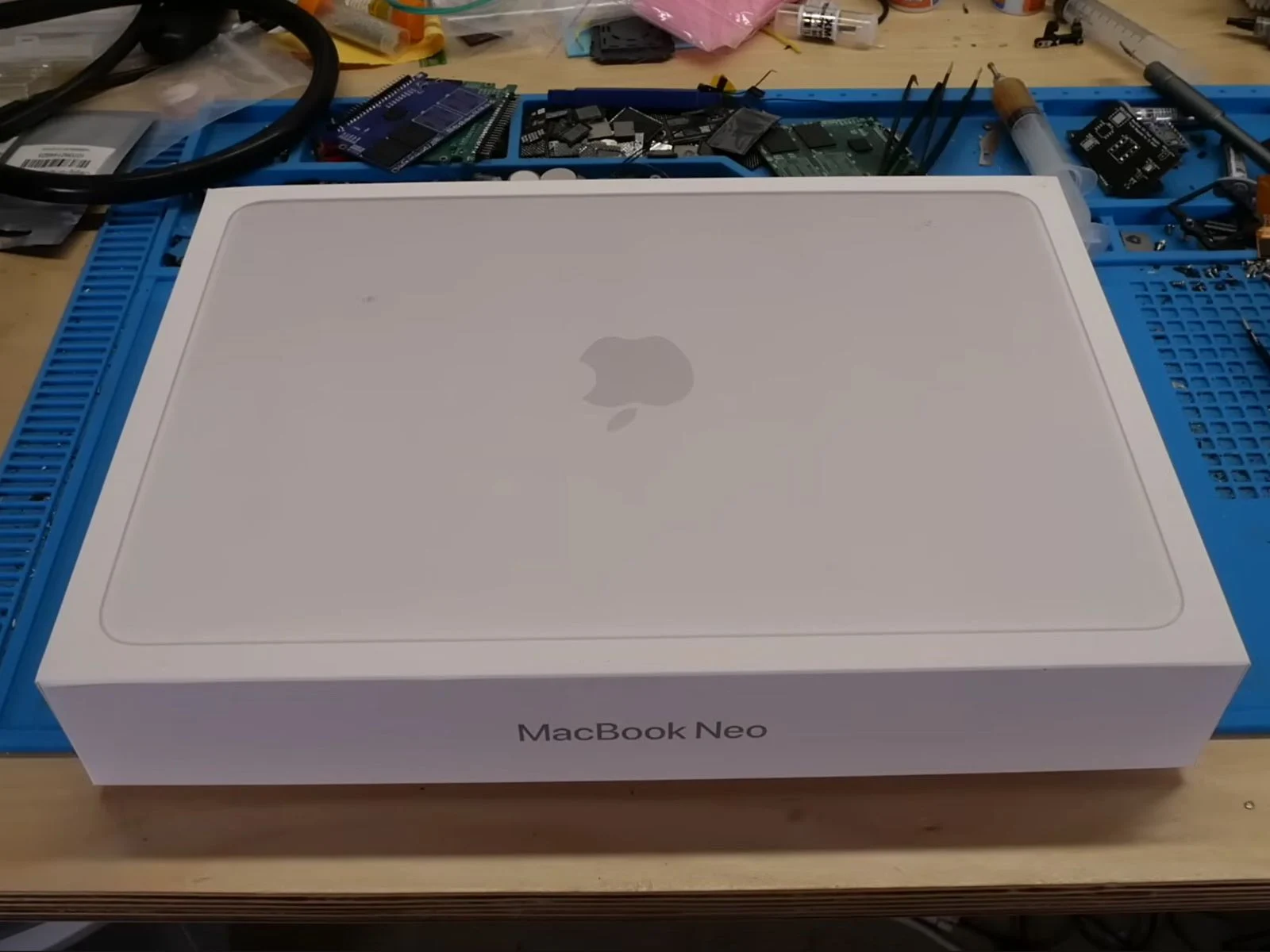
    Since the Neo and the iPhone 16 Pro share the same A18 Pro silicon, and the iPhone supports up to 1 TB storage, some question if the Neo could be upgraded too. To find out, the youtuber dosdude1 took a 1 TB NAND chip meant for iPhone 16 Pro and soldered it onto the Neo’s mainboard.

    Testing the Hardware and Initial Results

    Before starting with soldering and risking the warranty, the YouTuber checked how the Neo performs straight from the box. With a fresh install of macOS 26, it runs just as you’d expected for a machine with Apple Silicon.

    The RAM Limitation and Why It Can’t be Upgraded

    If you’re asking why the 8 GB RAM isn’t getting an upgrade, it’s because of the design of the A18 Pro. It uses a PoP setup, meaning the RAM is stacked right on top of the processor. And with no alternative packs available in this specific layout, RAM upgrades are practically impossible, even with soldering skills.

    Soldering the 1 TB NAND and Final Tests

    The YouTuber also explains that a used NAND from an old iPhone can’t be used, because the new NAND must be blank. Using a JC P15 programmer, they checked the chip and confirmed it was empty and ready to work with macOS.

    After soldering and reassembling, it was found that Neo’s A18 Pro uses a NAND-only boot process. Unlike older Macs that often get stuck with a blank NAND, the Neo stayed stable and quickly entered DFU mode, similar to an iPhone or iPad.

    Successful Upgrade and Performance

    Using Apple’s Configurator with a macOS IPSW file, the YouTuber saw the system detect the new 1 TB drive, format it, and complete the restore without any problem. When checked in macOS, the storage shows 1 TB and speeds in Disk Utility showed around 1700 MB/s — about 200 MB/s faster than the original 256 GB drive.

    Conclusion and Economic Factors

    While the upgrade was successful, the cost is high. Due to the ongoing shortage caused by AI component demands, buying a blank 1 TB NAND chip is very costly now, often over $200, compared to under $100 previously.

    The entire process is shown in the video linked below, where the YouTuber demonstrates the storage upgrade on the MacBook Neo.


    Sources

  • iPhone 16 Pro Base Model to Feature Double the Storage

    iPhone 16 Pro Base Model to Feature Double the Storage

    iPhone enthusiasts who prefer the Pro model but are dissatisfied with limited storage options might have something to look forward to. As per a report by Taiwanese market research firm TrendForce (via MacRumors), Apple is expected to eliminate the 128GB base storage option for the forthcoming iPhone 16 Pro, increasing it to a minimum of 256GB.

    Storage Upgrade and Price Implications

    This development is anticipated, given that Apple raised the base storage of the iPhone 15 Pro Max to 256GB last year. It’s logical to expect the Pro model to align with this trend in the iPhone 16 lineup. Nonetheless, this enhancement in base storage could result in a higher starting price for the iPhone 16 Pro.

    TrendForce indicates that this price hike may be more acceptable since the 16 Pro is slated to feature the tetraprism zoom lens, which was previously exclusive to the Pro Max model.

    Camera and Processor Enhancements

    Apple employed a similar strategy last year by introducing the tetraprism zoom lens on the iPhone 15 Pro Max, which naturally led to an increased cost. To justify the higher price, the company upgraded the base storage from 128GB to 256GB.

    In addition to storage and camera improvements, the report confirmed earlier leaks regarding the iPhone 16 series hardware. The non-Pro versions are likely to be equipped with the A18 chip, while the Pro models are expected to feature the more robust A18 Pro processor.

    Potential RAM Increase and Launch Speculations

    There is also a possibility that Apple might boost the RAM on the non-Pro models from 6GB to 8GB, potentially addressing the needs of Apple Intelligence features.

    These are initial speculations, and more definitive information about the iPhone 16 series will likely surface as the official launch event approaches, tentatively scheduled for September 9th.

  • Microsoft Launches White Xbox Series X and New Storage Options

    Microsoft Launches White Xbox Series X and New Storage Options

    Microsoft has officially introduced a white variant of the Xbox Series X, catering to fans who favor a lighter look for their console. This new model eliminates the disc drive, making it an entirely digital experience, but retains the same robust performance as the original Xbox Series X for current Xbox games. While black is elegant, white has a pristine appeal.

    New Offerings

    In addition to the white Xbox Series X, Microsoft has also unveiled a white version of the Xbox Series S. The white Xbox Series X features 1TB of storage and is set to launch later this year, priced at $449.99. This announcement comes alongside the introduction of a special edition 2TB “Galaxy Black” version of the original Xbox Series X, which will be available for $599.99. For gamers on a budget, Microsoft is also releasing a new white version of the Xbox Series S with 1TB of storage, priced at $349.99, compared to the smaller $299 console.

    Design and Rumors

    The new white Xbox Series X matches the “robot white” color scheme of the Xbox Series S. Although leaks suggested that Microsoft may have upgraded the cooling system for this white model, official confirmation will likely have to wait until detailed teardowns are conducted.

    Additionally, the white Xbox Series X appears to confirm the cancellation or delay of a previously rumored refreshed version of the console, codenamed “Brooklin.” Leaked details had described Brooklin as having a more cylindrical design, lacking a disc drive, and being marketed as “adorably all digital.” It was planned for a November release with a price tag of $499 and a new bundled controller featuring Xbox Wireless 2 connectivity.

    Official Statements

    Last September, Xbox chief Phil Spencer addressed leaks about the refreshed Xbox Series X design, hinting at possible changes in their hardware roadmap. Spencer stated, “It is hard to see our team’s work shared in this way because so much has changed and there’s so much to be excited about right now, and in the future. We will share the real plans when we are ready.”

    Microsoft’s official announcement dispels these rumors, offering a white Xbox Series X along with storage enhancements for both the standard and special edition models.

  • Samsung expands storage upgrade offer for Galaxy Tab A9 Plus

    Samsung expands storage upgrade offer for Galaxy Tab A9 Plus

    Samsung has recently announced the Galaxy Tab A9 series, comprising of two tablets: the Galaxy Tab A9 and the Galaxy Tab A9 Plus.

    Free Storage Upgrade Offer

    The Galaxy Tab A9 Plus was released in the US in January, and Samsung initially offered a free Book Cover accessory worth $50 with every purchase. However, the company has now replaced this offer with a free storage upgrade offer.

    This storage upgrade offer was first introduced by Samsung with the launch of the Galaxy S23 series last year, and it has been continued with the successor Galaxy S24 series as well. Now, the offer has been extended to the budget tablet Galaxy Tab A9 Plus.

    Customers in the US who purchase the Galaxy Tab A9 Plus from Samsung.com will receive double the storage and RAM. Additionally, they can also avail up to $90 trade-in bonus.

    For the price of the base 4GB + 64GB variant ($219), buyers will receive the higher 8GB + 128GB version instead. The higher memory configuration typically carries a price tag of $269, so customers will essentially save $50, which is the same benefit offered by the free Book Cover offer.

    Specifications and Features

    The Galaxy Tab A9 Plus features a sleek metal body and boasts an 11-inch 16:10 display. The LCD panel offers a resolution of 1920 x 1200 pixels and a 90Hz refresh rate.

    Under the hood, the tablet is powered by a Qualcomm Snapdragon 695 chip. It runs on One UI 5.1 based on Android 13.

    The device is equipped with an 8MP rear camera and a 5MP front-facing camera. It also features quad stereo speakers and a 7,040mAh battery. Additionally, it supports 15W charging.