Tag: SpaceX

  • Starlink India Launch: Affordable Service for 2 Million Users

    Starlink India Launch: Affordable Service for 2 Million Users

    Key Takeaways

    1. Starlink’s monthly subscription fee in India will be about $35, significantly higher than the expected $10.
    2. High setup and equipment costs limit Starlink’s ability to compete with local telecom providers like BSNL.
    3. Starlink aims to serve only 2 million customers in India, which may not threaten existing telecom services.
    4. Future expansions will include launching V3 satellites, expected to provide faster speeds and greater capacity by next summer.
    5. The current Starlink Standard Kit will not support the higher speeds of the V3 network, leading to the release of a new high-priced Performance dish for business customers.


    When Starlink begins its service in India, the monthly subscription fee will not be the expected $10 that experts thought might disrupt local telecom companies and lead to a swift growth in satellite Internet users.

    High Costs Ahead

    According to the Indian communications ministry, the launch of Starlink in India, along with all necessary ground stations and antenna equipment, will be very costly. The initial setup and equipment expenses are so significant that Starlink will only be able to provide its services at a price of about $35 a month after it starts operations.

    Market Competition

    This price is much higher than the hoped-for $10 per month, which would have allowed it to compete with government rural service providers like BSNL. The Minister has stated that “Starlink can only have 20 lakh customers in India and offer speeds of up to 200 Mbps,” suggesting that the pricing and speed of Starlink’s offerings will not pose a threat to the existing telecom services.

    These figures are important for the global Starlink users to know, as adding an additional two million customers could challenge Starlink’s network capabilities at increased speeds, even though SpaceX is currently enhancing its capacity by 5 Tbps every week.

    Future Expansion Plans

    Starting next year, the Starlink satellite Internet network will be able to accommodate more subscribers and deliver faster speeds, ensuring that current users’ experiences remain unaffected. SpaceX plans to start launching its V3 satellites by next summer using the Starship 3 rocket, which is in the testing phase.

    These new satellites are bigger and will provide ten times the capacity of the existing V2 models, while the supported downlink speeds will increase by 24 times. However, the current Starlink Standard Kit will not support the gigabit speeds that the V3 satellite network is expected to provide. Thus, Starlink has recently released a high-priced Performance dish, costing $1,999, which is primarily aimed at business customers.

    Source:
    Link

  • Starlink Download Speeds Surge After Recent Satellite Network Glitch

    Starlink Download Speeds Surge After Recent Satellite Network Glitch

    Key Takeaways

    1. The longest Starlink outage occurred on July 25, affecting many users for at least 2.5 hours.
    2. The outage was caused by issues with key internal software services that manage the core network.
    3. Starlink operates over 100 gateways in the U.S. to enhance Internet service in remote areas.
    4. SpaceX is upgrading ground stations for upcoming V3 satellites, which will significantly increase data capacity.
    5. Despite the outage, some users experienced improved download speeds afterward, suggesting a positive network enhancement.


    Starlink Internet interruptions are quite rare, as the network has mostly remained stable since SpaceX began launching its initial Starlink satellites into orbit.

    A Surprising Outage

    Therefore, the longest Starlink outage since its launch took many by surprise on Friday, July 25. Many of its six million users across the US and worldwide experienced a lack of satellite Internet for at least 2.5 hours, with some being affected for even longer.

    For the first time, Starlink issued a global outage alert on its website and managed to fix the problem relatively quickly for most users on the same day. SpaceX expressed its regret and explained that the issue was due to “key internal software services that operate the core network,” possibly pointing to the largest ground network supporting a satellite constellation ever created.

    Technical Infrastructure

    In the United States, Starlink runs over 100 gateways, each equipped with 150 antennas, to help eliminate dead zones and enhance ping for users in remote areas and rural settings. These antennas are produced in Redmond, WA, and are designed to channel the satellite Internet signal through the country’s extensive fiber optic infrastructure, thus enhancing coverage, reducing latency, and stabilizing connections.

    SpaceX is currently upgrading its ground stations in anticipation of launching its V3 satellites, which promise to deliver 10 times the data throughput of the current models, reaching up to 1 Tbps. For context, the Starlink Mini dish has a maximum speed of 100 Mbps, while only the Performance dish can utilize gigabit speeds. With each launch of V3 satellites in 2026, SpaceX plans to add 60 Tbps of network capacity, necessitating a new generation of terrestrial gateways to support this growth.

    Stability Concerns

    Regrettably, the ground-based network of Starlink can sometimes create instability, as was evident during the recent lengthy outage. A memo from SpaceX shared with suppliers revealed that a software update sent to the Starlink gateways overloaded their hardware, causing the network to stop processing data packets while the core update was being implemented.

    Although SpaceX provided the usual explanations and reassurances that they had learned from this incident, users of Starlink began to observe a surprisingly positive change over the weekend. After the outage, some users reported that their download speeds increased by three times or more, suggesting that the unfortunate update to the gateways was not merely a bug fix, but rather a significant network enhancement.

    Source:
    Link

  • Starlink US Customers Surpass 2 Million Amid Rapid Growth

    Starlink US Customers Surpass 2 Million Amid Rapid Growth

    Key Takeaways

    1. Starlink has surpassed 2 million active customers in the US, gaining over 600,000 in the past year.
    2. The service offers a median download speed of nearly 200 Mbps during peak times for its US customers.
    3. SpaceX introduced a cheaper “Residential Lite” option at $80 per month to attract more subscribers.
    4. While US growth is strong, other regions like Canada and Kenya are experiencing slower or declining subscriber growth.
    5. SpaceX plans to roll out gigabit speeds with its upcoming V3 satellites, but the timeline may be affected by ongoing challenges with the Starship rocket program.


    SpaceX’s satellite internet service, Starlink, has reached a notable milestone, now providing service to over 2 million active customers in the US. This represents a significant increase in its American user base.

    In the past year, the company gained more than 600,000 customers in the United States, indicating that efforts to spur growth, which seemed to be slowing, have been successful. This rise from 1.4 million US customers last year suggests that new strategies to draw users have been effective.

    Performance Highlight

    In a recent announcement marking this achievement, SpaceX emphasized the service’s performance. They stated, “In the United States alone, the median download speed across more than 2 million active Starlink customers during times of peak demand is nearly 200 Mbps as of July 2025.” The company has not clarified what they define as an “active customer” or whether the count accounts for multiple users sharing a single account. On a global scale, Starlink’s customer base now exceeds 6 million.

    To increase its subscriber base in the US, SpaceX has implemented various promotional strategies. These include providing free Starlink dishes for customers willing to commit to a 12-month service plan.

    New Pricing Plans

    Moreover, the company has introduced a cheaper “Residential Lite” option in select regions, costing $80 per month, which is a significant reduction from the standard fee of $120 monthly. Tim Farrar, a satellite industry analyst, observed the likely impact of these promotions. He stated, “The US growth presumably reflects the low-priced Lite package and free terminals with a year’s commitment.” This growth trend continues despite public criticism faced by SpaceX CEO Elon Musk.

    While the numbers in the US are on the rise, Starlink’s growth may not be as swift in other regions. The company announced that its customer count in Canada has surpassed 500,000.

    Regional Challenges

    However, Farrar noted that this is just a gain of 100,000 customers over the last year. In other areas, subscriber growth has either slowed down or declined. For instance, in Kenya, Starlink experienced its first quarterly drop in subscribers between December 2024 and March 2025, and a similar decrease was noted in Rwanda, hinting at possible growth challenges in certain markets.

    SpaceX has bold ambitions to enhance its network, aiming to roll out gigabit speeds in the coming year. This upgrade relies on the company’s third-generation Starlink satellites, referred to as V3. SpaceX plans to start launching these advanced satellites in the first half of 2026.

    “Each one of these new satellites is designed to provide over a terabit per second of downlink capacity (> 1,000 Gbps) and over 200 Gbps of uplink capacity to customers on the ground,” the company shared.

    Future Prospects

    The V3 satellites could position Starlink as a direct competitor to traditional fiber optic internet services. In preparation, SpaceX has already launched a new performance dish priced at $1,999, engineered to support these anticipated gigabit speeds.

    The deployment of the larger and heavier V3 satellites relies entirely on SpaceX’s Starship rocket. This massive vehicle is designed to transport multiple next-generation satellites into orbit simultaneously.

    Nevertheless, the Starship program has encountered major obstacles. The rocket has yet to successfully complete a full space mission, as its recent test flights have ended with explosions.

    These repeated setbacks raise questions about the timeline for deploying the V3 satellites and the realization of a gigabit-speed Starlink network.

    Source:
    Link


  • SpaceX Invests $2 Billion in xAI; Tesla Expected to Join

    SpaceX Invests $2 Billion in xAI; Tesla Expected to Join

    Key Takeaways

    1. SpaceX has invested $2 billion in AI startup xAI, representing a significant portion of the company’s recent fundraising efforts.
    2. The merger of xAI with X has increased its total value to $113 billion, with more fundraising rounds expected by year-end.
    3. Elon Musk is integrating xAI’s technology across his companies, including real-time support in X and updates for Tesla vehicles.
    4. The latest version of xAI’s product, Grok 4, is being recognized as highly advanced.
    5. Tesla may consider investing excess funds into xAI, pending approval from its board and shareholders.


    The richest person in the world, Elon Musk, often shifts technologies and skills between his various companies. The CEO of multiple firms is now said to be doing the same with money as SpaceX completes its biggest external investment in AI startup xAI.

    Major Investment in xAI

    SpaceX has purchased a $2 billion share in xAI, as first disclosed by The Wall Street Journal. This investment represents roughly 40 percent of the $5 billion that Morgan Stanley helped raise for the AI company a few weeks back.

    The new capital arrives after xAI combined with X, boosting the total worth of the merged company to $113 billion. More rounds of fundraising are anticipated before the end of the year.

    Integration of AI Across Companies

    Musk has been integrating xAI’s technologies into his other ventures. Grok is now part of X and is able to answer questions in real-time. This AI also manages customer support for SpaceX’s Starlink satellite internet service. Tesla cars are in the middle of receiving Grok (beta) as part of their latest software updates. Furthermore, Musk has mentioned that the Optimus robot will utilize Grok.

    SpaceX’s previous investments include the $524 million spent to buy Swarm Technologies back in 2021. Long before that, Musk allocated $20 million from SpaceX to assist Tesla in its early challenges.

    Latest Developments and Future Prospects

    Recently, xAI launched Grok 4, and this latest version of the AI has been hailed as the most intelligent in the world.

    Musk also mentioned that Tesla might invest some of its excess funds into xAI through a post on X. Nevertheless, he made it clear that any future investment from the electric vehicle company would need to be approved by both the board and shareholders.

    Source:
    Link

  • SpaceX Faces Lawsuit in Mexico for Environmental Concerns

    SpaceX Faces Lawsuit in Mexico for Environmental Concerns

    Key Takeaways

    1. SpaceX is developing Starship, the largest rocket ever, but faced a significant failure during a test on June 18.
    2. Mexico has filed a lawsuit against SpaceX, claiming the explosion breached international environmental laws.
    3. The Boca Chica Beach region, where SpaceX operates, has a fragile ecosystem with protected species affected by rocket launches.
    4. Environmental concerns include air, soil, and water contamination from emissions, as well as noise pollution impacting local wildlife.
    5. SpaceX claims to be working on reducing its ecological impact through cleaner engine technology and debris recovery methods, but recent incidents highlight ongoing challenges.


    For many years, SpaceX has changed the space sector through its innovative technologies while dramatically cutting down launch costs. However, like all success stories, there’s a troubling aspect to consider. Right now, this company faces a serious threat from a lawsuit brought against it by Mexico.

    Starship’s Ambitious Goals

    SpaceX is in the process of developing the biggest rocket ever, called Starship. However, not everything is going smoothly. The most recent test of this spacecraft, which occurred on June 18 at the Mexico border, ended in a total failure. During the upper section test, this remarkable vehicle unexpectedly exploded. While SpaceX insists that the environment was not harmed by this incident, Mexico strongly disagrees, viewing it as a breach of international environmental laws.

    Environmental Concerns

    It’s key to recognize that the Boca Chica Beach region, where Starship is situated, hosts a delicate ecosystem with several protected species. Every rocket launch or test emits gases and particulates into the atmosphere. Moreover, various substances like perchlorates and metal oxides pose a risk of contaminating the air, soil, and water.

    In addition to this, noise pollution and vibrations from launches can disturb the local ecosystem, including endangered species near the launch area. Furthermore, space debris resulting from explosions can negatively impact local wildlife and plant life, potentially destroying their habitats.

    SpaceX’s Initiatives

    In light of these environmental challenges, SpaceX asserts that it is taking steps to minimize its ecological impact. For instance, the Raptor engines, which run on liquid methane, are designed to be less polluting than traditional fuels. Additionally, the company is exploring various methods to recover debris and reduce waste. Nevertheless, recent events like the explosion on June 18 indicate that there is still much to be done, and new solutions need to be discovered.

    Source:
    Link

  • Starlink Imposes $1000 Surcharge for Sign-Up in 3 US States

    Starlink Imposes $1000 Surcharge for Sign-Up in 3 US States

    Key Takeaways

    1. Starlink has increased the demand surcharge for new Residential customers in Washington, Oregon, and Idaho to $1000 in major cities like Seattle and Portland.
    2. This surcharge has risen three times in 30 days, starting from $100 over a year ago, and is now combined with the Standard Kit price for a total upfront cost of $1,349.
    3. The surcharge is specific to congested areas and does not apply in less competitive regions, where the Standard Kit may still be available for $349 or even for free with a 12-month commitment.
    4. Residents in crowded areas may want to wait for SpaceX to improve network capacity before signing up for Starlink to avoid high costs.
    5. For immediate access, customers can choose the Roam plan with the Standard dish, but they will experience reduced data speeds during peak times.


    If you’re a resident of Washington, Oregon, or Idaho and considering getting Starlink service, you might want to think about postponing your signup. Starlink has stealthily increased the “demand surcharge,” which is a one-time cost for new Residential customers in heavily populated regions, to a staggering $1000.

    New Pricing for Major Cities

    Residents in Seattle, Redmond, Portland, and Sandpoint are now encountering this new $1000 fee when they attempt to enroll in the Residential plan, as reported by PCMag. This marks the third significant increase in the surcharge within just 30 days, starting from when the fee was first set at $100 over a year ago. In early June, it rose from $250 to $500, and then a few weeks later, it increased again to $750 for new sign-ups. However, it seems this was not enough to discourage new customers, prompting SpaceX to add yet another $250 last week, resulting in the total reaching an incredible $1000. Alongside the Standard Kit’s price of $349, newcomers are now looking at an upfront cost of $1,349 just to access the service.

    Surcharge Specifics and Market Insights

    SpaceX clarifies that the demand surcharge is only for those who are purchasing or activating a new Residential service plan in these congested zones. Washington stands out as one of the most crowded markets for Starlink, with Seattle showing some of the lowest average download speeds, which range from 54Mbps to 223Mbps. The silver lining is that this high surcharge is confined to certain areas in the Northwest. In other parts of Washington, where Starlink appears to have less competition, new customers only have to pay the standard $349 for the dish. Moreover, in some regions of Oregon and Idaho, SpaceX is still offering the Standard Kit for free if you agree to a 12-month commitment to the Residential plan.

    Waiting It Out or Alternative Options

    If you’re living in one of these congested areas, it might be wise to hold off until SpaceX can enhance its network capacity and eliminate the surcharge. However, if you need Starlink right away, you still have the option to purchase the Standard dish and activate the Roam plan instead. Just keep in mind that Roam users experience deprioritized data, meaning download speeds, especially during peak times, won’t be as fast as what you would expect from the Residential tier.

    Source:
    Link

  • SpaceX Offers Starlink Mini Kit Discount and Service Credit in US & Canada

    SpaceX Offers Starlink Mini Kit Discount and Service Credit in US & Canada

    Key Takeaways

    1. SpaceX offers a promotion for Starlink Mini Kit purchasers in the US and Canada, valid until July 7.
    2. US customers receive a $100 discount on the Mini Kit and a $100 service credit applied in the second month of their Roam plan.
    3. Canadian buyers pay CAD 499 (down from CAD 599) and receive a CAD 150 service credit.
    4. Starlink’s monthly plans for US users are $50 for 50 GB and $165 for unlimited, while Canadian prices are CAD 70 and CAD 189, respectively.
    5. The Mini Kit is designed for travelers, featuring a compact size, built-in WiFi, high download speeds, and quick setup for on-the-go use.


    Starlink Mini Kit purchasers in the United States and Canada can benefit from SpaceX’s new promotion that makes mobile internet a bit more affordable. The company is providing a discount on the mini receiving devices, along with a service credit, if both the purchase and the plan activation are completed by July 7.

    Savings for US Customers

    In the US, buyers can enjoy a $100 discount off the regular price of $499 for the Mini Kit. Additionally, they will receive an extra $100 in service credit, which will be automatically applied during the second month after they enroll in a Roam plan.

    Canadian Offers

    For those in Canada, Starlink users will only have to pay CAD 499 instead of the usual CAD 599. They will also receive a CAD 150 service credit.

    Starlink provides personal roaming monthly plans in the US at a rate of $50 per month for 50 GB, and $165 for unlimited access. In Canada, these plans are priced at CAD 70 and CAD 189 per month, respectively.

    Designed for On-the-Go Users

    The Mini Kit is tailored for people who are frequently traveling, such as adventurers and RV lovers. It features a built-in WiFi router and is compact and light enough to fit in a backpack. Users can achieve download speeds exceeding 100 Mbps, even while moving at speeds up to 160 km/h. The setup process is quick, and the equipment is durable enough to be mounted on vehicle roofs using accessories offered by Starlink.

    Source:
    Link

  • Starlink Increases Congestion Fee to $750 in Select States

    Starlink Increases Congestion Fee to $750 in Select States

    Key Takeaways

    1. New demand surcharge for Starlink in the U.S. can be up to $750 based on location.
    2. The fee is implemented in regions with high dish installations to prevent slow download speeds.
    3. The surcharge has increased from $100 to $250, and now to $750 in areas like Washington and Oregon.
    4. Total cost for a Starlink Residential connection is now at its highest, reaching $1,100 ($750 surcharge + $350 dish).
    5. SpaceX plans to launch Starship 3 in 2026 to improve download speeds, while the congestion fee helps manage current demand.


    Those interested in signing up for Starlink satellite Internet in the United States should get ready to shell out up to $750 in a “demand surcharge,” which varies based on their location.

    New Congestion Fee Explained

    This fee is new and applies in specific regions where an overload of dish installations could harm download speeds for all users. The surcharge reflects the company’s effort to manage network demand effectively.

    In major cities like Seattle, Redmond, and Spokane in Washington, as well as around Portland in Oregon, new Starlink dish purchasers are facing this $750 demand surcharge for their initial connection. This is part of an effort to ensure that the service remains reliable despite high demand.

    Historical Context of the Surcharge

    Last year, Starlink rolled out this demand surcharge for areas with high traffic. Initially, the fee was just $100 for each new connection. It later increased to $250, making the standard Starlink kit more costly than the roaming version for a period before SpaceX reduced the price of the Mini dish.

    Recently, after celebrating its six millionth customer, Starlink raised the surcharge to $450 and now to an astonishing $750 in certain parts of Washington and Oregon. This move aims to alleviate the overwhelming pressure on the network in crowded locations, thus preventing the need to throttle service for all users.

    Current Pricing and Future Plans

    “Because of high demand in your area, there is an extra one-time fee to access Starlink services,” states SpaceX. With the $750 surcharge added to the $350 cost for a dish, the total price for a Starlink Residential connection is now at its all-time high in the US.

    While SpaceX is gearing up to launch the Starship 3 rocket, which will deploy the advanced Starlink V3 satellites to enhance download speeds by ten times in 2026, the congestion fee remains a practical approach to manage high demand until then.

    Source:
    Link

  • SpaceX Mars Starship Rocket Explodes Before Static Fire Test

    SpaceX Mars Starship Rocket Explodes Before Static Fire Test

    Key Takeaways

    1. The SpaceX Starship rocket exploded during a static fire test, which is crucial for preparing for a Mars mission in 2026.
    2. The incident was labeled an “anomaly” by NASA, indicating thrusters did not ignite, likely causing the explosion during the fuel loading phase.
    3. SpaceX had previously conducted successful static fire tests with fewer engines, but this attempt involved six Raptor engines.
    4. There were no injuries from the explosion, and safety measures were in place, ensuring personnel and nearby residents remained safe.
    5. Elon Musk’s plans for a Mars mission will require a Super Heavy Booster with at least 42 engines, but the recent explosion may delay the timeline for orbital flights.


    The latest SpaceX Starship rocket, which is set for a Mars mission in 2026, exploded before its second standard static fire test at the Massey testing facility in Texas.

    Static Fire Tests Explained

    These static fire tests are designed to build on the Wet Dress Rehearsal (WDR) fuel loading launch system test. They include firing the thrusters for a few seconds to observe how the entire booster assembly operates. NASA labeled the incident as an “anomaly,” indicating that the thrusters did not ignite during this static fire test. This suggests that the explosion likely occurred during the WDR phase when the rocket was being loaded with liquid propellant for ignition.

    Previous Testing Successes

    SpaceX had previously conducted a static fire test with the Starship rocket, but only using one of the Raptor engines, unlike the six that were involved in the most recent attempt. The 36th Starship rocket is currently being tested for Flight 10, which will utilize the complete Super Heavy Booster assembly containing 33 Raptor engines. The booster had already undergone its own static fire tests and was successfully caught and reused from Flights 7 to 9, meaning that most issues needing resolution relate to the Starship rocket itself. SpaceX confirmed that there were no injuries, and cleanup efforts at the test site are continuing in coordination with local authorities.

    Safety Measures and Ongoing Operations

    On Wednesday, June 18, around 11 p.m. CT, the Starship set for the tenth flight test encountered a serious anomaly on the test stand at Starbase. A safety clearance zone was maintained during the operation, ensuring all personnel were safe. The Starbase team is diligently working to secure the test site and surrounding areas, in collaboration with local officials. There are no risks to residents in nearby communities, and people are advised to stay away from the area until the safety operations are complete.

    This incident marks the fourth Starship that SpaceX has lost this year, all experiencing RUD, or “rapid unscheduled disassembly,” which is a fancy way of saying they broke apart on the ground or during flight. The furthest a Starship has traveled was during Flight 9 in May, lasting 46 minutes before SpaceX lost communication.

    Future Plans for Mars Mission

    Elon Musk recently stated that the Mars-ready Starship, with an upper-stage rocket height of 171 feet (52m), will require a Super Heavy Booster assembly with at least 42 engines for its inaugural Mars landing planned for 2027. SpaceX had aimed to achieve the first Starship 3 rocket flight into orbit by the end of this year, but this recent explosion might delay that schedule. SpaceX is banking on this largest rocket ever constructed not only for the uncrewed Mars mission with Optimus robots aboard but also for the 2026 launch of its Starlink V3 satellites, which are expected to provide gigabit internet speeds.

    Source:
    Link

  • Starlink Internet Download Speeds in the US Rise 94% with New Satellites

    Starlink Internet Download Speeds in the US Rise 94% with New Satellites

    Key Takeaways

    1. SpaceX has nearly doubled Starlink’s download speeds, achieving a median of 104.71 Mbps, meeting FCC broadband criteria.
    2. The company has produced its 10 millionth dish and is currently manufacturing about 15,000 units daily to support a rising subscriber base of six million.
    3. Upcoming Starlink V3 satellites, set to launch in 2026, will provide significant improvements in upload speeds and throughput, reaching 1 Tbps.
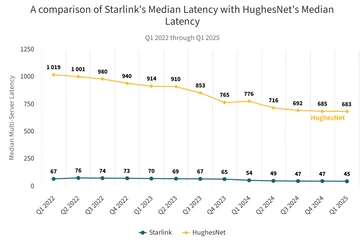
    4. The latency has improved, dropping from 76 ms to 45 ms, with expectations to reach under 20 ms with the V3 satellites.
    5. Starlink V3 will ensure that even lower-cost dishes meet broadband speed requirements, marking a milestone for satellite Internet.


    SpaceX has significantly improved the download speeds of its Starlink satellite Internet service, nearly doubling from the lows experienced in the third quarter of 2022 when it struggled to keep up with demand.

    Expansion of Capacity

    To showcase the satellite capacity it has been consistently adding, SpaceX recently celebrated the production of its 10 millionth dish, producing around 15,000 units every day at present.

    Despite a sharp rise in subscribers to six million, Starlink’s speeds have surged since the lows of 2022, reaching a median of 104.71 Mbps for downloads. This marks the first time it has met the FCC’s criteria for broadband Internet.

    Current User Experience

    Although only 17% of American Starlink users fully meet the FCC’s minimum broadband standards of 100 Mbps for downloads and 20 Mbps for uploads, this is largely due to the uplink capability of the current V2 satellites.

    With the upcoming launch of the Starlink V3 satellites—which are as large as a Boeing 737 when their solar panels are extended—the upload speeds are set to meet FCC broadband definitions as well. The V3 satellites are expected to provide 1 Tbps throughput, which is ten times the current Starlink download speeds, along with a substantial uplink boost to 160 Mbps.

    Historical Changes

    This development means that even users with the lower-cost and portable Starlink Mini dish will finally meet America’s broadband Internet speed requirements for both downloads and uploads, marking a historic moment for satellite Internet.

    SpaceX has not only managed to double the Starlink download and upload speeds in less than three years, even with a significant increase in subscribers, but it has also greatly enhanced the network’s latency. The ping time has dropped from a high of 76 ms to 45 ms, thanks to the addition of six new internet connection sites.

    Future Expectations

    The V3 satellite constellation, which SpaceX plans to launch starting in 2026, is expected to lower latency to a comfortable gaming level of under 20 ms. Elon Musk has even suggested that the lowest ping numbers could theoretically reach as low as 5 ms.

    The Starlink V3 satellites, which are set to provide a tenfold increase in download speeds and a 25-fold boost in upload speeds, will be transported to a lower orbit by SpaceX’s Mars-capable Starship 3 rocket, featuring 42 engines, with its first flight anticipated later this year.

    Source:
    Link