Tag: RTX 4090

  • New Free-to-Play MMORPG Launches on Steam with Mixed Reviews

    New Free-to-Play MMORPG Launches on Steam with Mixed Reviews

    Key Takeaways

    1. Rocky Launch and Player Expectations: Iverian Wars faced significant backlash at launch, with players feeling that the game did not meet their expectations, leading to “Mostly Negative” reviews.

    2. Gameplay and Technical Issues: A major bottleneck in the initial quest caused frustration, compounded by severe optimization problems, with frame rates dropping to 6-12 FPS even on high-end systems.

    3. Repetitive Gameplay Loop: Criticism arose over the gameplay loop, which felt “soulless” and overly reliant on repetitive “kill-and-return” quests, lacking the depth of modern action-RPGs.

    4. Visual and Engine Quality Concerns: The new engine reportedly produced visuals that were worse than the original 2008 game, with issues like glitchy textures and imprecise hitboxes.

    5. Monetization and Pay-to-Win Issues: The game’s monetization model raised concerns about “pay-to-win” mechanics, allowing players to quickly craft high-level PvP weapons through real-money purchases.


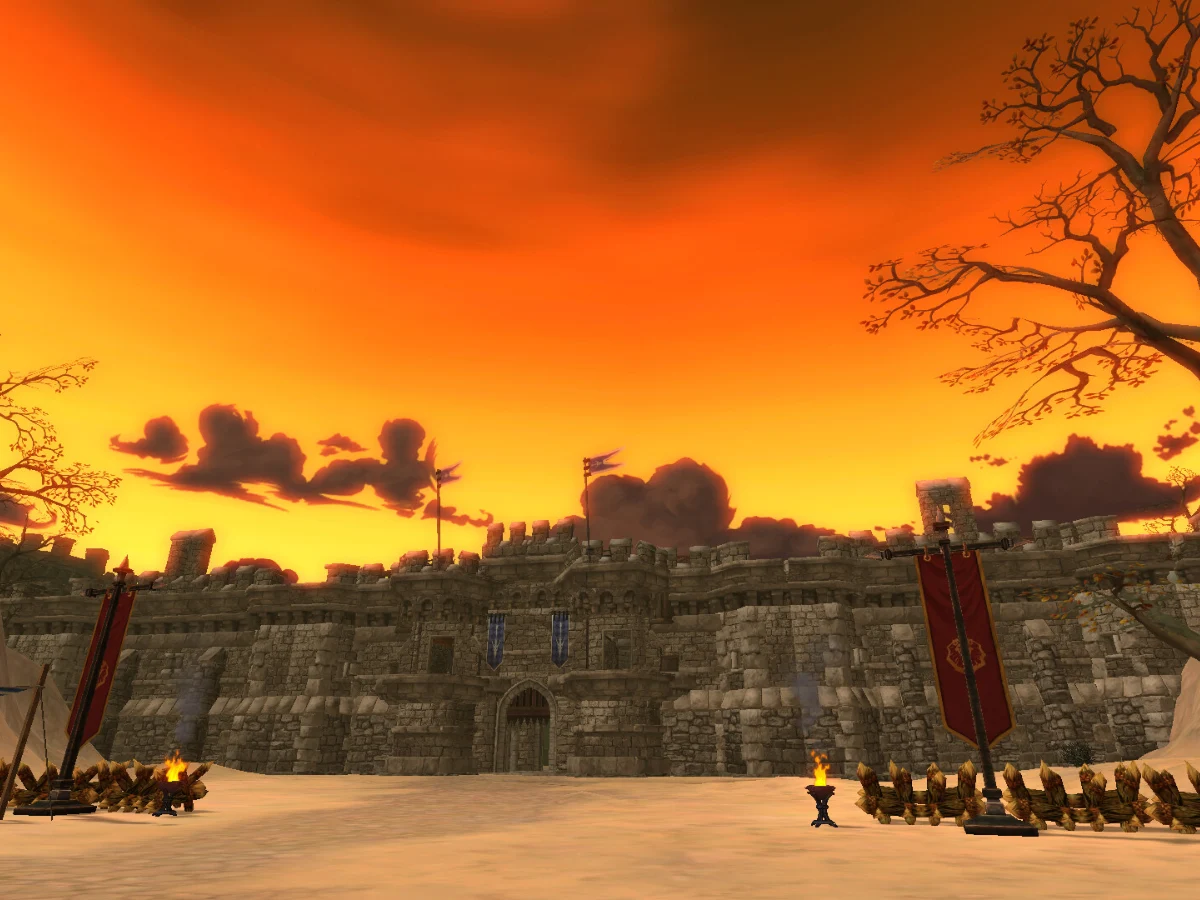
    Zemi Interactive launched Iverian Wars: Craxion vs Defugel in early access on Steam on February 24, 2026, aiming to refresh the Iveria universe for today’s gamers. Unfortunately, the game’s release has been rocky, showing a significant gap between what players expected and what they received. Previously known in development circles as 4Story: Origin, this game is essentially a rebranding of the 2008 Korean MMORPG 4Story. This connection has turned out to be a double-edged sword, as it did manage to attract a long-unengaged fan base, achieving a peak of 1,839 concurrent players initially. Yet, the “Mostly Negative” reviews tell a vastly different tale. Many in the community feel “nostalgia baited” by a title they believe has regressed from its decade-old predecessor.

    Major Issues at Launch

    The game’s infamy primarily stems from a disastrous bottleneck occurring within the first hour of gameplay. Players are directed into a starting quest that requires them to defeat specific spiders, but with hundreds of players vying for a limited number of spawns, progress comes to a standstill. This design flaw is made worse by serious optimization problems; players on Reddit and Steam forums have reported frame rates plummeting to between 6-12 FPS even on high-end machines like the RTX 4090 during these crowded encounters. On top of the lag, the gameplay loop has received sharp criticism for feeling “soulless.” Gamers note that it heavily relies on repetitive “kill-and-return” quests that lack the mechanical intricacy or smooth movement found in contemporary action-RPGs.

    A Disappointing Visual Experience

    To add more context, the shame surrounding Iverian Wars is closely tied to its own historical roots. Many fans are pointing out that the game’s “new” proprietary engine produces visuals that, in some ways, are worse than the original 2008 assets. Common issues include glitchy textures and imprecise building hitboxes. Additionally, the monetization model has already raised “pay-to-win” (P2W) alarms. Players have noted that high-level PvP weapons can be crafted almost instantly by spending real money on certain materials, effectively bypassing the usual progression grind.

    All these concerns, along with missing essential features like a working mouse-view response and a “Mixed” technical state, have turned this title into a cautionary example regarding the current landscape of F2P MMORPG relaunches. If you’re interested, you can visit Iverian Wars’ Steam page here—just make sure to check the latest patch notes before investing any significant time (or money) into this Iverian revival.

    Source:
    Link


  • GeForce Now Hourly Caps vs High DDR5 RAM Prices: A Comparison

    GeForce Now Hourly Caps vs High DDR5 RAM Prices: A Comparison

    Key Takeaways

    1. Nvidia GeForce Now will limit all subscribers to 100 hours of gaming per month starting January 1, 2025.
    2. Existing users received a grace period, but new users will face the limit immediately in 2025.
    3. Exceeding the 100-hour limit will incur additional charges: $2.99 for 15 hours (Performance tier) or $5.99 for extra hours (Ultimate tier).
    4. Serious gamers may find GeForce Now subscription costs exceeding the price of gaming consoles or high-end PCs over time.
    5. Despite potential price hikes and limits, many loyal users may continue using GeForce Now due to its superior performance compared to competitors.


    With the rising costs of GPU and DDR5 RAM, many people are turning to cloud gaming as a budget-friendly option. However, a well-known streaming platform for PC gamers is about to impose restrictions on all its subscribers. Starting in January, Nvidia GeForce Now will limit usage to 100 hours per month for every member. Recent analysis suggests that avid gamers might think about cancelling their subscriptions due to these changes.

    Notification of New Limits

    Subscribers first heard about the GeForce Now limits in November 2024. Although new users will face these restrictions in 2025, existing customers were granted a grace period. This leniency ends on January 1st, which led Reddit user appleroyales to investigate the potential consequences. Their research included a comparison of the expenses involved in building a gaming PC versus buying a console.

    Subscription Costs After Limits

    Once users exceed 100 hours, those on the $9.99 per-month Performance tier will need to pay an extra $2.99 for an additional 15-hour block. Gamers who subscribe to the Ultimate tier for $19.99 every 30 days will have to pay an additional $5.99 after hitting the limit. For casual players who only game a few hours each day, investing in a gaming rig with an RTX 4090, a PS5 Pro, or even a Steam Machine won’t provide better value.

    Long-Term Implications for Serious Gamers

    The situation becomes particularly interesting for more dedicated gamers. Ultimate tier subscribers who play about 6 hours daily will face steeper costs. After a year, their subscription payments could surpass the price of a discounted PS5 Pro at $650. By the end of five years, they might have spent around $3500, which could have gone into building a high-end gaming PC.

    For those who manage to squeeze in 16 hours of gaming each day, GeForce Now may quickly seem less appealing. Yet, there are other factors to consider beyond the price of DDR5 RAM. Some fans are concerned that increasing costs for storage, GPUs, and other components will make owning a desktop or laptop less feasible.

    Even though GeForce Now offers superior performance compared to platforms like Xbox Cloud Gaming, many loyal users are likely to stick with it. Nevertheless, these gamers are anxious that Nvidia might hike prices or further lower the monthly hour limits.

    Source:
    Link


  • Unlock RTX 4090 Laptop Performance to Beat RTX 5090 Laptops

    Unlock RTX 4090 Laptop Performance to Beat RTX 5090 Laptops

    Key Takeaways

    1. Power limits in gaming laptops often restrict GPU performance to prevent overheating and ensure stability.
    2. A modder successfully used shunt modding on an RTX 4090 GPU to report lower power consumption, allowing the GPU to reach higher clock speeds.
    3. The modification involved adding a 1 mOhm resistor to the existing 5 mOhm resistor, misleading the system about actual power usage.
    4. Adequate cooling and a strong power supply are essential for this mod, as the true power draw can reach up to 240W.
    5. While shunt modding can significantly boost performance, it carries risks of permanent damage and requires specialized tools to execute correctly.


    Power limits often prevent a high-performance GPU from achieving its full capabilities. In gaming laptops, where space and cooling are restricted, strict power limits are typically enforced to avoid overheating and ensure stable performance. But what if there was a way to deceive the system into believing that the GPU isn’t hitting its power limit? A modder has found a method to do just that, achieving impressive performance boosts that sometimes surpass a laptop equipped with an RTX 5090.

    The Modding Process

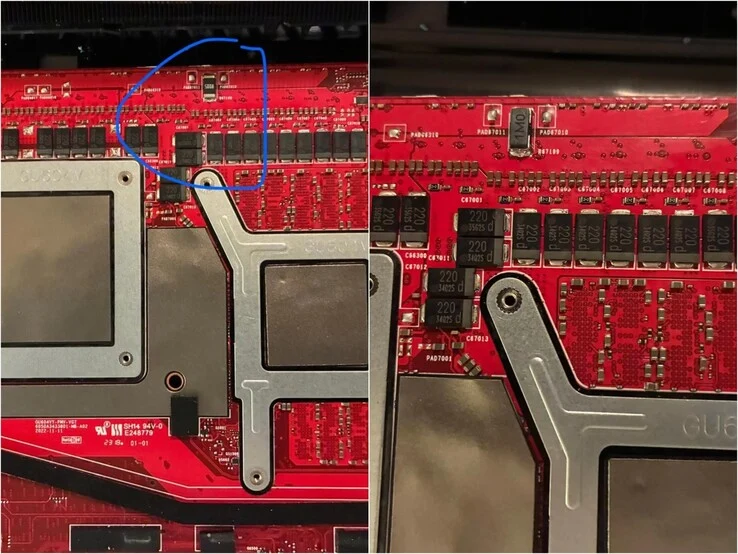
    According to a post by ‘thatavidreadertrue’ on Reddit, the user implemented shunt modding on a Zephyrus M16 that houses an RTX 4090 GPU. Shunt modding involves physically altering a resistor on the GPU, allowing it to report a lower power consumption. This enables the GPU to achieve its full clock speeds. The modder placed a 1 mOhm resistor on top of the existing 5 mOhm resistor, causing the GPU to indicate it was using six times less power than it actually was.

    Cooling and Power Supply Considerations

    Naturally, this modification requires a robust cooling system and a strong power supply. The Redditor mentioned that the Zephyrus M16 has sufficient power phases, and they replaced the old thermal paste on both the CPU and GPU with a higher-performance option. As a result, the M16 was showing power usage between 40W to 45W, while the true power draw could reach up to 240W (the maximum of the power adapter).

    Benchmark Results and Risks

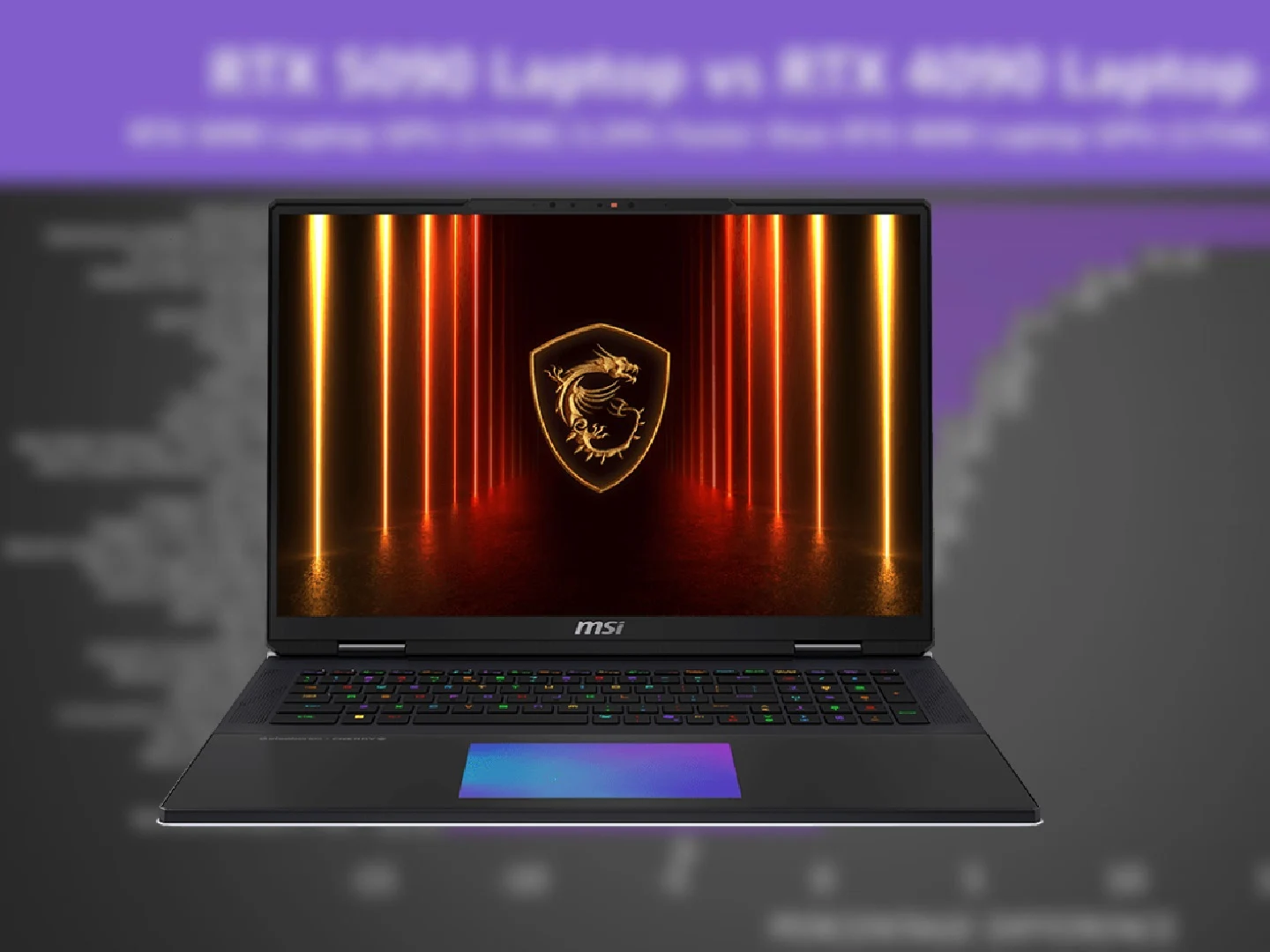
    The modder shared several benchmarks, including Speedway, Steel Nomad, Port Royal, and Time Spy. In most instances, as illustrated below, the modified M16 surpassed the typical performance of an RTX 5090 laptop.

    While shunt modding can be effective, it carries risks and demands some specialized tools. If you consider attempting this, be aware that there is a possibility of causing permanent damage to the components. However, if done correctly, you could potentially achieve RTX 5090 laptop performance at just half the price.

    Source:
    Link


  • DIY Handheld PC with RTX 4090: 120 FPS AAA Games at 72°C

    DIY Handheld PC with RTX 4090: 120 FPS AAA Games at 72°C

    Key Takeaways

    1. A DIY handheld device powered by an RTX 4090 can run Cyberpunk 2077 at 4K 60 FPS.
    2. The handheld features a 12.5-inch 4K IPS touchscreen, Intel Core i9-14900HX processor, 64 GB of RAM, and a 2 TB SSD.
    3. The device’s GPU operates at a TGP of 174 W, similar to a gaming laptop, and is powered by a standard gaming laptop charger.
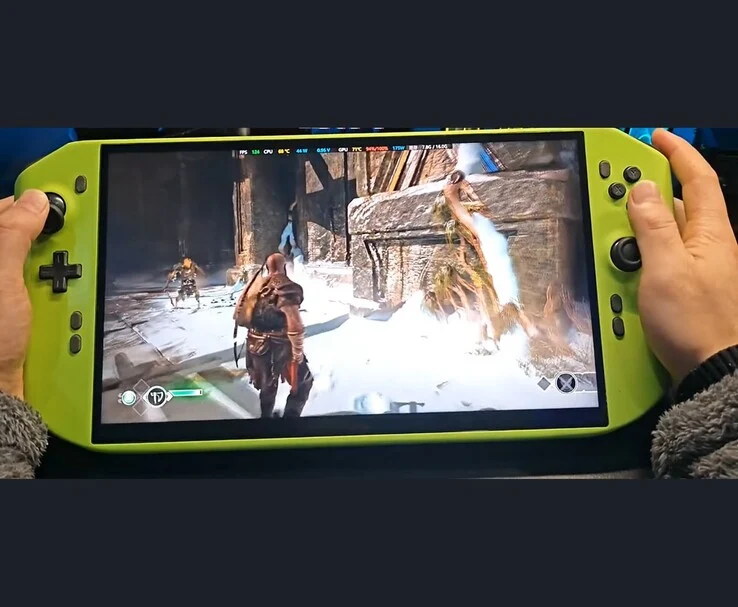
    4. In addition to Cyberpunk 2077, it can run God of War (2016) at 110-120 FPS with smooth gameplay.
    5. The system maintains impressive thermal performance, with the CPU and GPU temperatures staying around 67°C and 72°C, respectively.


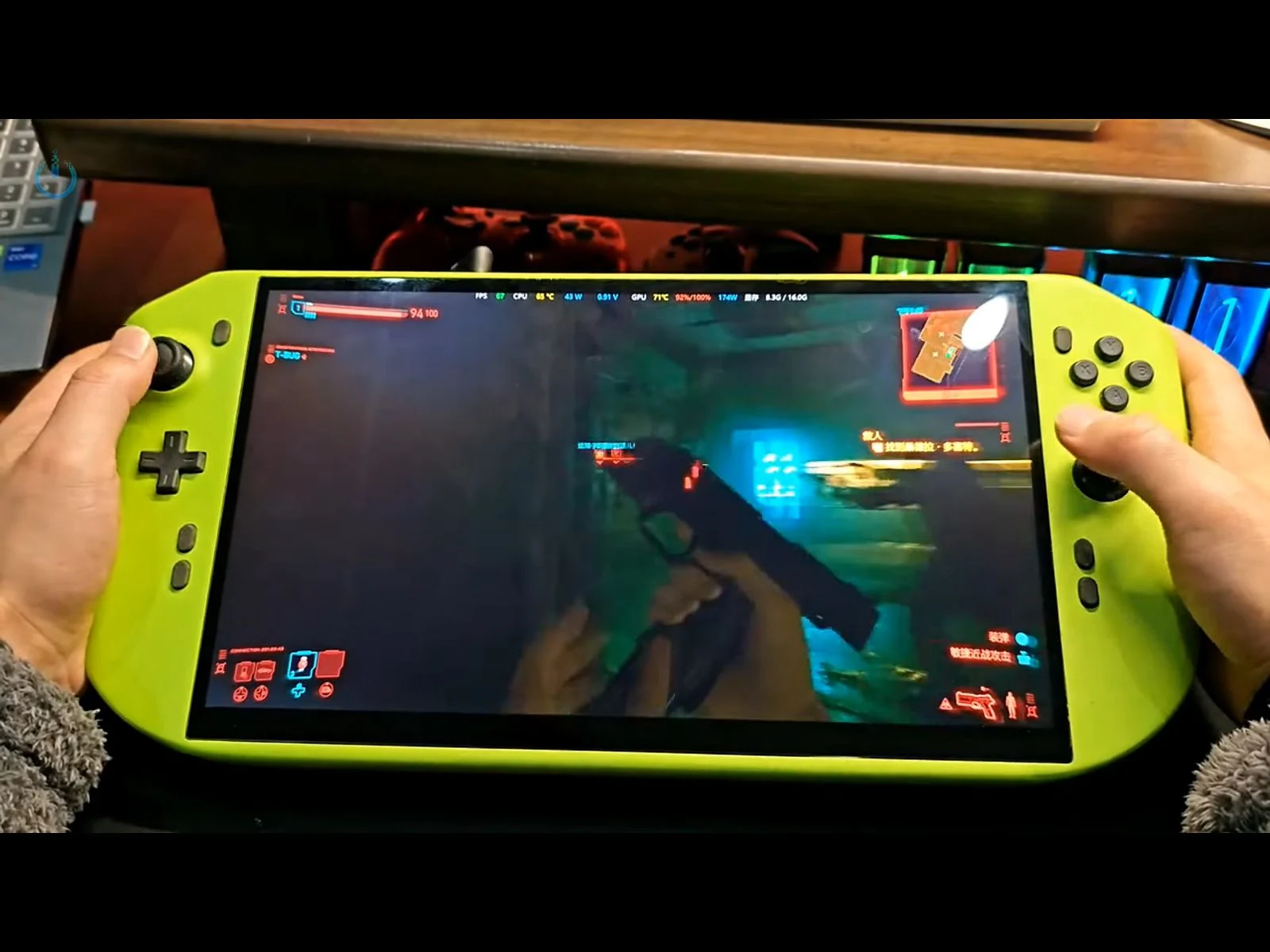
    I never imagined that gaming in 4K on a portable device would become a possibility, but then I came across a video from the YouTube channel ‘NITTRX.’ In this clip, the creator demonstrated a handheld device powered by an RTX 4090, playing Cyberpunk 2077 at an impressive 4K 60 FPS.

    Impressive Showcase

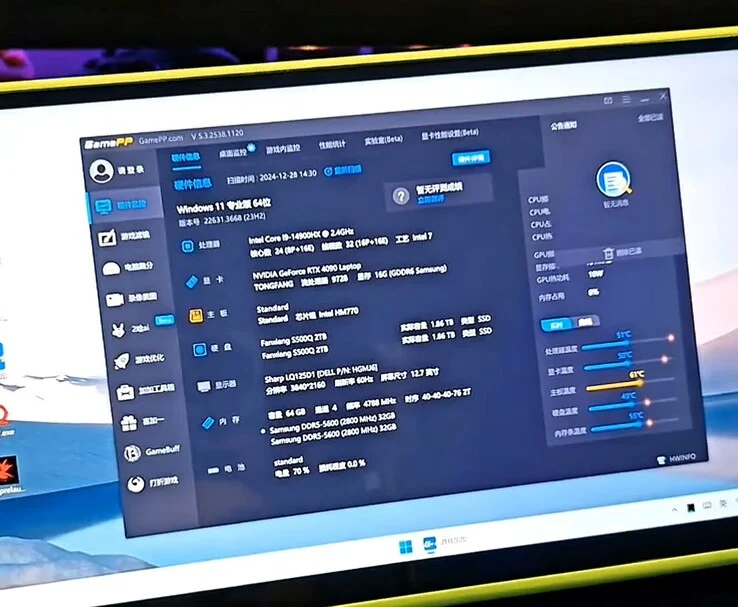
    The video is fairly brief, yet it highlights the DIY RTX 4090 handheld remarkably well. The YouTuber has used the mobile version of the RTX 4090 chip, equipped with 16 GB of GDDR6 VRAM, which is shown when the specifications are revealed at the video’s start. During gameplay, it’s clear that the GPU operates at a TGP of 174 W, similar to the laptop version of the RTX 4090. A regular gaming laptop charger can also be spotted in the video, supplying power to the DIY handheld.

    Specifications Unveiled

    In terms of specifications, this RTX 4090 handheld boasts a 4K IPS touchscreen display measuring 12.5 inches, the same kind previously found in a Dell Latitude 12 E7275. Additionally, it features an Intel Core i9-14900HX processor, 64 GB of RAM operating in quad-channel mode, and a 2 TB SSD. Essentially, it’s like a full gaming laptop packed into a compact 12.5-inch frame.

    When we look at gaming performance, the DIY handheld was able to run Cyberpunk 2077 at approximately 4K resolution with high or maximum graphical settings. I’m not entirely sure of these specifics because the creator doesn’t clearly display them in the video. Nevertheless, with the Steam performance overlay showing about 8.3 GB of VRAM in use, it’s reasonable to think that the game is indeed running at high graphics and resolution. The frame rate was around 60–70 FPS.

    Gaming Performance Analysis

    The YouTuber then played 2016’s God of War, achieving between 110 and 120 FPS with smooth gameplay. A particularly interesting aspect was the thermal performance: the 14900HX was sitting at about 67 degrees Celsius, while the RTX 4090 reached 72 degrees Celsius. Fitting such high-performance components in a tiny chassis is already quite amazing, but managing to keep them cool is an even more impressive achievement.

    The YouTuber continues to explore more gaming features throughout the rest of the video, which is linked below. I highly recommend watching it, as a DIY RTX 4090-powered handheld is definitely something everyone should witness to believe.

    Source:
    Link


  • Nvidia’s Media Tactics: Fallout from Gamers Nexus Exposé

    Nvidia’s Media Tactics: Fallout from Gamers Nexus Exposé

    Key Takeaways

    1. Nvidia’s Pressure Tactics: Gamers Nexus (GN) alleges that Nvidia has pressured them to include specific performance metrics (MFG4X) in GPU reviews, even for unsupported models, claiming this is misleading and unethical.

    2. Control Over Media Access: Nvidia reportedly threatened to restrict access to key engineers if GN did not comply with their editorial demands, indicating a desire to control media coverage rather than simply influence it.

    3. Erosion of Trust: GN argues that Nvidia’s tactics have eroded trust in media coverage of their products, making it difficult for audiences to discern whether metrics were included voluntarily or under pressure.

    4. Manipulative Corporate Culture: The article highlights concerns over Nvidia’s corporate culture, where executives may shift blame and use access to engineers as leverage against media outlets, impacting editorial independence.

    5. Commitment to Integrity: Gamers Nexus emphasizes their commitment to maintaining editorial independence, even at the risk of losing future access to Nvidia products, urging other media outlets to resist similar pressures.


    As Nvidia CEO Jensen Huang shares news about artificial intelligence, Gamers Nexus has taken this opportunity to reveal what it calls Nvidia’s growing manipulative behavior towards the media. In an editorial characterized by Steve Burke’s distinctive tone, the piece highlights a troubling trend of editorial pressure, coercive tactics based on access, and retaliatory measures that the outlet claims exceed standard industry practices.

    Nvidia’s Demands

    Gamers Nexus alleges that for the past six months, Nvidia has pressured its team to include Multi-Frame Generation 4X (MFG4X) performance metrics in GPU reviews, even in cases where the graphics cards tested do not support this feature. GN refused, asserting that such inclusion would be misleading, unethical, and fundamentally dishonest.

    Threats and Access Control

    Instead of relenting, Nvidia reportedly intensified its approach by threatening to deny access to key internal engineers — notably thermal engineer Malcolm and latency expert Gamm0 — both of whom resonate well with GN’s audience. Even though these engineers have no direct link to MFG technology, their availability was allegedly made contingent on GN agreeing to Nvidia’s editorial stipulations.

    The main allegation from GN is that Nvidia is not just trying to influence coverage but is actively seeking to control it. This includes urging reviewers to depict the RTX 5070 as comparable to the significantly more powerful RTX 4090 by highlighting synthetic MFG-enhanced figures. Such comparisons risk misleading consumers by stripping away essential context.

    The Nature of Communication

    Burke argues that this behavior shifts Nvidia’s once-open communication with the media towards manipulation. While Nvidia has historically provided technical insights and briefings, GN contends that this access is now being leveraged to enforce compliance with corporate messaging. Once viewed as a hallmark of transparency, access to Nvidia’s engineers is increasingly seen as conditional and transactional.

    Gamers Nexus is not isolated in voicing concerns. Burke mentions that the outlet contacted other reviewers and media representatives globally, revealing a pattern of behind-the-scenes pressure to influence editorial content. This includes explicit or implied expectations regarding how products should be framed and which benchmarks should be highlighted. According to GN, these strategies indicate a broader company-wide approach that goes beyond regional public relations teams.

    Nvidia’s History of Controversy

    Nvidia has faced its share of media influence controversies. In 2020, it temporarily cut off Hardware Unboxed’s GPU sampling access due to the outlet’s unwillingness to emphasize ray tracing metrics. A similar situation reportedly surfaced again, with Nvidia pressuring GN to modify its editorial stance on MFG and DLSS coverage.

    Burke claims that Nvidia informed Gamers Nexus that integrating MFG into reviews was necessary to “secure budget” for interviews with engineers, even though GN incurs costs for traveling, filming, and editing those interviews without any financial compensation from Nvidia. This framing implies that Nvidia perceives all media interactions as fundamentally transactional, regardless of financial exchanges.

    The Ripple Effect on Media

    This framing also casts a shadow over other media organizations. Once Nvidia establishes precedent for linking access to editorial direction, every interview, performance graph, or editorial decision becomes questionable. GN argues that this not only undermines their credibility but also that of any reviewer discussing MFG or DLSS without full transparency regarding the nature of those discussions.

    Gamers Nexus emphasizes that their frustration is not aimed at Nvidia’s engineers. On the contrary, they regard professionals like Malcolm and Gamm0 as knowledgeable and trustworthy, conveying insights born from experience rather than marketing agendas. These individuals have cultivated genuine connections with GN and its audience. However, GN now believes that Nvidia is intentionally using that rapport to enforce compliance.

    Emotional Pressure Tactics

    Burke notes that Nvidia often references these engineers when discussing coverage requirements. This tactic seems designed to apply emotional pressure, knowing that GN values these relationships. GN describes this as a form of manipulation, suggesting that if restricting access to GPUs fails, perhaps restricting access to respected engineers will succeed.

    Despite producing over an hour of independent content on MFG and DLSS, including detailed analyses, GN states that Nvidia was still dissatisfied because the coverage was not integrated into review articles. The demand was explicit: include MFG4X in the charts or lose access.

    Erosion of Trust

    GN contends that this insistence has tainted any MFG or DLSS coverage presented by any outlet. Even if another reviewer includes those metrics out of genuine curiosity, audiences may question whether they did so voluntarily or under undue pressure. This erosion of trust harms both independent media and Nvidia’s own credibility.

    Gamers Nexus has a history of engaging with major companies. They have previously confronted Intel and AMD over similar matters, emphasizing that this isn’t personal. However, the outlet feels that Nvidia’s tactics have crossed a new line that now encompasses not just hardware access, but access to personnel and potential internal reprisal.

    Concerns Over Corporate Culture

    Burke cites prior reports from former Nvidia employees who described a corporate culture where executives frequently shift blame downwards. GN worries that by going public with these claims, they might inadvertently harm the engineers and PR contacts who have no influence over high-level policies. Nonetheless, the outlet believes that transparency is essential for progress.

    The article also recalls Nvidia’s contentious GeForce Partner Program (GPP) from 2018, which effectively required board partners to align their gaming brands exclusively with GeForce to retain Nvidia support. This program, widely criticized for being anti-competitive, was eventually withdrawn under public pressure and investigative scrutiny.

    A Call for Integrity

    In GN’s perspective, the current situation mirrors GPP in both approach and execution. The company is allegedly attempting to shape perception and limit coverage by using access and relationships as pressure points rather than relying on product quality and transparency. The message seems to be: adhere to the script, or risk exclusion.

    GN concludes with a firm statement: they will not yield. Even if it means sacrificing future review samples, interviews, or relationships, they are committed to maintaining editorial independence. They also urge other outlets to take a stand. “If you give Nvidia an inch, they’ll take a mile,” warns Burke.

    The piece finishes not by calling for a boycott, but by acknowledging that Nvidia produces remarkable products and its engineers offer valuable insights. However, both consumers and reviewers must be able to trust that coverage is accurate, independent, and not subject to corporate pressure.

    At the heart of this conflict lies more than just performance metrics or technologies; it concerns the role of the press in an industry where access has become a bargaining tool and transparency comes with strings attached.

    We will keep tracking this situation and provide updates as new information comes to light.

    Source:
    Link

  • RTX 5090 Laptop GPU vs RTX 4090: 25-Game Benchmark Results

    RTX 5090 Laptop GPU vs RTX 4090: 25-Game Benchmark Results

    Key Takeaways

    1. The RTX 5090 laptop GPU shows a 20% performance advantage over the RTX 4090 in synthetic tests but doesn’t translate to significant gaming performance gains.

    2. In a broader gaming context, both the RTX 5090 and RTX 4090 perform similarly, with only slight advantages in some cases.

    3. At lower resolutions like 1080p, CPU performance impacts GPU performance analysis, complicating comparisons between models.

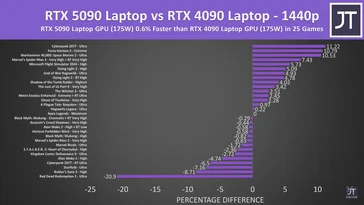
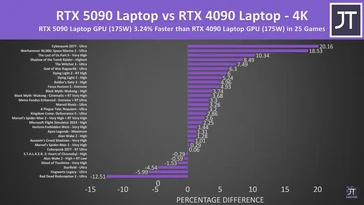
    4. The performance gap at 1440p and 4K is minimal, with the RTX 5090 only showing a 0.6% and 3% increase over the RTX 4090, respectively.

    5. Key advantages of the RTX 5090 include 24 GB VRAM, improved efficiency, and DLSS Multi-Frame Generation, but the RTX 4090 may be a better investment for most users.


    We did an analysis of the RTX 5090 and RTX 5080 laptop GPUs, and it shows these boards offer a solid performance advantage over their previous generation models in synthetic tests. For example, the RTX 5090 laptop outperformed the RTX 4090 laptop by as much as 20% in the 3DMark test suite. Nevertheless, this synthetic performance does not effectively translate into gaming performance, especially for the RTX 5090.

    Performance in Gaming

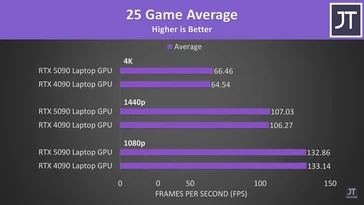
    Although the RTX 5090 laptop was 20% quicker than the RTX 4090 laptop for some individual games like Cyberpunk 2077 2.2 Phantom Liberty during our tests, it appears that the new GPU does not hold any edge over the RTX 4090 when evaluated in a broader context. The 25-game benchmark from Jarrod’sTech indicates that the RTX 5090 laptop and the RTX 4090 laptop perform largely on par.

    Importance of Resolution

    Before diving into the actual performance details, it’s worth noting that we have not considered the 1080p results. At lower resolutions, such as 1080p, CPU performance plays a bigger role, which complicates the process of determining the precise GPU performance.

    When tested at 1440p, the RTX 5090 laptop GPU only manages to be a slight 0.6% faster than the RTX 4090 laptop GPU. This includes the notably poor performance of the RTX 5090 laptop in Red Dead Redemption 2. Even if we ignore the Red Dead Redemption 2 score, the RTX 5090 laptop shows a meager 1.6% lead over the RTX 4090 laptop GPU.

    4K Performance Insights

    The gap in gaming performance between the RTX 5090 laptop and the RTX 4090 laptop isn’t significantly better at 4K. Both GPUs perform quite similarly, with JT’s testing revealing only a 3% increase in performance for the RTX 5090 laptop GPU. This is with the Red Dead Redemption 2 results included. However, removing Red Dead Redemption 2 from the equation doesn’t improve things for the RTX 5090 laptop.

    When looking at frame rates, the RTX 5090 laptop GPU averages 66 FPS across the 25 games tested at 4K, while the RTX 4090 laptop is nearly the same at 64.5 FPS. The results at 1440p also reflect this trend, with the RTX 5090 laptop GPU and the RTX 4090 laptop GPU averaging 107 and 106 FPS, respectively.

    Final Thoughts

    Ultimately, the RTX 5090 laptop GPU’s advantages are limited to its 24 GB VRAM, improved efficiency, and DLSS Multi-Frame Generation (MFG). However, it’s doubtful that anyone spending over $3,000 or $4,000 on a premium gaming laptop will prioritize efficiency. Buyers of high-end gaming laptops expect top-tier performance.

    Thus, if you don’t plan to use MFG and have no need for 24 GB of VRAM, the previous generation RTX 4090 gaming laptops are evidently a better investment.

    Source:
    Link


  • Unreleased Nvidia Titan Ada GPU: The RTX 4090 That Wasn’t

    Unreleased Nvidia Titan Ada GPU: The RTX 4090 That Wasn’t

    Key Takeaways

    1. The Titan Ada was a fully developed Nvidia graphics card that was ultimately discarded before launch, intended to be the flagship of the Ada Lovelace generation.
    2. It features a fully unlocked AD102 chip with 18,432 CUDA cores and 48 GB of GDDR6X memory, surpassing the RTX 4090 in both performance and design.
    3. Benchmark tests showed the Titan Ada outperforming the RTX 4090 by 10-15% while offering better performance-per-watt, but it was less compatible with newer games due to driver limitations.
    4. Reasons for its cancellation include potential market positioning issues with the RTX 5090, its large size and complex design, and a lack of strong performance-per-dollar ratio for consumer applications.
    5. The Titan Ada represents a significant yet unrealized engineering achievement in GPU history, highlighting Nvidia’s capabilities beyond what was released to consumers.


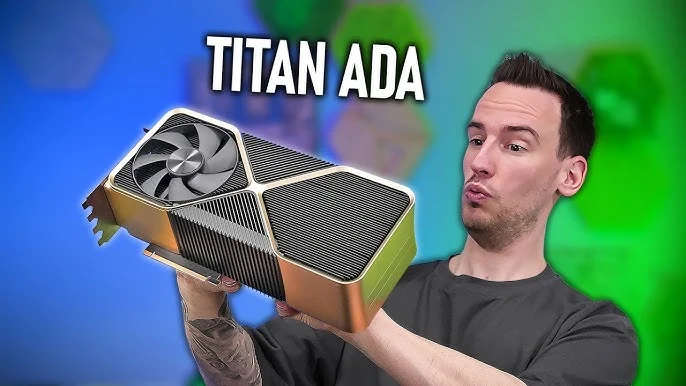
    In a surprising turn of events, the much-discussed Nvidia graphics card—the Titan Ada—has been uncovered and evaluated, revealing a GPU that was entirely developed but ultimately discarded prior to its launch. This card was intended to be the pinnacle of Nvidia’s Ada Lovelace generation, set to surpass the RTX 4090 in performance and aesthetics, giving us a peek at what could have truly represented the flagship of the RTX 40-series.

    Specifications and Features

    The Titan Ada operates on a fully unlocked AD102 chip, which is the same die found in the RTX 4090 but with additional hardware enabled. It boasts 18,432 CUDA cores—12.5% more than the 4090—and includes a whopping 48 GB of GDDR6X memory, twice as much as Nvidia’s most advanced consumer GPU to date. Despite its enormous capabilities, the design of the Titan Ada is sleek, featuring a large quad-slot cooler, two 12VHPWR connectors, and an attractive Titan-logo light. When compared to the already sizable RTX 4090, the Titan Ada is not only wider and heavier but also more imposing in every aspect.

    Benchmark Performance

    In various benchmark evaluations, such as 3DMark Time Spy Extreme and 3DMark Speedway, the Titan Ada consistently achieved remarkable scores. It outperformed the RTX 4090 by 10–15% while only consuming about 14% more power, showcasing a significant enhancement in performance-per-watt. For instance, in Remnant 2, it secured an average of 82 FPS, which is 10% above the RTX 4090’s performance, and in Cyberpunk 2077, it provided a 22% increase. Efficiency tests revealed that the Titan Ada slightly surpassed both the 4090 and even the newer RTX 5090 in terms of FPS-per-watt, a unique occurrence in high-end GPU assessments.

    Reasons for Its Cancellation

    Nonetheless, there are some concerns. The GPU was assessed with a 2023 driver, which restricts compatibility with newer games—numerous titles either failed to start or showed performance issues. Furthermore, while the RTX 5090 still outperformed the Titan Ada in absolute terms (by 11–26% based on the test), the Titan Ada’s impressive performance highlighted a surprisingly small difference between the two generations.

    So, what caused this monster to never hit the shelves?

    There are several plausible explanations. Firstly, from a product positioning perspective, launching a Titan Ada too close to the 5090—especially with only minor improvements—could have undermined Nvidia’s next-gen flagship. The success of the RTX 5090 might have been harder to defend had the Titan Ada been released first. Secondly, the card’s large size and complex design, particularly its substantial quad-slot cooler, would have presented challenges for both system builders and end users. The Titan Ada is physically daunting and not practical for many setups.

    Lastly, and possibly most importantly, Nvidia might have concluded that the performance-per-dollar ratio wasn’t strong enough to warrant a commercial release. The card seemed better suited for high-end professional or workstation applications, but would have likely needed specialized drivers and support infrastructure that Nvidia wasn’t prepared to provide for a single product launch.

    While the Titan Ada may never grace retail shelves, its existence illustrates that Nvidia had taken Ada Lovelace further than consumers ever expected. It remains an intriguing “what-if” scenario in GPU history—an engineering feat crafted to conquer, yet ultimately left unexploited.

    Expect more teardown videos and in-depth analysis of the Titan Ada’s internals and cooling systems in the future. For now, this insight into the card-that-never-came gives fans a rare glimpse at a phantom within Nvidia’s realm.

    Source:
    Link

  • RTX 4090 Connector Melting Issues: Ongoing Problems Explained

    RTX 4090 Connector Melting Issues: Ongoing Problems Explained

    Key Takeaways

    1. Connector Melting Issue: RTX 4090 users are experiencing melting 12VHPWR connectors, leading to burnt plastic odors and fusing to graphics cards and power supply units (PSUs).

    2. Thermal Imbalance: The lack of current monitoring across the 12V lines results in uneven current distribution, causing thermal hotspots and connector degradation.

    3. Resistance Variability: Significant inconsistencies in resistance values among the power pins can lead to localized heating, generating enough heat to compromise connector integrity.

    4. Vendor Accountability: Inno3D has denied responsibility for connector issues under warranty, while other vendors like ModDIY have shown willingness to assist, highlighting inconsistent vendor responses.

    5. Design Criticism: Der8auer criticizes Nvidia’s power connector design and calls for better protection and support for consumers, emphasizing the need for a redesign to prevent future failures.


    The ongoing issue of melting 12VHPWR connectors has come back into the spotlight, this time impacting a user of the RTX 4090 who reached out to overclocker and YouTuber Der8auer. While enjoying some gaming, the user detected a familiar burnt plastic odor and found that the high-power connector had fused to both the graphics card and PSU ends. The graphics card in question was an Inno3D model that had since been modified with water cooling, operating with an undervolt and connected via a ModDIY cable that used 16 AWG ultra-soft wires. Even with careful assembly and a PSU (SilverStone Extreme 850R) considered suitable for a 4090, the plug became stuck, indicating a thermal issue within the connector. Inno3D’s customer service, however, declined to provide assistance, claiming that the damage was on the cable and PSU sides—an argument that Der8auer finds technically flawed.

    Current Monitoring Issues

    Der8auer elaborates that the main problem focuses on the absence of current monitoring across the individual 12V lines in the 12VHPWR interface. It seems that RTX 40 and 50 series graphics cards are unable to identify uneven current distribution among their six power pins. This imbalance, often caused by varying contact resistances in the wires or pins, can create thermal hotspots. In this particular instance, Der8auer managed to take apart and replace the damaged connector on the GPU side himself, using an H++ version of the 12VHPWR plug. His measurements showed significant inconsistencies in resistance values—one pin was as low as 12 milliohms, while another reached 43 milliohms, and one had no connection whatsoever. These differences directly lead to uneven current flow, which results in localized heating and ultimately causes connector melting and degradation. Even with a modest power draw, this can generate up to 4.6 watts of heat concentrated in a small area—sufficient to compromise the connector’s integrity over time.

    Vendor Responses

    Adding to the frustration is the inconsistent response from vendors. ModDIY displayed some readiness to assist, including an offer to pay for repair costs, but Inno3D consistently denied any responsibility, even though the card was still under warranty. Der8auer emphasizes that only the GPU-side design can effectively reduce these risks, as neither the cable nor the PSU can monitor load distribution. He notes that while high resistance can effectively “cut off” a wire, it causes more current to flow through the remaining wires, which leads to a cycle of overheating. Ultimately, Der8auer criticizes Nvidia’s poor power connector design and the lack of accountability from its partners. With high-end graphics cards priced over 2,000 euros, consumers deserve better protection—and quicker support—when failures happen. Until Nvidia revisits this design, users face ongoing risks, regardless of how meticulously they assemble or undervolt their systems.

    Source:
    Link

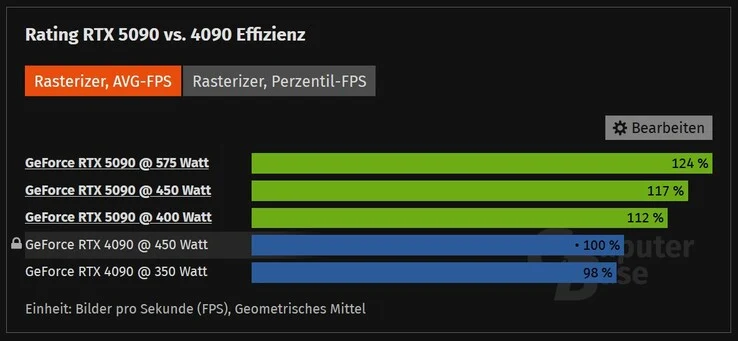
  • RTX 5090 vs RTX 4090: Efficiency Comparison at Same Power Level

    RTX 5090 vs RTX 4090: Efficiency Comparison at Same Power Level

    Reviews of the RTX 5090 have been released, and for those who seek top-tier performance without worrying about price or energy use, Nvidia has truly outdone itself with the RTX 5090. This graphics card excels in both rasterization and ray tracing, offering unmatched capabilities at 4K resolution. With the addition of DLSS 4, this GPU can achieve over 200 FPS in 4K gaming for titles that utilize Nvidia’s Multi-Frame Generation technology.

    Performance Comparison

    However, the RTX 5090 does not represent as significant an improvement over the RTX 4090 as the RTX 4090 did compared to the RTX 3090. In our evaluations, the new GPU shows an average performance increase of 27% over the RTX 4090. It’s important to note that this performance boost comes with a hefty rise in power usage; the RTX 5090 has a power rating of 575 W, compared to the RTX 4090’s 450 W.

    Power Normalization Insights

    This raises an intriguing question: How does the performance of the RTX 5090 stack up against the RTX 4090 when both cards are adjusted for power consumption? Luckily, ComputerBase has conducted tests, and the findings are quite enlightening.

    Their research indicates that the RTX 5090 achieves an average of 17% more FPS compared to the RTX 4090 in rasterization tasks when both GPUs are limited to 450 W. This means that when the RTX 5090 is restricted to using 125 W less power, it experiences an 8% decline in performance.

    CUDA Cores and Performance

    The 17% increase in performance at 450 W is particularly noteworthy, especially since the RTX 5090 contains 33% more CUDA cores than the RTX 4090. One might expect a more significant performance disparity than the observed 17% when the power advantage of the RTX 5090 is negated. That said, the slightly lower clock speeds of the RTX 5090 (113 MHz less) likely play a role in limiting its overall performance.

    In conclusion, it appears that Nvidia is relying on sheer power to maintain a competitive edge for the RTX 5090 over the RTX 4090. However, this approach may not bode well for the efficiency of the GPU, as the RTX 5090’s performance scales linearly with thermal design power (TDP)—showing a 27% performance increase for a 28% increase in energy consumption. For context, the RTX 4090 boasts over a 50% performance lead compared to the RTX 3090, with only a 29% higher TDP.

    Source:
    Link


  • RTX 5090 vs RTX 4090: Rasterization vs Ray Tracing Performance

    RTX 5090 vs RTX 4090: Rasterization vs Ray Tracing Performance

    The RTX 4090 stands as the top consumer desktop GPU within the RTX 40 series. With AMD not offering a rival to the RTX 4090, as the RX 7900 XTX is more aligned with the RTX 4080, Nvidia has maintained its dominance in the high-end gaming segment. Looking ahead, Team Green is expected to keep this top spot with the upcoming RTX 5090, especially since AMD has opted out of competing in the premium market with its RDNA 4 architecture.

    Performance Comparison

    Now, the big question is how does the RTX 5090 stack up against the RTX 4090? Nvidia has shared some performance figures for the RTX 5090, but didn’t provide in-depth insights into its raw rasterization or ray tracing performance. Instead, the focus has been on DLSS 4 and its impressive 4x Frame Generation.

    Benchmark Insights

    Fortunately, the RTX 5090 might already be in the hands of some reviewers, leading to the emergence of synthetic benchmark scores. Two notable results indicate that the RTX 5090 outperforms the RTX 4090 in both rasterization and ray tracing tests.

    According to a thread on Chiphell, which is likely to be taken down soon, the RTX 5090 achieved scores exceeding 24,000 in the 3DMark Time Spy Extreme test and over 13,500 in the Speed Way benchmark.

    Detailed Score Analysis

    Focusing on the Time Spy Extreme score, the RTX 4090’s results from 3DMark show values ranging from about 22,800 to 23,300. If we take a score of 22,800 for the RTX 4090 and 24,000 for the RTX 5090, it suggests that the Blackwell GPU is around 5.3% faster than its earlier version. Of course, results may vary with different high scores, but for our discussion, we can assume lower figures for both GPUs.

    When considering the 3DMark Speed Way test, which evaluates ray tracing, the RTX 5090’s reported score of 13,500+ positions it 8% ahead of the best RTX 4090 recorded in the 3DMark database. Again, since the RTX 4090 has scores that fall between about 11,430 and 12,489, the performance difference in favor of the RTX 5090 could be significantly larger if we base it on the lower RTX 4090 scores. For example, using the 11,430 Speed Way score for the RTX 4090, the RTX 5090’s performance is 18% superior.

    Conclusion

    Thus, it seems reasonable to conclude that the RTX 5090 could deliver nearly a 20% improvement in ray tracing capabilities compared to the RTX 4090.

    In summary, if the rasterization performance of the RTX 5090 is indeed less than 10% faster than the RTX 4090 as noted earlier, this raises questions about the $400 price hike. Such a slight improvement in rasterization might also clarify Nvidia’s strong emphasis on DLSS 4 during the RTX 50 launch.

    Nonetheless, we should hold off on forming any conclusions until we see third-party reviews for the RTX 5090. Until then, take any performance speculations regarding the RTX 5090 with a hefty dose of skepticism.