Tag: Gamers Nexus

  • Price Comparison: Steam Machine Costs More Than Faster PCs

    Price Comparison: Steam Machine Costs More Than Faster PCs

    Key Takeaway

    – Steam Machine pre-orders start at $1,049, with a compact, quiet, customizable design.
    – GPU performance matches an RTX 3060 / Arc A750 / RX 7600; CPU is similar to a Ryzen 5 5600X.
    – Cheaper gaming PCs exist (e.g., $899–$999) with better or comparable specs.
    – No upgrade options for CPU, GPU, or RAM, unlike conventional gaming PCs.
    – Best suited for users prioritizing compact size and SteamOS over value and upgradability.


    Pre-Order Pricing and Initial Hardware Impressions

    The Steam Machine will soon be available for pre-order at prices starting at $1,049. As initial tests show, the hardware certainly has its merits: the unit is not only compact but also whisper-quiet, and the case’s appearance can be customized in just a few simple steps thanks to a magnetically attached front panel. In terms of performance, however, the price is relatively high.

    Graphics and Processor Performance Compared

    As the review by Gamers Nexus shows, the Steam Machine’s graphics chip offers roughly the same performance as an Nvidia GeForce RTX 3060, an Intel Arc A750, or an AMD Radeon RX 7600, while the Intel Arc B580 and the Nvidia GeForce RTX 5050 are already slightly faster. The processor, with six Zen 4 CPU cores, is limited to a power dissipation of just 30 watts and is therefore only about as fast as an AMD Ryzen 5 5600X.

    Price Comparison with Alternative Gaming PCs

    A quick look at price comparisons shows that similarly fast gaming PCs can be found for significantly less. For example, a Zotac MEK with AMD Ryzen 5 5500, GeForce RTX 5050, 16 GB RAM and 1 TB SSD costs $899 on Amazon, while a Novatech Titan Pro with Ryzen 5 5500, significantly faster GeForce RTX 5060, 16 GB RAM and 1 TB SSD costs $999. On the more compact side, a Twelf Nyx D32 with Ryzen 5 5500, Radeon RX 7600, 16 GB and 512 GB is available for $899, while a much more powerful Ocean of Stars with Ryzen 5 7600X and AMD Radeon RX 9060 XT is offered for $1,369.

    Upgrade Limitations and Final Considerations

    While the Steam Machine is significantly more compact than most competitors, conventional gaming PCs can be upgraded later – the Steam Machine does not allow for processor or graphics card upgrades, and the RAM cannot be upgraded after purchase either. For those who prioritize value for money over compact dimensions and native support for SteamOS, it may be worth taking a look at alternative gaming PCs.


  • Linux GPU Benchmarks Outperform Windows Gaming, Nvidia’s Flaws

    Linux GPU Benchmarks Outperform Windows Gaming, Nvidia’s Flaws

    Key Takeaways

    1. Linux gaming can offer smooth gameplay, but there are compatibility issues and performance disparities compared to Windows.
    2. AMD graphics cards generally show better performance and reliability than Nvidia cards in Linux environments.
    3. Benchmarking challenges required Gamers Nexus to adjust their testing methodology, making direct comparisons with Windows benchmarks complicated.
    4. High-end GPUs like the Nvidia RTX 5090 and Radeon RX 9070 XT were tested, with AMD often outperforming Nvidia in certain games, especially at lower resolutions.
    5. Some games struggle on Linux, particularly those reliant on anti-cheat systems, limiting the overall gaming experience compared to Windows.


    By popular request, Gamers Nexus conducted thorough GPU tests on the gaming-centric Bazzite. The Linux operating system has persuaded some Windows users who are tired of ongoing issues to switch. The findings indicate that gamers can enjoy smooth gameplay on Linux, although there are compatibility restrictions. Additionally, as noted in other assessments, AMD graphics cards showed more reliable performance compared to Nvidia ones.

    Challenges in Benchmarking

    Before presenting the data, Steve Burke pointed out the challenges faced during Linux benchmarking. The team could not utilize the same Windows tools to assess frame rates. To complicate matters further, certain games have distinct versions for each operating system.

    Adjusting the Testing Methodology

    To tackle these obstacles, Gamers Nexus altered its testing methodology. They decided to halt updates in Bazzite, which risked missing important performance-enhancing patches. With such a variety of factors at play, Burke warned viewers against making direct comparisons with benchmarks from Windows.

    Included GPU Options

    The Linux GPU benchmarks featured high-end models such as the Nvidia RTX 5090 and the Radeon RX 9070 XT. However, cards like the RTX 5060, RX 9060 XT, and some from Intel were also tested. Overall, AMD cards performed well, often surpassing pricier Nvidia competitors in certain games.

    In Black Myth: Wukong, running at 1080p, the RTX 5090 came in first with an average fps of 114.8. Nonetheless, Gamers Nexus pointed out serious frame pacing problems, while the 9070 XT maintained a steadier 105.2 fps. Despite a huge price difference, most gamers would likely have a better experience with the AMD GPU. However, the gap in average frame rates between the two grew wider at higher resolutions.

    Performance in Specific Games

    The weakest game for Nvidia graphics cards in the tests seemed to be Starfield. Even at 4K resolution, the 9070 XT came out on top, with the RTX 5090 barely edging ahead of the 9070. Nvidia’s chips also produced strange results in the Linux version of Baldur’s Gate 3, although performance improved when using the Windows version through compatibility layers.

    Nvidia’s early dependence on proprietary drivers has put it at a disadvantage in Linux distributions like Bazzite. Still, no matter the hardware, the OS struggles to run games that rely on anti-cheat systems. Gamers Nexus had to exclude F1 24 from their testing, while titles like Battlefield 6 and Black Ops 7 are still not accessible.

    Conclusion

    Even with impressive benchmarks, gamers might face more crashes on the Windows alternative. The YouTube channel also found that ray tracing options were disabled in games like Dragon’s Dogma 2. Ultimately, while gaming on Linux has become less problematic, it may be premature to declare Windows obsolete.


    Source:
    Link


  • Gamers Nexus Faces Copyright Strike After Nvidia AI GPU Video

    Gamers Nexus Faces Copyright Strike After Nvidia AI GPU Video

    Key Takeaways

    1. Gamers Nexus is facing a copyright claim from Bloomberg related to a video on Nvidia AI GPU smuggling into China, citing fair use for including a short clip of President Trump.
    2. The channel anticipated backlash after exposing unauthorized GPU shipments, highlighting national security concerns that led to an export ban, later lifted.
    3. Editor-in-Chief Stephen Burke argues that the included segment qualifies as fair use, and YouTube accepted their counter-claim against the copyright strike.
    4. The motivations behind Bloomberg’s claim are unclear, but Gamers Nexus speculates it may relate to competition for views and Bloomberg’s ties to Nvidia and China.
    5. Legal experts believe Bloomberg’s case against Gamers Nexus is weak, and YouTube can terminate a channel after three copyright strikes within 90 days.


    Known for its straightforward and reliable reporting on PC hardware, Gamers Nexus often finds itself in the middle of disputes. The latest controversy involves a copyright claim made by Bloomberg against the well-known YouTube channel. This issue arises from a short clip in a video that examined the smuggling of Nvidia AI GPUs into China. Gamers Nexus included a segment of President Trump discussing the matter from Bloomberg, but they assert it is protected under fair use.

    Backlash Anticipated

    The channel anticipated backlash after exposing unauthorized GPU shipments. The U.S. blocked exports in April, worried that China might use the H20 Nvidia GPU chip in a way that jeopardizes national security. Although the ban was later lifted, President Trump’s remarks about the situation were featured in the Gamers Nexus piece. Since the footage was sourced from Bloomberg, they believed they were justified in asserting copyright infringement.

    Fair Use Defense

    Editor-in-Chief Stephen Burke maintains that the segment, being just a small part of an extensive video, should be considered fair use. The channel also added its own voice-over to the widely circulated appearance by the U.S. President. YouTube accepted Gamers Nexus’s counter-claim regarding the copyright strike. Consequently, Bloomberg now has the option to pursue a lawsuit, or else the AI GPU smuggling video may be available again within ten days.

    Speculations on Motivation

    The reasons behind Bloomberg’s actions remain ambiguous, but Burke has his speculations. The global media entity also reported on the illegal Nvidia GPU shipments. Nevertheless, their video did not garner the same level of interest, with feedback indicating it lacked any substantial reporting. Viewership for the Bloomberg video dropped significantly after the competing piece was released. Even if it’s just for ten days, Bloomberg’s video could gain from a resurgence in views.

    Gamers Nexus also assumes that Bloomberg’s connections to both Nvidia and China played a role in the claim. The outlet frequently endorses Nvidia items through sponsored content on its platform. Moreover, Bloomberg has a strong foothold in China, and critics have accused the organization of silencing stories that are unfavorable to the Chinese government.

    YouTube has the power to terminate a channel if it receives three copyright strikes within a span of 90 days. Nevertheless, legal experts consulted during Gamers Nexus’s response believe that Bloomberg’s case is weak.

    Source:
    Link


  • Counterfeit AMD 9800 X3D CPU Scam: Rising Threat of Fake Processors

    Counterfeit AMD 9800 X3D CPU Scam: Rising Threat of Fake Processors

    Key Takeaways

    1. A counterfeit AMD Ryzen 7 9800X3D was found to be a fake after inspection, lacking any real components.
    2. The fake CPU was bought as new on Amazon, highlighting return fraud where tampered items can be resold.
    3. Key signs of counterfeit CPUs include unusual weight, mismatched PCB numbers, and poor engraving quality.
    4. AMD’s verification process is less efficient than Intel’s, lacking a quick online serial number check.
    5. Buyers are advised to inspect CPUs immediately upon delivery, especially from third-party sellers, due to the rising sophistication of counterfeits.


    The Gamers Nexus team recently discovered a remarkably crafted but completely non-working fake AMD Ryzen 7 9800X3D. They only identified it as a counterfeit after removing the lid and looking at it closely under a microscope. What initially appeared to be a genuine chip — with the right weight and retail packaging — was actually just an empty shell lacking any silicon, solder, or real CPU die.

    Return Fraud Exposed

    This counterfeit was bought on Amazon as a new item, but it had clearly been tampered with and returned by a previous customer. It managed to pass through Amazon’s system without being detected and was sold again to another buyer, exemplifying a common case of return fraud. The packaging seemed untouched, and even the heat spreader was altered to imitate the internal structure of a real 9800X3D, including fake indentations beneath the IHS to replicate the appearance of a die.

    Deception Uncovered

    Attempts to boot the processor failed, and removing the lid confirmed the fraud. There were no signs of indium solder, no CCDs, and no IO die — just a blank substrate alongside a modified IHS. The only early hint was a weight difference of about 7 to 8 grams compared to a real CPU. A closer look revealed mismatched PCB numbers, incorrect SMD layouts, missing coating on components, and slight but noticeable font differences on the labels.

    Gamers Nexus pointed out several warning signs that buyers should be on the lookout for: unusual weight, differences in the arrangement or finish of components, unreadable or unscannable data matrix codes, serial numbers that don’t match between the box and chip, poor engraving quality, and signs of tampering with the packaging. Many of these issues can only be spotted once the CPU is physically inspected — or even delidded — showcasing the weaknesses of AMD’s current four-step verification process. In contrast to Intel, AMD does not provide a quick online serial number check but relies on a slower support form method.

    A Warning for Buyers

    Despite being an intricate fake, the processor was able to navigate through Amazon’s logistics system. This situation highlights how even large retailers are susceptible to fraudulent returns. Gamers Nexus advises consumers to inspect CPUs right after they are delivered, especially when purchasing from third-party sellers or open-box options. Although these counterfeits are still rare, they are becoming increasingly convincing and more difficult to detect.

    Source:
    Link

  • Gamers Nexus Exits PayPal Class Action for Viewer Privacy Updates

    Gamers Nexus Exits PayPal Class Action for Viewer Privacy Updates

    Key Takeaways

    1. Capital One issued a subpoena for sensitive viewer information from Gamers Nexus, despite the channel no longer being involved in the lawsuit.
    2. Gamers Nexus successfully contested the subpoena to protect the identity of its audience and sources, sacrificing future claims for better audience protections.
    3. The Capital One case is advancing quickly in court, with some claims allowed to proceed while others were dismissed, raising concerns about data access laws.
    4. Other companies face similar legal challenges regarding browser extensions that may redirect affiliate earnings from creators to themselves.
    5. Gamers Nexus plans to continue independent reporting on lawsuits and will donate profits from merchandise to organizations focused on digital rights and community initiatives.


    According to Gamers Nexus, Capital One has issued a subpoena requesting sensitive viewer information, such as names, addresses, and possibly traceable purchase histories linked to affiliate clicks. This action took place despite the channel not being involved in the Capital One lawsuit anymore. The bank’s request for “the identity of consumers” who clicked affiliate links would have put unrelated individuals and sources in jeopardy, those who interacted with GN through product recommendations, warranty checks, and other story tips. Gamers Nexus managed to contest the subpoena and completely exited all legal activities to stop any future demands for user information, sacrificing the ability to pursue similar claims later to ensure better protections for its audience and sources.

    Speedy Legal Developments

    The Capital One case has moved along quicker than other similar cases, utilizing Virginia’s fast-track “rocket docket” system and leading to a series of initial rulings. The judge allowed the case to advance on some important issues, including the assertion that Capital One might have overstepped its authorization to access users’ computers, while dismissing other matters regarding property and ownership of tracking data. Gamers Nexus criticized the dismissal of claims under California’s data access law, saying the court did not fully appreciate the time and expense involved in establishing affiliate links—especially when creators utilize tools like Genius Link to manage and localize their tracking systems.

    Broader Industry Implications

    Other significant companies are encountering comparable legal issues, with lawsuits alleging that browser extensions—like those found in Honey, Capital One Shopping, and Microsoft Edge—are intercepting purchases at checkout and replacing the original affiliate tag with their own. This disputed practice could shift earnings away from the creators who initially directed the sale. Most of these lawsuits are still at preliminary stages and are waiting for class action certification, but they may affect a wide array of creators and consumers if they progress. Although Ziff Davis, the parent company of RetailMeNot, is also mentioned, its gaming outlets like IGN and Eurogamer are not directly implicated.

    Now that Gamers Nexus is free from legal limitations, the organization intends to keep reporting on the lawsuits independently through its GNCA Tipline series, emphasizing consumer rights, privacy, and transparency. The profits from its Honeypot T-shirts, initially designed to help with legal expenses, will now be donated to organizations that advocate for digital preservation, consumer rights, and community computer reuse initiatives.

    Source:
    Link

  • Nvidia’s Media Tactics: Fallout from Gamers Nexus Exposé

    Nvidia’s Media Tactics: Fallout from Gamers Nexus Exposé

    Key Takeaways

    1. Nvidia’s Pressure Tactics: Gamers Nexus (GN) alleges that Nvidia has pressured them to include specific performance metrics (MFG4X) in GPU reviews, even for unsupported models, claiming this is misleading and unethical.

    2. Control Over Media Access: Nvidia reportedly threatened to restrict access to key engineers if GN did not comply with their editorial demands, indicating a desire to control media coverage rather than simply influence it.

    3. Erosion of Trust: GN argues that Nvidia’s tactics have eroded trust in media coverage of their products, making it difficult for audiences to discern whether metrics were included voluntarily or under pressure.

    4. Manipulative Corporate Culture: The article highlights concerns over Nvidia’s corporate culture, where executives may shift blame and use access to engineers as leverage against media outlets, impacting editorial independence.

    5. Commitment to Integrity: Gamers Nexus emphasizes their commitment to maintaining editorial independence, even at the risk of losing future access to Nvidia products, urging other media outlets to resist similar pressures.


    As Nvidia CEO Jensen Huang shares news about artificial intelligence, Gamers Nexus has taken this opportunity to reveal what it calls Nvidia’s growing manipulative behavior towards the media. In an editorial characterized by Steve Burke’s distinctive tone, the piece highlights a troubling trend of editorial pressure, coercive tactics based on access, and retaliatory measures that the outlet claims exceed standard industry practices.

    Nvidia’s Demands

    Gamers Nexus alleges that for the past six months, Nvidia has pressured its team to include Multi-Frame Generation 4X (MFG4X) performance metrics in GPU reviews, even in cases where the graphics cards tested do not support this feature. GN refused, asserting that such inclusion would be misleading, unethical, and fundamentally dishonest.

    Threats and Access Control

    Instead of relenting, Nvidia reportedly intensified its approach by threatening to deny access to key internal engineers — notably thermal engineer Malcolm and latency expert Gamm0 — both of whom resonate well with GN’s audience. Even though these engineers have no direct link to MFG technology, their availability was allegedly made contingent on GN agreeing to Nvidia’s editorial stipulations.

    The main allegation from GN is that Nvidia is not just trying to influence coverage but is actively seeking to control it. This includes urging reviewers to depict the RTX 5070 as comparable to the significantly more powerful RTX 4090 by highlighting synthetic MFG-enhanced figures. Such comparisons risk misleading consumers by stripping away essential context.

    The Nature of Communication

    Burke argues that this behavior shifts Nvidia’s once-open communication with the media towards manipulation. While Nvidia has historically provided technical insights and briefings, GN contends that this access is now being leveraged to enforce compliance with corporate messaging. Once viewed as a hallmark of transparency, access to Nvidia’s engineers is increasingly seen as conditional and transactional.

    Gamers Nexus is not isolated in voicing concerns. Burke mentions that the outlet contacted other reviewers and media representatives globally, revealing a pattern of behind-the-scenes pressure to influence editorial content. This includes explicit or implied expectations regarding how products should be framed and which benchmarks should be highlighted. According to GN, these strategies indicate a broader company-wide approach that goes beyond regional public relations teams.

    Nvidia’s History of Controversy

    Nvidia has faced its share of media influence controversies. In 2020, it temporarily cut off Hardware Unboxed’s GPU sampling access due to the outlet’s unwillingness to emphasize ray tracing metrics. A similar situation reportedly surfaced again, with Nvidia pressuring GN to modify its editorial stance on MFG and DLSS coverage.

    Burke claims that Nvidia informed Gamers Nexus that integrating MFG into reviews was necessary to “secure budget” for interviews with engineers, even though GN incurs costs for traveling, filming, and editing those interviews without any financial compensation from Nvidia. This framing implies that Nvidia perceives all media interactions as fundamentally transactional, regardless of financial exchanges.

    The Ripple Effect on Media

    This framing also casts a shadow over other media organizations. Once Nvidia establishes precedent for linking access to editorial direction, every interview, performance graph, or editorial decision becomes questionable. GN argues that this not only undermines their credibility but also that of any reviewer discussing MFG or DLSS without full transparency regarding the nature of those discussions.

    Gamers Nexus emphasizes that their frustration is not aimed at Nvidia’s engineers. On the contrary, they regard professionals like Malcolm and Gamm0 as knowledgeable and trustworthy, conveying insights born from experience rather than marketing agendas. These individuals have cultivated genuine connections with GN and its audience. However, GN now believes that Nvidia is intentionally using that rapport to enforce compliance.

    Emotional Pressure Tactics

    Burke notes that Nvidia often references these engineers when discussing coverage requirements. This tactic seems designed to apply emotional pressure, knowing that GN values these relationships. GN describes this as a form of manipulation, suggesting that if restricting access to GPUs fails, perhaps restricting access to respected engineers will succeed.

    Despite producing over an hour of independent content on MFG and DLSS, including detailed analyses, GN states that Nvidia was still dissatisfied because the coverage was not integrated into review articles. The demand was explicit: include MFG4X in the charts or lose access.

    Erosion of Trust

    GN contends that this insistence has tainted any MFG or DLSS coverage presented by any outlet. Even if another reviewer includes those metrics out of genuine curiosity, audiences may question whether they did so voluntarily or under undue pressure. This erosion of trust harms both independent media and Nvidia’s own credibility.

    Gamers Nexus has a history of engaging with major companies. They have previously confronted Intel and AMD over similar matters, emphasizing that this isn’t personal. However, the outlet feels that Nvidia’s tactics have crossed a new line that now encompasses not just hardware access, but access to personnel and potential internal reprisal.

    Concerns Over Corporate Culture

    Burke cites prior reports from former Nvidia employees who described a corporate culture where executives frequently shift blame downwards. GN worries that by going public with these claims, they might inadvertently harm the engineers and PR contacts who have no influence over high-level policies. Nonetheless, the outlet believes that transparency is essential for progress.

    The article also recalls Nvidia’s contentious GeForce Partner Program (GPP) from 2018, which effectively required board partners to align their gaming brands exclusively with GeForce to retain Nvidia support. This program, widely criticized for being anti-competitive, was eventually withdrawn under public pressure and investigative scrutiny.

    A Call for Integrity

    In GN’s perspective, the current situation mirrors GPP in both approach and execution. The company is allegedly attempting to shape perception and limit coverage by using access and relationships as pressure points rather than relying on product quality and transparency. The message seems to be: adhere to the script, or risk exclusion.

    GN concludes with a firm statement: they will not yield. Even if it means sacrificing future review samples, interviews, or relationships, they are committed to maintaining editorial independence. They also urge other outlets to take a stand. “If you give Nvidia an inch, they’ll take a mile,” warns Burke.

    The piece finishes not by calling for a boycott, but by acknowledging that Nvidia produces remarkable products and its engineers offer valuable insights. However, both consumers and reviewers must be able to trust that coverage is accurate, independent, and not subject to corporate pressure.

    At the heart of this conflict lies more than just performance metrics or technologies; it concerns the role of the press in an industry where access has become a bargaining tool and transparency comes with strings attached.

    We will keep tracking this situation and provide updates as new information comes to light.

    Source:
    Link

  • RTX 5080 Lacks ROPs, Causes Gaming Performance Loss in Tests

    RTX 5080 Lacks ROPs, Causes Gaming Performance Loss in Tests

    Key Takeaways

    1. The RTX 5070 Ti shows a performance drop of over 10% due to having eight fewer Render Output Units (ROPs), suggesting similar issues for RTX 5090 and RTX 5080 GPUs.

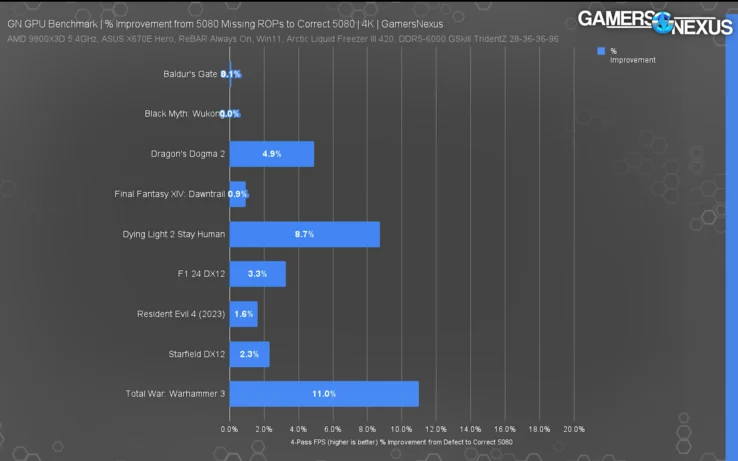
    2. Gamers Nexus tested an RTX 5080 with 104 ROPs against one with 112 ROPs, revealing performance differences of up to 11% in various games at 4K resolution.

    3. In games like Baldur’s Gate 3 and Black Myth: Wukong, there was no performance difference between the two RTX 5080 models, while Dying Light 2 showed an 8.7% advantage for the model with full ROPs.

    4. At 1440p resolution, the performance gap is generally slight, but specific titles like Dying Light 2 still show notable differences, emphasizing game-dependent performance.

    5. The performance drop in ROPs affects the RTX 5080’s competitiveness against other GPUs, prompting users to ensure their cards have all ROPs intact or consider refunds/replacements.


    We previously mentioned that the RTX 5070 Ti appears to experience a performance drop of over 10% due to having eight fewer Render Output Units (ROPs). From this, it was clear that the RTX 5090 and RTX 5080 GPUs would likely face similar performance issues.

    Latest Gaming Tests

    However, we lacked solid gaming tests to support this. That changed when Gamers Nexus tested a defective RTX 5080 that had only 104 ROPs against a normal one with all 112 ROPs across various games. The results could be concerning for certain gamers out there.

    Testing conducted by Gamers Nexus at 4K resolution shows that the RTX 5080 with full ROPs can have anywhere from no performance difference to an 11% gain. The smallest difference is found in games like Baldur’s Gate 3 and Black Myth: Wukong, where both cards perform the same. Nevertheless, the RTX 5080 with 112 ROPs has a 4.9% edge over the one with missing ROPs in Dragon’s Dogma 2. The gap widens to 8.7% in Dying Light 2 and reaches a notable 11% in Total War: Warhammer 3.

    Performance at Different Resolutions

    When looking at 1440p, the gap between a fully operational RTX 5080 and one that’s lacking 8 ROPs is slight in most games tested. Yet, in Dying Light 2, the RTX 5080 with 112 ROPs shows an improvement of 8.8%. In short, the decline in gaming performance varies by title. While some games perform the same on both cards, others reportedly lag on the RTX 5080 with fewer ROPs.

    Conclusion

    Not surprisingly, this drop in performance impacts the RTX 5080’s comparison with other GPUs in the titles where the most performance loss occurs. Gamers Nexus goes deeper into specific games and compares the performance results with the 5070 Ti and the RX 7900 XTX. Be sure to check out the full video, which is linked below.

    In summary, make sure your RTX 5090/5080/5070 Ti has all ROPs intact, and if not, consider asking for a refund or a replacement.

    Source:
    Link


  • GNCA: GamersNexus Consumer Advocacy YouTube Channel Launches

    GNCA: GamersNexus Consumer Advocacy YouTube Channel Launches

    Key Takeaways

    1. Item swap scams are a growing issue in Amazon’s return process, leading to customers receiving incorrect or used items instead of new ones.
    2. Amazon’s quality control measures are lacking, allowing swapped items to go undetected and be resold to unsuspecting customers.
    3. Gamers Nexus has experienced multiple instances of product swaps, highlighting a pattern in Amazon’s return policy that enables these scams.
    4. Customers should always check their orders upon arrival, especially for tech products, to ensure they received the correct items and specifications.
    5. If a wrong item is received, it’s important to document everything (photos, weights) and report the issue promptly to mitigate potential fraud.


    The latest video from Gamers Nexus on their YouTube channel brings attention to a troubling issue with Amazon’s return process: item swap scams. They recount an experience where they ordered a new Asus Loki 1000W power supply and ended up with a used Corsair SF 850 instead. Although the outer box was correct, the power supply inside was not what they expected, indicating a typical buy-and-return scam where a previous buyer exchanged the item for a less expensive one. Even more concerning is that Amazon’s system flagged the package for a weight difference, but it was still shipped. This raises questions about the effectiveness of Amazon’s quality control measures, which seem to be overlooked or ignored, resulting in defective or swapped items being sent to unsuspecting customers.

    Repeat Offenders

    Gamers Nexus has faced similar issues multiple times in the past. They have previously encountered mismatched CPU swaps and downgraded GPUs, and now a wrong power supply. The core of the problem is that these scams often remain undetected because the swapped items are returned in their original packaging, making it hard for Amazon’s warehouse staff or customers to notice the differences. The main problem lies in Amazon’s return policy, which allows these scams to continue thriving. Returned products are often repackaged and resold without proper inspections, which can result in them being sent back to other buyers. Because Amazon often accepts returns with minimal scrutiny, scammers exploit this loophole, passing the issue on to the next unsuspecting customer. While Gamers Nexus has had a smooth return process, newer accounts or infrequent buyers might struggle to prove they received the wrong item.

    Important Takeaways

    From the video, the message is straightforward: always check your orders as soon as they arrive. Even if you don’t intend to use the item immediately, opening the package and ensuring the correct items are inside can help you avoid a lengthy return process later. For tech products, it’s especially important to run software diagnostics to verify specifications. This is crucial for CPUs and GPUs, which are often altered through BIOS changes or label swaps. As Gamers Nexus points out, Amazon’s automated systems have flaws, and human checks are not always reliable. If you find you have received the wrong product, make sure to document everything—take photos, weigh the items, and report the issue right away. While Amazon might process a refund eventually, the increasing rate of these swap scams indicates that their return system is in dire need of improvement to protect honest customers from falling victim to someone else’s fraud.

    Source:
    Link