Tag: NASA

  • NASA’s GUARDIAN Detects Tsunami 40 Minutes Before Impact

    NASA’s GUARDIAN Detects Tsunami 40 Minutes Before Impact

    Key Takeaways

    1. An 8.8 magnitude earthquake struck Russia’s Kamchatka Peninsula, triggering a tsunami detected early by NASA’s GUARDIAN technology.
    2. GUARDIAN utilizes data from over 350 GNSS ground stations to identify disturbances in the ionosphere caused by tsunami pressure on the ocean surface.
    3. The system can detect tsunami signs up to 745 miles (1,200 kilometers) away and analyzes data in about 10 minutes for quick response.
    4. GUARDIAN successfully confirmed tsunami signals 30 to 40 minutes before waves reached Hawaii and other Pacific coasts.
    5. Experts believe GUARDIAN represents a “paradigm shift” in tsunami monitoring and will improve existing early warning systems.


    On July 29, an earthquake measuring 8.8 on the Richter scale rocked Russia’s Kamchatka Peninsula. This seismic event led to the formation of a tsunami, which NASA’s GUARDIAN managed to detect early on. GUARDIAN (GNSS Upper Atmospheric Real-time Disaster Information and Alert Network) is a new technology being created at NASA’s Jet Propulsion Laboratory (JPL).

    How GUARDIAN Works

    GUARDIAN functions by evaluating information from over 350 GNSS (Global Navigation Satellite System) ground stations located across the globe. As a tsunami approaches, the ocean surface exerts pressure on the air above it. This pressure disrupts the air all the way up to the ionosphere, resulting in disturbances.

    When disturbances occur in the ionosphere, the signals transmitted from GNSS stations become altered. This is the alteration that GUARDIAN is able to recognize. Notably, GUARDIAN has the potential to identify signs of a tsunami forming up to approximately 745 miles (1,200 kilometers) away from a given GNSS station.

    Quick Response Time

    GUARDIAN can analyze the incoming data about a potential tsunami in roughly 10 minutes. This rapid response gives experts sufficient time to take action, which may help avoid needless losses of life and damage to property.

    In the case of the recent tsunami, GUARDIAN successfully confirmed its signals 30 to 40 minutes before the waves impacted Hawaii and other coasts along the Pacific. Prior to the tsunami event, an artificial intelligence (AI) system and a prototype messaging system were integrated into GUARDIAN. The AI system was instrumental in detecting tsunami patterns, while the messaging system was responsible for alerting experts.

    The Future of Tsunami Monitoring

    Bill Fry, who is the chair of the United Nations technical group that evaluates the circum-Pacific tsunami monitoring system, has referred to GUARDIAN as part of a “Paradigm shift.” GUARDIAN is set to enhance the existing early warning systems, contributing to better forecasting of tsunami events.

    Source:
    Link


  • NASA’s Mars Announcement: Two Major Errors You Missed

    NASA’s Mars Announcement: Two Major Errors You Missed

    Key Takeaways

    1. Nicola Fox mistakenly stated that the Milky Way galaxy is about 100 billion light-years across, while it is actually around 100,000 light-years wide.
    2. The observable universe is approximately 92 billion light-years in size, making Fox’s claim incorrect.
    3. Lindsay Hays claimed the rocks on Mars are about 350 billion years old, which exceeds the age of the universe itself, estimated at 13.8 billion years.
    4. The oldest confirmed fossils on Earth are about 3.45 billion years old, much younger than Hays’ claim.
    5. Joel Hurowitz, the lead author of the study, estimated the age of the Martian rocks to be between 3.2 and 3.8 billion years.


    Two days ago, NASA shared news that many people are calling the strongest hint yet of possible ancient microbial life on Mars, which is definitely thrilling for those who love astronomy. However, there are mistakes made by Nicola Fox, who is the associate administrator for NASA’s Science Mission Directorate, and Lindsay Hays, a senior scientist for Mars Exploration in NASA’s Planetary Science, that no one seems to be discussing.

    Misleading Measurements

    About 22 minutes and 35 seconds into the livestream, Nicola stated, “our galaxy is about a hundred billion light-years across,” which is a completely incorrect figure. This number exceeds the total size of the observable universe, which is around 92 billion light-years wide. The Milky Way, our galaxy, is thought to be about 100,000 light-years across. Did she confuse our galaxy with the whole universe, or mix up 100,000 with 100 billion? That’s a question that remains unanswered.

    Incorrect Claims

    Next, Lindsay Hays appeared around the 41:15 mark, claiming that the rocks containing the possible organic material were about 350 billion years old, which she noted is roughly the same age as Earth’s earliest fossils.

    This too is a figure that even the universe can’t claim. The universe is estimated to be 13.8 billion years old, which is more than 25 times younger than the age she mentioned. Additionally, the oldest confirmed fossils discovered on Earth are believed to be approximately 3.45 billion years old. Joel Hurowitz, who is the lead author of the study that NASA reported, only estimated the rocks to be between 3.2 and 3.8 billion years old.

  • NASA Seeks Volunteers for Upcoming Manned Moon Mission

    NASA Seeks Volunteers for Upcoming Manned Moon Mission

    Key Takeaways

    1. NASA is seeking assistance from the aerospace sector, including businesses and volunteers, to track the Artemis II Orion spacecraft during its moon mission.
    2. The Artemis II mission is scheduled to launch in April 2026 and will involve four astronauts on a ten-day journey around the moon.
    3. Volunteers will use their own ground antennas to capture Orion’s radio signals and gather tracking measurements, but cannot transmit signals back.
    4. This initiative aims to enhance NASA’s navigation and communication framework by incorporating commercial resources into deep space exploration.
    5. Interested participants must submit their applications by October 27, and participation is voluntary and at no cost to the U.S. government.


    NASA has reached out to the aerospace sector — including businesses, universities, and everyday people — for assistance in tracking the Artemis II Orion spacecraft during its trip to the moon and back. This initiative is part of NASA’s ongoing strategy to incorporate commercial resources into its navigation and communication framework for space missions.

    The Artemis II Mission

    The Artemis II mission, set to launch in April 2026 or possibly earlier, will carry four astronauts from NASA on a ten-day journey around the moon. While NASA’s Deep Space and Near Space Networks will manage crucial communications, the agency is inviting volunteers to explore the effectiveness of non-NASA ground stations in deep space exploration. This effort builds upon the success of the 2022 uncrewed Artemis I mission, where ten volunteer partners effectively tracked the spacecraft.

    Volunteer Participation

    Individuals who volunteer for this mission will utilize their own ground antennas to passively capture Orion’s S-band radio signals and gather “one-way Doppler tracking measurements.” This will be a passive engagement since volunteers can only receive signals from the spacecraft and are not allowed to transmit back to it.

    The information collected from this mission will guide our shift towards a commercial-first strategy, ultimately enhancing the infrastructure necessary to fulfill long-term goals between the Moon and Mars. — Kevin Coggins, Deputy Associate Administrator for SCaN.

    How to Get Involved

    Submissions in response to this request must be made by October 27, and participation is entirely voluntary, without any cost to the U.S. government. For more details on how to apply, visit Sam.gov.

    If you’re interested in radio technology, you can purchase the Nooelec HackRF One Software Defined Radio on Amazon for $349.95.

    Source:
    Link


  • NASA Delays Launch Indefinitely for the Sixth Time

    NASA Delays Launch Indefinitely for the Sixth Time

    Key Takeaways

    1. The TOMEX+ mission has faced six launch delays since its initial planned date of August 18.
    2. NASA is working on setting a new launch date within the mission’s launch window, which ends on September 3.
    3. The mission involves three rockets: two for deploying vapor tracers to analyze wind patterns and one with a lidar instrument.
    4. The lidar-equipped rocket will launch approximately 5 minutes after the first two rockets.
    5. Sounding rocket missions are short, lasting 2 to 20 minutes, and are essential for studying the mesopause, an area of the atmosphere inaccessible to satellites and weather balloons.


    The TOMEX+ mission was first planned to launch on August 18, but it has faced multiple delays, totaling 6 reschedulings for various reasons. Below is a detailed look at each of these postponements.

    New Launch Date Coming Soon

    NASA is currently working on setting a new launch date this week. The mission’s launch window began on August 18 and will end on September 3. The TOMEX+ mission involves three rockets; two of them will deploy vapor tracers, which are similar to colorful smoke, allowing scientists to analyze wind patterns. The third rocket, set to launch approximately 5 minutes after the first two, will be equipped with a lidar instrument designed to monitor atmospheric density and movement over time.

    Importance of Sounding Rockets

    Sounding rocket missions are brief, typically lasting anywhere from 2 to 20 minutes. They play a crucial role in exploring the mesopause, a section of Earth’s atmosphere that satellites and weather balloons cannot reach.

    Source:
    Link


  • NASA InSAR Technology Detects Tiny Changes to Predict Disasters

    NASA InSAR Technology Detects Tiny Changes to Predict Disasters

    Key Takeaways

    1. HALE InSAR is a lightweight radar tool designed for detecting Earth’s surface changes with millimeter accuracy.
    2. Weighing under 15 pounds, it can be mounted on various HALE vehicles that can operate for extended periods at high altitudes.
    3. The device has low power requirements, needing less than 300 W, making it energy-efficient.
    4. It can self-locate without GPS, enabling functionality in areas with unreliable GPS signals.
    5. HALE InSAR has been tested successfully on an airship and stratospheric balloons, with plans for future tests on HALE aircraft and potential use in Earth’s orbit.


    HALE InSAR is a radar tool created by Aloft Sensing with the support of NASA’s Earth Science Technology Office (ESTO). This device is a small Interferometric Synthetic Aperture Radar (InSAR) mounted on a HALE (High-altitude Long-endurance) platform. It uses radio waves to detect changes in the Earth’s surface with remarkably precise millimeter accuracy.

    Advantages of HALE InSAR

    Although there are already InSAR devices available, HALE InSAR stands out due to its lightweight and compact design, weighing under 15 pounds (7 kilograms). Its small size allows it to be used on various types of HALE vehicles, which are lightweight and can operate for years without stopping, flying at altitudes as high as 13 miles (21 kilometers) above sea level.

    Performance and Features

    Not only is HALE InSAR lightweight, but it also has low power requirements, needing less than 300 W. A unique aspect of this system is its capability to locate itself without GPS, making it functional in areas where GPS signals may not be reliable. Additionally, it can adjust its focus without needing to move, thanks to its flat phased array antenna.

    The HALE InSAR device has been successfully tested on an airship at 65,000 feet (19,800 meters) and small stratospheric balloons. Its next test will involve a HALE aircraft, and there are plans for it to potentially reach Earth’s orbit in the future.

    Source:
    Link


  • NASA Unveils 1,000x Stronger, Heat-Resistant 3D-Printable Alloy

    NASA Unveils 1,000x Stronger, Heat-Resistant 3D-Printable Alloy

    Key Takeaways

    1. NASA developed a new 3D-printable alloy called GRX-810 that can withstand high temperatures in jet and rocket engines.
    2. Advanced computational modeling allowed NASA scientists to identify the ideal alloy blend quickly, reducing research time significantly.
    3. The new alloy demonstrated exceptional performance, showing double the strength, three and a half times the flexibility, and over 1,000 times the durability compared to existing materials.
    4. The manufacturing method used, “resonant acoustic mixing,” evenly distributes nano-oxide particles to enhance the alloy’s strength.
    5. Elementum 3D is commercializing the technology and working on GRX-810-based sensors for jet engines in collaboration with Vectoflow.


    The recent innovation from NASA’s Glenn Research Center presents a solution to a persistent issue in the aerospace field — the absence of a cost-effective 3D-printable material capable of enduring the intense heat found in jet and rocket engines. The newly created substance, an oxide dispersion strengthened alloy known as GRX-810, showcases unmatched performance and durability.

    Advanced Modeling Techniques

    To achieve this breakthrough, NASA scientists utilized computational modeling, successfully identifying the best alloy blend after just 30 simulations. Typically, this kind of research would require years of experimentation. The team, led by materials engineer Tim Smith, then applied a unique manufacturing method called “resonant acoustic mixing.” This technique involves evenly distributing nano-oxide particles, which serve as a strengthening agent, throughout a mixture of powdered metals such as nickel, cobalt, and chromium.

    Exceptional Performance Results

    NASA reports that the new alloy performed remarkably well during testing. At temperatures reaching 2,000 °F (1,093 °C), it exhibited double the strength, three and a half times the flexibility, and over 1,000 times the durability compared to the best existing alloys.

    This innovation marks a significant milestone in material science. The creation of new, stronger, and lighter materials is crucial as NASA looks to revolutionize the future of aviation. Traditionally, enhancing tensile strength would reduce a material’s capacity to stretch and bend before breaking, making this new alloy particularly impressive. — Dale Hopkins, a deputy project manager at NASA.

    Commercialization Efforts

    The technology is being commercialized by Elementum 3D, a company based in Colorado, that has secured a co-exclusive license for the alloy, which is patented by NASA. Elementum 3D is already collaborating with Vectoflow to develop GRX-810-based sensors designed for jet engines.

    Source:
    Link


  • NASA Invites Public Submissions After Astronaut’s Spectacular Capture

    NASA Invites Public Submissions After Astronaut’s Spectacular Capture

    Key Takeaways

    1. Nicole Ayers spotted a rare atmospheric phenomenon called a gigantic jet while on the ISS over a thunderstorm.
    2. Gigantic jets are different from sprites; they occur at about 20 km above the storm, unlike sprites which form around 50 miles (80 km) above.
    3. Both gigantic jets and sprites are types of transient luminous events (TLEs) caused by strong electrical activity in thunderstorms.
    4. Other TLEs include blue jets, halos, and ELVEs, which can also offer insights into thunderstorm behavior.
    5. NASA encourages the public to share photos of TLEs to help scientists study these phenomena.


    On July 3, Nicole Ayers, while she was on the ISS, caught an incredible sight as the space station flew over a thunderstorm in Mexico and the Southern United States. At first, she thought what she saw was a sprite. She shared her excitement in an X post, saying, “Just. Wow. As we went over Mexico and the U.S. this morning, I caught this sprite.”

    Understanding Sprites and Gigantic Jets

    Sprites, know also as red sprites, are transient luminous events (TLEs) that take place high above thunderstorm clouds or cumulonimbus. They are caused by strong electrical activity within the storms. Although sprites are not seen every day, further examination of Ayers’ image showed that what she saw wasn’t a sprite, but a rarer TLE called a gigantic jet.

    A gigantic jet occurs above thunderstorms, sending out strong electrical discharges from the top of the storm, around 20 km above ground, to the upper atmosphere, which is about 100 km above the Earth. The upper part of gigantic jets gives off red light, similar to sprites. However, gigantic jets burst out directly from the thunderstorm tops, while sprites form much higher, at about 50 miles (80 km) above the Earth’s surface.

    Other Types of TLEs

    In addition to gigantic jets and sprites, there are other types of TLEs, including blue jets, halos, and ELVEs, which stands for Emissions of Light and Very Low Frequency perturbations due to Electromagnetic Pulse Sources. Halos and ELVEs can occur alongside or even before sprites. Captured images of TLEs provide scientists with valuable insights into their formation, features, and connections to thunderstorms. Therefore, NASA is inviting the public to share their photos. If you’ve ever taken a picture of a similar phenomenon, visit Spritacular to submit your photo(s).

    Source:
    Link


  • NASA’s Moon Nuclear Reactor Plans Set for 2030 Launch

    Key Takeaways

    1. NASA is planning to deploy a nuclear reactor on the moon to provide electricity for future lunar activities, as part of the Fission Surface Power Project initiated in 2018.
    2. A project leader will be selected within 30 days, and a request for proposals from companies will be issued in 60 days, with a goal to have the reactor operational by 2030.
    3. The project faces significant challenges due to the unique lunar environment, including altered gravity, extreme temperatures, and the need for specialized technology.
    4. The reactor’s capacity has been increased to 100 kilowatts, up from an initial estimate of 40 kilowatts, emphasizing the project’s ambitious scope.
    5. This initiative is a strategic response to the International Lunar Research Station project by China and Russia, which poses potential risks for resource access for other countries.


    The nuclear and space competition is entering a new stage: producing nuclear energy on the moon. Recently, Sean Duffy, the acting head of NASA, unveiled a scheme focused on placing a nuclear reactor on the lunar surface. This initiative aims to provide electricity for upcoming lunar installations and activities.

    Fission Surface Power Project

    These efforts are part of the Fission Surface Power Project that has been around since 2018. Duffy has now intensified the focus on this energy source, aiming for a much stronger nuclear reactor and establishing a strict timeline: deployment is anticipated within five years.

    To make this happen, NASA has set a detailed schedule: within 30 days, a project leader is expected to be chosen, and a request for proposals from companies will be issued in 60 days. After that, the proposals will be assessed to find a strategic partner. Duffy mentioned that they hope to have the reactor deployed by 2030.

    Challenges Ahead

    Typically, this timeline would be considered tight, especially on Earth. For example, the latest nuclear reactors in the US, Vogtle 3 and 4, took over a decade to complete. Various obstacles like costs, financial issues, regulations, and even the pandemic have impacted construction timelines.

    This project encounters numerous hurdles. The unique lunar environment, characterized by altered gravity, lack of atmosphere, extreme temperature fluctuations, and other variables, demands the creation of specialized technology to ensure safety and reliability.

    Moreover, a nuclear reactor on the moon would need extensive logistical efforts for its transportation, assembly, and ongoing maintenance. The projected capacity for this reactor is set at 100 kilowatts, increasing from the initial estimate of 40 kilowatts.

    Strategic Importance

    This information came from an internal memo where Duffy stated that “to effectively advance this vital technology to support a future lunar economy, high power energy generation on Mars, and to enhance our national security in space, the agency must act swiftly.”

    This initiative is a response to the International Lunar Research Station (ILRS) project, a collaborative effort between China and Russia. This project aims for multidisciplinary research, and Duffy noted in the memo that it presents a potential risk, as Russia and China establish a Keep-out zone, which could limit access to resources for other countries.

    Source:
    Link


  • Hubble’s Sharpest Image of Fastest Interstellar Comet Ever

    Hubble’s Sharpest Image of Fastest Interstellar Comet Ever

    Key Takeaways

    1. 3I/ATLAS was first spotted on July 1, 2025, using the NASA-funded ATLAS system and the Gemini North Telescope, located 420 million miles from the Sun.

    2. Hubble Space Telescope observations suggest the comet’s nucleus could range from 1,000 feet to 3.5 miles in diameter, with visible dust plumes indicating activity.

    3. The dust loss rate observed aligns with typical patterns for comets discovered around 300 million miles from the Sun, as they heat up and release gas and dust.

    4. 3I/ATLAS travels at an extraordinary speed of 130,000 miles per hour, indicating it has been in space for billions of years, influenced by gravitational forces from nearby stars and nebulae.

    5. NASA plans further missions to study 3I/ATLAS, including its chemical composition, while some theorize it could be an alien probe, as suggested by Harvard University professor Avi Loeb.


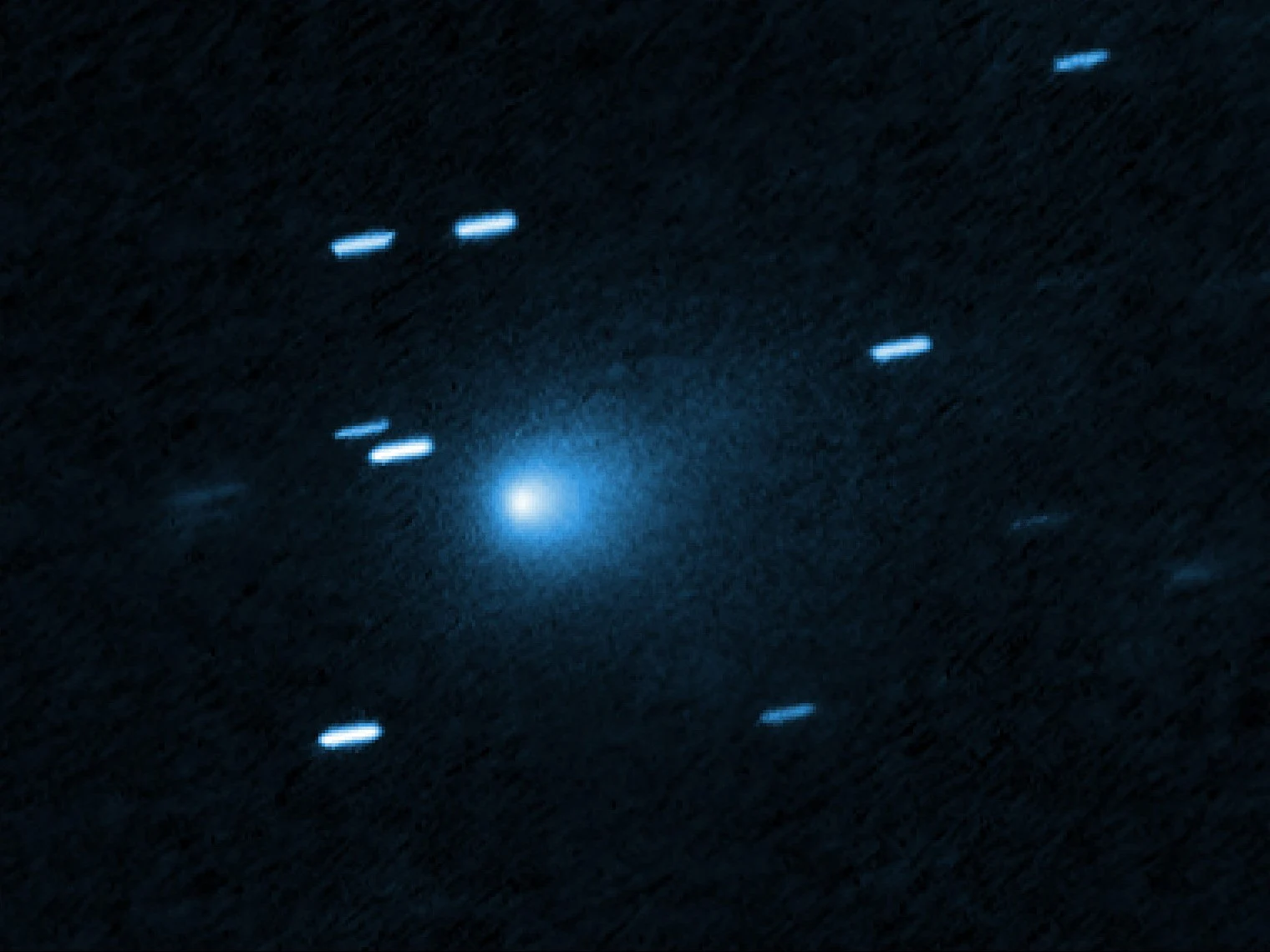
    3I/ATLAS was initially spotted on July 1, 2025, thanks to the NASA-funded Asteroid Terrestrial-impact Last Alert System (ATLAS), which was created by the University of Hawai’i. The comet was first seen 420 million miles away from the Sun with the help of the Gemini North Telescope. However, a follow-up observation by the NASA/ESA Hubble Space Telescope on July 21 has enabled scientists to better estimate the size of the comet’s nucleus.

    Size Estimations

    Data from Hubble indicates the nucleus could be as large as 3.5 miles (5.63 km) in diameter, though it might also be as tiny as 1,000 feet (304.8 m) wide. The images captured by Hubble show a dust plume coming from the side of the comet facing the Sun. Additionally, the pictures suggest that a dust tail is trailing away from the comet’s nucleus.

    Dust Loss Rate Insights

    The rate of dust loss revealed by Hubble’s observations isn’t unusual for 3I/ATLAS. It aligns with what is typically seen in comets first discovered around 300 million miles from the Sun. These comets, made of ice and dust, begin to heat up as they approach the Sun. The frozen materials transform into gas, leading to the dust being ejected away from the comet.

    Record-Breaking Speed

    Unlike other comets that have been observed, 3I/ATLAS is zooming through space at a staggering speed of 130,000 miles per hour (209,215 km/h). This rapid pace hints that the comet has been navigating through interstellar space for billions of years. It is thought that gravitational forces from stars and nebulae have gradually increased its speed over time.

    Despite the current information, one thing remains unseen—the nucleus itself. NASA has planned additional missions to gather more information about the comet, including what it’s made of chemically. In the meantime, Harvard University professor Avi Loeb has proposed a theory that it could be an alien probe.

    Source:
    Link


  • New White House Plan May Cut NASA Satellites for CO2 and Crops

    New White House Plan May Cut NASA Satellites for CO2 and Crops

    Key Takeaways

    1. OCO-2 and OCO-3 missions are at risk of ending due to federal budget decisions, not technical issues.
    2. Both satellites monitor carbon dioxide levels and provide important data on global photosynthesis and plant growth.
    3. Keeping the satellites operational costs about $15 million annually, with over $750 million already spent on their design and launch.
    4. NASA is considering shutting down the missions despite their ongoing value for climate information, as indicated by a 2023 review.
    5. The Trump administration’s proposed budget for FY2026 includes significant cuts, raising concerns about the future of these critical missions.


    Two NASA satellite missions, known as OCO-2 and OCO-3, could be ending soon. This isn’t because they are broken, but due to decisions made about the federal budget. Both of these missions are part of the Orbiting Carbon Observatory program, and they were designed to monitor carbon dioxide levels in the atmosphere of Earth. In addition, they have given us surprising information about plant growth by collecting global photosynthesis data. A wide range of users, from researchers to the Department of Agriculture, rely on these satellites to keep track of greenhouse gases and the health of crops.

    Budget Concerns

    According to NPR, keeping both satellites operational costs around $15 million each year. However, over $750 million in public funds have already been spent on their design and launch. Also, a failed launch in 2009 added to the overall expenses of the program.

    Even though they are valuable for science, recent moves by the Trump administration are raising alarms. Reports from inside NASA indicate that there are discussions about “Phase F” plans, which detail how to shut down these missions. If one of the satellites, which is a stand-alone unit in orbit, is turned off, it would burn up upon reentry. Scientists argue that these missions continue to provide essential climate information and should not be ended too soon.

    Future of the Missions

    NASA has already reached out to private companies and universities to take charge of the OCO-3 unit that is currently on the International Space Station. However, experts say that while the private sector is increasingly involved in Earth observation efforts, many of these projects still depend on significant public funding.

    Funding for the missions has been provided by Congress through September 2025, but the future looks quite grim. A review conducted by NASA in 2023 suggested that the missions should continue for at least another three years. Nonetheless, the proposed FY2026 budget from the Trump administration includes substantial cuts, leading to accusations of overreach from officials like Russ Vought at the OMB.

    Awaiting Clarification

    There has been no formal explanation from the administration so far, so we will need to wait to learn why missions that are still offering valuable climate data might be shut down.

    Source:
    Link