Tag: Mars exploration

  • How the Sun Removed Mars’ Atmosphere Over Time

    How the Sun Removed Mars’ Atmosphere Over Time

    Key Takeaways

    1. Mars was once warm and wet, with a thick atmosphere similar to Earth’s.
    2. The planet’s atmosphere thinned over billions of years due to solar wind and a weak magnetic field.
    3. The ESCAPADE mission, consisting of two spacecraft, aims to study Mars’ magnetosphere and atmosphere.
    4. ESCAPADE launched early and will use Earth’s gravity to reach Mars, arriving in September 2027.
    5. The mission will improve understanding of space weather around Mars, aiding in astronaut safety and equipment protection.


    Previously, Mars was a warm and wet place, possessing a thick atmosphere that resembled Earth’s. However, over billions of years, this atmosphere gradually faded away, transforming it into a cold, dry planet with a thin atmosphere. This change happened because of solar wind, which is a flow of charged particles emitted by the Sun. The solar wind interacted with Mars’ upper atmosphere, taking advantage of the planet’s weak magnetic field. As a result, Mars cooled down, lost its surface water, and most of its atmosphere vanished.

    Investigating Mars’ Atmosphere

    To explore these changes, the Escape and Plasma Acceleration and Dynamics Explorer (ESCAPADE) was launched. This NASA mission consists of two separate spacecraft. It is led by the Space Sciences Laboratory at UC Berkeley and is funded by NASA’s Heliophysics Division. The mission aims to measure the magnetosphere surrounding Mars, assess the strength of the solar wind, observe how particles escape from Mars’ atmosphere, and analyze the ionosphere. Before heading to Mars, ESCAPADE will delve into Earth’s magnetotail, examining the solar wind in that region.

    Launching Into Space

    Normally, spacecraft launch when Earth and Mars are aligned, but ESCAPADE took off early, looping around Lagrange Point 2. It will use Earth’s gravity to perform a slingshot maneuver towards Mars, expected to arrive in September 2027 after leaving in November 2026. This mission is set to enhance our understanding of space weather around Mars and will provide insights for better shield designs, safety protocols, and protecting astronauts and equipment.

    NASA’

    Source:
    Link


  • NASA’s Mars Reconnaissance Orbiter Takes Its 100,000th Image

    NASA’s Mars Reconnaissance Orbiter Takes Its 100,000th Image

    Key Takeaways

    1. NASA’s Mars Reconnaissance Orbiter (MRO) has been orbiting Mars for over 20 years and recently captured its 100,000th image.
    2. The primary goal of the MRO is to create a detailed map of Mars using its HiRISE camera, aiding future human mission planning.
    3. The 100,000th image features the Syrtis Major region and highlights the unique and colorful Martian landscape.
    4. The images captured by MRO provide insights into the dynamics of the Martian surface, including dune movement and avalanches.
    5. Researchers analyze these images for crucial information that will support upcoming space missions to Mars.


    Mars has captivated human interest for many years, leading to many missions aimed to explore it. Currently, multiple probes are in orbit around the planet, while rovers traverse its landscape. Recently, NASA’s Mars Reconnaissance Orbiter (MRO) marked a significant milestone by capturing its 100,000th image of the intriguing red planet, showcasing stunning vistas.

    A Long Journey in Space

    This probe has been circling Mars for over two decades. Its primary objective is to create a detailed map of the Martian surface, aided by its incredible tool, the HiRISE camera. However, the purpose of these images extends beyond merely inspiring astronauts; they are essential in distinguishing various surface types and identifying potential landing zones as plans for human missions to Mars shape up.

    Capturing Unique Landscapes

    After more than 20 years in operation, the probe achieved the remarkable feat of obtaining its 100,000th photo, which is quite impressive. Taken on October 7, this image features the Syrtis Major region, situated around 80 kilometers from the Jezero crater. Additionally, the photo displays many dunes that showcase a range of colors. This scenery vastly differs from our Earthly landscapes and appears to exhibit constant movement.

    Insights from the Experts

    Leslie Tamppari, a scientist involved in the MRO project at NASA’s Jet Propulsion Laboratory in Southern California, shares insights on the significance of these findings:

    “The HiRISE camera hasn’t just unveiled how distinct the Martian terrain is compared to Earth; it has also revealed the dynamics of that surface over time. We’ve observed dune fields migrating with the wind and avalanches rushing down steep cliffs.”

    As a result, researchers meticulously examine these images, as they may hold vital information for upcoming space missions.

    NASA Science

    Source:
    Link


  • NASA Rover Finds New Signs of Life on Mars

    NASA Rover Finds New Signs of Life on Mars

    Key Takeaways

    1. NASA’s Perseverance rover discovered “leopard spots” in Mars’ Bright Angel area, consisting of vivianite and greigite, minerals linked to possible past life.
    2. The formation of these minerals suggests a potential biological process rather than purely geological activity.
    3. Lead scientist Joel Hurowitz likened the discovery to a treasure hunt, indicating valuable findings but with unknown implications.
    4. Caution is advised, as the “leopard spots” do not provide definitive evidence of life; similar patterns can occur through non-biological processes.
    5. Analyzing the rock samples on Earth could yield strong evidence of life on Mars, but current budget cuts and political issues are delaying this possibility.


    According to a report from Space.com, lead scientist Joel Hurowitz from Stony Brook University shared some exciting news about NASA’s Perseverance rover. It has found strange “leopard spots” in the Bright Angel area of Mars. These areas are made up of the minerals vivianite (iron phosphate) and greigite (iron sulfide), which are both seen as possible signs of past life on Earth. These minerals form through redox reactions, a method some microbes on our planet use to create energy.

    A Treasure Hunt in Space

    Hurowitz described the finding like a treasure hunt: “The metal detector has gone off – we’ve found something valuable, but we don’t yet know exactly what.” The rock layers looked at show no signs of high heat or pressure, which makes it less likely that the “leopard spots” formed purely from geological processes. This raises the exciting possibility that biological processes could have played a role in their formation. In another interview with Space.com, Mike Tice from Texas A&M University pointed out that forming greigite naturally on Mars would be quite hard without some type of microbial activity.

    Caution on Claims of Life

    While the “leopard spots” are intriguing, they do not provide clear evidence of life beyond Earth. Similar chemical patterns can happen from non-biological means, and these can only be completely ruled out by thorough lab tests back on Earth. However, this would mean bringing the rock samples collected by Perseverance back to our planet – a task currently stalled due to budget cuts at NASA and political issues.

    If the samples can eventually be closely examined, they might give us the first strong proof of life outside Earth. “It would be the strongest evidence we’ve ever had on Mars,” Hurowitz said.

    Source:
    Link


  • NASA’s Mars Announcement: Two Major Errors You Missed

    NASA’s Mars Announcement: Two Major Errors You Missed

    Key Takeaways

    1. Nicola Fox mistakenly stated that the Milky Way galaxy is about 100 billion light-years across, while it is actually around 100,000 light-years wide.
    2. The observable universe is approximately 92 billion light-years in size, making Fox’s claim incorrect.
    3. Lindsay Hays claimed the rocks on Mars are about 350 billion years old, which exceeds the age of the universe itself, estimated at 13.8 billion years.
    4. The oldest confirmed fossils on Earth are about 3.45 billion years old, much younger than Hays’ claim.
    5. Joel Hurowitz, the lead author of the study, estimated the age of the Martian rocks to be between 3.2 and 3.8 billion years.


    Two days ago, NASA shared news that many people are calling the strongest hint yet of possible ancient microbial life on Mars, which is definitely thrilling for those who love astronomy. However, there are mistakes made by Nicola Fox, who is the associate administrator for NASA’s Science Mission Directorate, and Lindsay Hays, a senior scientist for Mars Exploration in NASA’s Planetary Science, that no one seems to be discussing.

    Misleading Measurements

    About 22 minutes and 35 seconds into the livestream, Nicola stated, “our galaxy is about a hundred billion light-years across,” which is a completely incorrect figure. This number exceeds the total size of the observable universe, which is around 92 billion light-years wide. The Milky Way, our galaxy, is thought to be about 100,000 light-years across. Did she confuse our galaxy with the whole universe, or mix up 100,000 with 100 billion? That’s a question that remains unanswered.

    Incorrect Claims

    Next, Lindsay Hays appeared around the 41:15 mark, claiming that the rocks containing the possible organic material were about 350 billion years old, which she noted is roughly the same age as Earth’s earliest fossils.

    This too is a figure that even the universe can’t claim. The universe is estimated to be 13.8 billion years old, which is more than 25 times younger than the age she mentioned. Additionally, the oldest confirmed fossils discovered on Earth are believed to be approximately 3.45 billion years old. Joel Hurowitz, who is the lead author of the study that NASA reported, only estimated the rocks to be between 3.2 and 3.8 billion years old.

  • NASA’s Stunning Image Reveals Mars’ Float Rocks and Sand Ripples

    NASA’s Stunning Image Reveals Mars’ Float Rocks and Sand Ripples

    Key Takeaways

    1. NASA’s Perseverance rover captured 96 images of the ancient site named “Falbreen” on Mars, creating a detailed panorama.
    2. A notable “float rock” was discovered, believed to have originated from a different location and moved by natural processes.
    3. The panorama features a distinctive band separating lighter-toned rocks rich in olivine from darker, older rocks containing clay.
    4. Perseverance has been drilling into the Martian surface at Falbreen, creating a bright white abrasion patch in the images.
    5. The rover is advancing our understanding of Mars and paving the way for future human exploration.


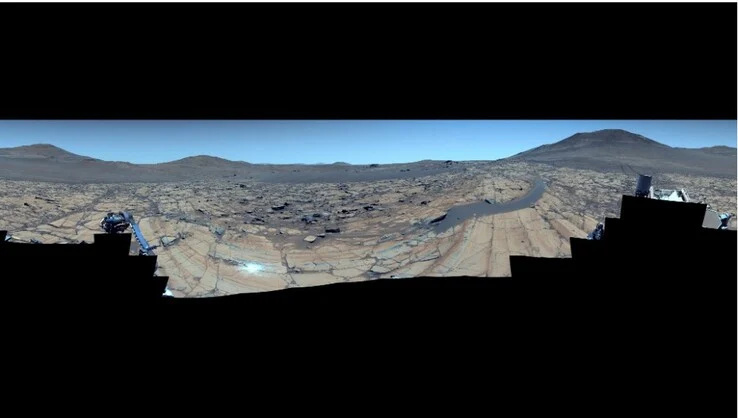
    On May 26, 2025, the imaging team aboard NASA’s Perseverance rover took advantage of the rover’s Mastcam-Z instrument to gather 96 images from a site thought to be among the oldest ever explored by the robotic vehicle. This location has been named “Falbreen” by the science team. The images were combined to create a stunning panorama that presents Mars as clear as daylight.

    Float Rock Discovery

    A prominent feature in the images is a sizeable rock that geologists refer to as a “float rock.” This term is used because scientists think the rock originated from a different location and was moved there by various natural processes, including landslides, water, or wind. The float rock is seen resting on a dark, crescent-shaped sand ripple that is approximately 14 feet (4.27 meters) away from the rover, positioned just to the right of the center of the mosaic.

    Distinctive Rock Bands

    Another interesting aspect of the panorama is a band that crosses the image from one side to the other, located just past the center. This band separates the lighter-toned rocks, which are closer to the rover, from the darker-toned rocks that are further away. The lighter rocks contain a high concentration of olivine, while the darker rocks are thought to be significantly older and rich in clay.

    Drilling and Analysis

    Perseverance has been examining the rocks and soil at Falbreen by drilling into the Martian surface. This drilling has created an abrasion patch that appears as a bright white circle just to the left of the center and near the bottom of the image. NASA’s Perseverance rover, which touched down on Mars on February 18, 2021, is continually enhancing our understanding of the planet, clearing a path for future human exploration.

    Source:
    Link