Tag: Mac Studio

  • Apple Confirms Mac Price Hike Due to Sky-High Memory Costs and Mac Shortages

    Apple Confirms Mac Price Hike Due to Sky-High Memory Costs and Mac Shortages

    Key Takeaway

    1. Supply-demand imbalance and a surge in AI-related demand are causing significant shortages and unavailability of Mac mini and Mac Studio.
    2. Global memory shortages, driven by AI server needs, are increasing memory costs and impacting product availability and pricing.
    3. Apple anticipates higher memory costs starting in the June quarter, which could lead to increased prices for high-performance Macs and other hardware.
    4. The broader hardware industry, including brands like Dell and Lenovo, is also experiencing price hikes due to the memory shortage.

    Supply Issues Hit Apple’s Product Line

    In recent news from Apple’s Q2 2026 earnings call, it’s clear that getting hold of their desktop lineup like the Mac mini and Mac Studio has been tough. CEO Tim Cook said that the supply and demand are still “several months” apart being balanced out. The unexpected jump in demand, especially from folks wanting Macs for artificial intelligence work, is causing quite a stir.

    Market Response and Availability

    The reaction from the market has been so strong that the basic Mac mini is now marked as “unavailable” on Apple’s official site. Additionally, Apple has stopped selling the 512GB RAM versions of the Mac Studio completely. The scarcity is a big change from previous availability, leaving many potential buyers in a lurch. The situation is driving home just how high the demand for high-end Macs really is.

    Global Memory Crisis Impact

    But the problem isn’t just about how popular Macs are—it’s tied to a larger global memory crisis. Because AI server demand dominates the chip production, the costs for memory components are soaring. This has caused a ripple effect across tech manufacturing. When companies like Apple see these cost pressures, they warn that higher expenses for memory are inevitable, starting from the June business quarter.

    Implications for Consumers and Industry

    To handle this, Apple is exploring various options to reduce the impact of rising costs. Still, the message is loud and clear: anyone in need of powerful Apple Silicon for AI projects will face longer wait times and possibly higher prices. The wider tech industry also feels the pinch. Well-known brands like Dell and Lenovo are already preparing for increased prices, as leading memory chip makers such as Samsung and SK Hynix prioritize AI server chips over regular consumer RAM. Smaller companies like Framework are also adjusting, hinting that budget-friendly laptops might become a thing of the past in the Windows segment too.

    Sources
  • Apple MacBook Pro with Tandem OLED Touchscreen Delayed by DRAM Crisis

    Apple MacBook Pro with Tandem OLED Touchscreen Delayed by DRAM Crisis

    Key Takeaway

    1. The new MacBook Pro is expected to feature a redesigned, thinner chassis, punch-hole display, and touchscreen OLED panel, marking the most significant update since 2021.
    2. Launch has been delayed to early 2027 due to supply chain issues caused by the DRAM crisis, despite software being on schedule for fall.
    3. The Mac Studio’s release has also been pushed to October, with improvements in performance through new chips but no design changes.
    4. The new MacBook Pro will include a new hinge and macOS adaptations but will not feature iPad-like functionalities such as Apple Pencil support.

    Future Changes for Apple MacBook Pro

    The MacBook Pro, with its new pricing at around $1,759, along with the upgraded Apple M6 Pro and M6 Max, is all set for a one of the most anticipated design overhauls since the M1 series launched in the fall of 2021. This upgrade features a slimmer body, a modern punch-hole instead of the classic notch, and a touchscreen that incorporates a tandem OLED panel, making it rumored to be the most substantial update in ages.

    Delay Due To External Factors

    According to recent info, mostly from Bloomberg, Apple’s release schedule might be pushed back cos of issues with DRAM shortage. While most rumors indicate a launch around the tail-end of 2026, now it looks like the next-gen MacBook Pro might only hit the shelves by early 2027, which is later than earlier thought. This has some implications on their overall release plans.

    Software and Design Expectations

    Sources say that Apple’s software development is still on track for a fall release, despite the delays with hardware production. The new MacBook Pro is expected to feature a reworked hinge design plus some macOS updates to work better with a touchscreen. Still, it seems unlikely that Apple plans to turn it into a full iPad hybrid—features like the Pencil will probably stay exclusive to tablets, not laptops.

    Impact on Other Apple Devices

    This delay appears to extend beyond just the MacBook Pro. Bloomberg’s insiders suggest that the upcoming Mac Studio’s deliveries won’t kick off until October. No major redesign is anticipated for the Mac Studio, but it will be more powerful because of new chip options, likely with either an Apple M5 Max or an M5 Ultra, making it a serious upgrade in performance.


    Sources

  • Mac Pro Discontinued as Mac Studio Becomes Apple’s Top Desktop

    Mac Pro Discontinued as Mac Studio Becomes Apple’s Top Desktop

    Key Takeaways

    1. Apple has put the Mac Pro on hold indefinitely, focusing instead on the Mac Studio line.
    2. The Mac Studio has been upgraded to the M3 Ultra chip, offering top performance previously found in Mac Pro.
    3. The Mac Studio supports up to 16 TB of storage and 512 GB of memory, catering to power users.
    4. The decision to abandon the Mac Pro may relate to the limited value of its expansion capabilities and high price.
    5. The last Mac Pro model lacked support for external GPUs, further diminishing its appeal.


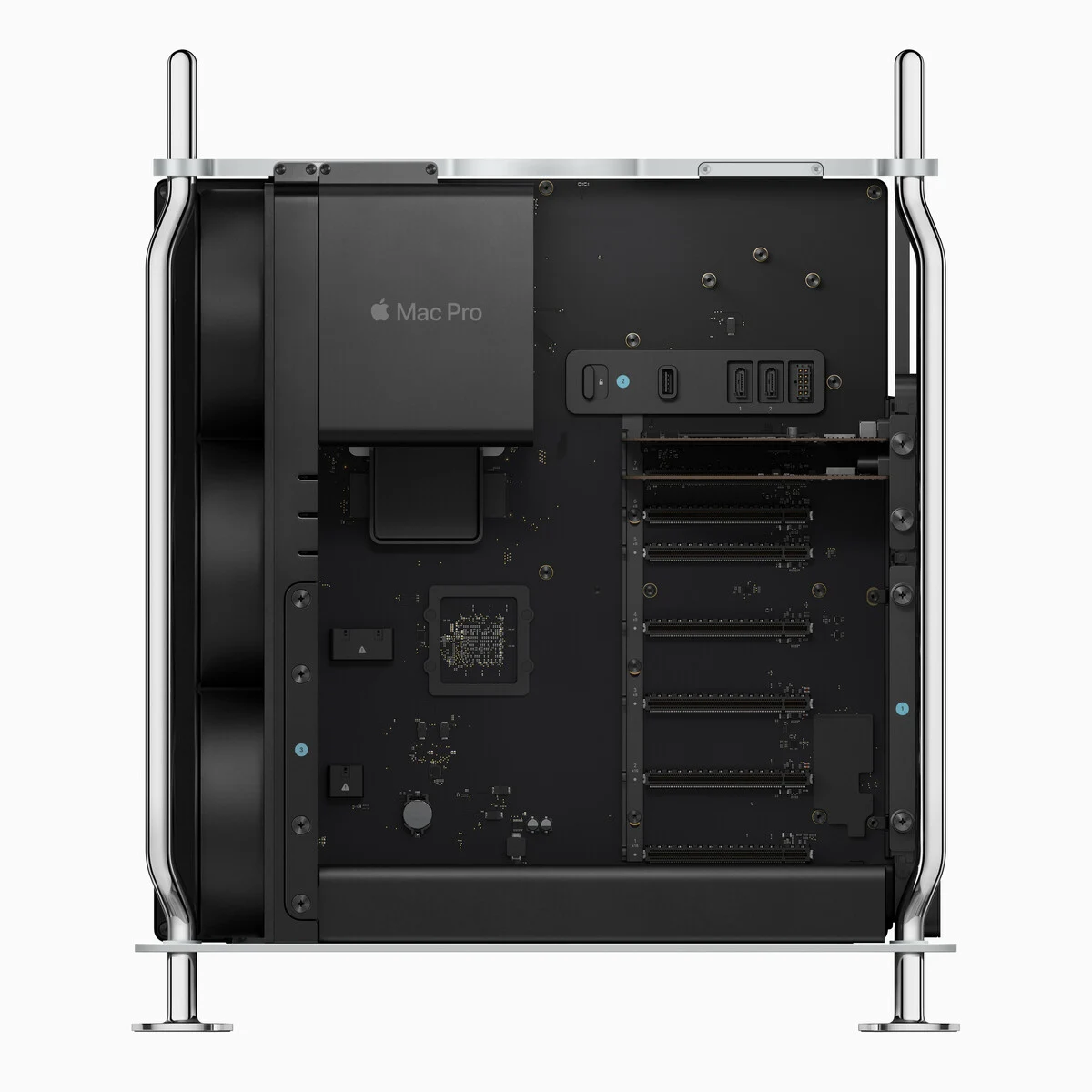
    It’s been almost three years since Apple unveiled the Mac Pro featuring an M2 Ultra System on Chip (SoC). There were some forecasts that hinted at an upgrade in the future, while others suggested that Apple has pretty much set aside its high-end desktop model. Recently, 9to5Mac reported that Apple has decided to put the Mac Pro on hold indefinitely.

    Shift to Mac Studio

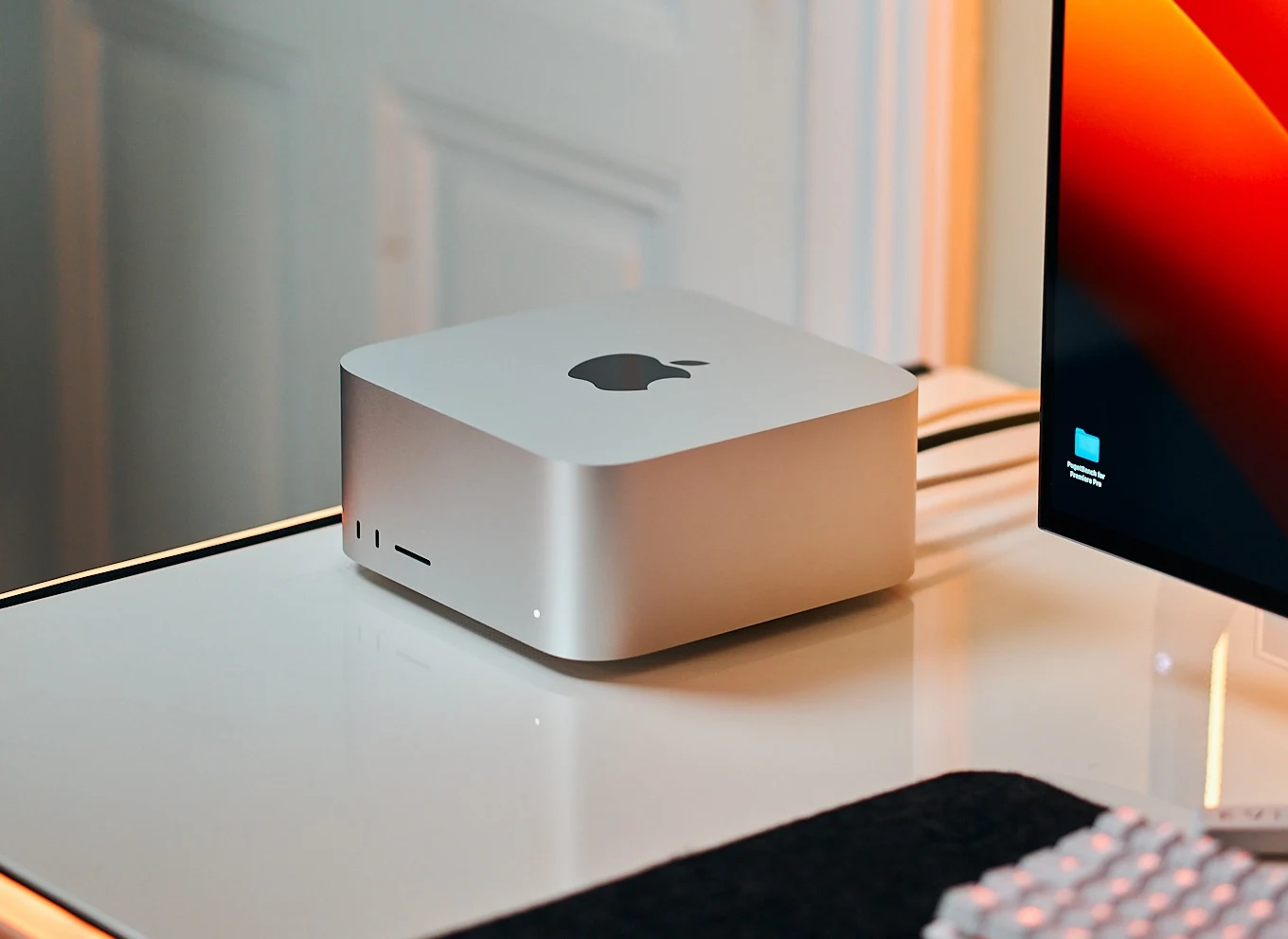
    This decision isn’t all that surprising, considering Apple has focused its efforts on the Mac Studio line, which recently received an upgrade to the M3 Ultra chip—a variant not available in any other Apple devices. Therefore, anyone who wants top-notch performance from Apple will now need to settle for a Mac Studio.

    Impressive Specs

    The Mac Studio, equipped with the M3 Ultra, already meets the needs of power users with support for up to 16 TB of storage and 512 GB of memory. It would make sense to think that future models will allow for even more, especially with an Ultra chip in play.

    As for the reason behind Apple’s choice to completely abandon the Mac Pro, it remains unclear. However, the move to their own silicon could provide some insight. Even though the last Mac Pro came with fully-operational PCIe slots, it lacked support for external GPUs. The limited expansion cards it did accommodate did not really justify its exorbitant price. And let’s not even start on those pricey wheels that came with it.

    9to5Mac

    Source:
    Link


  • Apple Raises RAM Upgrade Prices for M3 Ultra Mac Studio

    Apple Raises RAM Upgrade Prices for M3 Ultra Mac Studio

    Key Takeaways

    1. The M3 Ultra Mac Studio surprised many but falls behind the M4 Max in single-core performance despite its high price.
    2. The M3 Ultra features 512 GB of unified system memory, allowing users to run large language models locally without costly enterprise GPUs.
    3. Due to DRAM shortages, the Mac Studio’s maximum RAM configuration has been reduced from 512 GB to 256 GB.
    4. The price for upgrading to 256 GB has increased from $1,600 to $2,000, reflecting Apple’s longstanding premium pricing strategy for memory upgrades.
    5. An upcoming M5 Ultra SoC could introduce a new Mac Studio with advanced AI capabilities, but it’s unclear if it will offer a 512 GB memory option.


    When the M3 Ultra Mac Studio was revealed last year, it truly surprised many gadget enthusiasts. The M3 Ultra was introduced alongside the M4 Max variant, which made the former fall behind in single-core performance, even though it came with a staggering price tag.

    Specifications and Performance

    Despite this, the M3 Ultra offered an impressive 512 GB of unified system memory that the GPU and CPU shared, enabling users to run large language models (LLMs) locally without needing to invest in expensive enterprise-level GPUs.

    The ongoing shortage of DRAM has affected many, and it seems Apple has not escaped the impact either. As of now, the Mac Studio with 512 GB of RAM has been phased out, and the maximum configuration is now “only” 256 GB of RAM.

    Memory Capabilities

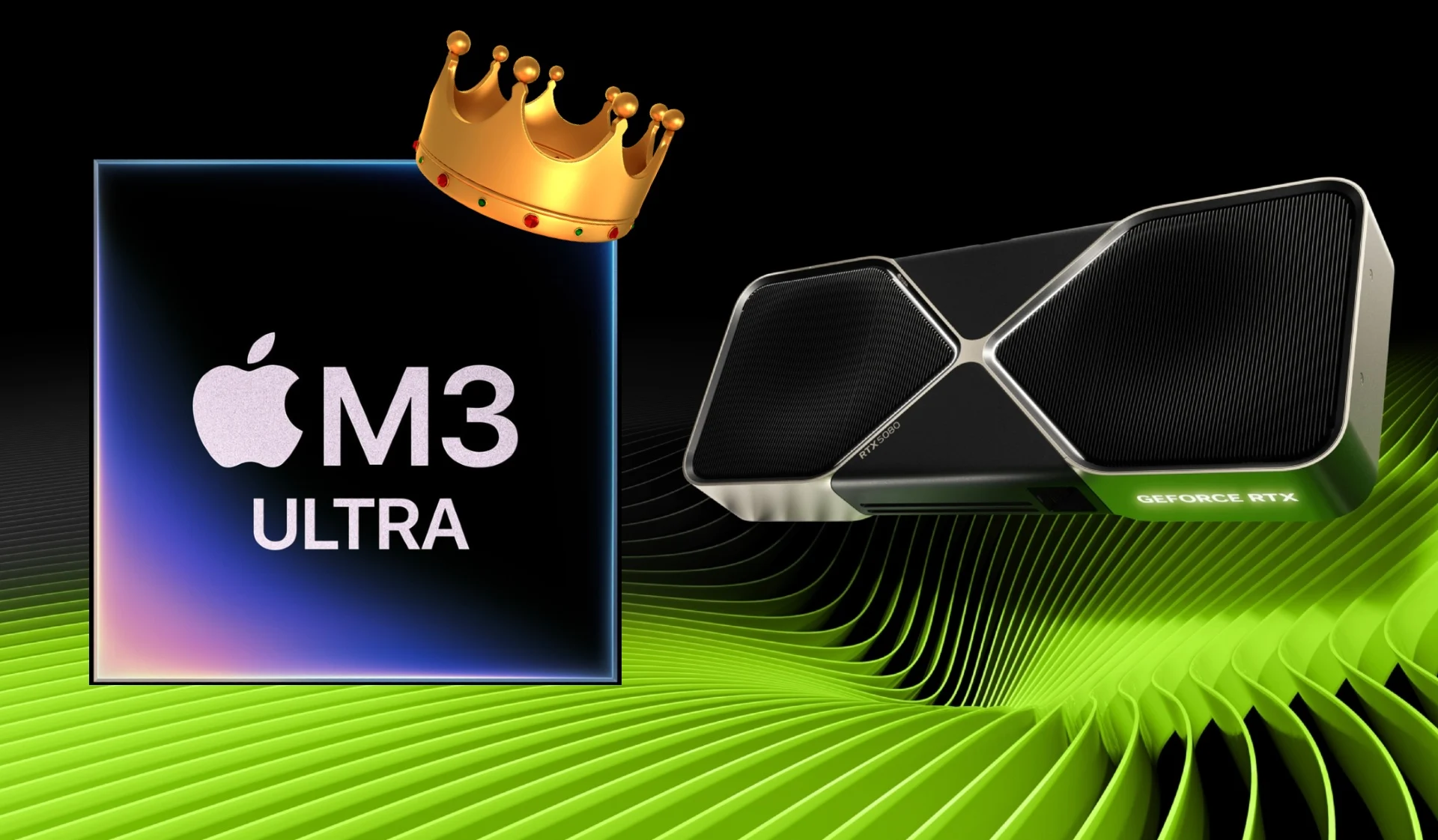
    Even with 256 GB of shared memory, the Mac Studio is capable of managing LLMs that other consumer-grade GPUs simply cannot handle. The top-tier Ryzen AI Max+ 395 APU from the AMD Strix Halo series only supports up to 128 GB (the ROG Flow Z13 is currently priced at $2,170 on Amazon). However, it’s important to note that the M3 Ultra doesn’t match the raw performance of other high-end consumer GPUs like the Nvidia GeForce RTX 5090.

    Interestingly, the costs for memory upgrades had remained stable in Apple’s ecosystem—until now. The upgrade to 256 GB for the Mac Studio, previously priced at $1,600, has now increased to $2,000. Other Mac models do not appear to have experienced any price adjustments.

    Pricing Strategy

    It’s crucial to mention that Apple has long charged high premiums for storage and memory upgrades, even before the supply chain issues came into play, suggesting that their current pricing approach is anything but generous. Nevertheless, it seems the company has decided that the 512 GB memory option for the Mac Studio was too costly given the current circumstances.

    As we mentioned earlier, the M5 Ultra SoC has been detected in a beta version of macOS, hinting that a new Mac Studio featuring exceptional AI capabilities thanks to neural accelerators in every GPU core is likely on the horizon. Whether this new version will offer a 512 GB memory configuration is still uncertain.


    Source:
    Link


  • Apple Shifts Focus to Mac Studio, No Mac Pro Update Soon

    Apple Shifts Focus to Mac Studio, No Mac Pro Update Soon

    Key Takeaways

    1. The last update for the Apple Mac Pro was in 2023, introducing the M2 Ultra chip, but no new upgrades are planned soon.
    2. Apple seems to have shifted focus away from the Mac Pro, with reports indicating it has “largely written off” this product.
    3. The Mac Studio has become the primary professional desktop for Apple, replacing the Mac Pro in the lineup.
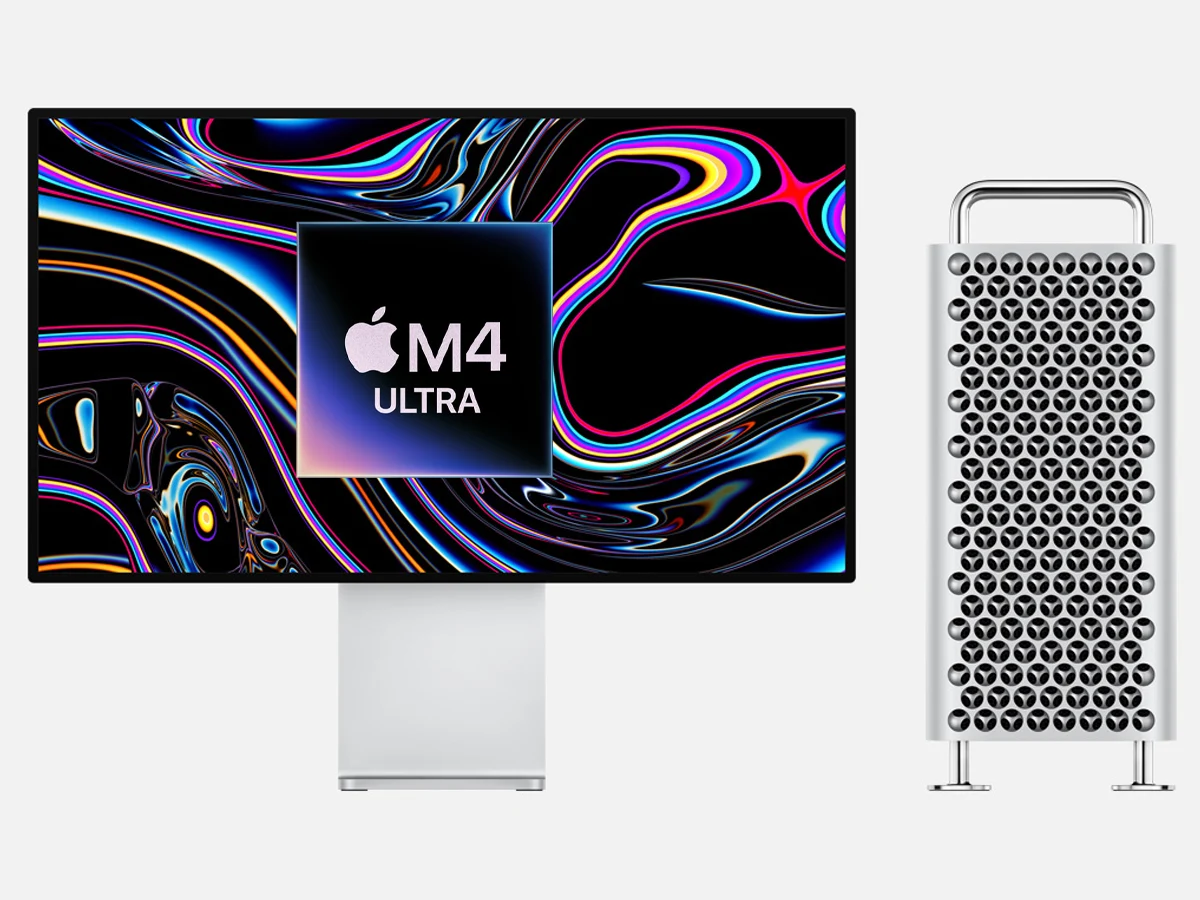
    4. The anticipated M4 Ultra chip for the Mac Pro has been canceled, with future updates likely featuring the M5 Ultra chip in a Mac Studio instead.
    5. A major update for the Mac Pro may not happen until 2026, with a possible significant upgrade in 2027.


    The Apple Mac Pro got its last update in 2023, introducing the M2 Ultra chip, which positioned it alongside the premium Windows tower PCs powered by Intel and AMD at that time. Since that update, the Windows desktop market has welcomed several new processors, but Apple has not yet revealed any plans for an upgrade to its high-performance desktop.

    Current Status of Mac Pro

    It appears that Apple does not intend to refresh the Mac Pro in the near future. Mark Gurman reported that the company has “largely written off the Mac Pro.” This indicates a significant shift in Apple’s focus regarding their professional desktops.

    Shift to Mac Studio

    According to the analyst, the Mac Studio has become the main product representing Apple’s professional desktop lineup. Gurman also mentioned that the anticipated M4 Ultra chip, which was expected to be part of the Mac Pro, has been “nixed.” This change suggests that the next powerful desktop chip will be the Apple M5 Ultra, which will likely be housed in a Mac Studio rather than a Pro.

    Future Updates

    These developments do not necessarily mean that Apple is discontinuing the Mac Pro. Instead, it suggests that a major update for the tower PC may not occur until 2026. However, there is a possibility of a more substantial upgrade in 2027, potentially featuring the M5 Ultra chip. As a point of reference, the current price for the M5-powered 16/512 GB MacBook Pro is $1,476 on Amazon.


    Source:
    Link


  • Apple’s Powerful Desktop Unable to Install Latest macOS Update

    Apple’s Powerful Desktop Unable to Install Latest macOS Update

    Key Takeaways

    1. Users with M3 Ultra Mac Studios are experiencing installation issues with macOS 26 Tahoe.
    2. The installation process fails at the final stages, reverting back to macOS Sequoia.
    3. Other Apple products, like the M4 MacBook Pro, can install macOS 26 Tahoe without issues.
    4. A potential cause for the problem may relate to the installer not recognizing the M3 Ultra’s Neural Engine.
    5. Apple is aware of the issue and is working on a solution.


    Despite its impressive capabilities, the M3 Ultra Mac Studio seems to have trouble with Apple’s newest operating system.

    Reports from users are filling up Apple’s Community forums, indicating that Mac Studios powered by the M3 Ultra can’t seem to install macOS 26 Tahoe, which was launched on September 15. The original poster, Boschje79, mentioned that the installation proceeds without any issues until the final stages, where the Mac Studio defaults back to loading macOS Sequoia instead of Tahoe.

    Users Share Their Frustrations

    Many users resonated with Boschje79’s experience, stating they, too, faced obstacles in updating their M3 Ultra Mac Studios. The problem appears to be confined to this specific setup, as individuals using other Apple products (like the M4 MacBook Pro 14, currently listed on Amazon for $1499) were able to install Tahoe without any problems.

    Another user, FilipOfficial, suggested that the installation failure might be linked to the installer not being able to recognize the M3 Ultra’s Neural Engine. The original thread included a panic message indicating that the installer couldn’t validate the Apple Neural Engine. At this time, it’s still unconfirmed whether this is the actual cause of the issue.

    Apple Working on a Solution

    Apple is aware of this issue and is actively pursuing a fix. However, for the moment, it appears that the most powerful desktop from Apple is stuck running slightly older software.

    Source:
    Link


  • RayCue Launches Thunderbolt 5 Docking Station for Mac Studio

    RayCue Launches Thunderbolt 5 Docking Station for Mac Studio

    Key Takeaways

    1. Product Overview: The RayCue 10-in-1 Thunderbolt 5 Dock is designed for the Mac Studio, providing a compact and powerful docking solution.

    2. High-Speed Connections: The dock features Thunderbolt 5 for data transfers up to 80 Gbps and supports two SSD installations for up to 16TB of additional storage.

    3. Storage Options: It allows for RAID 0 and RAID 1 configurations and supports CFexpress cards with speeds up to 10 Gbps.

    4. Multi-Monitor Setup: The dock includes two HDMI 2.1 ports and one DisplayPort 2.1 for connecting multiple external displays.

    5. Pricing and Availability: The dock is priced at $269 and ships starting September 10, including a Thunderbolt 5 cable but not an SSD.


    We’ve covered RayCue products multiple times in the past, as the brand provides a diverse range of docking options and has now launched another item in this category. The RayCue 10-in-1 Thunderbolt 5 Dock for Mac Studio is tailored specifically for Apple’s desktop system. This mini PC is compact yet powerful, allowing it to sit directly on top of the docking station. Buyers should ensure they refer to the official compatibility list before making a purchase since it works with different configurations.

    High-Speed Connections

    This dock connects to the Mac Studio through Thunderbolt 5, enabling data transfers of up to 80 Gbps. Users can install two SSDs, which allows for an additional storage capacity of up to 16TB for the Mac Studio. It supports both RAID 0 and RAID 1 setups, as well as CFexpress cards that can reach speeds of up to 10 Gbps. Additionally, there are a couple of USB 3.2 Type A ports and a standard 3.5mm headphone jack available.

    Multi-Monitor Setup

    For connecting monitors and external displays, there are two HDMI 2.1 ports and one DisplayPort 2.1 available. The TB5 dock delivers up to 45 watts of power through USB PD. You can order the new RayCue docking station directly from the manufacturer for $269, with shipments expected to start on September 10. This cost is for the dock itself along with a Thunderbolt 5 cable, but it does not come with an SSD. Alternatively, you can find other RayCue products on Amazon.

    Source:
    Link


  • Apple M3 Ultra Beats Nvidia RTX 5070 Ti but Lags Behind RTX 5080

    Apple M3 Ultra Beats Nvidia RTX 5070 Ti but Lags Behind RTX 5080

    Key Takeaways

    1. The M3 Ultra features a 32-core CPU with 24 high-performance cores and an 80-core GPU, making it the fastest chip ever in a Mac.

    2. The M3 Ultra excels in GPU performance, achieving 374 FPS in the GFXBench 4K Aztec Ruins test, nearly doubling the M3 Max’s score.

    3. In the Cinebench 2024 GPU test, the M3 Ultra scored around 20,000 points, outperforming the AMD Radeon RX 7900 XTX by 25% and matching the Nvidia RTX 4070 Ti.

    4. While the M3 Ultra shows great potential, its single-threaded performance may not be as strong, and real-world use may vary across different tasks.

    5. The M3 Ultra’s efficiency and substantial VRAM capacity set it apart, with expectations for more detailed performance comparisons against competitors in the future.


    Apple has just introduced the M3 Ultra, which is, without a doubt, the fastest chip ever put into a Mac. It features an impressive 32-core CPU that includes 24 high-performance cores and an 80-core GPU. The M3 Ultra is expected to show stunning results in benchmarks, though its performance in single-threaded tasks might not be as remarkable. Recently, it appeared on Geekbench, but the results were a bit underwhelming. However, as more reviews are released, the M3 Ultra’s capabilities are becoming clearer.

    GPU Performance Takes Center Stage

    According to a review by Dave2D and data from GFXBench, the M3 Ultra-powered Mac Studio excels in GPU tasks, which aligns with expectations since the M3 Max, which is the base for the Ultra, was a significant leap in GPU tech. In the GFXBench 4K Aztec Ruins (High Tier) test, the M3 Max scored about 200 FPS, while the M3 Ultra nearly doubled that, achieving an impressive 374 FPS. This performance puts the M3 Ultra (Metal) roughly 9% below the GeForce RTX 5080 (DirectX 12) and around 20% ahead of the RTX 5070 Ti, based on GFXBench’s findings. When compared to the M4 Max found in higher-end MacBook Pros, priced at $3,564 on Amazon, the M3 Ultra is approximately 63.6% faster.

    Cinebench Results Show Promise

    In the Cinebench 2024 GPU test, the M3 Ultra scored about ~20,000 points, as reported by The Verge. This figure puts it a staggering 25% ahead of the AMD Radeon RX 7900 XTX, which scores around ~16,000 points on the same benchmark. Interestingly, the M3 Ultra performs similarly to the Nvidia RTX 4070 Ti in this test. However, it’s worth noting that a handful of benchmark tests aren’t necessarily indicative of real-world use, especially given the variety of APIs in play.

    Furthermore, it’s likely that the M3 Ultra will excel in many tasks due to its specialized engines, although it may struggle in areas like 3D rendering when pitted against top-tier RTX cards. When it comes to efficiency and VRAM, the M3 Ultra stands out, especially since no consumer GPU gets close to delivering half a terabyte of reasonably fast VRAM. As time goes on, more practical performance comparisons between the M3 Ultra and its x86 rivals are expected, providing clearer insights for potential buyers.

    Source:
    Link


  • Apple M3 Ultra Debuts on Geekbench with New Mac Studio

    Apple M3 Ultra Debuts on Geekbench with New Mac Studio

    Key Takeaways

    1. The M3 Ultra chip offers significant improvements over the M2 Ultra, including 32 CPU cores and the ability to support up to 512 GB of unified memory.
    2. Geekbench scores show a 20% increase in single-core performance and a 30% increase in multicore performance for the M3 Ultra compared to the M2 Ultra.
    3. The GPU performance improvements are less pronounced, with a 13% increase in the Metal test and a 9% increase in the OpenCL benchmark.
    4. Compared to AMD’s Ryzen AI Max+ 395, the M3 Ultra shows about 9% better single-core performance and 33% better multicore performance, with a 63% advantage in GPU performance.
    5. The M3 Ultra-powered Mac Studio starts at $3,999 for 96 GB of RAM, significantly higher than a comparable system with Ryzen AI Max+ 395, which is priced at $1,999.


    Apple has quietly unveiled a brand new chip along with the latest Mac Studio. The M3 Ultra, which many thought was scrapped, brings some astonishing improvements over the M2 Ultra, including additional CPU cores and the ability to support up to 512 GB of unified memory. Recent Geekbench results have shed light on how the M3 Ultra compares with its predecessor.

    Performance and Specifications

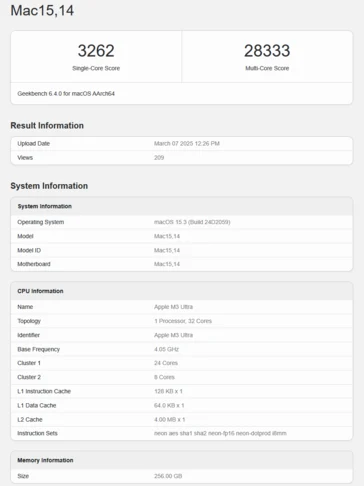
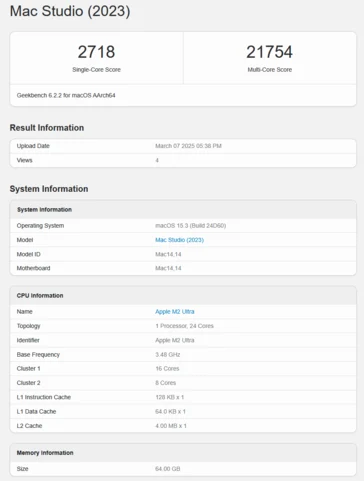
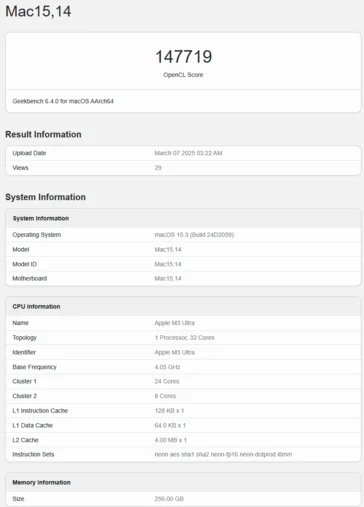
    The Mac Studio being discussed is referred to as code-named Mac15,14. Its predecessor, the one featuring the M2 Ultra, is known as Mac 14,14. This indicates that the latter is indeed the new model, as confirmed by its impressive specs including 32 CPU cores and 256 GB of RAM exclusive to the M3 Ultra. According to Apple’s official site, this model is equipped with 80 GPU cores.

    In the CPU test conducted by Geekbench 6.4, the M3 Ultra achieved scores of 3,262 and 28,333 points. Its predecessor, the M2 Ultra, managed 2,718 and 21,754 points. This shows a 20% boost in single-core performance and a 30% enhancement in multicore performance. The first improvement comes from an increase in clock speed (4.05 GHz compared to 3.48 GHz) and various upgrades made possible by the M3 architecture. The latter improvement is due to the higher number of CPU cores. However, these remarkable enhancements apply only to the CPU.

    GPU Performance

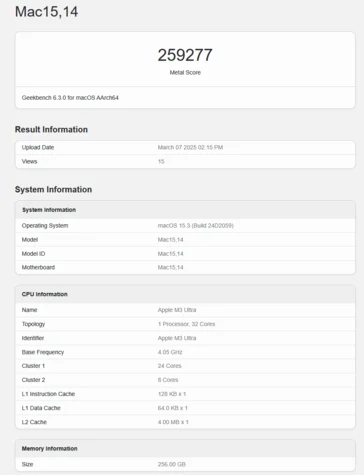
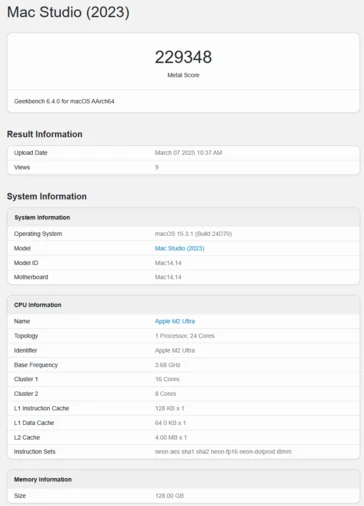
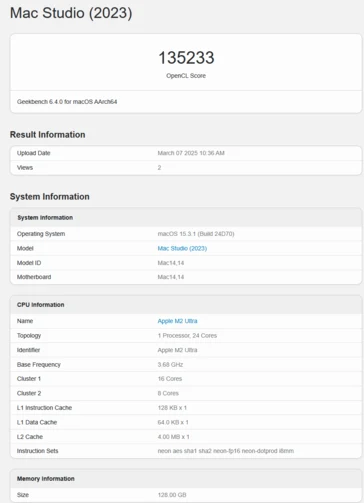
    When it comes to graphics, the improvements are less striking. In the Metal test from Geekbench, the M3 Ultra recorded 259,277 points, which is 13% faster than the M2 Ultra’s score of 229,348. A similar pattern emerges in the OpenCL benchmark, where the M3 Ultra (147,719) is about 9% faster than the M2 Ultra (135,233).

    The M3 Ultra can be compared to AMD’s Ryzen AI Max+ 395, which scored 2,978 and 21,269 points in Geekbench 6.4’s CPU test, along with 90,181 points in the OpenCL benchmark. In single-core performance, Apple’s M3 Ultra is about 9% superior and approximately 33% faster in multicore tests. On the GPU front, the advantage grows to an impressive 63%. Clearly, the increase in both CPU and GPU cores gives the M3 Ultra a significant edge over the Strix Halo.

    Pricing Comparison

    Apple still holds a commanding position in the market; however, a fully equipped Strix Halo machine featuring a Ryzen AI Max+ 395, 128 GB RAM, and free NVMe SSD slots from Framework can be purchased for just $1,999. In contrast, an M3 Ultra-powered Mac Studio with 96 GB of RAM will cost a staggering $3,999, which also comes with a mere 512 GB of non-upgradable storage.


  • Mac Studio Launches with New Apple M4 Max and M3 Ultra Chips

    Mac Studio Launches with New Apple M4 Max and M3 Ultra Chips

    Key Takeaways

    1. Apple has launched the new Mac Studio, featuring M4 Max and M3 Ultra chips, marking it as their most powerful small desktop yet.
    2. The M3 Ultra chip has a 28-core CPU and 60-core GPU, offering up to 892 GB/s memory bandwidth, while the M4 Max mirrors specs from the MacBook Pro.
    3. The M3 Ultra is 2.6 times faster than the previous M1 Ultra model and has a 32-core Neural Engine that processes tokens up to 16.9 times quicker.
    4. Connectivity options include four Thunderbolt 5.0 ports, two USB Type-C ports, two USB Type-A ports, HDMI 2.1, and a 10 Gb/s Ethernet port.
    5. Pricing starts at $1,999 for the M4 Max and $3,999 for the M3 Ultra, with pre-orders available now and general sales beginning on March 12.


    Apple has recently launched its latest small desktop, which many are calling its most powerful yet. Following Mark Gurman’s prediction, the new Mac Studio is finally available, featuring a combination of two generations of technology. Customers can choose between the M4 Max and the M3 Ultra, a chip that many thought was no longer in production.

    Performance Details

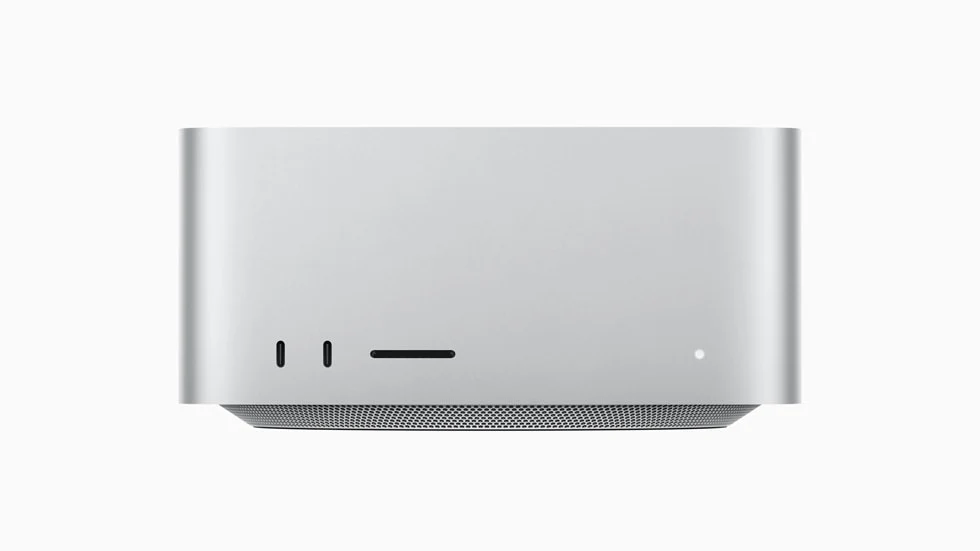
    The M3 Ultra is similar to its earlier model, consisting of two M3 Max chips placed together. It boasts a 28-core CPU, which includes 20 performance cores and 8 efficiency cores, along with a 60-core GPU. Users have the option to upgrade to a 32-core CPU and an 80-core GPU. Both options offer an impressive memory bandwidth that reaches up to 892 GB/s. In contrast, the specifications for the M4 Max are the same as those seen in the MacBook Pro, featuring up to a 16-core CPU and a 40-core GPU.

    Speed and Connectivity

    Apple asserts that the M3 Ultra is 2.6 times quicker than the Mac Studio equipped with the M1 Ultra. When compared to the same chip, its 32-core Neural Engine can generate tokens in LM Studio up to 16.9 times faster. The new Mac Studio is loaded with connectivity options, featuring four Thunderbolt 5.0 ports located at the rear, along with two USB 3.2 Type-C ports situated at the front (Thunderbolt 5.0 is exclusive to the M3 Ultra variant).

    Additional Features and Pricing

    Other connectivity features include two USB 3.0 Type-A ports, a 10 Gb/s Ethernet port, an HDMI 2.1 port, and a 3.5 mm audio jack. The base model of the M4 Max Mac Studio comes with 512 GB of storage and 36 GB of unified memory, while the M3 Ultra variant offers a 1 TB SSD and 96 GB of unified memory. The M4 Max can be expanded to 128 GB of RAM and 8 TB of storage, whereas the M3 Ultra can reach 512 GB of RAM and 16 TB of storage.

    The M4 Max supports video output for up to five displays, while the M3 Ultra can manage up to eight displays. Unfortunately, neither model supports Wi-Fi 7, so users will have to make do with Wi-Fi 6e and Bluetooth 5.3. The starting price for the M4 Max Mac Studio is $1,999, while the M3 Ultra version begins at $3,999. Pre-orders are now available on Apple’s website, with general sales set to start on March 12.

    Source:
    Link