Tag: iPhone 16e

  • First Reported Failure of Apple C1X Modem

    First Reported Failure of Apple C1X Modem

    Key Takeaways

    – Apple launched the C1 modem with the iPhone 16e, moving away from Qualcomm modems.
    – The C1 modem is more energy-efficient but does not support mmWave 5G speeds.
    – A user reported the first failure of the C1X modem, experiencing a “Mobile Service Issue Detected.”
    – Attempts to fix the problem, such as restarting the device and resetting network settings, were unsuccessful.
    – There is hope that Apple will repair the modem, especially since the iPhone 17 series is designed to be easier to fix.


    Apple launched the C1 modem with its iPhone 16e at the beginning of last year. This marked a new path for the brand as it moved away from Qualcomm modems. The new 5G modem is designed to be more energy-efficient but does not support mmWave 5G speeds. Later in the same year, Apple released the C1X update, which promised 50% faster mobile data and a 30% reduction in power usage. Now, the first reported failure of a C1X modem has come to light.

    Report of a Problem

    A user named ‘itstheskylion’ shared some screenshots of an error message on the r/iphone subreddit. They indicated that their iPhone Air, which uses the C1X modem, displayed a worrying message. The user woke up to find they had no cellular network, and upon inspecting the network settings, they encountered a ‘iPhone Hardware’ issue in the Mobile Diagnostics section. This was followed by a notification stating, “Mobile Service Issue Detected,” along with an option to contact Apple support.

    Attempts at Resolution

    In the comments section, the user mentioned several attempts to resolve the issue, including restarting their device, trying a different SIM card, and resetting network settings; however, none of these actions proved useful. At this point, it remains uncertain whether the user managed to take their device to Apple for a replacement or repair regarding the problem.

    Hope for a Solution

    This appears to be the first instance of a C1X modem malfunctioning, and hopefully, it won’t be the start of a trend. Commenters have speculated that Apple will probably repair the modem since the iPhone 17 series is designed to be easier to fix compared to earlier models. Let’s hope that the user finds a quick resolution to their issue soon.

    Source:
    Link


  • Apple iPhone to Block Location Tracking with Apple Modem Only

    Apple iPhone to Block Location Tracking with Apple Modem Only

    Key Takeaways

    1. The iOS 26.3 update allows data transfer between iPhones and Android smartphones.
    2. Users can now forward notifications to non-Apple smartwatches.
    3. A new privacy feature, “Limit Precise Location,” reduces location tracking by network operators.
    4. Users must manually enable the “Limit Precise Location” feature in settings after updating.
    5. This feature is only available with specific network providers and certain Apple devices.


    The Apple iPhone is gearing up for an update to iOS 26.3, which is set to roll out within the next few hours. This update brings a host of exciting new features. For instance, users will now be able to transfer data between an iPhone and an Android smartphone. Additionally, there’s finally the capability to forward notifications to smartwatches that are not made by Apple. A support document from Apple has also unveiled a privacy-focused feature that users may find beneficial.

    Privacy-Focused Features

    This new feature, dubbed “Limit Precise Location” by Apple, aims to stop network operators from using cell towers and signal strength to track the exact location of an iPhone. Apple states that iPhones with this feature turned on will send less information to cell towers. As a result, network operators won’t be able to pinpoint the precise location anymore; they will only have access to the general area where the user is situated. Importantly, Apple assures that this feature does not affect signal strength or the accuracy of location data in navigation apps, as these applications rely on GPS instead of cell towers for accurate tracking.

    Limitations of the Feature

    That said, there are a few limitations to keep in mind. First, users must manually turn on this feature after they install iOS 26.3 by going to Settings –> Cellular –> Data Options. Secondly, “Limit Precise Location” is only available with specific network providers; in the US, it’s offered exclusively by Boost Mobile. In the UK, this feature is limited to EE and BT users. Lastly, only devices equipped with an Apple C1 or C1X modem can support this feature, which includes the iPhone 16e, iPhone Air, and the iPad Pro that comes with the Apple M5 chip.

    Source:
    Link


  • Apple iPhone 17e Expectations: Budget Model After iPhone 16e Issues

    Apple iPhone 17e Expectations: Budget Model After iPhone 16e Issues

    Key Takeaways

    1. Apple has struggled to find a successful alternative to its standard iPhone models since the iPhone 11 series.
    2. The iPhone 16e has underperformed, making up only 8% of Apple’s sales in its first month, partly due to a high launch price.
    3. The company’s attempts with ‘mini’ and ‘Plus’ versions did not attract much interest, leading to a focus on the iPhone Air.
    4. The iPhone Air is reportedly not meeting expectations, and there are considerations to delay the iPhone Air 2.
    5. Apple plans to release the iPhone 17e in spring 2026, but the ‘e’ series may face discontinuation if it doesn’t succeed.


    In the past few years, Apple has had a hard time finding a successful alternative iPhone to its standard, Pro, and Pro Max lines. Since launching the iPhone 11 series in 2019, Apple has tried out ‘mini’ and ‘Plus’ versions. However, these options didn’t attract much interest, leading Apple to shift focus towards the iPhone Air, which is reportedly not meeting expectations, prompting the company to think about delaying the iPhone Air 2.

    iPhone 16e: A Sales Struggle

    As reported by Fixed Focus Digital, the iPhone 16e has joined the list of Apple’s commercial disappointments (curr. $389 on Amazon). While a well-known Weibo account hasn’t shed much light on the situation, a study by Counterpoint Research earlier this year showed that sales of the iPhone 16e were not up to par with earlier iPhone SE models. The research pointed out that a high launch price contributed to the lackluster sales, noting that the iPhone 16e made up only 8% of Apple’s sales in its first month on the market.

    Future of iPhone Models

    Keeping all this in consideration, Fixed Focus Digital indicates that Apple is still planning to release the iPhone 17e. If the company’s previous patterns are any indication, the iPhone ‘e’ series will only have one more opportunity to succeed before it is potentially discontinued. Presently, Fixed Focus Digital anticipates that the iPhone 17e will be launched in spring 2026, while the release of the iPhone Air 2 remains on hold for now.


    Source:
    Link


  • iPhone 17e: Affordable Model with A19 Chipset and New Design

    iPhone 17e: Affordable Model with A19 Chipset and New Design

    Key Takeaways

    1. The iPhone 17e is expected to be released in spring 2026 as the successor to the iPhone 16e.
    2. The iPhone 17e will likely maintain a 6.1-inch OLED screen with a 60 Hz refresh rate, similar to the iPhone 16e.
    3. The design will keep the distinctive notch seen in the iPhone 16e.
    4. Camera specs are expected to remain the same, featuring a 12 MP front camera and a 48 MP rear camera, with potential improvements from the Apple A19 chipset.
    5. Apple may redesign the entry-level iPhone after just one generation, though details are currently unclear.


    Apple hasn’t yet released the iPhone 17 series, but rumors are already swirling about the upcoming iPhone 17e, which is said to be the successor to this year’s iPhone 16e (currently priced at $470 for refurbished models on Amazon). The iPhone 16e, launched in February as the new alternative to the long-running SE series, received a mixed review due to several significant drawbacks.

    Plans for the iPhone 17e

    According to Digital Chat Station, Apple is only planning to fix a few issues with the iPhone 17e, which is expected to be available in spring 2026. It seems that the new model will feature a 6.1-inch OLED screen, which will stick with the criticized 60 Hz refresh rate found in the iPhone 16e. Digital Chat Station also suggests that the distinctive notch will remain in the design of the iPhone 17e as well.

    Camera and Performance Expectations

    Additionally, Digital Chat Station indicates that the camera specs for the iPhone 17e will likely be the same as this year’s model, featuring a 12 MP front camera and a 48 MP rear camera. However, these cameras may benefit from an enhanced image signal processor (ISP) thanks to the Apple A19 chipset. On the flip side, the leaker suggests that Apple is planning a redesign of its entry-level iPhone after just one generation, but details on that remain unclear for now.

    Source:
    Link


  • Apple iPhone 17e May Be Canceled, Budget iPhones in Doubt

    Apple iPhone 17e May Be Canceled, Budget iPhones in Doubt

    Key Takeaways

    1. The iPhone 16e is the next generation of the third-generation iPhone SE, suggesting a shift towards annual budget models by Apple.
    2. The potential launch of an iPhone 17e in 2026 is uncertain, as Apple is still deciding on its future release strategy.
    3. Apple’s traditional release cycle for budget iPhones has been every two to four years, making annual releases a notable change.
    4. Competitors are updating their smartphones more frequently, indicating a need for Apple to increase the pace of its budget phone releases.
    5. Possible enhancements for the iPhone 17e may include a newer processor and features like full MagSafe support or a design upgrade with Dynamic Island.


    The Apple iPhone 16e serves as the next generation of the third-generation iPhone SE. By placing this “budget” variant within the iPhone 16 collection, Apple has stirred up rumors that the company may launch an economical model annually, similar to how Google does with its Pixel A series. Nevertheless, a recent article from Bloomberg indicates that the arrival of an iPhone 17e in 2026 is not assured.

    Future of the iPhone 17e

    Apple is anticipated to make a decision about the iPhone 17e in the near future. Since creating a simplified iPhone model likely won’t require a lot of time, Apple has plenty of opportunity to reflect on its choice. Traditionally, iPhone SE versions have come out every two to four years, so introducing a new budget iPhone each year would mark a significant change in Apple’s approach.

    Competitive Landscape

    However, journalist Mark Gurman from Bloomberg noted that several of Apple’s rivals are updating their smartphone lines more than once a year. This implies that it would be logical for the e-series phones to debut at a quicker rate. Information regarding possible enhancements for the iPhone 17e is still vague, apart from the expected addition of a newer processor. It’s possible that Apple might finally provide full MagSafe support for its most affordable iPhone model or further develop its design, possibly swapping the large notch for a Dynamic Island, a feature that was first unveiled with the iPhone 14 Pro.

    Source:
    Link

  • iPhone 16e Surpasses SE 2022 Popularity in 2025 So Far

    iPhone 16e Surpasses SE 2022 Popularity in 2025 So Far

    Key Takeaways

    1. The iPhone SE 2022 captured 5% of the US market in Q1 2024 but has been overtaken by its successor, the 16e.
    2. The 16e, powered by the A18 chip, accounts for 7% of iPhone sales in 2025, significantly outperforming the SE’s 1%.
    3. The iPhone 14 still outsells the 16e with an 8% market share, despite the latter being a newer model.
    4. The iPhone 16 lineup is performing well overall, with strong sales for the standard model (20%) and the Pro Max (21%).
    5. The 16e is the least favored new iPhone in 2025, lacking certain features but still showing respectable performance relative to its specifications.


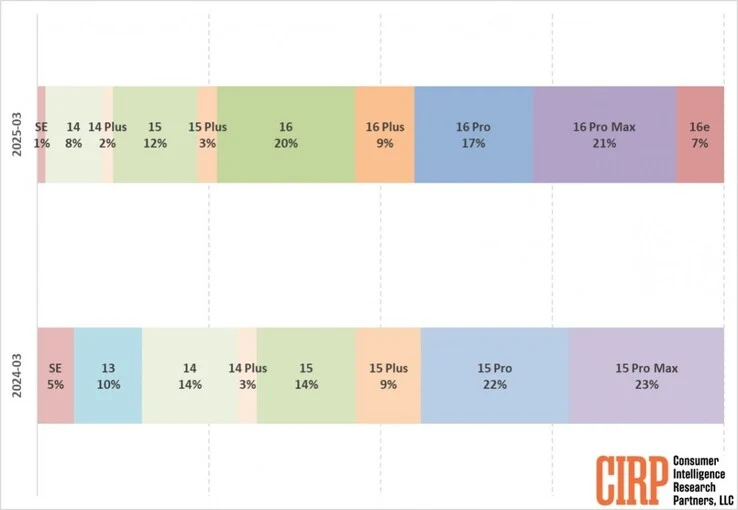
    The iPhone SE 2022 was Apple’s only mid-tier smartphone in 2024, capturing 5% of the US market during the first quarter (1Q2024), as per research from the CIRP analysis group. However, it has now been overtaken by its successor, the 16e, in the same quarter this year.

    Performance of the New 16e

    The new device powered by the A18 chip has accounted for 7% of all iPhone sales in 2025 so far, compared to only 1% for its SE predecessor. It also surpasses the 15 Plus and the 14 Plus, which hold 3% and 2% of the market share, respectively, at this point in time.

    Market Dynamics

    Interestingly, the iPhone 14, which shares a similar display and overall design with the 16e (with the exception of an additional rear camera), is still managing to outsell the newer model in the US, boasting an 8% market share.

    Meanwhile, the overall iPhone 16 lineup has seen strong sales, with 20% going to the standard model, 9% for the Plus version, and 17% for the Pro variant. However, the majority, 21%, of buyers have chosen the high-end 16 Pro Max.

    Conclusion

    This positions the 16e as the least favored new iPhone in 2025 according to this report. Yet, considering it lacks features like UWB for precise AirTag tracking, MagSafe, or the complete set of cores in its Apple GPU, it’s not performing as poorly as it might seem.

    Source:
    Link


  • iPhone 16e vs Galaxy S24 FE: Mid-Range Flagship Showdown

    iPhone 16e vs Galaxy S24 FE: Mid-Range Flagship Showdown

    Key Takeaways

    1. The iPhone 16e and Samsung Galaxy S24 FE are mid-range flagship smartphones with high-end features at a more affordable price.
    2. The iPhone 16e has a compact design, while the Galaxy S24 FE is bulkier and heavier, catering to different user preferences.
    3. The Galaxy S24 FE features a larger 6.7-inch Dynamic AMOLED 2X display with a 120Hz refresh rate, while the iPhone 16e offers a smaller but high-quality Super Retina XDR OLED display.
    4. The S24 FE has a peak brightness of 1900 nits, outperforming the iPhone 16e in brightness, although the iPhone excels in color accuracy with True Tone technology.
    5. Choosing between the two devices involves considering design, display size, performance, and pricing to find the best value for individual needs.


    The iPhone 16e and Samsung Galaxy S24 FE are highly awaited mid-range flagship smartphones, each presenting a blend of high-end features at a more reasonable cost. With Apple’s integrated ecosystem and Samsung’s rich Android experience, picking between the two can be challenging. Both devices offer enhancements in design, performance, and camera quality, yet they appeal to various user preferences. This comparison will detail their main differences in design, battery life, camera functionality, and pricing to assist you in determining which one provides the best value for your requirements.

    Design and Display

    iPhone 16e
    Both the iPhone 16e and the Galaxy S24 FE exhibit high-quality designs, though they appeal to distinct tastes. The iPhone 16e sports a more compact structure, making it simpler to handle with one hand, while the S24 FE is significantly bulkier and heavier. Apple sticks to its Ceramic Shield glass for toughness, while Samsung uses Gorilla Glass Victus+, which is also very resistant to scratches and falls.

    Display Performance

    Regarding display, the S24 FE stands out with its 6.7-inch Dynamic AMOLED 2X screen, providing a fluid 120Hz refresh rate and a remarkable peak brightness of 1900 nits. The iPhone 16e showcases a stunning Super Retina XDR OLED display but does lag a bit in brightness. Still, Apple’s color calibration and True Tone technology make it one of the finest for color accuracy. If you like a larger, more immersive display, the S24 FE is the clear winner; however, for those who desire a smaller, premium feel, the iPhone 16e still shines.

    Source:


  • The Decline of Small Phones: Reasons and Public Indifference

    The Decline of Small Phones: Reasons and Public Indifference

    Key Takeaways

    1. Rising Popularity of Larger Phones: The smartphone industry is increasingly favoring larger devices, making smaller phones rare and less available.

    2. Advantages of Bigger Screens: Larger screens enhance user experience for activities like video streaming, gaming, and multitasking, contributing to their dominance in the market.

    3. Battery Life and Camera Limitations: Smaller phones struggle with battery life and camera quality due to space constraints, making them less appealing to consumers.

    4. Market Trends and Consumer Preferences: Despite nostalgic feelings for compact phones, most consumers prioritize features over size, leading to low sales for smaller models.

    5. Foldable Phones as a Solution: Foldable devices offer a new approach to compactness, providing portability without sacrificing screen size, potentially reducing the need for traditional small phones.


    Smartphones are getting larger, and this is not just a passing fad—it is the path that the industry is taking. Consequently, smaller phones are becoming much rarer than they were a few years ago. The choices are dwindling as time goes on, with companies that once offered excellent compact phones no longer producing them.

    The Disappearance of Compact Options

    A prime example is Apple’s iPhone mini series, which provided a premium compact experience but has now been phased out. Even the cheapest iPhone in the lineup today, the new iPhone 16e, features a screen size larger than 6 inches.

    Why Small Phones Are Losing Popularity

    Why are smaller phones losing their appeal? The answer lies not only in what consumers prefer but also in a blend of market dynamics, hardware challenges, and evolving user habits.

    Advantages of Larger Screens

    It’s quite apparent why larger phones are dominating the market. A bigger screen enhances the experience of watching videos, playing games, and multitasking.

    Streaming services and social media are also designed with larger screens in mind, as they keep users engaged with content for extended periods. Plus, typing on a bigger keyboard is much simpler.

    Battery Life Over Size

    A smaller phone has limited space for a battery, which is a significant drawback. We expect our devices to last all day, even with heavy usage. However, achieving that with compact phones is difficult.

    Larger phones can accommodate bigger batteries, giving them a clear edge over their smaller counterparts. They also have extra room to manage heat and include a dedicated heat dissipation system, which helps maintain battery health over time.

    While chipsets have become more efficient, they can’t fully make up for the limitations of a small battery. This is why compact phones often receive criticism for having poor battery life, making them harder to sell.

    Cameras Need Room

    Smartphone cameras have become a crucial selling point for customers, but they also take up more internal space. High-end camera sensors need larger modules, advanced image processing chips, and additional parts like periscope lenses for zooming.

    On larger phones, manufacturers have the space to distribute these components without making significant sacrifices. On smaller devices, compromises have to be made—either by using smaller sensors or omitting features like telephoto lenses. This puts compact devices at a disadvantage in camera comparisons, which contributes to their declining popularity.

    Following Market Trends

    The smartphone industry follows a straightforward rule: produce what sells. The statistics reveal that most consumers prefer larger phones. The iPhone 13 Mini reportedly struggled with low sales, prompting Apple to discontinue the Mini series from the iPhone 14 lineup.

    We see similar patterns with other brands too. The Asus Zenfone 10, for instance, was a well-rounded compact Android flagship. However, the company chose to follow it up with the Zenfone 11 Ultra, which features a large 6.78-inch display.

    This trend is not just about demand; it’s also about profit. Compact phones require special engineering to fit flagship features into a small package. This results in higher production costs and fewer economies of scale.

    In contrast, larger phones share more components with existing models, making them cheaper to produce. With most consumers favoring larger devices, there’s little motivation for brands to keep making smaller ones.

    The Consumer Dilemma

    Moreover, we need to consider the difference between what people claim to want and what they actually purchase. Many users express nostalgia for smaller phones (including myself), but when it’s time to upgrade, we often opt for a larger model. This is because compact devices typically involve trade-offs—be it battery life, display quality, or camera performance.

    While we may appreciate the concept of a smaller phone, in reality, most of us place more importance on features than on size. The popularity of devices like the Galaxy S Ultra and iPhone Pro Max illustrates that many consumers are willing to carry a larger phone for better features.

    Foldables: A New Twist on Compact

    That being said, you can still experience a compact phone in 2025, but in a different way. Foldables are reshaping the conversation around small devices.

    Products like the Galaxy Z Flip and Motorola Razr provide a design that’s easy to carry without compromising screen size. When folded, they’re compact and portable. When opened, they deliver a full-sized display for an enhanced multimedia and productivity experience.

    Foldables tackle one of the major complaints about compact phones—limited display area—while providing something innovative.

    Although they are still pricier than standard smartphones, they are becoming more advanced each year. If foldable technology continues to progress, it may eliminate the need for traditional small phones.

    The Decline of Small Phones

    It’s doubtful that compact phones will have a significant comeback anytime soon. The market has shifted toward larger devices, and manufacturers have little reason to change that trend. Some brands might continue to produce small phones, but they will likely remain a niche market rather than a common choice.

    For those who still appreciate small phones, the best bet may be sticking with an older model or embracing foldables. Currently, the era of small phones is waning, and most people don’t seem to be bothered by it.

  • Apple iPhone 16 Discounts During Flipkart Big Savings Days Sale

    Apple iPhone 16 Discounts During Flipkart Big Savings Days Sale

    Key Takeaways

    1. Discounted iPhones: A range of iPhones, including the iPhone 16e and iPhone 16 series, are on sale during Flipkart’s Big Savings Days Sale from March 7 to March 13.

    2. Significant Price Cuts: Major discounts include the iPhone 16e reduced from 59,900 INR to 47,900 INR, and the iPhone 16 and iPhone 16 Plus now priced at 56,205 INR each.

    3. Exchange Bonuses Available: Customers can receive exchange bonuses up to 65,200 INR on certain models, enhancing savings on purchases.

    4. Limited Time Offer: The sale runs for a specific period, emphasizing urgency for customers to take advantage of the deals.

    5. Various Payment Discounts: Additional savings include UPI transaction discounts and instant bank cashback on select iPhone models.


    A range of iPhones have recently been marked down on Flipkart as part of the Big Savings Days Sale. This includes the latest models like the iPhone 16e, along with the flagship iPhone 16 series and some previous models too. Here are the specifics.

    Apple iPhone 16e Now Available at a Lower Price on Flipkart

    The discounts cover the complete iPhone 16 lineup and a selection of iPhone 15 models, which consists of the iPhone 16e, iPhone 16, iPhone 16 Plus, iPhone 16 Pro, iPhone 16 Pro Max, iPhone 15, and iPhone 15 Plus. This promotion is happening on Flipkart during the Big Savings Days Sale, running from March 7 to March 13. Here’s a rundown of the discounts:

    Discounted Prices for iPhone Models

    Apple iPhone 16e: Originally priced at 59,900 INR, now available for only 47,900 INR due to a 4,000 INR instant bank cashback and up to 8,000 INR exchange bonus.
    iPhone 16: Normally costs 79,900 INR but is now on sale for 56,205 INR, thanks to a significant drop of 9,901 INR and an exchange bonus of up to 9,799 INR.
    iPhone 16 Plus: Also priced regularly at 79,900 INR, now down to 56,205 INR, reflecting a 9,901 INR discount and up to 9,799 INR exchange bonus.
    iPhone 16 Pro: This model typically retails for 1,19,900 INR, but can be grabbed for just 44,900 INR with a 7,000 INR reduction, an additional 2,000 INR discount for UPI transactions, and a hefty exchange bonus of up to 65,200 INR.
    iPhone 16 Pro Max: With a regular price of 1,44,900 INR, it’s now available for 61,655 INR thanks to a 9,000 INR price cut, a 2,000 INR UPI transaction discount, and an exchange bonus of up to 65,200 INR.
    iPhone 15: This phone usually costs 69,900 INR and is currently available for 56,205 INR, offering a 4,901 INR discount, a 1,000 INR instant bank discount, and an exchange bonus of up to 2,799 INR.
    iPhone 15 Plus: Originally priced at 79,900 INR, it can now be purchased for 57,205 INR, reflecting a 10,901 INR price drop, a 1,000 INR credit card discount, and an exchange bonus of up to 6,799 INR.

  • iPhone 16e Supports Magnetic Wireless Charging Upgrade, Teardown Reveals

    iPhone 16e Supports Magnetic Wireless Charging Upgrade, Teardown Reveals

    Key Takeaways

    1. The iPhone 16e features a single rear camera setup, a first since the last SE model, with a starting price of $599.99.
    2. It includes a new battery removal system using electrically-debondable adhesive, shared with the flagship iPhone 16.
    3. The screen of the iPhone 16e can be swapped with the older iPhone 14, enhancing repairability and cost-effectiveness.
    4. Several parts from older iPhone models, such as MagSafe charging coils from iPhone 15 and 14, are compatible with the 16e.
    5. The charging magnets fit well within the rear panel of the 16e, maintaining compatibility with puck-style chargers, though charging speed remains at 7.5 watts.


    The iPhone 16e marks Apple’s return to a single rear camera setup, a first since the last SE model. However, besides this feature, the two devices don’t share much in common, especially not the new starting price of $599.99.

    Innovative Design Features

    This latest model includes Apple’s new system for battery removal, which uses electrically-debondable adhesive. This feature is also found in the regular flagship iPhone 16, as confirmed by both REWA Technology and PBKReviews.

    Enhancing Repairability

    Recently, PhoneRepairGuru, a Canadian repair service, has shared insights from a teardown of the 16e. They discovered that the screen can be swapped with the older iPhone 14, making repairs easier and possibly more cost-effective.

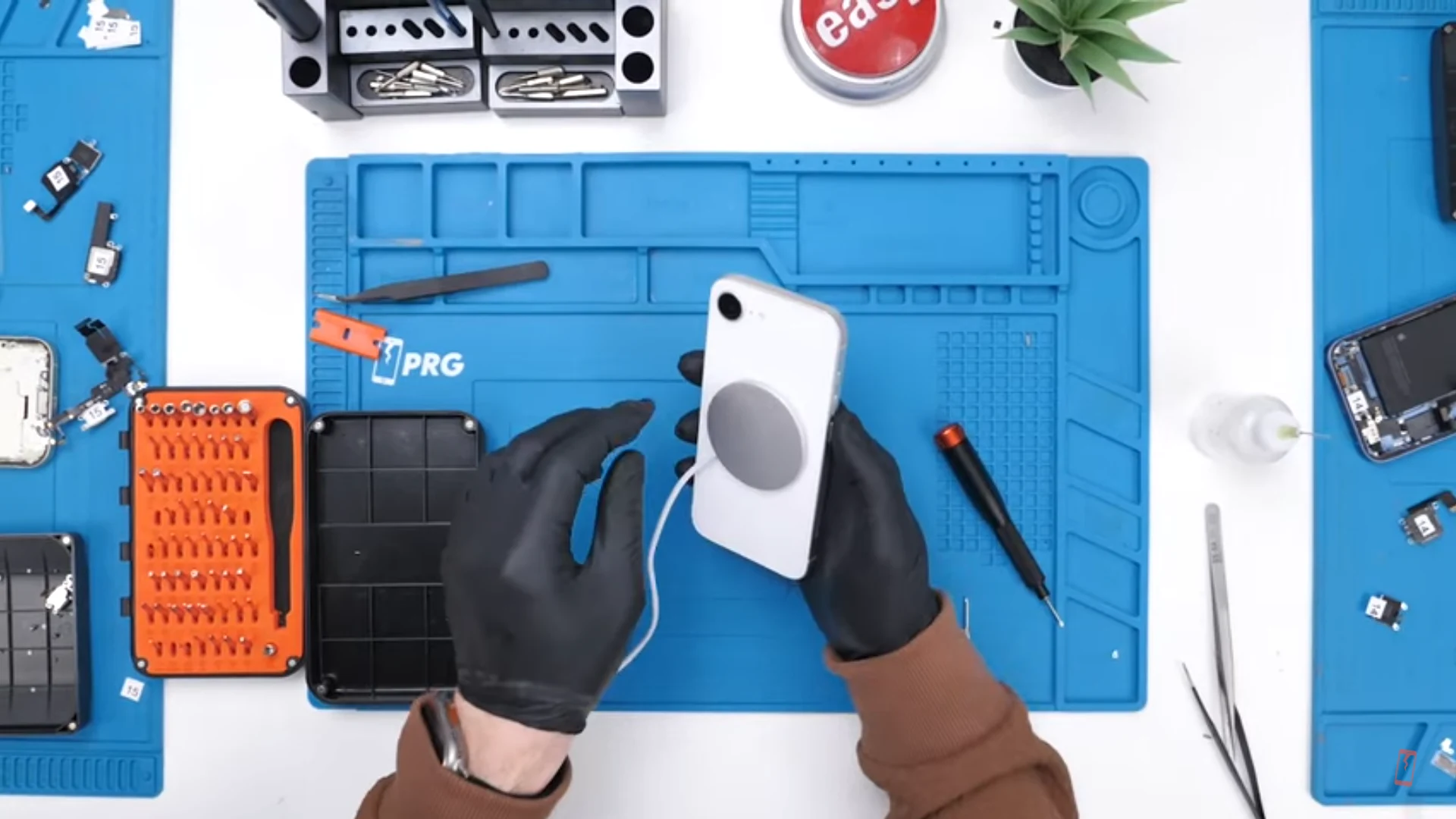
    PhoneRepairGuru also noted that several parts from older iPhone models can be used in the 16e. This includes MagSafe charging coils from both the iPhone 15 and 14. It’s curious, considering Apple has decided that MagSafe isn’t a priority for 16e users.

    Charging Capabilities

    Interestingly, the teardown revealed that a replacement set of charging magnets fits perfectly within the rear panel of the 16e, even after sealing it back up. While these magnets did not enhance the charging speed, which remains at a standard 7.5 watts, they did restore compatibility with puck-style chargers for this ‘budget’ iPhone.

    Alternatively, users can achieve similar results by purchasing a new case for the iPhone 16e.

    Source:
    Link