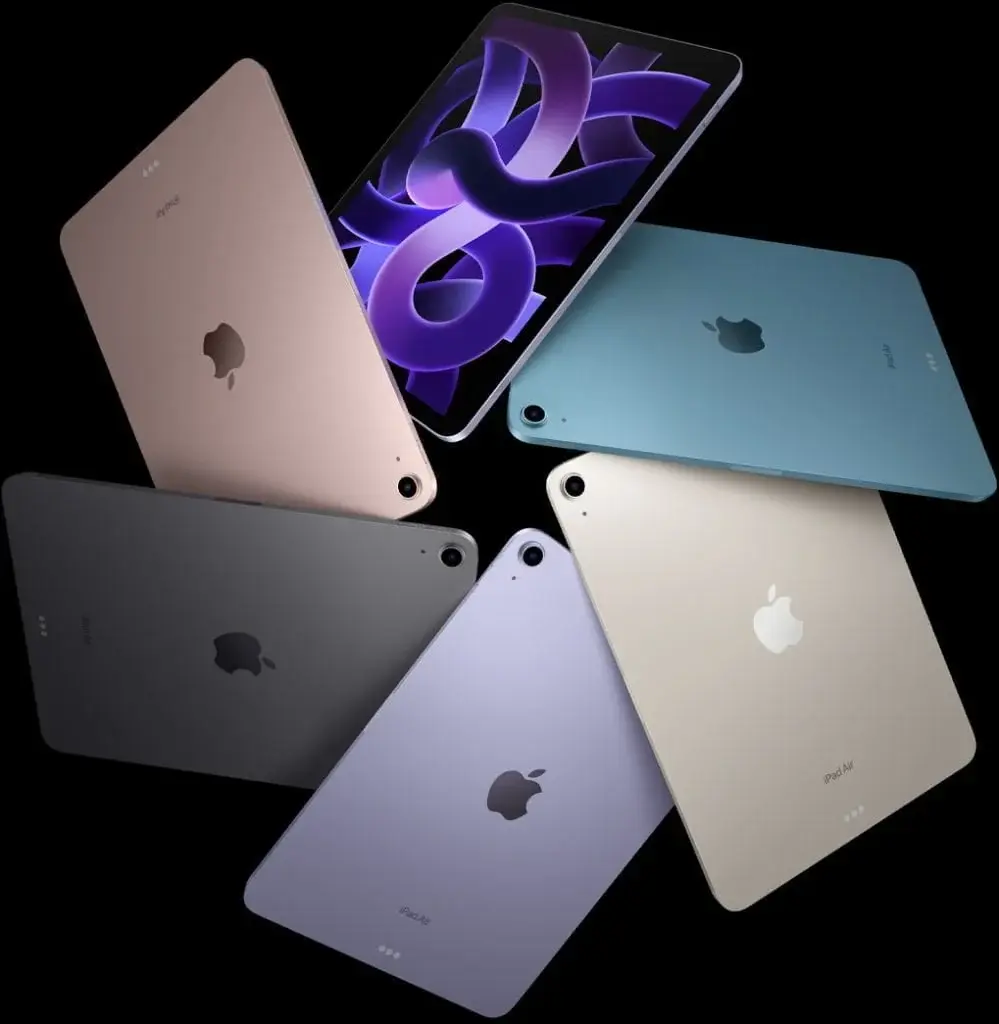
Tag: IPad

  • NATO Approves iPhone and iPad for Classified Information Use

    NATO Approves iPhone and iPad for Classified Information Use

    Key Takeaways

    1. Apple’s iPhone and iPad are now approved by NATO to handle secure and classified information without extra software adjustments.
    2. This is the first time a consumer gadget has received such approval from NATO, marking a significant milestone.
    3. Only devices running iOS 26 and iPadOS 26 with the “Indigo Configuration” are authorized by NATO.
    4. Key security features like Secure Enclave, encrypted Face ID, and Memory Integrity Management are crucial for NATO’s approval.
    5. Currently, only the iPhone and iPad have NATO’s approval; Apple’s computers have not yet qualified.


    Apple’s devices might soon play a role in promoting global peace.

    This week, Apple revealed that both the iPhone and iPad have been cleared to manage secure and classified information for NATO, with no need for extra software or adjustments. In simpler terms, these devices are secure enough right from the package to handle NATO’s sensitive data.

    A New Milestone

    This is the first instance of a consumer gadget getting such an approval. Previously, gadgets had to undergo significant changes, either in software or hardware, to fulfill NATO’s stringent security standards. Currently, Apple’s devices stand alone as the only consumer gadgets that NATO has authorized for use.

    Specific Requirements

    To clarify, only devices operating on iOS 26 and iPadOS 26 configured with the “Indigo Configuration” are sanctioned by NATO. The Indigo Configuration is a specially designed setup created by the German Bundesamt für Sicherheit in der Informationstechnik, known as BSI. This is Germany’s authority that manages data and information security. Even though no extra software is needed on the devices, mobile software management (MSM) and other configurations must still be adjusted.

    NATO pointed out that Apple’s Secure Enclave, encrypted Face ID, and Memory Integrity Management are vital components of the security systems in the iPhone and iPad. Notably, it’s worth mentioning that, at this moment, only the iPhone and iPad have received NATO’s approval; none of Apple’s computers have qualified yet.

    Source:
    Link


  • Apple’s iPad: 16 Years of Changing Personal Computing

    Apple’s iPad: 16 Years of Changing Personal Computing

    Key Takeaways

    1. The original iPad, launched on January 27, 2010, marked the beginning of a new era in personal computing and shaped the tablet market.

    2. The first-generation iPad featured a 9.7-inch display, a custom-designed chip, up to 64 GB of storage, and a battery life of up to 10 hours, priced starting at $499.

    3. Steve Jobs emphasized the iPad’s ability to create a new category of devices that offered an intimate and intuitive way to interact with apps and digital content.

    4. Despite mixed reviews regarding its necessity compared to laptops, the iPad achieved remarkable commercial success, selling over 300,000 units on its first day and exceeding 15 million units in its first year.

    5. The iPad has evolved into a diverse range of devices, including the iPad mini, Air, and Pro, incorporating advanced features and accessories, solidifying its role in everyday computing.


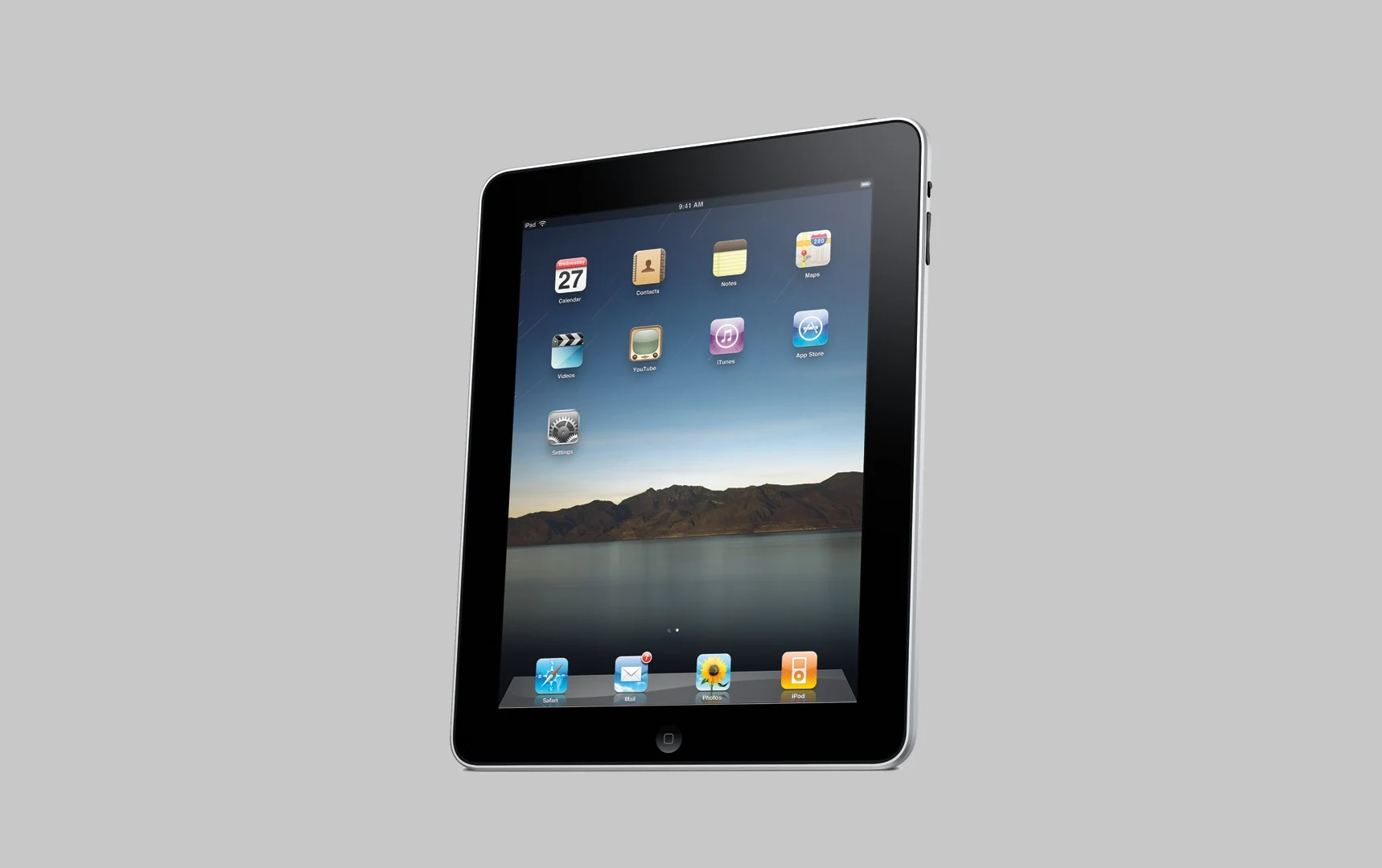
    Sixteen years ago, on January 27, 2010, Steve Jobs took the stage at the Yerba Buena Center for the Arts in San Francisco to introduce what he referred to as “a magical and revolutionary device.” This device was the original Apple iPad, and its launch signified the start of a new era in personal computing that would shape the current tablet market.

    Specifications of the First iPad

    The first-generation iPad was strategically placed between smartphones and laptops. It boasted a 9.7-inch LED-backlit multitouch screen, running on Apple’s inaugural custom-designed silicon chip. The device utilized a 30-pin dock connector and had storage options of up to 64 GB. Weighing in at 1.5 pounds, the original model featured thick black bezels, a physical Home button, and a curved aluminum backside. Apple advertised a battery life of up to 10 hours.

    With a starting price of $499, the iPad offered an easier, more user-friendly way to surf the web, read eBooks, watch videos, and use applications on a larger display. Jobs portrayed the tablet as a more personal and intuitive means of engaging with apps and digital content, especially for web browsing, media viewing, and reading.

    Jobs’ Vision for the iPad

    “iPad is our most advanced technology in a magical and revolutionary device at an unbelievable price. iPad creates and defines an entirely new category of devices that will connect users with their apps and content in a much more intimate, intuitive, and fun way than ever before,” Jobs stated.

    From a technical standpoint, the original iPad operated on a version of iOS tailored for its larger screen, bringing well-known apps like Safari, Mail, and Photos into a more expansive view. Apple also took this opportunity to launch iBooks and the iBookstore, marking the company’s entry into the e-reader sector, which was then dominated by Amazon’s Kindle.

    Mixed Reactions and Commercial Success

    The initial response to the iPad was a mix of opinions. Some reviewers praised the device as a top-notch platform for light computing and media experiences, while others doubted its necessity, claiming it lacked the functionality needed to replace a standard laptop. Even with these discussions, the iPad achieved impressive commercial success, selling over 300,000 units on its first day in April 2010 and hitting one million units within the first month. By the year’s end, total sales exceeded 15 million tablets, generating around $9.5 billion in revenue, solidifying the iPad as a vital Apple product.

    More significantly, the iPad sparked an entire industry. Competitors like Samsung, Microsoft, and Amazon quickly introduced their own tablets, each trying to either imitate or set themselves apart from Apple’s model.

    The iPad’s Evolution

    As time passed, the iPad transformed into a diverse range of devices. It expanded into the iPad mini, iPad Air, and iPad Pro, along with accessories like the Apple Pencil and Magic Keyboard. Later versions incorporated cameras, multitasking capabilities, various display sizes, USB-C connectivity, and enhanced performance levels akin to laptops. What started in 2010 as a “magical and revolutionary” concept has evolved into a well-known and impactful element of everyday computing.

    Apple, MacRumors’

    Source:
    Link


  • Instagram Launches Long-Awaited iPad App After 15 Years

    Instagram Launches Long-Awaited iPad App After 15 Years

    Key Takeaways

    1. Meta has finally released a native Instagram app for the iPad, 15 years after the device’s launch.
    2. The new app prioritizes Reels as the main feature for discovering and sharing content.
    3. A new Following tab organizes accounts into three categories: All, Friends, and Latest for easier navigation.
    4. The app’s layout allows for simultaneous viewing of comments alongside Reels without changing video size.
    5. This update follows the recent launch of an enhanced WhatsApp experience for iPad users.


    In 2010, Steve Jobs introduced the first iPad, a device that aimed to provide the “internet in your hands.” Yet, for 15 years, Meta has avoided creating a native Instagram app for this device.

    Finally Here!

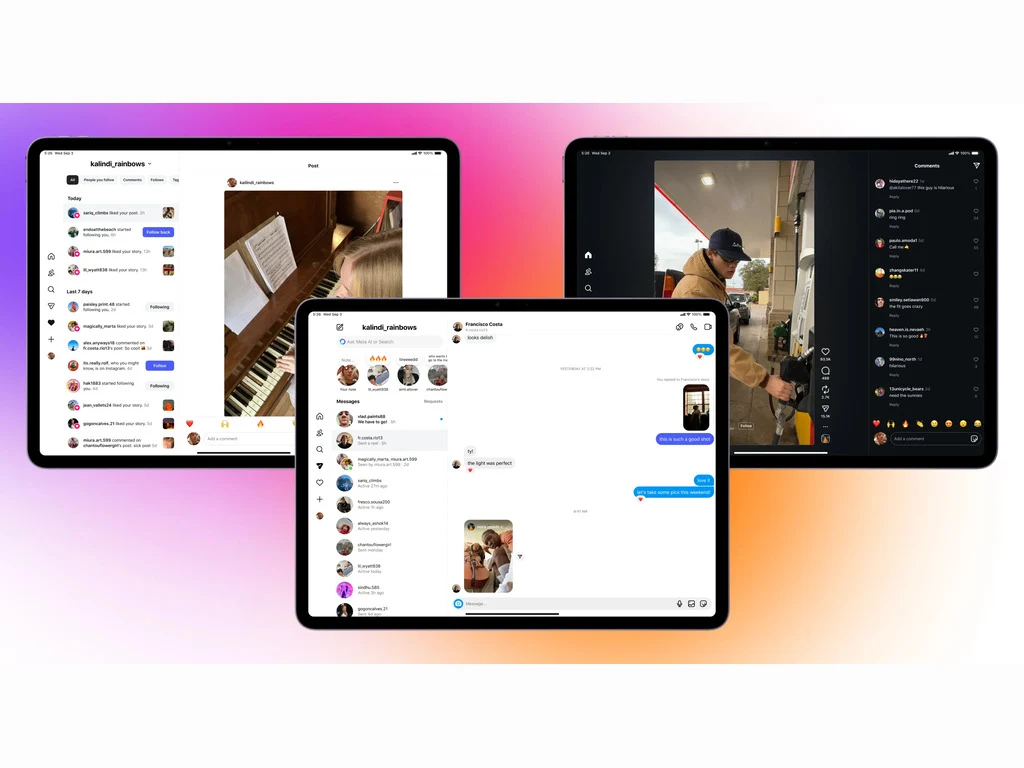
    That has changed with the debut of a native Instagram experience specifically for Apple’s tablet. The press release exclaims, “It’s finally here!” indicating that they took quite a while to get to this point.

    Focus on Reels

    The fresh app emphasizes Reels, making it the “main way for users to find and share entertaining content.” Upon opening the app, users are directly taken to Reels, with Stories displayed above. The navigation menu has been repositioned to the left, making it easier to move around the app with just a few taps.

    New Following Tab

    There’s a new Following tab that organizes your followed accounts into three distinct categories: All, Friends, and Latest. The All category shows posts and reels from everyone you follow, while Friends filters to only show content from those who follow you back. The Latest section arranges posts in chronological order, showing the newest content first.

    This revamped interface aims to simplify catching up on messages and notifications, featuring layouts that show both tabs. For instance, when viewing Reels, comments will appear on the side without altering the video size. The updated app is currently being launched to users all over the globe via the App Store on Apple devices.

    This update marks the second major Meta app to receive an enhanced experience for larger screens, following WhatsApp, which was released for the iPad a few months earlier.

    Source:
    Link


  • Apple Stops Development of Foldable iPad, Report Says

    Apple Stops Development of Foldable iPad, Report Says

    Key Takeaways

    1. Apple has reportedly paused development on its foldable iPad due to various challenges.
    2. Manufacturing issues, such as creating durable folding screens and hinge systems, are significant obstacles.
    3. Market demand for foldable tablets is currently limited, making it a niche segment.
    4. Internal evaluations may not support the investment needed for a foldable iPad at this time.
    5. The delay does not mean cancellation; Apple may revisit the foldable iPad concept in the future as technology and market conditions change.


    Rumors about a foldable iPad becoming part of Apple’s popular product range have been around for a while. The concept of a larger screen that can fold for easier carrying is definitely intriguing. Nevertheless, new reports indicate that these foldable iPad aspirations might be postponed, at least for the time being.

    Development Delays

    Although details are still quite limited and not officially confirmed by Apple, a recent report from DigiTimes suggests that Apple has stopped working on its foldable iPad. The reasons for this supposed hold-up refer to several crucial elements that may have caused Apple to rethink its short-term objectives in this field.

    Manufacturing Challenges

    A major obstacle frequently mentioned in the creation of foldable gadgets is the production process. Designing sturdy and dependable folding screens at scale presents a significant engineering challenge. Problems with the hinge system, screen folding marks, and overall durability are all issues that producers need to tackle. It’s likely that Apple faced challenges in meeting its quality benchmarks without causing prices to soar.

    Market Considerations

    In addition to production difficulties, there may also be factors related to market demand and pricing. While foldable technology is certainly captivating, the existing market for foldable tablets is probably a very niche segment when compared to regular tablets. Apple likely evaluates potential demand thoroughly, and it’s possible that internal estimates did not support the hefty investment needed for a costly, foldable iPad.

    It’s essential to understand that this reported delay doesn’t necessarily imply a total cancellation of a foldable iPad in the future. Apple is recognized for its long-term research and development initiatives, and the concept could definitely be revisited later as technology advances and market dynamics shift. The Apple Vision Pro, despite its market struggles, illustrates this point as it aims to play a significant role for the company down the line.

    At this moment, though, those who are eagerly waiting for a folding iPad from Apple may need to exercise a bit more patience.

    Source:
    Link

  • Apple iPad Launches with A16 Chip Starting at Rs 34,900

    Apple iPad Launches with A16 Chip Starting at Rs 34,900

    Key Takeaways

    1. Apple launched the new 7th Generation iPad Air with the M3 chipset on March 4, 2025, alongside a more affordable base iPad model.
    2. The base iPad features a 10.9-inch Liquid Retina display, an A16 processor, and comes with iPadOS 18 pre-installed.
    3. Both iPads include 12MP front and rear cameras, weigh around 480 grams, and have a battery life of up to 10 hours.
    4. The new iPad is available in four colors and offers WiFi-only or cellular options with three storage configurations.
    5. Pricing for the base iPad starts at Rs 34,900 for the 128GB WiFi model, with additional accessories like the Smart Folio and Magic Keyboard Folio available for purchase.


    Apple has just launched the new 7th Generation iPad Air featuring the M3 chipset today (4th March 2025). However, this release wasn’t a solo act; the company also introduced a new base iPad, which comes with a more budget-friendly price. Here’s all the important information.

    iPad Specifications

    The newest Apple iPad boasts a 10.9-inch Liquid Retina display that can reach a peak brightness of 500 nits. Unlike the iPad Air, the base model opts for an older Apple A16 processor instead of the M series chips; this is a 5-core CPU with 4 GPU cores and 16 Neural Engine cores. It’s available in three different storage options and comes pre-installed with iPadOS 18.

    Features of the iPad

    Like the iPad Air, the standard Apple iPad features a 12MP camera on the back and a 12MP camera on the front. It weighs about 480 grams and has a thickness of 7mm. The device is powered by a 28.6Whr battery, offering up to 10 hours of web surfing on WiFi. Additional features include stereo speakers, dual microphones, Bluetooth 5.2, and Touch ID.

    Pricing and Release Information

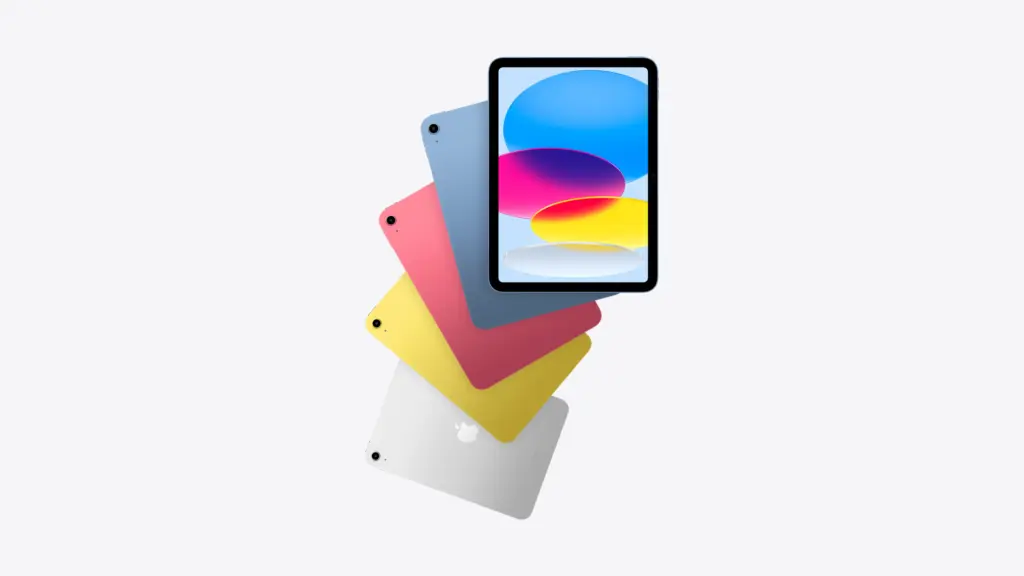
    Apple has released the new iPad in four color choices: Pink, Silver, Yellow, and Blue. There are options for WiFi only or cellular compatibility, along with three storage configurations. Here’s the pricing breakdown:

    iPad (WiFi Only)
    – 128GB – Rs 34,900
    – 256GB – Rs 44,900
    – 512GB – Rs 64,900

    iPad (WiFi + Cellular)
    – 128GB – Rs 49,900
    – 256GB – Rs 59,900
    – 512GB – Rs 79,900

  • Apple Denies iPad-Mac Rivalry, Unveils Touchscreen MacBook Plans

    Apple Denies iPad-Mac Rivalry, Unveils Touchscreen MacBook Plans

    Apple recently introduced the iPad Pro 2024, which surprisingly features the new M4 chipsets. This comes even though the M3 processors are still less than a year old. The latest iPad Pro models seem almost excessively powerful given the constraints of iPadOS. Historically, Apple has promoted these iPads as viable laptop alternatives, causing a blurring of the lines between tablets and laptops. Unlike iPads, MacBooks do not offer touchscreens or the same level of versatility. Now, Apple's VP of iPad and Mac Product Marketing has discussed how the two devices compare and whether Apple plans to add touchscreen support to its laptops.

    Apple Might Still Consider Touchscreen Macs

    The new iPad Pro models undeniably outperform Macs, but they fall short due to iPadOS's lack of optimization. In a discussion with The Wall Street Journal's Joanna Stern, Apple VP Tom Boger compared the two devices. According to Boger, Apple views iPads and MacBooks as complementary rather than competitive. The iPad is designed primarily for touch interaction, whereas the Mac is intended for use with a keyboard, mouse, or trackpad.

    When asked if Apple would introduce a touchscreen Mac, Boger clarified that iPads are designed for touch while Macs are not, due to the different computing paradigm offered by macOS. He noted that many users own both types of devices, using iPads to extend their work from Macs. Apple's Continuity feature further enhances this seamless integration.

    Future Possibilities for Touchscreen MacBooks

    Joanna Stern also inquired whether Apple might reconsider its stance on touchscreen MacBooks. Boger hinted at the possibility, stating, "Oh, I can’t say we never change our mind." This suggests that Apple has not entirely ruled out the idea of a touchscreen MacBook, even though it seems unlikely in the near term.

    Previously, Mark Gurman reported that Apple is indeed working on a touchscreen MacBook with a potential release date set for 2025.

  • Apple Pencil Pro Launches: New Abilities & Find My Support

    Apple Pencil Pro Launches: New Abilities & Find My Support

    Apple has unveiled its latest generation iPad Air and iPad Pro models along with the introduction of a new stylus called the Apple Pencil Pro. This upgraded stylus offers enhanced features, making it an attractive option for creative professionals.

    New Features of Apple Pencil Pro

    The Apple Pencil Pro maintains a similar design to its predecessor, featuring a matte finish and a flat side that can magnetically attach to the side of compatible devices such as the new iPad Pros with M4 processors and the iPad Air M2.

    Enhanced Functionality

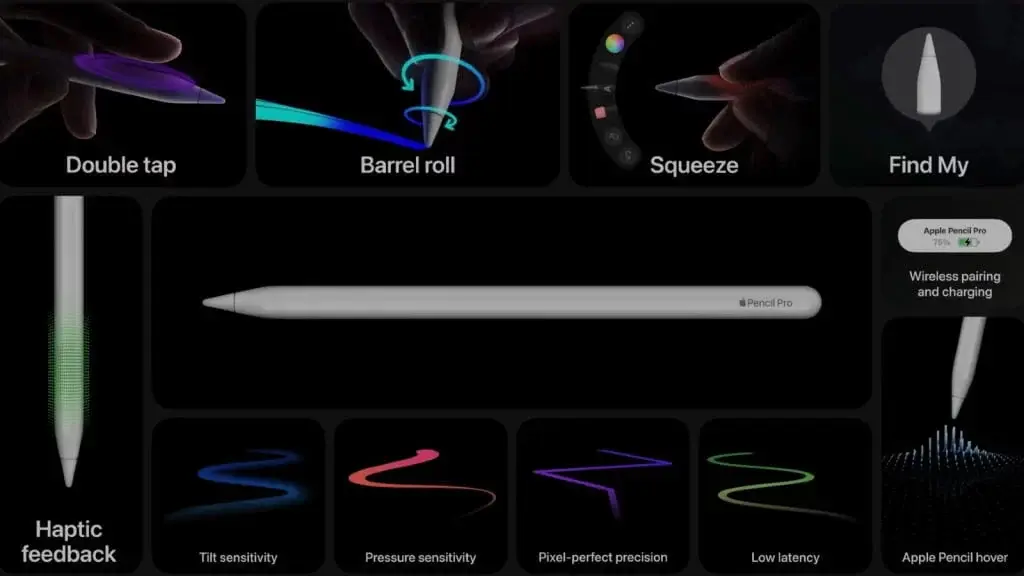
    Building on features from the previous model, the Apple Pencil Pro offers pixel-perfect accuracy, low latency, tilt and pressure sensitivity, wireless charging and pairing, hover capabilities, and double-tap functionality for changing tools. A new addition is the Squeeze feature, enabling users to execute actions like adding shapes or accessing the color palette by squeezing the stylus.

    Advanced Technology Integration

    Equipped with a new gyroscope, the Apple Pencil Pro allows users to rotate the barrel to adjust the orientation of the pen and brush tool, enhancing control and mimicking a pen-and-paper experience. The inclusion of a Hover feature enables users to preview where the pencil will mark for increased precision, while a custom haptic engine provides feedback based on stylus usage.

    The Apple Pencil Pro includes integration with Apple's Find My network for easy location in case of misplacement, offering peace of mind to users.

    The Apple Pencil Pro is now available for pre-order at a price of $129 (~Rs 11,900).

  • Unfortunate Update: New iPad Air to Retain LCD Display

    Unfortunate Update: New iPad Air to Retain LCD Display

    iPad mini, iPad, iPad Air, and iPad Pro are the tablets offered by Apple, with the Pro model boasting the best specifications. Initially rumored to feature mini-LED technology, the 2024 12.9-inch iPad Air will now come with an LCD screen, as Apple has opted out of incorporating mini-LED displays in this model.

    Ross Young, CEO of Display Supply Chain Consultants (DSCC) and a prominent analyst in the display industry, previously suggested that the 2024 iPad Air could sport a mini-LED panel. However, citing high manufacturing costs of mini-LED panels, he now reveals that the iPad Air will utilize an LCD panel instead.

    Apple's Decision and Future Plans

    Ross Young also hinted at Apple's plan to introduce a new iPad model equipped with a mini-LED display in late 2024. The specific model is yet to be determined—it might be a budget-friendly iPad Pro variant or an entirely fresh iPad series. While Apple is known to be developing a new iPad Air, detailed technical specifications remain undisclosed.

    Mini-LED Technology Overview

    Mini-LED display technology, known for enhancing contrast and providing deep black levels compared to LCD screens, falls short of the vibrant colors of OLED displays. By leveraging smaller LEDs for display illumination, mini-LEDs can deliver superior color accuracy. Although Apple integrated mini-LED panels in the 2021 iPad Pro, they have chosen not to include this technology in the iPad Air series due to its high production costs.

  • Apple ‘Let Loose’ Event on May 7: Expectations & Latest Updates

    Apple ‘Let Loose’ Event on May 7: Expectations & Latest Updates

    Last month, Apple introduced the MacBook Air M3 laptop, and now the tech giant based in Cupertino is preparing to showcase new devices.

    Apple’s Upcoming Event Announcement

    The company has organized a launch event set to occur in a few weeks, titled ‘Let Loose,’ featuring an artistic teaser suggesting the imminent release of new products.

    Numerous speculations have circulated, indicating that Apple is gearing up to reveal the next-generation iPads. This unveiling is highly anticipated as the previous year did not witness any new tablet announcements from the company.

    Apple Let Loose Event Details

    Scheduled for May 7 at 7 am PT, the Apple Let Loose event will be conducted virtually. Viewers can catch the live stream on Apple’s official YouTube channel, the Apple TV app, and the Apple Events website.

    The artistic depiction of the event showcases the Pencil alongside the Apple logo in a range of colors, alluding to enhanced graphic design capabilities. This visual cue suggests the potential launch of the next-generation iPads, accompanied by accessories like a new Pencil and Magic Keyboard.


    Apple 'Let Loose' Event on May 7: Expectations & Latest Updates
  • Resident Evil 4 coming to Apple iPhone, iPad, and macOS on December 20

    Resident Evil 4 coming to Apple iPhone, iPad, and macOS on December 20

    During the iPhone 15 series announcement, the company unveiled its plans to bring console level AAA games to its mobile devices and PCs. Resident Evil Village was one of the first titles to drop for the iPhone, and now, the release date for Resident Evil 4 has been revealed.

    Resident Evil 4 Launch Date

    The Cupertino based giant has confirmed that the game will be available on 20th December 2023. For those unaware, the title is the Resident Evil 4 Remake from Capcom. This means that it features improved visual fidelity along with a refreshed storyline. Furthermore, the title also supports PlayStation, Xbox, and other wireless controllers.

    However, even if you don’t have a controller, the game can be enjoyed thanks to built-in touch controls that are fully customizable. In other words, you can enjoy a console game on the go. The Resident Evil 4 Remake is releasing for the iPhone 15 Pro and iPhone 15 Pro Max that are running on iOS 17 or later. Similarly, iPads with the M1 chip or later that are running on iPadOS 17 or higher are also eligible for the game.

    Last but not least, MacBooks, Mac mini, and Mac Studio with the M1 or newer chips running on macOS 13 and higher can also run Resident Evil 4 Remake. The game is currently listed for pre-orders on the Apple App Store. A free demo will also be available for those wanting to try out the game before buying it. It is available for purchase for 59.99 US Dollars, with a DLC expansion listed for 19.99 US Dollars.