Tag: Core Ultra 9 285K

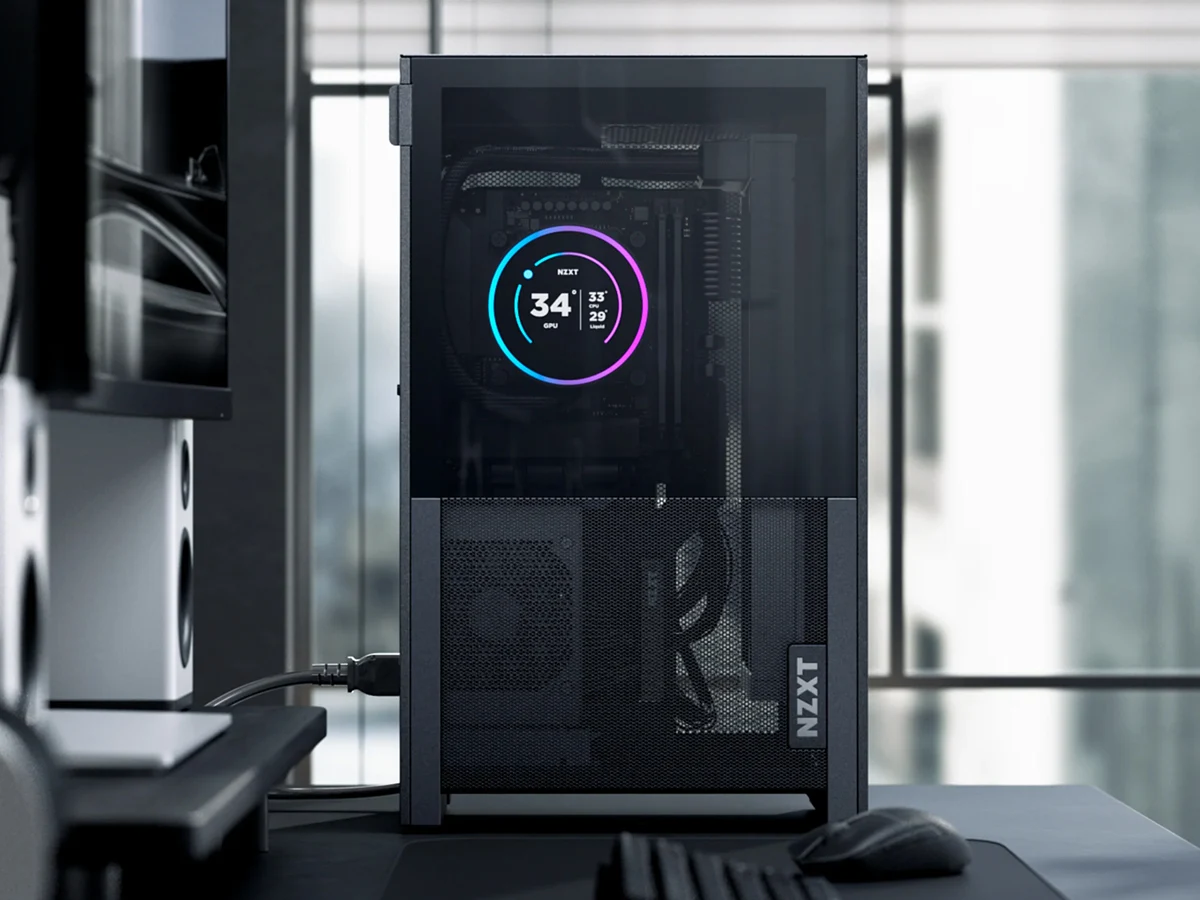
  • NZXT Launches H2 Mini PC with Nvidia RTX 5080 and CPU Options

    NZXT Launches H2 Mini PC with Nvidia RTX 5080 and CPU Options

    Key Takeaways

    1. NZXT has launched the H2 Flow, a compact mini-ITX case supporting up to a 280mm radiator and a 331mm graphics card.
    2. A prebuilt gaming PC is available, featuring the Nvidia RTX 5080 GPU with options for either Intel or AMD processors.
    3. The Intel setup uses the Core Ultra 9 285K with a Gigabyte Z890I Aorus Ultra motherboard, while the AMD option includes the Ryzen 7 9800X3D on a Gigabyte B850I Aorus Pro.
    4. Both configurations come with 32GB of DDR5 RAM, 2TB NVMe storage, and are capable of running AAA games smoothly at 1440p and over 60FPS at 4K.
    5. The H2 Flow case is priced at $149.99 and is available globally, while the prebuilt mini PC is exclusive to the US with a launch MSRP of $3,499.


    NZXT has unveiled the H2 Flow, a compact mini-ITX case that supports a radiator of up to 280mm and a graphics card as long as 331mm. For anyone looking to create a small form factor gaming mini PC with this case, the company is currently offering a well-equipped prebuilt system for a short period.

    Prebuilt Gaming Setup

    The prebuilt gaming PC features the desktop Nvidia RTX 5080 GPU (PNY Epic-X, currently priced at $1,399 on Amazon), and NZXT gives buyers the choice of pairing it with either an Intel or AMD processor. Specifically, one option includes the Core Ultra 9 285K, and for this setup, NZXT utilizes the Gigabyte Z890I Aorus Ultra motherboard.

    AMD Option

    On the other hand, the AMD configuration comes with the Ryzen 7 9800X3D, which is built on a Gigabyte B850I Aorus Pro. Both setups are equipped with 32GB of DDR5 RAM operating at 5200MHz, along with 2TB of NVMe storage. A Lian Li SP850G power supply unit drives the components, while the CPU is cooled using the Kraken Elite 240 Liquid Cooler.

    These Intel and AMD setups are highly capable of running AAA games smoothly at 1440p, and with some adjustments, you can achieve over 60FPS at 4K resolution too. However, be aware that the prebuilt NZXT H2 gaming mini PC is available exclusively in the US, with both options having a launch MSRP of $3,499.

    H2 Flow Availability

    If you’re only interested in the H2 Flow mini-ITX case, it is available worldwide for $149.99. For further insight into the chassis, you can check out the video linked below.

    Source:
    Link


  • Intel Nova Lake Power Consumption Leak: 496W PL2, 854W PL4

    Intel Nova Lake Power Consumption Leak: 496W PL2, 854W PL4

    Key Takeaways

    1. The flagship Intel Nova Lake-S processor may draw over 700 W during full multi-core use, with a PL2 power limit exceeding 400 W.
    2. Power limit specifications for Nova Lake-S include PL1 at 150 W, PL2 at 496 W, PL3 at 498 W, and PL4 at 854 W.
    3. Conflicting reports exist, with some leakers suggesting the power limits may not apply to the 52-core model but rather to the 42-core variant.
    4. Intel’s upcoming processors, including Nova Lake, are expected to have significantly higher power requirements compared to previous generations.
    5. Official announcements regarding Intel’s next-gen processors are still months away, so leaked specifications should be viewed with caution.


    Thanks to a steady stream of leaks and rumors, we’re learning quite a bit about Intel’s upcoming Nova Lake desktop processors, particularly their expected power limits. Recently, it was reported that the flagship 52-core Nova Lake-S could draw over 700 W during full multi-core use. Additional reports have indicated that the PL2 power limit for these Nova Lake-S chips also exceeds 400 W.

    Power Limit Specifications Revealed

    Leaker HXL has shared a table with details about the PL1, PL2, PL3, and PL4 power limits for Nova Lake-S. According to the leaker, these numbers apply to the dual-compute-tile Nova Lake-S K-series models, which feature up to 52 cores.

    From the leaked power limit data, it’s evident that the dual-compute-tile Intel Nova Lake desktop CPUs require significant power. The PL1 is set at 150 W, while PL2, PL3, and PL4 are 496 W, 498 W, and 854 W respectively. This makes the high-end Intel Core Ultra 400 series look extremely power-hungry. For example, the Intel Arrow Lake Core Ultra 9 285K has a PL1 of 125 W and a PL2 of 250 W. Meanwhile, the notorious 14th-gen Core i9-14900K, which runs at 6 GHz, shares the same PL1 and PL2 values as the Core Ultra 9 285K.

    Conflicting Information from Other Leakers

    However, another leaker, Jaykihn, has disputed HXL’s claims, referring to the leaked Nova Lake power limits as “outdated,” a sentiment echoed by UNIKO’s Hardware. More intriguingly, Jaykihn suggests that these figures may not pertain to the flagship 52-core Core Ultra 9 but rather to the 42-core Core Ultra 7 Nova Lake SKU, which includes 14 P-cores, 24 E-cores, and 4 LP E-cores.

    In essence, it’s possible that Intel has adjusted, maybe even reduced, the power limits for the Core Ultra 7 variant to align more closely with our expectations for Arrow Lake CPUs.

    That being said, it’ll be several months before we hear any official announcements regarding the next-gen Intel processors. Therefore, it’s wise to approach the leaked Nova Lake specifications, including power limits, with caution.

    Source:
    Link


  • Intel Nova Lake PL2 Power Limit Leaks for Core Ultra 400 CPUs

    Intel Nova Lake PL2 Power Limit Leaks for Core Ultra 400 CPUs

    Key Takeaways

    1. The Intel Nova Lake desktop CPU can draw over 700 W at full load, featuring 52 cores, which is significant for its market segment.
    2. The PL2 power limit for Nova Lake CPUs is expected to be higher than 400 W, particularly for models with dual compute tiles.
    3. Nova Lake CPUs will have a higher core count compared to Arrow Lake, increasing energy demands, making a 400+ W PL2 reasonable.
    4. High power limits do not align with average user needs for energy-efficient CPUs, as seen with the Ryzen 7 9800X3D and Core Ultra 9 285K.
    5. If Intel can maintain acceptable power limits for mainstream Nova Lake-S Core Ultra 5 CPUs while ensuring performance, concerns over high PL2 for 48/52-core models may lessen.


    We recently shared that the leading Intel Nova Lake desktop CPU, featuring 52 cores, can draw over 700 W when fully loaded. This number is truly astonishing, especially since Nova Lake is not aimed specifically at the high-end desktop (HEDT) market. We also pointed out that the PL2 power limit for the Nova Lake Core Ultra 400 CPUs will be lower but still noteworthy.

    Power Limit Insights

    Kopite7kimi suggests that even a PL2 of 400 W is merely a “conservative lower limit,” as Nova Lake CPUs equipped with dual compute tiles will need more than 400 W at full capacity. This represents a significant increase compared to the Core Ultra 9 285K.

    Intel’s official specifications indicate that the Core Ultra 9 285K has a PL2 of 250 W. Clearly, the CPU can draw much higher power under extreme conditions, as we’ve demonstrated in our assessments. Essentially, the Intel Nova Lake desktop CPUs will have a PL2 exceeding 60% compared to the 24-core flagship from Intel Arrow Lake.

    Core Count and Energy Needs

    It’s important to highlight that Nova Lake-S processors are set to have a substantial increase in core count over Arrow Lake. For instance, the top-tier Core Ultra 400 chip is anticipated to boast an impressive 52 cores. Naturally, powering this many cores simultaneously demands considerable energy, making the 400+ W PL2 reasonable.

    However, this high PL2 doesn’t align with the needs of the average user who seeks an energy-efficient CPU that performs adequately. Take the Ryzen 7 9800X3D as an example; it’s considered the top gaming CPU while also being one of the most power-efficient options available. The same can be said for the Core Ultra 9 285K. Even though the chip has seen a decline in gaming performance, it remains remarkably fast in multi-core applications, showing up to 64% more energy efficiency compared to the Core i9-14900K in multi-core tasks.

    Looking Ahead

    If Intel can guarantee that its mainstream Nova Lake-S Core Ultra 5 desktop CPUs, featuring 18, 24, and 28 cores, operate within acceptable power limits while delivering solid performance, the 400+ W PL2 for the 48/52-core models may not be a concern.

    Source:
    Link


  • Intel Nova Lake 52-Core CPU Power Consumption Leaks Revealed

    Intel Nova Lake 52-Core CPU Power Consumption Leaks Revealed

    Key Takeaways

    1. Intel’s Nova Lake-S desktop CPUs are expected to feature up to 52 cores and 288 MB of last-level cache, aiming to compete with AMD’s Zen 6 lineup.

    2. The K-series Nova Lake CPU may draw over 700 W under full load, indicating high power consumption, especially with power limits disabled.

    3. This high power consumption positions the Nova Lake as a High-End Desktop (HEDT) platform rather than a typical consumer CPU.

    4. The anticipated power usage of over 700 W is a significant increase compared to current Intel CPUs, like the Core Ultra 9 285K and i9-14900K.

    5. Buyers should prepare for a high price tag for the 52-core Nova Lake-S CPU and invest in a strong cooling solution.


    Intel’s upcoming Nova Lake-S desktop CPUs are likely to be released later this year. These new chips are expected to feature up to 52 cores and 288 MB of bLLC, potentially allowing Intel to compete more effectively with AMD’s upcoming Zen 6 CPU lineup. Nevertheless, as previously noted, the combination of 52 cores and 288 MB of last-level cache is expected to come at a very high price.

    Expected Power Consumption

    According to Kopite7kimi, the K-series Nova Lake desktop CPU, presumed to be the 52-core version, may draw over 700 W when under full load. This power consumption figure is believed to be with the power limits disabled, so a lower yet still considerable PL2 power limit is anticipated.

    Market Positioning

    This 700+ W figure is incredibly high for a consumer CPU aimed at everyday users and gamers. However, Kopite7kimi suggests that this should be viewed more as a High-End Desktop (HEDT) platform instead of a standard flagship consumer CPU, like the Core Ultra 9 285K (which is available on Amazon).

    Comparison with Current CPUs

    When comparing the 700+ W power usage of Nova Lake to Intel’s Arrow Lake, it represents a significant jump from the existing Arrow Lake CPUs. For example, the Core Ultra 9 285K reached a maximum of 356 W during a Cinebench R15 multi-core test, while even the extremely power-hungry Core i9-14900K peaked at 548 W in the same test. Therefore, with a consumption of over 700 W, the 52-core Intel Nova Lake-S flagship seems like a bold move for a non-HEDT CPU.

    However, when we look at current HEDT platforms, such as the Intel Xeon W-2400/W-3400 series and the Ryzen Threadripper 9000X processors, the anticipated power usage starts to make more sense.

    In any case, it’s evident that if you’re planning to grab the 52-core Nova Lake-S CPU upon its release, you should be ready to fork out a significant amount for both the CPU itself and a robust cooling solution.

    Source:
    Link


  • Ryzen 7 5800X3D vs Core Ultra 9 285K: Gaming Performance Test

    Ryzen 7 5800X3D vs Core Ultra 9 285K: Gaming Performance Test

    Key Takeaways

    1. The AMD Ryzen 7 5800X3D remains a top-performing gaming CPU, closely competing with Intel’s latest flagship, the Core Ultra 9 285K.
    2. At 1080p/Medium settings, the Ryzen 7 5800X3D achieved an average of 188 FPS, almost matching the performance of the Ryzen 5 9600X.
    3. Even at 1080p/Ultra settings, the Ryzen 7 5800X3D held strong against CPUs like the Core i5-14600K, with an average FPS of 151.
    4. There is a suggestion for AMD to reintroduce AM4 CPUs like the Ryzen 7 5800X3D, as DDR4 RAM prices are more affordable compared to DDR5.
    5. Reintroducing the Ryzen 7 5800X3D would provide gamers with a solid and cost-effective alternative in a challenging market for memory and SSDs.


    When we took a look at the AMD Ryzen 7 5800X3D back in 2022, it was the quickest gaming CPU available. It even outperformed the much pricier Core i9-12900K, which is Intel’s top 12th-gen CPU. Fast forward to today, and the Ryzen 7 5800X3D’s performance remains quite relevant. Actually, testing from Hardware Unboxed shows that the Ryzen 7 5800X3D is only a few percentage points behind Intel’s latest flagship, the Core Ultra 9 285K.

    Performance at 1080p/Medium

    In the 14 games that HU tested at 1080p/Medium settings, the Ryzen 7 5800X3D achieved an average of 188 FPS, along with a 1% Low of 151. This means the CPU was nearly on par with the Ryzen 5 9600X and was just a tad behind the Core Ultra 9 285K (which you can find on Amazon). The Ryzen 7 9800X3D, on the other hand, was noticeably faster, boasting a 35% higher average FPS compared to the Ryzen 7 5800X3D.

    Performance at 1080p/Ultra

    The findings were similar at 1080p/Ultra, where the Ryzen 7 5800X3D still held its ground against the Core i5-14600K and the Ryzen 5 9600X. For example, while the Core i5-14600K and Ryzen 5 9600X had an average FPS of 153, the Ryzen 7 5800X3D closely matched this performance with an average of 151 FPS.

    In simpler terms, even with recent games like Battlefield 6, the Ryzen 7 5800X3D can keep pace with the newest CPUs. This is excellent news for those who are already using this processor or are planning to build a new system with it.

    Potential Reintroduction of AM4 CPUs

    As pointed out by HU, it would be beneficial for AMD to bring back AM4 CPUs like the Ryzen 7 5800X3D. Due to the current shortage in RAM supply, the prices of DDR4 RAM modules, although still high, are much more reasonable compared to DDR5 RAM kits. Since the latest Zen 5 and Intel Arrow Lake chips only work with DDR5, building a PC with the newest Intel/AMD CPUs has become quite costly for everyday gamers.

    Thus, bringing back the Ryzen 7 5800X3D would offer consumers a solid and affordable alternative to the latest CPUs. This is particularly crucial now, as the memory and SSD market may worsen in the future, and improvements might not come until 2028.

    Source:
    Link


  • Core Ultra 9 285K vs Ryzen 7 9800X3D: Intel’s Gaming Struggles

    Core Ultra 9 285K vs Ryzen 7 9800X3D: Intel’s Gaming Struggles

    Key Takeaways

    1. Intel’s Arrow Lake Core Ultra 200S processors prioritize power efficiency over maximum performance.
    2. The gaming performance of the Core Ultra 200S chips has declined, significantly lagging behind AMD’s Zen 5 CPUs.
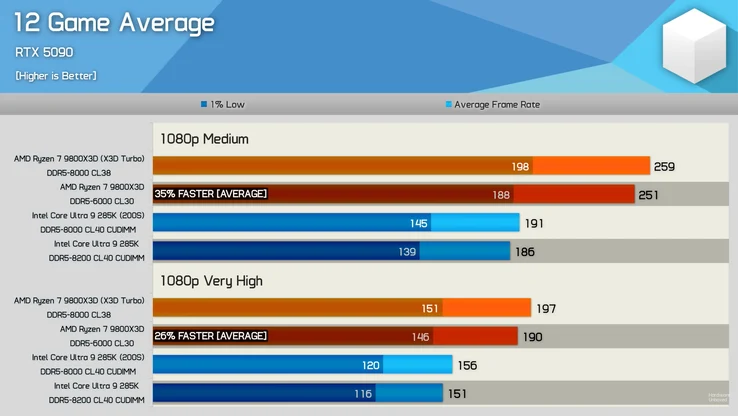
    3. The Ryzen 7 9800X3D outperformed the Core Ultra 9 285K by an average of 35% in gaming tests at 1080/Medium settings.
    4. Intel’s updates and the new 200S Boost overclocking tool provided only a slight 3% performance increase for the Core Ultra 9 285K.
    5. The Ryzen 7 9800X3D remains the top choice for gamers, while Intel faces challenges in regaining their former gaming performance dominance.


    With the launch of the Arrow Lake Core Ultra 200S desktop processors, Intel seems to have shifted its strategy. The focus moved from aiming for the highest performance to seeking better power efficiency. To some degree, Intel succeeded in cutting down the power usage of the Arrow Lake desktop chips while still maintaining solid single-core and multi-core performance. Nevertheless, the gaming capabilities of the Core Ultra 200S desktop processors saw a significant decline, falling short when compared to AMD’s Zen 5 CPUs.

    Performance Comparisons

    For example, in our review of the Zen5X3D chip, it was found that the Ryzen 7 9800X3D was an astonishing 40% quicker in gaming. Even though the Core Ultra 200S Arrow Lake chips debuted with some issues, Intel has since rolled out updates and fixes to help close the gaming performance gap. Moreover, they introduced a one-click overclocking tool named the 200S Boost, aimed at maximizing the performance of the Core Ultra 200S processors.

    Gaming Tests

    Hardware Unboxed conducted a comparison of the gaming performance between the Ryzen 7 9800X3D and the Core Ultra 9 285K, testing both with and without the 200S Boost to evaluate how much progress the Intel Arrow Lake flagship has made since its debut. Unfortunately, even with performance-enhancing updates and the 200S Boost, the Core Ultra 9 285K still could not compete with the Ryzen 7 9800X3D in gaming scenarios. According to Hardware Unboxed’s testing of 12 games at 1080/Medium settings, the Ryzen 7 9800X3D was about 35% faster on average. The margin narrowed when switching to 1080p/High settings, but it remained a noteworthy 26% ahead of the Core Ultra 9 285K. This is significant, especially given that the Core Ultra 9 285K utilized faster DDR5-8200 memory in comparison to the Ryzen’s DDR5-6000.

    Conclusion

    The gaming performance of the Core Ultra 9 285K reportedly saw a slight boost with the 200S Boost, but it was only around 3%. As a result, the Ryzen 7 9800X3D continues to be much swifter than the Core Ultra 9 285K, whether the chip is overclocked using the 200S Boost or not. In simple terms, if you are a gamer in search of the very best CPU, the Ryzen 7 9800X3D is the clear choice. This is a disappointing reality for Intel, as their CPUs were once the top performers in gaming. The outlook doesn’t seem to get any better with the forthcoming Intel Arrow Lake Refresh. However, Intel might have a shot at competing against AMD with Nova Lake, though that architecture is still a few years off.


  • Intel Arrow Lake Review: Core Ultra 200S CPUs’ Efficiency vs. Gaming

    Intel Arrow Lake Review: Core Ultra 200S CPUs’ Efficiency vs. Gaming

    The introduction of the Intel Arrow Lake Core Ultra 200S CPUs has stirred up quite a bit of debate. On one side, these new processors don’t really offer significant performance improvements and actually lag behind in gaming performance. On the flip side, Intel has indeed kept its word regarding a substantial boost in efficiency.

    Mixed Reviews

    With a multitude of reviews flooding in, it can be quite challenging for consumers to accurately assess the true capabilities of these products. Different publications have their own methods for testing CPUs, leading to varied results. Luckily, 3DCenter has gathered 20 reviews of the Arrow Lake launch, providing a comprehensive overview of Intel’s latest desktop processors.

    Performance Insights

    From what we can gather, the Arrow Lake CPUs show a slight but not particularly impressive increase in application performance. According to the data from 3DCenter, the top-end Core Ultra 9 285K is about 7% faster than the Core i9-14900K, but it is also 3% slower than the Ryzen 9 9950X.

    Dropping down the lineup, the Core Ultra 5 245K and Core Ultra 7 265K present performance boosts of 3.9% and 4.6% over the Core i5-14600K and Core i7-14700K, correspondingly. In addition, the Core Ultra 5 245K is 3.5% faster compared to the Ryzen 7 9700X, while the Core Ultra 7 265K matches the Ryzen 9 9900X’s performance.

    Gaming Performance Woes

    In a nutshell, Intel’s Arrow Lake chips offer a marginal enhancement over the 14th-gen models, but they lack hyperthreading. Unfortunately, the gaming performance takes a hit, with these CPUs generally underperforming compared to both their predecessors and the competing Zen 5 series.

    For example, the Core Ultra 9 285K is about 6% behind the Core i9-14900K and trails the Ryzen 9 9950X by 4.2%. It also cannot compete with the leading gaming processor, the Ryzen 7 7800X3D, which is a staggering 16% faster. This news is a letdown for Intel enthusiasts, particularly with the recent announcement of the Ryzen 7 9800X3D, which claims a 20% increase in gaming performance over the Core Ultra 9 285K.

    The Core Ultra 7 265K and Core Ultra 5 245K don’t perform much better either, with the former showing a 7% drop against the Core i7-14700K and the latter lagging by 4% against the Core i5-14600K. Furthermore, both the Ryzen 7 9700X and Ryzen 9 9900X outperform their Intel counterparts by 10% and 3.3%, respectively.

    Future Considerations

    In short, Intel supporters hoping for their favorite brand to surpass AMD will likely have to be patient for upcoming architectures like Panther Lake and Nova Lake, as Intel currently lacks a competitive response.

    One area where the Core Ultra 200S CPUs excel is in power consumption. Thanks to various enhancements, such as a new process node and the removal of hyperthreading, Intel has achieved significant reductions in power usage compared to the 14th-gen Raptor Lake CPUs. This topic has been explored in depth in our review of the Core Ultra 9 285K.

    Efficiency Gains

    According to 3DCenter’s data, the Core Ultra 9 285K has an average power consumption of just 147 W during application workloads, compared to 198 W for the Core i9-14900K and 160 W for the Ryzen 9 9950X. This lower energy usage allows the flagship Arrow Lake chip to boast 44% better energy efficiency in applications compared to the Core i9-14900K and 6% better against the Ryzen 9 9950X.

    The efficiency of Arrow Lake is also clear in gaming scenarios, where the Core Ultra 9 285K consumes roughly 88 W on average, outperforming both the Core i9-14900K (140 W) and the Ryzen 9 9950X (111 W). The only CPU that is faster in gaming and uses less power is the Ryzen 7 7800X3D, which stands out at just 56 W.

    Conclusion

    Turning to the Core Ultra 5 245K and Core Ultra 7 265K, these Arrow Lake models show application efficiency gains of 33% and 42% compared to the Core i5-14600K and Core i7-14700K, respectively. Nevertheless, the Ryzen 7 9700X remains more efficient than the Core Ultra 5 245K by 16%, and the Ryzen 9 9900X is still slightly behind the Core Ultra 7 265K by 9%.

    In conclusion, the gaming power consumption for both the Core Ultra 5 and Ultra 7 is lower than that of their 14th-gen counterparts and AMD’s Zen 5 processors, registering at only 68 W and 80 W, respectively.

    To summarize, Intel’s Arrow Lake chips seem to be aimed at users who are either upgrading from older architectures or are in search of processors that emphasize efficiency over raw performance. For everyone else, better alternatives are readily available in the market.

    Buy the Intel Core Ultra 5 245K | Ultra 7 265K on Amazon

    3DCenter


    Image 1
    Image 1
    Image 1
  • Intel Core Ultra 285K Sold Out, Restock Expected This Weekend

    Intel Core Ultra 285K Sold Out, Restock Expected This Weekend

    Yesterday, on October 25th, Intel introduced the Core Ultra processors, also referred to as the Arrow Lake-S CPUs. Shortly after, retailers began listing this new generation on their websites. Even though reviews about gaming performance are mixed, the top model, the Core Ultra 9 285K, appears to be performing well in sales.

    Quick Sell-Out in Japan

    Recent reports from Akiba indicate that the flagship processor sold out almost immediately in Japan. One retailer mentioned that the initial supply was quite limited. Regardless, it looks like the Core Ultra 9 285K is completely out of stock now.

    Availability in Tokyo

    Currently, the only places you can purchase it are Tsukumo PC and Tsukumo eX in Tokyo. Here, the seller has bundled it with the Intel Z890 motherboard or is selling it in bulk. This is a great option for customers looking to get the new LGA 1851 motherboard together with the processor. According to the Akiba report, a store employee said that shoppers should be able to buy the CPU this weekend.

    US Retailers Check

    In the US, we did a quick check on major retailers such as Amazon, Best Buy, and Newegg. As of now, the Core Ultra 9 285K is out of stock on both Newegg and Best Buy. On the other hand, it doesn’t appear to be listed on Amazon. For those interested, the Core Ultra 7 265K is available for $404 on Amazon, making it the next best option.

    If you happened to miss it, after launching the Core Ultra 200V processors in September, Intel has now launched its next series of CPUs—the Core Ultra 200 desktop series. Alongside these processors, Intel has also introduced the Intel Z890, which features the new LGA 1851 socket.


    Image 1
  • Intel Core Ultra 9 285K Beats i9-14900K by 11%, Lags vs Ryzen 9 9950X

    Intel Core Ultra 9 285K Beats i9-14900K by 11%, Lags vs Ryzen 9 9950X

    Intel has recently introduced its Arrow Lake-S series of desktop CPUs, and true to Intel’s style, there are some unique features. This time, the x86 giant has opted for a focus on efficiency, claiming that its new lineup delivers performance similar to the previous Raptor Lake-R models while consuming significantly less power.

    Benchmark Leaks Surface

    As expected, benchmark leaks for the new series are surfacing online. A recent leak highlights the single- and multi-threaded performance of the top-of-the-line Core Ultra 9 285K in CPU-Z and Blender. For those keeping track, the results are both surprising and underwhelming, especially considering that the Arrow Lake-S series lacks hyper-threading support, which might upset some users.

    Performance Insights

    In a prior Passmark test, the Core Ultra 9 285K showcased notable improvements in single-threaded performance, easily taking the top spot. However, due to the absence of hyper-threading, the 285K struggled against last-generation offerings from both AMD and Intel. In the new CPU-Z benchmark leak, the narrative changes. The Core Ultra 9 285K shows an 11% gain in multi-threaded performance, although it still falls short compared to the 14900KS and 14900K in single-threaded tasks.

    Thermal Concerns

    Interestingly, the benchmark results indicate that the Core Ultra 9 285K reached temperatures exceeding 100 degrees C, suggesting that the CPU experienced significant thermal throttling. Nevertheless, it did achieve peak speeds of 5.5 GHz on its P-cores and 4.6 GHz on its E-cores. Whether there was more performance to be had is uncertain, but it’s known that an ASRock Z890 motherboard was used alongside 2 x 16 GB of DDR5-5600 RAM and an RTX 4080 Super.

    Blender Results

    Turning to the Blender benchmark outcomes, the data shows that the Core Ultra 9 285K surpasses the i9-14900K by a notable margin of over 14%, yet it is clearly outperformed by AMD’s Ryzen 9 9950X, which leads the 285K by nearly 7%. The specifics of the hardware used in these tests remain unclear, indicating that the results may not fully reflect real-world performance.

    momomo_us, 9550pro via Twitter


    Image 1
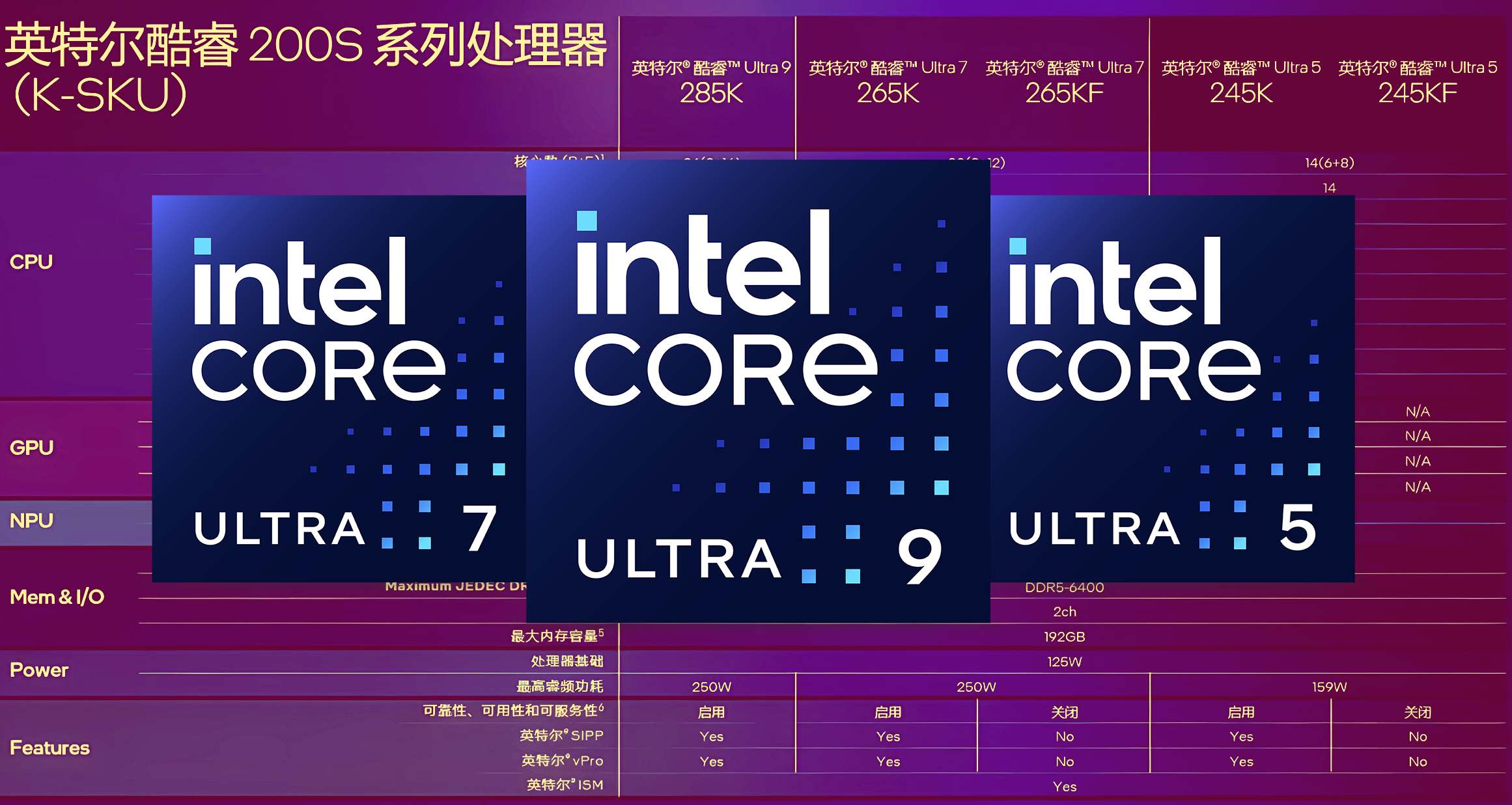
  • Intel Arrow Lake-S: Core Ultra 9 285K, 7 265K, 5 245K Specs Confirmed

    Intel Arrow Lake-S: Core Ultra 9 285K, 7 265K, 5 245K Specs Confirmed

    Intel’s new Arrow Lake-S series of desktop CPUs is under a lot of pressure to compete against AMD’s strong push in the CPU market. We had some clues about what to expect, but a recent leaked slide has revealed the complete lineup, confirming what we can look forward to.

    What’s Included in the Lineup

    The slide shows that the Arrow Lake-S series will feature five different models. Leading the pack is the Core Ultra 9 285K CPU, which boasts 24 cores but, unfortunately, has only 24 threads due to the lack of hyperthreading. These cores are divided into 16 ‘Skymont’ efficiency cores and 8 ‘Lion Cove’ performance cores. This CPU can reach speeds of up to 5.7 GHz and has a thermal design power (TDP) of 250 W.

    Mid-Tier Options

    Following that, the series includes the Core Ultra 7 265K and Core Ultra 7 265KF CPUs. Both of these models come equipped with 8 performance cores and 12 efficiency cores, summing up to 20 cores and 20 threads. Like the previous model, neither supports hyperthreading. The Core Ultra 7 265KF, as indicated by its name, lacks integrated graphics, while the Core Ultra 7 265K includes an integrated GPU with 4 Xe cores running at 2.0 GHz. Additionally, the ‘KF’ version does not support Intel vPro and SIPP features.

    Entry-Level Choices

    Lastly, we have the Core Ultra 5 245K and Core Ultra 5 245KF CPUs. Both models feature a 14-core setup with 6 efficiency and 8 performance cores. The situation is similar to the earlier variants: the Core Ultra 5 245K has an integrated GPU with 4 Xe cores clocked at a slightly lower speed of 1.9 GHz and includes vPro and SIPP support, while the 245KF model does not have these features.

    All CPUs in this lineup support up to 192 GB of dual-channel DDR5-6400 RAM and come with 24 PCIe lanes. Intel is set to officially announce these new CPUs in the near future, but getting a sneak peek like this is always exciting. Based on the leaked performance tests of the Core Ultra 9 285K, it seems that Intel’s Arrow Lake-S series is expected to deliver impressive single-threaded performance.

    Purchase Recommendation

    HXL via Twitter


    Image 1