
Key Takeaways
1. Intel’s Arrow Lake Core Ultra 200S processors prioritize power efficiency over maximum performance.
2. The gaming performance of the Core Ultra 200S chips has declined, significantly lagging behind AMD’s Zen 5 CPUs.
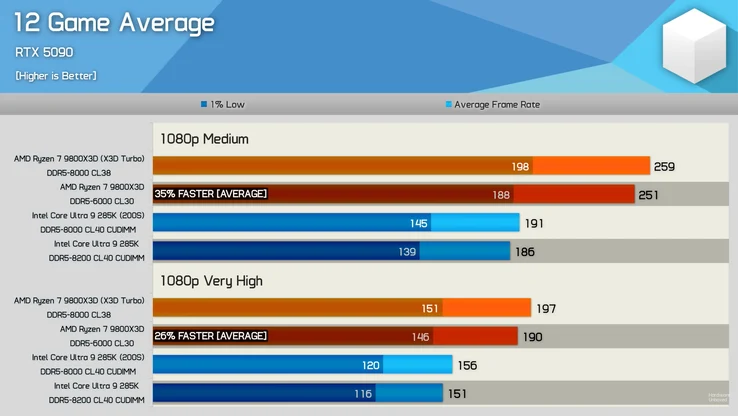
3. The Ryzen 7 9800X3D outperformed the Core Ultra 9 285K by an average of 35% in gaming tests at 1080/Medium settings.
4. Intel’s updates and the new 200S Boost overclocking tool provided only a slight 3% performance increase for the Core Ultra 9 285K.
5. The Ryzen 7 9800X3D remains the top choice for gamers, while Intel faces challenges in regaining their former gaming performance dominance.
With the launch of the Arrow Lake Core Ultra 200S desktop processors, Intel seems to have shifted its strategy. The focus moved from aiming for the highest performance to seeking better power efficiency. To some degree, Intel succeeded in cutting down the power usage of the Arrow Lake desktop chips while still maintaining solid single-core and multi-core performance. Nevertheless, the gaming capabilities of the Core Ultra 200S desktop processors saw a significant decline, falling short when compared to AMD’s Zen 5 CPUs.
Performance Comparisons
For example, in our review of the Zen5X3D chip, it was found that the Ryzen 7 9800X3D was an astonishing 40% quicker in gaming. Even though the Core Ultra 200S Arrow Lake chips debuted with some issues, Intel has since rolled out updates and fixes to help close the gaming performance gap. Moreover, they introduced a one-click overclocking tool named the 200S Boost, aimed at maximizing the performance of the Core Ultra 200S processors.
Gaming Tests
Hardware Unboxed conducted a comparison of the gaming performance between the Ryzen 7 9800X3D and the Core Ultra 9 285K, testing both with and without the 200S Boost to evaluate how much progress the Intel Arrow Lake flagship has made since its debut. Unfortunately, even with performance-enhancing updates and the 200S Boost, the Core Ultra 9 285K still could not compete with the Ryzen 7 9800X3D in gaming scenarios. According to Hardware Unboxed’s testing of 12 games at 1080/Medium settings, the Ryzen 7 9800X3D was about 35% faster on average. The margin narrowed when switching to 1080p/High settings, but it remained a noteworthy 26% ahead of the Core Ultra 9 285K. This is significant, especially given that the Core Ultra 9 285K utilized faster DDR5-8200 memory in comparison to the Ryzen’s DDR5-6000.
Conclusion
The gaming performance of the Core Ultra 9 285K reportedly saw a slight boost with the 200S Boost, but it was only around 3%. As a result, the Ryzen 7 9800X3D continues to be much swifter than the Core Ultra 9 285K, whether the chip is overclocked using the 200S Boost or not. In simple terms, if you are a gamer in search of the very best CPU, the Ryzen 7 9800X3D is the clear choice. This is a disappointing reality for Intel, as their CPUs were once the top performers in gaming. The outlook doesn’t seem to get any better with the forthcoming Intel Arrow Lake Refresh. However, Intel might have a shot at competing against AMD with Nova Lake, though that architecture is still a few years off.

Leave a Reply