Tag: camera comparison

  • Oppo Find X9 Ultra vs Vivo X300 Ultra: Best Value

    Key Takeaway

    – Oppo Find X9 Ultra wins on battery life, audio quality, and connectivity speed.
    – Vivo X300 Ultra has a superior display, better cameras, and more powerful haptics.
    – Oppo runs cooler under load, while Vivo’s software and brightness control are more polished.
    – Vivo is significantly more expensive in Europe (€2,000 vs. €1,500), but prices drop as imports.
    – Choice depends on priorities: performance & endurance (Oppo) vs. display & photography (Vivo).


    Comparing the Oppo Find X9 Ultra and Vivo X300 Ultra

    In our reviews of the Oppo Find X9 Ultra and Vivo X300 Ultra, both smartphones, powered with the Snapdragon 8 Elite Gen 5, present themselves as strong companions for everyday use. However, a direct comparison between the Oppo and Vivo phones reveals that both flagships have different strengths and weaknesses and therefore appeal to different types of users. Their pricing also realy differs right from the start.

    Pricing and Storage Configurations

    There are already clear price differences. In Europe, the Find X9 Ultra is available for an RRP of just under €1,500, while the X300 Ultra is more expensive. The RRP for the only storage option with 16 GB of RAM and 1 TB of storage, is just under €2,000. As imports, however, the prices already start noticeably lower for both flagships (around $1,100). This makes the Oppo a considerably more affordable option, but the Vivo’s premium price tag may be justified by some high-end features.

    Audio and Battery Performance

    The difference between the Oppo Find X9 Ultra and Vivo X300 Ultra is clear when it comes to audio quality. The Oppo phone delivers more powerful and balanced speakers and the drivers offer more depth, more stable highs as well as a significantly more linear frequency response in our measurements. The SPL value is also around 4.5 dBA higher than that of the Vivo phone, which sounds flatter in direct comparison and drops more sharply at high frequencies. Another advantage of the Find X9 Ultra is its battery life.

    The 7,050 mAh silicon-carbon battery lasts over five hours longer in the Wi-Fi battery test than the 6,600 mAh battery of the Vivo X300 Ultra. This is a difference that is definitely noticeable in everyday use. The slightly lower temperature development also speaks in favor of the Oppo flagship. Both top phones struggle with the high heat output of the Snapdragon 8 Elite Gen 5 under continuous load, but the Vivo phone reaches almost 55 °C in our measurements, while the Find X9 Ultra’s case remains slightly cooler at around 50 °C.

    Connectivity and Storage Speed

    The Find X9 Ultra is also ahead in terms of connectivity and storage performance. It even sets new records in our Wi-Fi measurements, while the Vivo flagship only achieves around half the speed. However, the approximately 2,000 Mbit/s of the Vivo phone is more than sufficient in everyday use, so the Find X9 Ultra’s advantage is more theoretical. The situation is similar with UFS storage. Here, the Oppo flagship is almost twice as fast in our review but the practical added value is likely to be rather small. For most users, the Vivo’s slower speeds will not be a hinderance.

    Display and Camera Advantages of the Vivo

    On the other hand, the Vivo X300 Ultra has noticeable advantages when it comes to the display and cameras. The 6.82-inch OLED panel is significantly brighter in everyday use than the Oppo phone’s 144 Hz screen. While the Find X9 Ultra only achieves around half of the advertised maximum brightness and cannot maintain it for long, the Vivo phone remains stable in our measurements and impresses with better automatic brightness control. Oppo’s automatic brightness control often sets it too low in everyday use. The vibration motor also seems more powerful on the Vivo phone, a point that is often underestimated in everyday use.

    The Vivo X300 Ultra is also ahead in terms of camera quality. The ultra-wide-angle camera delivers visibly better results thanks to its larger sensor, and the main camera also benefits from Vivo’s truly excellent, probably industry-leading software. The Oppo Find X9 Ultra can keep up here, but in our opinion, it does not quite reach the level of the Vivo flagship. On the other hand, the Oppo flagship offers practical special buttons, including for camera functions, which the Vivo model completely lacks.
  • Oppo Find X9 Ultra Camera Review: Smarter Than 1-Inch Sensors

    Oppo Find X9 Ultra Camera Review: Smarter Than 1-Inch Sensors

    Key Takeaway

    – The Find X9 Ultra’s new 200MP Sony sensor offers better dynamic range and detail than the Find X8 Ultra’s 1-inch sensor.
    – The Find X9 Ultra has a significant edge in high-magnification zoom quality.
    – The Find X8 Ultra performs slightly better in absolute darkness (less grain).
    – The Find X9 Ultra is roughly $400 more expensive than the Find X8 Ultra.


    Oppo’s Camera Flagships Compared

    The camera smartphones from Oppo have been among the most exciting camera phones in the Android ecosystem for several years now. With the Find X9 Ultra, the manufacturer is now launching a new flagship with outstanding hardware. But its predecessor, the Find X8 Ultra, still claims to deliver the best photo quality.

    Daily Performance and Price Differences

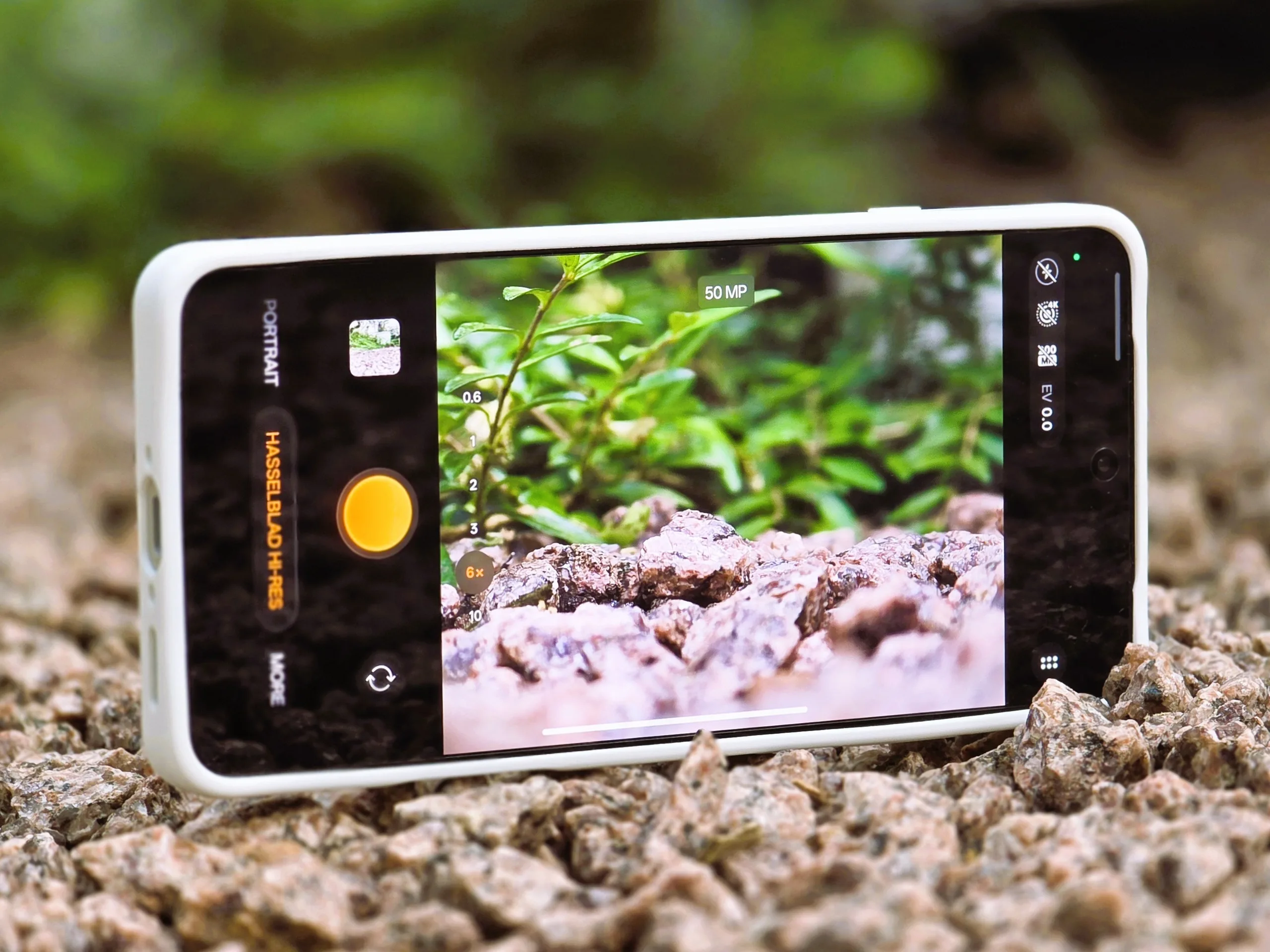
    In this comparison, we take a look at how the Hasselblad cameras of the two Oppo flagships perform in everyday use. Does the Find X9 Ultra really deliver the better photos? Or is the 2025 model with its 1-inch sensor more convincing after all? In terms of price, the Find X8 Ultra starts at around $800, while its successor, as an import, currently starts at around €1,037, making it roughly $400 more expensive.

    The Sony Sensor Advantage

    Compared to the Find X8 Ultra, the Sony camera in the Find X9 Ultra achieves a significantly higher light yield — at least that’s what the manufacturer says. According to Oppo, the increase is ten percent for the main camera. However, the stacked sensor “only” measures 1/1.12 inches and is therefore smaller than the 1-inch format of the Find X8 Ultra. On the other hand, the Sony Lytia 901 with 200 MPix offers four times the resolution and therefore significantly more scope for pixel binning to reduce image noise in low light.

    Real-World Photo Results

    The photo results, as well as the shots in the review, speak in favor of the Find X9 Ultra’s new sensor. The photos offer slightly more dynamic range and, thanks to variable pixel binning, the images also show a little more detail than the Find X8 Ultra’s. Only in absolute darkness (book motif) does the 200-MPix camera produce slightly more grain than the 2025 flagship with its 1-inch-format lens.

    How to View Full Resolution Images

    In order to better differentiate image details between the two top Oppo smartphones, all image files can bei open in full resolution. Click the corresponding photos to open them.

    Zoom Performance Gains

    Apart from the main cameras, the Find X9 Ultra has made significant gains in terms of photo quality, especially when zooming in at high magnification. You can find all the camera samples and information about the new Oppo high-end phone in the full review.

    • Find X8 Ultra starts at around $800
    • Find X9 Ultra starts at around €1,037 (import)
    • Price difference is roughly $400
    • Sony Lytia 901 features 200 MPix
    • Find X9 Ultra sensor measures 1/1.12 inches
    • Find X8 Ultra uses a 1-inch sensor
    • Main camera light yield increased by ten percent
    Sources
  • Vivo X300 Ultra vs Sony Alpha A7 Full-Frame Camera Comparison

    Vivo X300 Ultra vs Sony Alpha A7 Full-Frame Camera Comparison

    Key Takeaway

    1. The Vivo X300 Ultra’s 200MP sensor produces sharper images than a Sony Alpha A7 III with a 24-70mm GM2 lens, despite the smaller sensor size.
    2. The Vivo device offers competitive color accuracy and quality, closely resembling that of a professional Sony camera.
    3. While the Vivo X300 Ultra shows strong performance, it lacks testing in challenging lighting conditions like night scenes or fast-moving subjects.
    4. The comparison highlights that high-resolution smartphone cameras can rival some traditional full-frame cameras in image detail and color.

    Interesting Easter Content for Photography Enthusiasts

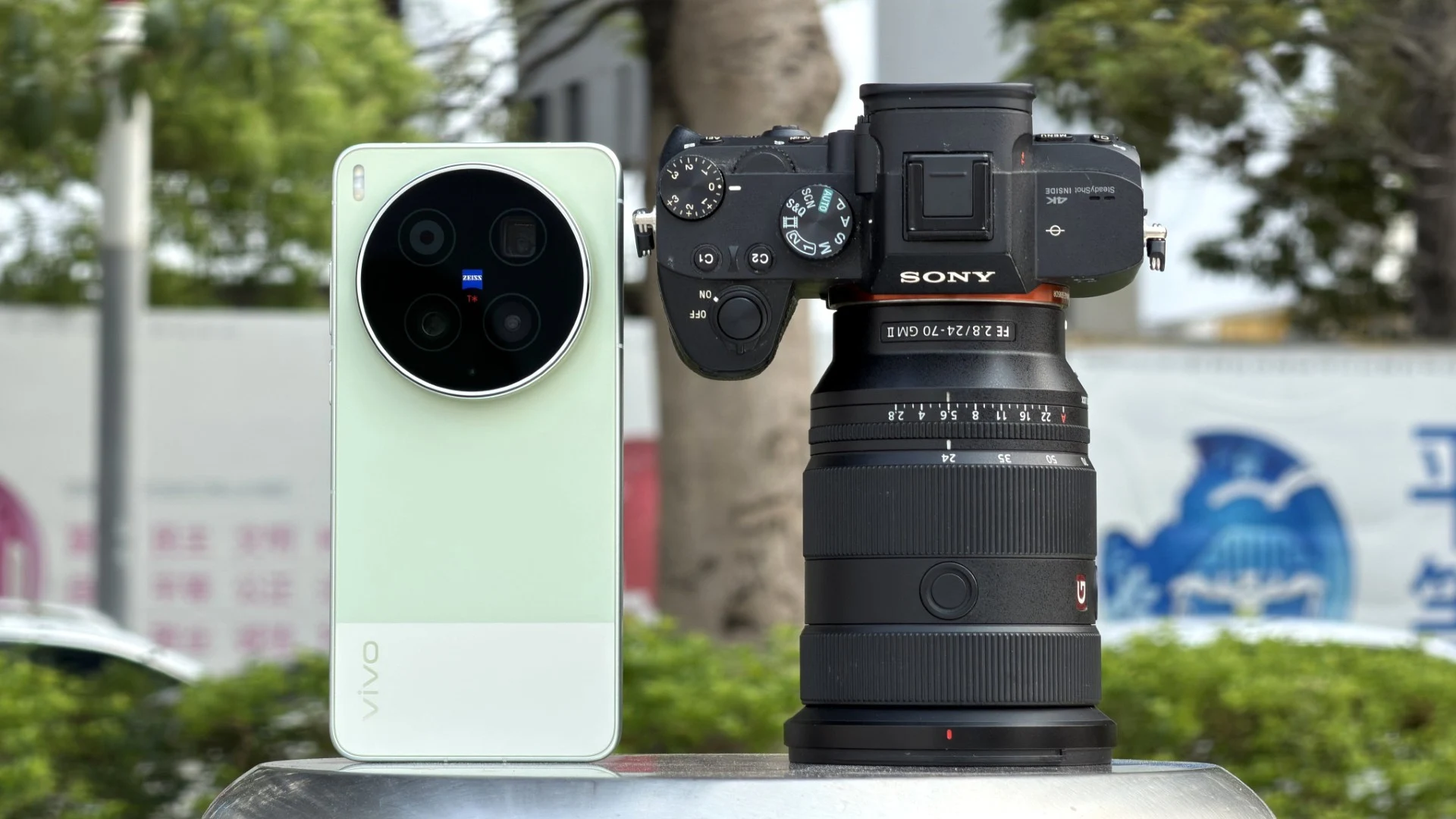
    If you are just bored this easter weekend and want somthing fun and educational, then you should really check out a cool video made by fenibook that you can find on YouTube. The video offers an hands-on look at how a new 35mm 1/1.12-inch 200MP sensor in the Vivo X300 Ultra stacks up against a more traditional setup using a Sony Alpha A7 III with a 24-70mm GM2 zoom lens. And for those who like to dig deeper, a Google Drive archive has been made public where you can see all the original files from the face-off—so you can see firsthand the detailed comparison.

    Cost and Specifications: Deep Dive

    When talkin about the price tags, the Sony full-frame mirrorless camera plus the zoom lens come with a hefty price point. The camera body alone is priced at $1,999 and is discounted to $1,698. The zoom lens is quite more expensive at $2,449. That makes the Vivo X300 Ultra, estimated at around $2,000, look more appealing, especially considering it is more compact and lighter. But some experts think a better cost-effective alternative might be something like the Panasonic Lumix S5D, which offers good features without breaking the bank.

    Video Quality and Comparative Analysis

    The comparison video, despite being in Chinese and lacking effective subtitles, clearly shows that the Vivo X300 Ultra’s 200 MP images are sharper than the Sony’s 24 MP shots most of the time. That revelation is quite astonishing considering the big difference in megapixels, especially given the Sony sensor’s size – which is about nine times larger than Vivo’s LYT-901 sensor. Many expected the larger sensor to have the edge, but it seems the Vivo has made incredible progress in resolution and detail.

    Color Accuracy and Technical Limitations

    Vivo also seems to be doing very well with color reproduction, often matching what the professional Sony camera produces. Vivo claims that their multispectral sensor and new algorithms help them improve color fidelity and detail, which is evident in many of the shots. However, critics have pointed out that the comparison lacks challenging lighting conditions like night shots or fast-moving subjects in low light. The absence of comparisons at different focal lengths, such as 14mm or 85mm lenses, might be due to the fixed zoom range of the Sony lens, but this brieffall doesn’t take away from the fact that Vivo’s flagship camera holds its ground in some aspects against a much more expensive full-frame camera system—showing that even in still photography, the new tech can hold up very well in practical scenarios.

    Sources
  • Samsung Galaxy S26 Ultra Hands-On Comparison Images Revealed

    Samsung Galaxy S26 Ultra Hands-On Comparison Images Revealed

    Key Takeaways

    1. The Galaxy S26 Ultra was released in select locations, including Dubai, just days before the Galaxy Unpacked event.
    2. A tech YouTuber purchased the Galaxy S26 Ultra for around $3,300, but the storage capacity is unclear and preorder offers were not included.
    3. Initial impressions include comparisons with the Galaxy S25 Ultra and Apple’s iPhone 17 Pro Max, showcasing the new device’s features.
    4. The camera bump on the S26 Ultra is thicker than the S25 Ultra, despite no major changes in sensor hardware.
    5. The periscope telephoto camera design has changed from rectangular to round, and the new display feature is highlighted in a hands-on video.


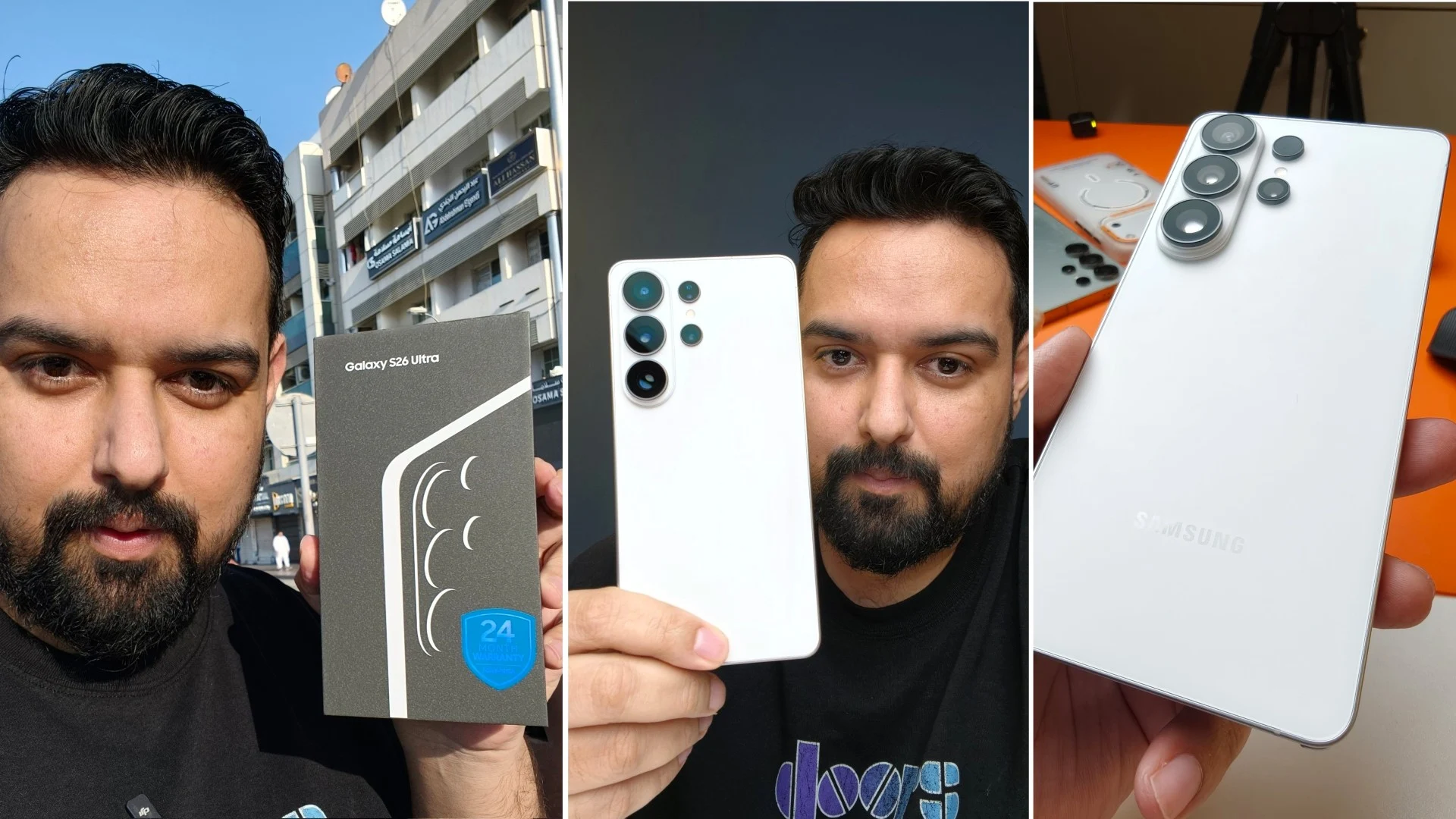
    Just four days ahead of the highly anticipated Galaxy Unpacked event, the Galaxy S26 Ultra has already hit the shelves in select places like Dubai. Tech YouTuber Sahil Karoul managed to snag a white Galaxy S26 Ultra for approximately $3,300. The specific storage capacity of this unit remains unclear, and it appears that preorder offers were not included in his purchase.

    Initial Impressions

    In the first set of images, the eager buyer showcases the pricey white Samsung flagship for the camera, and after quickly setting it up and moving data from a Galaxy S25 Ultra (which you can find on Amazon), he jumps into comparisons with various other smartphones. These comparisons feature the previous model, Apple’s iPhone 17 Pro Max, in addition to the Vivo X300 Pro.

    Camera Design Observations

    One thing that stands out is the thickness of the new camera bump, which looks quite pronounced, especially when compared to the S25 Ultra that already appears somewhat worn in these initial photos. The camera module seems particularly hefty when viewed from the side, which is a bit surprising since the sensor hardware hasn’t reportedly undergone major changes from the last model, even though the optics have become noticeably quicker.

    Changes in Telephoto Design

    Another noticeable change is the alteration in the shape of the periscope telephoto camera, which has shifted from a rectangular to a round design. Additionally, Sahil has uploaded a preliminary hands-on video that emphasizes the new display feature of the Galaxy S26 Ultra, which is likely to be one of its most captivating highlights.

    @KaroulSahil

    Source:
    Link


  • Cheaper Phone 3a Pro vs Flagship Phone 3: Camera Test Results

    Cheaper Phone 3a Pro vs Flagship Phone 3: Camera Test Results

    Key Takeaways

    1. The Nothing Phone (3) excelled in main camera performance, consistently ranking high in the evaluation.
    2. The Nothing Phone (3a) Pro performed well, particularly in selfie images, low-light conditions, and audio quality.
    3. In video performance, the Nothing Phone (3) was the clear leader, especially in stabilization and zoom capabilities.
    4. Both the Nothing Phone (3a) and (3a) Pro underperformed in macro and tele-macro photography, while the Phone (3) and CMF Phone 2 Pro delivered better results.
    5. Despite the Nothing Phone (3) being a flagship device priced at nearly double the (3a) Pro, the performance difference was found to be disappointing.


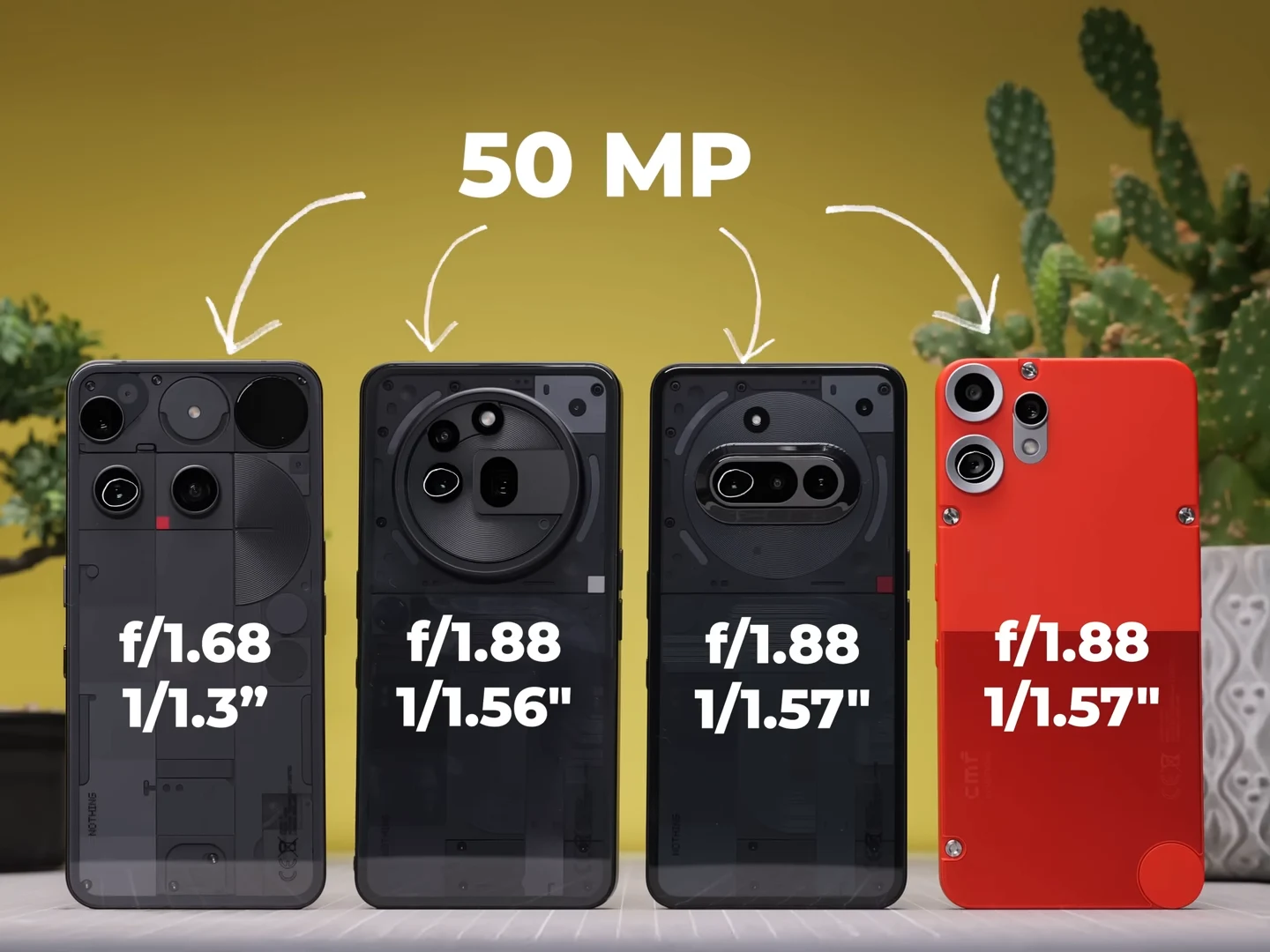
    In a recent camera comparison video released two days ago, Versus conducted a thorough evaluation of various devices. The assessment included different categories such as main camera, ultra-wide camera, portrait, video, audio, slow motion, zoom, macro, low light, selfie, and more.

    Main Camera Showdown

    When it came to main camera photos, the Nothing Phone (3) emerged as the frontrunner and kept its position throughout the evaluation. Nevertheless, it faced some tough competition from the Nothing Phone (3a) Pro, which was not far behind and even surpassed the Phone (3) in several categories. The (3a) Pro excelled in capturing selfie images, low-light scenarios, and audio quality.

    Video Performance

    In the video categories, which included outdoor and indoor testing as well as stabilization and slow-motion capabilities, the Nothing Phone (3) clearly stood out as the top performer. For zoom photography, it outperformed the competition by a significant margin, thanks to its advanced AI-powered image processing.

    Macro and Tele-Macro Results

    Surprisingly, the macro and tele-macro performance was a letdown for both the Nothing Phone (3a) and the (3a) Pro. On the other hand, the flagship Phone (3) and the budget-friendly CMF Phone 2 Pro (currently priced at $299 on Amazon) delivered satisfactory results. The CMF Phone 2 Pro produced well-colored images, while the Phone (3) captured finer details in its pictures.

    In conclusion, the rankings showed that the Phone (3) claimed the top position. However, the difference in performance was rather disappointing, especially considering it is marketed as a flagship device and was priced at nearly twice that of the Phone (3a) Pro, which retails for $799.

  • Xiaomi 15 Ultra Teardown: Discover Its Inner Secrets

    Xiaomi 15 Ultra Teardown: Discover Its Inner Secrets

    Key Takeaways

    1. WekiHome disassembled the Xiaomi 15 Ultra just after its launch in China, revealing details about its new features.
    2. The Xiaomi 15 Ultra boasts a 200 MP telephoto camera using Samsung’s ISOCELL HP9 sensor.
    3. Compared to its predecessor, the new model lacks the variable aperture and instead uses a glass filter for better reflection diffusion.
    4. The motherboard has grown significantly to accommodate the new camera sensor, taking up almost half of the phone’s space.
    5. The Xiaomi 15 Ultra is reported to be difficult to repair due to many screws, plastic clips, and adhesive.


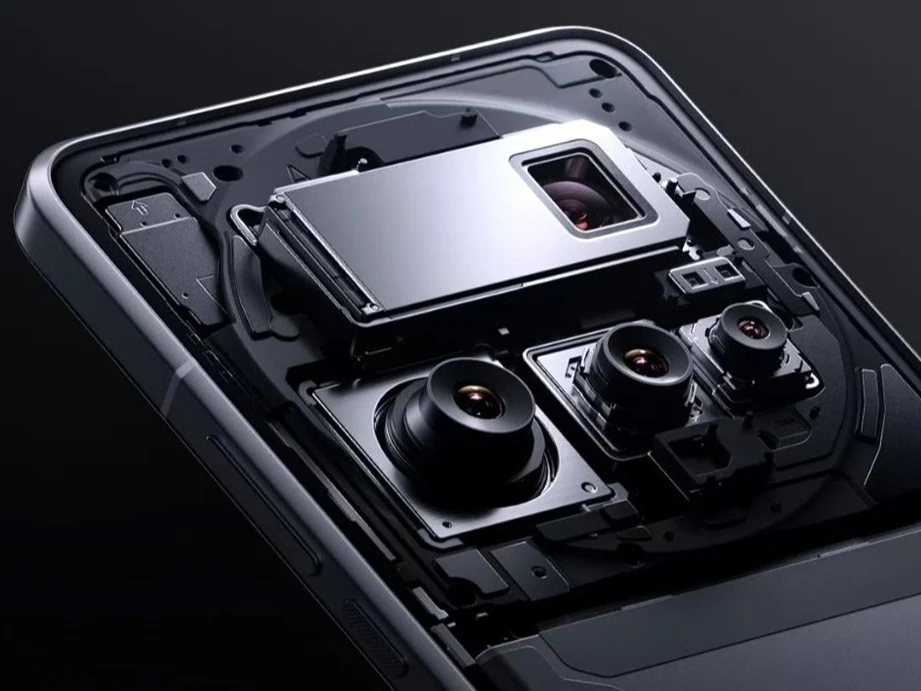
    WekiHome has quickly disassembled the Xiaomi 15 Ultra, just a day after its official launch in China. While Xiaomi plans to unveil the device globally later this week, details about its impressive camera system are already emerging. Notably, Xiaomi has showcased the size of its brand new 200 MP telephoto camera, which utilizes Samsung’s ISOCELL HP9 sensor.

    Camera Sensor Comparison

    WekiHome took it a step further by comparing all the camera sensors of the Xiaomi 15 Ultra with those of its previous model, which is currently priced at $1,029 on Amazon. The YouTuber notes that Xiaomi has removed last year’s variable aperture, which could adjust between f/1.63 and f/4.0. Instead, a new glass filter has been introduced, which Xiaomi asserts will more effectively diffuse reflections.

    Repairability Concerns

    The motherboard has increased in size to fit the new telephoto camera sensor, now occupying almost half of the phone. Sadly, this year’s Ultra remains quite challenging to repair due to numerous screws, plastic clips, and adhesive. For more information on the internal components of Xiaomi’s latest flagship and how it fares against the Xiaomi 14 Ultra, please check out the video below.

    Source:
    Link