Tag: amd

  • AMD Ryzen 9 9900X Geekbench: 3401 Single-Core Score Revealed

    AMD Ryzen 9 9900X Geekbench: 3401 Single-Core Score Revealed

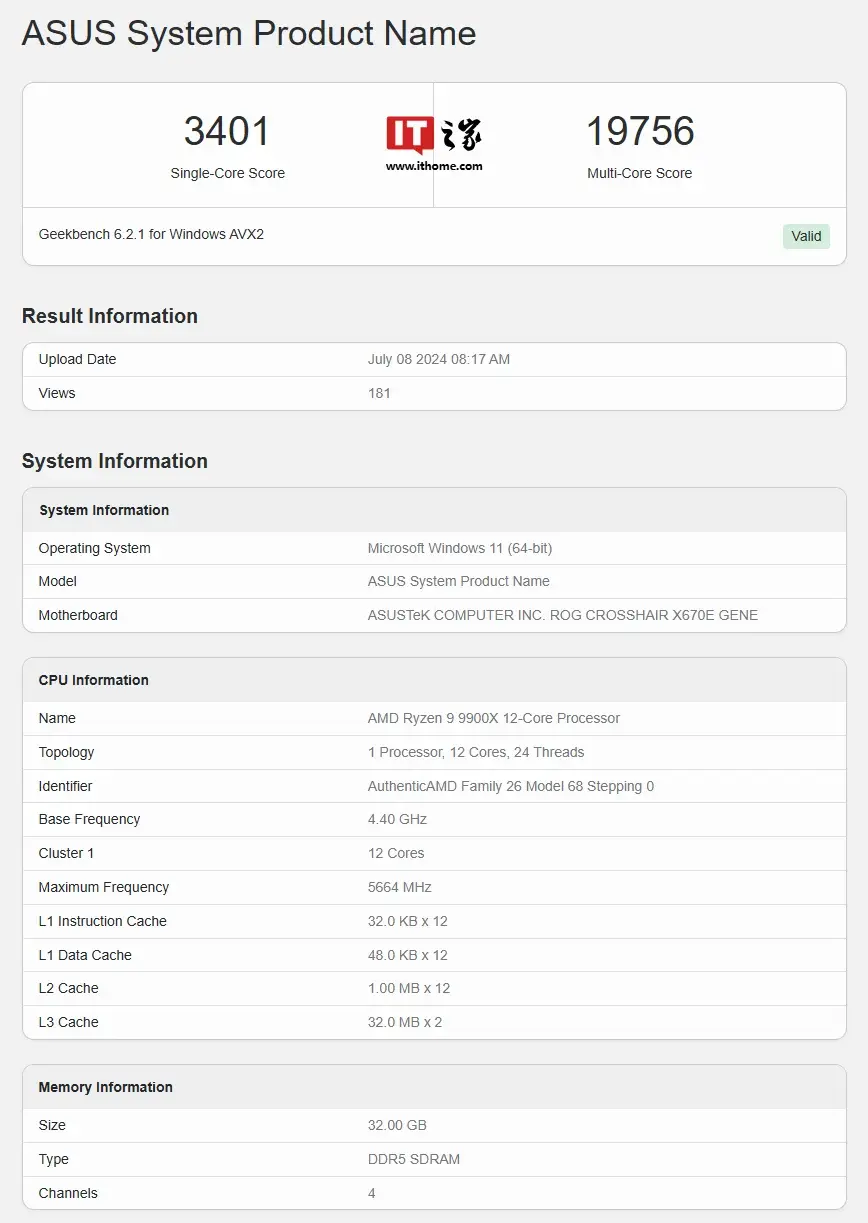
    The upcoming Ryzen 9 9900X processor has been recently spotted in the Geekbench database, revealing notable performance improvements. This 12-core, 24-thread CPU, built on the Zen 5 architecture, achieved a single-core score of 3401 and a multi-core score of 19756 in Geekbench 6.2.1. In comparison to the previous generation Ryzen 7900X, which recorded scores of 2925 for single-core and 17849 for multi-core, the 9900X exhibits a substantial performance boost of 16.3% in single-core and 10.7% in multi-core operations.

    CPU Frequency Details

    The Geekbench test was conducted on a system featuring the ASUS ROG CROSSHAIR X670E GENE motherboard. During the testing phase, the CPU hit a peak frequency of 5664 MHz and maintained an average frequency of 5654 MHz.

    Specifications and Performance

    The leaked benchmark data pertains to a Ryzen 9 9900X processor based on the Zen 5 architecture. This 12-core, 24-thread CPU includes 64MB of L3 cache, with a base clock speed of 4.4 GHz and a maximum boost clock of 5.6 GHz. The processor operates with a thermal design power (TDP) of 120W.

  • AMD Rebrands Upcoming Ryzen CPUs as “Ryzen AI 300” to Surpass Intel

    AMD Rebrands Upcoming Ryzen CPUs as “Ryzen AI 300” to Surpass Intel

    A recent leak suggests that AMD might be revamping its mobile processor branding strategy.

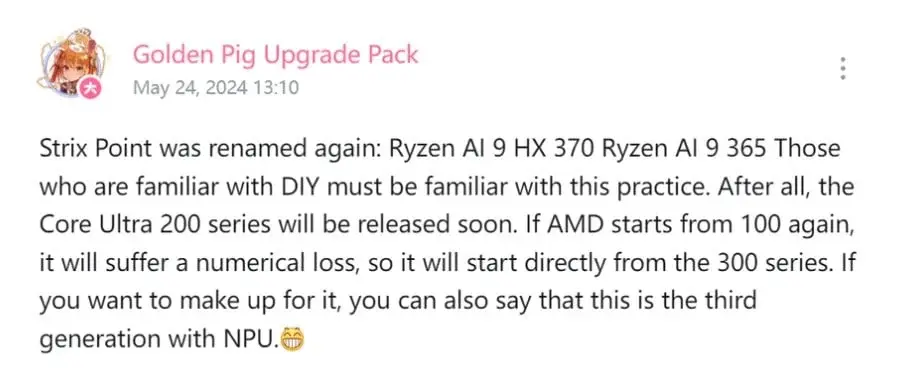
    A well-known leaker, Golden Pig, on the Bilibili forums, reports that AMD is potentially abandoning its current Ryzen naming convention for its upcoming Zen 5 mobile processors. The new branding is rumored to be "Ryzen AI" accompanied by a 300-series number.

    New Branding Strategy

    This information follows an earlier Asus leak that hinted at a 100-series numbering scheme for the initial Ryzen AI processors. However, Golden Pig's report indicates that AMD has decided to jump to the 300-series to outdo Intel's rumored "inferior" 200-series numbering for their next-generation Lunar Lake/Arrow Lake processors.

    Emphasizing Neural Processing

    AMD might also be aiming to emphasize the inclusion of a Neural Processing Unit (NPU) in these chips, a crucial component for Microsoft's new Copilot+ AI PCs.

    AMD’s history of adopting competitor branding strategies, especially in the motherboard market, supports this rumor. The company's alleged use of the B650 chipset name reportedly led Intel to adopt B660 for their competing chipset to avoid confusion.

    If accurate, the "Ryzen AI" branding would likely encompass AMD’s entire mobile processor lineup featuring their XDNA NPU technology. This includes Strix Point, the codename for AMD’s next-generation mainstream Ryzen mobile processors that will succeed the Ryzen 8040 series.

    Strix Point and Strix Halo

    Strix Point is anticipated to boast Zen 5 CPU architecture, RDNA 3.5 graphics, and an XDNA2 NPU with approximately 30 TOPS of performance. Strix Halo, the codename for AMD’s high-performance mobile APU designed to compete with Apple’s M3/M4 processors, might also be included under the "Ryzen AI" branding.

  • AMD Launches Ryzen 8000 Series 4nm Embedded Processors with NPU

    AMD Launches Ryzen 8000 Series 4nm Embedded Processors with NPU

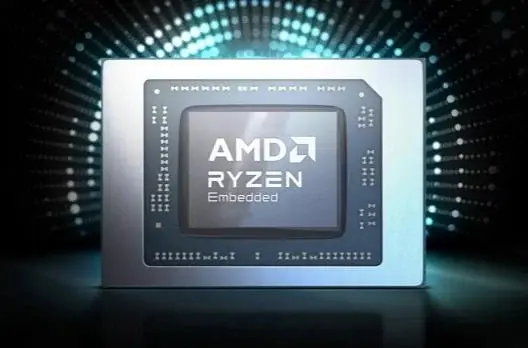
    AMD has recently introduced a groundbreaking innovation in the realm of industrial AI with the launch of the Ryzen 8000 series embedded processors. These processors mark a significant advancement by incorporating a Neural Processing Unit (NPU) based on AMD’s XDNA architecture, tailored specifically to address the demanding workloads of industrial Artificial Intelligence applications.

    Cutting-Edge Technology Integration

    The Ryzen 8000 series integrates a Zen 4 CPU, RDNA 3 GPU, and a novel XDNA Neural Processing Unit, setting a new standard in processing capabilities for industrial AI tasks. This sophisticated configuration, developed on a state-of-the-art 4nm process, combines the power of Zen 4 CPU architecture, RDNA 3 GPU architecture, and the innovative XDNA architecture NPU. Notably, this integration results in an exceptional 39 TOPS of AI computing power, with the NPU alone contributing a substantial 16 TOPS.

    Enhanced Performance and Features

    In addition to its AI capabilities, the Ryzen 8000 series offers a host of impressive features. With 20 lanes of high-speed PCIe Gen 4 connectivity, efficient data transfer is ensured, while support for dual-channel DDR5 5600 memory with error correction (ECC) guarantees smooth operation. The processors have the capacity to drive immersive visuals by supporting up to four independent 4K displays. Furthermore, hardware decoding and encoding capabilities for popular video codecs such as AV1, H.264, and H.265 simplify video processing tasks.

    Diverse Offerings and Collaborative Partnerships

    To cater to a variety of requirements, the Ryzen 8000 series is available in four distinct models. AMD is actively collaborating with embedded Original Design Manufacturer (ODM) partners like Advantech, ASRock, and iBASE to build a robust ecosystem around these processors. As the demand for AI technologies continues to rise, leading companies like Nvidia and AMD are developing advanced AI chips to support extensive research initiatives on a larger scale.

  • US License Policy Sparks Debate: Huawei’s Chip Supply Uncertain due to Intel and AMD.

    US License Policy Sparks Debate: Huawei’s Chip Supply Uncertain due to Intel and AMD.

    The conflict between major chip manufacturers and the U.S. government has created uncertainty regarding Huawei's chip supply. Intel has managed to maintain its license to sell advanced laptop CPUs to Huawei, while AMD is facing challenges in obtaining a similar license, leading to a revenue disparity of over $512 million.

    Licensing Disparities

    AMD's unsuccessful attempts at securing a licensing agreement have raised concerns of unfair treatment within the industry. Figures like Republican Senator Marco Rubio have called for a reassessment by the Biden administration, yet official responses have been scarce, leaving Intel's license status uncertain as it nears expiration.

    Huawei's Vulnerability

    Huawei, a significant player in the global laptop market, heavily relies on Intel for its CPUs. Any restrictions on chip sales could significantly impact the company's laptop offerings and market share, especially in China. The outcome of these deliberations holds immense importance for Huawei's future prospects.

    Industry Implications

    The implications of these licensing challenges extend beyond AMD and Intel to other chip makers like Qualcomm and MediaTek. Qualcomm succeeded in obtaining a license for Huawei's smartphones, whereas Mediatek faced a setback with a denied application, resulting in decreased sales. Microsoft's recent collaboration with Intel for chip manufacturing further highlights the industry's response to these regulatory uncertainties.

    The tech industry is navigating a complex landscape where decisions on licensing policies can have substantial effects on global supply chains and market dynamics. As Intel's license hangs in the balance, the broader impact of these policies reverberates throughout the industry.

  • HDMI Forum Denies AMD’s Linux Driver Support for HDMI 2.1

    HDMI Forum Denies AMD’s Linux Driver Support for HDMI 2.1

    AMD’s efforts to improve its open-source Linux graphics driver (AMDGPU) by incorporating HDMI 2.1 features have faced a significant obstacle. Despite extensive internal development aimed at enabling crucial functionalities such as 4K@120Hz and 5K@240Hz, the HDMI Forum has rejected AMD’s proposal.

    AMD’s Proposal Rejected

    The rejection has implications for Linux users with newer AMD Radeon graphics cards, who may find themselves unable to fully exploit the capabilities of HDMI 2.1-enabled displays. AMD conveyed its disappointment with the Forum’s decision, emphasizing that achieving an open-source HDMI 2.1 implementation would be unfeasible without infringing upon HDMI Forum stipulations.

    The HDMI Forum justified its decision based on legal and compliance concerns related to the open-source dissemination of the HDMI 2.1 specification. This development underscores the challenges encountered by open-source HDMI developers following the HDMI Forum’s move to restrict its specifications in 2021.

    Recommendation for Linux Users

    Consequently, the latest HDMI features are expected to remain inaccessible through open-source drivers. AMD’s suggestion for Linux users seeking features like high-refresh-rate 4K gaming is to opt for DisplayPort connections as an alternative.

    Windows Users Unaffected

    In contrast, Windows users with AMD graphics will continue to enjoy full HDMI 2.1 functionality, underscoring a disparity within the open-source development landscape. This discrepancy also sheds light on potential tensions within the relationship between AMD and the HDMI Forum.

    Uncertain Future for Linux Users

    The rejection raises questions about whether Linux users with AMD graphics will ever harness the full potential of next-generation HDMI 2.1 displays. Currently, both AMD and the HDMI Forum seem entrenched in their respective stances, limiting choices for consumers and leaving the situation unresolved.

  • AMD’s Largest Global Design Center Located in India

    AMD’s Largest Global Design Center Located in India

    AMD Launches Technostar Research and Development Campus in India

    A Center for Innovation

    Covering a substantial 500,000 square feet, the Technostar campus will serve as the workplace for around 3,000 engineers committed to the advancement of state-of-the-art CPUs, GPUs, adaptive SoCs, and FPGAs targeting personal computers and data centers.

    Cultivating Cooperation and Creativity

    The Technostar campus features contemporary research and development laboratories, purpose-specific visitor demonstration areas, and collaborative meeting spots to foster creativity and cooperation among engineers.

    Opening Ceremony and Notable Personalities

    The commencement was headed by Ashwini Vaishnaw, Union Cabinet Minister for Railways, Telecommunications, Electronics, and Information Technology, Government of India, along with Mark Papermaster, Chief Technology Officer, and David Wang, Senior Vice President of Radeon Technologies Group.

    Dedication to India’s Semiconductor Environment

    Minister Vaishnaw underscored the importance of AMD’s investment in India’s semiconductor sector. Mark Papermaster conveyed the firm’s trust in India’s engineering capabilities.

    Summary

    AMD’s initiation of Technostar marks a significant stride in reinforcing its footprint in India. With cutting-edge amenities and a committed workforce, this design hub will push forward semiconductor innovations and play a part in the burgeoning semiconductor landscape in India.

  • Breaking Boundaries: NVIDIA and AMD Set to Unveil ARM-Based Processors for PCs

    Breaking Boundaries: NVIDIA and AMD Set to Unveil ARM-Based Processors for PCs

    In a groundbreaking move, tech giants NVIDIA and AMD are gearing up to launch ARM-based chips for PCs, marking a significant stride in the ongoing rivalry with Intel. This bold venture promises a new horizon of performance and efficiency in the computing realm.

    Embracing the ARM Architecture

    Traditionally, the PC market has been dominated by x86 architecture, primarily from Intel. However, the winds of change are blowing, as NVIDIA and AMD step into the realm of ARM-based chips. ARM’s architecture is renowned for its efficiency and low power consumption, making it a preferred choice for mobile devices. Transitioning this technology to the PC sector signifies a monumental shift, potentially offering consumers more efficient, cooler, and quieter computing solutions.

    NVIDIA’s foray into ARM-based PC chips poses a major new challenge to Intel, which has long held a stronghold on the PC market. As per a recent report from Reuters, NVIDIA’s commitment to developing ARM-based chips is now official, and the tech behemoth aims to diversify its chip offerings, reducing the reliance on the x86 architecture.

    The Competitive Landscape

    The move by NVIDIA and AMD comes at a critical juncture where the battle for market share in the chip industry is intensifying. Intel, once the unrivaled champion in the chip-making realm, now faces fierce competition. The incoming ARM-based chips from NVIDIA and AMD are rumored to hit the market by 2025, according to insights from The Verge. This timeline sets the stage for an exhilarating race in innovation and market positioning among the chip-making titans.

    Moreover, the collaborative effort between NVIDIA and AMD as reported by VideoCardz, highlights a remarkable coalition aimed at disrupting the status quo in the chip industry. The united front presents a formidable challenge to Intel and heralds a new era of processor technology, marked by enhanced efficiency and potentially lower costs for consumers.

    Future Implications

    The shift to ARM-based chips signifies more than just a technical evolution; it’s a pivotal movement in the chip industry’s landscape. The success of these ventures could potentially redraw the competitive boundaries, offering a fresh narrative in the ongoing saga of processor technology evolution.

    Intel, with its rich legacy in the chip industry, is bound to respond to this new challenge, and as such, the next couple of years will be brimming with innovation and strategic moves that could reshape the PC processor market in profound ways.

    The anticipation surrounding the ARM-based chips from NVIDIA and AMD is palpable, and the tech community is keenly watching the developments as they unfold.


    Sources: Reuters, VideoCardz, The Verge

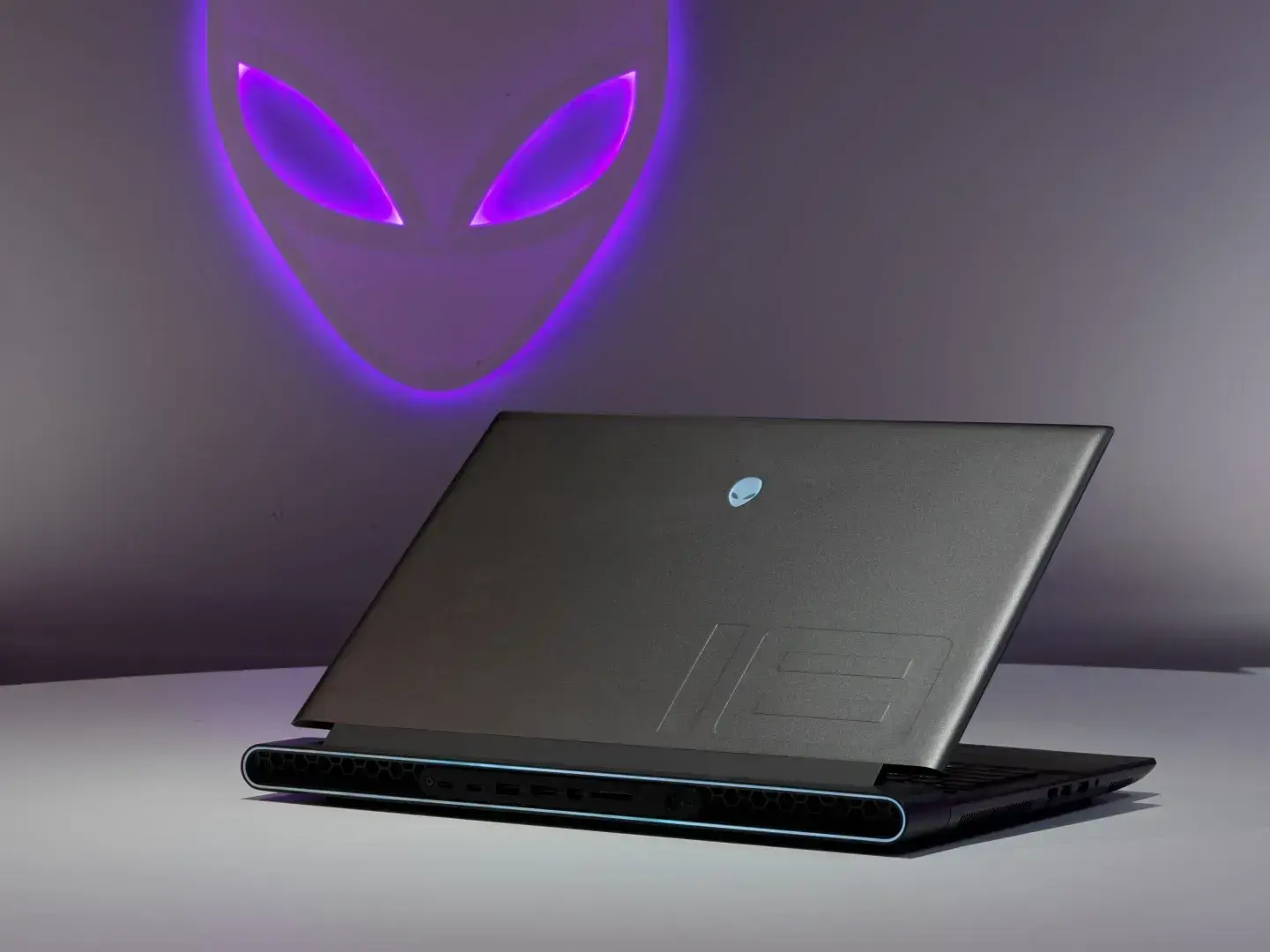
  • Dell Alienware M18 Introduces AMD Radeon RX 7900M Featuring RDNA 3 Architecture and Chiplet Design

    Dell Alienware M18 Introduces AMD Radeon RX 7900M Featuring RDNA 3 Architecture and Chiplet Design

    The world of high-end mobile gaming is bracing itself as AMD unveils its latest marvel, the Radeon RX 7900M GPU. This revelation stands as a testament to AMD’s commitment to pushing the boundaries of what’s possible in the realm of mobile gaming technology. The Radeon RX 7900M is here to set a new benchmark with its top-tier performance, ensuring that gaming enthusiasts no longer have to compromise on power when opting for mobile solutions.

    Power-Packed Performance

    The core essence of the Radeon RX 7900M lies in its powerful performance which is structured to cater to the demands of modern high-end games. With a robust 180W total graphics power, this GPU is a powerhouse designed to deliver unparalleled gaming experiences on the go. The infusion of this high wattage ensures that the GPU can handle the most graphically intensive tasks, making it a coveted choice among gamers and creators alike.

    Seamless Integration with Dell Alienware m18

    A notable highlight of the Radeon RX 7900M’s debut is its integration with the upcoming Alienware m18 gaming laptop. This strategic alliance amplifies the GPU’s potential, promising a seamless synergy between hardware that’s tailored to meet the expectations of the most discerning gamers. The Alienware m18, equipped with the formidable RX 7900M, is poised to become a beacon of mobile gaming prowess, ensuring that every frame is rendered with precision and vibrancy.

    Cutting-Edge Architectural Design

    AMD has meticulously engineered the Radeon RX 7900M with a focus on optimizing the architectural design to achieve superior performance metrics. This finesse in design translates to a GPU that not only meets but exceeds the performance benchmarks set by its predecessors. The AMD Radeon RX 7900M is a masterpiece of engineering that showcases the brand’s dedication to delivering cutting-edge technology in the mobile gaming sphere.

    In conclusion, the Radeon RX 7900M by AMD heralds a new era in mobile gaming, blending a sleek design with monstrous performance. The seamless integration with the Alienware m18 further accentuates the GPU’s appeal, making it a must-have for any serious gamer looking to elevate their mobile gaming experience.

    Dell Alienware M18 Introduces AMD Radeon RX 7900M Featuring RDNA 3 Architecture and Chiplet Design
    Alienware M18

    • Display: 18-inch, FHD+/QHD+, 165Hz/480Hz, 3ms, 300nits, 100% DCI-P3 Colour Gamut, 1000:1 contrast ratio, ComfortView Plus, AMD FreeSync, Dynamic Display Switching
    • Processor: AMD Ryzen 7 7945HX R9, 16-core/32 threads, 80MB cache, up to 5.4GHz
    •  GPU: AMD Radeon RX 7900M, 16GB GDDR6, 180W TGP, 200W with SmartShift Max
    • RAM And Storage: up to 64GB Dual Channel DDR5 4,800MHz, up to 8.5TB Tri-storage configuration
    • Battery and Charging: 97Wh, 6-cell, 330W charging
    • Software: Windows 11 64-bit
    • Connectivity: Wi-Fi 6E, Bluetooth 5.2, Ethernet, 3.5mm jack, 3 Type-A USB 3.2 Gen 1 ports, 3 Type-C USB 4 Gen 2 ports with PD and DisplayPort 1.4, HDMI 2.1, mini-display port, SD card slot.
    • Dimensions: 319.9 x 410.3 x 25.1mm, 4.23kg
    • Other features: Vapor chamber cooling, Dolby Vision, Dolby Atmos, Alienware FHD camera, dual-array mics, Windows Hello, Alien FX lighting, Alienware M Series per-kley AlienFX RGB keyboard, multi-touch gesture trackpad
    • Price: Starting at $2,799 (~Rs 2,32,500)

    Source: MySmartPrice, NotebookCheck

  • AMD Set to Revolutionize High-End Desktop Computing with Threadripper 7000 PRO and non-PRO Zen4 CPUs

    AMD Set to Revolutionize High-End Desktop Computing with Threadripper 7000 PRO and non-PRO Zen4 CPUs

    In a bold response to the evolving demands of high-end desktop (HEDT) computing, AMD is on the brink of unveiling its next-generation Threadripper 7000 series, sub-divided into PRO and non-PRO models, designed to work in tandem with the new WRX90 and TRX50 motherboards. This launch not only marks AMD’s stride towards dominating the HEDT sector but also signifies a crucial shift in the ongoing competition with Intel, especially in the workstation segment.

    Superior Technology and Performance

    The core of AMD’s innovation lies in the adoption of the Zen4 architecture and the newer 5nm TSMC manufacturing process, promising a significant leap in performance compared to the existing Zen3-based Threadripper Pro 5000 series​1​. With chiplets ranging from 8 to 12 in count, the Threadripper 7000 series is also slated to feature a massive 96-core model in its PRO lineup, marking a monumental stride in multi-core processing capabilities​2​.


    A noteworthy highlight is the Threadripper Pro 7995WX, boasting 96 cores alongside a staggering 384MB of Level 3 cache and 128 PCIe Gen5 lanes. This high-end SKU is expected to be a powerhouse for intensive computing tasks, although pricing details remain elusive. Conversely, the series will also cater to more modest requirements with models featuring as few as 12 cores​1​.

    Packaging and Motherboard Compatibility

    The physical distinction between the PRO and non-PRO models is manifested in their packaging, with gray and silver for the PRO variants, and gray and orange for the non-PRO models. This distinction extends to motherboard compatibility as well. The WRX90 motherboards are targeted at workstations while the TRX50 motherboards mark AMD’s venture into the consumer market, both embracing the sTR5 socket and supporting DDR5 memory and PCIe Gen5 standards​2​.

    Competitive Edge Over Intel

    The Threadripper 7000 series is a calculated move by AMD to solidify its standing in the face of Intel’s offerings, especially with the recent launch of the Sapphire Rapids Xeon W-2400 and W-3400 series. The higher core counts and superior memory bandwidth, courtesy of official DDR5 support, are expected to offer a compelling alternative to Intel’s lineup, especially in the realm of overclocking and high-performance computing​3​.

    In summary, the AMD Threadripper 7000 series, with its PRO and non-PRO models, is set to redefine the paradigms of high-end desktop computing. With a broad spectrum of models catering to varying computing needs, coupled with enhanced performance and new motherboard compatibilities, AMD is poised to usher in a new era of HEDT computing.

    Sources: VideoCardz, NAG

  • The Feather-Light Dynabook GA83-XW: Japan’s Latest AMD Marvel with a Day-Long Battery Life

    The Feather-Light Dynabook GA83-XW: Japan’s Latest AMD Marvel with a Day-Long Battery Life

    The pursuit of creating high-performing yet lightweight laptops has always driven innovation in the tech world. The recent launch of Dynabook’s GA83-XW in Japan is a testament to this relentless pursuit. Tipping the scales at a mere 875 grams, this enterprise ultrabook is now the lightest AMD-powered laptop, taking portability to a new level without compromising on performance.

    Uncompromised Performance

    At the core of the GA83-XW is AMD’s potent Ryzen 7 5700U processor, ensuring a smooth multitasking experience. This laptop is not just about a sleek design and a lightweight frame, but also about delivering robust performance to cater to the demanding needs of modern professionals. Its 24-hour battery life is an emblem of its efficiency, making it a dependable companion for those long business trips.

    A Feather-light Companion

    The GA83-XW’s headline feature is its weight. At just 875 grams, carrying it around is a breeze. It’s an enterprise ultrabook designed with the modern-day professional in mind – where every gram counts. The chassis is constructed from a magnesium alloy, which is known for its light weight and durability, providing a perfect balance between portability and robustness.

    Long-lasting Battery Life

    One of the most prominent features of the GA83-XW is its impressive battery life. With up to 24 hours of runtime, this laptop ensures you stay productive throughout the day, without having to hunt for a power outlet. It’s a feature that’s not just convenient but crucial in today’s fast-paced work environment.

    The Dynabook GA83-XW is a groundbreaking release in the realm of lightweight laptops. Its superior battery life paired with a lightweight design, all powered by a strong AMD processor, makes it a formidable choice for professionals on the go. As it launches in Japan, many await its availability globally, anticipating a ripple effect in the market where the demand for lighter and longer-lasting laptops is ever-growing.

    The GA83-XW is not just a laptop; it’s a statement of what’s achievable when innovative design meets cutting-edge technology. The blend of functionality, design, and performance makes it stand out in a crowded market, setting a high bar for what we can expect in the future of ultralight laptops.

    Sources: TechRadar NotebookCheck