Tag: amd

  • Frank Azor Addresses RX 9070 XT Price Rumors

    Frank Azor Addresses RX 9070 XT Price Rumors

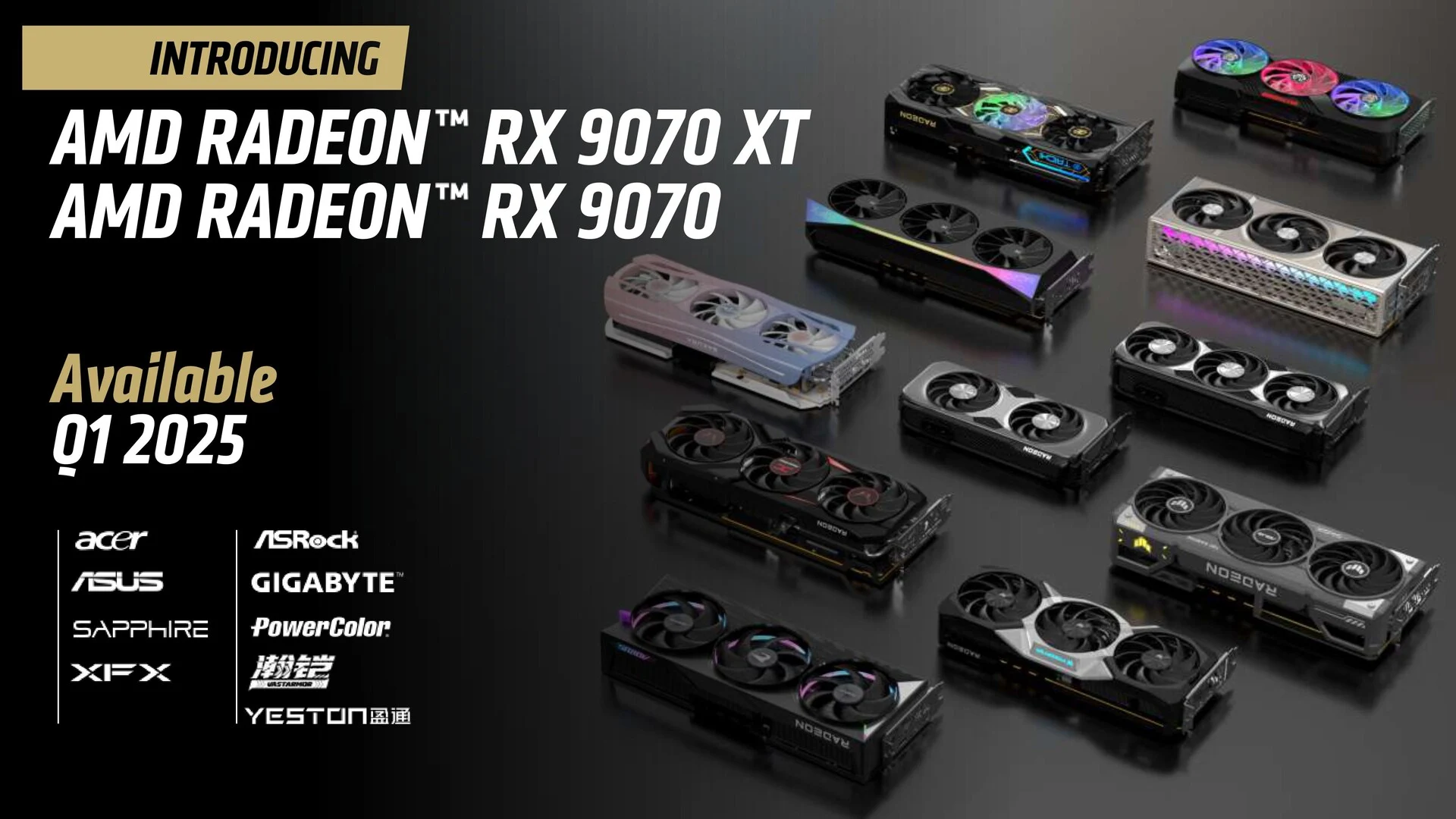
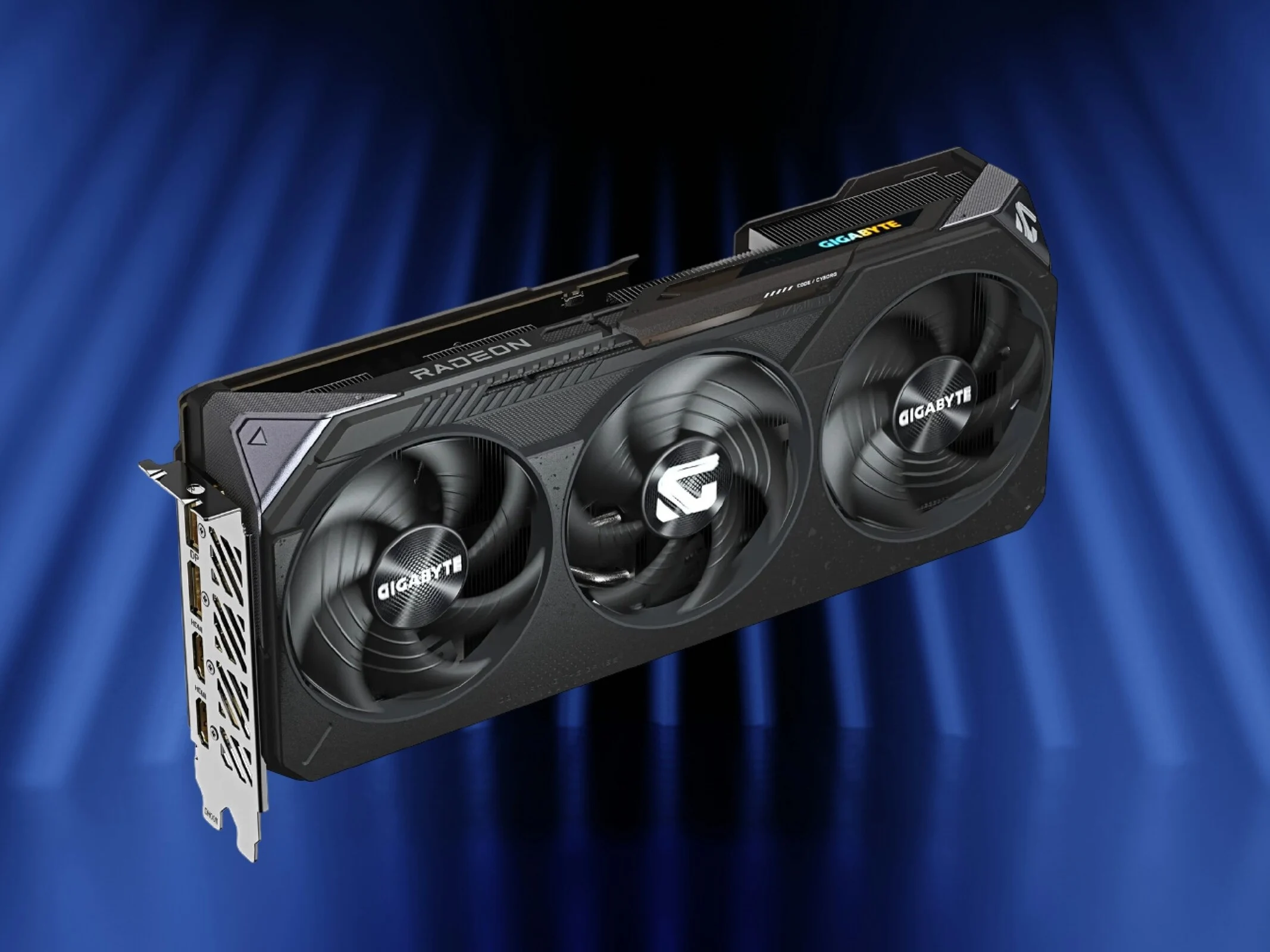
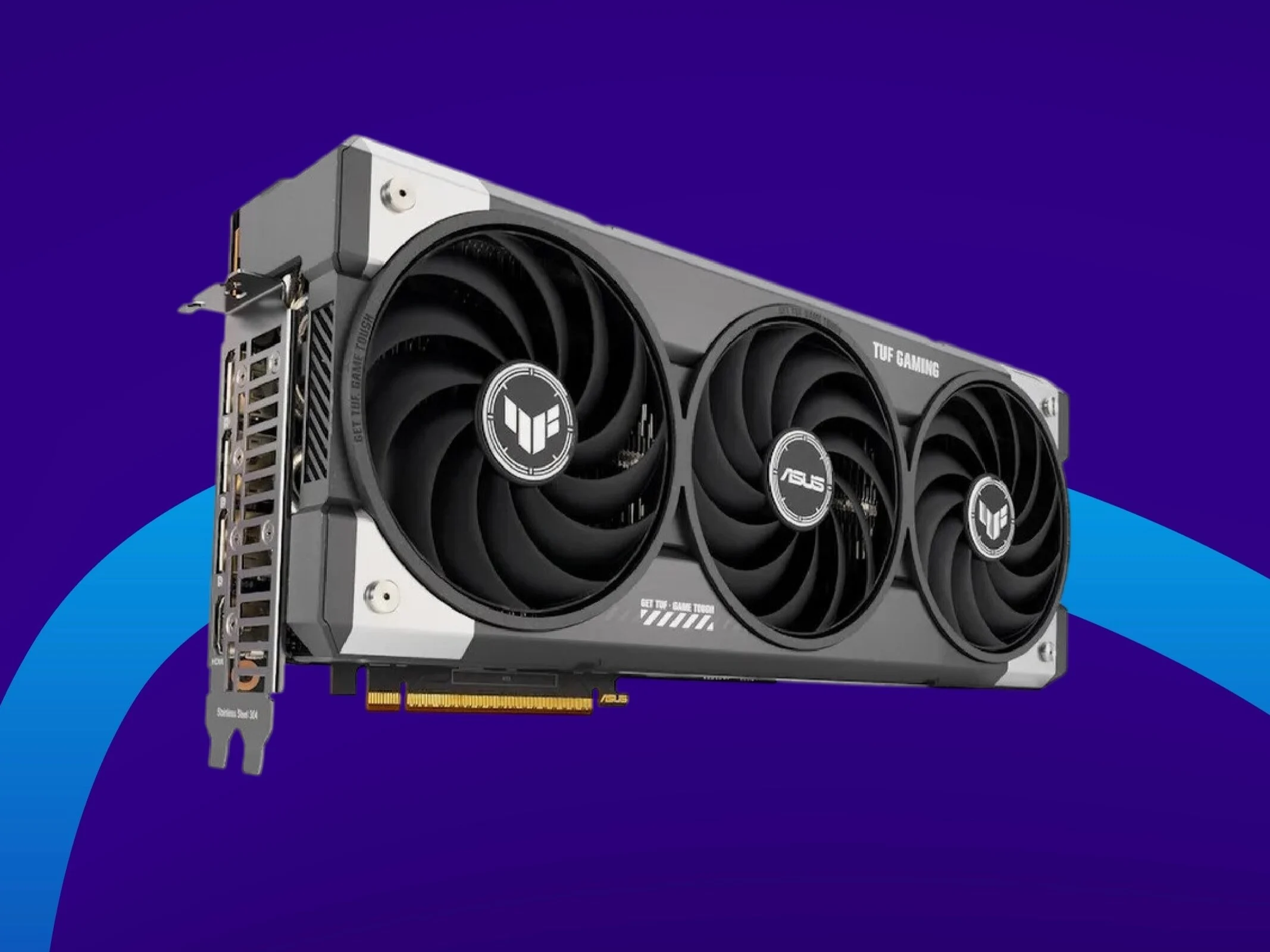
    AMD has recently decided to delay the launch of the RX 9070 and RX 9070 XT until March, sparking a lot of discussion about why this change happened. Some sources suggest that Team Red is taking extra time to refine the software for the RDNA 4 GPUs. Others believe that the delay is influenced by the upcoming RTX 50 series cards, particularly the RTX 5070 Ti and RTX 5070, which may be putting pressure on AMD.

    Retailers Have Stock

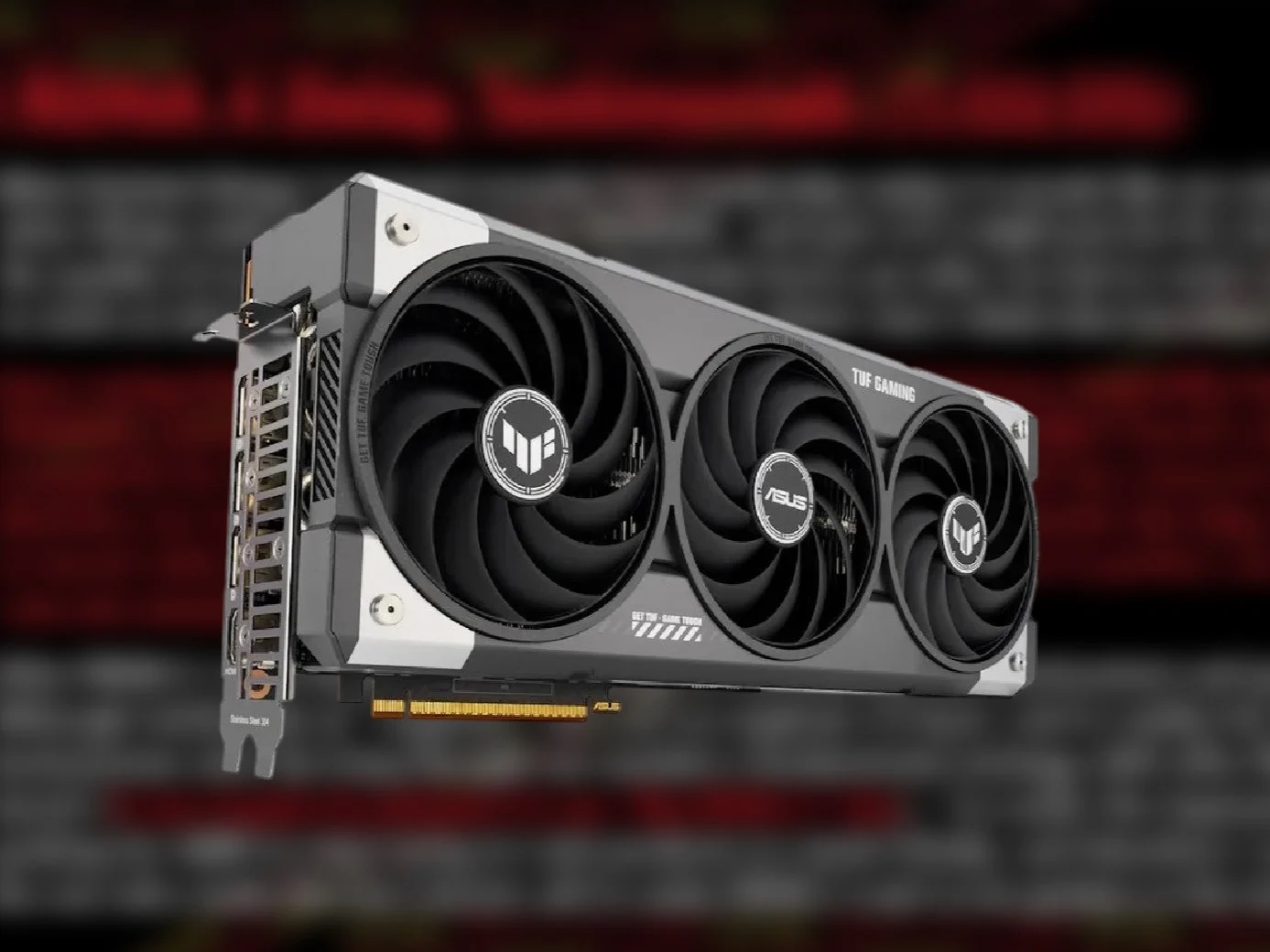
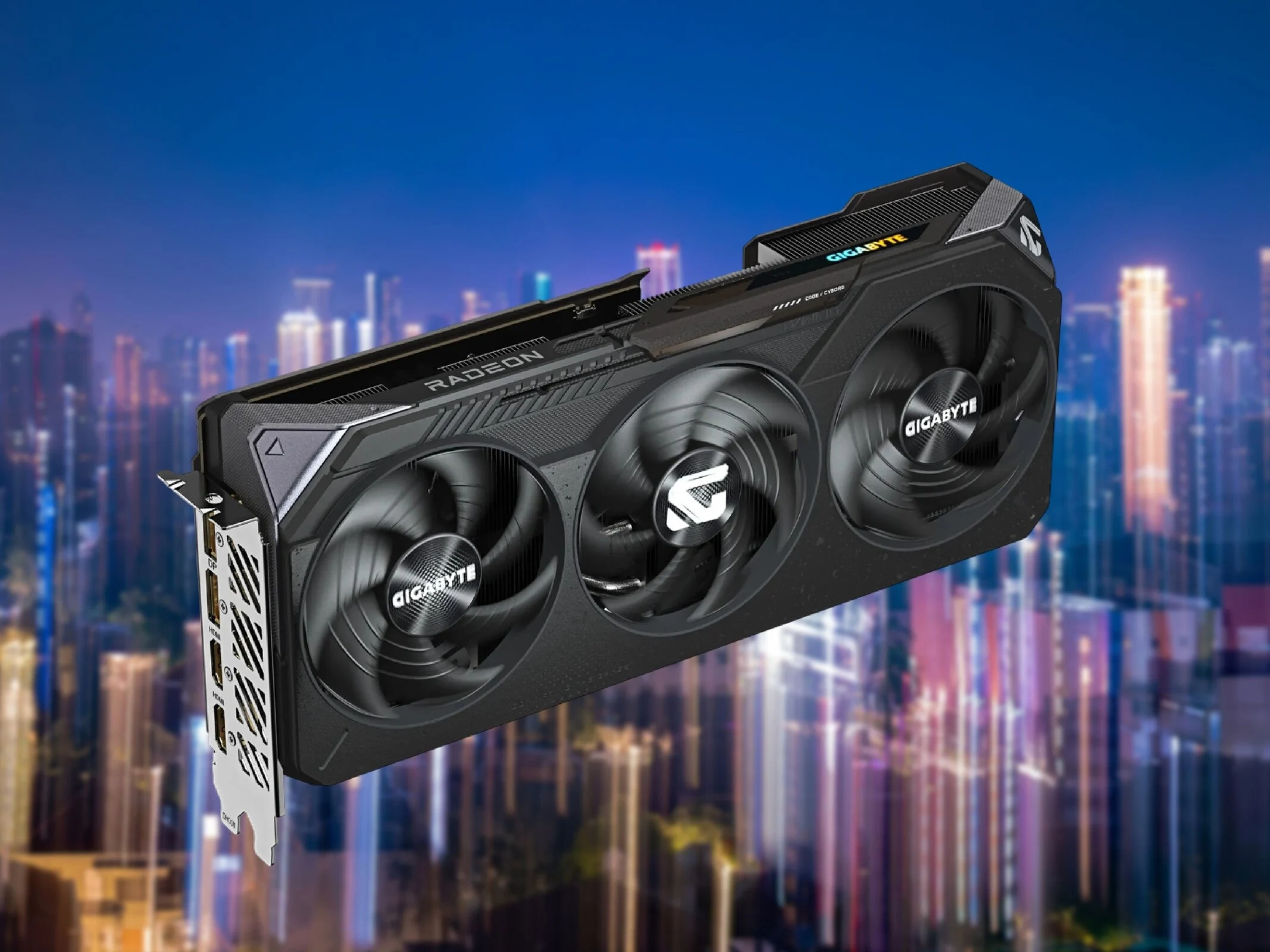
    As the situation unfolds, it appears that retailers already have RX 9000 series cards in stock but are unable to sell them just yet. A Bulgarian retailer named Gplay released a video claiming that they possess these GPUs that were initially set to launch in January, now postponed to March. This supports earlier reports regarding the cards’ availability.

    Pricing Speculations

    Additionally, Gplay’s video hints that AMD may have initially intended to set higher prices for the RX 9070 XT and RX 9070 than what recent leaks suggest. Currently, rumors have the RX 9070 XT priced between $479 and $550. If Gplay’s claims hold true, the pricing might have been aimed at positioning the RX 9070 XT similarly to the RX 7900 XT and pricing the RX 9070 significantly above the RX 7800 XT. VideoCardz reports that the RX 9070 XT might have been priced around $899, with the RX 9070 potentially around $749. For context, the RX 7900 XT and RX 7800 XT launched at $899 and $499, respectively, although you can find these GPUs listed for lower prices on Amazon now.

    AMD’s Response

    If AMD had indeed priced the new cards along the lines of Gplay’s statement, it would have created a difficult situation for the RDNA 4 GPUs, especially since Nvidia has set the prices for the RTX 5070 at $549 and the RTX 5070 Ti at $749, which are lower than many anticipated. Despite Gplay’s compelling claims, Frank Azor has refuted any thoughts that AMD ever considered such high pricing for the RX 9070 XT. He responded to VideoCardz’s post on X by stating that a starting price of $899 was never part of their strategy.

    Given that AMD seemingly did not plan to charge $899 for the RX 9070 XT, it’s plausible to think that the delay in the RDNA 4 release stems from a desire to launch with well-developed drivers and to strike the right balance between price and performance. Regardless of the final reasons, it is crucial for the RX 9070 and RX 9070 XT to make a significant impact for AMD in this new generation of GPUs.

    Source:
    Link
  • AMD FSR 4 and RX 9070 Enhance Compatibility with FSR 3.1 Games

    AMD FSR 4 and RX 9070 Enhance Compatibility with FSR 3.1 Games

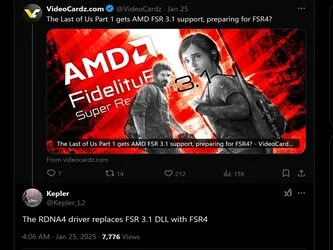
    Recently, news has spread among gamers that the Radeon RX 9070 and RX 9070 XT are now set for a March release. While this may be a wait, those who enjoy AMD graphics can look forward to FSR 4 being compatible with the currently supported FSR 3.1 games. FSR 4 represents AMD’s newest AI-driven upscaling technology that enhances framerates while maintaining image quality. The well-known leaker Kepler_L2 has assured that the upgrade process should be easy for both AMD and its users.

    FSR 4 Exclusivity

    It’s important to note that unlike FSR 3.1, FSR 4 will only work with AMD GPUs built on the RDNA 4 architecture. This means that gamers will have to be patient and await the RX 9000 series to experience the latest advancements in upscaling. Nevertheless, PCGamingWiki has listed many games compatible with FSR 3.1 that could readily take advantage of these upgrades. According to Kepler_L2, the upgrade process is simple and requires just a swap of an older AMD driver file with a new FSR 4 DLL.

    AMD’s Future Plans

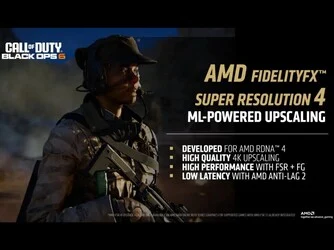
    The expectation that FSR 4 would improve upon FSR 3.1 isn’t shocking, especially after AMD’s CES 2025 presentation. When comparing it to Nvidia’s DLSS 4 demonstration, the details about how FSR 4 will enhance gaming performance were somewhat vague. Nonetheless, the updated upscaler is designed to work together with frame generation to boost framerates. Additionally, AMD Anti-LAG 2 is expected to decrease latency, which often follows upscaling. Toward the end of the CES preview slide, AMD indicated that FSR 4 will necessitate that games already support FSR 3.1.

    Implications of Delay

    The unexpected delay of the RX 9000 series provides AMD with additional time to fine-tune games. Recently, well-known titles such as The Last of Us Part 1 have received patches for FSR 3.1 support. Some gamers remain doubtful that FSR 4 will mark a significant advancement in upscaling technology, making the pricing and raw performance of AMD’s upcoming GPUs crucial factors to consider.

    Source:
    Link


  • Radeon RX 9070 XT Pre-Order Date Leaked by Retailer

    Radeon RX 9070 XT Pre-Order Date Leaked by Retailer

    AMD’s choice to postpone the launch of the Radeon RX 9000 series is quite strange, even though the company claims it was necessary to fix some issues with their software. What we do know is that a few GPUs are set to be sold starting in March. A recent listing from B&H Photo and Video in the US (shared by Videocardz) provides a clearer timeline.

    Pre-Order Details

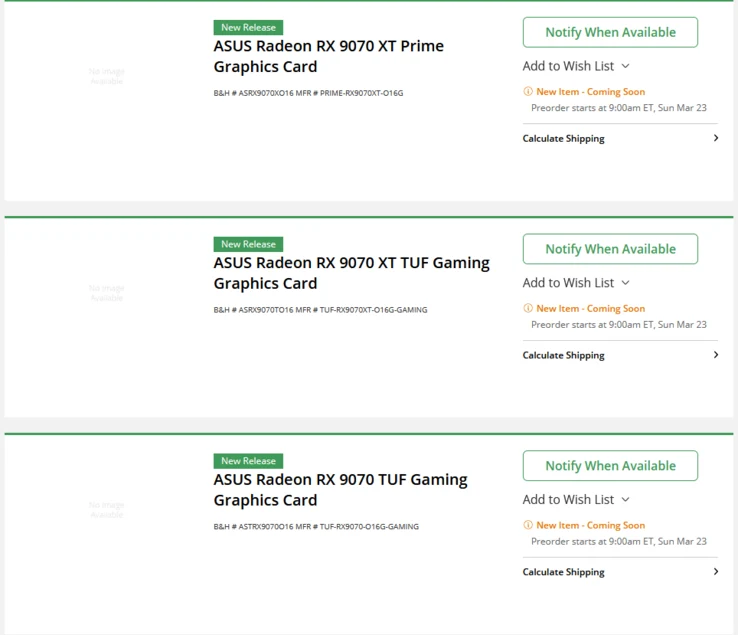
    There are multiple listings for the Asus RX 9070 XT graphics cards, indicating they will be available for pre-order on March 23. This is about two months later than the rumored launch date of January 23. Keep in mind that this is just a pre-order date, and reviews for the card may come out sooner. For instance, our review of the Nvidia GeForce RX 5090 was published today, but pre-orders won’t start until January 30.

    Placeholder Dates

    However, it’s quite possible that the date mentioned above is just a placeholder. There’s a strong possibility that AMD will launch the Radeon RX 9070 XT around the same time as its Blackwell-based rival, the GeForce RTX 5070 Ti, expected to be released on February 20. Early leaks suggest that the RDNA 4 flagship could perform somewhere between the GeForce RTX 4080 and the RTX 4080 Super in rasterization, and around the RTX 4070 Ti level in ray tracing.

    Price Considerations

    Despite the performance predictions, the eventual success of the Radeon RX 9070 will largely depend on its pricing. Although this could fluctuate, recent estimates place it between $450 and $550. Additionally, we shouldn’t overlook the other models in the lineup. Variants like the RX 9070, RX 9060 XT (tentative), and RX 9060 are expected to disrupt the sub-$500 GPU market, a segment that Nvidia has largely stepped away from.

    Source:
    Link


  • AMD RX 9000 Delay: RDNA 4 Shift and RX 9070 March Launch Details

    AMD RX 9000 Delay: RDNA 4 Shift and RX 9070 March Launch Details

    AMD has announced that the RDNA 4 GPUs will be released in March 2025, which has stirred up quite a bit of debate. While some folks believe that delaying the RX 9000 cards allows AMD to better observe the RTX 50 series, others feel this could be a significant blunder, especially since the RX 9070/XT may get overshadowed by the buzz surrounding the RTX 5070 and 5070 Ti.

    Uncovering AMD’s Strategy

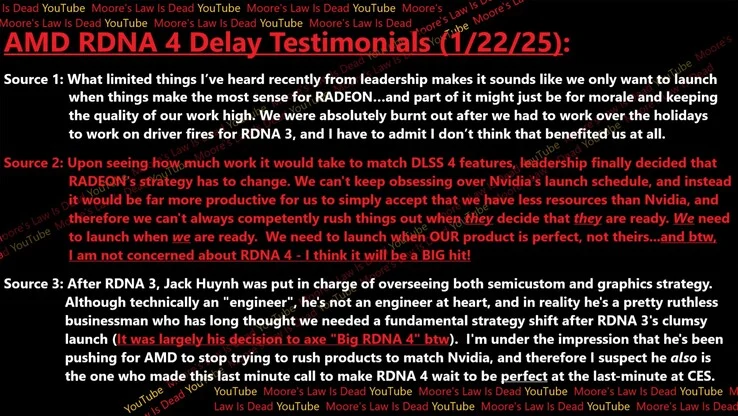
    Despite the discussions, the exact reason for AMD’s postponement of the RX 9000 release is still not entirely clear. However, an X post from David McAfee, along with a thorough leak from Moore’s Law Is Dead, might shed some light on AMD’s true intentions. According to Moore’s Law Is Dead, AMD appears to be changing its approach to launching Radeon GPUs by separating their product launches from the competition’s schedule.

    In interviews with MLID, various AMD insiders have suggested that Team Red is now prioritizing the release of new products based on what is best for RADEON, rather than reacting to Nvidia’s hardware and software launches. AMD is said to be moving away from being overly focused on Nvidia’s timeline, only putting out new products when they believe they are “Perfect.” A source even told Tom that they are “not worried about RDNA 4” and are confident it will succeed.

    Leadership Insights

    Additionally, it seems that Jack Huynh, who is the Senior Vice President and General Manager of Computing and Graphics at AMD, has been pushing for a change in strategy following the “clumsy launch” of RDNA 3. He is thought to be the influential figure behind the last-minute decision to delay RDNA 4 and was a key player in the choice to cancel the flagship RDNA 4 model.

    So, if we take MLID’s findings at their word, AMD has made a choice to stop pursuing Nvidia and will only release Radeon GPUs when they are genuinely prepared. Interestingly, David McAfee echoed this sentiment on X, confirming that Team Red is “taking a little extra time to optimize the software stack for maximum performance.” They are also aiming to “enable more FSR 4 titles,” which is expected given that FSR 4 will be compared to Nvidia’s latest DLSS version. The delay is also said to allow AIBs more time to prepare inventory for the launch.

    Final Thoughts

    In summary, the delay of RDNA 4 appears to stem from AMD’s desire to avoid rushing the RX 9000 GPUs solely due to Nvidia’s activities. Instead, the focus is on refining the software experience and ensuring solid support for FSR 4. Only time will reveal what impacts, whether good or bad, this strategic change will have for AMD.

    Source:
    Link


  • AMD Delays RX 9070/XT Reveal Despite GPUs Stocked at Retailers

    AMD Delays RX 9070/XT Reveal Despite GPUs Stocked at Retailers

    As AMD shared initial details about the RDNA 4 GPUs at CES 2025, many fans were eager for a thorough announcement and impending launch. There were also rumors circulating that AMD would introduce the RX 9070 and RX 9070 XT around mid-January, aiming for a release on January 23. Unfortunately, these rumors turned out to be inaccurate, as Team Red announced yesterday that the RDNA 4 graphics cards will actually launch in March.

    The Uncertainty of Leaks

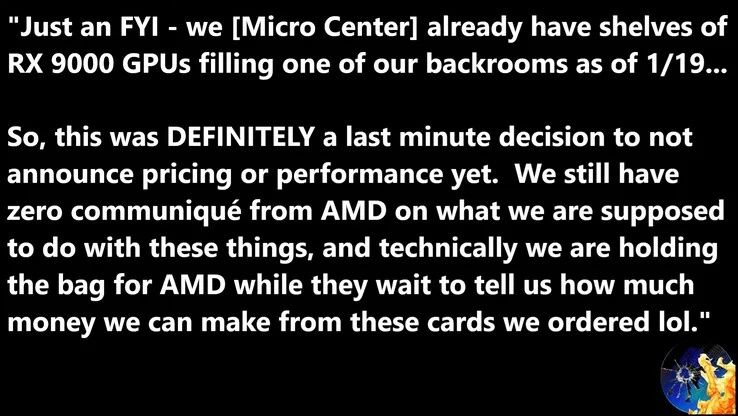
    This situation raises the question: Were the rumors about AMD releasing the RX 9000 series in January 2025 always incorrect, or did AMD alter their schedule at the last moment? It looks like it might be the second scenario since Moore’s Law is Dead has reported that Micro Center already possesses RX 9000 GPUs in stock. The source indicates that Micro Center has “shelves of RX 9000 GPUs” stored in one of its backrooms. It seems Team Red has left Micro Center “holding the bag,” without sharing any pricing details.

    Retail Supply and Strategy

    Moreover, if a leading retailer has a supply of RX 9000 cards, it’s fair to assume that other stores might also have RDNA 4 graphics cards on hand. Thus, it seems AMD has opted to wait and observe the ultimate pricing, performance, and public reception of the RTX 5070/RX 5070 Ti, which is set to launch in February 2025. Given that AMD lacks a direct rival to the RTX 5090 and RTX 5080 this time, it’s crucial for the company to successfully launch the RX 9070 and RX 9070 XT regarding price and performance. Pushing back the RX 9070/XT release to March allows AMD the ideal chance to achieve that.

    Waiting for the Launch

    Now, all we can do is wait and see if the expected pricing and performance of the RX 9070/XT align with reality. Regarding the performance metrics, leaks suggest that both the RX 9070 and RX 9070 XT will exceed the rasterization capabilities of the RX 7900 XT and RX 7800 XT, respectively. The ray tracing performance is rumored to see a significant boost, with the RX 9070 XT anticipated to surpass the RX 7900 XTX in this area.

    In terms of pricing, the RX 9070 XT might be positioned between $479 and $550, while the RX 9070 is expected to be under $500. That said, GPU pricing can be quite unpredictable, and last-minute changes are always a possibility. Therefore, it’s wise to approach this information with caution.

    Source:
    Link


  • AMD Delays Launch of Radeon 9000 Series Desktop Graphics Cards

    AMD Delays Launch of Radeon 9000 Series Desktop Graphics Cards

    AMD has finally spoke up about their new desktop graphics cards. David McAfee, who is the CM of AMD’s Radeon division, shared on X that these cards will be available for purchase in March 2025. Before that, there will be a launch event where they will reveal detailed specifications and features. However, he didn’t mention an exact date for either the launch or the event, so you might be waiting for up to two months to get the high-end Radeon RX 9070 XT.

    Speculations on Launch Details

    It remains uncertain how many different models AMD plans to introduce at that time. For sure, the Radeon RX 9070 XT and RX 9070 are confirmed, but AMD has been completely tight-lipped about the less powerful Navi 44 models. A lot of people are thinking that a March release might be too late since Nvidia’s Blackwell-based GeForce RTX 5070 Ti and RTX 5070 will already be available.

    Clarifying Rumors

    Still, this information puts to bed the rumors of RDNA 4 making its debut on January 23. The Radeon RX 9070 XT is expected to be priced between $479 and $550 when it launches. If the latest leaks regarding its performance are true, it will fall somewhere between the GeForce RTX 4080 and RTX 4080 Super, depending on the game. On paper, the RX 9070 XT might compete with Nvidia’s GeForce RTX 5070 in rasterization but could fall short because of AI enhancements like DLSS 4.0 and multi-frame generation.

    Final Thoughts from David McAfee

    David McAfee addressed these points on X, confirming the upcoming plans for the Radeon series. As the exact specs and features remain undisclosed for now, enthusiasts will have to keep their eyes peeled for more updates.

    Source:
    Link

  • Affordable AMD Ryzen 5 7400F Launches as New Zen 4 CPU

    Affordable AMD Ryzen 5 7400F Launches as New Zen 4 CPU

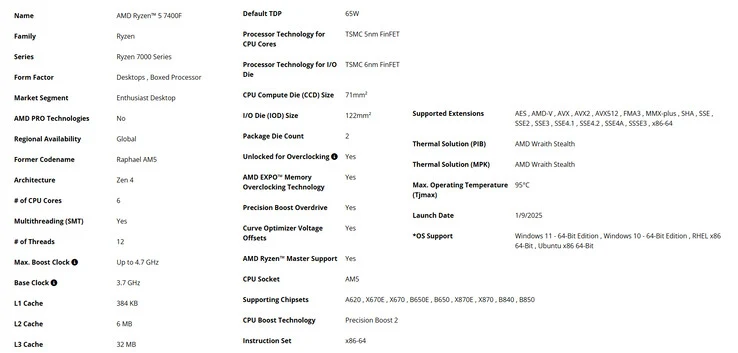
    AMD has introduced the Ryzen 5 7400F in China, adding to the growing lineup of Zen 4 processors. This new CPU is priced at CNY 849 in the Chinese market, which is about $116. This makes it one of the more budget-friendly Zen 4 options in AMD’s range.

    Global Pricing Expectations

    While we can’t expect the same pricing internationally, it’s likely that the Ryzen 5 7400F will stay under the $150 threshold in the global market. This CPU features a configuration of 6 cores and 12 threads, similar to the 7500F model. However, the boost clock speed is a bit lower at 4.7 GHz compared to the 5.0 GHz of the 7500F. The base clock speed remains unchanged.

    No Integrated Graphics

    Importantly, the Ryzen 5 7400F lacks an integrated GPU, which isn’t surprising for a CPU in the $120 range. Therefore, users will need a dedicated GPU for builds using this processor, like the XFX Speedster Radeon RX 6600, currently priced at $229.99 at Best Buy. AMD seems to be focusing on OEMs and system builders, but these kinds of CPUs often end up being sold individually by retailers.

    Performance Insights

    In terms of performance, the Ryzen 5 7400F should closely match the Ryzen 5 7500F. Given their similar configurations, the 7400F’s slightly slower boost clock will likely result in marginally lower benchmark scores than the 7500F. Nonetheless, it should provide a solid price-to-performance ratio when compared to the Ryzen 5 7600 and 7600X, which are priced at $229 and $299, respectively.

    There has been no announcement on when it will be available globally, but AMD has indicated that the Ryzen 5 7400F will be introduced internationally. For more details about this new Zen 4 CPU, check out the spec sheet attached below.

    Source:
    Link


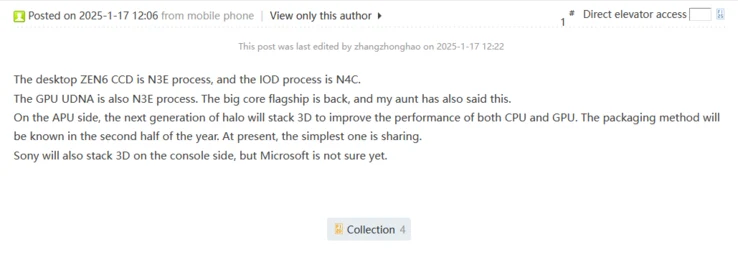
  • AMD 2026 Roadmap Leak: 3D V-Cache for PlayStation Chip and Strix Halo

    AMD 2026 Roadmap Leak: 3D V-Cache for PlayStation Chip and Strix Halo

    A recent leak from Chiphell has revealed AMD’s plans for 2026. The company has already launched most of its products for 2025 at CES 2025, except for the RDNA 4. Now, we can see some of AMD’s future strategies, although the roadmap is missing details on mainstream laptop CPUs and Epyc server components.

    Upcoming Ryzen CPUs

    To kick things off, AMD is set to introduce its Zen 6 Ryzen 11,000 desktop CPUs (this name is not final). The CPU tiles will be produced using TSMC’s N3E process, while the I/O die will be made on the N4C node. This approach aligns with AMD’s strategy of not always being at the forefront of technology.

    GPU Developments

    According to earlier gossip, AMD is looking to combine its RDNA and CDNA series into a new line called UDNA. This will be the foundation for all GPUs and AI accelerators released by AMD. In 2026, the GPUs will also utilize TSMC’s N3E technology, featuring a premium model this time around.

    AMD leaker Kepler_L2 noted that the new offering won’t be considered a “flagship.” It is expected to outperform the RTX 4090 but will likely fall short compared to the newly announced RTX 5090. This suggests that AMD is concentrating more on affordable, upper-mid-range products.

    Exciting Innovations

    In a twist, AMD is looking to enhance Strix Halo (or maybe Medusa Halo?) by adding 3D V-cache. This addition will be alongside the existing 32 MB Infinity Cache, and it will be intriguing to see how this enhancement performs.

    The most exciting news is that Sony is planning to incorporate 3D V-cache into one of its future products. This chip could potentially be used in an upcoming handheld gaming console, or it might power the PlayStation 6. Meanwhile, Microsoft remains uncertain about its direction in this regard.

    Source:
    Link


  • New RX 9070 XT Specs Leak: Performance, Release Date, Power Use

    New RX 9070 XT Specs Leak: Performance, Release Date, Power Use

    CES 2025 brought unexpected news for AMD enthusiasts, as the company chose not to unveil the RDNA 4 GPUs. While the exact motivation remains unclear, many speculate that AMD wants to gauge Nvidia’s offerings with the RTX 50 series before making their own announcements.

    AMD’s Strategic Focus

    This decision seems logical because, without any flagship products, AMD must focus on the mid-range RX 9070 XT and RX 9070 to ensure they offer great price-to-performance ratios. Recent leaks have suggested promising performance improvements for these cards. Notably, leaker All_The_Watts has shared critical information regarding the performance, release date, and TDP of the RX 9070 models.

    Performance Comparisons

    All_The_Watts asserts that the RX 9070 XT performs at least as well as the RTX 4070 Ti Super, though it does fall short of the RTX 4080. This aligns with earlier reports indicating that the RX 9070 XT could outperform the RTX 4070 Ti Super, being roughly equivalent to the RTX 4080 Super in the game Black Myth: Wukong.

    In terms of the RX 9070, the leaker suggests that this RDNA 4 card could either surpass or at least match the RTX 4070 Super, but it won’t reach the speed of the RTX 4070 Ti Super. This is at odds with an earlier leak suggesting the RX 9070 was comparable to the RX 7900 XT, which is 23% faster than the RTX 4070 Super in 3DMark Time Spy Graphics, according to our tests on Call of Duty: Black Ops 6.

    Performance Gains Expected

    Even if the performance estimates for the RX 9070 XT and RX 9070 are on the low side, these GPUs would still outperform the RX 7800 XT by 18.5% and the RX 7700 XT by 25%, based on 3DMark Time Spy Graphics results.

    It’s worth noting that, according to All_The_Watts, AMD appears to be overclocking the RX 9070/XT models to enhance their performance. The impact of this overclocking is visible in the leaker’s claims about clock speeds and possibly TDP.

    According to All_The_Watts, the RX 9070 XT is potentially being overclocked to reach clock speeds at or above 3 GHz. This is a significant increase compared to the RX 7900 XT, which has a max clock frequency of 2.4 GHz and a gaming frequency of 2 GHz.

    Power Consumption Considerations

    However, this increase in clock speed may lead to higher power usage, as the RX 9070 XT is reported to have a TDP in the range of 300 W. For context, the RX 7900 XT has a TDP of 315 W.

    For the RX 9070 non-XT model, the alleged clock speed and TDP are said to be equal to or greater than 2 GHz and in the 200 W range, respectively.

    In conclusion, according to a leak from Moore’s Law Is Dead, All_The_Watts has indicated that the RDNA 4 cards could be revealed on January 15. We won’t have to wait long to find out if these leaked details hold true. Until then, it’s best to treat this information as mere speculation.

    Source:
    Link

  • AMD FSR 4 Review: Enhanced Quality and Detail with ML Technology

    AMD FSR 4 Review: Enhanced Quality and Detail with ML Technology

    AMD’s CES announcement about RDNA 4 was quite unusual, with Team Red sharing details about the new graphics card generation in bits and pieces after the main reveal. Recently, independent tests carried out by Hardware Unboxed on YouTube (you can view the full video below) have largely validated many of AMD’s touted performance and quality enhancements.

    Impressive Performance Observed

    The Hardware Unboxed crew managed to get a glimpse of how AMD’s FSR 4 compares to FSR 3.1 during the CES 2025 event, using demo systems that showcased Ratchet and Clank Rift Apart on the latest Radeon RX 9070 GPUs. Their findings indicated a noticeable boost in upscaling quality, featuring sharper edges, improved antialiasing, and a reduction in overall visual artefacts.

    Visual Enhancements in 4K Mode

    In addition to visual enhancements, these upgrades were particularly evident in 4K Performance mode, which has not been FSR’s strong suit in earlier assessments. The most obvious improvement is seen in small, fast-moving details, such as particles, where FSR 3.1 has difficulty with edges, resulting in pixelation and unclear details. The fur on Ratchet also shows a significant upgrade, with FSR 4 offering much finer hair texture compared to FSR 3.1, even though some smoothing is still present.

    Clarity in Distant Elements

    Elements that are further away, like guard rails in the crowd stands shown in the footage, are rendered much more distinctly with FSR 4 in contrast to FSR 3.1. Enhancements are clear in reflections, transparent surfaces, and holographic effects, which exhibit less detail distortion when utilizing FSR 4.

    One of the major updates in FSR 4 is that the upscaling technology now employs machine learning, akin to Nvidia’s DLSS, which has traditionally been seen as superior to AMD’s offering. If AMD’s FSR 4 can deliver the improved quality suggested by Hardware Unboxed, it may revolutionize the upcoming gaming handhelds equipped with RDNA 3.5 iGPUs—assuming AMD permits FSR 4 to function on those iGPUs, as it is currently restricted to RDNA 4.

    Limited Testing Scope

    It is worth noting that this evaluation was conducted on just one game and a singular scene, which means it might not fully represent overall performance. Nevertheless, it’s quite remarkable to witness AMD making such significant progress in AI-enhanced upscaling. The Radeon RX 9070 XT and other GPUs in the 9070 series are anticipated to launch sometime in Q1 2025.

    Source:
    Link