Tag: 3D V-cache

  • AMD Ryzen 5800X3D Relaunch Required Extensive Engineering Work

    AMD Ryzen 5800X3D Relaunch Required Extensive Engineering Work

    Key Takeaway

    – AMD re-announced the Ryzen 7 5800X3D at Computex 2026 as a re-release, set for June 25 at $350.
    – The chip highlights AM4 platform longevity, allowing gamers to keep using DDR4 memory and existing motherboards.
    – Re-engineering was required because TSMC’s original 3D V-Cache stacking process was no longer available.
    – Engineers had to re-qualify, fabricate, test, and validate the chip using the new stacking approach to meet quality standards.


    Comptex Re-Intros the 5800X3D Chip

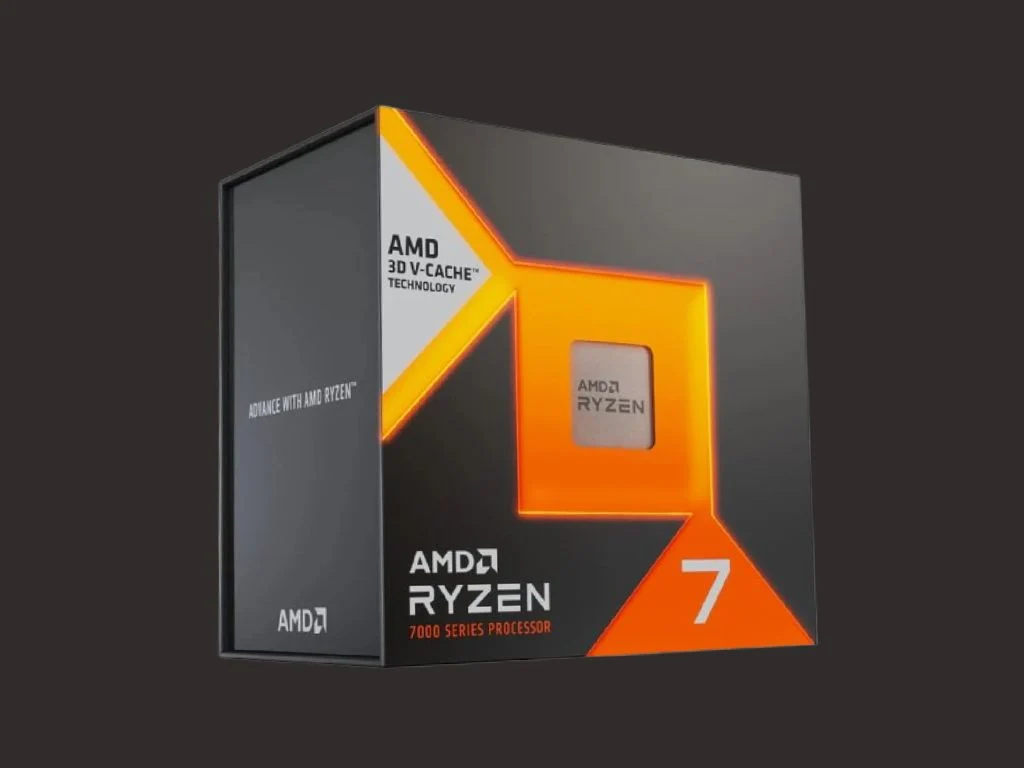
    After numerous leaks and rumors, the AMD Ryzen 7 5800X3D has been formally re announced by Team Red at Computex 2026. The tenth anniversary of the 5800X3D just goes to show the longevity of the AM4 platform, even as the company continues to produce Zen 4 and Zen 5 chips. This means gamers can stick to reliable, relatively inexpensive DDR4 memory without haveing to upgrade their motherboards, while still getting a bump in CPU and gaming performance.

    Return of the King at $350

    In press briefings at Computex, AMD framed the Ryzen 7 5800X3D as the “Return of the King,” evoking the chip’s status in 2022 as the first Ryzen gaming processor to introduce 96MB of 3D V-Cache. Even today, it remains one of the best go-to options, with the re-release set for June 25, 2026, at a retail price of $350.

    McAfee Addresses Gamers

    At Computex, David McAfee, the corporate VP and GM of AMD’s Client Channel and Graphics Business, addressed gamers while announcing the processor. Stating “We’re commited to giving gamers high-performance technologies with the flexibility to upgrade their systems over time. Ultimately, our goal is to deliver unmatched ownership experiences for players around the world.” The road to re-releasing the Ryzen 7 5800X3D was not as straightforward though as simply refabricating the chips, because AMD says a lot of engineering effort went into adapting to the current chip manufacturing landscape.

    Engineering Behind the Return

    Bringing back the 5800X3D wasn’t just a matter of dusting off the old design and pressing “go” on the production line. McAfee stated that “a whole body of engineering work” went into reproducing the original bonding process TSMC used for the 5800X3D. This is because, as AMD moved forward to second-generation 3D V-Cache designs, the original process was no longer available. So engineers had to re-qualify the design for the new stacking approach, fabricate and validate new sample chips, and run extensive reliability tests to ensure the re-released chip would meet quality control requirements and gamers’ standards.

    Process Changes Explained

    McAfee explained: “It’s not as simple as bringing back the 5800X3D. The original stacking process that was used at TSMC changed when we went from first-gen to second-gen cache, so we had to re-engineer that product, and there actually went a fair amount of development work into bringing back the 5800X3D.” AMD had to put a whole lot of work into re-validating the chip for modern fabrication.

    • 96MB of 3D V-Cache
    • Re-release date: June 25, 2026
    • Retail price: $350
    • AM4 platform compatibility
    • DDR4 memory support
    Sources
  • Budget 8-core AMD Ryzen 7 7700X3D in the works reveal

    Budget 8-core AMD Ryzen 7 7700X3D in the works reveal

    Key Takeaway

    – Rumor: AMD prep for a budget-friendly Ryzen 7 7700X3D (Zen 4 with 3D V-Cache) aimed at budget-conscious gamers.
    – Specs (rumored): 8 cores / 16 threads, 96 MB L3 cache, 120W TDP, base 4.0 GHz, boost up to 4.5 GHz.
    – Performance expectation: In-game performance within ~5–10% of the higher-end 7800X3D, at a lower price point (~$300).
    – Market impact: Could broaden access to 3D V-Cache tech and improve price-to-performance in gaming CPUs if launched.


    Budget Ryzen 7000 X3D Rumor Surfaces

    AMD is reportedly working on a budget-friendly Ryzen 7000 series X3D CPU for gamers that doesn’t break the bank while still delivering top-tier gaming performance in CPU-intensive titles. The chatter comes from a known hardware leaker going by chi11eddog, who claims the lineup will include a new Zen 4-based chip using the company’s 3D V-Cache tech. This would place the product as the latest entry in the Ryzen 7000 X3D family, specifically aimed at budget-minded players who aren’t willing to splurge on flagship parts.

    Rumored Pricing and Target

    It’s rumored that the Ryzen 7 7700X3D will be priced around $300 at retail, potentially making it an attractive option for price-to-performance in gaming. The idea is to broaden access to AMD’s 3D V-Cache tech for a wider audience. Some speculation suggests AMD could be using leftover or repurposed dies to assemble this more affordable processor.

    Key Specs Leaked

    The leaker’s post on X reportedly includes some essential specs: “R7 7700X3D, 120W, 8C16T, 96MB.” In comparison to the current Zen 4 X3D octa-core CPU, the Ryzen 7 7700X3D resembles the 7800X3D on paper, both offering eight cores, sixteen threads, and 96MB of L3 cache (32MB standard plus 64MB stacked via 3D V-Cache). The main variation appears in clock frequencies.

    Performance and Cooling

    Sources claim the 7700X3D would run at a base clock of 4.0 GHz and boost up to 4.5 GHz, which are about 200 MHz and 500 MHz lower respectively than the 7800X3D’s 4.2/5.0 GHz. The total power draw is pegged at 120 watts, implying that high-end cooling might not be strictly necessary. The lower clocks could also help the chip stay a bit cooler than its larger sibling, a reasonable trade-off for a budget-focused model.

    Market Impact and Availability

    Early reports suggest gaming performance could dip only around 5–10% versus the 7800X3D, which would be acceptable for many players when weighed against the lower price tag. The 7800X3D originally launched at $449 in 2023 and still commands roughly $350–$380 in today’s market, depending on availability. The Ryzen 7 7700X3D might offer similar gains at a fraction of the cost, presenting a helpful option as hardware prices fluctuate.

    Official Confirmation and Timing

    Despite the chatter, AMD has not officially announced the Ryzen 7 7700X3D. Historically, the company has released more affordable chips after higher-end, well-binned units become scarce, so the candidate could arrive soon, aligning with a PC gaming market that could use some relief on hardware costs.

    Sources
  • AMD Ryzen 9000 CPU Leak: Dual 3D V-Cache Features Revealed

    AMD Ryzen 9000 CPU Leak: Dual 3D V-Cache Features Revealed

    Key Takeaways

    1. AMD is releasing new CPUs on the AM5 platform, shifting focus from AM4.
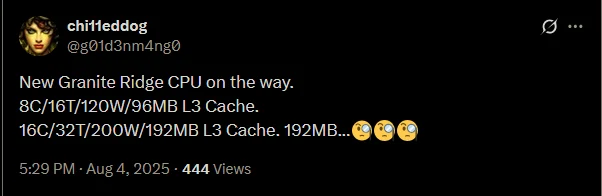
    2. The first upcoming CPU features 8 cores, 16 threads, a TDP of 120 Watts, and 96 MB of L3 cache.
    3. The second CPU boasts 16 cores, 32 threads, a TDP of 200 Watts, and an impressive 192 MB of L3 cache.
    4. The 192 MB cache indicates the use of 64 MB of 3D V-Cache per CCD, a first for this segment.
    5. Speculation surrounds the naming of these CPUs, with possibilities like Ryzen 7 9700X3D and Ryzen 9 9990X3D.


    While AMD keeps putting out AM4 CPUs even now, the newer AM5 platform hasn’t been getting the same spotlight. However, this could shift soon. It seems like Team Red has two new CPUs in the pipeline, both featuring a large amount of L3 cache.

    Exciting New Specs

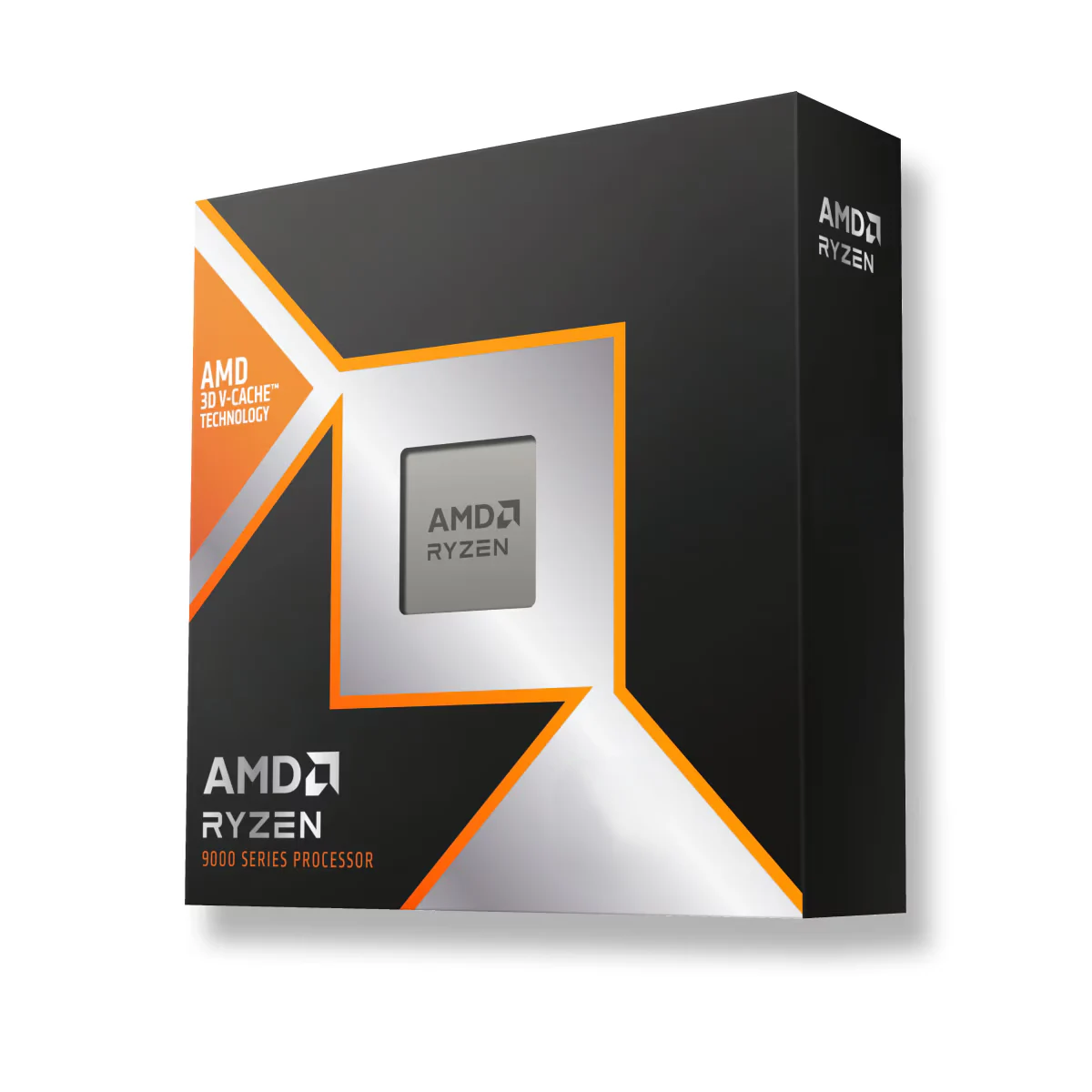
    According to leaker @g01d3nm4ng0, one of AMD’s forthcoming Granite Ridge (Ryzen 9000 series) CPUs is set to have 8 cores, 16 threads, a TDP of 120 Watts, and an impressive 96 MB of L3 cache. In terms of specifications, this matches the Ryzen 7 9800X3D, making it intriguing to see how they will vary. It’s likely to be released as the Ryzen 7 9700X3D, possibly with slightly lower clock speeds.

    A Promising Second CPU

    The second CPU appears to be even more exciting: it features 16 cores, 32 threads, a TDP of 200 Watts, and a staggering 192 MB of L3 cache. This is significantly more powerful than the Ryzen 9 9950X3D, which has a lower TDP of 170 Watts and less cache. The 192 MB of cache indicates that each CCD will include 64 MB of 3D V-Cache, a first for this segment.

    Speculation on Naming

    There were whispers about a Ryzen 9000 X3D CPU that would use two 3D V-cache tiles before these CPUs were officially revealed, but those rumors were quickly dismissed. It’s still too soon to say what the name will be since such a product has never been seen before. Could it be the Ryzen 9 9990X3D? The connection to Granite Ridge further assures us that it is meant for consumers, not just for enterprise applications.

    Source:
    Link


  • AMD Zen 7 Leak: New 3D Core, IPC Boost, Release Date & More

    AMD Zen 7 Leak: New 3D Core, IPC Boost, Release Date & More

    Key Takeaways

    1. AMD’s Zen 7 CPU architecture is expected to focus on enhancing efficiency, IPC (Instructions Per Cycle), and frequency, rather than significantly increasing core count compared to Zen 6.

    2. The introduction of a 3D Core is a key feature of Zen 7, utilizing advanced TSMC process nodes (1.4 nm for core chiplets and 4 nm for V-Cache chiplets).

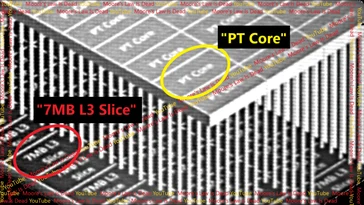
    3. Zen 7 is anticipated to achieve a 15-25% IPC improvement over Zen 6, with each core featuring 2 MB of on-die L2 cache and 7 MB of L3 cache, extending the 3D V-Cache concept.

    4. AMD’s Epyc Zen 7 server processors may include 33-core chiplets, potentially allowing for total core counts of up to 264, with backward compatibility to Zen 6 IODs.

    5. The projected timeline for Zen 7 includes a “Tape Out” in October 2026, with a full launch expected by late 2027 or early 2028.


    By all accounts, it seems we still have over a year to wait before AMD reveals its next-generation Zen 6 CPU architecture. However, this hasn’t deterred Moore’s Law Is Dead from providing some insights about Zen 7, the successor to Zen 6. Recently, we reported that AMD has significant ambitions for Zen 7, including the launch of a 3D Core.

    Insights on Zen 7

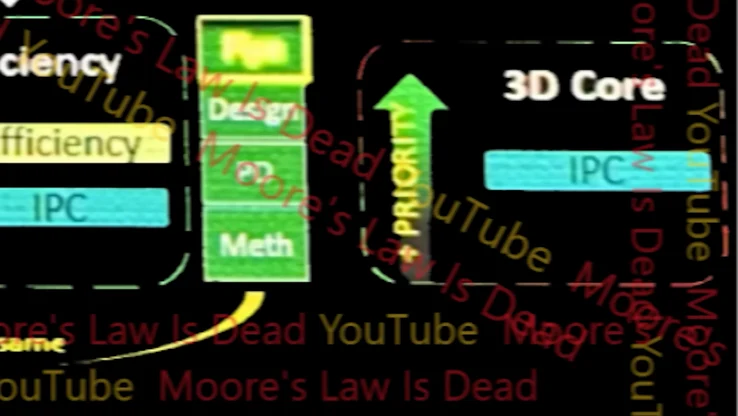
    Moore’s Law Is Dead has shared more details about Zen 7 and AMD’s innovative 3D Cores. The source suggests that while Zen 7 may not significantly increase the core count compared to Zen 6, AMD plans to enhance efficiency, IPC, and frequency across all core types. Currently, AMD is said to be developing a single Zen 7 CPU architecture and dividing it into five distinct variants.

    Exciting Developments

    While MLID outlines some of AMD’s architectural and design objectives for Zen 7, the most intriguing aspect is the rumored 3D Core. Based on internal documents allegedly seen by MLID and confirmed through an AMD insider, AMD is reportedly choosing the advanced TSMC 1.4 nm process node for Zen 7 core chiplets and a 4 nm process for V-Cache chiplets. Even though this approach may raise costs, AMD appears committed to using the latest TSMC process node for its CPU cores.

    Performance Expectations

    With this cutting-edge process, Zen 7 is expected to achieve a 15-25% IPC improvement over Zen 6. This increase in IPC may be influenced by the cache modifications that AMD plans to implement in Zen 7 CPUs. The leaker indicates that Zen 7 processors will come with 2 MB of on-die L2 cache per core and 7 MB of L3 cache per core, utilizing V-Cache chiplets. This effectively means that AMD is extending the 3D V-Cache concept it first introduced with the Ryzen 7 5800X3D, giving each Zen 7 CPU core its own V-Cache, thus coining the term “3D Core.”

    If AMD successfully launches a 3D Core, it’s easy to imagine that Zen 7 CPUs could deliver outstanding gaming performance, especially since the leading gaming CPUs available today are AMD models featuring a dedicated L3 “3D V-Cache” component.

    Server Chip Developments

    Furthermore, MLID asserts that AMD’s Epyc Zen 7 server processors will incorporate 33-core chiplets, potentially leading to a total core count of up to 264. Additionally, it seems that the Zen 7 Epyc core chiplets will be backward compatible with Zen 6 IODs, which AMD plans to unveil next year.

    MLID mentions that AMD’s current goal for the “Tape Out” of Zen 7 is set for October 2026. Team Red is reportedly aiming for a full launch by the end of 2027 or the beginning of 2028.

    Finally, the fact that Zen 7 is more than two years away suggests that the information provided by MLID should be taken with caution. We will likely hear official confirmations about Zen 7 only once Zen 6 CPUs are available on the market.

    Source:
    Link


  • AMD Zen 7 3D Core Leaks: Mandatory Cache Chiplets for Gaming Boost

    AMD Zen 7 3D Core Leaks: Mandatory Cache Chiplets for Gaming Boost

    Key Takeaways

    1. AMD is expected to enhance gaming capabilities in Zen 6 CPUs by increasing the size of the 3D V-Cache.
    2. Zen 7 is rumored to introduce a unified CPU architecture with various core types, including “Classic,” “Dense,” “Efficiency,” and “Low-Power” cores.
    3. The new “3D Core” in Zen 7 will feature individual cache chiplets for each core, rather than a shared cache unit.
    4. AMD is heavily investing in the latest process node technology for Zen 7, aiming for cutting-edge manufacturing from TSMC or Samsung.
    5. Anticipation for more details on Zen 7, particularly regarding the 3D Core, is high, with expectations of improved gaming performance.


    We are currently at a stage in the progression of AMD Zen 5 Ryzen 9000 CPUs where there is an uptick in leaks and speculation about future AMD CPU designs. We’ve shared a lot of information about Zen 6 enhancements, such as the expected CPU core counts, clock speeds, and cache capacities. Additionally, leaks have verified that AMD plans to boost the gaming capabilities of Zen 6 CPUs further by enlarging the 3D V-Cache.

    AMD’s Future Plans

    Thanks to insights from Moore’s Law Is Dead, we might have a clearer picture of AMD’s strategy for CPU architectures post-Zen 6. Zen 7, or whatever name the successor to Zen 6 will carry, is said to introduce a range of new features, including a novel “3D Core”.

    According to the information provided by MLID, AMD aims to create a unified CPU architecture with Zen 7, which will then be divided into various product categories. Reportedly, Team Red is working on new core types, including “Classic,” “Dense,” “Efficiency,” and “Low-Power” cores for Zen 7. Moreover, AMD is investing heavily in the latest process node for Zen 7, meaning they will utilize whatever cutting-edge nodes are available from foundries like TSMC or Samsung at that time.

    The Exciting New 3D Core

    Despite the interesting details shared by MLID, none are as thrilling as the introduction of Zen 7’s new “3D Core.”

    MLID hasn’t disclosed too much about the 3D Core, as it seems the leaker is reserving details for a more comprehensive Zen 7 leak in the future. However, what we do know about the 3D Cores for Zen 7 is quite intriguing.

    To begin with, while Zen 7’s 3D Core uses the same cache-stacking concept seen in 3D V-Cache, it is fundamentally distinct. From our understanding, each Zen 7 3D Core will feature its own cache chiplet, instead of having a single cache unit shared across the entire CCD.

    Presently, AMD’s 3D V-Cache CPUs, like the Ryzen 7 9800X3D, utilize one 64 MB cache chiplet positioned beneath a CCD that houses 8 cores. This means the 64 MB 3D V-Cache is distributed across the CCD. MLID suggests that every 3D Core in a Zen 7 CPU will possess its own cache chiplet, rather than relying on one block for the entire CCD.

    Anticipation for More Details

    We’ll need to wait for a more detailed leak from MLID regarding Zen 7 to gain additional insights about the 3D core. Until that happens, it’s an exciting prospect if AMD is indeed pursuing this direction with Zen 7, as it could lead to significantly enhanced gaming performance.

    It’s already established that 3D V-Cache is extremely beneficial for gaming. Over the last two CPU generations, the top gaming CPUs available have been AMD models featuring 3D V-Cache, such as the Ryzen 9 9950X3D and Ryzen 7 7800X3D. Thus, it’s easy to imagine that a Zen 7 CPU equipped with 3D Cores, each having its own cache chiplet, could dominate gaming performance.

    As always, rumors like these are prone to inaccuracies or may overlook crucial details. Therefore, it’s wise to approach this information with a healthy skepticism.

    Source:
    Link


  • AMD Ryzen 9950X3D and 9900X3D Now Available for Purchase

    AMD Ryzen 9950X3D and 9900X3D Now Available for Purchase

    Key Takeaways

    1. The AMD Ryzen 9950X3D and Ryzen 9900X3D were launched as the latest gaming CPUs in the 9000 series lineup, available for purchase online.

    2. The Ryzen 9950X3D features 16 cores, 32 threads, a boost clock of up to 5.7 GHz, and a total cache of 144 MB with 3D V-Cache technology.

    3. The Ryzen 9900X3D has 12 cores, 24 threads, and a cache of 140 MB, with a maximum boost clock of 5.5 GHz, and operates within a 120 TDP envelope.

    4. Both processors demonstrate strong performance in productivity and gaming, comparable to high-end competitors like the Intel Core Ultra 9 285K.

    5. The new second-generation 3D V-Cache technology allows for lower temperatures and improved overclocking potential, enhancing overall performance.


    The AMD Ryzen 9950X3D and Ryzen 9900X3D, highly anticipated by gamers and tech enthusiasts, were officially launched today after being first revealed at CES 2025. These cutting-edge X3D processors, known as the “most advanced gaming CPUs,” are now available for purchase through online platforms such as Newegg and Amazon.

    Availability of New CPUs

    Currently, you can find the new CPUs for sale online. Following the Ryzen 7 9800X3D, the Ryzen 9950X3D and the Ryzen 9900X3D are the newest members in the 9000 series lineup. The Ryzen 9950X3D stands as the premium option, closely resembling the Ryzen 9950X (currently priced at $541.73 on Amazon). It boasts 16 cores and 32 threads, with a boost clock speed reaching up to 5.7 GHz and a thermal design power of 170W. The standout feature is the 3D V-Cache enhanced CCD, which provides an impressive total cache of 144 MB.

    Performance Insights

    In our evaluation of the AMD Ryzen 9950X3D, we discovered that its performance is comparable to that of the Intel Core Ultra 9 285K, the Core i9-14900K, and the Ryzen 9 9950X according to various CPU benchmarks. The processor excelled in both productivity tasks and gaming tests, with the new generation V-Cache positively impacting gaming performance.

    On the other hand, the AMD Ryzen 9 9900X3D shares many similarities with the Ryzen 9900X (currently $378.65 on Amazon). Both chips feature an identical configuration of 12 cores and 24 threads and provide 64 MB of L3 cache across two CCDs. One CCD integrates a 2nd Generation 3D V-Cache stack, boosting the cache capacity to 140 MB. The Ryzen 9900X3D can achieve a maximum boost clock of 5.5GHz, slightly less than the 9900X, although both processors operate within a 120 TDP envelope.

    Technical Features

    As previously mentioned, both of these processors incorporate the signature 3D V-Cache technology, now with enhancements. The second-generation 3D V-Cache allows both chips to run at lower temperatures and offers significant potential for overclocking. Additionally, both CPUs are compatible with standard CO and PBO utilities, making them versatile options for users looking to maximize performance.

  • AMD 2026 Roadmap Leak: 3D V-Cache for PlayStation Chip and Strix Halo

    AMD 2026 Roadmap Leak: 3D V-Cache for PlayStation Chip and Strix Halo

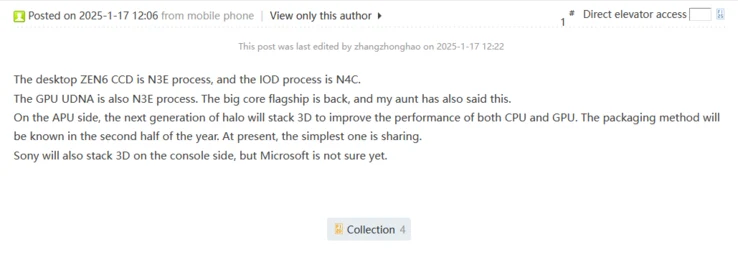
    A recent leak from Chiphell has revealed AMD’s plans for 2026. The company has already launched most of its products for 2025 at CES 2025, except for the RDNA 4. Now, we can see some of AMD’s future strategies, although the roadmap is missing details on mainstream laptop CPUs and Epyc server components.

    Upcoming Ryzen CPUs

    To kick things off, AMD is set to introduce its Zen 6 Ryzen 11,000 desktop CPUs (this name is not final). The CPU tiles will be produced using TSMC’s N3E process, while the I/O die will be made on the N4C node. This approach aligns with AMD’s strategy of not always being at the forefront of technology.

    GPU Developments

    According to earlier gossip, AMD is looking to combine its RDNA and CDNA series into a new line called UDNA. This will be the foundation for all GPUs and AI accelerators released by AMD. In 2026, the GPUs will also utilize TSMC’s N3E technology, featuring a premium model this time around.

    AMD leaker Kepler_L2 noted that the new offering won’t be considered a “flagship.” It is expected to outperform the RTX 4090 but will likely fall short compared to the newly announced RTX 5090. This suggests that AMD is concentrating more on affordable, upper-mid-range products.

    Exciting Innovations

    In a twist, AMD is looking to enhance Strix Halo (or maybe Medusa Halo?) by adding 3D V-cache. This addition will be alongside the existing 32 MB Infinity Cache, and it will be intriguing to see how this enhancement performs.

    The most exciting news is that Sony is planning to incorporate 3D V-cache into one of its future products. This chip could potentially be used in an upcoming handheld gaming console, or it might power the PlayStation 6. Meanwhile, Microsoft remains uncertain about its direction in this regard.

    Source:
    Link


  • AMD Ryzen 7 9800X3D Launching in October; Ryzen 9 Models Next Year

    AMD Ryzen 7 9800X3D Launching in October; Ryzen 9 Models Next Year

    Last year, AMD introduced the Ryzen 9 7950X3D and Ryzen 9 7900X3D, followed shortly by the Ryzen 7 7800X3D. Since that time, several new 3D V-cache models have been released, including the Ryzen 5 5600X3D, Ryzen 7 5700X3D, and Ryzen 5 7600X3D, appearing at various times. However, AMD seems to be planning a different approach for the upcoming Zen 5 X3D models, according to a recent rumor from Chiphell.

    Upcoming Launch

    The AMD Ryzen 7 9800X3D is expected to debut alone in late October, accompanied by new X870 motherboards. There is a possibility that AMD could unveil the Ryzen 9 9900X3D and Ryzen 9 9950X3D at the same time, although these processors are likely to be released next year, presumably after CES 2025. These new CPUs are rumored to feature ‘special attributes’ that distinguish them from previous generations.

    Performance Expectations

    Moore’s Law is Dead has speculated that the Ryzen 9 9950X3D may feature a doubled amount of 3D V-cache. It can be assumed that the Ryzen 9 9900X3D will receive similar enhancements, along with a potential price increase. If these speculations hold true, both CPUs are expected to perform exceptionally well in benchmarks, maintaining their top positions until the arrival of Zen 6. Neither of these models will support overclocking, which has been the norm since the Ryzen 7 5800X3D period.