
Key Takeaways
1. Performance Comparison: The Steam Deck OLED outperforms the Switch 2 in full power mode, achieving higher frame rates and faster load times in games like Cyberpunk 2077.
2. Limited Power Performance: Under a restricted power budget of 8.6 W, the Switch 2 significantly surpasses the Steam Deck, showing 2.5 times higher average FPS and better performance in demanding games.
3. Standby Power Efficiency: The Switch 2 demonstrates superior standby power efficiency, consuming only 1.18 W compared to the Steam Deck’s 4 W during idle tests.
4. Game Performance: The Switch 2 effectively uses DLSS for better frame rates in games, while the Steam Deck faced issues with native 1080p performance in certain titles.
5. User Concerns: While some users appreciate the Switch 2’s features, there are concerns about Nintendo’s control over the platform and potential issues like devices getting bricked or overheating.
Ever since the introduction of Switch 2, Nintendo and its new handheld gaming console have been the topic of much chatter. There have been reports of Switch 2 devices getting bricked, overheating in certain situations, and comparisons between the Switch 2 and the Xbox Series console regarding performance. While some users commend its features, others express concerns about Nintendo’s alleged strict control over the platform and ownership of devices.
Performance Comparison
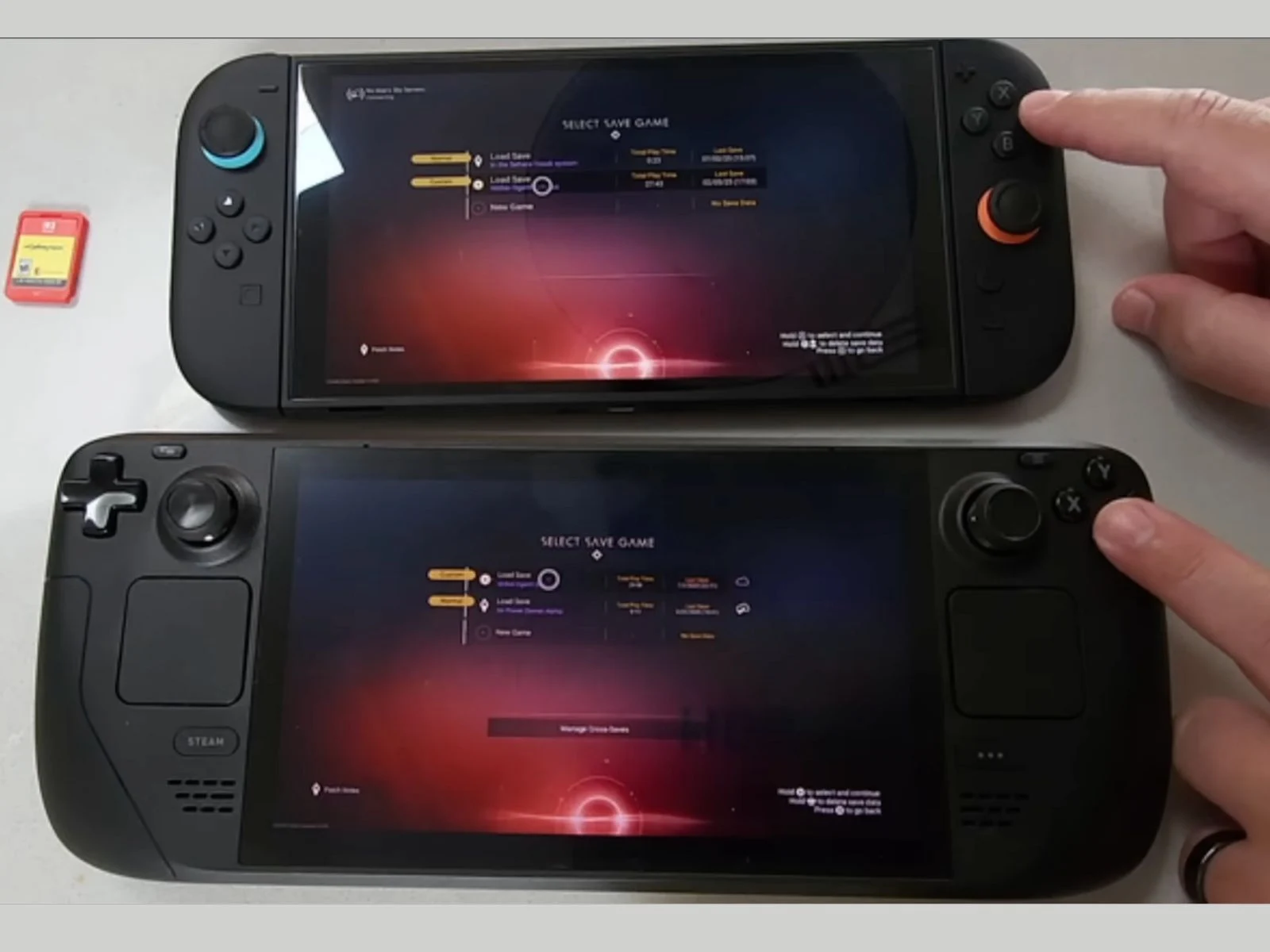
Recently, the YouTube channel The Phawx pitted the Steam Deck OLED against the Nintendo Switch 2, revealing some unexpected findings. The YouTuber put both devices through their paces in handheld mode, concentrating on games like Cyberpunk 2077 and No Man’s Sky. The aim was to assess both raw performance and energy efficiency. Frame rates were meticulously counted using high-frame-rate video capture to ensure precision, while power usage was tracked based on battery drain under controlled settings.
Results Under Full Power
When operating at full capacity, the Steam Deck OLED comes out on top. According to The Phawx, playing Cyberpunk 2077 at a total system power of 24 W yielded an average frame rate of 41.6 FPS, in contrast to the Switch 2’s 33.5 FPS, giving the Steam Deck a lead of around 24%. Load times also favored the Steam Deck due to its superior CPU speeds, with Cyberpunk loading nearly 78% quicker.
Performance at Limited Power
However, the tables turn when both devices are restricted to an 8.6 W power budget, which is the average system power draw of the Switch 2 under load, as noted by The Phawx. In this situation, the Switch 2 provides 2.5 times higher average FPS, 226% better 1% lows, and can deliver up to three times the performance in games like Cyberpunk 2077 and No Man’s Sky, thereby outperforming the Steam Deck OLED within the same thermal and power limits.
In No Man’s Sky, the Steam Deck OLED faced challenges at native 1080p with FXAA, since Intel’s XeSS upscaling was inoperative, as explained by The Phawx in their video. On the other hand, the Switch 2 utilized DLSS to upscale from a lower internal resolution, resulting in smoother frame rates while maintaining the same power constraints.
Standby Power Efficiency
Standby power consumption revealed a similar trend. In a 12-hour idle test, the Switch 2 drew just 1.18 W compared to the Steam Deck’s 4 W, achieving three times better standby efficiency. Although the ARM-based Switch 2 still doesn’t quite match high-end mobile chips like the Snapdragon X Elite, it still surpasses x86-based handhelds, per The Phawx’s analysis.
These findings indicate that while the Steam Deck OLED excels in performance with no power limits, Nintendo’s Switch 2 currently excels in providing playable performance within tight thermal and power restrictions. For a more detailed technical analysis, you should definitely check out the full video by The Phawx linked below; they do a fantastic job explaining each test and their methods.
Source:
Link
Leave a Reply