
Key Takeaways
1. Budget office laptops typically feature IPS screens with around 300 nits brightness, 60 Hz refresh rate, and limited color range.
2. High-end business laptops often use OLED panels, but IPS panels avoid PWM flickering and light reflection issues.
3. Lenovo’s ThinkPad E-series now offers upgraded IPS screens with higher resolutions and refresh rates for an additional cost.
4. The ThinkPad E14 G7 has a higher resolution of 2880 x 1800 pixels, but may appear grainy in bright areas, while the E16 G3 performs better with 2560 x 1600 pixels.
5. The improved refresh rate on upgraded displays allows for better image editing capabilities.
Inexpensive office laptops usually come with rather poor screens, and not long ago, there were still VA panels around. Currently, the norm for budget-friendly office notebooks features IPS screens with a brightness level of approximately 300 nits, 60 Hz refresh rate, and limited color range. This decision makes sense for companies aiming to cut costs, especially with the rise of flexible workspaces where laptops are frequently connected to larger external displays. Consequently, the quality of the built-in screen becomes less significant.
Premium Laptops and Their Displays
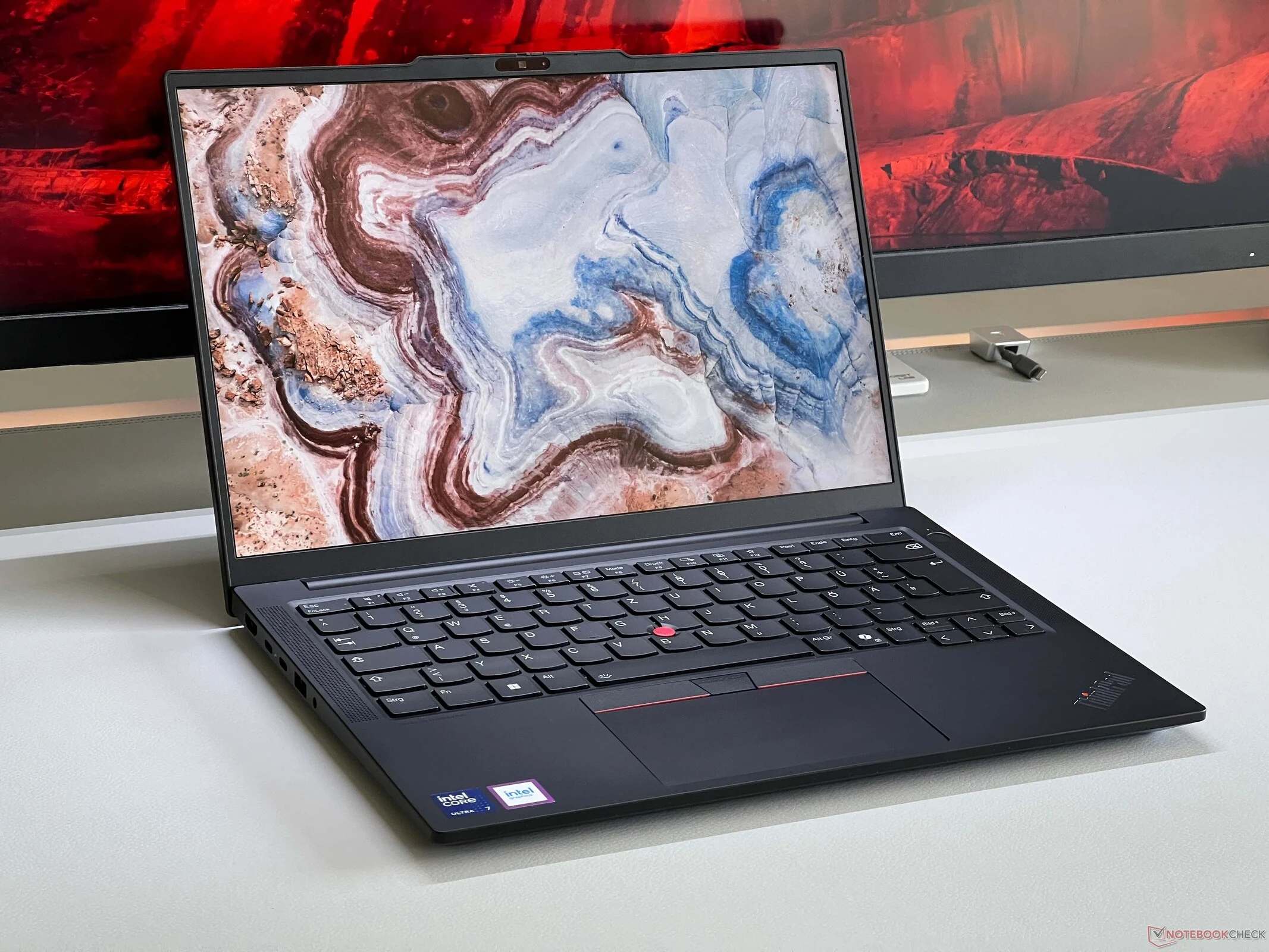
High-end business laptops typically offer OLED panels, which do have their clear benefits. However, IPS panels are free from PWM flickering issues, and matte screens do not reflect light problems either. Lenovo is now providing improved IPS screens for its more affordable ThinkPad E-series. Both the ThinkPad E16 G3 and the ThinkPad E14 G7 can be upgraded to high-resolution IPS panels boasting 120 Hz refresh rates and full sRGB color coverage for an extra fee of merely 60 Euros.
Screen Comparisons and Performance
Interestingly, the smaller ThinkPad E14 G7 features a slightly higher resolution of 2880 x 1800 pixels (16:10), although it does present a somewhat grainy appearance on bright areas. In contrast, the larger 16-inch display of the ThinkPad E16 G3, with 2560 x 1600 pixels, performs better in this regard. Nevertheless, the image quality is undoubtedly superior compared to the standard screen. The enhanced refresh rate, in particular, represents a significant upgrade, allowing users to even edit images on the optional displays.


Leave a Reply