
Key Takeaways
1. SMIC has successfully developed its first 5 nm-grade smartphone SoC, the Kirin 9030, using the N+3 process node.
2. The Kirin 9030 features a high transistor density of about 125 Mtr/mm², comparable to Samsung’s 5LPE node.
3. The chip is tested with the Huawei Mate 80 Pro Max, featuring a CPU with varying core speeds and a Maleoon 935 GPU.
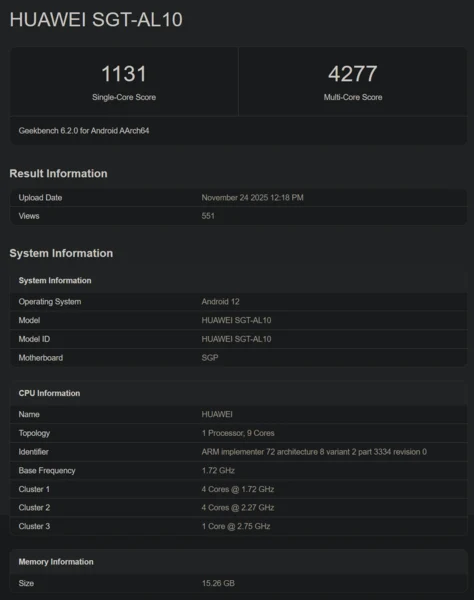
4. Geekbench scores for the Kirin 9030 are 1,131 (single-core) and 4,277 (multi-core), though these do not reflect its full potential.
5. Despite advancements, the Kirin 9030 is expected to lag behind competitors like Snapdragon 8 Elite Gen 5 and MediaTek Dimensity.
SMIC has made a notable advancement in its ability to produce semiconductors. The company has successfully created its first 5 nm-grade smartphone System on Chip (SoC) using its N+3 process node, which has been in the works since last year. With an impressive transistor density of about 125 Mtr/mm², this chip can stand alongside Samsung’s 5LPE node. This particular chip is the Kirin 9030, which will be the driving force behind the new Huawei Mate 80 series smartphones.
Specifications Revealed
Recently, the Kirin 9030 was found on Geekbench while being tested with the Huawei Mate 80 Pro Max (model HUAWEI SGT-AL10), which comes equipped with 16 GB of RAM. The chip includes one primary CPU core (likely from the Taishan family) running at 2.75 GHz, along with four additional cores clocked at 2.27 GHz and another four cores at 1.72 GHz. Additionally, it boasts a Maleoon 935 GPU, although detailed specifications for this GPU remain unclear.
Performance Insights
In the Geekbench tests, the Kirin 9030 achieved scores of 1,131 for single-core and 4,277 for multi-core performance. A leaker known as Digital Chat Station on Weibo pointed out that these results do not fully represent the chip’s capabilities, as it was not operating at its maximum speed during testing. Even when at full capacity, the Kirin 9030 is expected to fall short compared to competitors like the Snapdragon 8 Elite Gen 5 and MediaTek Dimensity, which is understandable due to its significant process node disadvantage.
Conclusion
In summary, while SMIC’s Kirin 9030 marks a step forward in semiconductor technology, it still has a way to go before matching leading contenders in the market. The developments in the Huawei Mate 80 series will be interesting to follow, particularly as they showcase this new chip’s potential.
Source:
Link
Leave a Reply