

Key Takeaways
1. Fast charging does not significantly damage battery capacity after 500 cycles for both iPhones and Android devices.
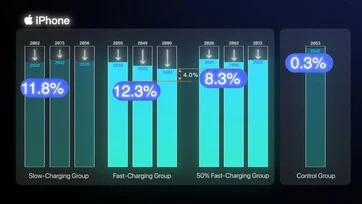
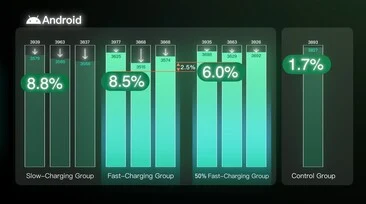
2. Keeping your smartphone battery between 30% and 80% can lead to a slight increase in capacity over time (4% for iPhones, 2.5% for Android).
3. The study automated charge and discharge tests to ensure accurate results across different devices.
4. Storing batteries at half-charge, full-charge, or nearly empty showed no noticeable differences in capacity over a week.
5. The video reflects a strong commitment to quality, technical skill, and thorough investigation into battery performance.
Tech enthusiasts from the newer YouTube channel HTX Studio have taken great steps to investigate if fast charging actually damages battery life, which is a common belief. Is it more beneficial to charge your smartphone overnight with a slower 5-watt charger, or should you only use between 30% and 80% of its overall capacity? These inquiries, along with a few others, are succinctly addressed in a brief, 7-minute video that showcases clear dedication in terms of time, technical skills, and production quality. If you don’t want to know the outcome yet, we will share the results later on.
Testing Methodology
In this study, 10 Apple iPhone 12 models and ten iQOO 7 devices were sorted into four distinct groups. The battery capacities of all these smartphones were measured both before and after the testing process. The charge and discharge test was automated using an app that manages a discharge loop, triggering charging through a relay as soon as the battery level drops to 5%. After completing 500 charge cycles, the remaining battery capacities for the four groups were observed.
Key Findings
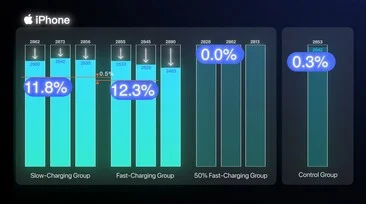
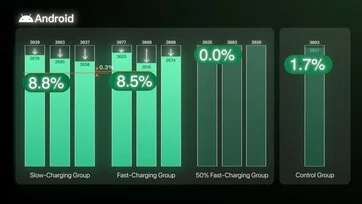
The findings are pretty straightforward. Fast charging does not significantly reduce battery capacity after 500 charging cycles for either iPhones or Android devices. Keeping your smartphone within the “ideal” range of 30% to 80% capacity can lead to a slight increase in capacity over many charging cycles. In the study, this resulted in a 4% increase for iPhones and a 2.5% increase for the Android devices tested. Still, the tester concluded that it hardly matters how or how quickly you charge your smartphone battery.
Starting from minute 3:40, the video delves into other battery-related questions, like whether it’s better to store batteries when they are half-charged, fully charged, or nearly empty. While a week may not be a lengthy enough timeframe, no noticeable differences in capacity were detected during this duration. Notably, the effort put into this video is just the beginning. As shown in the last few minutes, there have been two similar experiments conducted in the past two years that also did not produce clear results. The personal story regarding the tester’s first iPhone, which concludes the video, is particularly heartwarming.
Source:
Link


Leave a Reply