Category: Video / Photo

  • Arzopa D14 Digital Picture Frame: Perfect Valentine’s Day Gift

    Arzopa D14 Digital Picture Frame: Perfect Valentine’s Day Gift

    Key Takeaways

    1. The Arzopa D14 digital picture frame features a 14-inch LCD display with a resolution of 1920 x 1200 pixels, ideal for showcasing photos and videos.
    2. It supports various media formats and offers 32GB of internal storage, with the ability to connect via WiFi, USB, or SD cards up to 128GB.
    3. The frame includes a unique Like + Gift function for sending photos remotely, enhancing the sharing experience.
    4. Special features include a gravity sensor for automatic rotation, built-in speakers, night mode for reduced eye strain, and real-time weather updates.
    5. A Valentine’s Day promotion offers discounts and additional savings for purchasing multiple products, making it a thoughtful and lasting gift option.


    The Arzopa D14 digital picture frame stands out as a thoughtful gift for Valentine’s Day, merging modern technology with lasting emotional significance. This frame features a 14-inch LCD display with a sharp resolution of 1920 x 1200 pixels and an aspect ratio of 16:10, making it ideal for showcasing photos and short videos. Its size allows it to fit seamlessly into various home decor and desk environments. Moreover, the anti-glare screen and expansive 89-degree viewing angles ensure that images and videos are easily seen from multiple positions, while the brightness level of 300 cd/m² keeps visuals vibrant even in typical indoor lighting.

    Technical Specifications

    The Arzopa D14 operates on a quad-core RK3326 processor and is equipped with 1GB of RAM along with 32GB of internal storage. It supports various image and video formats, allowing users to transfer media through WiFi, USB drives, or SD cards up to 128GB, and can also connect to Windows PCs via wired methods. A standout feature is the Like + Gift function, which enables users to send photos as gifts remotely, elevating the experience beyond simple file transfers. Supporting videos up to two minutes long and offering unlimited cloud storage makes this device a perfect tool for preserving memories for more than just special occasions.

    Additional Features

    Noteworthy features include a gravity sensor for automatic screen rotation, built-in speakers rated at 2 watts each, and a night mode designed to reduce eye strain. Additionally, the D14 can display real-time weather updates, and it supports touch inputs, eliminating the need for external devices to manage the frame’s functions.

    As part of Arzopa’s “You are my favorite View” promotion for Valentine’s Day, running from February 2 to February 15, there are significant discounts available on both the official site and Amazon. The frame is marked down, and buyers can receive an extra 15% off when purchasing three products. There’s also an opportunity to enter a lucky draw for more prizes. In conclusion, the Arzopa digital frame is more than just a temporary gift; it offers lasting value well beyond Valentine’s Day, making it an ideal present for couples and families who wish to cherish their memories.

    Bigger Gift Options

    For those seeking an even grander Valentine’s Day present, consider the Arzopa Z3FC portable monitor, which can enhance workspace setups and works well as part of a thoughtful gift combination. Use the voucher code ARZOPA15 to receive a 15% discount on this item.

    Source:
    Link


  • Comet C/2025 K1 (Atlas) Disintegrates in New Images

    Comet C/2025 K1 (Atlas) Disintegrates in New Images

    Key Takeaways

    1. C/2025 K1 (ATLAS) is a newly discovered comet from the Oort cloud, first spotted in May 2025.
    2. The comet broke apart into four pieces after its close approach to the Sun on October 8, 2025, due to strong gravitational forces and solar winds.
    3. Observations from the Asiago Observatory and the Virtual Telescope Project identified multiple fragments of the comet.
    4. New images captured in January 2026 showed the four bright pieces of the disintegrated comet.
    5. The event highlights the potential for similar occurrences in the future, with many comets in the Oort cloud offering opportunities for further study.


    C/2025 K1 (ATLAS) is a comet that does not appear in regular cycles and was first spotted in May 2025 by the ATLAS system. It comes from the Oort cloud and made a close approach to the Sun on October 8, 2025, but unfortunately did not make it through, breaking apart into four pieces in the process.

    The Comet’s Composition and Fate

    This comet, made up of ice and dust, encountered harsh conditions as it neared our Sun. When it got close, it was hit by strong gravitational forces and intense solar winds. Despite its sad end, this event provided astronomers a chance to witness its breakup into multiple fragments.

    Observations and Discoveries

    On November 11, 2025, scientists from the Asiago Observatory in Italy reported seeing two fragments of the comet. Later, Gianluca Masi, an astronomer from the Virtual Telescope Project in Italy, observed three, and possibly even a fourth fragment, as mentioned in a news release.

    Future Implications

    On January 28, 2026, new images of the comet’s fragmentation were revealed. These pictures, taken on November 11 and December 6 by the Gemini North telescope in Chile, showed the four bright pieces of the disintegrated comet.

    Although this cosmic event was remarkable, it’s likely that similar occurrences could take place again down the line. Comets like C/2025 K1 (ATLAS) are abundant in the Oort cloud, and there might be billions out there. This could give astronomers more insight into their behaviors and help them learn about their make-up and paths within our solar system.

    Source:
    Link


  • DJI Lito 1 and X1 Drones Officially Confirmed Release

    DJI Lito 1 and X1 Drones Officially Confirmed Release

    Key Takeaways

    1. The FCC is a reliable source for information about upcoming products, especially for devices with wireless capabilities.
    2. Certification from the FCC is necessary for many electronic devices, including drones.
    3. DJI has recently received certification for two new drones: the DJI Lito 1 and Lite X1.
    4. The DJI Lito 1 is expected to target the same consumer group as the DJI Mini 4K, while the Lito X1 may follow the DJI Mini 5 Pro.
    5. The DJI Lito 1 has 22GB of internal storage, and the Lito X1 has 42GB, with both models likely using the O5 standard for long-distance image transmission.


    The FCC is a reliable source for information leaks. Certification from the FCC and other regulatory bodies is necessary for many devices, especially those with wireless capabilities. Although these documents typically lack comprehensive data sheets, they do reliably indicate the upcoming products. Recently, two new drones from DJI, the DJI Lito 1 and Lite X1, have obtained their certification and are now approved for sale in the United States.

    Specs and Market Position

    Currently, specific technical information about the two DJI drones has not been disclosed, although images and some specifications have surfaced. The DJI Lito 1 is anticipated to take the place of the DJI Mini 4K (which starts at $239 on Amazon) or at least cater to the same consumer group, suggesting that this drone is not solely aimed at professional operators. Conversely, the DJI Lito X1 might be the next model following the DJI Mini 5 Pro.

    Storage and Transmission

    Reports indicate that the smaller DJI Lito 1 has an internal storage capacity of 22GB, while the DJI Lito X1 boasts around 42GB. Nevertheless, both drones typically include a microSD card slot. In terms of transmitting images wirelessly over long distances, New Camera suggests that these new DJI models will utilize the O5 standard. This means they could potentially offer an almost unlimited range, provided a 5G cellular signal is accessible.

    Source:
    Link


  • Affordable Security Camera with 3 Lenses and People Tracking

    Affordable Security Camera with 3 Lenses and People Tracking

    Key Takeaways

    1. The WQQ890-XM-2 security camera features three cameras, allowing wider area coverage with a single device, priced around $38 on Banggood.
    2. It has a resolution of 1920 x 1080 pixels, but the image quality may not be very sharp, and only the lower camera is remotely controllable.
    3. The camera includes AI-driven automatic person detection, enabling it to follow specific individuals.
    4. Images and videos can be stored on the cloud or a memory card (up to 256GB), but it requires a wired power connection and operates on 2.4GHz WiFi.
    5. With an IP66 rating, the camera supports two-way audio and has a built-in light to deter unwanted visitors.


    We have previously discussed various surveillance cameras that come with more than just one lens. The WQQ890-XM-2, which you can now find for about $38 on Banggood, embodies this idea by having three cameras. The idea is that with multiple cameras, one can observe larger areas using just one device, which can save money in the long run.

    Camera Features

    At first sight, it may seem like the WQQ890-XM-2 has four cameras. Nevertheless, the upper middle camera is merely a dummy. Regardless, this security camera boasts a resolution of 1920 x 1080 pixels, indicating that the images from the WQQ890-XM-2 aren’t particularly crisp. The lower camera is the only one that can be controlled remotely; the other two need to be adjusted by hand. This device also features AI-driven automatic person detection, allowing the lower camera to follow specific individuals.

    Storage and Connectivity

    You can save images and videos either on the cloud or on a memory card, which can hold up to 256GB. Data transmission occurs over WiFi but is limited to the 2.4GHz band; however, keep in mind that a wired power connection is necessary since it does not come with a battery or solar panel. On top of that, this security camera has an IP66 rating and allows for two-way audio communication, plus it has a built-in light to help ward off unwanted visitors.

    Source:
    Link


  • Transform Your iPhone into a Pro Camera: Teleconverter Kit Crowdfund

    Transform Your iPhone into a Pro Camera: Teleconverter Kit Crowdfund

    Key Takeaways

    1. Smartphone camera kits, originally by Xiaomi, are now popular among brands like Vivo and Oppo, with Apple possibly introducing similar accessories for the iPhone 18 Pro.
    2. iPhone users can pre-order a new accessory kit from the team behind the Vivo X300 Pro Kit, featuring two versions with different add-ons.
    3. The Retrova camera kit includes a detachable grip, 2.35x telephoto extender, and a microSD card slot for high-speed video storage.
    4. Additional features include remote controls, fill lights, and a specialized camera app with a retro interface and pro shooting modes.
    5. Delivery for the camera grip is expected in March and the complete kit in April, with easy upgrades planned for future iPhone models.


    Smartphone camera kits were initially created by Xiaomi in China, but now they are very common among brands like Vivo and Oppo, especially in their top-tier flagship devices like the Vivo X300 Pro and the Oppo Find X9 Pro. This trend has made its way to California, where a recent leak suggests that Apple might also be trialing external teleconverters. These could serve as optional zoom enhancements for better image quality when capturing photos of faraway subjects. It’s possible that such an accessory could debut with the iPhone 18 Pro later this year.

    Pre-Order Options for iPhone Users

    If you already have an iPhone 16 Pro, iPhone 16 Pro Max, iPhone 17 Pro, or iPhone 17 Pro Max, you can now pre-order a compatible accessory kit created by the same team behind the Vivo X300 Pro Kit. This kit offers two versions with a variety of add-ons. The Retrova basic camera kit is available on Kickstarter for $72 (plus $18 for shipping) and comes with an iPhone case that has a detachable camera grip. Alternatively, the all-in-one package, priced at $184 (plus $18 shipping), includes a 2.35x telephoto extender, a filter adapter ring, and extra accessories like a carrying strap and tripod mount.

    Features and Specifications

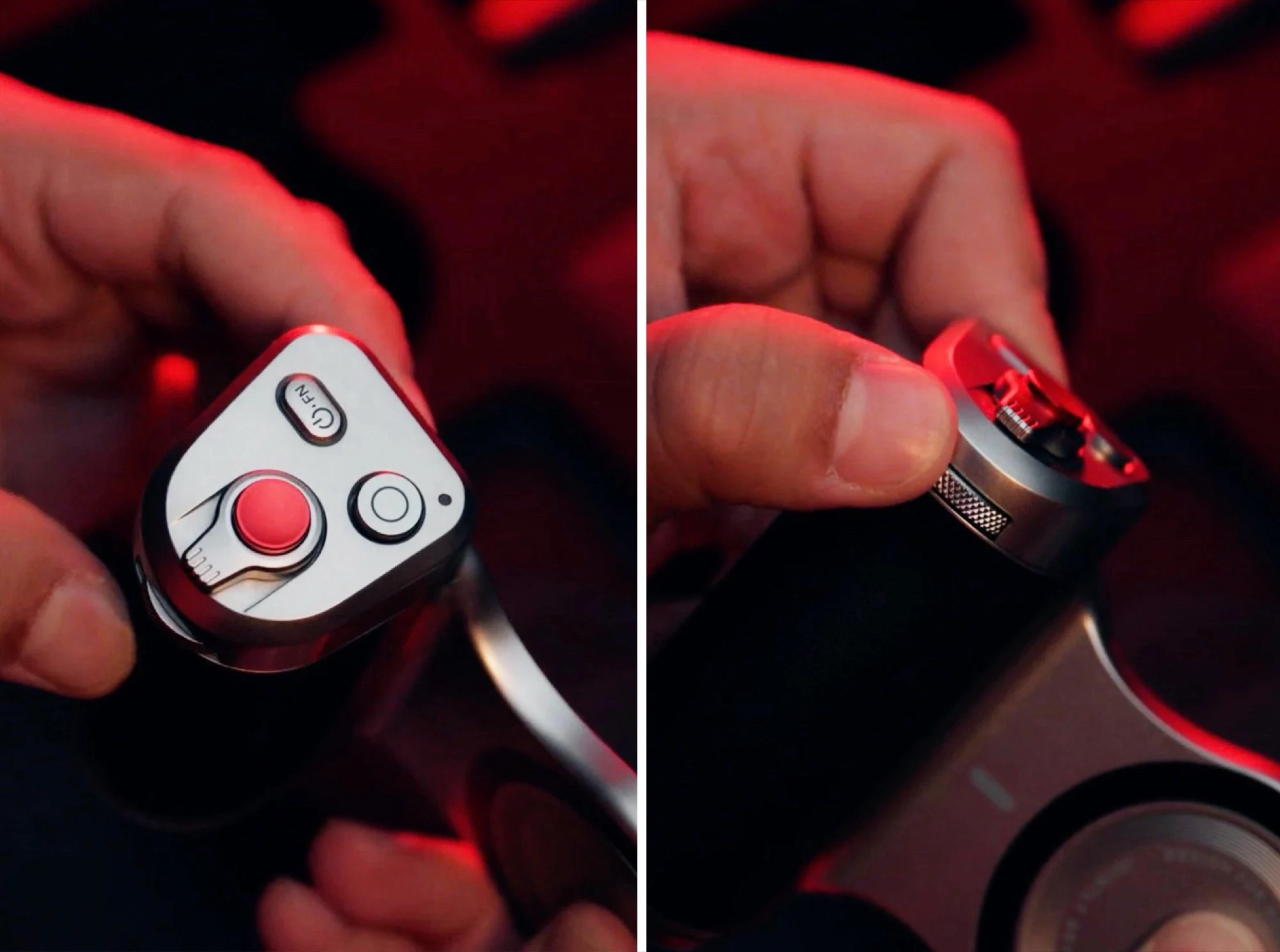
    The camera grip is designed with a two-stage shutter button for focusing and shooting, a multifunction button, a zoom rocker, and a control dial to adjust settings like exposure and ISO. Unlike the kits made for Vivo and Oppo phones, Retrova adds a microSD card slot at the bottom, letting users save ProRes video recordings directly to the memory card at speeds reaching 312 MB/s. The teleconverter screws onto the front of the telephoto lenses, changing the iPhone 17 Pro’s 4x telephoto lens into a 235mm equivalent 10x optical zoom. With the iPhone 16 Pro’s 5x telephoto lens, the 2.35x magnification results in a 282mm equivalent 12x telephoto lens.

    Additional Accessories and App Features

    Extras available include a 2x teleconverter, a 62mm/67mm filter adapter ring, remote controls, and fill lights that can be magnetically attached to the center of the camera kit case. The camera app provided by the manufacturer features a retro graphical user interface, offering various filters and a complete pro mode for manual shooting and video recording. The camera grip also includes a 300 mAh battery, which seems to be mainly for operational use rather than serving as a power bank for the attached iPhones.

    PGYTech has indicated that delivery for the camera grip is expected in March, while the complete kit should arrive in April. However, with crowdfunding platforms, there is always a risk of delays or even losing invested funds. That said, such a scenario seems unlikely here since PGYTech is a reputable maker of accessories for cameras and smartphones. Whether the telephoto lens will provide high-quality results is still uncertain, but it is promised to feature professional optics composed of extra-low dispersion glass with 13 elements. Another promise is an easy upgrade for the kit to fit the upcoming iPhone 18 Pro by just swapping out the protective case.

    Kickstarter

    Source:
    Link


  • Webb’s 255-Hour Study Maps Dark Matter in 800,000 Galaxies

    Webb’s 255-Hour Study Maps Dark Matter in 800,000 Galaxies

    Key Takeaways

    1. The James Webb Space Telescope (JWST) captured images of a section of the sky in the Sextans constellation, displaying nearly 800,000 galaxies and a dark matter map.
    2. Dark matter is invisible and doesn’t interact with light, but its presence is inferred through gravitational effects on visible matter, specifically via gravitational lensing.
    3. There are two types of gravitational lensing: strong (noticeable bending of light) and weak (subtle light distortion), with Webb’s dark matter map relying on weak gravitational lensing techniques.
    4. Webb’s findings reveal additional clumps of dark matter compared to Hubble’s 2007 map, showing twice as many galaxies and providing a clearer view.
    5. The COSMOS project involves collaboration with various telescopes to enhance understanding of galaxy formation and the influence of dark matter on their growth.


    As part of the Cosmic Evolution Survey (COSMOS) initiative, Webb has taken images of a section of the sky found in the Sextans constellation. This area spans 0.54 square degrees, which is roughly two and a half times larger than a Full Moon. The image displays nearly 800,000 galaxies, and it also overlays a map that highlights dark matter.

    Understanding Dark Matter

    Dark matter is something we can’t see directly, neither with our eyes nor with traditional telescopes. This is because it doesn’t give off, reflect, absorb, or block light. Still, we can find dark matter since it interacts with the universe via gravity. Big clusters of dark matter can bend space-time. As the light from nearby galaxies travels to Earth, this bending occurs, which is known as gravitational lensing.

    Types of Gravitational Lensing

    There are two main kinds of gravitational lensing: strong and weak. Strong gravitational lensing creates a noticeable bending of light in images. Weak gravitational lensing, on the other hand, causes a much subtler distortion of the light. Astronomers carefully examine thousands of galaxies to spot these patterns. The dark matter map created by Webb relies on weak gravitational lensing techniques.

    In the image produced, dark matter is shown in blue. The areas that are a brighter blue signify a higher concentration of dark matter. Although Hubble mapped this region in 2007, Webb’s findings show additional clumps of dark matter, as it features around twice as many galaxies compared to Hubble’s map. Moreover, Webb provides a clearer and more detailed view.

    Collaboration with Other Telescopes

    Many other telescopes have contributed to the COSMOS project. Researchers are using these varied perspectives to better comprehend how galaxies develop and how dark matter affects their growth.

    Source:
    Link


  • TikTok Uninstalls Surge in US Amid Privacy and Censorship Fears

    TikTok Uninstalls Surge in US Amid Privacy and Censorship Fears

    Key Takeaways

    1. TikTok has experienced a 150% increase in daily app deletions in the U.S. following a change in ownership.
    2. Users are concerned about new privacy policies that allow collection of sensitive information, raising fears of censorship.
    3. TikTok USA assures users that discussions on sensitive topics will continue despite concerns about censorship.
    4. Technical issues, including a significant data center outage, have negatively affected user experience and accessibility.
    5. Rival apps like UpScrolled and Skylight Social have seen increased downloads as users seek alternatives to TikTok.


    TikTok is facing a significant drop in users across the United States. Recent data from Sensor Tower indicates that daily app deletions have surged by nearly 150% within the first five days following the change in ownership compared to the earlier quarter. Users have pointed to a mix of technical issues and worries about privacy, along with the political views of the new operators, as major factors driving this trend.

    New Policies Cause Concern

    The latest updates to TikTok’s terms of service and privacy policies have sparked criticism, especially regarding sections that permit the collection of sensitive information like ethnicity, sexual orientation, and immigration status. Although these provisions have been in the guidelines since August 2024, they are seen as indicative of the new owners’ political ideology. Many users and content creators are anxious that the app might face more censorship moving forward. In response to these concerns, TikTok USA has denied any plans for censorship, assuring users that discussions on sensitive topics, including US Immigration and Customs Enforcement (ICE) and the Jeffrey Epstein controversy, will still be allowed on the platform.

    Technical Issues Worsen User Experience

    Compounding the situation are technical glitches that have impacted the algorithm and uploading features. A data center outage on January 25 left numerous users unable to access TikTok for more than 24 hours. As a result, rival apps like UpScrolled and Skylight Social experienced a significant uptick in downloads. Even with the large number of uninstalls, active engagement with the app in the US has remained relatively consistent, indicating that the main user demographic is still showing loyalty for the time being.

    Source:
    Link


  • Leica Noctilux-M 35mm f/1.2 Lens: Made in Germany, Better than Summilux

    Leica Noctilux-M 35mm f/1.2 Lens: Made in Germany, Better than Summilux

    Key Takeaways

    1. Leica has introduced the 35 mm f/1.2 Noctilux-M lens, marking the first wide-angle addition to its Noctilux series.
    2. The new lens design is similar to the 35 mm f/1.4 Summilux, with increased dimensions and weight for better light sensitivity.
    3. It features a complex construction with ten elements, including three aspherical elements and a floating element for improved close-up image quality.
    4. Performance-wise, the Noctilux lens is sharper at full aperture than the Summilux f/1.4, but has noticeable vignetting and moderate distortion.
    5. The 35 mm f/1.2 Noctilux-M is priced at $9,650, making it one of the more expensive options compared to its counterparts.


    Since 1966, when the 50 mm f/1.2 Leica Noctilux lens was introduced, Leica has been known for its fast lenses in the Noctilux series. The company is now unveiling a third addition to its lineup, joining the 50 mm f/0.95 and the 75 mm f/1.25 Noctilux lenses: the 35 mm f/1.2 Noctilux-M. This marks the first instance of Leica providing a wide-angle lens in the Noctilux range.

    Design and Dimensions

    The new lens design bears a strong similarity to the 35 mm f/1.4 Summilux. With a length of 50.2 mm and a diameter of 64.6 mm, it is a touch larger, and the filter thread diameter has increased from 46 to 49 mm. Additionally, the weight has risen by 23% to 14.7 oz. This extra weight could be considered a minor trade-off for a lens that allows for half a stop faster exposure, or 50% more sensitivity to light.

    Construction Quality

    The heft comes from its intricate design, which consists of ten elements arranged in five groups, including three aspherical elements and a floating element. This floating element is specifically intended to maintain high image quality, even when focusing on subjects at close range. The Noctilux has a minimum focusing distance of 0.5 meters, which is an improvement over the 0.7 meters found in the Leica M system.

    Performance Insights

    According to Leica’s MTF curves, the latest Noctilux lens is considerably sharper at full aperture compared to the Summilux at f/1.4. Although the edges of the image never achieve complete sharpness, especially when stopped down, the Leica APO-Summicron-M 35 mm f/2.0 is a superior option when faster speeds aren’t required. Distortion is moderate; however, vignetting is pronounced, with around three stops, which is common for fast Leica M lenses, as a more compact design is prioritized to prevent interference with the rangefinder. This lens is produced in Germany, with production tolerances reported to be less than 3 nm per millimeter.

    The Leica Noctilux-M 1.2/35 ASPH. is currently available through Leica’s official online store and authorized dealers at a suggested retail price of $9,650. For context, the 35 mm f/1.4 Leica Summilux-M retails for $6,415, while the 35 mm f/2 APO-Summicron is priced at $9,090.

    Source:
    Link


  • DJI Osmo 360 II: New Action Camera with Battery Upgrade Revealed

    DJI Osmo 360 II: New Action Camera with Battery Upgrade Revealed

    Key Takeaways

    1. DJI launched new action cameras, including the Osmo Action 4, Osmo Action 5 Pro, and Osmo Action 6 with variable aperture technology.
    2. The company introduced the Osmo Nano and Osmo 360, with the latter priced at $418 on Amazon.
    3. A new version, the Osmo 360 II, is in development and has been listed with the FCC, but may not be available for purchase in the US.
    4. The Osmo 360 II will support Bluetooth Low Energy 5.1 and Wi-Fi 6, and will feature a new 2,150 mAh battery.
    5. The Osmo 360 II is expected to launch around May or June in 2026.


    DJI has launched several action cameras last year, including the new versions of the Osmo Action 4 and Osmo Action 5 Pro. The Osmo Action 6, in particular, introduces variable aperture camera technology to the Osmo Action lineup. Additionally, the company has expanded its offerings with the Osmo Nano and Osmo 360, which is currently priced at $418 on Amazon, taking the action camera line in new directions.

    New Developments on the Horizon

    Recent findings from a regulatory body show that DJI is in the process of creating a new version of the Osmo 360. The Osmo 360 II has been listed with the Federal Communications Commission (FCC). However, if the RS 5 camera stabiliser is any indication, it seems that the Osmo 360 II might not be available for purchase in the US.

    Details from the FCC

    Despite DJI’s complicated relationship with the US, the FCC has provided some insights into the Osmo 360 II before its official launch. For example, this upcoming action camera will support Bluetooth Low Energy 5.1 and Wi-Fi 6, even though there are newer standards. Furthermore, the Osmo 360 II will feature a different battery type compared to the 1,950 mAh and 7.5 Wh battery used in both the previous model and the Osmo Action 6.

    As shown in the image below, DJI has approved the Osmo 360 II with a new 2,150 mAh battery. With a voltage of 3.86V indicated, we can conclude that this battery offers around 8.3 Wh of energy. Therefore, the Osmo 360 II should come equipped with roughly a 10% larger battery than the earlier version. While other technical specifics about the Osmo 360 II are not available yet, a confidentiality letter from DJI suggests that the company aims to launch it around May or June in 2026.

    FCC via The New Camera

    Source:
    Link


  • DJI Launches Ronin 5 Camera Stabilizer Worldwide

    DJI Launches Ronin 5 Camera Stabilizer Worldwide

    Key Takeaways

    1. The DJI Ronin 5 (RS 5) has launched globally after a two-week availability in China and is the only fifth-generation product from DJI so far.
    2. The RS 5 features improved battery life and faster charging, along with DJI’s latest stabilisation technology, but has a lower payload capacity of 3 kg compared to the RS 4 Pro’s 4.5 kg.
    3. The RS 5 is not available for sale in the United States, but it is priced at $479 in Canada and starts at £485 and €569 in Europe.
    4. Combo packages for the RS 5 can reach up to $1,138 (around $1,539), with additional bundles available for enhanced features and accessories.
    5. It remains unclear if DJI will release the RS 5 in the US market in the future.


    The DJI Ronin 5 (RS 5) has officially launched globally after a two-week period of availability in China. This camera stabiliser is the only fifth-generation product from DJI that has been introduced so far. For those looking for a more compact option, the RS 4 Mini is still available for $349 on Amazon.

    Features and Improvements

    As mentioned earlier, the RS 5 comes with enhanced battery life and faster charging capabilities. It also marks DJI’s first use of its fifth-generation stabilisation technology. However, it has a lower payload capacity of 3 kg, compared to the RS 4 Pro’s 4.5 kg limit.

    Availability and Pricing

    In a surprising move, DJI has chosen not to sell the RS 5 in the United States. However, it is available in other parts of North America, like Canada, where it is priced at $479 (around CA$648). Combo packages can go as high as $1,138 (approximately $1,539). Currently, it remains uncertain if DJI will ever bring the RS 5 to the US market.

    In Europe, the RS 5 is priced starting at £485 and €569. Additionally, DJI is offering a package that includes the RS Enhanced Intelligent Tracking Module and an Electronic Briefcase Handle for £619 and €719. Other bundle options include the SDR Transmission Combo and various accessories, which we have detailed below.

    Source:
    Link