Category: Phones

Stay updated with the latest phone news, reviews, and trends. Discover cutting-edge smartphones, features, and innovations in our Phones category at GizNewsDaily

  • iQOO Z10 Turbo Tops AnTuTu Mid-Range Rankings with Dimensity 8400

    iQOO Z10 Turbo Tops AnTuTu Mid-Range Rankings with Dimensity 8400

    Key Takeaways

    1. Vivo’s iQOO Z10 Turbo leads the AnTuTu monthly Android sub-flagship performance rankings with a score of 1,800,196.
    2. The REDMI Turbo 4 ranks second, scoring 1,699,698, showcasing the performance differences within the same chipset family.
    3. The OnePlus Ace 3V, with a Snapdragon 7+ Gen 3, secures third place with a score of 1,418,257, remaining the top Qualcomm 7-series device.
    4. Significant shifts are noted in the mid-range rankings for the first time in a while, with various devices competing closely.
    5. Notable absences in the rankings include anticipated models using the Snapdragon 8s Gen 4, which are classified as flagship devices by Qualcomm.


    In April 2025, Vivo dominated the AnTuTu monthly Android flagship performance rankings, securing the top three positions with its X200 series achieving new performance milestones. Moreover, AnTuTu also unveiled fresh mid-range rankings, showing significant shifts for the first time in a while. These findings are derived from average scores of valid benchmark tests, excluding any models that had less than 1,000 valid entries.

    April 2025 AnTuTu Android Sub-Flagship Rankings

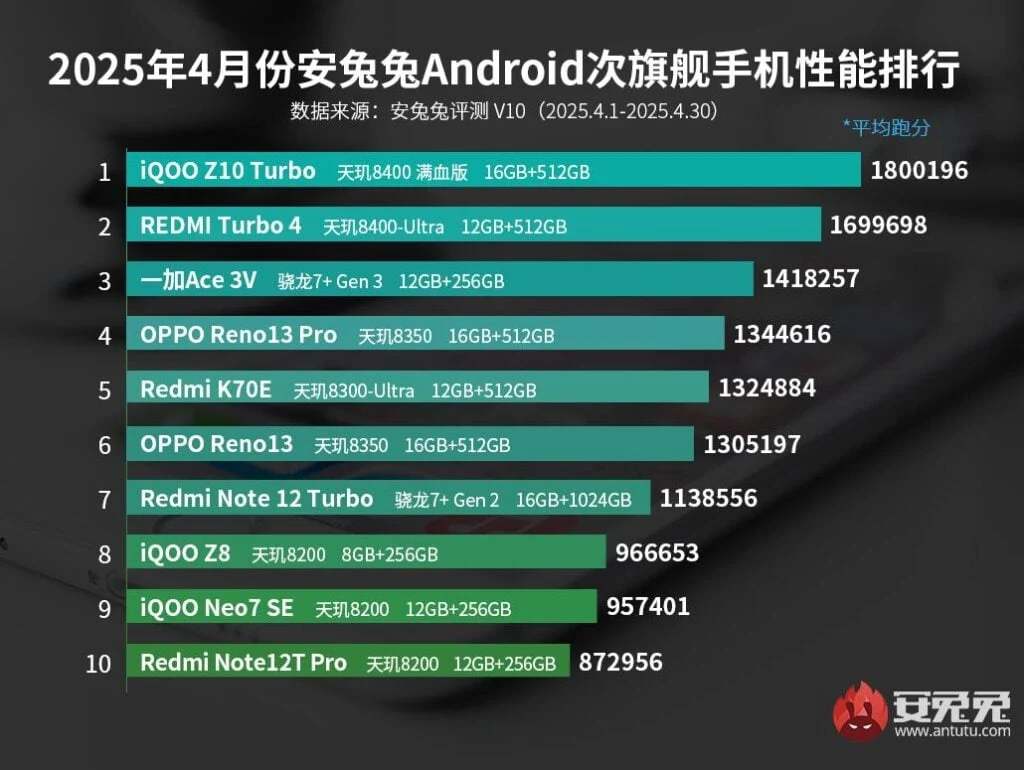
    1. iQOO Z10 Turbo (Dimensity 8400, 16GB + 512GB) – 1800196
    2. REDMI Turbo 4 (Dimensity 8400-Ultra, 12GB + 512GB) – 1699698
    3. OnePlus Ace 3V (Snapdragon 7+ Gen 3, 12GB + 256GB) – 1418257
    4. OPPO Reno 13 Pro (Dimensity 8350, 16GB + 512GB) – 1344616
    5. Redmi K70E (Dimensity 8300-Ultra, 12GB + 512GB) – 1324884
    6. OPPO Reno 13 (Dimensity 8350, 16GB + 512GB) – 1305197
    7. Redmi Note 12 Turbo (Snapdragon 7+ Gen 2, 16GB + 1024GB) – 1138556
    8. iQOO Z8 (Dimensity 8200, 8GB + 256GB) – 966653
    9. iQOO Neo 7 SE (Dimensity 8200, 12GB + 256GB) – 957401
    10. Redmi Note 12T Pro (Dimensity 8200, 12GB + 256GB) – 872956

    iQOO Z10 Turbo: The Leader

    At the top of the list is the newly launched iQOO Z10 Turbo, which is powered by the Dimensity 8400 and has achieved an impressive average AnTuTu score of 1,800,196. This makes it the leading non-flagship device for the month, offering both peak performance and stability in thermal management.

    REDMI Turbo 4: A Close Second

    In the second position, we have the REDMI Turbo 4, featuring the Dimensity 8400-Ultra and scoring an average of 1,699,698. Despite being from the same chipset family as the Z10 Turbo, slight tuning variances and unique thermal conditions of the device contribute to the difference in performance.

    Third place is held by the OnePlus Ace 3V from last year, which sports the Snapdragon 7+ Gen 3 and achieves an average score of 1,418,257. It continues to be the top-ranking device with a Qualcomm 7-series chip this month.

    Notable Absences

    Certain anticipated models, particularly those with the Snapdragon 8s Gen 4, are notably absent from this list, such as the iQOO Z10 Turbo Pro. AnTuTu has clarified that this particular chip is categorized as a flagship by Qualcomm, meaning devices using it will be placed in the flagship rankings rather than sub-flagship or mid-range categories. This classification will also be applicable to future MediaTek 9-series chips, including the anticipated Dimensity 9400e.

    Source:
    Link


  • iQOO Neo 10 Pro+ Launching Soon: 7,000mAh Battery, Dual 50MP Cameras

    iQOO Neo 10 Pro+ Launching Soon: 7,000mAh Battery, Dual 50MP Cameras

    Key Takeaways

    1. iQOO is set to launch the standard Neo 10 with Snapdragon 8s Gen 4 in India this month.
    2. The iQOO Neo 10 Pro+ will feature a 2K display, Snapdragon 8 Elite chipset, and a 7,000mAh battery with 120W fast charging.
    3. The Neo 10 Pro+ will include a 50MP main camera and a 50MP ultra-wide camera for photography.
    4. Security features will consist of an ultrasonic in-screen fingerprint sensor, with a design featuring a plastic middle frame and glass back.
    5. Future releases may include a Z10 series phone powered by the Dimensity 9400 Plus, differing from the usual dual-model launch pattern of previous years.


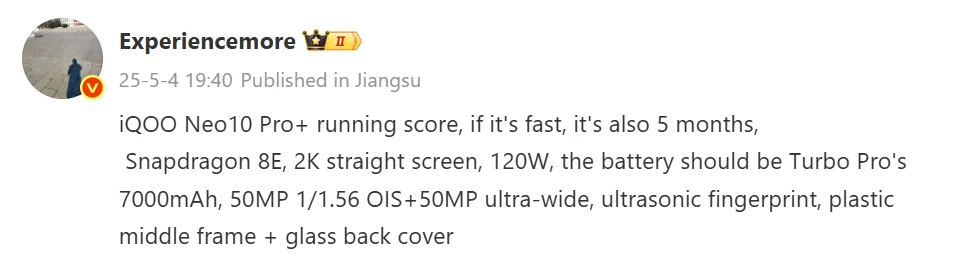
    iQOO is preparing to introduce the standard Neo 10 featuring the Snapdragon 8s Gen 4 in India. Teasers have already started appearing, indicating that the launch is likely to happen this month. Meanwhile, in China, the company is said to be ready to unveil a different model in the Neo series, known as the iQOO Neo 10 Pro+. A recent leak from tipster Experience More suggests that this device will also launch this month in China, along with some key specs.

    iQOO Neo 10 Pro+ Specs (Rumored)

    According to the leak, the iQOO Neo 10 Pro+ will come with a flat display boasting a 2K resolution and will run on the Snapdragon 8 Elite chipset. Previous leaks mentioned that it will have a 6.82-inch OLED display. The new information further indicates that the Neo 10 Pro+ will be powered by a 7,000mAh battery capable of 120W fast charging. For photography, it will sport a 50-megapixel main camera, accompanied by a 1/1.56-inch sensor, plus another 50-megapixel ultra-wide camera.

    Design and Security Features

    For user security, the Neo 10 Pro+ will include an ultrasonic in-screen fingerprint sensor. Regarding the build quality, the device is said to have a plastic middle frame complemented by a glass back. This Neo 10 Pro+, believed to carry the model number V2463A, has already been spotted on Geekbench and China’s 3C certification platform. On the benchmarking site, it was noted with the Snapdragon 8 Elite chip, 12GB of RAM, and Android 15.

    Market Trends and Future Releases

    In previous years, iQOO launched two Neo flagship models (one with Snapdragon and another with Dimensity) around mid-year in China. However, this year might only showcase a Snapdragon version. According to DCS, a flagship powered by the Dimensity 9400 Plus, which was initially expected to be part of the new Neo 10 series, is now thought to belong to the upcoming Z10 series. This suggests a future Z10 Turbo phone featuring that chipset may be on the horizon.

  • Galaxy Z Fold 7 and Flip 7 Production Begins for July Launch

    Galaxy Z Fold 7 and Flip 7 Production Begins for July Launch

    Key Takeaways

    1. Samsung has started production of the Galaxy Z Flip 7 and Galaxy Z Fold 7, along with their accessories, on track for a May timeline and early July announcement.
    2. The company has reduced production targets to 3 million units for the Flip 7 and 2 million for the Fold 7, reflecting a 40% decrease compared to last year’s models due to lower demand.
    3. New accessories are being developed, and a tri-foldable phone may launch later this year, although production will be limited to 200,000 units due to high expected costs.
    4. The Galaxy Z Flip 7 is rumored to feature a larger cover screen and may use Samsung’s Exynos 2500 processor, with a potential switch to a Snapdragon chip if necessary.
    5. The Galaxy S25 Edge is set to launch soon, with pre-orders available in the UK and global release anticipated by the end of May.


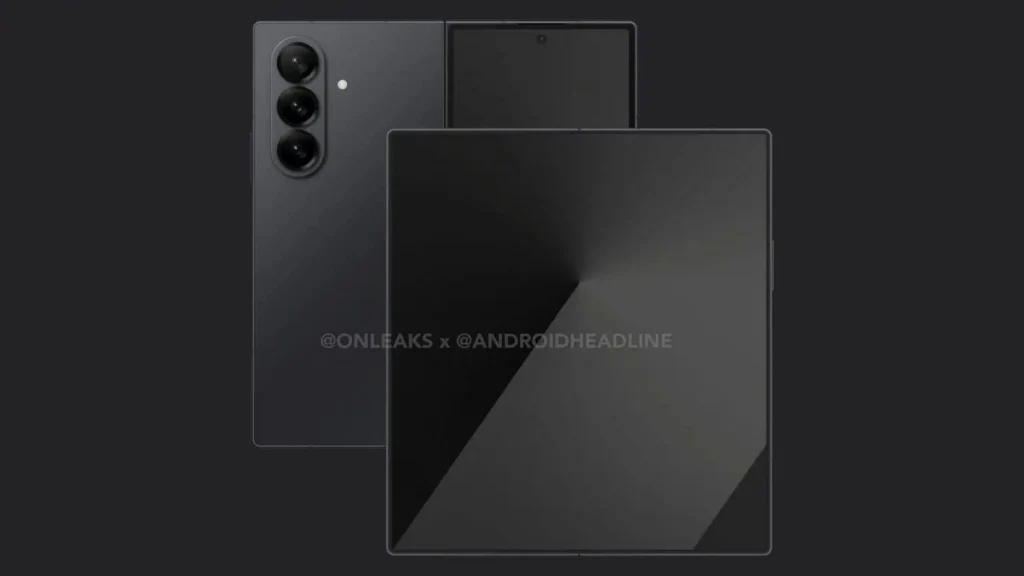
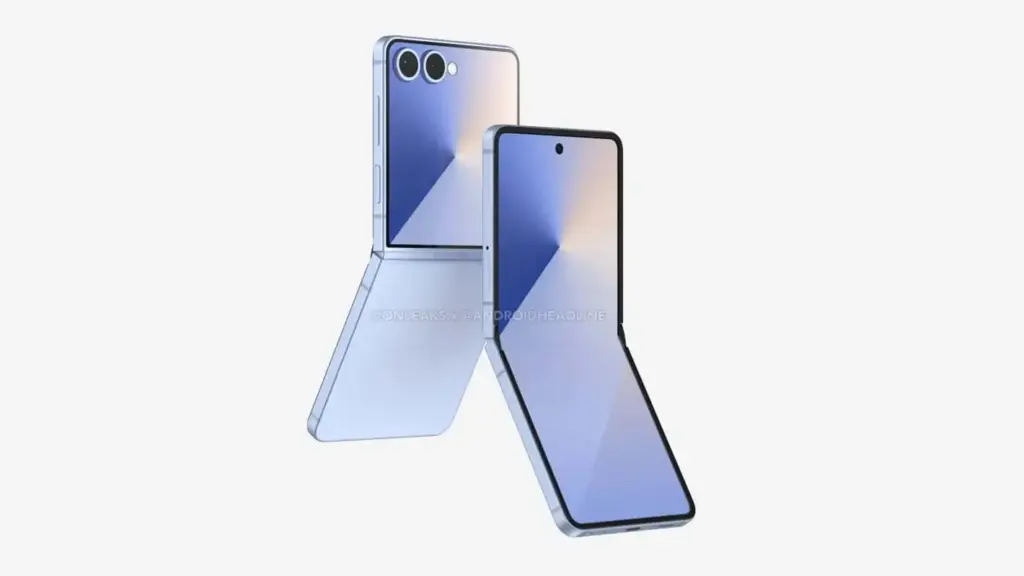
    Samsung seems to be making good progress with its new foldable smartphones. According to an X post from PandaFlashPro, the production of the Galaxy Z Flip 7 and Galaxy Z Fold 7 has started, along with their accessories. The information suggests that Samsung is on track with its timeline set for May, which aligns with the expected announcement in early July.

    Production Adjustments

    Reports indicate that Samsung has begun making the Flip 7 and Fold 7, along with foldable OLED panels for both devices. Despite this, the company has lowered its production targets this year due to a forecasted decrease in demand. The Flip 7 is expected to have a production cap of 3 million units, while the Fold 7 will only see 2 million units made, making for a total drop of around 40 percent when compared to last year’s models.

    New Accessories and Future Plans

    Samsung is also gearing up to launch accessories for both phones, and there are hints that a tri-foldable phone could arrive later in the year. However, with an anticipated production run of just 200,000 units, this device is likely to appeal to a small niche market, mainly due to its expected high cost. The Galaxy Z Flip 7 is rumored to come with a bigger cover screen and might be equipped with Samsung’s own Exynos 2500 processor, which would be the brand’s first chipset built using 3nm technology. Nevertheless, some leaks suggest that Samsung could revert to using a Snapdragon chip if the Exynos version is not ready in time. For the Galaxy Fold 7, it is expected to feature the Snapdragon 8 Elite for Galaxy, just like the Galaxy S25 series.

    Upcoming Launches

    On another note, the Galaxy S25 Edge is scheduled to launch next week, boasting a sleek design. Pre-orders have already started in the UK, offering special perks for those who order early. It is anticipated to be revealed on May 13 in South Korea and on May 23 in China, with other regions likely receiving the S25 Edge by May 30.

  • Lava Yuva Star 2 Launches: Stylish Design Priced at Rs 6,499

    Lava Yuva Star 2 Launches: Stylish Design Priced at Rs 6,499

    Key Takeaways

    1. Affordable Price: The Lava Yuva Star 2 is priced at Rs 6,499, targeting entry-level users.
    2. Display and Operating System: It features a 6.75-inch HD+ display and runs on Android 14 Go for a simple user experience.
    3. Performance Specs: The phone is powered by an unnamed Unisoc chipset, with 4GB of RAM and an additional 4GB of virtual RAM, plus 64GB of internal storage.
    4. Camera and Security: It includes a dual camera setup with a 13-megapixel rear camera and a 5-megapixel front camera, along with a side-mounted fingerprint sensor for security.
    5. Durability and Design: The device offers dust and water resistance, face unlock, and features a glossy back for a premium look.


    Lava has unveiled its latest budget-friendly smartphone, the Lava Yuva Star 2. This model comes as a successor to the original Yuva Sar, which was launched in August 2024. According to the brand’s official information, this phone aims to cater to entry-level users while keeping affordability at the forefront.

    Specifications and Features of Lava Yuva Star 2

    The Lava Yuva Star 2 boasts a sizable 6.75-inch HD+ display. It operates on Android 14 Go, providing a straightforward interface without any pre-installed third-party applications.

    Inside, the device is driven by an unnamed Unisoc chipset and offers 4GB of RAM, plus an extra 4GB of virtual RAM. The internal storage capacity is 64GB. A robust 5,000mAh battery fuels the phone, supported by a 10W USB-C charger, ensuring long-lasting performance.

    Camera and Security Features

    On the back, you’ll find a dual camera setup featuring a 13-megapixel AI-enabled lens, while the front sports a 5-megapixel camera. For security purposes, it includes a side-mounted fingerprint sensor. Other notable features comprise dust and water resistance, face unlock ability, anonymous call recording, and a glossy back that enhances its premium design.

    Pricing and Availability in India

    The Lava Yuva Star 2 comes in two attractive colors: Radiant Black and Sparkling Ivory. It is priced at Rs 6,499 for the 4GB+64GB model. Consumers can purchase it through offline retailers nationwide. Additionally, Lava offers its well-known Free Service@Home program, providing users with added ease for after-sales assistance.


  • Samsung Galaxy Z Fold 7 and Flip 7 Battery Sizes: What’s New?

    Samsung Galaxy Z Fold 7 and Flip 7 Battery Sizes: What’s New?

    Key Takeaways

    1. Samsung is set to unveil the Galaxy Z Fold 7 and Galaxy Z Flip 7 later this year, with rumors about their specifications and features already circulating.
    2. The Galaxy Z Fold 7 has a total battery capacity of approximately 4,272mAh, while the Galaxy Z Flip 7 has a total capacity of 4,174mAh.
    3. The battery capacity of the Galaxy Z Fold 7 is slightly lower than its predecessor, while the Galaxy Z Flip 7 offers a larger battery compared to the Galaxy Z Flip 6.
    4. Both smartphones have reportedly begun mass production ahead of their expected launch in July.
    5. The Galaxy Z Fold 7 is rumored to be thinner than the Oppo Find N5 and will feature the Snapdragon 8 Elite processor, while the Galaxy Z Flip 7 is expected to use the Exynos 2500 chipset.


    Samsung’s upcoming flagship foldable smartphones are expected to unveil later this year, with many rumors and reports already surfacing about the Galaxy Z Fold 7 and Galaxy Z Flip 7. These leaks have provided us with a lot of information regarding their specifications, design, and features. Recently, a new certification has also verified their battery sizes. Let’s take a closer look.

    Certification Findings

    The Galaxy Z Fold 7 and Galaxy Z Flip 7 from the South Korean electronics company have been identified in the UL Demko certification (as noted by 91Mobiles). The Z Fold 7 has been assigned the model numbers EB-BF966ABE and EB-BF967ABE for its dual battery cells. According to the certification details, this high-end foldable includes batteries of 2,126mAh and 2,146mAh, leading to a total battery capacity of approximately 4,272mAh.

    Battery Comparisons

    Even though this may seem lower than the Galaxy Z Fold 6’s battery, the actual rated capacity could be around 4,400mAh. Conversely, the Galaxy Z Flip 7 has been associated with the model numbers EB-BF766ABE and EB-BF767ABE for its battery configurations. It features batteries of 1,189mAh and 2,985mAh, bringing the total to 4,174mAh. Thus, the Galaxy Z Flip 7 indeed offers a larger battery compared to its predecessor.

    Production and Expectations

    As per a report from earlier today, both the Galaxy Z Fold 7 and Galaxy Z Flip 7 are said to have commenced mass production ahead of their anticipated launch in July. The Galaxy Z Fold 7 is rumored to be thinner than the Oppo Find N5. This flagship foldable will likely feature the Snapdragon 8 Elite processor, while the Galaxy Z Flip 7 is anticipated to launch with the Exynos 2500 chipset.

  • OnePlus 13T Sales Surge: Rising Demand for Premium Compact Phones

    OnePlus 13T Sales Surge: Rising Demand for Premium Compact Phones

    Key Takeaways

    1. OnePlus 13T achieved impressive sales, generating CNY 200,000,000 ($27.5m) in just ten minutes and setting a record for offline pre-orders.
    2. The phone is competitively priced at CNY 2,899, significantly lower than flagship models like the Xiaomi 15.
    3. Modern design changes have made the 6.3-inch OnePlus 13T comparable in size to older, smaller models, despite not being traditionally “compact.”
    4. The trend for compact phones is primarily seen in China, with many new models not planned for international release.
    5. Global consumers have limited options for compact premium Android devices, with only a few models currently available.


    After a long wait filled with teasers, OnePlus has finally unveiled its 13T in China last month, marking its entry into the growing market of premium compact phones. The OnePlus 13T has achieved remarkable sales since its launch, suggesting a strong interest in this segment.

    Impressive Sales Figures

    According to Louis Lee, the President of OnePlus China, the OnePlus 13T saw extraordinary sales right from the start, with the company raking in CNY 200,000,000 ($27.5m) in just ten minutes. He also mentioned that the 13T surpassed all its similarly priced competitors and set a new company record for the highest number of offline pre-orders.

    Competitive Pricing

    Interestingly, the OnePlus 13T is priced lower than many flagship models in China, retailing at CNY 2,899 compared to the Xiaomi 15’s CNY 4,499 MSRP. This suggests a strong appetite for compact premium phones in the Chinese market. Other manufacturers are also catching on, with new models like the Vivo X200 Pro mini, OPPO Find X8s, and Xiaomi 15 all launching in the current-gen premium category, roughly around the 6.3-inch size.

    Changing Perceptions of Size

    While some might argue that a 6.3-inch phone isn’t precisely compact, the design changes, such as taller display ratios and slimmer bezels, have made modern devices of this size comparable to older, smaller models. For instance, the 6.32-inch 13T is actually smaller overall than the 5.5-inch Samsung Galaxy S6 Edge.

    Sadly, this rising trend for compact phones hasn’t made much impact on the global market and seems to be mostly confined to China. Both the Vivo X200 Pro mini and OPPO Find X8s aren’t planned for international release. Similarly, the OnePlus 13T is set to launch in India only as the OnePlus 13S.

    Source:
    Link

  • Apple Tests Under-Display Face ID for iPhone 18 Pro Models

    Apple Tests Under-Display Face ID for iPhone 18 Pro Models

    Key Takeaways

    1. Apple is testing under-display Face ID technology for the iPhone 18 Pro and Pro Max, expected in 2026.
    2. The iPhone 18 Pro series will feature a single hole cutout in the top left corner of the display.
    3. The design of the hole cutout is similar to older Android devices, which have since moved to a centered design.
    4. Non-pro models (iPhone 18 and iPhone 18 Air) will retain the 2+1 punch hole design (Dynamic Island) like the iPhone 16.
    5. The upcoming iPhone 17 Air will already have a successor in the works with the iPhone 18 series.


    The iPhone 17 series is still several months from its release, yet there are already speculations regarding the iPhone 18 series. Recently, new information has emerged about the possible designs for the iPhone 18 Pro and iPhone 18 Pro Max.

    Under-Display Face ID Testing

    According to Chinese insider, Digital Chat Station, Apple is currently experimenting with under-display Face ID technology for the iPhone 18 Pro and iPhone 18 Pro Max, expected to launch in 2026. The leak also indicates that the devices will feature a single HIAA (hole in active matrix) cutout.

    Design Details

    A report from The Information provided further details, mentioning that this single hole will be positioned in the top left corner of the display. This design approach was previously adopted by Android devices a few years ago, but it has since been replaced by a more centered hole design.

    Non-Pro Models

    In contrast, the non-pro versions, which consist of the iPhone 18 and iPhone 18 Air, will maintain a standard 2+1 punch hole (Dynamic Island) similar to the iPhone 16, as stated by Digital Chat Station. This differentiation in design between the pro and non-pro models isn’t surprising, as it’s happened before.

    It’s noteworthy that the yet-to-be-released iPhone 17 Air is already set to have a successor in the works.

    Source:
    Link

  • Excited for Moto G86? Don’t Miss the Upcoming Moto G96!

    Excited for Moto G86? Don’t Miss the Upcoming Moto G96!

    Key Takeaways

    1. Motorola is focusing on its mid-range Moto G series, with the Moto G86 expected to be the top model.
    2. A new device called the Moto G96 is also in development, expected to be an upgrade over the Moto G86.
    3. Details about the Moto G96’s features and specifications are currently unknown.
    4. The Moto G96 may not be released in the US market, following a trend in the Moto G series.
    5. The Moto G86 is anticipated to be launched in June, following the release pattern of its predecessor.


    Fresh from introducing the Moto Edge 60 and Razr 60 series, Motorola seems to have shifted its attention to the mid-range Moto G number line. Last month, a leak showed the design of the soon-to-come Moto G86, which is positioned to be the top model in this series. However, new information has emerged indicating that a different Moto G phone is on the way, one that is expected to be better than the Moto G86.

    New Developments

    A post by Evan Blass (@evelaks) on X mentions that Motorola has a new device planned, dubbed the Moto G96. While details about its features and specifications are not yet disclosed, the name suggests that it will be an upgrade over the Moto G86, which has not been officially launched yet.

    Uncertainty Ahead

    Given the limited details available, it is difficult to predict the design, specifications, or release date of the Moto G96. However, it appears likely that this model will not be available in the US market, as the Moto G number series usually does not get official announcements for the US, at least not since the Moto G100 came out in 2021.

    Timing for the G86

    In contrast, the Moto G86 is expected to be released in June, considering that its predecessor, the Moto G85 (currently listed on Amazon for $269.99), was unveiled in June 2024.

    Source:
    Link

  • LG Achieves Mass Production of Blue Phosphorescent OLED Panels

    LG Achieves Mass Production of Blue Phosphorescent OLED Panels

    Key Takeaways

    1. LG Display is the first company to mass-produce blue phosphorescent OLED panels, a key element in achieving energy-efficient displays.
    2. The breakthrough was made possible through collaboration with Universal Display Corporation (UDC) and will debut at SID Display Week 2025.
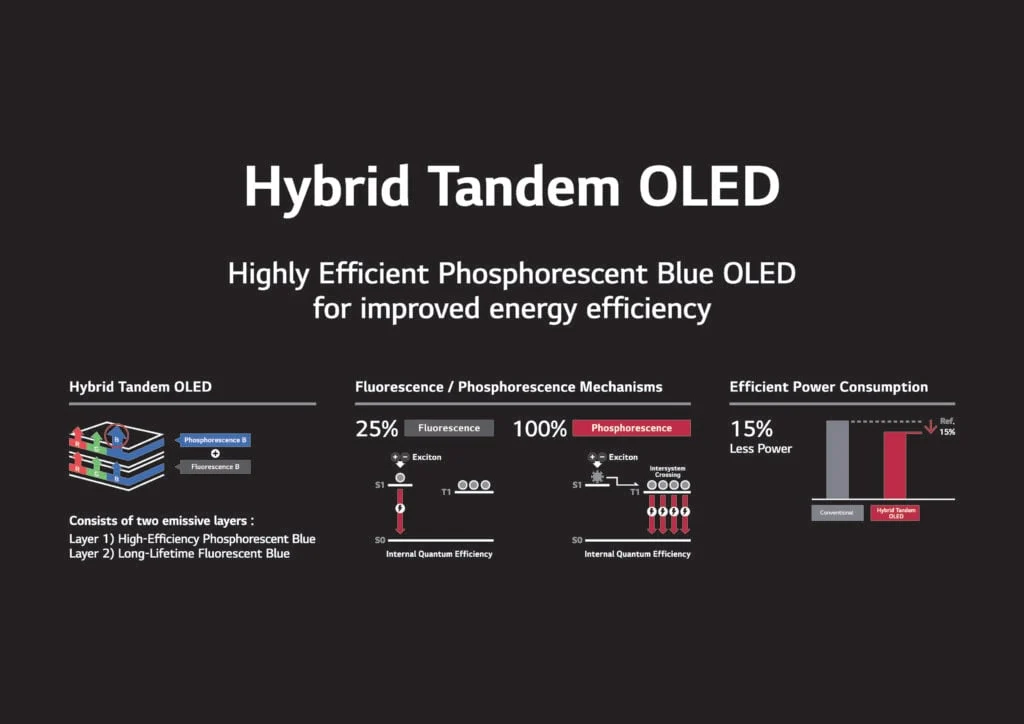
    3. Blue phosphorescent materials address the inefficiency of current blue fluorescence, which only achieves 25% light emission efficiency.
    4. LG’s innovative “dual-stack tandem” design combines blue fluorescence with blue phosphorescence, reducing power consumption by approximately 15%.
    5. This technology enables brighter displays, longer battery life, and potential applications in smartphones, tablets, wearables, and AR/VR devices.


    LG Display has recently achieved a significant milestone that many in the display sector have long sought after. They are now the first to mass-produce blue phosphorescent OLED panels. This is crucial because blue has often been seen as the missing element in what is referred to as the “dream OLED,” a display that utilizes energy-efficient phosphorescence for red, green, and blue colors.

    LG Display’s Breakthrough in Power Efficiency

    This innovation comes after eight months of collaboration with Universal Display Corporation (UDC), and the new panel is scheduled to make its debut at SID Display Week 2025 in San Jose. Interestingly, many people thought Samsung would be the first to succeed in creating blue phosphorescence and integrate it into future foldable devices like the Galaxy Z Fold 7 or Flip 7, but LG has taken the lead.

    The Importance of This Development

    So, why is this important? While red and green phosphorescent materials have been utilized for years in current OLED displays due to their high efficiency and low power consumption, blue has remained a tough nut to crack. Blue light, having a shorter wavelength and higher energy, poses significant challenges. The existing OLED panels have depended on blue fluorescence, which, while more stable, is quite inefficient, reaching only 25% light emission efficiency at best.

    Innovative Design Approach

    LG’s new method employs a hybrid “dual-stack tandem” structure. The lower layer continues to use blue fluorescence for added durability, but it is now combined with a blue phosphorescent layer on top. This setup reduces power consumption by approximately 15% while maintaining stability and lifespan. In an age dominated by power-hungry smartphones, tablets, and AI devices, this achievement is not just remarkable; it’s crucial.

    This advancement heavily relies on UDC’s PHOLED technology, which utilizes organometallic compounds that include heavy metals like iridium. These materials enable the panel to harness both singlet and triplet excitons, allowing it to extract significantly more light from the same energy input with nearly 100% efficiency.

    Beyond Just Energy Savings

    The advantages extend beyond merely lower power consumption. The new panels might facilitate brighter displays, longer-lasting batteries, and potentially slimmer devices. LG indicates that this technology is primarily targeted at small and medium displays, currently focusing on smartphones and tablets. However, there is evident potential for use in wearables, foldable devices, AI PCs, and even AR or VR headsets.

    The quest for blue phosphorescent OLED has been one of the toughest challenges in display technology. With LG’s recent breakthrough, the dream OLED is no longer just a theoretical idea—it is becoming a reality and will be available soon.

    Source:
    Link


  • iQOO Neo 10 Certification Hints at 120W Charging Support

    iQOO Neo 10 Certification Hints at 120W Charging Support

    Key Takeaways

    1. iQOO is set to launch the Neo 10 globally, differing from its Chinese version released in December.
    2. The global Neo 10 may be a rebranded or modified version of the iQOO Z10 Turbo Pro.
    3. The device has received approvals in India, Malaysia, Indonesia, and certification from the UAE’s TDRA platform.
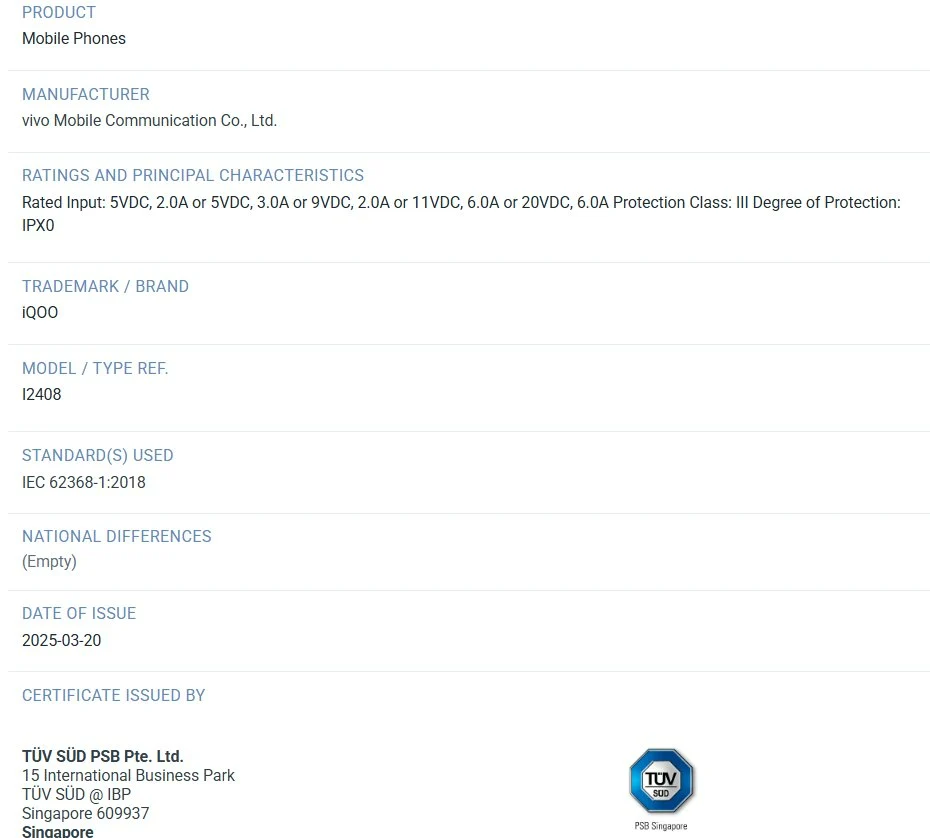
    4. The Neo 10 is expected to support 120W fast charging, as indicated by TUV certification.
    5. Anticipated specifications include a Snapdragon 8s Gen 4 chipset, 12GB RAM, a 6.78-inch AMOLED display, a 7,000mAh battery, and a dual-camera setup with a 50MP rear camera.


    iQOO appears to be preparing for the launch of the iQOO Neo 10 in the global market. This model is expected to differ from the Chinese version that was introduced back in December of the previous year. Recent reports indicate that the global Neo 10 might be a rebranded or modified version of the iQOO Z10 Turbo Pro, which was launched not long ago in China. In the past few days, the global Neo 10 has gained approval in countries like India, Malaysia, and Indonesia. Now, it has also achieved certification from the UAE’s TDRA platform. Furthermore, it has received TUV certification, which highlights its fast-charging features.

    Certification Details

    The earlier sightings of the iQOO Neo 10’s global variant, which included appearances at Bluetooth SIG and Geekbench, referred to the device by its I2405 model number. However, as shown in the screenshot above, the Neo 10 has surfaced with a different model number—I2408—in the UAE’s TDRA database. The other image shows the TUV certification for the I2408 variant, revealing that the phone is likely to support 120W fast charging. The new certifications do not provide any additional specifications about the device.

    Expected Specifications

    As per the Geekbench listing, the Neo 10 is anticipated to come equipped with the Snapdragon 8s Gen 4 chipset, 12GB of RAM, and run on Android 15. If it is indeed based on the Z10 Turbo Pro, it might feature a 6.78-inch AMOLED display with a resolution of 1.5K and a refresh rate of 144Hz. It is also expected to have a substantial 7,000mAh battery and offer storage options of up to 256GB.

    For photography, the device might boast a dual-camera setup on the rear with a 50-megapixel and an 8-megapixel lens. On the front, it could feature a 32-megapixel selfie camera, similar to the Neo 10R, rather than the 16-megapixel camera found on the Z10 Turbo Pro.