Category: Computers

  • 4chan Taken Down: Major Hack Shuts Down Infamous Forum Site

    4chan Taken Down: Major Hack Shuts Down Infamous Forum Site

    Key Takeaways

    1. 4chan was hacked by a group called “Soyjack.party,” leading to serious security breaches.
    2. The hackers gained access to users’ IP addresses, restored deleted boards, and took control of the site’s databases.
    3. Following the breach, 4chan administrators took the site offline to limit damages but faced ongoing connection issues after bringing it back online.
    4. The hack was attributed to outdated PHP software that had not been updated since 2016, making the site vulnerable.
    5. The incident highlights the irony of 4chan being a platform for leaking data while falling victim to a significant data breach itself.


    An internet behemoth faced a serious breach today, but it’s not the one you might expect.

    4chan, the notorious anonymous online forum known for its countless memes and significant influence on internet culture, was taken offline earlier today due to a hacking incident that provided admin access. A hacker group calling themselves “Soyjack.party” has stepped forward to claim the act.

    Access Granted

    This breach enabled the group to obtain users’ IP addresses, restore deleted boards, and take charge of the website’s databases. Following a post that declared the hack, the administrators decided to take the site down. It has since been brought back online, but users are still facing some connection problems.

    One of the hackers, who goes by the name “Chud,” made a post boasting about their success:

    “Tonight has been a real special night for us at the soyjak party. On April 14, 2025, a hacker, who has been inside 4cuck’s system for more than a year, carried out the operation soyclipse, reopening /qa/, revealing personal data of several 4cuck staff members, and leaking site code. To try to limit the damages, 4cuck admins have taken all servers offline, but there are rumors that the servers have already been fully compromised and might stay down for a while.”

    The Suspected Cause

    While the reason behind the hack remains unclear, it is believed that the outdated version of PHP used by 4chan was the entry point. It seems the forum hasn’t updated its PHP since 2016, leaving it vulnerable to numerous known exploits. This is quite ironic since 4chan is often a go-to platform for leaking data from hacks targeting major corporations and government bodies.

    Source:
    Link
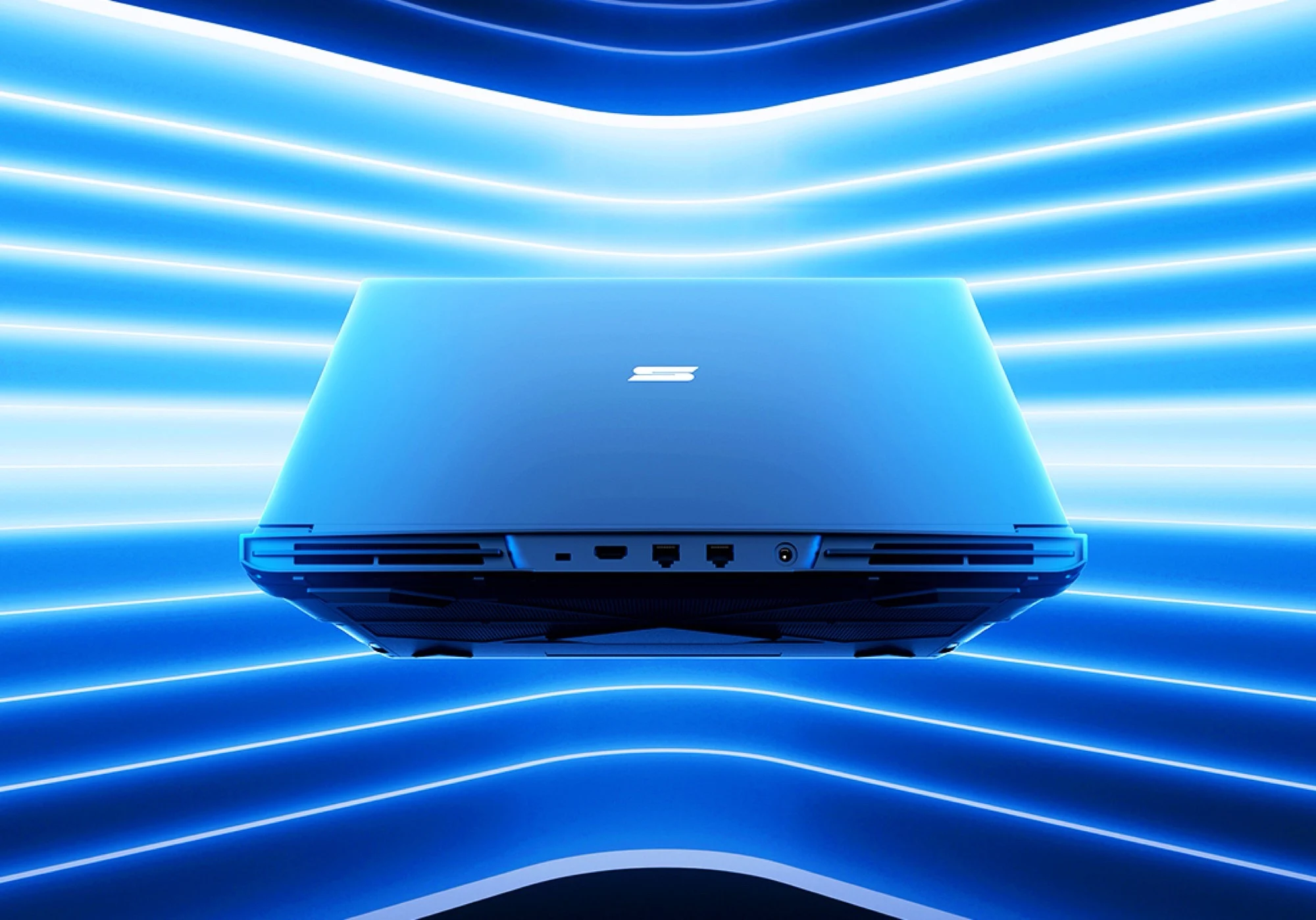
  • Schenker Key 18 Pro: RTX 5090, 256GB RAM, 32TB SSD, 4K Display

    Schenker Key 18 Pro: RTX 5090, 256GB RAM, 32TB SSD, 4K Display

    Key Takeaways

    1. High Performance: The Key 18 Pro features an Intel Core Ultra 9 275HX and Nvidia GeForce RTX 5090 Laptop GPU, providing powerful performance for demanding tasks.

    2. Cooling System: It includes advanced cooling with PTM7950 thermal compound, two fans, and 282 cooling fins to manage heat effectively.

    3. Memory and Storage: Supports up to 256GB of RAM and features four M.2 slots for a maximum of 32TB of internal storage, including PCIe 5.0 compatibility.

    4. Display and Audio: Offers an 18-inch IPS screen with options for 240Hz QHD or 200Hz 4K, along with a high-quality audio system and RGB backlit keyboard.

    5. Pricing and Availability: Starting price is €3,199, with various upgrade options available, including different GPUs and display resolutions, specifically for the European market.


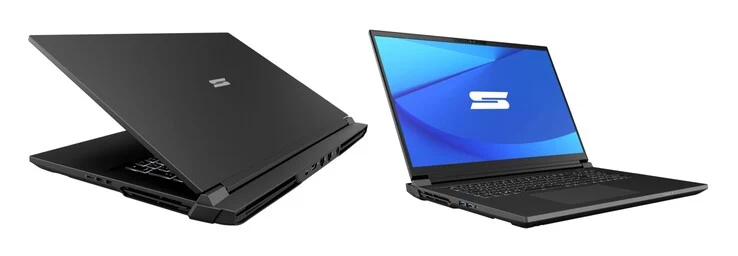
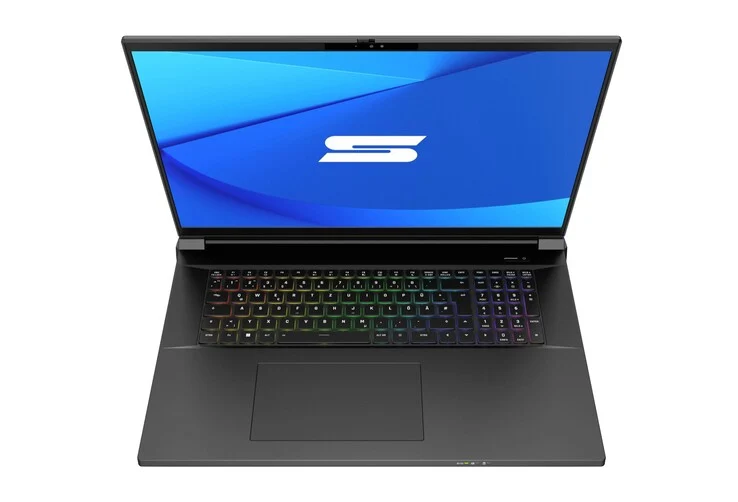
    Schenker has launched the Key 18 Pro, a large 18-inch laptop that weighs nearly 9 lbs and measures 1.14 inches in thickness. It’s designed to deliver high performance, featuring an Intel Core Ultra 9 275HX and an Nvidia GeForce RTX 5090 Laptop GPU with 24GB of GDDR7 VRAM, boasting a total graphics power (TGP) of 175 watts, including Dynamic Boost.

    Performance Specs

    When the CPU and GPU are both operating at full capacity, this giant laptop can reach peaks of 285 watts temporarily, then stabilize at a sustainable 250 watts. To deal with heat, Schenker employs PTM7950 thermal compound for both the CPU and GPU. The Key 18 Pro is also equipped with two fans and 282 cooling fins for improved airflow.

    Memory and Storage Options

    This 18-inch laptop can support up to 256GB of RAM for an additional cost of €730. It features a total of four M.2 slots, including one that utilizes the latest PCIe 5.0 interface, allowing for an impressive maximum of 32TB of internal storage.

    Display and Audio Features

    All versions come with an 18-inch IPS screen that has a 16:10 aspect ratio, reaching 500 nits of brightness and full DCI-P3 color support. Buyers can choose between a 240Hz QHD panel or a 200Hz 4K display.

    The Key 18 Pro also includes a robust audio system with five drivers, featuring a 4W subwoofer. Additionally, it has a 5 MP webcam and a keyboard that boasts RGB backlighting. Connectivity options are extensive, with two 2.5GbE ports, two Thunderbolt 5 ports, two USB-A ports with 10 Gbit/s speed, and HDMI 2.1.

    Pricing and Availability

    The Schenker Key 18 Pro is currently available on the company’s official online store, starting at €3,199. The entry-level model includes an Intel Core Ultra 9 275HX, Nvidia GeForce RTX 5070 Ti Laptop GPU, 32GB of RAM, a 1 TB SSD, and the previously mentioned 1600p display. An upgrade to a 4K display costs an additional €265, while the GeForce RTX 5090 Laptop GPU can be added for another €1,430. Note that these prices are specific to the European market, as Schenker laptops aren’t officially offered in the US.

    Source:
    Link


  • Nvidia Projects $5.5 Billion Loss from US Chip Export Restrictions

    Nvidia Projects $5.5 Billion Loss from US Chip Export Restrictions

    Key Takeaways

    1. Nvidia warns that new Trump administration measures could reduce its revenue by $5.5 billion due to H20 chip export restrictions to China.
    2. The company’s first quarter earnings may include $5.5 billion in charges linked to H20 products, affecting inventory and purchase agreements.
    3. Nvidia needs a license to sell the H20 chip to China for the indefinite future, as it was previously designed for export.
    4. Concerns arise over the potential use of the H20 chip in Chinese AI technologies, particularly with the introduction of the DeepSeek language model.
    5. The Trump administration is investigating trade policies, including tariffs on semiconductor imports, following existing restrictions on chip exports to China since October 2022.


    In a recent regulatory announcement made on Tuesday, Nvidia has cautioned that new measures from the Trump administration, which may restrict exports of the H20 chip to China, could potentially reduce the company’s revenue by as much as $5.5 billion.

    Financial Impacts of H20 Chip

    Nvidia stated that its first quarter earnings might reflect up to about $5.5 billion in charges related to H20 products, which include costs linked to inventory, purchase agreements, and associated reserves.

    The filing noted that the Government has informed Nvidia it will need a license to sell this chip “for the indefinite future.” This chip was the most powerful one Nvidia had available for China and was already undergoing scrutiny by the White House, which was likely to ban its exports. The company had specifically designed and produced this chip with the intention of exporting it to China, as it adhered to current regulations.

    Concerns Over Chinese AI Development

    These new restrictions follow the introduction of the Chinese language model, DeepSeek, which posed a challenge to American models and raised alarms within the Government regarding the chip’s potential use in fueling such technologies.

    The report mentioned that the Government believes “the covered products may be used in, or diverted to, a supercomputer in China.” This action could significantly affect Nvidia’s financial performance, estimating a $5.5 billion impact for the quarter ending on April 27th.

    Ongoing Investigations into Trade Policies

    In recent days, the Trump administration has also initiated investigations into the pharmaceutical and semiconductor sectors to assess whether additional tariffs on imports are necessary. Since October 2022, the United States has enacted restrictions on chip exports to China, which have intensified in recent days under the Trump administration.

    Source:
    Link

  • Radxa Dual 2.5G Router HAT for Raspberry Pi with NVMe SSD Support

    Radxa Dual 2.5G Router HAT for Raspberry Pi with NVMe SSD Support

    Key Takeaways

    1. Radxa offers single-board computers (SBCs) to compete with Raspberry Pi, with products like the Rock 5B Plus and Rock 5T priced at $226.99.
    2. The new Dual 2.5G Router HAT enhances Raspberry Pi 5 functionality by adding two 2.5 Gigabit Ethernet ports using the Realtek RTL8125B controller.
    3. The HAT features an M Key slot for installing M.2 2280 SSDs, which can operate at speeds up to PCIe 3.0 x1.
    4. The product includes an IPEX to FPC adapter, screws, standoffs, and a heatsink for heat management.
    5. The Radxa Dual 2.5G Router HAT is available for approximately $40 on AliExpress and Arace Tech.


    Radxa makes several single-board computers (SBCs) aiming to challenge the more widely used Raspberry Pi ecosystem. The company sometimes takes inspiration from the naming of Raspberry Pi devices, like with the Rock 5B Plus and the Rock 5T, which is currently priced at $226.99 on Amazon.

    New Expansion Board

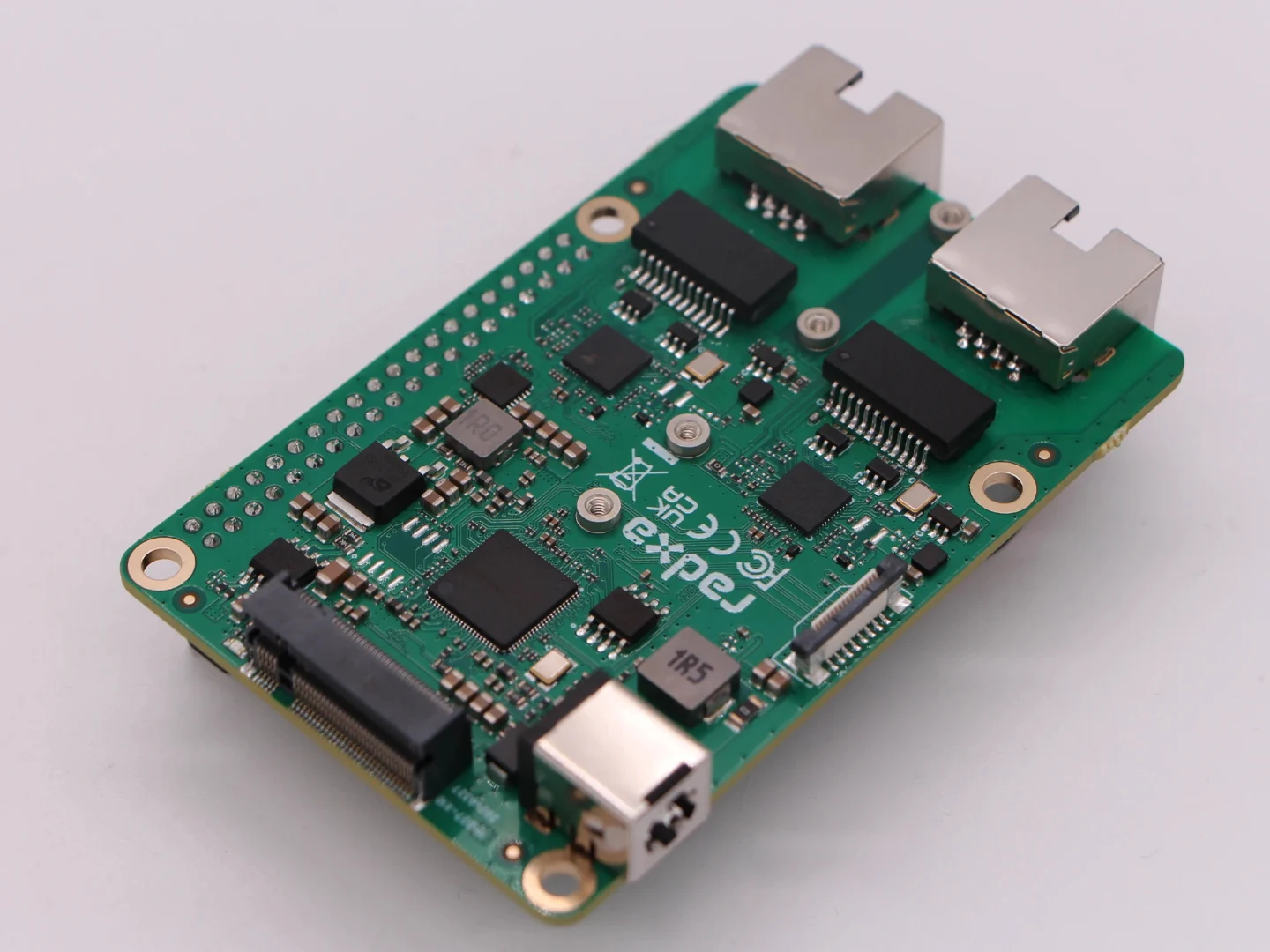
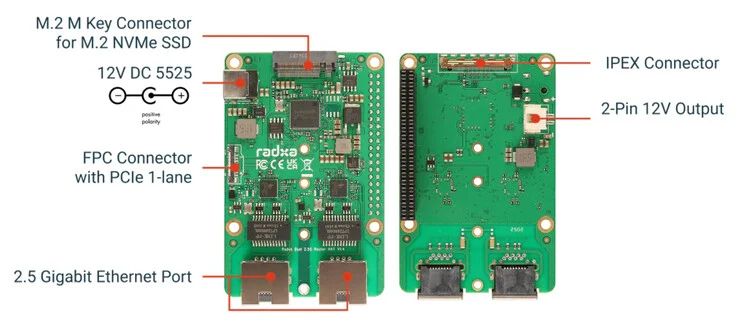
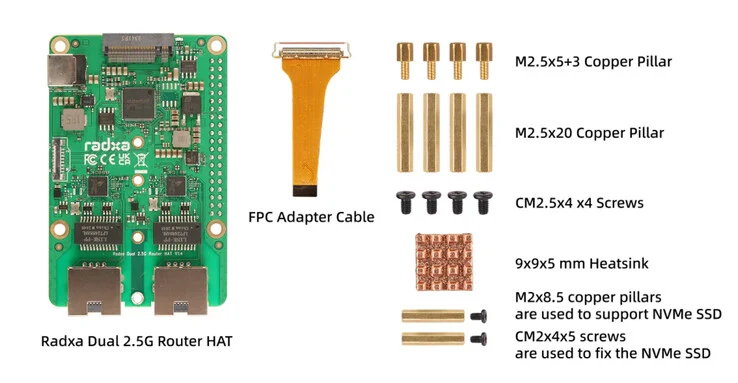
    Recently, Radxa introduced an add-on board that enhances the functionality of the Raspberry Pi 5. This product, named the Dual 2.5G Router HAT, adds two 2.5 Gigabit Ethernet ports to the Raspberry Pi 5 through the SBC’s 40-pin GPIO header. Notably, these ports use the Realtek RTL8125B controller, unlike alternatives from MediaTek or Intel.

    Added Features

    The new product also includes an M Key slot, allowing users to install an M.2 2280 SSD. Radxa claims that these SSDs can operate at speeds of up to PCIe 3.0 x1 via an IPEX connector. However, there is a bit of confusion since the company markets the HAT as using FPC, yet it includes an IPEX to FPC adapter in the package. The HAT comes with screws, standoffs, and a heatsink to help manage heat and prevent throttling.

    Currently, you can buy the Radxa Dual 2.5G Router HAT on AliExpress for roughly $40. You can also find it at Arace Tech for a similar price. For more information, check out Radxa’s wiki.

    Source:
    Link


  • New Modular TKL Mechanical Keyboard Teased Before Kickstarter Launch

    New Modular TKL Mechanical Keyboard Teased Before Kickstarter Launch

    Key Takeaways

    1. The upcoming mechanical keyboard, Sachiel, is named after biblical roots, like KBDcraft’s previous models.
    2. Sachiel features a classic TKL (tenkeyless) layout and a Lego-inspired case design for versatility and personalization.
    3. The keyboard is expected to support QMK firmware and VIAL software for extensive customization options, including macros and remapping.
    4. It will likely include a gasket mount design for improved typing comfort and reduced strain during extended use.
    5. The Sachiel is anticipated to launch in April via a Kickstarter campaign, with a projected price range of $100 to $130.


    KBDcraft has revealed a sneak peek of its upcoming mechanical keyboard. The new model, called Sachiel, draws its name from biblical roots, similar to other keyboards in the KBDcraft range like Adam, Israfel, and Lilith. This time around, however, there seems to be more options for personalisation and it features a classic TKL (tenkeyless) layout.

    Design Insights

    While detailed specs are still under wraps, KBDcraft keyboards typically share a common look, and some insights can be gathered from the teaser on social media (via KBDcraft on X). For instance, the Sachiel will include the same Lego-inspired case as its predecessors. This design, reminiscent of Lego blocks, provides a lot of versatility, allowing for simple case alterations, comfortable adjustments like typing angle changes, and various visual tweaks. The teaser also hints at the ability to replace the six navigation keys commonly found on the right side of TKL keyboards with four rotary encoders.

    Customisation Features

    If past KBDcraft models are a guide, the Sachiel will feature QMK firmware and compatibility with VIAL, a web-based software for keyboard customisation. This support for QMK and VIAL likely means that the four rotary encoders will be very adaptable, along with the rest of the keyboard, allowing for macros and remapping capabilities. Furthermore, it’s expected that Sachiel will incorporate the same gasket mount used in other KBDcraft block models, which provides a bit of give while typing and helps to reduce strain during extended typing sessions.

    Launch and Pricing Speculations

    Although the Sachiel has yet to be officially released, KBDcraft has hinted that it will make its debut in April through a Kickstarter campaign. The pricing details are still not confirmed, but looking at the prices for the Lilith and Adam keyboards available on Amazon, which are $89.99 and $79.99 respectively, it’s reasonable to assume that Sachiel will be priced between $100 and $130, especially considering the additional cost for the swappable knob module.

    Source:
    Link

  • Snapdragon X Elite 2 Rumored to Boost Performance by 22%

    Snapdragon X Elite 2 Rumored to Boost Performance by 22%

    Key Takeaways

    1. The Snapdragon X Elite 2 may feature 18 CPU cores and is expected to launch in October 2023, with broader availability by 2026.
    2. CPU boost clocks for the Snapdragon X Elite 2 could start at 4.4 GHz, potentially reaching up to 5.0 GHz, while the high-end model may boost between 3.8 GHz and 4.4 GHz.
    3. Performance gains of 18-22% are anticipated, but higher clock speeds alone may not guarantee these improvements.
    4. The Snapdragon X Elite 2 could utilize TSMC’s N3P process, with speculation about a possible N2P node delaying availability until 2026.
    5. Qualcomm faces software support challenges, particularly with the Windows-on-Arm platform, affecting the performance and return rates of laptops with Snapdragon chips.


    So far, news regarding Qualcomm’s upcoming laptop SoCs has been limited. One source mentioned that the Snapdragon X Elite 2 (or Snapdragon X2 Elite) might be released with 18 CPU cores, while another indicated a launch date in October, with broader availability expected to begin in 2026. A recent leak from a well-known Weibo blogger, Fixed Focus Digital (shared by Jukanlosreve on X), provides some insights into the CPU speeds.

    New CPU Clocks Revealed

    It seems that the Snapdragon X Elite 2/Snapdragon X2 Elite will have Nuvia-based CPUs, with boost clocks starting at 4.4 GHz. This could potentially increase to around 5.0 GHz in certain workloads. On the other hand, the high-end Snapdragon X Elite model (X1E-84-100) might boost between 3.8 GHz and 4.4 GHz. The leak also suggests that this could lead to a performance increase of 18-22%.

    Potential for Performance Gains

    However, just a rise in clock speed might not be sufficient to achieve the aforementioned performance gains. The first-generation Snapdragon X Elite was produced using TSMC’s N4P process, while the next-gen Snapdragon X2 Elite/Snapdragon X Elite 2 may utilize the N3P node. Some speculate it could use N2P, but if that’s the case, it probably wouldn’t be ready for the market until 2026.

    Software Support Challenges

    Despite the raw performance, Qualcomm’s significant challenge with the Snapdragon X Elite has been related to software support. Some laptops equipped with these chips have even been labeled as “frequently returned item” on Amazon. However, Qualcomm is not entirely to blame, as many of these problems are rooted in the Windows-on-Arm platform.

    Source:
    Link

  • GMKtec Strix Halo EVO-X2 Mini PC Pre-Order Pricing Revealed

    GMKtec Strix Halo EVO-X2 Mini PC Pre-Order Pricing Revealed

    Key Takeaways

    1. GMKtec has launched the EVO-X2 mini PC in China and plans to make it globally available soon, with pre-orders starting now.
    2. The base model of the EVO-X2 is priced at $1,499, while an upgraded version will cost $1,999; both require a deposit for priority shipping and discounts.
    3. The base configuration includes 64 GB of RAM and 1 TB of storage, with an upgraded option featuring 128 GB of RAM and 2 TB of storage.
    4. The EVO-X2 features the Ryzen AI Max+ 395 processor and Radeon 8060S iGPU, performing similarly to the Nvidia RTX 4070 Laptop.
    5. Key features include two USB4 ports, WiFi 7, Bluetooth 5.4, a maximum TDP of 140 W in “Performance Mode,” and compatibility for up to 4 TB of storage.


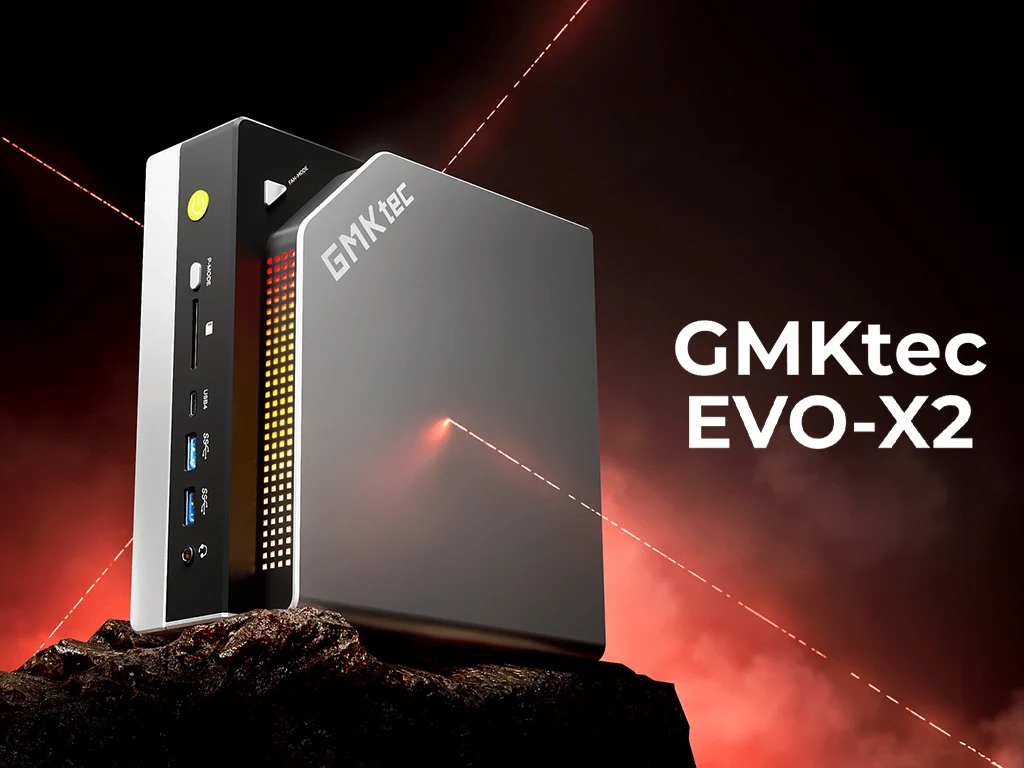
    GMKtec has officially launched the EVO-X2 in China. Following this announcement, the company revealed that the gaming mini PC will soon be available globally and provided additional information. According to the latest news, the Strix Halo system is set to be available for purchase starting May 7, 2025, and the company is currently accepting reservations for priority shipping.

    Pre-Order Details

    To reserve the Ryzen AI Max+ 395-powered mini PC, customers must make a minimum deposit of $100, which will grant them a $100 discount on the final price. If someone chooses not to pay the $100 deposit for the GMK EVO-X2, the company has stated that the pre-sale price for the base model will be $1,499, positioning it among the pricier mini PCs available.

    Configuration Options

    The base model of the EVO-X2 features 64 GB of RAM and 1 TB of storage. There’s also an upgraded version that increases the memory to 128 GB and the storage to 2 TB (the 2 TB Samsung 990 Pro is currently priced at $169.99 on Amazon). This higher-end Ryzen AI Max+ 395 option will have a pre-sale price of $1,999, and it necessitates a $200 pre-order deposit for priority shipping and a corresponding $200 discount.

    The company has not yet disclosed the standard prices for the two configurations of the GMKtec EVO-X2. The standout feature of this mini PC is the Ryzen AI Max+ 395 coupled with the Radeon 8060S iGPU. Our thorough analysis indicates that this AMD iGPU performs comparably to the Nvidia RTX 4070 Laptop.

    Additional Features

    Moreover, the GMK EVO-X2 boasts an extensive I/O, including two USB4 ports, although this Strix Halo mini PC lacks an OCuLink port. Other significant features include WiFi 7, Bluetooth 5.4 support, a maximum TDP of 140 W in “Performance Mode,” and compatibility for up to 4 TB of storage.

    Source:
    Link

  • Engineered Copper Alloy Enhances Reliability in Electrical Systems

    Engineered Copper Alloy Enhances Reliability in Electrical Systems

    Key Takeaways

    1. A new copper alloy (Cu-3Ta-0.5Li) can withstand temperatures up to 800°C for over 10,000 hours while maintaining strength and structure.
    2. The alloy features a unique nanoscale structure that prevents grain coarsening and creep deformation, enhancing its stability under heat.
    3. It has a yield strength of 1120 MPa at room temperature, surpassing traditional copper alloys in performance.
    4. The alloy is ideal for high-temperature applications in computing, aerospace, and defense, providing a lightweight alternative to nickel-based superalloys.
    5. The research demonstrates the significant impact of atomic-scale changes on material performance for advanced electronics and industrial uses.


    A research group from Arizona State University, in collaboration with national defense and educational institutions, has created a novel copper alloy that could be beneficial for thermal and structural functions in high-temperature environments. The nanocrystalline Cu-3Ta-0.5Li alloy sustains its strength and structure at temperatures reaching 800°C for more than 10,000 hours, offering better performance compared to traditional copper alloys.

    Key Innovation

    The primary breakthrough is found in the nanoscale structure of the alloy. By integrating lithium precipitates into a tantalum-rich bilayer, the researchers successfully stabilized the internal configuration, which stops grain coarsening and creep deformation. This property allows the material to keep its shape and strength, even when subjected to extended heat. Additionally, the alloy boasts a yield strength of 1120 MPa at room temperature, which is significantly higher than current commercial copper alternatives.

    Potential Applications

    For sectors like computing, aerospace, and defense—where it’s crucial to control heat and mechanical stress—this new material could provide a valuable option. The alloy’s stability under varying temperatures and loads positions it as a strong candidate for high-performance heat spreaders, sensors, or lightweight structural components in demanding conditions.

    While existing solutions frequently depend on heavier nickel-based superalloys, the Cu-Ta-Li material offers a lighter alternative without compromising thermal resilience. The research effectively highlights how small changes at the atomic scale can enhance performance in ways that are significant for both advanced electronics and industrial uses.

    Source:
    Link

  • Intel Sells 51% Stake in Altera for $4.46 Billion Deal

    Intel Sells 51% Stake in Altera for $4.46 Billion Deal

    Key Takeaways

    1. Intel is selling its FPGA unit, Altera, to Silver Lake for $4.46 billion, significantly less than its original investment of $17 billion in 2015.
    2. The deal will provide Intel with $3.4 billion in cash and is aimed at improving the company’s focus and financial health.
    3. Altera’s CEO, Sandra Rivera, will resign, and Raghib Hussain from Marvell Technology Inc. will become the new CEO.
    4. Altera is a leading supplier of programmable chips, including FPGAs and SoCs, with applications across various industries.
    5. The transaction is expected to close in the latter half of 2025, after which Altera will operate as an independent entity.


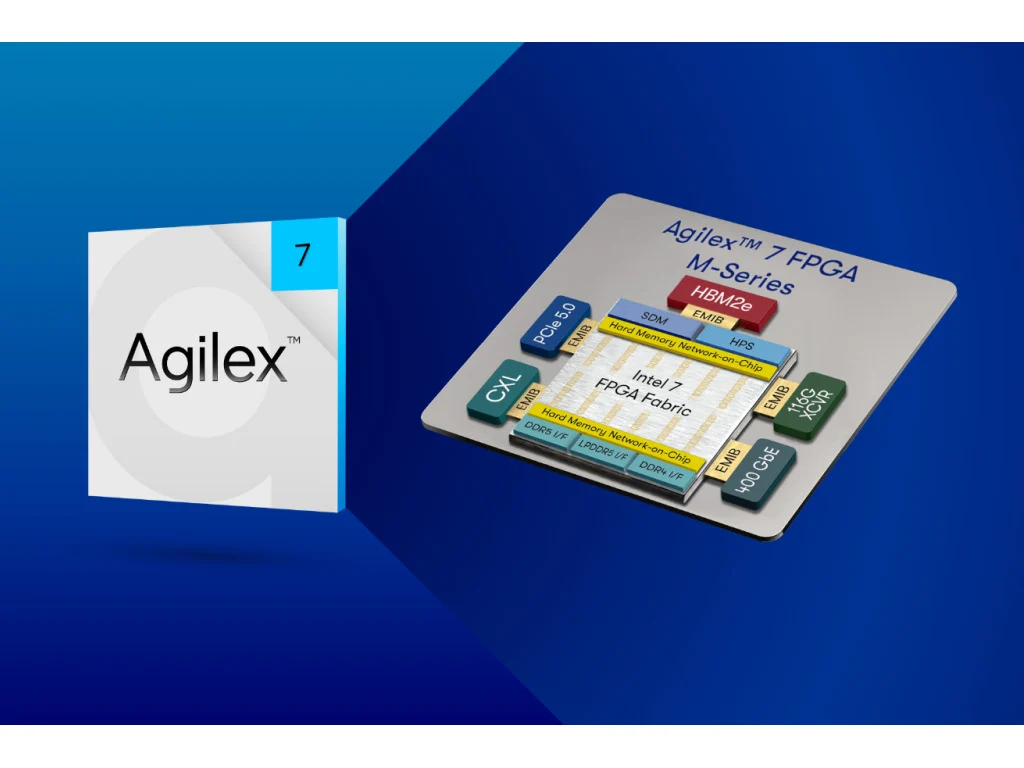
    Intel is set to hand over its FPGA unit, Altera, to the private equity firm Silver Lake for a sum of $4.46 billion. This transaction values Altera at $8.75 billion, which is almost 50% less than the $17 billion Intel invested in 2015.

    Cash Flow and Strategic Focus

    As reported by Bloomberg, Intel will gain $3.4 billion in cash from this deal. Intel’s CEO, Lip-Bu Tan, expressed that this decision will “sharpen” the company’s focus, decrease its cost structure, and enhance its financial standing.

    Leadership Changes

    With this transition, Altera’s CEO, Sandra Rivera, will resign, and Raghib Hussain, who is the president of products and technologies at Marvell Technology Inc., will take over her role.

    Kenneth Hao, who is the chairman and managing partner at Silver Lake, mentioned that this investment represents “a once-in-a-generation opportunity to invest in a scale leader in advanced semiconductors.”

    Altera’s Market Position

    Altera is recognized as a top supplier of programmable chips, such as Field-programmable Gate Arrays (FPGA) and System-on-a-chip (SoC) components. These chips can be adapted for a wide range of uses, including data centers, communication systems, industrial automation, and much more.

    The agreement is expected to finalize in the latter half of 2025. After the transaction is complete, Intel will detach Altera’s financial data from its own, allowing Altera to function as a completely independent entity.

    “Altera is in a strong position to capitalize on its current momentum and create groundbreaking FPGA-based solutions that are influencing the future of computing driven by AI,” said Hussain. “I deeply appreciate the contributions Sandra has made and the team she has assembled as we embark on Altera’s new growth journey.”

    Source:
    Link

  • ThinkPad P14s Gen 6: AMD Ryzen AI 9 HX Pro 370 Specs Leak

    ThinkPad P14s Gen 6: AMD Ryzen AI 9 HX Pro 370 Specs Leak

    Key Takeaways

    1. Lenovo’s new ThinkPads for 2025 will feature AMD CPUs but are primarily aimed at office users, lacking powerful Ryzen options.
    2. All new models are limited to eight cores, with minimal performance improvements compared to previous Zen4 versions.
    3. Lenovo plans to launch a new ThinkPad P series workstation lineup, including the ThinkPad P14s Gen 6 AMD with a twelve-core Ryzen AI 9 HX Pro 370.
    4. The ThinkPad P14s G6 AMD can support up to 96 GB of DDR5-5600 RAM, but this is limited to certain models with specific CPUs.
    5. The ThinkPad P14s Gen 6 AMD is expected to be available soon, following the launch of the ThinkPad T14 Gen 6 AMD around May or June.


    Lenovo has revealed a range of ThinkPads for 2025 that come equipped with AMD CPUs, but, so far, they are all targeted at office users and lack the more powerful AMD Ryzen CPUs. Up until the middle of April, we’ve seen various models from the Zen5 lineup.

    Performance Insights

    These models share a common trait: they are all limited to eight cores. While the Zen5 architecture is more efficient in comparison to its predecessor, Zen4, the performance improvements in the eight-core versions are minimal or non-existent. This is largely due to the fact that Zen5 CPUs utilize a mix of large and small cores, whereas the eight-core Zen4 versions consisted entirely of large cores. Given the exciting performance jumps seen in the 12-core Zen5 models, such as the Ryzen AI 9 365, Ryzen AI 9 HX 370, and Ryzen AI 9 HX 375, the new AMD ThinkPad laptops feel less thrilling than they might have been.

    Upcoming ThinkPad P Series

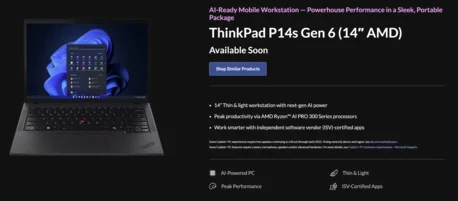
    However, things are set to change: Lenovo is preparing to unveil their new ThinkPad P series workstation lineup for 2025, and early details about the Lenovo ThinkPad P14s Gen 6 AMD have surfaced, thanks to a premature product page posted by Lenovo Malaysia.

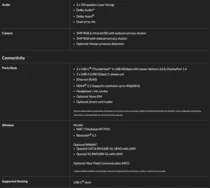
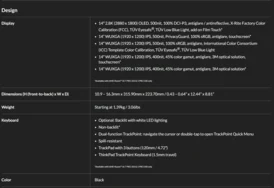
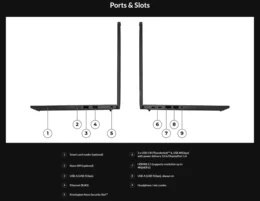
    The standout feature of this new model is its design, which is based on the ThinkPad T14 Gen 5 AMD (available on Amazon) and the ThinkPad T14 Gen 6 AMD. It will come with the Strix Point AMD Ryzen AI 9 HX Pro 370, boasting twelve cores. Apart from that, it appears to match the specifications of the T14 Gen 6 AMD.

    Specifications and Availability

    Another intriguing detail found in the specifications is that the Lenovo ThinkPad P14s G6 AMD can support up to 96 GB of DDR5-5600 RAM. However, this applies only to the Krackan Point versions that are equipped with the AMD Ryzen AI 5 Pro 340 and AMD Ryzen AI 7 Pro 350. This implies that the Strix Point versions may have limitations on memory, likely capping at 64 GB with soldered options.

    The listing indicates that the Lenovo ThinkPad P14s Gen 6 AMD will be “available soon.” Considering that the ThinkPad T14 Gen 6 AMD is expected to launch around May or June, we wouldn’t anticipate its workstation counterpart to hit the market any earlier than that.

    Source:
    Link