Tag: FPGA

  • SuperSega Creator Returns with V3 Console That Looks Like a PC

    SuperSega Creator Returns with V3 Console That Looks Like a PC

    Key Takeaway

    1. Alejandro Martin’s new project, SuperSega V3, is a wooden PC case supporting original Sega cartridges and high-end hardware, moving away from the FPGA approach.
    2. The project involves hand-crafted woodwork, a flexible AMOLED display, and aims to deliver a nostalgic gaming experience with modern technology, but may not be cost-effective.
    3. Past ventures by Martin, including the original SuperSega and Compuwood, faced delays, refunds issues, and legal challenges, casting doubt on the new project’s viability.

    Introducing the New Wooden Gaming PC

    Alejandro Martin, who previously made headlines for the failed FPGA SuperSega console, has come back with a new bizarre project. This time, he’s offering a wooden PC case that supports the installation of high-end hardware, and surprisingly, it also supports playing original Sega cartridges. His past project, the SuperSega FPGA, did not succeed and was labeled by many as a scam, but now he’s trying again with a different concept.

    New Features and Design

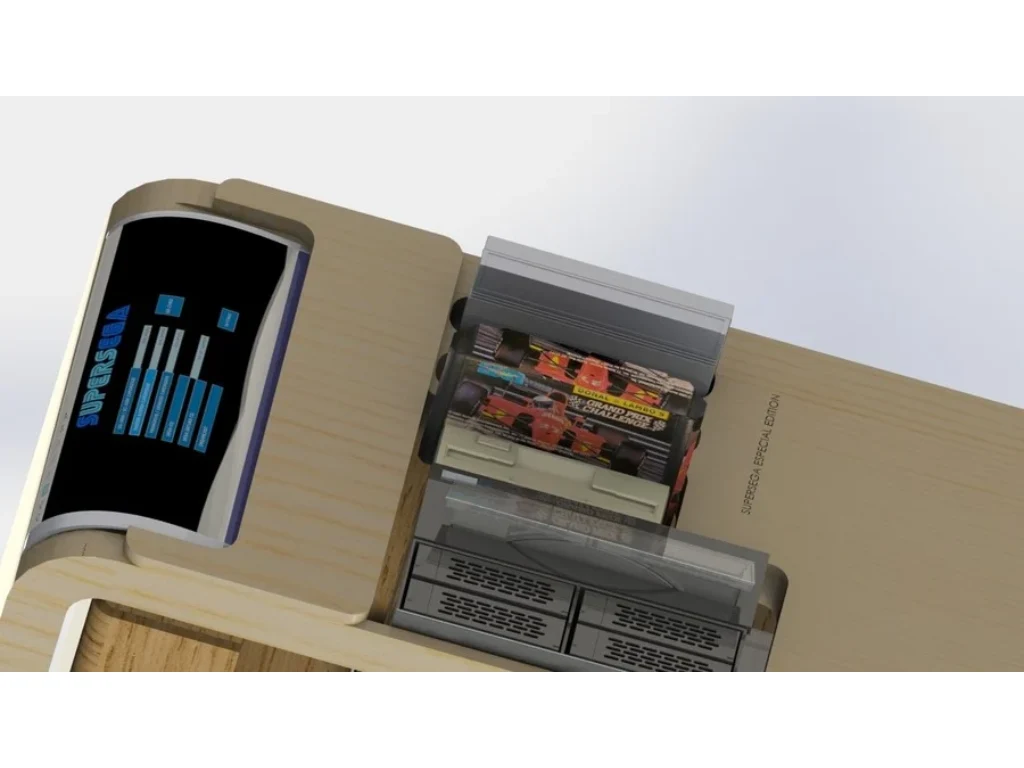
    The latest iteration, called SuperSega v3, features a wooden case made from what he refers to as “Spanish wood”. The case is designed to house powerful PC components along with support for classic Sega cartridges like Mega Drive, SG-1000, SC-3000, and Master System. Additionally, it has slots for optical drives compatible with Mega CD and Sega Saturn games. The standout feature is a large, curved AMOLED display with a resolution of 2480 x 1860, which intentionally bends around the edge of the case for a more immersive experience.

    Shift From FPGA to Raw PC Power

    Unlike his earlier FPGA approach, Martin is now focusing on raw computing power, claiming the system offers “an unparalleled gaming experience that no FPGA console could even come close to.” He emphasizes that each device will be handcrafted, with no pre-orders or charges until the unit is fully complete. Customers will be billed only once their specific unit is ready for shipment, according to his statements.

    Background and Past Controversies

    His previous attempt, the Compuwood project launched in April, faced numerous delays and disappointments, especially after the notorious failure of the original SuperSega. Many backers were upset as Alejandro delayed refunds, and the prototypes looked quite amateurish from the start. Additionally, Sega themselves issued a cease-and-desist order against the SuperSega name, adding legal pressure to the project’s challenges.

    Expectations and Reality

    For retro gamers and PC enthusiasts, this project sounds very exciting: a portable device that combines retro Sega cartridge support with the power of a high-end PC capable of running games at 4K resolution, all seen through a compact AMOLED screen. However, skeptics argue that it’s just another high-priced PC running emulators, which is already achievable with any modern gaming machine. The real value and uniqueness of this setup remains questionable.

    Pricing and Availability

    Alejandro has yet to reveal official prices. Given the custom wooden craftsmanship, the specialized cartridge hardware, and the curved AMOLED screen, it’s fair to assume the final cost will be quite high. Production is currently limited to small batches, probably in the low double digits, with hopes of larger production runs planned for 2027 if things go as intended. Buyers should be cautious as the project might not come through as hoped, given its past track record.

    Sources
  • FPGA Developer Calls Plaion’s NeoGeo AES+ a “Bait and Switch”

    FPGA Developer Calls Plaion’s NeoGeo AES+ a “Bait and Switch”

    Key Takeaway

    1. The Neo Geo AES+ is a modern, hardware-accurate reproduction of the original 1990s console, using custom ASIC chips instead of emulation or FPGA-based solutions.
    2. Support from notable FPGA developers suggests the project aims to surpass emulation quality, but there are debates about whether ASIC-based hardware is truly superior.
    3. Concerns have been raised that the use of ASIC chips may limit updateability, leading to skepticism about the long-term flexibility and authenticity of the console.

    Neo Geo AES+ Rebirth Set for 2026

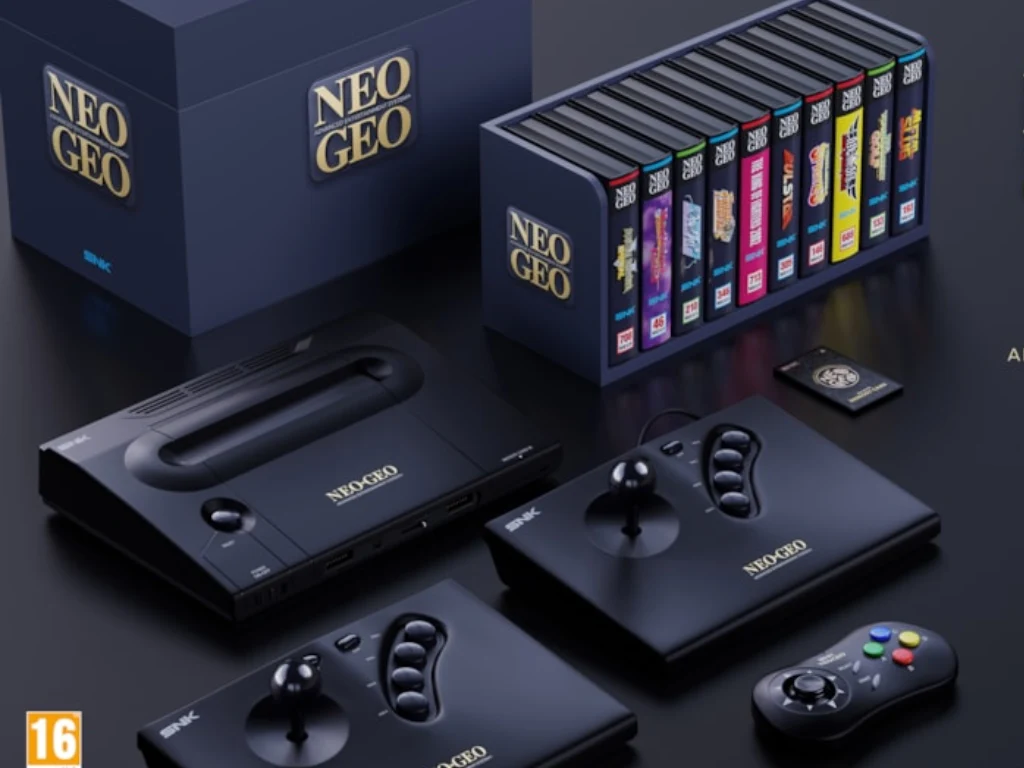
    Mark the calendar for November 13, 2026, because the Neo Geo AES+ is plan to make its comeback with a modern twist, kinda like the original 1990s home console but with updated features. You can pre-order now, with the classic black edition costing around $250, and if you like that white anniversary look, that’s priced a bit higher. Honestly, it looks just like the old one from the outside, but underneath, things are quite different, even with some hints that it might use FPGA cores instead of the typical ASIC chips.

    Specification and Hardware Details

    Most importantly, Plaion clearly said that the Neo Geo AES+ isn’t just an emulation or a simplified FPGA version. They’ve gone as far as developing special new ASIC chips that are meant to perfectly imitate the hardware and software of the original console. This isn’t a cheap clone, but a serious effort to recreate every detail from scratch, or so they say.

    Although Plaion did not originally reveal their team working on the project, well-known FPGA experts like Jotego and Furrtek have been involved, making sure things are on the right track with the custom ASICs. This is pretty significant because these names have a solid reputation in the retro gaming chip scene, giving some confidence that this recreated console might really come close to the real deal.

    Expert Opinions and Industry Insights

    Furrtek, who’s been recognized for creating tools like the Neo CD SD Loader and the Fusion Converter, expressed his excitement about the Neo Geo AES+. His post, which has now been deleted, stated, “The Neo Geo AES+ has every chance of being the best since SNK stopped making hardware. It might not be perfect, but it aims to outperform simple emulation, uphold the brand, and respect us fans.”

    What he meant by “better,” is that this new hardware could do a lot more than just run software via emulation. However, some critics remain skeptical about whether this hardware approach actually surpasses emulation, and whether it justifies the hype, especially considering the price and effort involved.

    Controversy Over FPGA vs ASIC Approaches

    An FPGA developer, Pramod Somashekar, voiced concerns about what he calls a “bait and switch.” He explained on social media that what’s happening might be a simple MiSTer core, but split across multiple ASICs instead of running on a single FPGA. His main worry is about upgradability — since ASICs are hard-wired and immutable once made, unlike FPGAs, which can be reprogrammed to fix errors or improve features later down the line. So, if this hardware has a flaw, there isn’t much you can do about it, he argued.

    Despite the controversy, the Neo Geo AES+ will be able to run both original cartridges and recent re-releases. It includes HDMI support for the latest TVs, and also supports retro displays via RGB, composite video, stereo sound, and region switches. Still, whether it can meet the high standards of the now very competitive retro gaming scene remains to be seen, especially in light of such questions from the community.

    On the bright side, Furrtek is no stranger to the scene, and Jotego has earned respect for contributions to the FPGA community, giving fans some hope that this project might deliver on its promises despite the debates around hardware design choices.

    Sources
  • Transform Your Laptop into a Penetration Testing Tool with M.2 Module

    Transform Your Laptop into a Penetration Testing Tool with M.2 Module

    Key Takeaways

    1. The xSDR is now available on Crowd Supply, exceeding its funding target before the March 2026 deadline, and offers enhancements over the previous uSDR platform, including 2×2 MIMO support and wider bandwidth in the same compact size.

    2. Key specifications include the Lime Microsystems LMS7002M RF transceiver, AMD Artix-7 FPGA, tuning range of 30 MHz to 3.8 GHz, and sample rates up to 122.88 MSPS in SISO mode and over 80 MSPS in MIMO mode.

    3. The module features a 12+2-pin GPIO header for managing external RF components and precise timing synchronization, allowing for complex multi-channel setups.

    4. The xSDR is compatible with software tools like GNU Radio and integrates with wsdr.io for easy browser-based configuration, targeting applications in cellular testing, RF analysis, and wireless data links.

    5. Priced at $549, the xSDR is aimed at professionals and advanced hobbyists, with potential performance limitations due to USB 2.0 speed and risks associated with hardware crowdfunding, such as certification delays and component availability.


    The xSDR is now available through Crowd Supply, having successfully met its funding target well before the March 2026 deadline. This new module is an advancement from the previous uSDR platform, now featuring support for 2×2 MIMO and a wider bandwidth, all within the same dimensions of 30 mm × 22 mm.

    Key Specifications

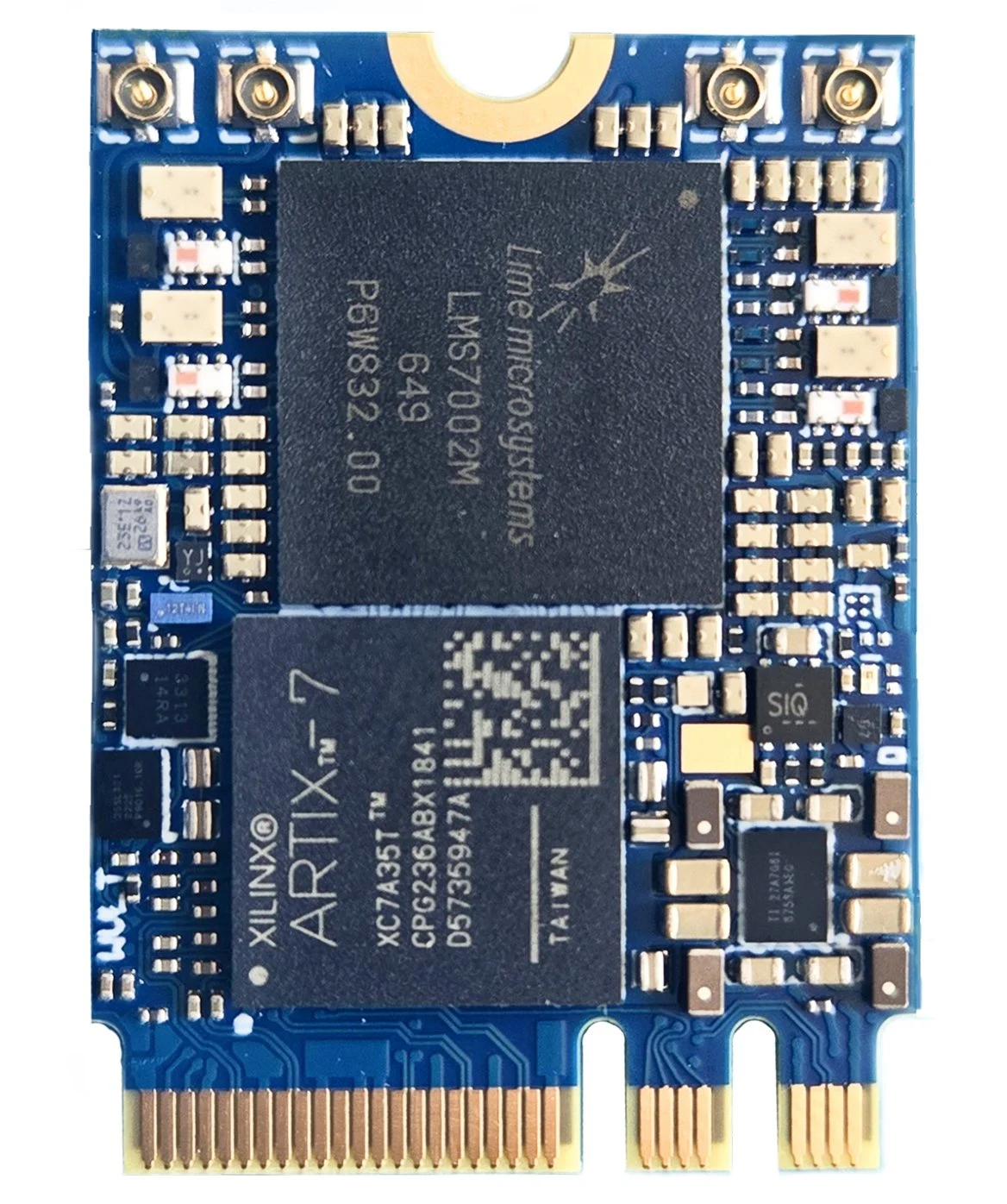
    At its foundation, the xSDR utilizes the Lime Microsystems LMS7002M RF transceiver, combined with an AMD Artix-7 XC7A50T FPGA. This setup allows for a tuning range from 30 MHz to 3.8 GHz. The SDR can handle sample rates ranging from 0.1 MSPS to 122.88 MSPS in SISO mode, and over 80 MSPS in MIMO mode, with channel bandwidths varying from 0.5 MHz to 90 MHz. There are four MHF4 antenna connectors that provide access to two RX and two TX channels.

    GPIO Capabilities

    The module features a 12+2-pin 1.8V GPIO header accessible via the reserved pins of the M.2 A+E key interface. This can be used to manage external RF front-ends, switch antenna relays, or enable JTAG for debugging custom gateware. Notably, one of these GPIO pins can be set as a 1PPS (Pulse Per Second) input, allowing it to accept precise timing signals from a GPS Disciplined Oscillator (GPSDO) to synchronize multiple boards for phase-coherent, multi-channel setups.

    On the software front, the xSDR is compatible with tools such as GNU Radio, srsRAN, and SoapySDR. It also integrates with wsdr.io, a web-based platform that supports WebUSB, enabling users to configure and manage radio functions straight from a browser without the need for elaborate driver installations.

    Use Cases and Limitations

    Wavelet Lab promotes this module for cellular testing (LTE and 5G), embedded RF analysis, custom wireless data links, and various research applications. It can also be employed for penetration testing using software like Universal Radio Hacker. With appropriate configurations, the xSDR is capable of mimicking, intercepting, or decoding numerous wireless protocols.

    While the module boasts extensive bandwidth and 2×2 MIMO capabilities, it may face limitations due to USB 2.0 speed in specific setups. Supporting both USB 2.0 and PCIe 2.0 ×2 through the M.2 interface, installing it in a slot that only accommodates USB could restrict its maximum performance. Priced at $549, the xSDR targets professionals, researchers, and advanced hobbyists, rather than beginners.

    Manufacturing for the xSDR will be conducted by Wavelet Lab, with final deliveries managed by Mouser Electronics through the Crowd Supply network. As with most hardware crowdfunding efforts, risks include tariff changes, component availability issues, firmware concerns, and possible delays in certification or compliance, which could affect delivery schedules.

    Source:
    Link


  • Commodore 64 Ultimate: New Edition with Modern & Classic Features

    Commodore 64 Ultimate: New Edition with Modern & Classic Features

    Key Takeaways

    1. The Commodore 64 Ultimate is a new version of the classic home computer, priced at $299.99, with shipping expected between October and November 2025.
    2. It is compatible with at least 99% of all 1980s and 1990s cartridges, games, and accessories, but uses an AMD Xilinx Artix-7 FPGA instead of the original processor.
    3. The system features 128 MB of DDR2 RAM, 16 MB of flash storage, and video output options through HDMI or DIN-8 connectors.
    4. Audio options include a 3.5mm jack and optical output, with built-in Ethernet and Wi-Fi connectivity; the keyboard has mechanical switches and RGB lighting.
    5. The package includes a USB stick with licensed video games, music, and demos, including a sequel to Jupiter Lander called Ascension.


    Historically, the Commodore 64 stands out as one of the most famous home computers. Now, there’s a new version called the Commodore 64 Ultimate that is up for pre-order. The price for this new edition is $299.99, and it is expected to ship between October and November 2025.

    Compatibility and Specifications

    The manufacturer claims that at least 99% of all cartridges, games, and accessories from the 1980s and 1990s will work with this system. It is worth noting that this model does not use the original processor; instead, it is powered by an AMD Xilinx Artix-7 FPGA. It comes equipped with 128 MB of DDR2 RAM and 16 MB of flash storage. Users can enjoy video output through HDMI or DIN-8 connectors, which lets them experience their favorite games on classic tube TVs. The system also supports USB storage devices and emulation for the cassette drive, which can be connected like a traditional data cassette or floppy disk drive.

    Audio and Connectivity Features

    For audio, it offers a 3.5mm jack and optical output via S/PDI, with both Ethernet and Wi-Fi built in. The keyboard maintains the original layout and features mechanical Gateron Pro 3.0 switches along with integrated RGB lighting. Additionally, the package includes a USB stick containing licensed video games, music, and demos, featuring a special sequel to Jupiter Lander called Ascension.

    Conclusion

    With this new release, Commodore aims to blend nostalgia with modern technology, ensuring that fans of the original Commodore 64 can enjoy their beloved games with updated features. The excitement around the Commodore 64 Ultimate is palpable, and many are eager to get their hands on it when it becomes available.

    Source:
    Link


  • Intel Sells 51% Stake in Altera for $4.46 Billion Deal

    Intel Sells 51% Stake in Altera for $4.46 Billion Deal

    Key Takeaways

    1. Intel is selling its FPGA unit, Altera, to Silver Lake for $4.46 billion, significantly less than its original investment of $17 billion in 2015.
    2. The deal will provide Intel with $3.4 billion in cash and is aimed at improving the company’s focus and financial health.
    3. Altera’s CEO, Sandra Rivera, will resign, and Raghib Hussain from Marvell Technology Inc. will become the new CEO.
    4. Altera is a leading supplier of programmable chips, including FPGAs and SoCs, with applications across various industries.
    5. The transaction is expected to close in the latter half of 2025, after which Altera will operate as an independent entity.


    Intel is set to hand over its FPGA unit, Altera, to the private equity firm Silver Lake for a sum of $4.46 billion. This transaction values Altera at $8.75 billion, which is almost 50% less than the $17 billion Intel invested in 2015.

    Cash Flow and Strategic Focus

    As reported by Bloomberg, Intel will gain $3.4 billion in cash from this deal. Intel’s CEO, Lip-Bu Tan, expressed that this decision will “sharpen” the company’s focus, decrease its cost structure, and enhance its financial standing.

    Leadership Changes

    With this transition, Altera’s CEO, Sandra Rivera, will resign, and Raghib Hussain, who is the president of products and technologies at Marvell Technology Inc., will take over her role.

    Kenneth Hao, who is the chairman and managing partner at Silver Lake, mentioned that this investment represents “a once-in-a-generation opportunity to invest in a scale leader in advanced semiconductors.”

    Altera’s Market Position

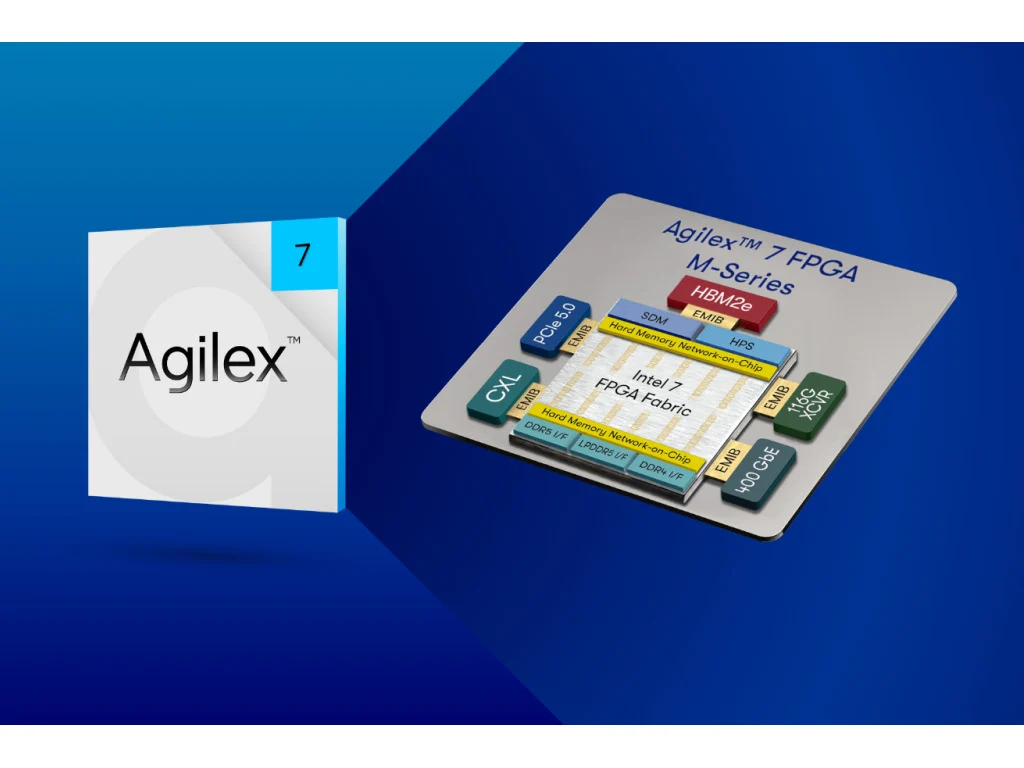
    Altera is recognized as a top supplier of programmable chips, such as Field-programmable Gate Arrays (FPGA) and System-on-a-chip (SoC) components. These chips can be adapted for a wide range of uses, including data centers, communication systems, industrial automation, and much more.

    The agreement is expected to finalize in the latter half of 2025. After the transaction is complete, Intel will detach Altera’s financial data from its own, allowing Altera to function as a completely independent entity.

    “Altera is in a strong position to capitalize on its current momentum and create groundbreaking FPGA-based solutions that are influencing the future of computing driven by AI,” said Hussain. “I deeply appreciate the contributions Sandra has made and the team she has assembled as we embark on Altera’s new growth journey.”

    Source:
    Link

  • Analogue 3D: Nintendo 64 Reimagined for $249.99 with 4K Gameplay

    Analogue 3D: Nintendo 64 Reimagined for $249.99 with 4K Gameplay

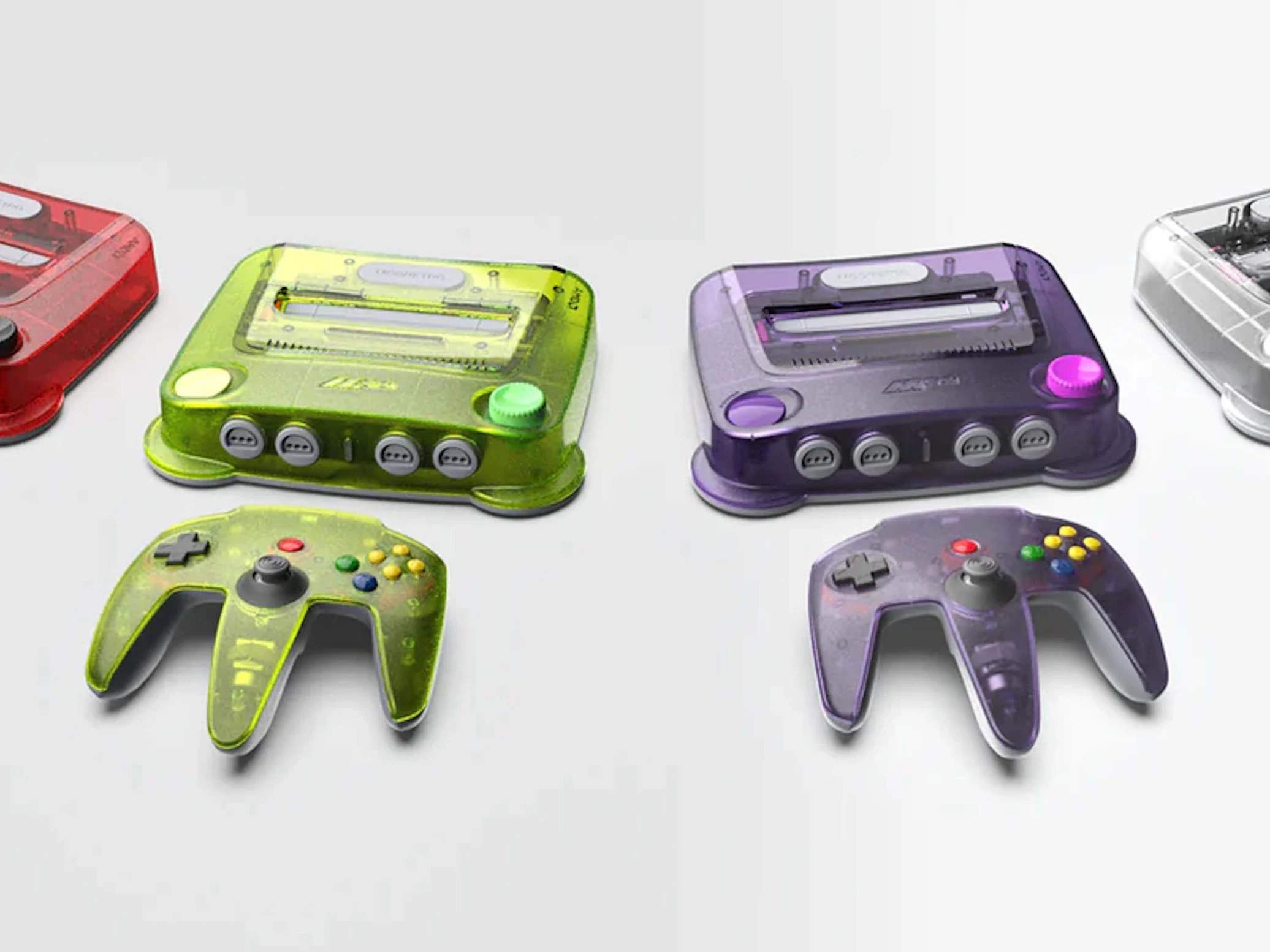
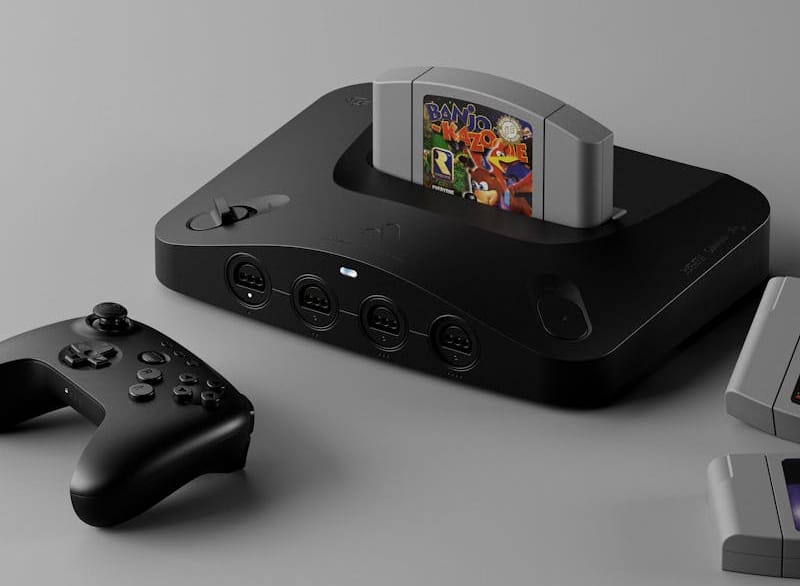
    It took a bit of time, but Analogue has finally shared more information about its new version of the N64, known as the Analogue 3D. This console uses a field-programmable gate array (FPGA) chip to emulate N64 games in hardware. Analogue describes their product in a few interesting ways:

    The Analogue 3D is a significant step in preserving video games: it’s not just the first new take on the N64 in the world, but also the first recreation that is completely compatible with the original. After almost four years of work on the FPGA, Analogue has eliminated the typical issues found with software emulation, like input lag, sound and graphic inaccuracies, and frame rate problems. Now, you can enjoy the N64 just like it was meant to be played, without any compromises.

    Features and Capabilities

    In practical terms, the Analogue 3D can play N64 cartridges in 4K resolution over HDMI and it is region-free. Additionally, the console is said to work with original accessories and includes support for the Expansion Pak. It also features modes for CRT and PVM displays and offers a variable refresh rate for smoother gameplay.

    Technical Specs and Availability

    This impressive functionality comes from the Intel Cyclone 10 GX FPGA chip, which has 220K logic elements (LEs). Pre-orders for the Analogue 3D will start on October 21 at 03:00 UTC. The console is set to retail for $249.99 and will be available in black and white colors before shipping. However, it’s likely that supply will be limited, as is often the case with products from Analogue.


    Image 1