
Key Takeaways
1. The xSDR is now available on Crowd Supply, exceeding its funding target before the March 2026 deadline, and offers enhancements over the previous uSDR platform, including 2×2 MIMO support and wider bandwidth in the same compact size.
2. Key specifications include the Lime Microsystems LMS7002M RF transceiver, AMD Artix-7 FPGA, tuning range of 30 MHz to 3.8 GHz, and sample rates up to 122.88 MSPS in SISO mode and over 80 MSPS in MIMO mode.
3. The module features a 12+2-pin GPIO header for managing external RF components and precise timing synchronization, allowing for complex multi-channel setups.
4. The xSDR is compatible with software tools like GNU Radio and integrates with wsdr.io for easy browser-based configuration, targeting applications in cellular testing, RF analysis, and wireless data links.
5. Priced at $549, the xSDR is aimed at professionals and advanced hobbyists, with potential performance limitations due to USB 2.0 speed and risks associated with hardware crowdfunding, such as certification delays and component availability.
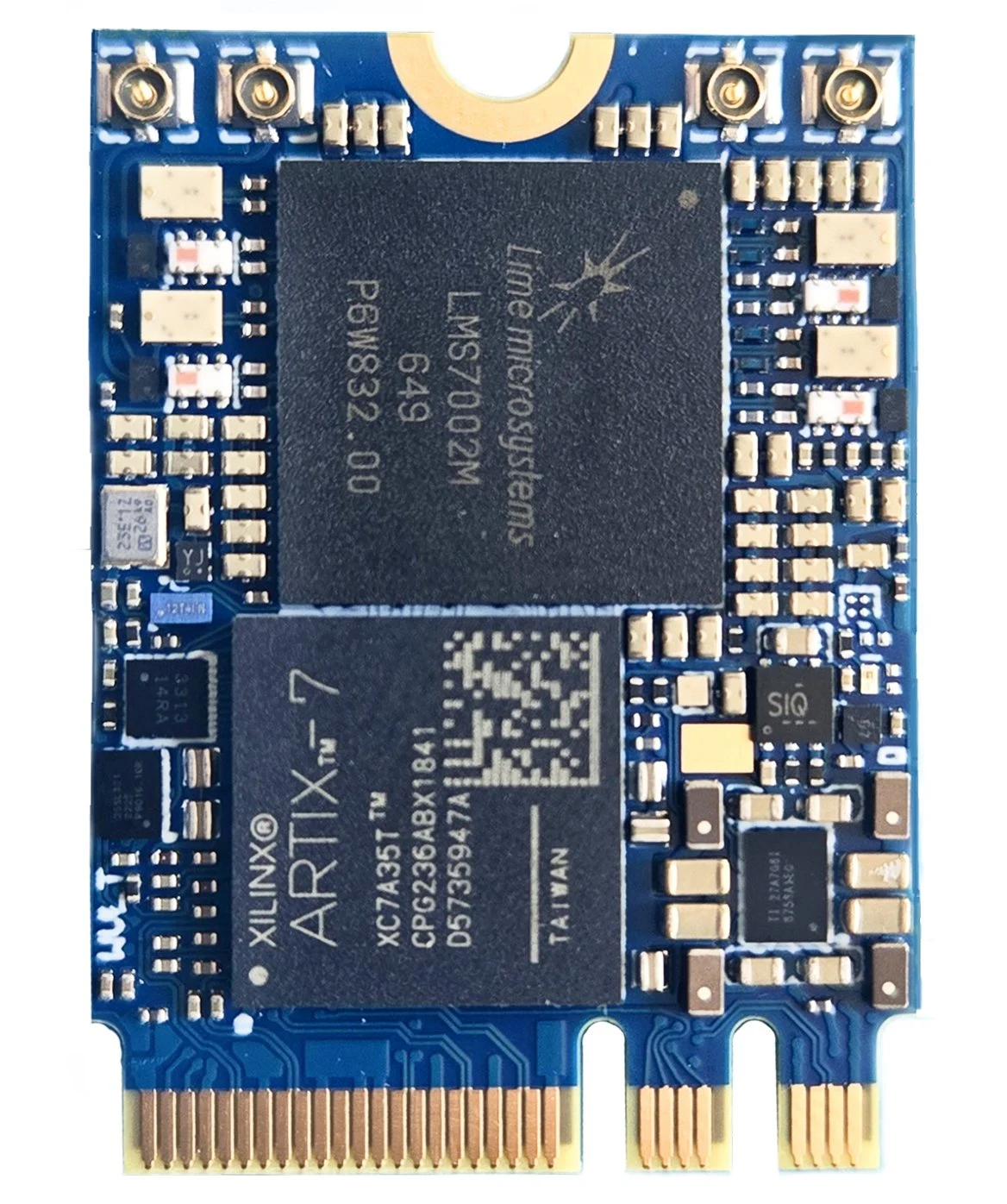
The xSDR is now available through Crowd Supply, having successfully met its funding target well before the March 2026 deadline. This new module is an advancement from the previous uSDR platform, now featuring support for 2×2 MIMO and a wider bandwidth, all within the same dimensions of 30 mm × 22 mm.
Key Specifications
At its foundation, the xSDR utilizes the Lime Microsystems LMS7002M RF transceiver, combined with an AMD Artix-7 XC7A50T FPGA. This setup allows for a tuning range from 30 MHz to 3.8 GHz. The SDR can handle sample rates ranging from 0.1 MSPS to 122.88 MSPS in SISO mode, and over 80 MSPS in MIMO mode, with channel bandwidths varying from 0.5 MHz to 90 MHz. There are four MHF4 antenna connectors that provide access to two RX and two TX channels.
GPIO Capabilities
The module features a 12+2-pin 1.8V GPIO header accessible via the reserved pins of the M.2 A+E key interface. This can be used to manage external RF front-ends, switch antenna relays, or enable JTAG for debugging custom gateware. Notably, one of these GPIO pins can be set as a 1PPS (Pulse Per Second) input, allowing it to accept precise timing signals from a GPS Disciplined Oscillator (GPSDO) to synchronize multiple boards for phase-coherent, multi-channel setups.
On the software front, the xSDR is compatible with tools such as GNU Radio, srsRAN, and SoapySDR. It also integrates with wsdr.io, a web-based platform that supports WebUSB, enabling users to configure and manage radio functions straight from a browser without the need for elaborate driver installations.
Use Cases and Limitations
Wavelet Lab promotes this module for cellular testing (LTE and 5G), embedded RF analysis, custom wireless data links, and various research applications. It can also be employed for penetration testing using software like Universal Radio Hacker. With appropriate configurations, the xSDR is capable of mimicking, intercepting, or decoding numerous wireless protocols.
While the module boasts extensive bandwidth and 2×2 MIMO capabilities, it may face limitations due to USB 2.0 speed in specific setups. Supporting both USB 2.0 and PCIe 2.0 ×2 through the M.2 interface, installing it in a slot that only accommodates USB could restrict its maximum performance. Priced at $549, the xSDR targets professionals, researchers, and advanced hobbyists, rather than beginners.
Manufacturing for the xSDR will be conducted by Wavelet Lab, with final deliveries managed by Mouser Electronics through the Crowd Supply network. As with most hardware crowdfunding efforts, risks include tariff changes, component availability issues, firmware concerns, and possible delays in certification or compliance, which could affect delivery schedules.
Source:
Link