Category: Artificial intelligence

  • Micron Launches New 9th Gen NAND SSDs for Enhanced Storage

    Micron Launches New 9th Gen NAND SSDs for Enhanced Storage

    Key Takeaways

    1. Micron Technology launched three SSDs using 276-layer G9 NAND technology: the 9650, 6600 ION, and 7600, aimed at enhancing AI and cloud workloads.
    2. The 9650 SSD features a four-lane PCIe 6.0 interface, achieving up to 28 GB/s read and 14 GB/s write speeds, with significant energy efficiency improvements.
    3. The 6600 ION prioritizes storage capacity, offering models up to 122.88 TB, with a future 245 TB version, providing high energy efficiency and reducing power consumption.
    4. The 7600 series focuses on low latency, with response times under 1 ms and competitive read/write speeds, effectively doubling random-write throughput compared to competitors.
    5. Initial samples of the 9650 and 7600 are in customer qualification, with the 6600 ION set to ship in Q3 2025 and the 245 TB model by mid-2026, enhancing AI infrastructure capabilities.


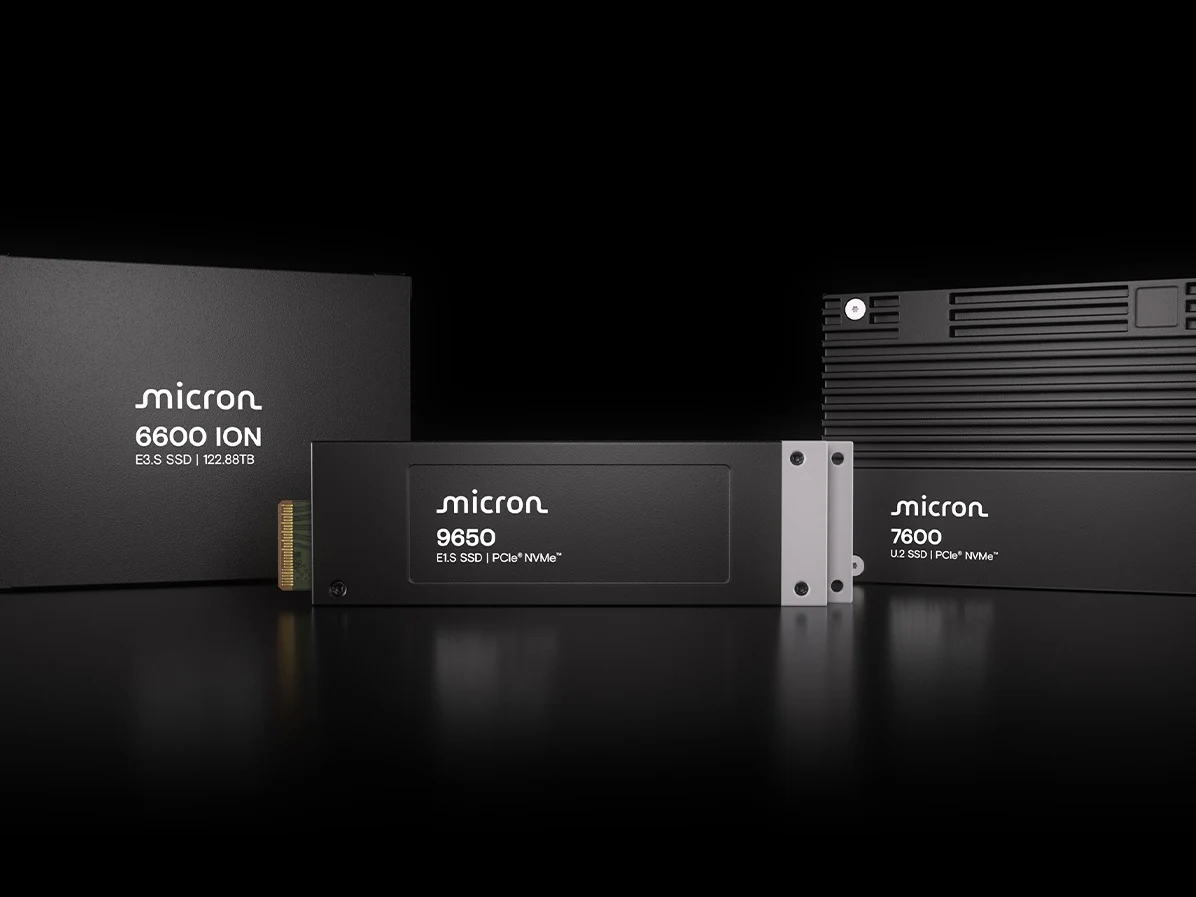
    Micron Technology has rolled out a set of three data-center SSDs using their 276-layer G9 NAND technology. These include the 9650 PCIe Gen 6 NVMe flagship model, the 6600 ION series aimed at high capacity, and the latency-focused 7600 PCIe Gen 5 drive. The goal of these new offerings is to provide a combination of high bandwidth, extreme density, and reliable response times to support the growing needs of AI clusters and cloud workloads.

    Key Features of the 9650 SSD

    The 9650 SSD stands out as the first drive to utilize a four-lane PCIe 6.0 interface. Micron states that it can achieve sequential transfer rates of up to 28 GB/s for reading and 14 GB/s for writing, along with a remarkable 5.5 million random-read IOPS. Furthermore, its enhanced power management allows for energy efficiency improvements of up to 67 percent compared to similar Gen 5 alternatives. This SSD is mainly designed for AI servers and is available in E1.S and E3.S form factors, which can be cooled by air or liquid. It also supports peer-to-peer transfers with Nvidia Blackwell GPUs through Astera Labs or Broadcom retimers, without needing to involve the host CPU.

    Capacity and Energy Efficiency of the 6600 ION

    When it comes to prioritizing raw capacity, the 6600 ION uses QLC NAND on a PCIe 5.0 platform. The initial capacities include 30.72 TB, 61.44 TB, and 122.88 TB, with a 245 TB model set to launch in the first half of 2026. Micron claims to deliver 4.9 TB per watt and has a 37 percent energy advantage over traditional HDD arrays. This enables a single 1U server to accommodate 2.4 PB of flash storage, significantly reducing rack-level power consumption by several megawatt-hours each day.

    The Latency-Focused 7600 Family

    The 7600 series completes the lineup as a mainstream Gen 5 option that prioritizes low latency. It maintains sub-1 ms response times on tasks like RocksDB and achieves sequential read speeds of 12 GB/s, write speeds of 7 GB/s, along with up to 2.1 million random-read IOPS. These specifications effectively double the random-write throughput compared to rival drives in the same category.

    Initial samples of the 9650 and 7600 are already going through customer qualification, while the 122 TB 6600 ION is set to ship in Q3 2025, followed by the 245 TB version in the first half of 2026. Collectively, these three SSDs position Micron to enhance AI infrastructure with faster data paths, larger flash pools, and improved quality-of-service assurances, all built on a vertically integrated controller, firmware, and NAND stack.

    Source:
    Link


  • Tesla’s AI6 Chip on Samsung 2nm: Optimus & Dojo, Not Cars

    Tesla’s AI6 Chip on Samsung 2nm: Optimus & Dojo, Not Cars

    Key Takeaways

    1. Tesla and Samsung’s multibillion-dollar agreement aims for vertical integration and reducing geopolitical risks, with AI6 chip production expected to start in 2028.
    2. Samsung has begun preparatory work for the AI6 chip, focusing on designs for the Optimus humanoid robot and Dojo supercomputer, not specifically for Tesla vehicles.
    3. Elon Musk announced plans to use the AI6 chip across all Tesla products, but initial production may prioritize robots and supercomputers while vehicles continue with AI4 and AI5 chips.
    4. Tesla’s partnership with Samsung allows it to distance itself from TSMC and geopolitical concerns, while maintaining in-house chip design and optimizing production in Texas.
    5. Tesla is shifting away from Chinese suppliers for key components, opting for LG batteries in new models and reinforcing partnerships with South Korean companies like Samsung.


    The recent multibillion-dollar agreement between Tesla and Samsung regarding the AI6 chip appears to be driven by a desire for vertical integration and a strategy to mitigate geopolitical risks. Analysts predict that the production of the 2nm Tesla AI6 chip will kick off in 2028, with maximum output expected between 2029 and 2032.

    Samsung’s Early Steps

    In contrast, reports from Korean media suggest that Samsung has commenced the preparatory work for manufacturing the AI6 chip. However, the focus of the initial designs is directed towards the next generation of the Optimus humanoid robot and the Dojo FSD supercomputer clusters, rather than specifically for Tesla’s vehicles.

    Musk’s Vision vs. Reality

    This situation raises questions, particularly since Elon Musk stated during the last quarterly call that Tesla plans to utilize the same AI6 chip across all its necessary products, including cars, robots, and the expansive Dojo computer vision initiative. He also noted that the company’s vehicles are set to receive next-gen self-driving hardware by late 2026, with the AI5 chip being so “spectacular” it may conflict with U.S. export regulations concerning AI computing capabilities.

    Tesla may not find it practical to design the AI5 chip and rely on TSMC for its 3nm production just to use it in cars for a year before transitioning to the 2nm Samsung AI6 in 2028. It’s likely that the initial batches of the AI6 will be utilized for Optimus robots and Dojo computer clusters, while Tesla’s vehicles continue to operate with the AI4 and AI5 chips, benefiting from FSD algorithm updates developed by Dojo.

    Strategic Choices

    Tesla’s partnership with Samsung appears to have been motivated by a compelling price proposal and the opportunity for joint development of the AI6 silicon. Musk has indicated that he intends to oversee production processes at Samsung’s Taylor, TX facility, focusing on optimization and cost-efficiency.

    By shifting to Samsung’s chips produced in Texas, Tesla can distance itself from TSMC and any related geopolitical concerns, while adhering to U.S. government regulations or subsidies, all while still designing its AI chips in-house.

    Moving Away from China

    Tesla’s strategy to move away from Chinese suppliers for key EV components such as AI computing and batteries is evident in its new models. For example, the upcoming Model 3+ in China will feature the LG ternary battery pack used in the Model Y, instead of the CATL batteries. The LG battery not only offers higher energy density but also positions the sedan favorably in markets where CATL products might encounter tariffs or restrictions.

    The new six-seat Model Y L variant, which is set to launch in the fall, will use the same battery pack. Additionally, Tesla has entered into a $4.3 billion agreement with LG for energy storage batteries, further reinforcing its shift from Chinese suppliers to those based in Korea.

    Samsung’s Foundry Win

    For Samsung, this deal is a significant boost for its foundry operations. Its own Exynos chips, which power devices like the Galaxy Z Flip 7—currently $200 off on Amazon—have frequently lagged behind Qualcomm’s Snapdragon series due to thermal issues linked to TSMC’s production processes.

    Samsung has faced challenges with the yield of its 2nm GAA production method, but it has improved from initial low figures to about 40%. It is expected to reach the required yield of 60% or more at the Taylor foundry after new equipment is installed next year. If this goal isn’t met, Samsung might initially produce the AI6 chip at a loss. However, the contract with Tesla is seen as valuable, potentially breaking TSMC’s stronghold on advanced chip manufacturing.

    Notably, TSMC’s U.S. foundry can only supply 7% of the chips that American companies need, which may have influenced Tesla’s decision to partner with Samsung and its Texas facility, humorously noted by Musk to be “conveniently located not far from my house.”

    Source:
    Link

  • Wyoming AI Campus Could Use Five Times More Power Than Homes

    Wyoming AI Campus Could Use Five Times More Power Than Homes

    Key Takeaways

    1. Mayor Patrick Collins supports a new data center campus in Wyoming, with an initial capacity of 1.8 GW and potential growth to 10 GW.
    2. The facility’s first phase is projected to consume 15.8 TWh annually, significantly exceeding Wyoming’s residential energy needs.
    3. To meet high energy demand, Tallgrass plans to use dedicated gas and renewable energy sources, a shift for the state which currently exports much of its electricity.
    4. The proposed site is near Cheyenne, which already hosts data centers from Microsoft and Meta, leveraging its favorable climate and energy infrastructure.
    5. If approved, the project could position Wyoming as a leading site for AI computation amidst increasing domestic energy demands.


    Mayor Patrick Collins has supported a plan from infrastructure experts Tallgrass and AI computing company Crusoe to establish a new data center campus. The campus is anticipated to start with a capacity of 1.8 GW and has the potential to grow to 10 GW of IT load. This would exceed the total electricity usage of all homes in the state combined.

    Initial Energy Demand

    In the first phase, the facility is projected to consume around 15.8 TWh annually. This figure is five times greater than the residential energy needs of Wyoming. When fully operational, the center could require 87.6 TWh, which is more than double the state’s yearly electricity generation. According to calculations referenced by Ars Technica, it’s estimated that one gigawatt can power about one million homes in the U.S.

    Energy Solutions

    Due to the public grid’s inability to support such a high demand, Tallgrass intends to combine dedicated gas-fired generation with renewable energy sources. This is a significant change for Wyoming, which currently exports nearly 60% of the electricity it generates. Governor Mark Gordon has expressed support for the project, recognizing the potential benefits it could bring to local natural gas suppliers.

    Location and Approvals

    The proposed site is situated just south of Cheyenne, near U.S. Route 85. State and county authorities still need to approve the plans. Cheyenne already has data centers run by Microsoft and an almost-finished Meta campus worth $800 million. These tech giants are attracted to the area’s cool, dry climate and robust energy infrastructure.

    Tallgrass and Crusoe have yet to identify an anchor tenant for the campus. This has led to speculation that the site might be linked to OpenAI’s “Stargate” project. A spokesperson from Crusoe did not confirm or deny this possibility. The company already collaborates with OpenAI on a one-gigawatt facility in Abilene, Texas, which they claim is the largest data center site in the world. Additionally, Crusoe aims to secure another 4.5 GW of capacity in partnership with Oracle.

    Future Prospects

    If the Cheyenne project moves forward on its proposed “sooner rather than later” timeline, Wyoming could emerge as one of the largest locations globally for AI computation. At the same time, the state will be testing its capacity to balance energy exports with the growing domestic demand for machine-learning workloads.

    Source:
    Link

  • AI Uncovers Many Earthquakes Under Yellowstone National Park

    AI Uncovers Many Earthquakes Under Yellowstone National Park

    Key Takeaways

    1. Yellowstone National Park is not only known for its beautiful scenery but also for its frequent earthquakes and risks associated with the Yellowstone Caldera.

    2. Recent AI advancements have revealed over 86,000 earthquakes in Yellowstone, significantly more than previously estimated.

    3. The earthquakes are classified as seismic swarms, which are minor earthquakes occurring in a short time within a small area, linked to ancient faults.

    4. AI technology is being utilized to monitor seismic activity and assess risks in regions like Yellowstone.

    5. The Yellowstone supervolcano erupts approximately every 600,000 years, with the last major eruption over 620,000 years ago, highlighting the importance of ongoing research and safety measures.


    Yellowstone National Park captures the attention of countless visitors globally with its stunning scenery. Nevertheless, hidden beneath this beautiful environment is a significant threat. Recently, advancements in artificial intelligence have uncovered strange activities occurring deep within the Earth.

    Earthquakes and Caldera Concerns

    Yellowstone is famous not only for its incredible views but also for the frequent earthquakes and the risks associated with the Yellowstone Caldera.

    To address this constant hazard, researchers have started utilizing AI to analyze seismic data collected over the past fifteen years. The findings are indeed concerning, revealing more than 86,000 earthquakes. This number is much higher than what was previously estimated.

    Understanding Seismic Swarms

    Specifically, these earthquakes are classified as seismic swarms. This term refers to a series of minor earthquakes that happen in a short time frame within a small geographic region. It’s crucial to distinguish them from regular earthquakes occurring worldwide, like the recent one in Russia. The latter often signify specific geological activities, especially in volcanic regions where magma interacts with water and rocks.

    The seismic swarms detected beneath Yellowstone are linked to ancient faults that are millions of years old. However, employing AI in this research area offers numerous advantages, especially in monitoring regions at risk and those that may face threats in the future.

    Eruption Frequencies and Safety Measures

    It’s important to highlight that the Yellowstone supervolcano typically erupts approximately every 600,000 years. The last significant eruption was over 620,000 years ago. This average eruption cycle is a key reason why extensive research is ongoing, and proactive measures could be necessary to safeguard millions of lives in case of a deteriorating situation.

    Source:
    Link

  • WAIC Launches Two AI Alliances to Boost China’s Chip Ecosystem

    WAIC Launches Two AI Alliances to Boost China’s Chip Ecosystem

    Key Takeaways

    1. Model-Chip Ecosystem Innovation Alliance: A partnership among GPU manufacturers and large-language model experts to unify hardware and frameworks for seamless model transitions on Chinese accelerators.

    2. Shanghai General Chamber of Commerce AI Committee: Focused on implementing AI solutions in manufacturing and services, linking model creators with industrial users.

    3. Huawei’s CloudMatrix 384: A new server cabinet consolidating 384 Ascend 910C chips, outperforming Nvidia’s cluster in some metrics despite lower per-chip performance.

    4. New Software and Consumer Products: Innovations showcased include Tencent’s Hunyuan3D World Model, Baidu’s voice and gesture mimicry toolkit, and Alibaba’s Quark AI Glasses.

    5. Strategic Collaboration: The partnerships aim to standardize and reduce fragmentation in China’s AI industry amidst tightening U.S. export restrictions.


    China’s AI industry took the opportunity at the World Artificial Intelligence Conference (WAIC) held in Shanghai to unveil two important partnerships aimed at enhancing the local technology framework and decreasing dependence on American silicon.

    The Model-Chip Ecosystem Innovation Alliance

    The first of these partnerships, named the Model-Chip Ecosystem Innovation Alliance, consists of GPU manufacturers like Biren, Huawei, Enflame, and Moore Threads, along with experts in large-language models such as StepFun. The alliance’s primary objective is to unify hardware, frameworks, and LLMs through shared interfaces, allowing models to transition seamlessly between Chinese accelerators with minimal hassle.

    Shanghai General Chamber of Commerce AI Committee

    On a different front, the Shanghai General Chamber of Commerce AI Committee is dedicated to implementing AI solutions in manufacturing and services. This group includes founding members such as SenseTime, MiniMax, Iluvatar CoreX, and Metax, and is intended to serve as a link between model creators and industrial users.

    Huawei’s CloudMatrix 384

    In terms of hardware innovations, Huawei made waves with its CloudMatrix 384, a server cabinet that consolidates 384 Ascend 910C chips. Additionally, SemiAnalysis reports that this system surpasses Nvidia’s GB200 NVL72 cluster in certain metrics, compensating for lower performance on a per-chip basis with a compact system design. Metax also showcased a 128-chip C550 “supernode” intended for liquid-cooled data center applications.

    In addition to hardware, WAIC presented several new software and consumer products: Tencent released its Hunyuan3D World Model 1.0 for generating text-to-3D scenes; Baidu introduced a toolkit capable of mimicking a presenter’s voice and gestures from just ten minutes of footage; and Alibaba offered a sneak peek at its Quark AI Glasses, set to launch in 2025, featuring guidance and Alipay QR-code capabilities powered by its Qwen model.

    Through the collaboration of chip manufacturers, model developers, and end-users, these two new partnerships aim to hasten standardization and minimize fragmentation within China’s rapidly evolving AI landscape—this strategy may be crucial as U.S. export restrictions continue to tighten.

    Source:
    Link

  • OpenAI Introduces Study Mode Feature for ChatGPT Users

    OpenAI Introduces Study Mode Feature for ChatGPT Users

    Key Takeaways

    1. OpenAI has launched a new feature called Study Mode in ChatGPT to help students learn step-by-step.
    2. Study Mode is available for Free, Plus, Pro, and Team accounts, with plans to include ChatGPT Edu accounts soon.
    3. The mode customizes learning by using quizzes to assess students’ knowledge and guide them through problem-solving.
    4. ChatGPT encourages critical thinking by providing hints and questions instead of direct answers, aiding exam preparation.
    5. OpenAI is continuously updating its features and encourages users to check their YouTube channel for the latest news.


    OpenAI has enhanced ChatGPT with a new feature called Study Mode, designed to assist students in understanding how the responses are created, step-by-step. The company plans to take effective learning techniques discovered through this mode and integrate them into its main AI models in the future.

    Availability of Study Mode

    Study Mode is currently accessible to users with Free, Plus, Pro, and Team accounts. In the next few weeks, it will be introduced for ChatGPT Edu accounts. This feature can be selected from the various modes available in the prompt window, which also includes options like Deep Research among others.

    Tailored Learning Experience

    In this mode, ChatGPT assesses students’ knowledge through quizzes and adjusts its responses accordingly. Instead of giving direct answers, it guides students with a series of steps, hints, and questions that encourage them to think critically and find the solution themselves.

    The AI also evaluates students on their understanding and ability to apply their newfound knowledge to similar problems, which can be beneficial for exam preparation.

    For students who tend to zone out in lectures, there is the Plaud Note AI voice recorder, which utilizes ChatGPT to automatically transcribe and condense lecture content.

    Further Updates from OpenAI

    Keep an eye on OpenAI’s latest developments, including their YouTube channel, for more exciting updates!

    Source:
    Link

  • EU Plans $34.6B AI Factory to Double Compute Capacity with Hubs

    EU Plans $34.6B AI Factory to Double Compute Capacity with Hubs

    Key Takeaways

    1. The European Commission has allocated €10 billion for the first network of 13 regional AI factories and plans to invest an additional €20 billion for larger gigafactories.

    2. Each gigafactory is expected to cost between €3 and €5 billion and will house at least 100,000 high-performance GPUs, significantly increasing Europe’s AI computing power.

    3. The initiative aims to enhance Europe’s sovereignty in AI by providing centralized infrastructure for start-ups and SMEs to access affordable resources for training and inference.

    4. Securing adequate electricity supply poses a challenge, as a single gigafactory may consume up to one gigawatt of power, necessitating upgrades to power grids and generation capacity.

    5. Initial pilot factories are already operational, with projects like Telenor’s AI factory in Norway and a major facility opening in Munich, aiming to close the trans-Atlantic AI gap.


    Europe’s “AI factory” initiative has transitioned from being just an idea to actual building, with the European Commission allocating €10 billion (≈ US$11.6 billion) for the first network of 13 regional AI factories. Additionally, they plan to invest another €20 billion (≈ US$23.2 billion) to kickstart a second phase of much larger gigafactories.

    Ambitious Scale of Gigafactories

    These gigawatt-class facilities are quite ambitious: each is expected to cost between €3 and €5 billion (≈ US$3.5–5.8 billion) and will contain at least 100,000 high-performance GPUs. They are projected to provide significantly more computing power than the largest current AI clusters in Europe. According to UBS modeling, if 10 to 15 of these plants are fully constructed, they could contribute around 1.5 to 2 GW of IT load—approximately 15% of Europe’s existing data center capacity.

    Aiming for Sovereignty

    Brussels presents this project as a matter of sovereignty. The European Union has around 30% more AI researchers per capita compared to the United States, yet it lacks sufficient computing resources to meet their goals. By bringing together hardware, data, and expertise in centralized “one-stop shops,” the Commission aims to provide start-ups and small-to-medium enterprises (SMEs) with affordable access to large-scale infrastructure for training and inference.

    Electricity Supply Challenges

    However, securing enough electricity might be a significant challenge. Experts warn that a single gigafactory could consume as much as one gigawatt of power, which is similar to the output of a mid-size nuclear power plant. Upgrading the existing power grids and increasing generation capacity will likely require more time than constructing the data centers themselves. The role of private investment remains uncertain; officials acknowledge that public funding alone won’t bridge the financial gap, and think tanks like Bruegel have raised concerns about whether subsidies are the right approach for such large-scale projects.

    Progress on Pilot Sites

    Some initial pilot factories are already operational. Telenor’s small AI factory in Norway has started testing language services for public-sector clients, while the first major EU facility is set to open in Munich in early September. If the challenges related to power and financing are addressed, Brussels is optimistic that this computing infrastructure will help close the trans-Atlantic AI gap and foster a new wave of European models and applications.

    Source:
    Link

  • MIT AI Autonomous Lab Promises Better Batteries and Solar Panels

    MIT AI Autonomous Lab Promises Better Batteries and Solar Panels

    Key Takeaways

    1. MIT researchers developed an autonomous lab using a smart algorithm and robotics to quickly discover new materials.
    2. The system utilizes a genetic algorithm to design and test hundreds of new polymer blends automatically.
    3. It can create and test up to 700 new polymer blends each day, speeding up the discovery process significantly.
    4. The platform successfully identified a polymer blend that improved enzyme stability at high temperatures by 18%.
    5. This innovation has the potential to revolutionize various fields, including batteries and medicines.


    Researchers from MIT have created a completely autonomous platform that employs a smart algorithm and a robotic system to quickly discover new materials. This so-called ‘autonomous lab’ has the potential to greatly enhance the development of future technologies that affect our everyday lives, including everything from batteries to medicines.

    How It Works

    The closed-loop system operates by utilizing a genetic algorithm to cleverly design hundreds of promising new polymer blends. These recipes are then sent to a robotic platform, which automatically mixes the chemicals and carries out tests on the new materials. The results are relayed back to the algorithm, which learns from what it finds and creates an even better set of materials for the subsequent round of experiments.

    Speed of Discovery

    This automated workflow is remarkably quick, enabling the system to create and test as many as 700 new polymer blends each day. The researchers mention that this fast-paced discovery process could revolutionize multiple important fields.

    Types of Materials Found

    In its early experiments, the system aimed to identify a polymer blend that could maintain enzyme stability at elevated temperatures. The platform was able to discover a blend that outperformed any of its individual components by 18%, highlighting its capability to uncover innovative and unexpected solutions. The findings were published in the journal Matter.

  • Adobe Enhances Photoshop with New AI Features

    Adobe Enhances Photoshop with New AI Features

    Key Takeaways

    1. Adobe has launched new AI features in the beta version of Photoshop, including tools for object removal, image enhancement, and composite creation.
    2. The Harmonize tool uses generative AI to blend new elements into images by adjusting colors, lighting, and shadows.
    3. The Generative Upscale tool enhances low-resolution images, increasing quality up to eight megapixels, but generated details are not authentic.
    4. The enhanced Remove tool improves item removal and fills gaps with matching backgrounds using the Adobe Firefly Image Model.
    5. The Projects feature helps organize and share files related to specific projects, enhancing user convenience.


    Adobe has introduced fresh AI functionalities in the beta version of its Photoshop image editing software. These innovations aim to simplify the process for photo editors by enabling them to remove unwanted objects, enhance image resolution, and create composite images. To utilize these features, interested users must first enroll in the beta program as outlined in the provided link.

    Harmonize Feature

    The Harmonize (beta) tool has emerged from Project Perfect Blend, which was initially showcased in 2024. This feature utilizes generative AI technology to modify the color, lighting, shadows, and tones of new elements added to an image, making them blend in seamlessly without the hassle of complex editing tasks, as per Adobe’s claims. When applied to an object, users are offered a variety of composited looks to choose from, enhancing their creative options.

    Generative Upscale Tool

    Generative Upscale (beta) harnesses AI’s ability to add finer details when enlarging low-resolution images, boosting quality up to eight megapixels. This functionality is akin to AI tools from Topaz Labs that upscale photos and videos. However, it’s important to note that the details generated are not authentic and should not be relied upon for critical research or investigative purposes.

    Enhanced Remove Tool

    The Remove tool has received updates to improve the removal of selected items from photos. It utilizes the Adobe Firefly Image Model, as explained in the associated PDF document, to fill in the gaps left behind with backgrounds that appropriately match the surrounding area.

    Moreover, users now have the option to choose the Firefly Image Model to work with the existing Generative Fill and Generative Expand tools, ensuring that the AI output aligns better with the edited image. Additionally, the Projects (beta) feature has been implemented to organize all files related to a project, making access and sharing more convenient.

    Source:
    Link

  • Meta Faces Lawsuit for Using Pirated Adult Content in AI Training

    Meta Faces Lawsuit for Using Pirated Adult Content in AI Training

    Key Takeaways

    1. Strike 3 Holdings has filed a copyright infringement lawsuit against Meta for unlawfully downloading and sharing 2,396 copyrighted materials via BitTorrent.
    2. The lawsuit claims Meta used both corporate and residential IP addresses to access and distribute Strike 3’s works, recording over 100,000 unauthorized distribution events.
    3. Strike 3 alleges that Meta targeted its works to expedite file downloads and utilized them to train AI models, potentially harming Strike 3’s market position.
    4. The studio is seeking statutory damages, a permanent injunction against Meta, and the removal of all identified files from Meta’s systems.
    5. Meta has not publicly responded to the allegations presented in the lawsuit.


    Strike 3 Holdings, known for its adult film productions, has initiated a copyright infringement lawsuit against Meta Platforms, Inc. This legal action was filed on July 23, 2025, in the U.S. District Court for the Northern District of California. The complaint claims that Meta unlawfully downloaded and shared 2,396 of Strike 3’s copyrighted materials using the BitTorrent system, with some instances occurring on the same day the new content was released.

    Claims of Unauthorized Usage

    In the lawsuit, Strike 3 argues that Meta utilized both its corporate and hidden IP addresses, along with residential IPs associated with its employees, to access and share the copyrighted material. The studio’s specialized detection tools, VXN Scan and Cross Reference Tool, reportedly recorded over 100,000 unauthorized distribution events linked to Meta’s network.

    Allegations of AI Training

    The lawsuit also states that Meta strategically targeted these works to speed up the downloading of more files by taking advantage of BitTorrent’s “tit-for-tat” method, which is designed to promote file sharing among peers and discourage free-riding. It also claims that these works were utilized to train Meta’s AI models, like LLaMA 4 and Movie Gen. This could potentially enable Meta to create content similar to what Strike 3 produces, thus affecting the studio’s competitive edge in the market.

    Strike 3 is asking for statutory damages, a permanent injunction to prevent Meta from using its works in the future, and the removal of all identified files from Meta’s systems. Additionally, the studio emphasizes that it never gave Meta permission to utilize its films for AI training or any other usage, referencing prior lawsuits that accused Meta of using pirated material for training its language models.

    No Response from Meta

    As of now, Meta has not made any public statements regarding the allegations mentioned in the lawsuit.

    Source:
    Link