Category: All News

  • OnePlus Ace 6 Ultra Leaked Specs: Higher Refresh Rate & Larger Battery

    OnePlus Ace 6 Ultra Leaked Specs: Higher Refresh Rate & Larger Battery

    Key Takeaway

    1. The OnePlus Ace 6 Ultra is expected to feature a significantly larger 8,500mAh battery, up from 6,700mAh in the previous model.
    2. It will have an upgraded 165Hz display refresh rate, compared to 144Hz in the Ace 5 Ultra.
    3. The phone is rumored to be powered by the MediaTek Dimensity 9500 processor.
    4. The device may have similar camera specifications to its predecessor, likely not matching the high-end camera capabilities of other flagship phones with the same processor.

    Upcoming OnePlus Ace 6 Ultra Come June 2023?

    Rumors are circulating about the soon-to-be-announced oneplus device, the Ace 6 Ultra, expected to arrive in April 2023. The anticipation has grown as fresh leaks provide crucial insights into what kind of features this new model might bring to the table. It looks like oneplus is really aiming to grab attention with some major upgrades over previous models. If the leaks are correct, this could be a very exciting release for fans and tech geeks alike.

    Technical Specifications Leaked from Weibo

    An insider on Weibo, known as @PandaVeryBald, shared some images claiming to reveal the key specs of the Ace 6 Ultra. The info covers three main aspects — battery, display refresh rate, and processor. These details suggest the manufacturer is focusing on improving battery life, visual smoothness, and overall performance, which is pretty promising. But, as always, take such leaks with a grain of salt until an official announcement.

    Battery & Display: Massive Improvements

    In terms of battery, the new Ace 6 Ultra allegedly packs an 8500mAh capacity. That’s quite a jump from the 6700mAh found in the previous version, promising longer usage without needing to recharge frequently. The refresh rate is also said to be increased to 165Hz, up from 144Hz, which could translate into much smoother scrolling and gaming experience. Although the screen size and technology weren’t specifically mentioned, chances are it’s an AMOLED panel, possibly with higher brightness output making it brighter and clearer even under direct sunlight.

    Performance & Camera Expectations

    The processor is speculated to be the MediaTek Dimensity 9500. This chip is currently used in high-end devices like the Oppo Find X9 Pro and Vivo X300 Pro, which means this phone could perform admirably in daily tasks and gaming. On the camera side, though, upgrades seem unlikely. Last year’s Ace 5 Ultra featured a 50MP main sensor alongside an 8MP ultrawide — pretty decent but not groundbreaking. The front camera, at 16MP, is typical for selfies and video chats. Thus, while the Ace 6 Ultra might excel in speed and battery, it might not impress much when it comes to photography capabilities.

    Sources
  • New Blood CEO Criticizes NVIDIA DLSS 5: Who Actually Asked For This?

    New Blood CEO Criticizes NVIDIA DLSS 5: Who Actually Asked For This?

    Key Takeaway

    1. Industry figures like David Oshry and David Szymanski criticize Nvidia’s DLSS 5 for blurring lines between traditional upscaling and generative AI, questioning its designation and impact on game quality.
    2. Developers are urged to push back against DLSS 5 commercially and creatively, advocating for higher native hardware performance instead of relying on AI-driven enhancements.
    3. Concerns are raised about the potential negatively affecting game clarity, accessibility, and originality due to the steep tradeoffs associated with the new DLSS technology.

    Industry Leaders Voice Concerns Over Nvidia’s DLSS 5

    Recently, prominent figures in the gaming development world, including New Blood Interactive’s CEO, David Oshry, and David Szymanski, creator of Dusk, have openly criticized Nvidia’s upcoming DLSS 5 technology. They argue that the new feature, scheduled for release this fall with the RTX 50-series GPUs, blurs the lines between traditional rendering and AI enhancement, raising worries about artistic integrity and transparency. The new iteration aims to combine photorealistic levels of lighting and detail, but some developers feel it crosses ethical boundaries they believe previously did not exist.

    Developer Reactions and Concerns

    • New Blood Interactive, known for its indie hits reminiscent of PS1-style graphics such as ULTRAKILL and Gloomwood, strongly oppose the technology. Oshry questioned the necessity and transparency, saying, “Please tell me what generative AI has to do with Deep Learning Super Sampling.”
    • He emphasized transparency by suggesting that if Nvidia had called it “Generative Upscaling,” the backlash might have been different but still problematic. He criticized Nvidia’s branding as misleading, asserting, “We all have working eyes and can see exactly what we think it is.”
    • To counteract DLSS 5, Oshry suggests that developers and players should “vote with our wallets” by boycotting the technology and advocating for hardware improvements, like increased native performance and cost reductions, instead of relying on AI upscaling.
    • He compared current trends to past battles against microtransactions and loot boxes, urging the community to resist what he perceives as exploitative practices in game development.

    Industry Divergence and Support

    Despite the pushback from some developers, others believe Nvidia’s technology will prevail. For example, the director of Kingdom Come: Deliverance 2 stated, “Haters won’t be able to stop this,” signifying confidence that DLSS 5’s adoption is inevitable. This divide highlights ongoing tensions in the industry regarding AI’s role in game graphics.

    Szymanski’s Perspective on Optional Features

    Szymanski voiced concerns that claims of DLSS 5 being optional are misleading. He compared it to real-time global illumination, which is often touted as optional but practically essential in modern games. He commented, “Games are now built to lean on those technologies,” suggesting that AI upscaling is becoming a core feature rather than a choice. While acknowledging DLSS 4.5’s benefits, Szymanski pointed out that these advancements come with significant compromises in clarity and accessibility, impacting the overall player experience.

    The Artistic Future of Gaming

    Oshry further criticized Nvidia’s direction by sarcastically questioning if developers should abandon traditional game art altogether, suggesting an AI-driven art approach could replace human creativity. He questioned the purpose of craftsmanship in game design when AI might generate visuals automatically, reflecting ongoing debates about the future landscape of game art and AI’s role within it.

    Sources
  • Switch 2 Game Leaks Including Star Fox Sorry Nintendo Ex-Employee

    Switch 2 Game Leaks Including Star Fox Sorry Nintendo Ex-Employee

    Key Takeaway

    1. Leaks about unannounced Nintendo projects, especially from credible sources like NateTheHate, significantly impact the company’s marketing plans and frustrate Nintendo’s efforts to keep secrets.
    2. Despite strict legal actions and protections, Nintendo has struggled to prevent leaks, making insiders like NateTheHate difficult to control.
    3. Public reaction is mixed—some fans welcome early leaks for anticipation, while others prefer to wait for official announcements.

    Recent Gaming Leaks Stir Controversy

    Leaks about unannounced projects is somethin that happens all the time in the gaming worlds. Sometimes, it’s just a small annoyance, but other times, it messes up marketing plans for a long time. Recently, on a podcast, a well-known insider, NateTheHate, let slip some info about upcoming Switch 2 games. An ex-Nintendo communication boss thinks that these leaks are not just small problems but a lot more serious for his past employer.

    Inside Look from a Former PR Expert

    Kit Ellis used to be head of marketing at Nintendo for around 13 years. Now, he hosts a podcast with Krysta Yang, who also worked in public relations there. After NateTheHate’s revelations, Kit made a quick YouTube video where he talked about how Nintendo probably feels about all this. His point was that the company must be pretty mad about the leaks, especially given how secretive they try to be.

    Details About Upcoming Games

    The insider shared some pretty exciting info, including when fans might see new games like a Star Fox comeback and a remake of The Legend of Zelda: Ocarina of Time. He even mentioned that by 2027, we could see a new 3D Mario game. Because of how much he revealed, Kit pointed out that “Nintendo is absolutely furious about this,” as they might be worried about spoilers ruining their plans.

    Media and Public Reactions

    What sets this leak apart from others, though, is how the media reacted. Usually, many news outlets don’t spread rumors unless they are confirmed, but NateTheHate has such a good record of predictions that people took his words seriously. He correctly predicted when the Switch 2 would be announced, which made his revelations more credible, and the news went all over.

    Legal and Ethical Concerns

    Kit explains, “Nintendo has a problem with leaks that they just can’t seem to fix.” Even though they are very strict and sue anyone talking about upcoming games or showing unreleased footage, these leaks still happen. Despite all their efforts with lawyers, they haven’t managed to stop one guy from revealing spoilers anymore. It’s kind of a mystery how NateTheHate gets away with it all without getting caught.

    Community’s Mixed Feelings About Leaks

    Fans are divided on whether these leaks should keep happening. Some gamers, who think Nintendo’s next direct is way overdue, are happy about the spoilers because it builds excitement. But others believe fans should wait patiently for Nintendo to officially announce their games, like Star Fox or future Mario adventures. So, opinions about leaks are pretty split in the community.


    Sources

  • The Sims Creator Continues AI Memory Game Proxi Despite Funding Lapse

    The Sims Creator Continues AI Memory Game Proxi Despite Funding Lapse

    Key Takeaway

    1. Will Wright has dedicated a decade and personal funds to develop “Proxi,” an AI-driven game transforming personal memories into digital avatars, but the project faces significant developmental and financial challenges.
    2. The project aims to explore subconscious connections and create interactive proxies of people from players’ memories, with the potential for avatars to interact across genealogy sites in the future.
    3. Despite innovative aspirations, “Proxi” has struggled with funding, layoffs, and technical hurdles, with Wright continuing to seek new investors while embracing the possibility of failure.

    Creator Will Wright’s Long-Term Vision Falls Into Struggles

    Will Wright, known widely as the mind behind classics such as The Sims, SimCity, and Spore, has dedicated over a decade in pursuit of a personal vision. His recent efforts focus on a very ambitious project, in which he invested millions, that aims to change the way we think about memories and AI. Since co-founding Maxis and reaching peak success with The Sims, Wright pursued a quiet but intense passion project beginning in 2015 called Proxi: Yesterday’s Tomorrow’s You.

    Development Challenges and Funding Woes

    This project was planned to be an innovative AI-driven game, where players could turn their personal memories into a digital universe populated by avatars called Proxies. These proxies would replicate real people, thus creating a digital landscape that explores subconscious connections. But, despite the initial enthusiasm, the journey wasn’t smooth. Wright and his team, which started with about 30 members, struggled as the project faced significant financial hurdles. The developer team was eventually laid off in October 2024 due to lack of funding, leaving only a small nominal staff of unpaid volunteers.

    The Concept of Proxi and Its Exciting Potential

    Proxi intended to be much more than just a game. It was envisioned as an experimental exploration into human psychology, combining storytelling with neuroscience. Wright collaborated with notable veterans such as the co-designer of Carmen Sandiego in Gallium Studios, where discussions about neural patterns and memory sorting took place. At its core, the game would use AI to analyze stored memories, connect unrelated experiences, and generate immersive scenes with proxies representing real people and ancestors.

    Current Status and Future Uncertainty

    Now, the project is in a very tentative phase, with Wright saying that it feels “kind of like Frankenstein,” since the entire concept hinges on the powerful, yet unpredictable, AI engine that forms the “brain” of the Proxies. There’s hope that in the future, these proxies could interact with each other across online platforms, creating a dynamic web of personal connections. Still, the project remains unfinished and lacks consistent funding, with Wright actively searching for new supporters to continue his work. Despite the setbacks, he persists believing that even a failure would be worthwhile if it means pushing the boundaries of understanding human memory and AI.

    Sources
  • Crimson Desert Reminds Me I’m Not 16 Anymore: My Gaming Experience

    Crimson Desert Reminds Me I’m Not 16 Anymore: My Gaming Experience

    Key Takeaway

    1. Crimson Desert offers a vast, visually appealing open world with complex systems, but its quest design often lacks depth and meaningful integration of exploration.
    2. The game combines elements from titles like Assassin’s Creed, Zelda, and Breath of the Wild, but is limited by a linear narrative and restricted decision-making options.
    3. While delivering engaging combat and challenging boss fights, some gameplay mechanics, like meal preparation, can become frustrating due to menu navigation and animations.
    4. The game’s broad scope and systemic features may appeal to players interested in witnessing industry trends firsthand, but its repetitive quests and shallow moments reflect modern gaming’s formulaic tendencies.

    Remembering the Launch of Fallout 3

    I remember the moment when Fallout 3 was first released—holding that special lunchbox, and knowing I was in for some serious gaming sessions over the next couple of days. Back then, I was still young, my responsibilities minimal, and every dollar I spent on games felt like a great value for the hours of fun I would get. But now, in 2026, things have changed quite a bit: I have a job, a mountain of games to play, and a lot more options to choose from. So, every gaming choice is now measured against other activities and a huge library of titles, not just the fun of playing itself.

    Crimson Desert: A Industry Trend Snapshot

    Much has been said about Crimson Desert already, including some of our own impressions. I’m not here to declare if the game is outright good or bad but rather to acknowledge that it might turn out to be a game worth trying, especially for those curious about recent big industry trends, even if not paying full price. When compared to upcoming titles like Grand Theft Auto VI, Crimson Desert could be seen as a candidate for the zenith of open-world games, featuring complex systems, boss battles, and camp management features. The game seems to tap into modern gaming’s appetite for rich, varied experiences, which makes it an interesting one to watch or play firsthand.

    Different Perspectives on Crimson Desert

    Approaching Crimson Desert is like viewing it from several different lenses. Some might say it’s a blend of Assassin’s Creed and Zelda: Tears of the Kingdom—in terms of exploration and open-world mechanics—though it’s immediately clear that the game is rooted in the online role-playing genre, especially with Black Desert Online’s influence. The story remains linear, no choice-driven branching here, which might be seen as a missed opportunity—imagine being able to strike a deal with a criminal instead of always turning them in. The protagonist, Kliff, guides us through his story vividly, but players don’t get to make decisions that affect the narrative arc directly.

    Choices and Systems in Gameplay

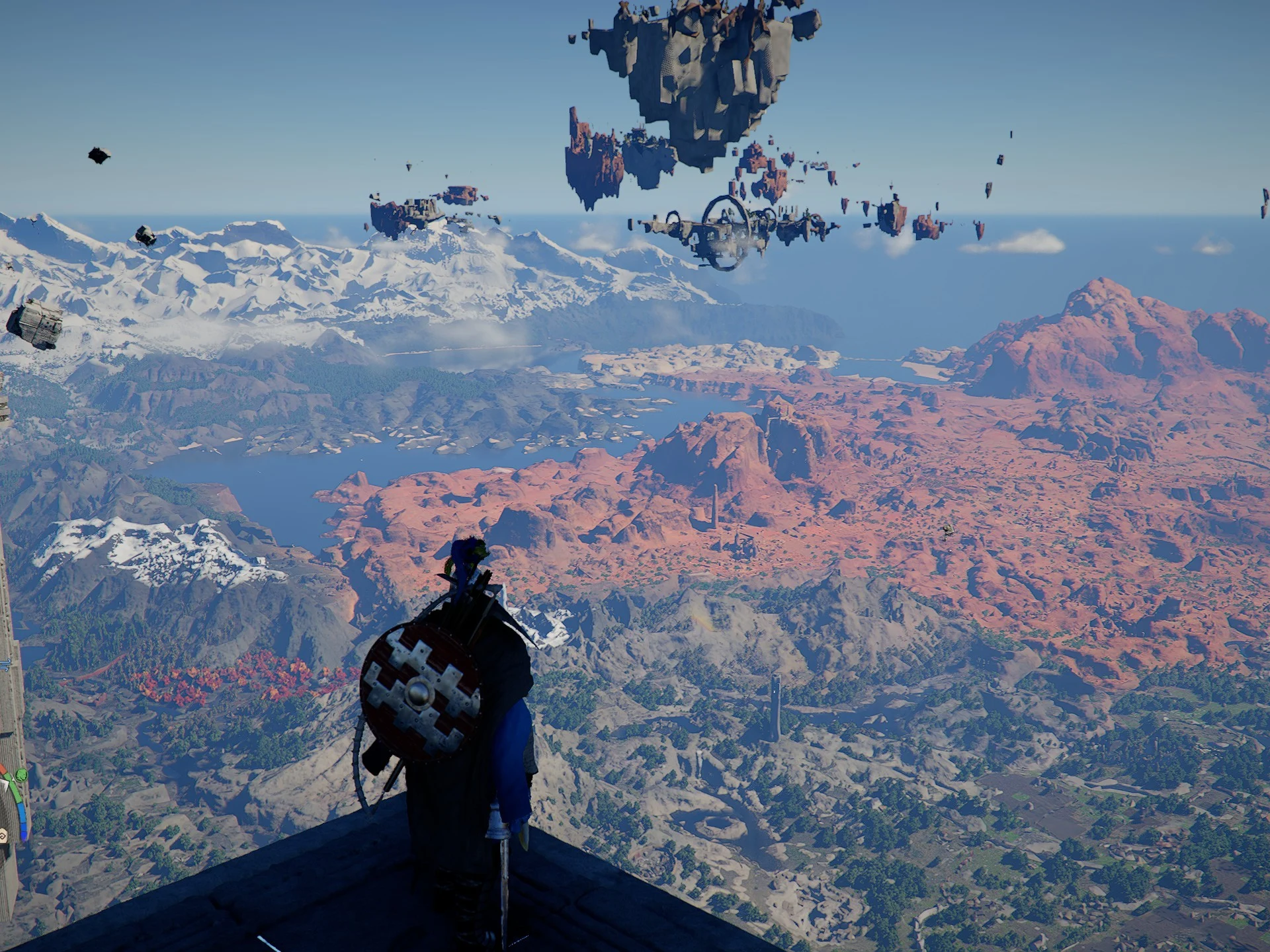
    On the systemic front, the game offers plenty of decision points. You can’t always settle conflicts peacefully, but you are free to pick how to handle combat situations. Expanding camps or taking control of other main characters is something you can do within specific limits, using a camera zoom similar to GTA V. As the game shows its inspiration, flying Abyss or wings, it echoes moments from Breath of the Wild and Tears of the Kingdom, emphasizing freedom and vertical exploration. It’s interesting how these elements, especially with wings and floating abilities, contribute to a more immersive experience, yet also highlight the game’s familiar design influences.

    Storytelling and Exploration

    While it’s understandable for games to follow a set story path, Crimson Desert as an action-adventure sometimes feels limited when the open world is inviting to explore but does not significantly influence the story. For instance, a quest involving a saddler wondering about how a saddle was received by a customer ends in a rather unremarkable fashion, with dialogue that could have been more meaningful. Despite the satisfaction shown by the customer, the ending feels somewhat hollow, missing an opportunity to add emotional weight or depth. Many quests suffer from similar repetitiveness, lacking meaningful engagement and emotional impact, which is unfortunate given the potential of such a vast world.

    Quest Design and Player Engagement

    • Repetitive quests aren’t all bad—they can be relaxing and help players learn about the game world.
    • However, Crimson Desert seems to waste some of the player’s time, especially compared to modern online RPGs that manage to keep presentation quality high even during simple tasks.
    • Even with its flaws, the game’s exploration remains a standout, offering visually stunning landscapes and atmospheric cities.

    Gameplay Depth and Combat

    In terms of gameplay, Crimson Desert provides both breadth and depth—particularly with its combat system and tough boss fights. When things get too hard, players can level up or upgrade their gear, similar to Dark Souls or Elden Ring, where preparing meals for health regeneration adds a strategic touch. Preparing these meals is animated, with Kliff presenting the finished dish, which is a nice detail. But navigating menus and watching animations for every meal can become tedious, gradually shifting from engaging to frustrating as the game progresses. Such shifts are indicative of how modern games sometimes struggle to maintain player enjoyment during repetitive tasks.

    Reflection on Gaming Preferences

    Back in my teenage years, Crimson Desert would probably have felt more exciting and immersive than it does today. That’s the reality of changing priorities and the growth of alternative entertainment. The phrase “It’s not you, it’s me,” feels fitting—it’s about how our relationship with games and time itself evolves. Crimson Desert isn’t terrible; there are moments where it genuinely shines, offering a complex, expansive experience. Nevertheless, it’s also a reminder of how modern game design can sometimes be more about quantity than quality—full of hype, patches, and updates that shift difficulty levels unexpectedly. That is the gaming landscape of 2026—sometimes under the early access or ongoing development model, which means patience and updates are the norm rather than the exception.

    Final Thoughts

    While Crimson Desert may not be perfect, it undeniably stands out for its scale and scope. It’s a game that, despite some shallow moments, offers a mixture of compelling combat, exploration, and beautiful environments. Like many modern titles, it’s a reflection of a broader industry in flux—constantly evolving, sometimes overhyped, but still capable of delivering memorable experiences for players willing to look past its flaws.



    Sources

    • Crimson Desert PS5 Patch Boosts Performance with FSR Upscaling

      Crimson Desert PS5 Patch Boosts Performance with FSR Upscaling

      Key Takeaway

      1. The 1.01.00 update introduced a fixed 4K toggle in performance mode, improving visuals on PS5.
      2. FSR upscaling contributed significantly to sharper images, pleasing many players despite some frame rate compromises.
      3. The update also reduced load times and addressed critical bugs, enhancing overall game stability and performance.
      4. While players appreciate the visual improvements, some express concerns about potential frame rate drops to around 40fps with 4K enabled.

      Improved Visuals on PS5 After Last Update

      After the release of Crimson Desert, many console players, specifically those on PS5, had issues with blurry visuals. The performance mode, which was meant to give higher frames, ended up delivering subpar graphics. But fans started noticing a shift after the recent patch, which made things look better.

      Patch 1.01.00 Details

      In the new update, Pearl Abyss added a very useful fix. They included a toggle to force 4K resolution in performance mode, which helps games look sharper on even basic TVs and monitors. The big boost probably comes from the use of FSR upscaling, which many Reddit users are praising. This gives players the chance to enjoy a more detailed vision of the game without sacrificing too much on frame rate.

      Player Reactions & Community Feedback

      Gamers on Reddit are talking about the update’s impact, with some calling it “incredible.” Users like 68WhiskeyAR mentioned they are “blown away how smooth and consistent” the gameplay now feels after just one update. Many who value more fluid action feel the visuals are now much sharper, making gameplay more enjoyable.

      Some Drawbacks Still Persist

      Not every player is entirely happy about the changes. Although performance mode on PS5 looks better with 4K enabled, there are some downsides. Frame rates tend to dip to around 40fps when reaching that resolution, which is similar to the balanced setting. Still, despite these issues, most gamers are quite satisfied with the improved visuals and stability from the update.

      Other Fixes & Game Performance Enhancements

      The patch isn’t just for visuals — it also brought a lot of other improvements. There are shorter load times across different platforms, making the game more enjoyable. Developers managed to fix critical bugs, like the map crash problem that was causing trouble on PlayStation consoles. Overall, the game’s momentum has grown, especially on PC where peak Steam players have increased significantly.

      Game State & Future Prospects

      Before its launch, it was suspected that Pearl Abyss might have kept some Crimson Desert footage under wraps. The game, initially, didn’t seem fully ready, which was a concern. But now, even without certain features like PSSR upscaling on the PS5 Pro, the standard version has improved visuals that come closer to what was expected. Fans are hopeful for further updates and refinements.

      Sources
    • Apple Launches Business Platform for Device and App Management

      Apple Launches Business Platform for Device and App Management

      Key Takeaway

      1. Apple Business is a centralized platform for managing Apple devices, apps, and support in organizations.
      2. The platform aims to simplify device management across companies of all sizes by consolidating tools and services.
      3. Apple is positioning Apple Business as a unified, easier-to-understand solution to support and deploy Apple products in workplace environments.

      Introduction to Apple Business

      Apple has launched a new service called Apple Business which is meant to help corporations manage Apple gadgets, apps, and support through one unified platform. This service is described as an all-in-one hub designed to streamline managing Apple devices for all types of businesses, big or small. The idea is to replace the need for juggling multiple systems for hardware, software, and support with a single, centralized tool.

      Benefits for Companies

      Targeted at companies who use Apple products in their daily tasks, Apple Business simplifies how they oversee these devices. The platform combines key aspects such as device administration, application access, and end-user support into one easy-to-use solution. This makes it easier for organizations to keep track of and support their Apple ecosystems without jumping between different platforms.

      Broader Market Reach

      • Unlike traditional management systems aimed mainly at large enterprises, Apple is reaching out to smaller businesses as well.
      • It aims for a broader scope by offering a simplified management layer for companies of any size who rely on Apple hardware.
      • This moves Apple to a more visible position in the workspace market, emphasizing its tools beyond just consumer use.

      Strategic Movement

      Historically, Apple has sold hardware to workplaces, but now with Apple Business, that presence is more directly integrated as a company service. Instead of focusing only on individual devices, this new platform delivers a cohesive environment for business management and support, helping organizations better understand and deploy Apple assets.

      Missing Details & Future Plans

      While Apple’s initial announcement highlights the platform’s purpose and core benefits—device management, app handling, and support—specific details like pricing or technical features are not provided yet. These aspects will be crucial for IT teams who want to see how it matches their existing systems and workflows.

      Conclusion

      Overall, Apple’s move to present its workplace services under a unified business platform signifies a strategic shift. It consolidates parts of its ecosystem into a single point for company management, focusing on making this solution easier to understand and adopt for organizations expanding their use of Apple hardware and software.

      Sources
    • Oppo Watch X3 Mini in Three Stylish Colors Revealed

      Oppo Watch X3 Mini in Three Stylish Colors Revealed

      Key Takeaway

      1. The Oppo Watch X3 Mini will be available in three colors: High-gloss Gold, Mocha Brown, and Starlight Silver, with interchangeable 18mm straps.
      2. The smartwatch appears to target women, featuring functions like Menstrual Cycle Exercise Guidance based on hormonal levels.
      3. It is scheduled for release in April, alongside other Oppo products like the Oppo Ear Clips and Oppo K15 Pro.

      Introduction of the Oppo Watch X3 Mini

      Recently, a leak showed us the design of the Oppo Watch X3 Mini, and now Oppo itself has shared official images of this device. The photos not only give us a clearer look at the small size of this smartwatch but also show us the variety of colors it will come in.

      Color Options and Design

      According to the images shared on Weibo, the Oppo Watch X3 Mini will be available in three different colors. This is a step up from the Oppo Watch X2 Mini, which was only released in two colors. The new smartwatch will feature High-gloss Gold, Mocha Brown, and Starlight Silver, each with distinctly different straps. All straps are 18mm quick-release types, so they can easily swapped with either original or third-party bands.

      Target Audience and Feature Highlights

      For those who prefer a smaller smartwatch, the Oppo Watch X3 Mini should meet your needs. Oppo seems to target women in particular with this device. They even posted about a feature called Menstrual Cycle Exercise Guidance, which, according to translation, is designed to give exercise recommendations based on hormonal levels.

      Features and Special Functions

      • The watch will suggest exercises tailored to hormonal changes.
      • It includes access to fat-burning workouts shown by top fitness influencers.
      • This indicates a focus on health, fitness, and personalized guidance.

      Release Information and Additional Devices

      The Oppo Watch X3 Mini is set to be released in April. Besides this smartwatch, Oppo is also planning to launch other products such as the Oppo Ear Clips and the Oppo K15 Pro. Fans of the brand can expect a busy year ahead with new tech and accessories.

      Sources
    • GitHub’s 2026 Actions Security Roadmap Overview

      GitHub’s 2026 Actions Security Roadmap Overview

      Key Takeaway

      1. Focus on enhancing default security, policy controls, and visibility within GitHub Actions to strengthen software supply chain security.
      2. Emphasis on centralized governance features to enable organizations to enforce usage policies across repositories and teams.
      3. Broader platform security approach, extending beyond just runners and secrets, to include defaults, oversight, and operational transparency.
      4. The roadmap is directional, prioritizing strategic improvements with gradual implementation rather than immediate product releases.

      GitHub’s 2026 Roadmap For Making Actions Safer

      GitHub, in its latest shared roadmap, discussed plans for the year 2026 targeted at making GitHub Actions more secure. They focus on making default settings safer, improving policy controls, and giving better insight into continuous integration and deployment (CI/CD) sites. This just isn’t about adding one new feature but rather strengthening their whole platform’s security, especially related to the software supply chain. The aim is to create a more locked-down experience, with a strong push on security-by-default and more tools for organizations to manage workflows, runners, and dependencies more effectively at higher scales.

      Shift Towards More Secure Development Processes

      Since GitHub Actions plays such a crucial role in many teams’ development processes, these security updates will impact how developers build, test, and deploy their code. The plan hints at reducing common vulnerabilities by tightening controls and offering organizations more centralized policies, helping prevent human error or malicious activities. They want to make sure each step in the automation pipeline is more safeguarded against attack and accidental misconfigurations.

      Policy and Visibility Improvements

      One of the major focus areas is policy enhancement. GitHub states they are developing stronger governance features enabling teams to clearly define rules around how Actions are used across different repositories and entire organizations. These controls are especially helpful in larger environments where total risk management is complex but crucial. Additionally, observability within CI/CD processes is being improved, giving teams better tools and insights to watch over what happens during automation, which is extremely vital given the increasing threats like supply chain hacks and credential abuse that have been in the news lately.

      Broader Platform Security Approach

      Instead of just limiting its concerns to runners or secrets, GitHub is framing Actions security as a part of a larger effort to secure the overall platform—covering defaults, oversight, and operational visibility. Although the upgrades are mainly conceptual at this time, they signify a strategic move towards more wary but productive workflows. The company is not providing specific product launch dates yet but rather indicating the priority areas for future development.

      Implications for Developers and Teams

      For developers and teams heavily using GitHub Actions, keeping an eye on this roadmap is recommended, as upcoming enhancements could influence how they configure their workflows, set organizational policies, or monitor activity. Even if the exact timelines and features aren’t set in stone, the overall direction suggests a future where security measures become more integrated and stricter, aligning with enterprise needs so that safer, more controlled development becomes the norm.

      Sources
    • CheckMag | Host Your Own LLM Without GPU for More Freedom

      CheckMag | Host Your Own LLM Without GPU for More Freedom

      Key Takeaway

      1. Hosting your own LLM ensures data privacy and control, avoiding handing over data to large tech companies.
      2. KoboldCPP is a user-friendly, versatile tool that supports running GGUF and GGML models on various platforms, including Windows, Linux, and Docker.
      3. Model selection, format, size, and hardware (CPU/GPU/RAM) significantly impact performance and speed, with lighter models running faster on less powerful hardware.

      What actually (what happens to your data when you ask an AI) is pretty much anyone’s guess, but whatever happen with it, it definitely isn’t yours anymore.

      Advantages of Hosting Your Own AI

      Along with image and video generation, if you’re interested in trying out Large Language Models (LLM), but don’t want to hand your data to big tech companies, hosting your own AI is surprisingly simple and offers some big advantages over the big corporations. For example, all the data you handle stay under your control, which is a big plus especially if you worried about privacy or sensitive info. Also, you get to choose from many models like Deepseek, Gemma2, or GPT-3, and you can use versions that won’t limit the types of questions you want to ask or the tasks you want to perform.

      Tools and Compatibility

      KoboldCPP is a user friendly, single-executable AI text-generation software that runs GGUF and GGML Large Language Models. It supports both GPU and CPU and can serve as a backend for AI storytelling or chat. You can get KoboldCPP from GitHub and it’s compatible with Windows, Linux, Mac, or even Docker containers.

      Setting Up and Accessing Models

      Hosting in a container makes it super easy to connect the LLM to all devices on your network. There are pre-made templates for major platforms including Unraid and TrueNAS, which makes setup easier. You can also install it on other systems; just remember to add firewal rules to secure your network. When choosing which model to use, Hugging Face is the best place to find models in GGUF format, which are necessary for compatibility. If you’re planning D&D simulations, picking an uncensored model is a smart move because censored models might refuse to generate content that involves harm or sensitive material.

      Model Performance and Selection

      Some models like Deepseek and Claude tend to “think” out loud, meaning they spill out their entire thought process for each query. Handy if you’ve got a powerful GPU, but very slow without one. Experimenting with different models will help you find what works best for your setup, with Gemma2 being a good starting point. Once you find the GGUF file URL on the model’s page, remember that larger models require more RAM, so choose accordingly.

      Installation Tips and Hardware Considerations

      Installing KoboldCPP on Windows is fairly straightforward. If you’re not using a GPU, ensure you download the NoCUDA version. The program might take some time to start, because it needs to download the model first—on Windows, this is easy to see, but on systems like Unraid or TrueNAS, you’ll need to check logs. You might need to increase your Docker container’s storage if your chosen model is large. KoboldCPP has four interface modes: instruct, story, chat, and adventure. Although it isn’t the fastest, the generated text is close to normal reading speed, which makes it suitable for gaming or storytelling scenarios, especially on a decent CPU like the AMD 5950x or newer models. More cores and RAM can dramatically improve speed and capacity for bigger models.

      Hardware Recommendations for Best Performance

      While using a GPU greatly improves AI performance and speeds up generation, you can still host an effective LLM with just decent hardware. If you aim to avoid the privacy issues of ChatGPT, Claude, or Gemini, and don’t want to shell out for top-tier hardware, this method still offers a good user experience. With the right setup, you can enjoy private, customizable AI models without needing high-end, expensive components.