
Key Takeaways
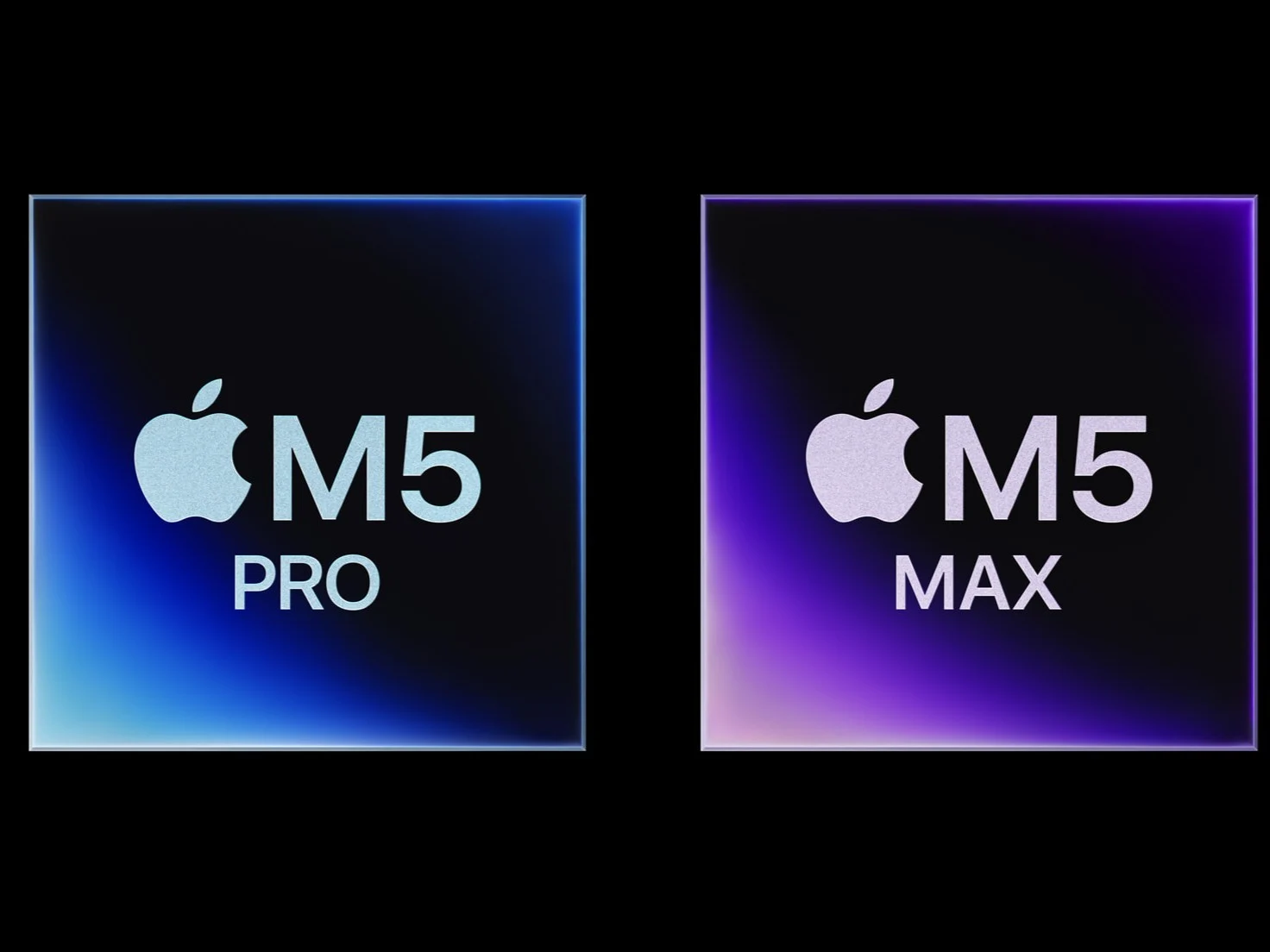
1. Apple launched the M5 Pro and M5 Max laptop chips, built using TSMC’s N3P process technology.
2. The M5 Pro features up to 18 CPU cores and a 20-core GPU, while the M5 Max has an 18-core CPU with options for 32-core or 40-core GPUs.
3. Both chips claim up to a 35% GPU performance boost over the M4 series, with the M5 Max outperforming the M4 Max by up to 20% in general applications.
4. The M5 Max supports up to 128GB of unified memory with a maximum bandwidth of 614GB/s.
5. The new chips include Thunderbolt 5.0 compatibility, hardware acceleration for various video codecs, and a 16-core NPU for AI tasks.
Apple has unveiled its latest top-tier laptop chips, the M5 Pro and M5 Max, after several months since the release of the standard M5 alongside the new iPad Pro model. The company has subtly indicated that both chips are built using TSMC’s N3P process technology. Interestingly, the M5 Pro and M5 Max integrate two N3P chiplets into one unified chip, a design approach we’ve encountered previously with Apple’s Ultra series. This also hints at the potential introduction of an M5 Ultra in the future.
M5 Pro Specifications
For the M5 Pro, users can expect up to 18 CPU cores, which includes 12 performance cores (previously called E-cores) and 6 super cores (formerly known as P-cores), complemented by a 20-core GPU. There’s also a lower-spec option featuring 15 CPU cores (10+5) and 16 GPU cores. The M5 Max guarantees an 18-core CPU, which can be paired with either a 32-core or a 40-core GPU. Overall, while there’s an increase in the number of CPU cores, the GPU specs remain largely unchanged on a physical level.
Performance Claims
Apple asserts that the M5 Pro and M5 Max deliver up to a 35% performance boost in GPU capabilities over the M4 Pro and M4 Max, particularly in applications utilizing ray tracing. In general-purpose applications, the M5 Max’s GPU reportedly outperforms the M4 Max by up to 20%. Furthermore, the M5 Max can now accommodate up to 128GB of unified memory, achieving a maximum memory bandwidth of 614GB/s.
Caution on Metrics
However, it’s important to note that these figures come directly from Apple, so it’s wise to wait for third-party evaluations before forming a conclusion. Apple is likely to maintain its lead in single-core performance, and the additional CPU cores may assist in closing the performance gap with AMD’s Strix Halo. Additionally, the Apple M5 Pro and M5 Max are compatible with Thunderbolt 5.0 ports and feature hardware-accelerated H.264/HEVC, AV1, and ProRes decoding and encoding engines. Apple has also integrated a 16-core NPU to handle AI-driven tasks.
Source:
Link
Leave a Reply