
Key Takeaways
1. A new moon has been discovered orbiting Uranus, increasing the total number of known moons to 29.
2. The newly found moon is small, with an estimated diameter of 6 miles (10 kilometers), likely missed by Voyager 2 in 1986.
3. The moon orbits about 35,000 miles (56,500 km) from Uranus, making it the 14th small inner moon recognized around the planet.
4. Uranus is unique for having many small inner moons, indicating a complex and turbulent history.
5. The discovery highlights the advanced capabilities of the James Webb Space Telescope in detecting faint celestial objects, with formal naming pending approval from the International Astronomical Union.
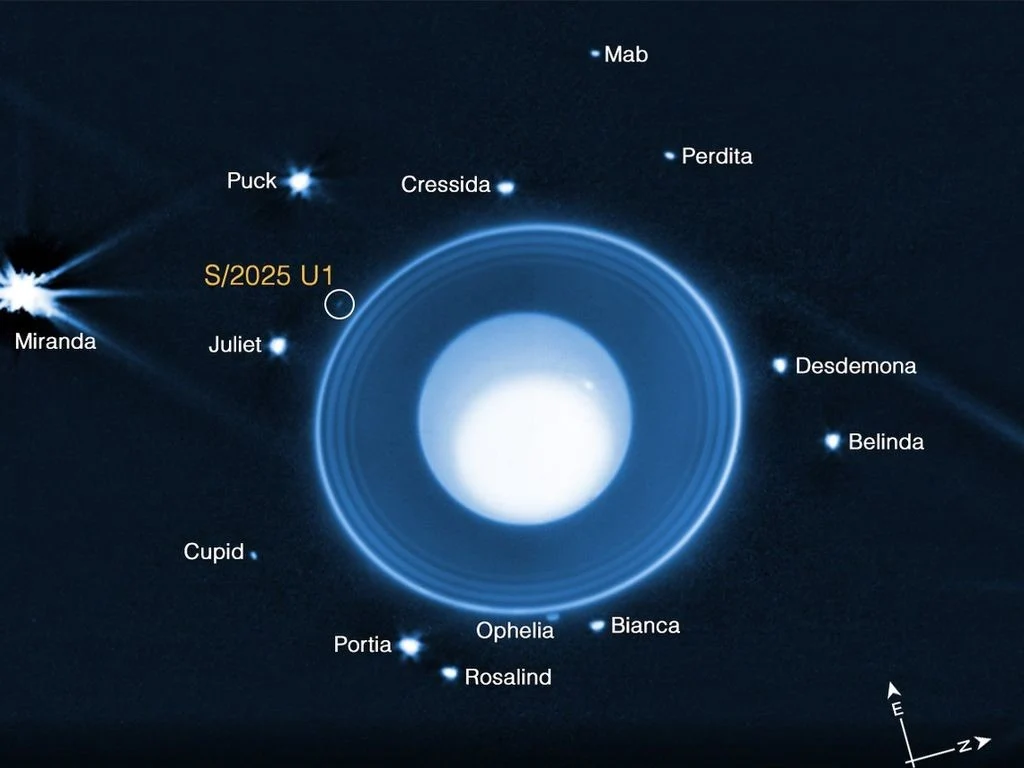
A team of astronomers has found a small new moon orbiting Uranus by looking at data from NASA’s James Webb Space Telescope. This finding—achieved by studying a set of long-exposure images taken on February 2, 2025—brings the total number of known moons orbiting Uranus to 29, making Earth seem a bit unlucky.
Size and Discovery
This newly discovered moon has an estimated diameter of just 6 miles (10 kilometers), which makes it quite small. Lead scientist Maryame El Moutamid believes its tiny size is probably why it wasn’t detected by Voyager 2 during its flyby of Uranus in 1986. However, that’s not the only thing the spacecraft overlooked; it has recently been found that Uranus emits more heat than it takes in from the sun, which alters prior scientific understanding.
Orbital Details
The new moon is the 14th recognized member of the ice giant’s group of small inner moons. It orbits approximately 35,000 miles (56,500 km) away from the planet’s center, situated between the orbits of Bianca and Ophelia.
According to Matthew Tiscareno from the SETI Institute, no other planet has as many small inner moons as Uranus, and the elaborate interactions among them and the rings suggest a turbulent past.
Future Considerations
The researchers point out that the data comes from “Webb science in progress” and hasn’t yet undergone peer review. A formal naming of the moon will require approval from the International Astronomical Union. This discovery highlights the capabilities of Webb’s infrared sensitivity, which enables it to spot faint objects that previous telescopes could not, extending the boundaries of space exploration beyond what missions like Voyager 2 achieved.
Source:
Link
Leave a Reply