
Key Takeaways
1. Steve Mould partnered with NASA astronaut Don Pettit to explore the chain fountain effect in zero gravity on the ISS.
2. The chain fountain effect occurs when a chain of beads is pulled from a cup, creating an upward force that defies classical mechanics.
3. The experiment faced challenges in zero gravity, leading Mould and Pettit to arrange the chain into a closed loop for smoother movement.
4. The results confirmed Mould’s theory, showing the chain flowed through its loop as expected while maintaining its shape in weightlessness.
5. The project was a personal milestone for Mould, who fulfilled his childhood dream of doing science with an astronaut.
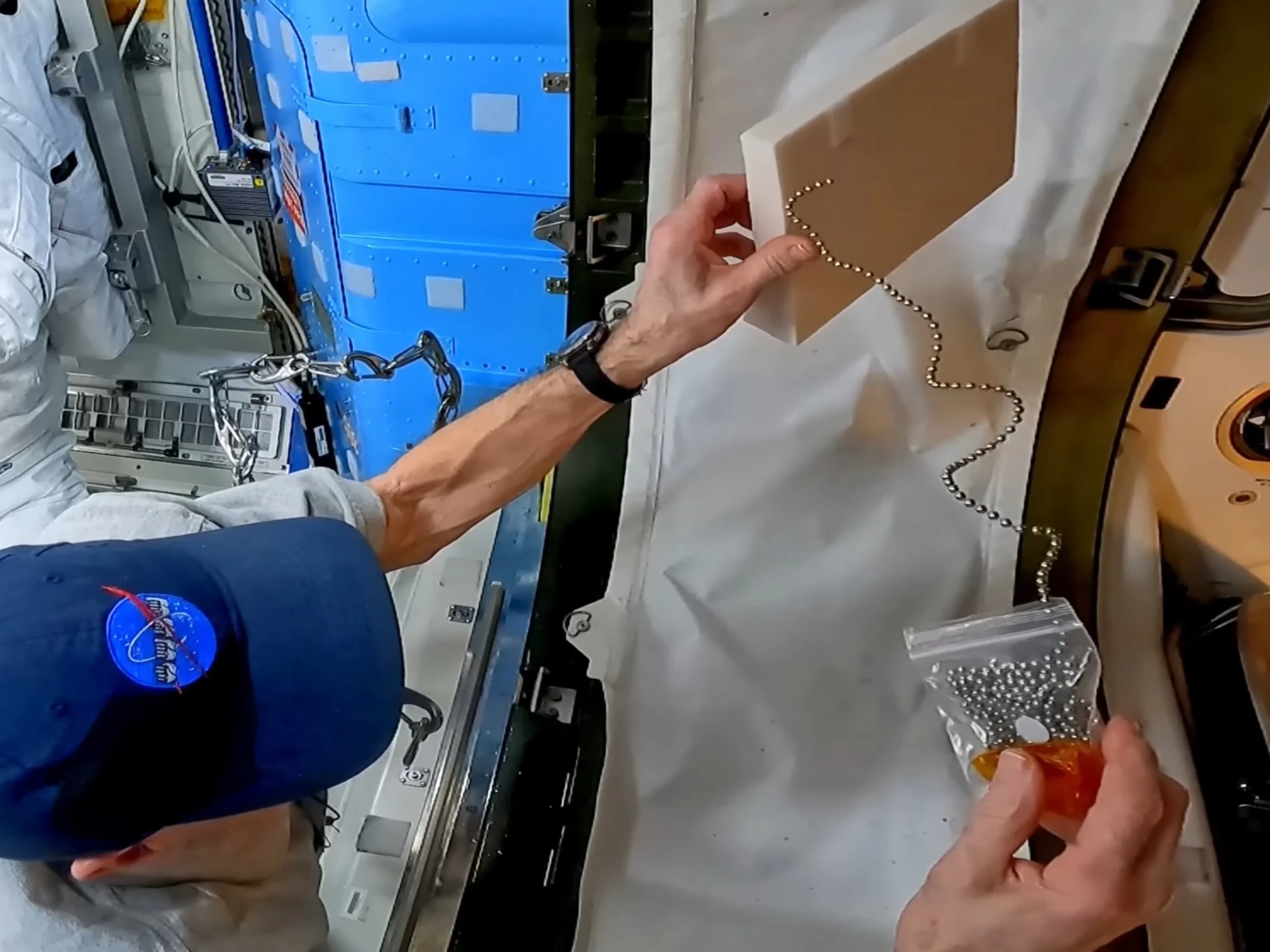
British science communicator Steve Mould, who is one of the top science YouTubers with 3.44 million subscribers, has partnered with NASA astronaut Don Pettit on the International Space Station (ISS) to explore the chain fountain effect in a zero-gravity setting for the very first time.
Discovery of the Chain Fountain Effect
Mould stumbled upon this phenomenon nearly a decade ago: when a chain of beads is pulled out of a cup, it briefly lifts above the rim before dropping down – an occurrence that seemed to go against classical mechanics at first. Later, he showed that the impact of the chain links against the edge of the container creates an extra upward force – a discovery that has been validated by physical models since then.
The Experiment in Space
Through the European Space Agency (ESA), Mould connected with astronaut Samantha Cristoforetti, who took a four-meter chain to the ISS. Since she had limited time for experiments, she handed the project over to NASA astronaut Don Pettit, who performed the experiment under Mould’s supervision via a Microsoft Teams call.
In the weightlessness of space, it quickly became apparent that setting up the experiment was nearly impossible without chaos. The chain moved in an unpredictable way, acting almost like molecules. In zero gravity, objects continue to move forever since there’s no energy loss. After a few unsuccessful tries, Mould and Pettit opted to arrange the chain into a closed loop, which allowed for smoother movement without tangling.
Surprising Results
What they found was unexpected: the chain “flowed” through its own loop precisely as Mould’s theory suggested. Initially, the loop kept a more angular form, but gradually smoothed out over time due to friction between the links and slight air movements. Ultimately, Mould determined that the experiment proved his theory correct – a chain in zero-gravity holds its shape as long as it moves steadily and is free from outside forces.
The feedback on the video has been extremely positive. Viewers commended Mould’s enthusiasm and Pettit’s childlike wonder, while also making jokes about using Microsoft Teams in space (“Even in space, you can’t escape Teams”). For Steve Mould, this project was a personal achievement: “I wanted to be an astronaut when I was young – and now I’m doing science with one.”
Source:
Link

Leave a Reply