Tag: Wi-Fi 7

  • Huawei’s New Wi-Fi 7 Mesh Router: Stylish Design Meets Performance

    Huawei’s New Wi-Fi 7 Mesh Router: Stylish Design Meets Performance

    Key Takeaways

    1. Huawei launched the X3 Pro router with a unique design featuring a see-through cone and a model of a fictional mountain peak.
    2. The router includes Wi-Fi 7 connectivity but lacks visual indicators for connectivity status, unlike some competitors.
    3. The X3 Pro supports a mesh network with smaller satellites, offering peak transfer speeds of 3570 Mbps over a 6 GHz band.
    4. It has three Gigabit Ethernet ports, two of which support 2.5 Gbit/s, and includes PowerLAN support for using existing wiring.
    5. The X3 Pro is priced at CNY 1,299 in China, with bundles and satellites available, but international availability is not yet announced.


    Huawei has officially launched its beautifully crafted X3 Pro router after giving a sneak peek last month. This router was released alongside premium devices such as the Mate X7, MatePad Edge, Mate 80 Pro Max, and the new Watch Ultimate Design. The X3 Pro stands out visually compared to many modern routers, featuring a see-through cone that houses a model of a fictional mountain peak.

    Functional Design

    The design serves a purpose beyond aesthetics. Huawei cleverly uses the mountain model to conceal several antennas. Additionally, the integrated lighting allows the router’s appearance to shift between cool and warm tones. However, unlike the Netgear Orbi range, which includes models like the Orbi 770 that visually indicate connectivity status, the X3 Pro does not have this capability, even though it offers Wi-Fi 7 connectivity (currently priced at $699 on Amazon).

    Network Capabilities

    In addition to the main router, Huawei has developed smaller satellite units that help create a mesh network, boasting theoretical peak transfer speeds of 3570 Mbps over a 6 GHz band. The X3 Pro is also equipped with three Gigabit Ethernet ports, two of which support the 2.5 Gbit/s standard. Furthermore, Huawei has incorporated PowerLAN support, enabling the X3 Pro and its satellites to extend using the existing wiring in a home or apartment instead of relying solely on a wireless connection.

    Pricing and Availability

    In China, the X3 Pro is priced at CNY 1,299 (approximately $184), while a bundle containing the router and a satellite costs CNY 1,999 (around $282). Each individual satellite is available for CNY 799 (about $113). However, Huawei has not yet revealed any plans to distribute the X3 Pro outside of China.

    Source:
    Link


  • Apple’s N1 Chip Boosts iPhone 17’s Network Performance vs. Android

    Apple’s N1 Chip Boosts iPhone 17’s Network Performance vs. Android

    Key Takeaways

    1. The iPhone 17 features Apple’s new N1 networking chip, supporting Wi-Fi 7 and Bluetooth 6, resulting in a nearly 40% performance increase over the iPhone 16.
    2. In global median download speeds, Google’s Pixel 10 led at 335.35 Mbps, followed closely by the iPhone 17 at 329.56 Mbps, with the iPhone outperforming the Pixel in less favorable conditions.
    3. In North America, the iPhone 17 achieved a top speed of 416.14 Mbps, surpassing the Pixel 10 Pro and Samsung Galaxy S25.
    4. The iPhone 17 demonstrated the best 10th-percentile download speed at 56.08 Mbps, indicating reliable performance in challenging Wi-Fi 7 environments.
    5. North America had the highest Wi-Fi 7 user distribution at 20.62%, significantly leading other regions like Northeast Asia and Europe.


    A fresh analysis from Ookla, a company known for network diagnostics and the Speedtest app, looked into the network performance of Apple’s iPhone 17 in comparison to the latest Android flagship devices. The tests focused on Apple’s new N1 networking chip against rival chips from Qualcomm, Broadcom, and MediaTek.

    N1 Networking Chip Features

    The N1 chip marks Apple’s initial venture into custom networking technology, featured in the iPhone 17 series, and it supports Wi-Fi 7 and Bluetooth 6. According to the final results derived from crowdsourced data from Speedtest, the iPhone 17 saw almost a 40% increase in performance when stacked against the iPhone 16, which relied on a Broadcom chip.

    Download Speeds Compared

    Google’s Pixel 10 achieved the top median download speed worldwide at 335.35 Mbps, slightly ahead of the iPhone 17’s 329.56 Mbps. In the least favorable conditions, the iPhone 17 outperformed with a speed of 56.08 Mbps, whereas the Pixel 10 reached a maximum of 53.25 Mbps.

    In the North American region, the iPhone 17 showcased speeds reaching up to 416.14 Mbps, while the Pixel 10 Pro came in at 411.21 Mbps, and the Samsung Galaxy S25 settled at 323.69 Mbps.

    Consistency and Performance

    Apple’s latest model also boasted the best 10th-percentile download speed at 56.08 Mbps, proving to be a reliable option even under less-than-ideal Wi-Fi 7 circumstances.

    The report highlighted that the N1 chip’s limitation of a 160 MHz channel width, as opposed to the 320 MHz capacity of Wi-Fi 7, hasn’t yet hindered actual performance in practical terms. The iPhone 17 exhibited the highest 90th percentile speeds across all devices in North America, hitting up to 976.39 Mbps, while the Pixel 10 reached 932.19 Mbps and Samsung’s Galaxy S25 recorded 815.19 Mbps.

    Wi-Fi 7 User Distribution

    In terms of Wi-Fi 7 users, North America led the way with 20.62% of the study’s participants, followed by Northeast Asia at 5.38%, Europe at 4.95%, Southeast Asia at 2.95%, and the Gulf region at 1.73%.

    Ookla’s analysis provides valuable insights into the performance of the iPhone 17 and its networking capabilities against leading competitors in the market.

    Source:
    Link


  • Asus ROG Rapture GT-BE19000AI Router: AI Processor & 32GB Storage

    Asus ROG Rapture GT-BE19000AI Router: AI Processor & 32GB Storage

    Key Takeaways

    1. Asus has launched the ROG Rapture GT-BE19000AI, the world’s first AI-driven Wi-Fi 7 router.
    2. The router features a quad-core CPU at 2.6 GHz, 4 GB RAM, and a dedicated AI processor with its own 4 GB RAM.
    3. Advanced capabilities include running applications like Home Assistant and a Private Edge AI chatbot for troubleshooting.
    4. The router can reduce gaming latency by up to 34% and achieves wireless speeds up to 19 Gbps.
    5. Wired connections include two 10 GbE ports and four 2.5G LAN ports, with a total possible wired speed of 31 Gbps.


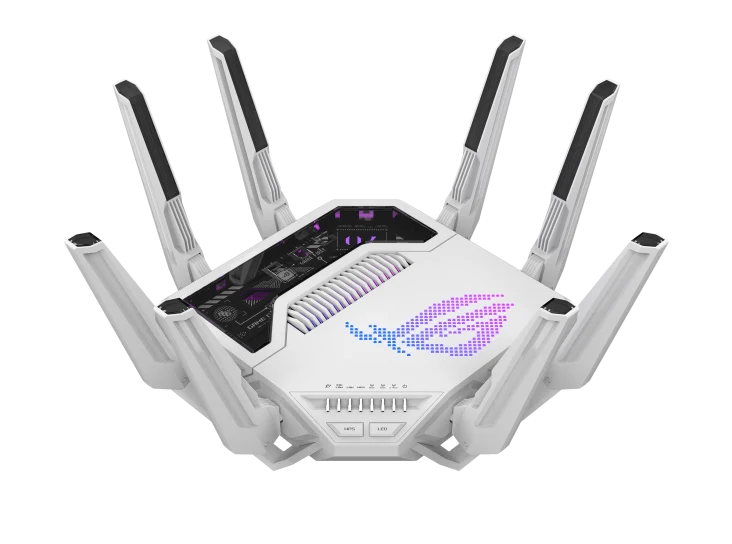
    AI continues to be a major attraction for device manufacturers, which explains their tendency to include AI features in nearly every product imaginable. If you’re looking for a router that uses AI to optimize latency, simplify network access, and maintain top-notch performance, Asus has introduced the ROG Rapture GT-BE19000AI, marking it as the first AI-driven Wi-Fi 7 router in the world.

    Specifications and Performance

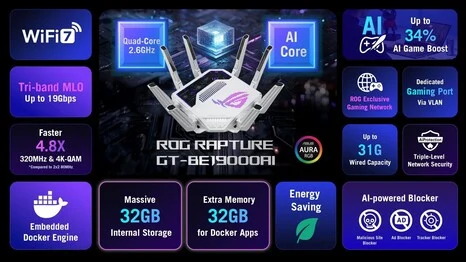
    This router is powered by a quad-core CPU operating at 2.6 GHz, backed by 4 GB of RAM and 32 GB flash storage. It also has a dedicated AI processor with four cores clocked at 2.1 GHz and a 7.9 TOPS NPU, featuring an extra 4 GB of RAM and another 32 GB of flash storage. This setup allows AI functionalities to operate independently from the main tasks, ensuring smooth performance.

    Advanced Features

    The separate AI processor allows for the incorporation of a Docker Engine, enabling users to run applications such as Home Assistant for smart home control or Frigate for AI-driven video recognition. Many additional applications are compatible and can run directly on the router, allowing users to manage various IoT devices effortlessly over a broader coverage area.

    Another innovative feature is the Private Edge AI chatbot assistant. This tool assists users in troubleshooting common problems and executing quick control functions. Moreover, the AI Enhancement suite provides automatic options to enhance Wi-Fi stability, gaming latency, energy efficiency, and device management, which helps create a faster and more reliable online experience.

    Gaming Capabilities

    When it comes to gaming, the ROG Rapture GT-BE19000AI can minimize latency by as much as 34% through features like GTNet and Adaptive QoE. These functionalities continuously monitor network traffic and adjust priorities on the fly, ensuring the quickest routes are taken in real time.

    With the latest Wi-Fi 7 technology, this router can achieve wireless speeds of up to 19 Gbps. In terms of wired connections, there are two 10 GbE ports and four additional 2.5G LAN ports. One of the 10G ports can serve as a dedicated gaming connection, which can be set up with minimal configuration. For even higher wired speeds, two Ethernet ports can be bonded to create a single logical link, providing a combined bandwidth of 20 Gbps. The total wired speeds can reach an impressive 31 Gbps.

    Source:
    Link


  • TP-Link BE3600 Travel Router Connects 90 Devices to Wi-Fi 7

    TP-Link BE3600 Travel Router Connects 90 Devices to Wi-Fi 7

    Key Takeaways

    1. Wi-Fi 7 Support: The TL-WR1502X router supports Wi-Fi 7, achieving combined bandwidths of up to 3.6 Gbps on 2.4 GHz and 5 GHz channels.

    2. High Device Capacity: It can support up to 90 wireless devices simultaneously.

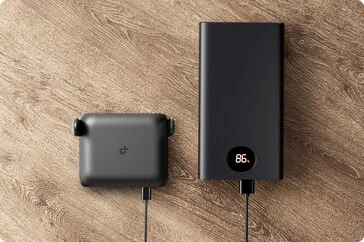
    3. Portable Power Options: The router can be powered via USB-C, a power bank, and has a USB-A port for data transfer and internet access.

    4. Simplified Connectivity: Users can connect all devices ahead of time and easily connect to public networks without setting up each device individually.

    5. VPN Compatibility: The router supports OpenVPN and WireGuard, compatible with over 35 VPN services, and includes a USB port for sharing external hard drives across the network.


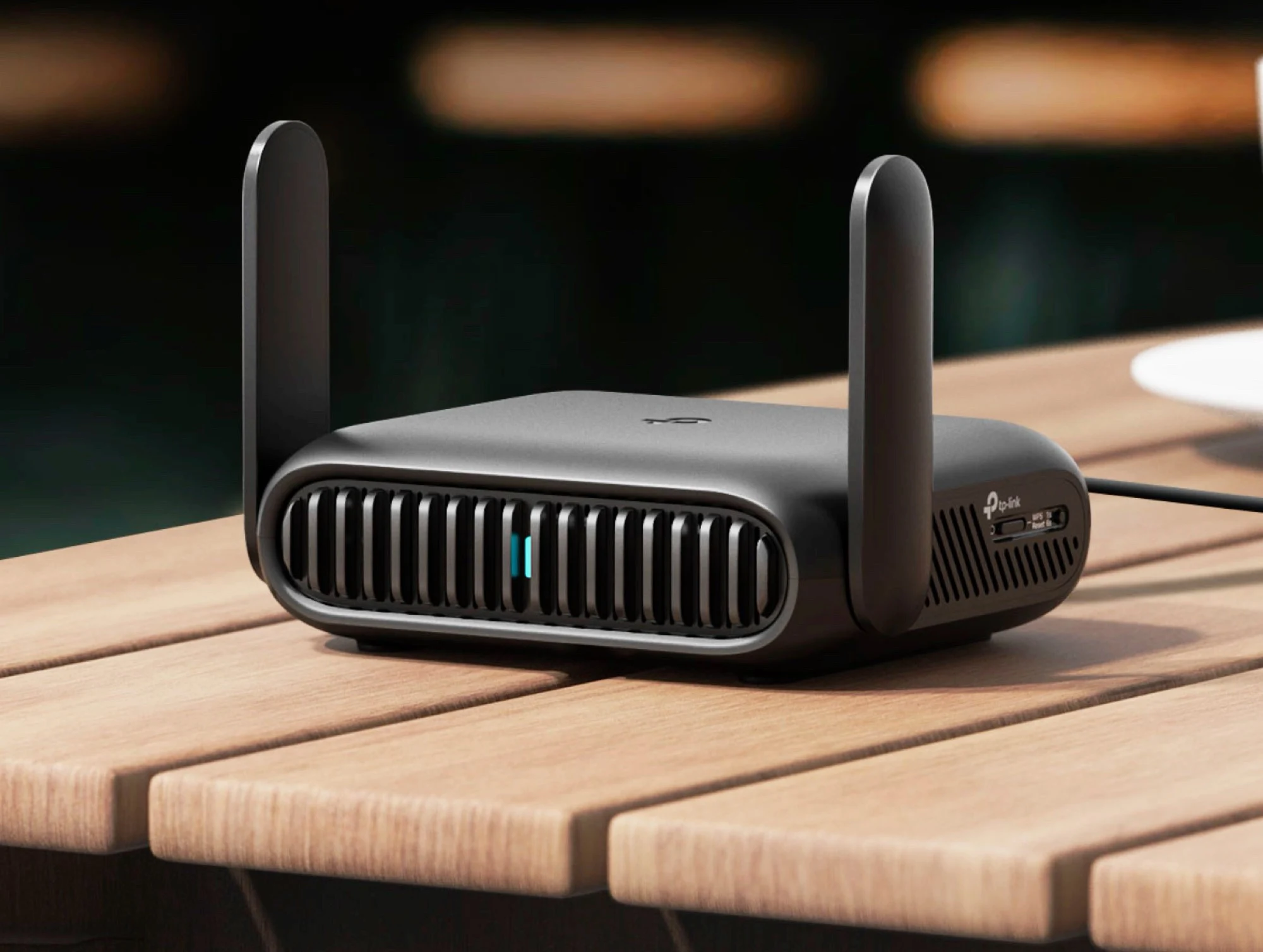
    TP-Link is adding a new powerful and portable Wi-Fi router to its lineup, the TL-WR1502X, which now includes support for Wi-Fi 7. This new feature enables it to achieve combined bandwidths of up to 3.6 Gbps when utilizing both the 2.4 GHz and 5 GHz channels. According to the company, this router can support as many as 90 wireless devices at once.

    Portable Power Options

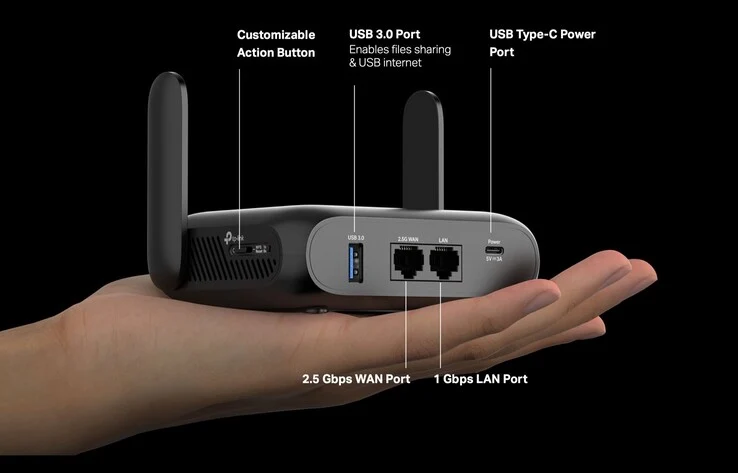
    For travelers, the router can be easily powered through a USB-C connection or by using a power bank. There’s also a USB-A port that supports data transfer speeds of up to 5 Gbps, allowing users to connect a 5G modem or a compatible smartphone for internet access. Additionally, users can plug into a 2.5 Gbps Ethernet port. As is common with TP-Link products, users can link the router to an existing Wi-Fi network through a dedicated smartphone application.

    Simplified Connectivity

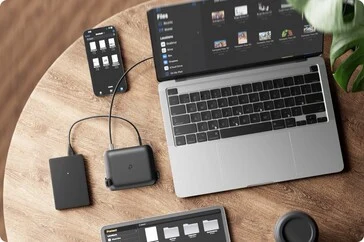
    This feature is particularly handy for connecting all devices to the router’s Wi-Fi ahead of time, which means you only need to connect the router to a public network when you arrive at places like airports or hotels, instead of setting up each device separately. The router also supports OpenVPN and WireGuard, making it compatible with over 35 VPN services. Plus, the USB port provides an option to share an external hard drive across the network.

    The TP-Link Wi-Fi 7 BE3600 Travel Router (TL-WR3602BE) is currently available in the United States for a price of $139.99. Details regarding its release in other countries are still to be announced. More information can be found on the official product page of TP-Link.

    Source:
    Link


  • Next-Gen Apple TV 4K Launching This Year with Major Upgrades

    Next-Gen Apple TV 4K Launching This Year with Major Upgrades

    Key Takeaways

    1. The latest Apple TV 4K model was released in October 2022, featuring the Apple A15 Bionic chip, 4 GB of RAM, and up to 128 GB of storage.
    2. A new version of the Apple TV 4K is expected to be unveiled before the end of 2025, with significant enhancements.
    3. The upcoming model may include Apple’s own Wi-Fi and Bluetooth chip supporting Wi-Fi 7, improving streaming performance and picture quality.
    4. A new processing unit, potentially a scaled-down version of the Apple A18 or A19 chip, is anticipated to enhance gaming performance and reduce power usage.
    5. The next Apple TV could be priced lower to compete better in a crowded market.


    The most recent model of the Apple TV 4K was released in October 2022. It is powered by the Apple A15 Bionic chip, comes with 4 GB of RAM, and offers up to 128 GB of flash storage. This device continues to be one of the most capable set-top boxes available today. However, there are expectations that Apple will soon unveil a new version with several notable enhancements. According to information from a supposedly trustworthy source, MacRumors indicates that the next-gen Apple TV 4K might arrive before the close of 2025.

    Notable Innovations Ahead

    The upcoming model is set to introduce two primary upgrades. To begin with, Apple is likely to incorporate its own Wi-Fi and Bluetooth chip for the first time, which will support Wi-Fi 7. This represents a major advancement over the current version that is restricted to Wi-Fi 6. This change should enhance the performance of streaming applications and allow for lower latency and improved picture quality, especially when utilizing a TV as a wireless monitor through AirPlay. Additionally, a new processing unit is anticipated, with Apple expected to use a scaled-down variant of the Apple A18 from the iPhone 16 or possibly the new Apple A19 from the iPhone 17.

    Enhanced Performance and Competitive Pricing

    The newer chip is likely to lead to reduced power usage and might introduce new functionalities. It should also significantly improve gaming performance, although the Apple TV still has a fairly limited assortment of games and offers minimal support for game streaming services. Lastly, the next version of the Apple TV could come at a lower price point, as Apple is reportedly looking to be more competitive with pricing in a market that is quite intense.

    Source:
    Link


  • Xiaomi BE3600 Router: Affordable Wi-Fi 7 Now in Europe

    Xiaomi BE3600 Router: Affordable Wi-Fi 7 Now in Europe

    Key Takeaways

    1. Wi-Fi 7 Support: The Xiaomi Router BE3600 features Wi-Fi 7, offering speeds up to 3,600 Mbps and improved throughput compared to Wi-Fi 6.

    2. Powerful Hardware: It includes a Qualcomm Wi-Fi 7 quad-core processor, 4K QAM technology, and supports connections for up to 128 devices.

    3. Easy Mesh Networking: The router allows for simple setup of mesh networks, connecting up to 10 routers simultaneously, and can be managed via the Xiaomi Home app.

    4. Affordable Pricing: The Xiaomi Router BE3600 is priced at €64.99/PLN 299 in select European countries, making it a budget-friendly option.

    5. Enhanced Gaming Features: It offers exclusive acceleration for Xiaomi and Redmi smartphones, reducing lag and latency for online gaming experiences.


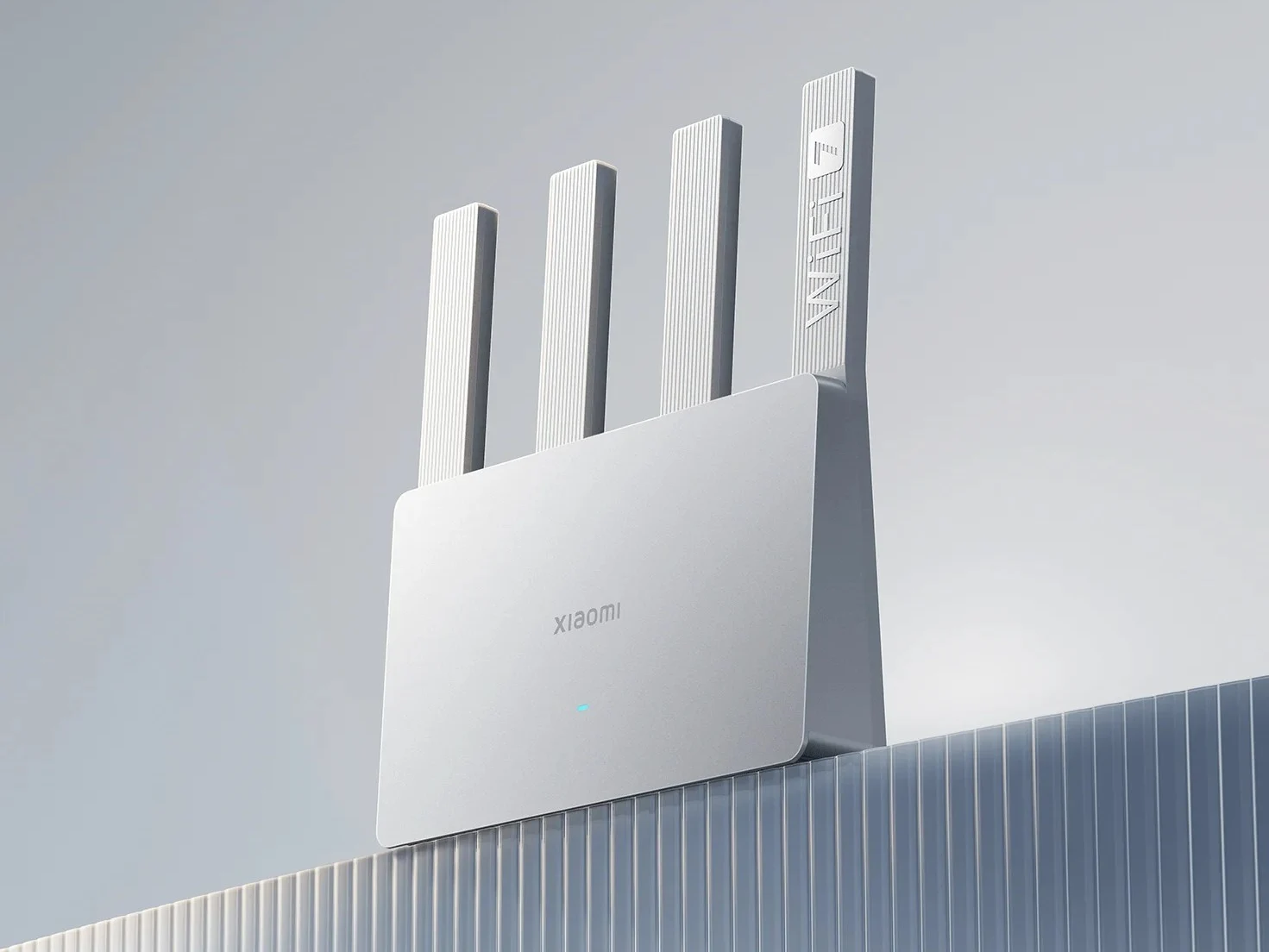
    Xiaomi has recently introduced the Router BE3600 in Europe. This device has been available on the brand’s global store for a while and can also be imported through platforms like Geekwills to various regions around the world.

    Advanced Wi-Fi Capabilities

    The Xiaomi Router BE3600 supports Wi-Fi 7, allowing for reliable data transfers and wireless speeds of up to 3,600 Mbps. When compared to Wi-Fi 6, Xiaomi asserts that the actual throughput has improved by 50%, while the maximum theoretical data rate has been enhanced by 48%. It supports protocols such as Wi-Fi 802.11a/b/g/n/ac/ax/be and 802.3/3u/3ab/3bz, utilizing OFDMA technology and Multi-RU allocations to help lower latency. Xiaomi claims that these high speeds are perfect for online gaming, HD streaming, and video calls. Additionally, there’s a feature for ‘exclusive acceleration’ for Xiaomi and Redmi smartphones, which are detected automatically and prioritized for better gaming experiences, resulting in less lag and reduced latency.

    Robust Hardware Features

    Equipped with 4K QAM technology, this router aims to improve data throughput for compatible devices. It features a 2×2 Multiple-Input Multiple-Output (MIMO) configuration and is powered by a Qualcomm Wi-Fi 7 quad-core processor running at 1.1 GHz, offering up to 10,120 DMIPS and the ability to connect up to 128 devices at once. Furthermore, it includes a 2.5G Ethernet port for 2000M broadband and three gigabit Ethernet ports, with provisions for dual-LAN link aggregation and customizable IPTV settings.

    Easy Mesh Networking

    Setting up a mesh network or integrating the router into an existing system is said to be simple. Xiaomi’s Mesh networking allows for the connection of up to 10 routers at the same time, supporting mixed networks. You can manage the router using the Xiaomi Home app, available for both iOS and Android devices. The router itself has a sleek white design, with dimensions of 209.98 x 40.95 x 219.83 mm and features four high-gain antennas. You can purchase the Xiaomi Router BE3600 in countries like Germany and Poland for €64.99/PLN 299, making it a relatively affordable option. It is also displayed on the Mi UK store, although it’s not yet available for purchase there.

    Source:
    Link


  • Framework Laptop 13 Upgrade: AMD Strix Point, Wi-Fi 7, New Keyboard

    Framework Laptop 13 Upgrade: AMD Strix Point, Wi-Fi 7, New Keyboard

    Key Takeaways

    1. New Hardware: The Framework Laptop 13 features upgraded AMD Strix Point hardware, including the option for a Ryzen AI 9 HX 370 processor.

    2. Quality Improvements: Enhancements include Wi-Fi 7 support, a new thermal compound, and an upgraded keyboard with a travel distance of 1.5 mm, plus a Co-Pilot key for Windows users.

    3. Specs and Compatibility: The laptop supports up to 96 GB of DDR5-5600 RAM, up to 8 TB of storage, and can connect up to four devices through USB-C/HDMI ports.

    4. Pricing and Options: The entry-level version starts at $749 with a previous generation processor, while the new Strix Point version starts at $899 for a 2.8K display.

    5. Availability: Pre-orders for the Framework Laptop 13 are open, with shipping set to begin shortly.


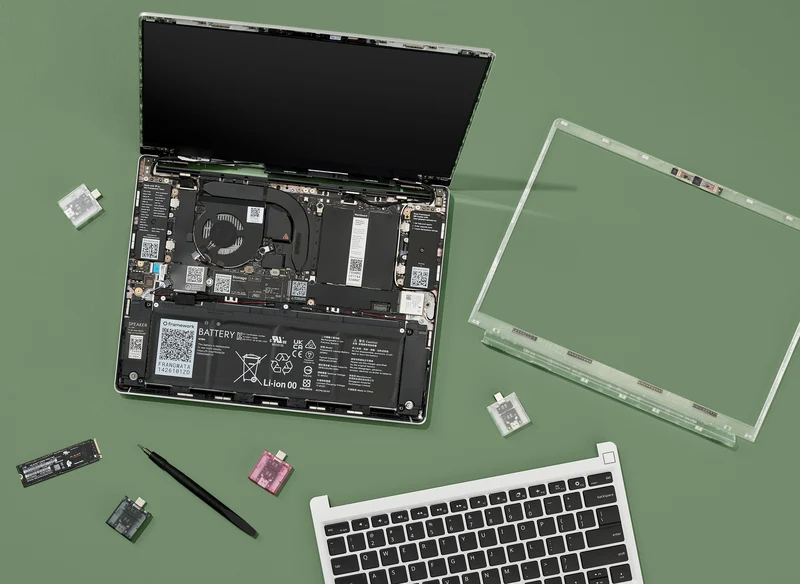
    Along with its Framework Desktop, the Framework Laptop 13 has been updated with new hardware from AMD. However, it’s not the Strix Halo, as that is only for desktops. Instead, you get something really good: Strix Point. You can now upgrade to a Ryzen AI 9 HX 370, which is the best option available from Strix Point.

    Quality Improvements

    Additionally, the Framework Laptop 13 comes with several enhancements for user convenience. It now supports Wi-Fi 7 and uses a new Honeywell PTM7958 thermal compound. The keyboard has been upgraded to the second generation, featuring new keys with a travel distance of 1.5 mm. There’s also a Co-Pilot key available for the models that include Windows. If you prefer Linux, you can even print the logo of your favorite Linux distribution on the key.

    Specs and Compatibility

    Most of the specifications of the Framework Laptop 13 remain unchanged. For instance, the DDR5-5600 RAM is still there, but now you can have up to 96 GB. Storage options have also improved, allowing for up to 8 TB through the M.2 NVMe slot. Furthermore, there are some internal upgrades; all four modules can now output display signals. This means you can connect up to four devices using 4 USB-C/HDMI ports simultaneously.

    Pricing and Availability

    The Framework Laptop 13 is now priced more competitively than before. The entry-level version starts at $749, but this only includes a previous generation AMD Ryzen 7040 model. If you want the Strix Point (Ryzen AI 300), you’ll need to pay a minimum of $899, which includes a 2.8K 120 Hz 3:2 display. Alternatively, you can purchase a motherboard for $499 to upgrade your existing Framework Laptop 13. Pre-orders are open now, and shipping will begin shortly.

  • MSI MEG VISION X AI 2nd: Gaming Desktop with 13″ Touchscreen

    MSI MEG VISION X AI 2nd: Gaming Desktop with 13″ Touchscreen

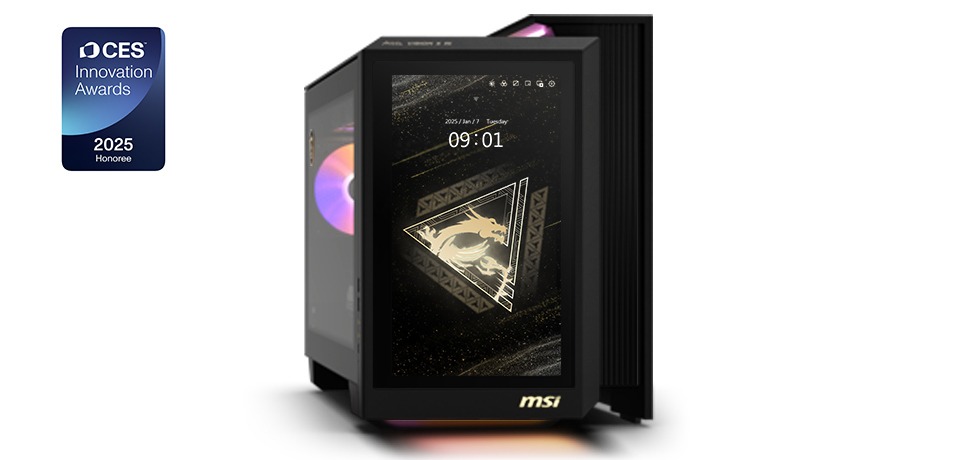
    MSI has introduced the MEG VISION X AI 2nd gaming desktop at CES 2025, where it won two CES Innovation Awards for its impressive design and technical features. This latest model showcases MSI’s commitment to pushing boundaries in high-performance computing, catering to gamers and creatives alike.

    Intelligent Control with AI Technology

    One of the standout aspects of this desktop is its 13-inch FHD AI HMI touchscreen, which serves as a smart control hub. This display includes built-in speakers and a microphone, allowing users to engage with MSI’s range of AI tools. The system tracks user habits and automatically modifies settings to optimize performance. Users can personalize their interface with various widgets, while the screen also acts as an extra display to boost productivity and support creative tasks.

    High-End Performance and Storage Solutions

    For its processing power, MSI has selected premium components, featuring NVIDIA GeForce RTX 50 Series GPUs and Intel Core Ultra 9 285K processors. The system architecture consists of 4 DDR5 UDIMM slots and leverages SSD Gen 5.0 technology, which provides a 1.18x enhancement in AI model training speed. To ensure reliable performance during resource-intensive activities, MSI has added an extra 8-pin PCIe power connector, ensuring stable power supply to the GPU.

    Superior Thermal Management

    MSI’s dedication to cooling is evident in their Silent Storm Cooling AI solution. This innovative system uses a specialized air chamber design along with AI-driven fans, in addition to thorough monitoring of SSD temperatures. The inclusion of Glacier Armor heatsinks results in a remarkable 25% drop in component temperatures during heavy use, which helps keep performance at its peak.

    Enhanced Wi-Fi Connectivity

    Connectivity options are boosted with the inclusion of Wi-Fi 7 technology, allowing transfer speeds reaching up to 5.8 Gbps—2.4 times faster than older versions. This enhancement significantly elevates streaming quality, speeds up file transfers, and improves overall wireless performance for users who need high-bandwidth connections. Information regarding the pricing and availability of the MEG VISION X AI 2nd Gen gaming desktop will be disclosed later. Keep an eye out for further announcements.

    Source: Link


    Image 1
    Image 1
    Image 1
  • Intel Wi-Fi 7 BE1750x Boosts Online Gaming Experience

    Intel Wi-Fi 7 BE1750x Boosts Online Gaming Experience

    Wi-Fi 7 is here, and gamers can already benefit from the cutting-edge technology thanks to Intel’s latest Killer Wi-Fi modules. This new standard not only offers faster transfer rates and increased bandwidth, but it also greatly reduces latency, which is essential for activities like remote gaming. Moreover, users will experience a more reliable connection even when multiple devices are connected to the same network. This stability is particularly useful for video streaming when others are gaming or downloading content.

    Advancements Over Previous Standards

    Wi-Fi 7 represents a significant upgrade from Wi-Fi 6 and Wi-Fi 6E. While it retains some fundamental features from earlier versions, such as frequency bands (2.4 GHz, 5 GHz, and 6 GHz), almost all other aspects see improvements. Although the addition of 6 GHz in Wi-Fi 6E did not enhance maximum transfer speeds, Wi-Fi 7 boasts theoretical speeds reaching up to 5.8 Gbps. This increase in speed is due to two main factors: the channel bandwidth has been doubled from 160 to 320 MHz, and the data density has risen from 1024 to 4096 QAM (quadrature amplitude modulation), allowing each symbol to carry 12 bits instead of 10.

    Connectivity Enhancements

    An important feature of the new Wi-Fi 7 is its Multi Link Operation (MLO). In earlier standards, devices could only connect to the router using a single frequency—either 2.4, 5, or 6 GHz. With Wi-Fi 7, devices can connect through two frequencies at once. For instance, if you move around your home, the connection can switch frequencies without dropping the connection.

    For our evaluation, we used the MSI Stealth 16 AI Studio A1V laptop, which has the Killer Wi-Fi 7 BE1750x (BE200NGW) module and the associated Killer Intelligence Center software. The Wi-Fi 7 router we tested was the Asus Rapture GT-BE98, currently available online for about 620 Euros.

    Performance Testing

    Our standardized Wi-Fi tests, which we consistently use for reviews, showed a performance increase to 2.9-3.0 Gbps for downloads and even around 3.9 Gbps for uploads. In contrast, Wi-Fi 6 and Wi-Fi 6E max out at 1.8-1.9 Gbps, marking a substantial enhancement.

    Intel’s Killer Wi-Fi module includes the Killer Intelligence Center software, which provides an overview of all available networks and suggests optimizations for network settings or faster networks to connect to. It also features two presets, Multimedia and Creative, each with a distinct priority order for applications. We will explore some of these features in more detail.

    Prioritizing Applications

    The Killer Prioritization Engine allows users to prioritize specific applications, with online gaming being set as the highest priority by default. This setup ensures a smooth gaming experience, even if other applications like streaming or downloads are running in the background. Users can customize the priority list and set bandwidth limits for individual apps.

    An example is Steam Remote Play, which streams a game from a host PC to another device on the same network. We tested it with Grand Theft Auto V while simultaneously downloading multiple files to stress our connection. As shown in the accompanying screenshots with the Steam latency tracker, the streaming latency remained stable at around 30 ms with the Prioritization Engine activated. However, once we deactivated it, we noticed significant latency spikes (80-160 ms) and a marked decline in gaming quality.

    Smart Network Recommendations

    The Killer Intelligence Engine analyzes the network environment and suggests better networks when available. For instance, when using our standard cable router, the software recommended switching to the superior Wi-Fi 7 connection provided by the Asus Rapture GT-BE98.

    This functionality is further enhanced by Smart AP Selection, which not only assesses signal strength but also evaluates the quality of the Wi-Fi connection. If another connection offers a better signal, the access point can be switched automatically.

    The Killer Engine leverages one of Wi-Fi 7’s advantages by establishing two simultaneous connections. This is particularly beneficial for online gaming, as it requires both stable connections and low latency for an optimal experience. If one connection becomes congested, the Killer Engine can seamlessly switch frequencies to maintain low latency, ensuring your gaming is uninterrupted. This capability is effectively demonstrated in the provided video.

    Enhanced Network Performance

    The Killer Doubleshot 2.0 feature can boost network performance by utilizing all available network adapters at once. This is especially useful for gaming laptops that typically have both wired and wireless connectivity. For the MSI Stealth, the Wi-Fi 7 connection can be combined with the Ethernet adapter (2.5 Gbps), allowing high-priority applications to be automatically routed to the best connection.

    The new Wi-Fi 7 technology brings numerous benefits to users and represents a significant enhancement over Wi-Fi 6E. With a compatible Wi-Fi 7 router, transfer rates can nearly double compared to Wi-Fi 6, and the ability to use two connections simultaneously greatly enhances the online experience.

    Conclusion

    With higher transfer rates, reduced latency, and improved stability, the combination of Wi-Fi 7 and Intel’s Killer Engine delivers an excellent gaming experience and greater convenience for everyday use.

    Intel’s Killer Wi-Fi 7 modules take full advantage of the new technology, allowing users to tailor their online experience to their preferences. The Killer Intelligence Center software is user-friendly, providing recommendations based on the current network situation. All features are easily accessible, and once activated, the software automatically handles prioritization and the selection of the best available network. Gamers can enjoy their gaming sessions without worrying about network competition from other family members.



    Image 1
    Image 1
    Image 1
    Image 1
    Image 1
    Image 1
    Image 1
  • Sony PlayStation 5 Pro Delay Indefinitely in India

    Sony PlayStation 5 Pro Delay Indefinitely in India

    Sony has postponed the release of the PlayStation 5 Pro in India due to the unavailability of the telecom spectrum for Wi-Fi 7 in the country. This gaming console operates on the 6GHz frequency band necessary for its IEEE 802.11be (Wi-Fi 7) certified network radios.

    Official Confirmation

    In a statement sent to High Chaos Run, Sony stated that the “PS5 Pro will not be offered in certain countries (including India at this time) where the 6GHz wireless band used in IEEE 802.11be (Wi-Fi 7) is not permitted yet.”

    Regulatory Delays

    As per a report from Business Standard, India’s Department of Telecommunications (DoT) has delayed its decision regarding this spectrum allocation and has until 2027 to make a final decision.

    Future Spectrum Use

    Sources quoted by the Financial Express have mentioned that India plans to designate the upper segment of the band (6425-7125 MHz) for telecommunications companies for their 5G and 6G services. Moreover, the Indian Space Research Organisation (ISRO) utilizes this network for satellite communications and has raised concerns about potential interference if the band is allocated for telecom purposes.