Tag: SteamOS 3.8

  • Is a Steam Machine Reveal Coming? New SteamDB Update Hints

    Key Takeaway

    – Steam Sub 1629447 package was updated multiple times on June 17, fueling speculation.
    – Reddit community interprets the update as a possible preparatory step for a Steam Machine launch.
    – SteamOS 3.8 recently added support for upcoming Steam Machine hardware.
    – Leaker suggests a potential announcement on June 23, with reservations starting a week later.
    – No official confirmation from Valve, but cumulative clues point to an imminent reveal.


    Speculation around Valves Steam Machine continues. The latest trigger is a SteamDB screenshot posted on X by Steam Hardware Updates. It shows that a previously hidden Steam package has been updated again. This is not a physical package, but a digital product or license package on Steam that determines which content users are allowed to download or activate. Shortly afterward, the tip also made its way to Reddit, where the community immediately began discussing it as a possible preparatory step for the launch of the living-room PC.

    Steam Sub 1629447 Updates Noticed

    Specificaly, the package in question is “Steam Sub 1629447.” According to SteamDB, it was modified several times within a short period on June 17. Exactly what changed is unknown. SteamDB only shows that changes were made, not what was altered. Nevertheless, the Reddit community sees the package update as another small piece of the puzzle that could point to an imminent unveiling of the Steam Machine.

    Recent Leaks and SteamOS Support

    With the SteamOS 3.8 update, Valve recently added support for upcoming Steam Machine hardware to its own operating system. In addition, the leaker Steam Hardware Updates recently suggested that Valve could announce the Steam Machine on June 23, with reservations starting one week later. The latest hint therefore fits well with the recent leaks. Although Valve has yet to make any official announcement, the signs pointing to an imminent presentation continue to grow.


    Sources
  • SteamOS 3.8: New Steam Machine Clues & Better Handheld Support

    Key Takeaway

    – SteamOS 3.8 released with modernized Arch Linux base, kernel 6.16, and KDE Plasma 6.4.3 desktop mode
    – Practical improvements include faster updates, better Wi-Fi, HDMI audio fixes, and mono audio accessibility
    – Expanded support for third-party handhelds like Lenovo Legion Go, ASUS ROG Ally, and MSI Claw
    – Initial support for Steam Machine hardware added, fueling speculation about a 2026 launch
    – Enhanced features for HDR, VRR, external displays, Remote Play, and screen casting


    Valve’s new SteamOS 3.8 update realesed on June 18

    Valve officially released SteamOS 3.8 on June 18. After several months of beta testing, the update arrives as one of the most comprehensive SteamOS releases in recent years. In addition to numerous improvements for the Steam Deck, Valve is expanding support for third-party handhelds while also dropping fresh hints about potential Steam Machine hardware. These changes mark a significant step for the platform.

    The updated Arch Linux base and kernel version changes

    The update introduces a modernized Arch Linux base and Linux kernel 6.16. Users should benefit from broader hardware support, improved stability and more efficient power management. Valve has also upgraded desktop mode to KDE Plasma 6.4.3 and made Wayland the default display protocol. The aim is to bring desktop mode closer to the responsiveness and performance of Gaming Mode. Support for HDR, VRR, external displays and TV scaling has also been improved across the board.

    Practical improvements and audio fixes made available

    While these changes may sound rather technical, SteamOS 3.8 also brings several practical improvements. Updates should now install faster, Wi-Fi connections should be more reliable, HDMI audio detection has been improved and mono audio has been added as an accesibility feature. Valve has also fixed issues affecting individual games such as Star Wars Jedi: Survivor, Starfield and SpongeBob SquarePants: Titans of the Tide. Remote Play, game recording and screen casting through applications such as OBS and Discord have also recieved improvements for better performance.

    Support for various third-party handheld gaming devices is expanded

    Valve is no longer focusing solely on the Steam Deck. SteamOS is increasingly being adapted for handheld gaming PCs from other manufacturers. Devices mentioned in the update include models from the Lenovo Legion Go, ASUS ROG Ally, MSI Claw, GPD and OneXPlayer families. Among other things, Valve is improving controller support, gyro controls, automatic screen rotation, SD card stability, Bluetooth compatibility, GPU stability and power management. Input latency has also been reduced on some handhelds like certain ASUS models.

    Windows handhelds compared to SteamOS user experience

    This is particularly interesting because many Windows-based handhelds offer plenty of power but often feel more like miniature gaming PCs than true consoles in everyday use. SteamOS could help close that gap: turn on the device, launch a game and start playing – without dealing with Windows quirks, driver issues or desktop maintenance. This seamlessness is expected to appeal to consumers wanting a console-like handheld.

    Initial Steam Machine hardware support and upcoming rumors

    According to Valve’s patch notes, SteamOS 3.8 also includes initial support for Steam Machine hardware. While the company has not provided any further details about the living-room PC, the wording alone has been enough to reignite speculation. On Reddit, many users see the update as another important preparatory step toward the launch of the Steam Machine. Recent SteamDB updates to Steam Machine-related package entries have further fueled the rumors. According to a leaker, Valve could officially unveil the Steam Machine as early as June 23, 2026.

    Sources
  • Strix Halo Handheld: Cyberpunk 2077 on SteamOS vs. Windows 11

    Strix Halo Handheld: Cyberpunk 2077 on SteamOS vs. Windows 11

    Key Takeaways

    1. The GPD Win 5 runs SteamOS 3.8 natively, allowing full support for controllers, Wi-Fi, and Bluetooth.
    2. Power management in SteamOS on the GPD Win 5 requires additional tools, as TDP controls are not available in the native menu.
    3. Gaming performance on SteamOS is competitive, with titles like Marvel’s Spider-Man 2 and Cyberpunk 2077 achieving 70-74 FPS at 1080p.
    4. Windows 11 outperforms SteamOS in some games, such as Borderlands 4, suggesting better driver optimization for demanding titles.
    5. Battery life for AAA games is similar on both operating systems, approximately two hours at 25 W.


    The GPD Win 5 is said to perform nicely with Windows 11, which it comes pre-installed with, and it can run a range of indie and AAA games. This brings up the question of how well the new AMD Strix Halo-powered handheld would do with a lightweight, gaming-oriented Linux system like SteamOS.

    Exploring SteamOS on GPD Win 5

    This is what YouTuber ETA PRIME aimed to discover in their recent video. They started by loading the official SteamOS Hollow 3.8 main branch build onto the GPD Win 5, marking the first version that boots completely on AMD’s latest Strix Halo and Strix Point APUs.

    ETA PRIME explained that this particular release was selected because it fixes the long-standing boot issue that had stopped SteamOS from working on these processors. With the improved boot chain in version 3.8, the GPD Win 5 now runs SteamOS natively, providing full controller support, Wi-Fi, Bluetooth, and system-level features similar to those of the Steam Deck.

    Hardware Specifications

    The test unit features AMD’s Ryzen AI Max 385 APU working alongside a 30-CU Radeon 8050S iGPU. It’s loaded with 32 GB of RAM, which ETA PRIME set up to divide 16 GB for system use and 16 GB for the iGPU. SteamOS correctly identifies the platform under System settings as “Hollow 3.8” and lists the APU as model 385.

    Despite this progress, one limitation of SteamOS on non-Deck devices is the TDP control from the standard performance overlay. As shown by ETA PRIME, power limits do not show up in the native menu on the Win 5, leading them to install Decky Loader with the SimpleDeckyTDP plugin. With this configuration, the handheld can be adjusted anywhere from a low 4 W up to a reported 120 W slider range.

    Gaming Performance

    In practical terms, ETA PRIME keeps the power usage between 20 and 45 W for gaming on the go, noting that the Windows 11 “Performance” mode on the GPD Win 5 typically sits around 45 W and can peak to 65 W while on battery. For SteamOS, the YouTuber generally kept AAA games between 25 and 45 W.

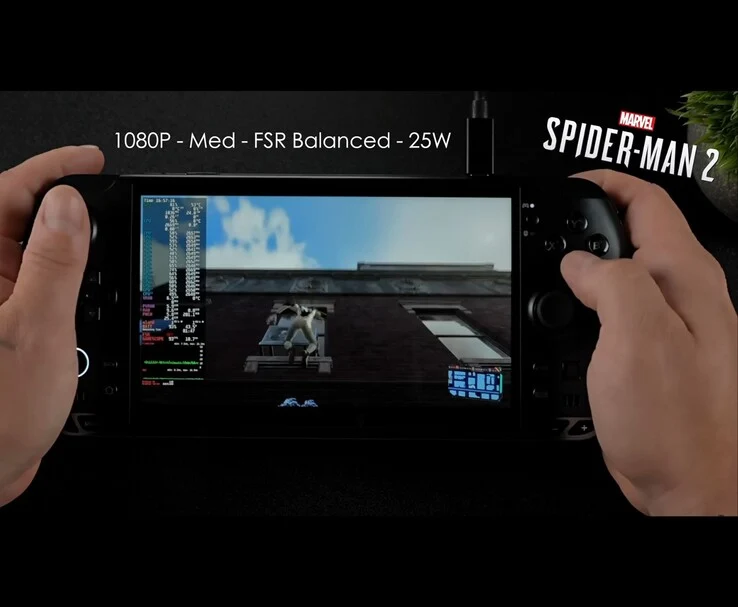
    During their tests, Marvel’s Spider-Man 2 was the first game they tried. At 1080p, Medium settings, FSR Balanced, and a 25 W TDP, the game averaged about 71 FPS without frame generation. Switching to the “High” preset could yield similar performance by raising power to around 35 W, the YouTuber noted.

    Next on the list was Cyberpunk 2077. Running at 1080p, Steam Deck preset, and a 25 W TDP, it averaged approximately 74 FPS. When set to 1080p, Ultra preset, FSR Quality, and a 45 W TDP, the game performed at roughly 71 FPS on average. The Ryzen Max chips were seen to scale effectively with power, with 45 W comfortably supporting 1080p Ultra gameplay. However, after 45 W, the Strix Halo chip’s performance begins to stabilize.

    Borderlands 4 at 1080p, Medium settings, FSR Balanced, and a 45 W TDP sometimes dipped below 60 FPS. In comparison, the same game runs about 13 FPS faster on Windows 11 with similar settings, indicating it might not be fully optimized for SteamOS just yet.

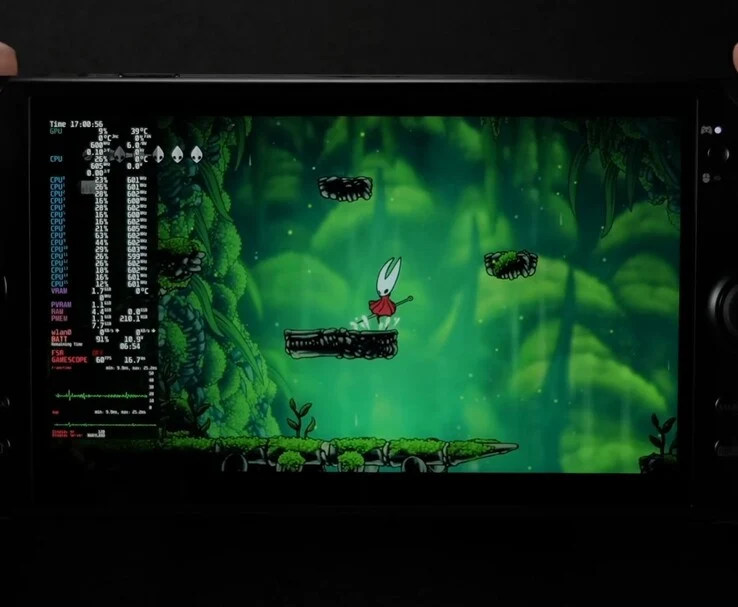
    Lastly, Hollow Knight: Silksong, a 2D indie game, was tested at a 6 W TDP with a frame rate capped at 60 FPS. The total system draw was around 10.5 W, suggesting nearly eight hours of gameplay.

    The YouTuber also checked out games like The Witcher 3: Wild Hunt, Elden Ring, and Doom: The Dark Ages in their video, which is linked below.

    Conclusion

    When looking at gaming performance between SteamOS and Windows 11 on the GPD Win 5, the results present a mixed picture. In Borderlands 4, Windows 11 has a clear advantage, averaging about 13 FPS higher at identical 1080p Medium settings and a 45 W TDP, implying better driver optimization on Windows’ part.

    Marvel’s Spider-Man 2 shows almost equal results between the two systems, with both holding around 70–74 FPS at Medium settings in the 25–28 W power range, though the Windows 11 test did not clarify whether FSR was set to Balanced.

    Battery life also remains roughly the same, offering about two hours of gameplay for AAA titles at 25 W on either operating system. Overall, while SteamOS 3.8 shows competitive performance in most cases, Windows 11 still holds a slight edge in more demanding games due to its well-developed drivers and broader game optimization.

    This indicates that although SteamOS and various Linux distributions are becoming more popular, there is still some work needed from developers to reach the same level of performance as Windows 11 in gaming.

    Source:
    Link